location Hyundai Sonata 2010 Owner's Manual
[x] Cancel search | Manufacturer: HYUNDAI, Model Year: 2010, Model line: Sonata, Model: Hyundai Sonata 2010Pages: 285, PDF Size: 9.38 MB
Page 4 of 285
F4
A110A01A-AAT
VEHICLE DATA COLLECTION AND EVENT DATA RECORDERS
This vehicle is equipped with an event data recorder (EDR). The main purpose of an EDR is to
record, in certain crash or near crash-like situations, such as an air bag deployment or hitting
a road obstacle, data that will assist in understanding how a vehicle's systems performed. The
EDR is designed to record data related to vehicle dynamics and safety systems for a short
period of time, typically 30 seconds or less. The EDR in this vehicle is designed to record such
data as:
o How various systems in your vehicle were operating;
o Whether or not the driver and passenger safety belts were buckled/fastened;
These data can help provide a better understanding of the circumstances in which crashes and
injuries occur. NOTE: EDR data are recorded by your vehicle only if a non-trivial crash situation
occurs; no data are recorded by the EDR under normal driving conditions and no personal data
(e.g., name, gender, age, and crash location) are recorded. However, other parties, such as law
enforcement, could combine the EDR data with the type of personally identifying data routinely
acquired during a crash investigation.
To read data recorded by an EDR, special equipment is required, and access to the vehicle or
the EDR is needed. In addition to the vehicle manufacturer, other parties, such as law
enforcement, that have the special equipment, can read the information if they have access to
the vehicle or the EDR.
Page 46 of 285
1
FEATURES OF YOUR HYUNDAI
33
!
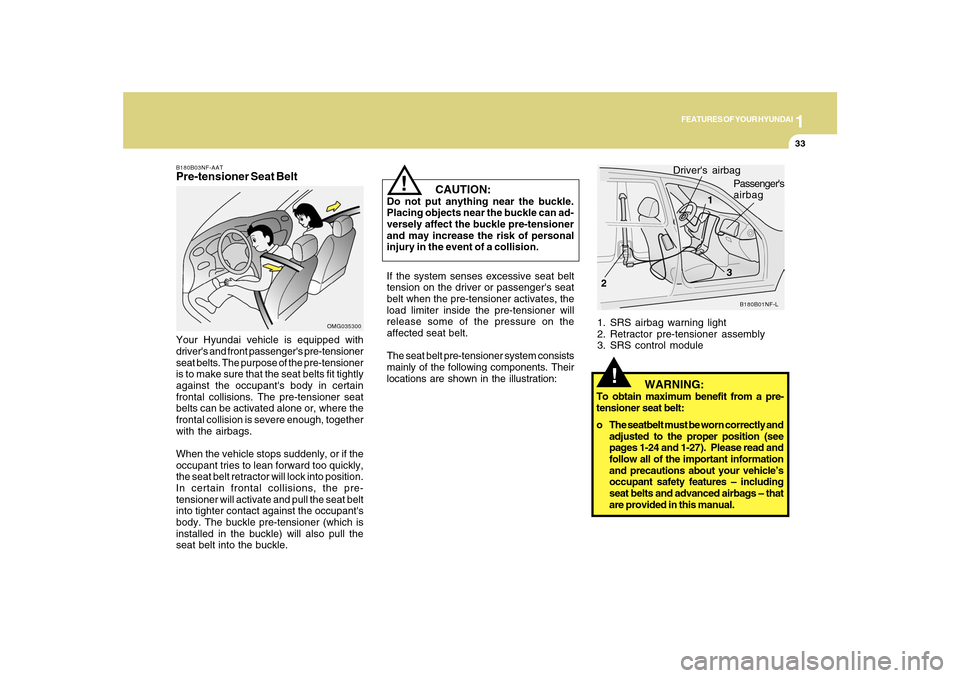
1. SRS airbag warning light
2. Retractor pre-tensioner assembly
3. SRS control module
B180B01NF-L
1
23 Driver's airbag
Passenger's
airbag
WARNING:
To obtain maximum benefit from a pre-
tensioner seat belt:
o The seatbelt must be worn correctly and
adjusted to the proper position (see
pages 1-24 and 1-27). Please read and
follow all of the important information
and precautions about your vehicle’s
occupant safety features – including
seat belts and advanced airbags – that
are provided in this manual.
!
CAUTION:
Do not put anything near the buckle.
Placing objects near the buckle can ad-
versely affect the buckle pre-tensioner
and may increase the risk of personal
injury in the event of a collision.
If the system senses excessive seat belt
tension on the driver or passenger's seat
belt when the pre-tensioner activates, the
load limiter inside the pre-tensioner will
release some of the pressure on the
affected seat belt.
The seat belt pre-tensioner system consists
mainly of the following components. Their
locations are shown in the illustration:
B180B03NF-AATPre-tensioner Seat BeltYour Hyundai vehicle is equipped with
driver's and front passenger's pre-tensioner
seat belts. The purpose of the pre-tensioner
is to make sure that the seat belts fit tightly
against the occupant's body in certain
frontal collisions. The pre-tensioner seat
belts can be activated alone or, where the
frontal collision is severe enough, together
with the airbags.
When the vehicle stops suddenly, or if the
occupant tries to lean forward too quickly,
the seat belt retractor will lock into position.
In certain frontal collisions, the pre-
tensioner will activate and pull the seat belt
into tighter contact against the occupant's
body. The buckle pre-tensioner (which is
installed in the buckle) will also pull the
seat belt into the buckle.
OMG035300
Page 55 of 285
1FEATURES OF YOUR HYUNDAI42
B990A04NF-AATMain components of occupant clas-
sification systemo A detection device located within the
front passenger seat cushion.
o Electronic system to determine whether
passenger air bag systems (both front
and side) should be activated or deac-
tivated.
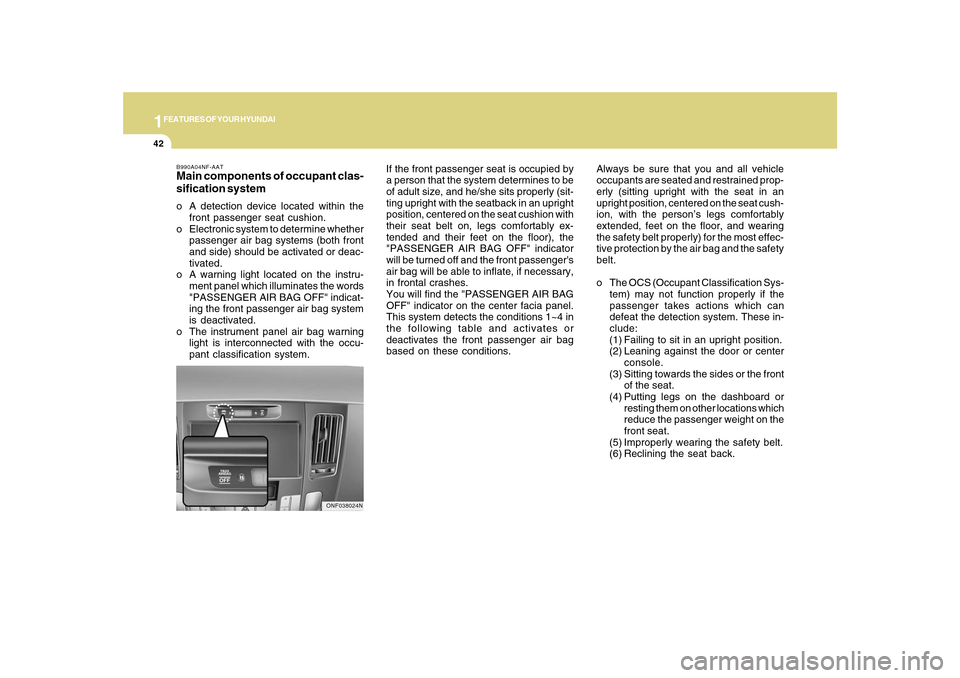
o A warning light located on the instru-
ment panel which illuminates the words
"PASSENGER AIR BAG OFF" indicat-
ing the front passenger air bag system
is deactivated.
o The instrument panel air bag warning
light is interconnected with the occu-
pant classification system.If the front passenger seat is occupied by
a person that the system determines to be
of adult size, and he/she sits properly (sit-
ting upright with the seatback in an upright
position, centered on the seat cushion with
their seat belt on, legs comfortably ex-
tended and their feet on the floor), the
"PASSENGER AIR BAG OFF" indicator
will be turned off and the front passenger's
air bag will be able to inflate, if necessary,
in frontal crashes.
You will find the "PASSENGER AIR BAG
OFF" indicator on the center facia panel.
This system detects the conditions 1~4 in
the following table and activates or
deactivates the front passenger air bag
based on these conditions.
ONF038024N
Always be sure that you and all vehicle
occupants are seated and restrained prop-
erly (sitting upright with the seat in an
upright position, centered on the seat cush-
ion, with the person’s legs comfortably
extended, feet on the floor, and wearing
the safety belt properly) for the most effec-
tive protection by the air bag and the safety
belt.
o The OCS (Occupant Classification Sys-
tem) may not function properly if the
passenger takes actions which can
defeat the detection system. These in-
clude:
(1) Failing to sit in an upright position.
(2) Leaning against the door or center
console.
(3) Sitting towards the sides or the front
of the seat.
(4) Putting legs on the dashboard or
resting them on other locations which
reduce the passenger weight on the
front seat.
(5) Improperly wearing the safety belt.
(6) Reclining the seat back.
Page 67 of 285
1FEATURES OF YOUR HYUNDAI54
The brake fluid level warning light indi-
cates that the brake fluid level in the brake
master cylinder is low and hydraulic brake
fluid conforming to DOT 3 or DOT 4 speci-
fications should be added. After adding
fluid, if no other trouble is found, the car
should be immediately and carefully driven
to a Hyundai dealer for inspection. If further
trouble is experienced, the vehicle should
not be driven at all but taken to a dealer by
a professional towing service.
Your Hyundai is equipped with dual-
diagonal braking systems. This means
you still have braking on two wheels even
if one of the dual systems should fail. With
only one of the dual systems working,
more than normal pedal travel and greater
pedal pressure are required to stop the
car. Also, the car will not stop in as short a
distance with only half of the brake system
working. If the brakes fail while you are
driving, shift to a lower gear for additional
engine braking and stop the car as soon as
it is safe to do so.
B260J01NF-AAT
Charging System Warning
Light
The charging system warning light should
come on when the ignition is turned on,
then go out when the engine is running. If
the light stays on while the engine is
running, there is a malfunction in the
electrical charging system. If the light comes
on while you are driving, have the system
checked by your Hyundai dealer as soon
as possible.B260K01S-AAT
Trunk Lid Open Warning Light
This light remains on unless the trunk lid is
completely closed and latched.
!
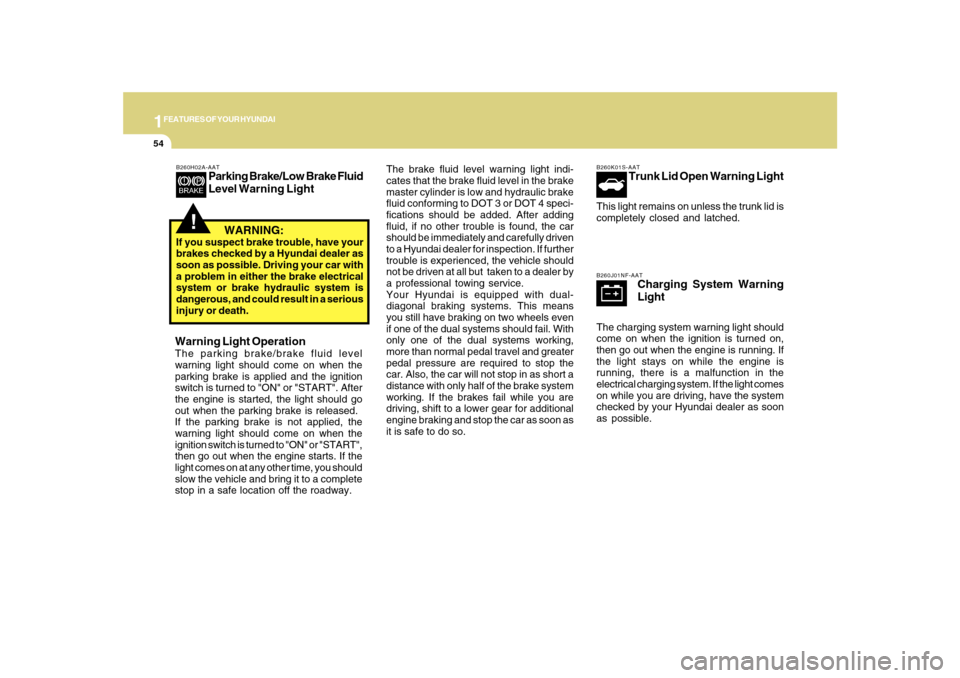
B260H02A-AAT
Parking Brake/Low Brake Fluid
Level Warning Light
WARNING:
If you suspect brake trouble, have your
brakes checked by a Hyundai dealer as
soon as possible. Driving your car with
a problem in either the brake electrical
system or brake hydraulic system is
dangerous, and could result in a serious
injury or death.Warning Light OperationThe parking brake/brake fluid level
warning light should come on when the
parking brake is applied and the ignition
switch is turned to "ON" or "START". After
the engine is started, the light should go
out when the parking brake is released.
If the parking brake is not applied, the
warning light should come on when the
ignition switch is turned to "ON" or "START",
then go out when the engine starts. If the
light comes on at any other time, you should
slow the vehicle and bring it to a complete
stop in a safe location off the roadway.
Page 81 of 285
1FEATURES OF YOUR HYUNDAI68
ONF048071NONF048072
NOTE:The engine must be running for the rear
window defroster to operate.
CAUTION:
Do not clean the inner side of the rear
window glass with an abrasive type of
glass cleaner or use a scraper to remove
foreign deposits from the inner surface
of the glass as this may cause damage
to the defroster elements.
!
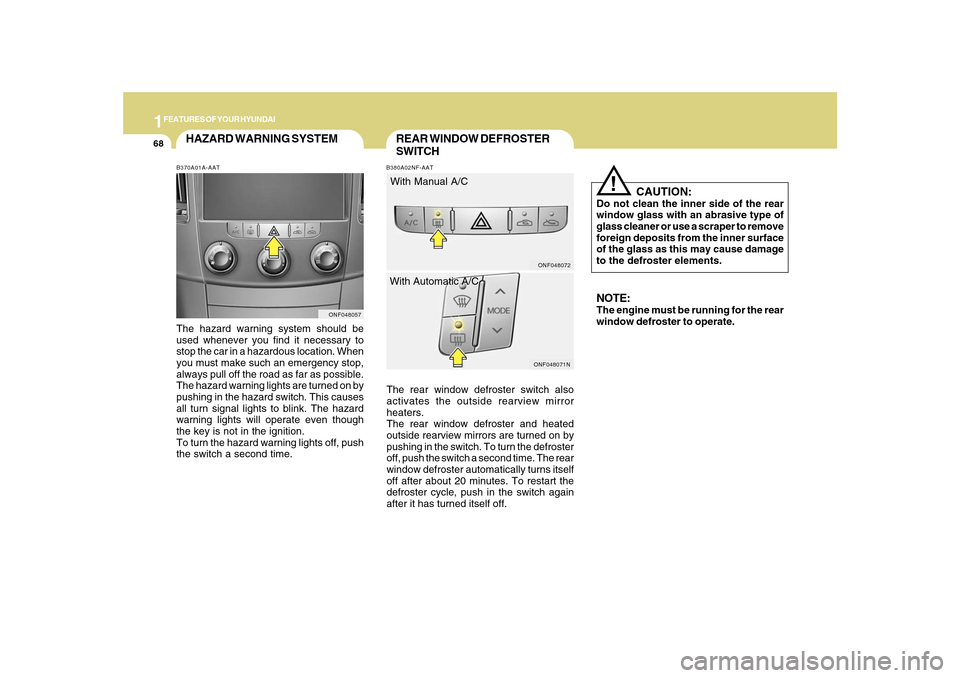
B380A02NF-AATThe rear window defroster switch also
activates the outside rearview mirror
heaters.
The rear window defroster and heated
outside rearview mirrors are turned on by
pushing in the switch. To turn the defroster
off, push the switch a second time. The rear
window defroster automatically turns itself
off after about 20 minutes. To restart the
defroster cycle, push in the switch again
after it has turned itself off.REAR WINDOW DEFROSTER
SWITCHWith Manual A/C
With Automatic A/C
HAZARD WARNING SYSTEMB370A01A-AATThe hazard warning system should be
used whenever you find it necessary to
stop the car in a hazardous location. When
you must make such an emergency stop,
always pull off the road as far as possible.
The hazard warning lights are turned on by
pushing in the hazard switch. This causes
all turn signal lights to blink. The hazard
warning lights will operate even though
the key is not in the ignition.
To turn the hazard warning lights off, push
the switch a second time.
ONF048057
Page 94 of 285
1
FEATURES OF YOUR HYUNDAI
81
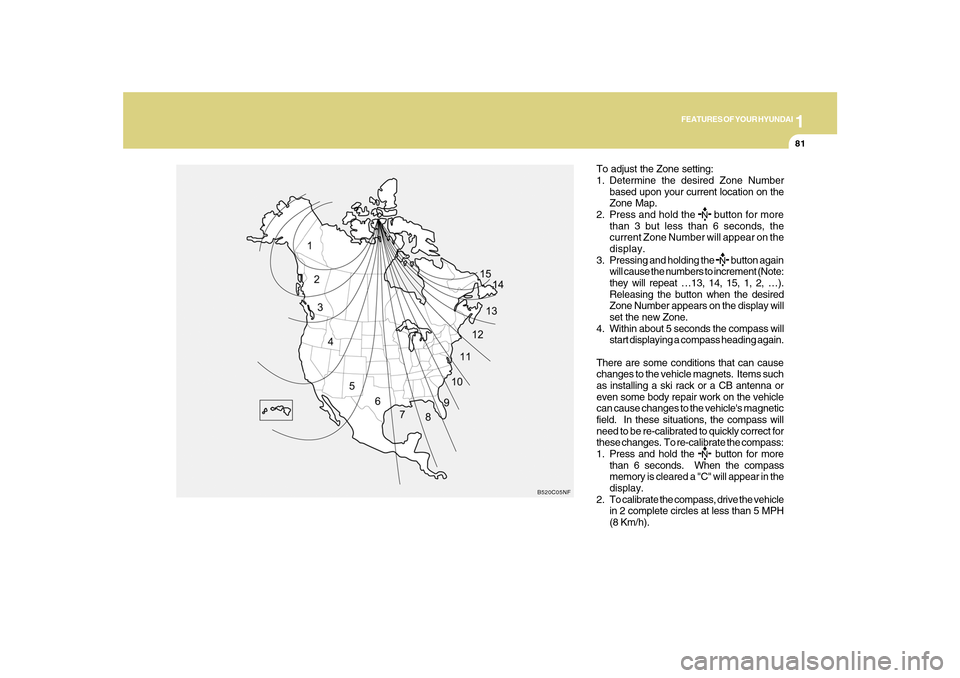
To adjust the Zone setting:
1. Determine the desired Zone Number
based upon your current location on the
Zone Map.
2. Press and hold the
button for more
than 3 but less than 6 seconds, the
current Zone Number will appear on the
display.
3. Pressing and holding the
button again
will cause the numbers to increment (Note:
they will repeat …13, 14, 15, 1, 2, …).
Releasing the button when the desired
Zone Number appears on the display will
set the new Zone.
4. Within about 5 seconds the compass will
start displaying a compass heading again.
There are some conditions that can cause
changes to the vehicle magnets. Items such
as installing a ski rack or a CB antenna or
even some body repair work on the vehicle
can cause changes to the vehicle's magnetic
field. In these situations, the compass will
need to be re-calibrated to quickly correct for
these changes. To re-calibrate the compass:
1. Press and hold the
button for more
than 6 seconds. When the compass
memory is cleared a "C" will appear in the
display.
2. To calibrate the compass, drive the vehicle
in 2 complete circles at less than 5 MPH
(8 Km/h).
B520C05NF
Page 96 of 285
1
FEATURES OF YOUR HYUNDAI
83
Standard Programming
To train most devices, follow these
instructions:
1. For first-time programming, press and
hold the two outside buttons, HomeLink
®
Channel 1 and Channel 3 Buttons, until
the indicator light begins to flash (after
20 seconds). Release both buttons. Do
not hold the buttons for longer than 30
seconds.
2. Position the end of your hand-held trans-
mitter 1-3 inches (2-8 cm) away from the
HomeLink
® buttons while keeping the
indicator light in view.
3. Simultaneously press and hold both
the HomeLink
® and hand-held
transmitter button. DO NOT release the
buttons until step 4 has been completed.
4. While continuing to hold the buttons the
red Indicator Status LED will flash slowly
and then rapidly after HomeLink
®
successfully trains to the frequency
signal from the hand-held transmitter.
Release both buttons.
5. Press and hold the just-trained
HomeLink
® button and observe the red
Status Indicator LED. If the indicator
light stays on constantly, programming
is complete and your device should
activate when the HomeLink
® button is
pressed and released.
6. To program the remaining two
HomeLink
® buttons, follow steps 2
through 5.Rolling Code Programming
Rolling code devices which are "code-
protected" and manufactured after 1996
may be determined by the following:
o Reference the device owner's manual
for verification.
o The handheld transmitter appears to
program the HomeLink Universal
Transceiver but does not activate the
device.
o Press and hold the trained HomeLink
button. The device has the rolling code
feature if the indicator light flashes rapidly
and then turns solid after 2 seconds.
To train rolling code devices, follow these
instructions:
1. At the garage door opener receiver
(motor-head unit) in the garage, locate
the "learn" or "smart" button. This can
usually be found where the hanging
antenna wire is attached to the motor-
head unit. Exact location and color of
the button may vary by garage door
opener brand. If there is difficulty
locating the training button, reference
the device owner's manual or please
visit our Web site at www.homelink.com.
2. Firmly press and release the "learn" or
"smart" button (which activates the
"training light").
NOTE:There are 30 seconds in which to initiate
step3.
3. Return to the vehicle and firmly press,
hold for two seconds and then release
the desired HomeLink
® button. Repeat
the "press/hold/release" sequence a
second time to complete the
programming. (Some devices may
require you to repeat this sequence a
third time to complete the programming.)
4. Press and hold the just-trained
HomeLink
® button and observe the red
Status Indicator LED. If the indicator
light stays on constantly, programming
is complete and your device should
activate.
5. To program the remaining two
HomeLink® buttons, follow either steps
1 through 4 above for other Rolling
Code devices or steps 2 through 5 in
Standard Programming for standard
devices.
Gate Operator & Canadian Programming
During programming, your handheld trans-
mitter may automatically stop transmitting.
Continue to press the Integrated
HomeLink
® Wireless Control System button
(note steps 2 through 4 in the Standard
Programming portion of this document)
while you press and re-press ("cycle") your
Page 173 of 285
2
DRIVING YOUR HYUNDAI
20
C190B01S-AATTrailer HitchesSelect the proper hitch and ball
combination, making sure that its location
is compatible with that of the trailer or
vehicle being towed.
Use a quality non-equalizing hitch which
distributes the tongue load uniformly
throughout the chassis.
The hitch should be bolted securely to the
car and installed by a qualified technician.
DO NOT USE A HITCH DESIGNED FOR
TEMPORARY INSTALLATION AND
NEVER USE ONE THAT ATTACHES
ONLY TO THE BUMPER.C190C01Y-AATTrailer BrakesIf your trailer is equipped with a braking
system, make sure it conforms to federal
and/or local regulations and that it is
properly installed and operating correctly.NOTE:If you tow a trailer or vehicle, your car will
require more frequent maintenance due
to the additional load. See Maintenance
Under Severe Usage Conditions" on
page 5-6.
TRAILER OR VEHICLE TOWING!
C190A01TG-AATIf you are considering towing with your car,
you should first check with your State's
Department of Motor Vehicles to determine
their legal requirements.
Since laws vary from State to State the
requirements for towing trailers, cars, or
other types of vehicles or apparatus may
differ. Ask your Hyundai dealer for further
details before towing.
CAUTION:
o Do not do any towing with your car
during its first 1,200 miles (2,000 km)
in order to allow the engine to properly
break in. Failure to heed this caution
may result in serious engine or
transaxle damage.
o When towing a trailer, be sure to con-
sult your Hyundai dealer for further
information on additional require-
ments such as a towing kit, etc.
USE OF LIGHTSC180A01A-AATCheck your lights regularly for correct op-
eration and always keep them clean. When
driving during the day in conditions of poor
visibility, it is helpful to drive with headlights
on low beam. This enables you to be seen,
as well as to see.
Page 184 of 285
3
WHAT TO DO IN AN EMERGENCY
3
JUMP STARTING!
o If you should accidentally get acid on
your skin or in your eyes, immediately
remove any contaminated clothing and
flush the area with clean water for at
least 15 minutes. Then promptly obtain
medical attention. If you must be trans-
ported to an emergency facility, continue
to apply water to the affected area with
a sponge or cloth.
o The gas produced by the battery during
the jump-start operation is highly
explosive. Do not smoke or allow a
spark or an open flame in the vicinity.
o The battery being used to provide the
jump start must be 12-volt. If you cannot
determine that it is a 12-volt battery, do
not attempt to use it for the jump start.
o To jump start a car with a discharged
battery, follow this procedure exactly:
1. If the booster battery is installed in
another vehicle, be sure the two vehicles
are not touching.
2. Turn off all unnecessary lights and
acces-sories in both vehicles.
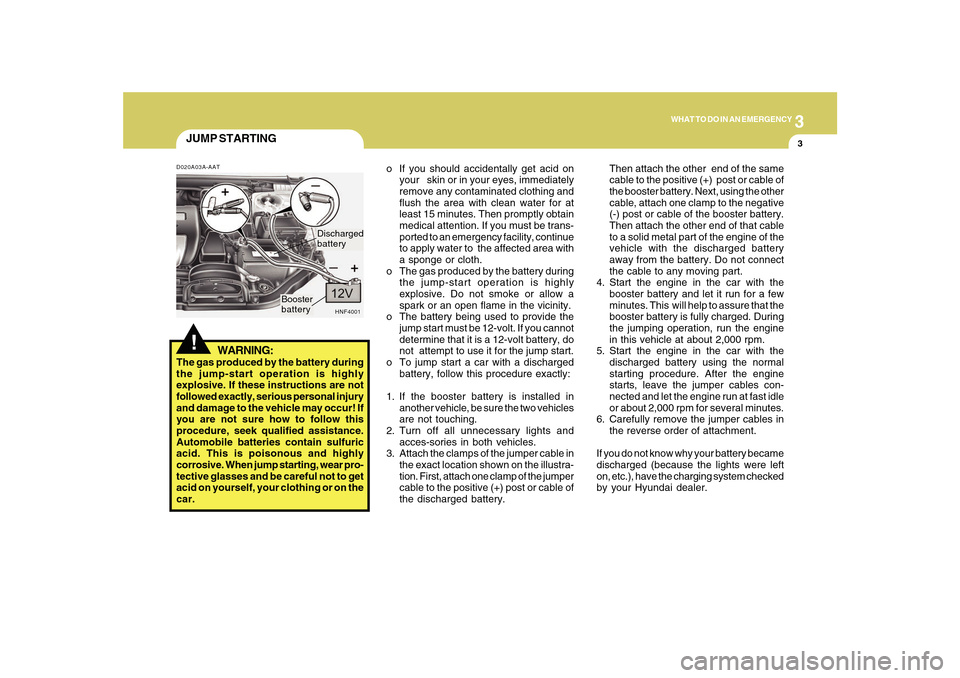
3. Attach the clamps of the jumper cable in
the exact location shown on the illustra-
tion. First, attach one clamp of the jumper
cable to the positive (+) post or cable of
the discharged battery.Then attach the other end of the same
cable to the positive (+) post or cable of
the booster battery. Next, using the other
cable, attach one clamp to the negative
(-) post or cable of the booster battery.
Then attach the other end of that cable
to a solid metal part of the engine of the
vehicle with the discharged battery
away from the battery. Do not connect
the cable to any moving part.
4. Start the engine in the car with the
booster battery and let it run for a few
minutes. This will help to assure that the
booster battery is fully charged. During
the jumping operation, run the engine
in this vehicle at about 2,000 rpm.
5. Start the engine in the car with the
discharged battery using the normal
starting procedure. After the engine
starts, leave the jumper cables con-
nected and let the engine run at fast idle
or about 2,000 rpm for several minutes.
6. Carefully remove the jumper cables in
the reverse order of attachment.
If you do not know why your battery became
discharged (because the lights were left
on, etc.), have the charging system checked
by your Hyundai dealer.
D020A03A-AAT
WARNING:
The gas produced by the battery during
the jump-start operation is highly
explosive. If these instructions are not
followed exactly, serious personal injury
and damage to the vehicle may occur! If
you are not sure how to follow this
procedure, seek qualified assistance.
Automobile batteries contain sulfuric
acid. This is poisonous and highly
corrosive. When jump starting, wear pro-
tective glasses and be careful not to get
acid on yourself, your clothing or on the
car.
HNF4001
Booster
batteryDischarged
battery
Page 196 of 285
3
WHAT TO DO IN AN EMERGENCY
15
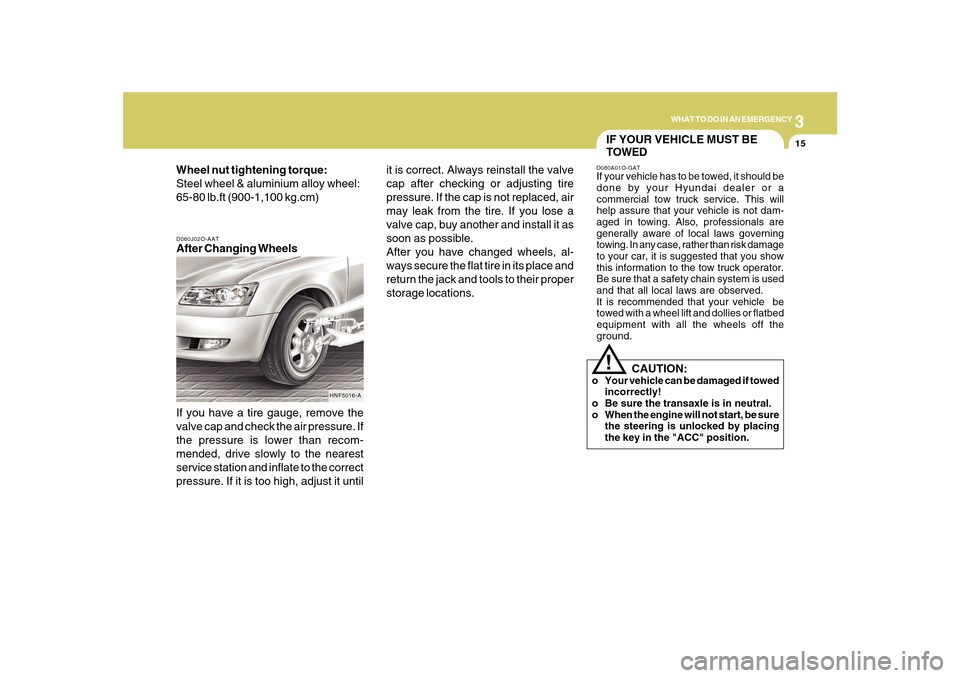
D060J02O-AATAfter Changing Wheels
If you have a tire gauge, remove the
valve cap and check the air pressure. If
the pressure is lower than recom-
mended, drive slowly to the nearest
service station and inflate to the correct
pressure. If it is too high, adjust it until Wheel nut tightening torque:
Steel wheel & aluminium alloy wheel:
65-80 lb.ft (900-1,100 kg.cm)
HNF5016-A
it is correct. Always reinstall the valve
cap after checking or adjusting tire
pressure. If the cap is not replaced, air
may leak from the tire. If you lose a
valve cap, buy another and install it as
soon as possible.
After you have changed wheels, al-
ways secure the flat tire in its place and
return the jack and tools to their proper
storage locations.
IF YOUR VEHICLE MUST BE
TOWEDD080A01O-GATIf your vehicle has to be towed, it should be
done by your Hyundai dealer or a
commercial tow truck service. This will
help assure that your vehicle is not dam-
aged in towing. Also, professionals are
generally aware of local laws governing
towing. In any case, rather than risk damage
to your car, it is suggested that you show
this information to the tow truck operator.
Be sure that a safety chain system is used
and that all local laws are observed.
It is recommended that your vehicle be
towed with a wheel lift and dollies or flatbed
equipment with all the wheels off the
ground.!
CAUTION:
o Your vehicle can be damaged if towed
incorrectly!
o Be sure the transaxle is in neutral.
o When the engine will not start, be sure
the steering is unlocked by placing
the key in the "ACC" position.