Size Hyundai Sonata 2011 Owner's Manual
[x] Cancel search | Manufacturer: HYUNDAI, Model Year: 2011, Model line: Sonata, Model: Hyundai Sonata 2011Pages: 380, PDF Size: 7.97 MB
Page 47 of 380

Safety features of your vehicle30
3
Using a child restraint systemFor small children and babies, the use of
a child seat or infant seat is required. This
child seat or infant seat should be of
appropriate size for the child and should
be installed in accordance with the man-
ufacturer's instructions.
(Continued)
• Never leave children unattended
in a vehicle – not even for a short
time. The car can heat up very
quickly, resulting in serious
injuries to children inside. Even
very young children may inadver-
tently cause the vehicle to move,
entangle themselves in the win-
dows, or lock themselves or oth-
ers inside the vehicle.
• Never allow two children, or any two persons, to use the same
seat belt.
• Children often squirm and repo- sition themselves improperly.
Never let a child ride with the
shoulder belt under their arm or
behind their back. Always proper-
ly position and secure children in
the rear seat.
• Never allow a child to stand-up or kneel on the seat or floor of a
moving vehicle. During a colli-
sion or sudden stop, the child
can be violently thrown against
the vehicle’s interior, resulting in
serious injury.
(Continued)
(Continued)
• Never use an infant carrier or achild safety seat that "hooks"
over a seatback, it may not pro-
vide adequate security in an acci-
dent.
• Seat belts can become very hot, especially when the car is parked
in direct sunlight. Always check
seat belt buckles before fasten-
ing them over a child.
CRS09
OYF039056N
Forward-facing child restraint systemRearward-facing child restraint system
YF hma 3.qxp 11/25/2009 4:56 PM Page 30
Page 61 of 380

Safety features of your vehicle44
3Occupant classification systemYour vehicle is equipped with an occu-
pant classification system in the front
passenger's seat. The occupant classification system is
designed to detect the presence of a
properly-seated front passenger and
determine if the passenger's front air bag
should be enabled (may inflate) or not.
The driver's front air bag is not affected
or controlled by the occupant classifica-
tion system.
Main components of occupant
classification system• A detection device located within the
front passenger seat frame.
• Electronic system to determine whether the front passenger air bag system
should be activated or deactivated.
• A warning light located on the instru- ment panel which illuminates the words
PASS AIR BAG "OFF" indicating the
front passenger air bag system is deac-
tivated.
• The instrument panel air bag warning light is interconnected with the occupant
classification system.
If the front passenger seat is occupied by
a person that the system determines to be
of adult size, and he/she sits properly (sit-
ting upright with the seatback in an upright
position, centered on the seat cushion
with their seat belt on, legs comfortably
extended and their feet on the floor), the
PASS AIR BAG "OFF" indicator will be
turned off and the front passenger's air
bag will be able to inflate, if necessary, in
frontal crashes.
You will find the PASS AIR BAG "OFF"
indicator on the center facia panel. This
system detects the conditions 1~4 in the
following table and activates or deacti-
vates the front passenger air bag based
on these conditions.
OYF039059N
OYF039053N
Type AType B
YF hma 3.qxp 11/25/2009 4:59 PM Page 44
Page 62 of 380

345
Safety features of your vehicle
Always be sure that you and all vehicle
occupants are seated and restrained
properly (sitting upright with the seat in
an upright position, centered on the seat
cushion, with the person's legs comfort-
ably extended, feet on the floor, and
wearing the safety belt properly) for the
most effective protection by the air bag
and the safety belt.
• The OCS may not function properly ifthe passenger takes actions which can
affect the classification system. These
include:
(1) Failing to sit in an upright position.
(2) Leaning against the door or center console.
(3) Sitting towards the sides or the front of the seat.
(4) Putting legs on the dashboard or resting them on other locations
which reduce the passenger weight
on the front seat.
(5) Improperly wearing the safety belt.
(6) Reclining the seat back.
C040301ABHCondition and operation in the front passenger occupant classification system*1) The system judges a person of adult size as an adult. When a smaller adult
sits in the front passenger seat, the
system may recognize him/her as a
child depending on his/her physique
and posture.
*2) Do not allow children to ride in the front passenger seat. When a larger
child who has outgrown a child
restraint system sits in the front pas-
senger seat, the system may recog-
nize him/her as an adult depending
upon his/jer physique or sitting posi-
tion. *3) Never install a child restraint system
on the front passenger seat.
WARNING
Riding in an improper position or
placing weight on the front passen-
ger's seat when it is unoccupied by
a passenger adversely affects the
occupant classification system
(OCS).
(Continued)
Condition detected by the
occupant classification system
1. Adult *
1or child age 13 and up*
2
2. Infant or child restraint system with 12 months old*
3
3. Unoccupied
4. Malfunction in the system Off
On
On
Off Off
Off
Off
On Activated
Deactivated
Deactivated Activated Activated
Activated
Deactivated Activated Activated
Activated
Activated
Activated
PASSENGER
AIR BAG “OFF” indicator light
SRS
warning light
Curtainair bag
Side
air bag
Front
passenger air bag
Indicator/Warning light Devices
YF hma 3.qxp 11/25/2009 4:59 PM Page 45
Page 105 of 380
425
Features of your vehicle
Power windowsThe ignition switch must be in the ON
position for power windows to operate.
Each door has a power window switch
that controls the door's window. The driv-
er has a power window lock switch which
can block the operation of passenger
windows. The driver’s door has a master
power window switch that controls all the
windows in the vehicle. The power win-
dows can be operated for approximately
30 seconds after the ignition key is
removed or turned to the ACC or LOCK
position. However, if the front doors
open, the power windows cannot be
operated within the 30 second period
after ignition key removal.✽NOTICEWhile driving with the rear windows
down or with the sunroof (if equipped) in
an open (or partially open) position, your
vehicle may demonstrate a wind buffet-
ing or pulsation noise. This noise is a
normal occurrence and can be reduced
or eliminated by taking the following
actions. If the noise occurs with one or
both of the rear windows down, partially
lower both front windows approximate-
ly one inch. If you experience the noise
with the sunroof open, slightly reduce the
size of the sunroof opening.
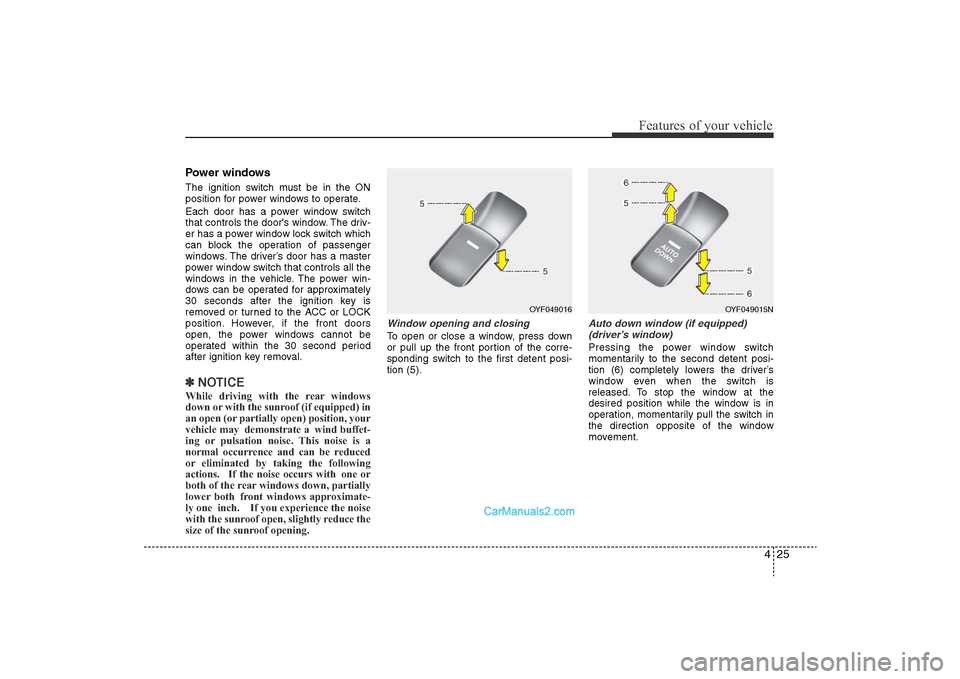
Window opening and closingTo open or close a window, press down
or pull up the front portion of the corre-
sponding switch to the first detent posi-
tion (5).
Auto down window (if equipped)
(driver’s window)Pressing the power window switch
momentarily to the second detent posi-
tion (6) completely lowers the driver’s
window even when the switch is
released. To stop the window at the
desired position while the window is in
operation, momentarily pull the switch in
the direction opposite of the window
movement.
OYF049016
OYF049015N
YF HMA 4-103.QXP 12/24/2009 5:10 PM Page 25
Page 192 of 380
Features of your vehicle112
4MIDDLE Control
To increase the MIDDLE, rotate the knob
clockwise, while to decrease the MID-
DLE, rotate the knob counterclockwise.
TREBLE Control
To increase the TREBLE, rotate the knob
clockwise, while to decrease the TRE-
BLE, rotate the knob counterclockwise.
FADER Control
Turn the control knob clockwise to
emphasize rear speaker sound(front
speaker sound will be attenuated).
When the control knob is turned counter-
clockwise, front speaker sound will be
emphasized(rear speaker sound will be
attenuated).
BALANCE Control
Rotate the knob clockwise to emphasize
right speaker sound(left speaker sound
will be attenuated).
When the control knob is turned counter
clockwise, left speaker sound will be
emphasized(right speaker sound will be
attenuated).
10. Manual Channel Selector Press the [ FOLDER ] button while
listening to a radio channel to manually
adjust frequency.11. Automatic Channel Selection
Button• When the [SEEK ] button is pressed,
it increases the band frequency to auto-
matically select channel. Stops at the
previous frequency if no channel is
found.
• When the [TRACK ] button is press- ed, it reduces the band frequency to
automatically select channel. Stops at
the previous frequency if no channel is
found.
YF HMA 4-104~(AUDIO).QXP 12/24/2009 5:21 PM Page 112
Page 244 of 380

Driving your vehicle28
5Indicator lightWhen ignition switch is turned to ON, the
indicator light illuminates, then goes off if
the ESC system is operating normally.
The ESC indicator light blinks whenever
ESC is operating or illuminates when
ESC fails to operate.
The ESC OFF indicator light comes on
when the ESC is turned off with the but-
ton.
ESC OFF usageWhen driving
• ESC should be turned on for daily driv-
ing whenever possible.
• To turn ESC off while driving, press the ESC OFF button while driving on a flat
road surface.
Never press the ESC OFF button while
ESC is operating (ESC indicator light
blinks).
If ESC is turned off while ESC is operat-
ing, the vehicle may slip out of control.✽ NOTICE• When operating the vehicle on a
dynamometer, ensure that the ESC is
turned off (ESC OFF light illuminat-
ed).
• Turning the ESC off does not affect ABS or brake system operation.
CAUTION
Driving with varying tire or wheel
sizes may cause the ESC system tomalfunction. When replacing tires,make sure they are the same size asyour original tires.
WARNING
The Electronic Stability Control sys-
tem is only a driving aid; use pre-
cautions for safe driving by slowing
down on curved, snowy, or icy
roads. Drive slowly and don’t
attempt to accelerate whenever the
ESC indicator light is blinking, or
when the road surface is slippery.
■ESC indicator light ■ ESC OFF indicator light
YF hma 5.qxp 11/25/2009 5:45 PM Page 28
Page 257 of 380

541
Driving your vehicle
More severe weather conditions of winter
result in greater wear and other prob-
lems. To minimize winter driving problem,
you should follow these suggestions:
Snowy or icy conditionsTo drive your vehicle in deep snow, it may
be necessary to use snow tires or to
install tire chains on your tires. If snow
tires are needed, it is necessary to select
tires equivalent in size and type of the
original equipment tires. Failure to do so
may adversely affect the safety and han-
dling of your car. Furthermore, speeding,
rapid acceleration, sudden brake appli-
cations, and sharp turns are potentially
very hazardous practices.
During deceleration, use engine braking
to the fullest extent. Sudden brake appli-
cations on snowy or icy roads may cause
skids to occur. You need to keep suffi-
cient distance between the vehicle in
operation in front and your vehicle. Also,
apply the brake gently. It should be noted
that installing tire chains on the tire will
provide a greater driving force, but will
not prevent side skids.✽NOTICETire chains are not legal in all states.
Check state laws before fitting tire
chains.
Snow tires If you mount snow tires on your vehicle,
make sure they are radial tires of the
same size and load range as the original
tires. Mount snow tires on all four wheels
to balance your vehicle’s handling in all
weather conditions. Keep in mind that the
traction provided by snow tires on dry
roads may not be as high as your vehi-
cle's original equipment tires. You should
drive cautiously even when the roads are
clear. Check with the tire dealer for max-
imum speed recommendations.Do not install studded tires without first
checking local, state and municipal regu- lations for possible restrictions againsttheir use.
WINTER DRIVING
WARNING
- Snow tire size
Snow tires should be equivalent in
size and type to the vehicle's stan-
dard tires. Otherwise, the safety
and handling of your vehicle may
be adversely affected.
1JBB3305
YF hma 5.qxp 11/25/2009 5:47 PM Page 41
Page 258 of 380
Driving your vehicle42
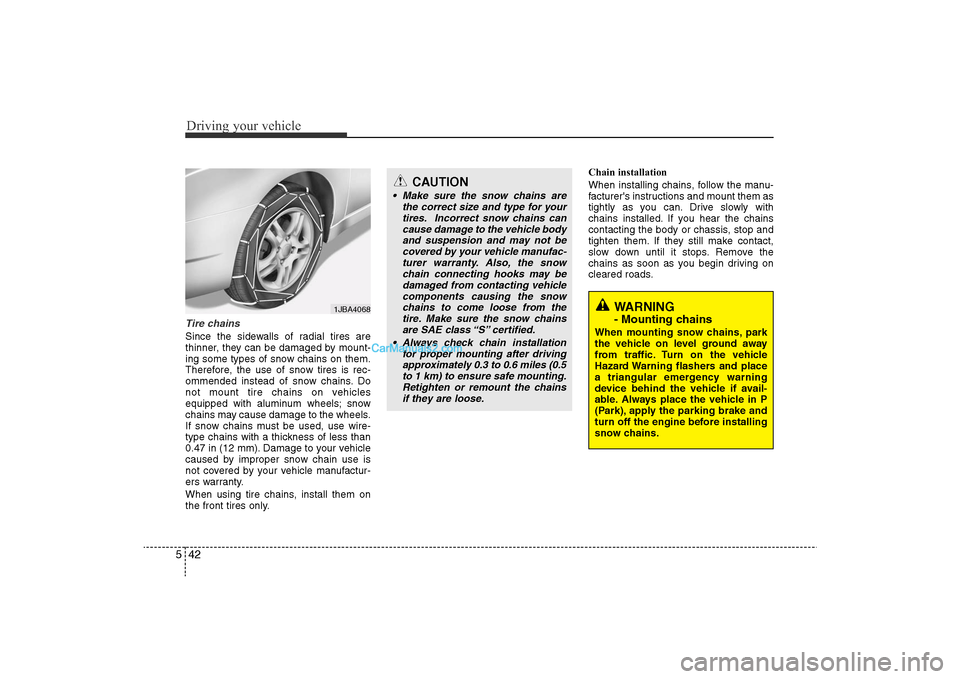
5Tire chains Since the sidewalls of radial tires are
thinner, they can be damaged by mount-
ing some types of snow chains on them.
Therefore, the use of snow tires is rec-
ommended instead of snow chains. Do
not mount tire chains on vehicles
equipped with aluminum wheels; snow
chains may cause damage to the wheels.
If snow chains must be used, use wire-
type chains with a thickness of less than
0.47 in (12 mm). Damage to your vehicle
caused by improper snow chain use is
not covered by your vehicle manufactur-
ers warranty.
When using tire chains, install them on
the front tires only. Chain installation
When installing chains, follow the manu-
facturer's instructions and mount them as
tightly as you can. Drive slowly with
chains installed. If you hear the chains
contacting the body or chassis, stop and
tighten them. If they still make contact,
slow down until it stops. Remove the
chains as soon as you begin driving on
cleared roads.
CAUTION
• Make sure the snow chains are
the correct size and type for yourtires. Incorrect snow chains can cause damage to the vehicle bodyand suspension and may not becovered by your vehicle manufac-turer warranty. Also, the snowchain connecting hooks may bedamaged from contacting vehicle components causing the snowchains to come loose from thetire. Make sure the snow chainsare SAE class “S” certified.
• Always check chain installation for proper mounting after drivingapproximately 0.3 to 0.6 miles (0.5to 1 km) to ensure safe mounting.Retighten or remount the chainsif they are loose.
WARNING - Mounting chains
When mounting snow chains, park
the vehicle on level ground away
from traffic. Turn on the vehicle
Hazard Warning flashers and place
a triangular emergency warning
device behind the vehicle if avail-
able. Always place the vehicle in P
(Park), apply the parking brake and
turn off the engine before installing
snow chains.
1JBA4068
YF hma 5.qxp 11/25/2009 5:47 PM Page 42
Page 259 of 380
543
Driving your vehicle
Use high quality ethylene glycol
coolantYour vehicle is delivered with high quality
ethylene glycol coolant in the cooling
system. It is the only type of coolant that
should be used because it helps prevent
corrosion in the cooling system, lubri-
cates the water pump and prevents
freezing. Be sure to replace or replenish
your coolant in accordance with the
maintenance schedule in section 7.
Before winter, have your coolant tested to
assure that its freezing point is sufficient
for the temperatures anticipated during
the winter.Check battery and cablesWinter puts additional burdens on the
battery system. Visually inspect the bat-
tery and cables as described in section
7. The level of charge in your battery can
be checked by an authorized HYUNDAI
dealer or a service station.
Change to "winter weight" oil if
necessaryIn some climates it is recommended that
a lower viscosity "winter weight" oil be
used during cold weather. See section 8
for recommendations. If you aren't sure
what weight oil you should use, consult
an authorized HYUNDAI dealer.Check spark plugs and ignition
systemInspect your spark plugs as described in
section 7 and replace them if necessary.
Also check all ignition wiring and compo-
nents to be sure they are not cracked,
worn or damaged in any way.
WARNING
- Tire chains
• The use of chains may adverselyaffect vehicle handling.
• Do not exceed 20 mph (30 km/h) or the chain manufacturer’s rec-
ommended speed limit, whichev-
er is lower.
• Drive carefully and avoid bumps, holes, sharp turns, and other
road hazards, which may cause
the vehicle to bounce.
• Avoid sharp turns or locked- wheel braking.
CAUTION
• Chains that are the wrong size or improperly installed can damageyour vehicle's brake lines, sus-pension, body and wheels.
• Stop driving and retighten the chains any time you hear themhitting the vehicle.
YF hma 5.qxp 11/25/2009 5:47 PM Page 43
Page 261 of 380
545
Driving your vehicle
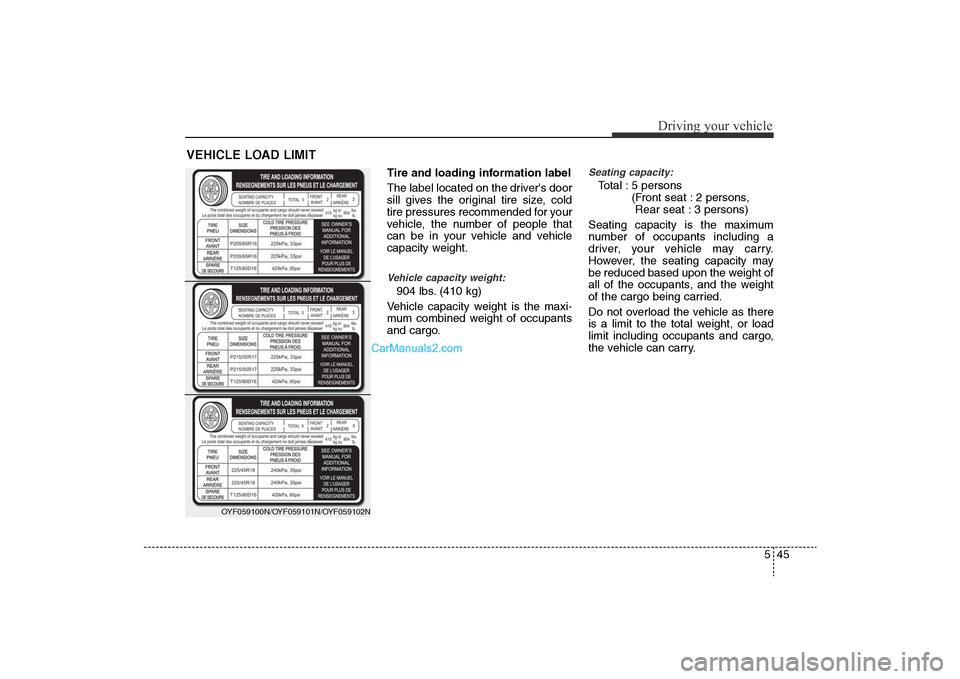
Tire and loading information label
The label located on the driver's door
sill gives the original tire size, cold
tire pressures recommended for your
vehicle, the number of people that
can be in your vehicle and vehicle
capacity weight.Vehicle capacity weight:904 lbs. (410 kg)
Vehicle capacity weight is the maxi-
mum combined weight of occupants
and cargo.
Seating capacity:Total : 5 persons (Front seat : 2 persons, Rear seat : 3 persons)
Seating capacity is the maximum
number of occupants including a
driver, your vehicle may carry.
However, the seating capacity may
be reduced based upon the weight of
all of the occupants, and the weight
of the cargo being carried.
Do not overload the vehicle as there
is a limit to the total weight, or load
limit including occupants and cargo,
the vehicle can carry.
VEHICLE LOAD LIMIT
OYF059100N/OYF059101N/OYF059102N
YF hma 5.qxp 11/25/2009 5:50 PM Page 45