Air Hyundai Sonata 2013 Owner's Manual
[x] Cancel search | Manufacturer: HYUNDAI, Model Year: 2013, Model line: Sonata, Model: Hyundai Sonata 2013Pages: 410, PDF Size: 35.93 MB
Page 384 of 410
769
Maintenance
Aluminum or chrome wheel mainte-
nanceThe aluminum or chrome wheels are
coated with a clear protective finish.
Do not use any abrasive cleaner, pol-
ishing compound, solvent, or wire
brushes on aluminum or chrome
wheels. They may scratch or damage
the finish.
Clean the wheel when it has cooled.
Use only a mild soap or neutral deter-
gent, and rinse thoroughly with water.
Also, be sure to clean the wheels after
driving on salted roads. This helps pre-
vent corrosion.
Avoid washing the wheels with high-
speed car wash brushes.
Do not use any cleaners containing
alkaline or acid detergents. It may
damage and corrode the aluminum or
chrome wheels coated with a clear
protective finish.
Corrosion protectionProtecting your vehicle from corrosion
By using the most advanced design and
construction practices to combat corro-
sion, we produce cars of the highest
quality. However, this is only part of the
job. To achieve the long-term corrosion
resistance your vehicle can deliver, the
owner's cooperation and assistance is
also required.
Common causes of corrosion
The most common causes of corrosion
on your car are:
Road salt, dirt and moisture that is
allowed to accumulate underneath the
car.
Removal of paint or protective coatings
by stones, gravel, abrasion or minor
scrapes and dents which leave unpro-
tected metal exposed to corrosion.
WARNING
After washing the vehicle, test the
brakes while driving slowly to see if
they have been affected by water. If
braking performance is impaired,
dry the brakes by applying them
lightly while maintaining a slow for-
ward speed.
YF HMA 7.qxp 1/16/2012 6:21 PM Page 69
Page 385 of 410
Maintenance70 7High-corrosion areas
If you live in an area where your car is
regularly exposed to corrosive materials,
corrosion protection is particularly impor-
tant. Some of the common causes of
accelerated corrosion are road salts,
dust control chemicals, ocean air and
industrial pollution.Moisture breeds corrosion
Moisture creates the conditions in which
corrosion is most likely to occur. For
example, corrosion is accelerated by
high humidity, particularly when tempera-
tures are just above freezing. In such
conditions, the corrosive material is kept
in contact with the car surfaces by mois-
ture that is slow to evaporate.
Mud is particularly corrosive because it is
slow to dry and holds moisture in contact
with the vehicle. Although the mud
appears to be dry, it can still retain the
moisture and promote corrosion.
High temperatures can also accelerate
corrosion of parts that are not properly
ventilated so the moisture can be dis-
persed. For all these reasons, it is par-
ticularly important to keep your car clean
and free of mud or accumulations of
other materials. This applies not only to
the visible surfaces but particularly to the
underside of the car.To help prevent corrosion
You can help prevent corrosion from get-
ting started by observing the following:
Keep your car clean
The best way to prevent corrosion is to
keep your car clean and free of corrosive
materials. Attention to the underside of
the car is particularly important.
If you live in a high-corrosion area —
where road salts are used, near the
ocean, areas with industrial pollution,
acid rain, etc.—, you should take extra
care to prevent corrosion. In winter,
hose off the underside of your car at
least once a month and be sure to
clean the underside thoroughly when
winter is over.
YF HMA 7.qxp 1/16/2012 6:21 PM Page 70
Page 386 of 410
771
Maintenance
When cleaning underneath the car,
give particular attention to the compo-
nents under the fenders and other
areas that are hidden from view. Do a
thorough job; just dampening the accu-
mulated mud rather than washing it
away will accelerate corrosion rather
than prevent it. Water under high pres-
sure and steam are particularly effec-
tive in removing accumulated mud and
corrosive materials.
When cleaning lower door panels,
rocker panels and frame members, be
sure that drain holes are kept open so
that moisture can escape and not be
trapped inside to accelerate corrosion.
Keep your garage dry
Don't park your car in a damp, poorly
ventilated garage. This creates a favor-
able environment for corrosion. This is
particularly true if you wash your car in
the garage or drive it into the garage
when it is still wet or covered with snow,
ice or mud. Even a heated garage can
contribute to corrosion unless it is well
ventilated so moisture is dispersed.Keep paint and trim in good condition
Scratches or chips in the finish should be
covered with "touch-up" paint as soon as
possible to reduce the possibility of cor-
rosion. If bare metal is showing through,
the attention of a qualified body and paint
shop is recommended.
Bird droppings : Bird droppings are high-
ly corrosive and may damage painted
surfaces in just a few hours. Always
remove bird droppings as soon as possi-
ble.
Don't neglect the interior
Moisture can collect under the floor mats
and carpeting to cause corrosion. Check
under the mats periodically to be sure
the carpeting is dry. Use particular care if
you carry fertilizers, cleaning materials or
chemicals in the car.
These should be carried only in proper
containers and any spills or leaks should
be cleaned up, flushed with clean water
and thoroughly dried.
Interior careInterior general precautions Prevent chemicals such as perfume, cos-
metic oil, sun cream, hand cleaner, and
air freshener from contacting the interior
parts because they may cause damage
or discoloration. If they do contact the
interior parts, wipe them off immediately.
See the instructions that follow for the
proper way to clean vinyl.
CAUTION
Never allow water or other liquids
to come in contact with electri-
cal/electronic components inside
the vehicle as this may damage
them.
When cleaning leather products
(steering wheel, seats etc.), use
neutral detergents or low alcohol
content solutions. If you use high
alcohol content solutions or
acid/alkaline detergents, the color
of the leather may fade or the sur-
face may get stripped off.
YF HMA 7.qxp 1/16/2012 6:21 PM Page 71
Page 388 of 410

773
Maintenance
EMISSION CONTROL SYSTEMThe emission control system of your
vehicle is covered by a written limited
warranty. Please see the warranty infor-
mation contained in the Owner’s
Handbook & Warranty Information book-
let in your vehicle.
Your vehicle is equipped with an emis-
sion control system to meet all applicable
emission regulations.
There are three emission control sys-
tems, as follows.
(1) Crankcase emission control system
(2) Evaporative emission control system
(3) Exhaust emission control system
In order to assure the proper function of
the emission control systems, it is rec-
ommended that you have your car
inspected and maintained by an author-
ized HYUNDAI dealer in accordance with
the maintenance schedule in this manu-
al.Caution for the Inspection and
Maintenance Test (With Electronic
Stability Control (ESC) system)
To prevent the vehicle from misfir-
ing during dynamometer testing,
turn the Electronic Stability Control
(ESC) system off by pressing the
ESC switch.
After dynamometer testing is com-
pleted, turn the ESC system back on
by pressing the ESC switch again.
1. Crankcase emission control
systemThe positive crankcase ventilation sys-
tem is employed to prevent air pollution
caused by blow-by gases being emitted
from the crankcase. This system supplies
fresh filtered air to the crankcase through
the air intake hose. Inside the crankcase,
the fresh air mixes with blow-by gases,
which then pass through the PCV valve
into the induction system.2. Evaporative emission control
(including ORVR: Onboard
Refueling Vapor Recovery)
systemThe Evaporative Emission Control
System is designed to prevent fuel
vapors from escaping into the atmos-
phere.
(The ORVR system is designed to allow
the vapors from the fuel tank to be
loaded into a canister while refueling at
the gas station, preventing the escape of
fuel vapors into the atmosphere.)
YF HMA 7.qxp 1/16/2012 6:21 PM Page 73
Page 389 of 410

Maintenance74 7CanisterFuel vapors generated inside the fuel
tank are absorbed and stored in the
onboard canister. When the engine is
running, the fuel vapors absorbed in the
canister are drawn into the surge tank
through the purge control solenoid valve.Purge Control Solenoid Valve (PCSV)The purge control solenoid valve is con-
trolled by the Engine Control Module
(ECM); when the engine coolant temper-
ature is low during idling, the PCSV clos-
es so that evaporated fuel is not taken
into the engine. After the engine warms-
up during ordinary driving, the PCSV
opens to introduce evaporated fuel to the
engine.
3. Exhaust emission control
systemThe Exhaust Emission Control System is
a highly effective system which controls
exhaust emissions while maintaining
good vehicle performance.Vehicle modifications This vehicle should not be modified.
Modification of your vehicle could affect
its performance, safety or durability and
may even violate governmental safety
and emissions regulations.
In addition, damage or performance
problems resulting from any modification
may not be covered under warranty.
If you use unauthorized electronic
devices, it may cause the vehicle to
operate abnormally, wire damage, bat-
tery discharge or fire. For your safety,
do not use unauthorized electronic
devices.
Engine exhaust gas precautions (car-
bon monoxide) Carbon monoxide can be present with
other exhaust fumes. Therefore, if you
smell exhaust fumes of any kind inside
your vehicle, have it inspected and
repaired immediately. If you ever sus-
pect exhaust fumes are coming into
your vehicle, drive it only with all the
windows fully open. Have your vehicle
checked and repaired immediately.
WARNING
- Exhaust
Engine exhaust gases contain car-
bon monoxide (CO). Though color-
less and odorless, it is dangerous
and could be lethal if inhaled.
Follow the instructions on this
page to avoid CO poisoning.
YF HMA 7.qxp 1/16/2012 6:21 PM Page 74
Page 390 of 410
775
Maintenance
Do not operate the engine in confined
or closed areas (such as garages) any
more than what is necessary to move
the vehicle in or out of the area.
When the vehicle is stopped in an
open area for more than a short time
with the engine running, adjust the
ventilation system (as needed) to draw
outside air into the vehicle.
Never sit in a parked or stopped vehi-
cle for any extended time with the
engine running. When the engine stalls or fails to start,
excessive attempts to restart the
engine may cause damage to the
emission control system.
Operating precautions for catalytic
converters (if equipped)
Your vehicle is equipped with a catalytic
converter emission control device.
Therefore, the following precautions
must be observed:
Use only UNLEADED FUEL for gaso-
line engines.
Do not operate the vehicle when there
are signs of engine malfunction, such
as misfire or a noticeable loss of per-
formance.
Do not misuse or abuse the engine.
Examples of misuse are coasting with
the ignition off and descending steep
grades in gear with the ignition off.
Do not operate the engine at high idle
speed for extended periods (5 minutes
or more).
Do not modify or tamper with any part
of the engine or emission control sys-
tem. All inspections and adjustments
must be made by an authorized
HYUNDAI dealer.
Avoid driving with a extremely low fuel
level. Running out of fuel could cause
the engine to misfire, damaging the
catalytic converter.
Failure to observe these precautions
could result in damage to the catalytic
converter and to your vehicle.
Additionally, such actions could void your
warranties.
CALIFORNIA PROPOSI-
TION 65 WARNING
Engine exhaust and a wide variety
of automobile components and
parts, including components found
in the interior furnishings in a vehi-
cle, contain or emit chemicals
known to the State of California to
cause cancer and birth defects and
reproductive harm. In addition, cer-
tain fluids contained in vehicles
and certain products of component
wear contain or emit chemicals
known to the State of California to
cause cancer and birth defects or
other reproductive harm.
WARNING
- Fire
A hot exhaust system can ignite
flammable items under your vehi-
cle. Do not park, idle, or drive the
vehicle over or near flammable
objects, such as grass, vegeta-
tion, paper, leaves, etc.
The exhaust system and catalytic
system are very hot while the
engine is running or immediately
after the engine is turned off. Keep
away from the exhaust system
and catalytic, you may get burned.
Also, do not remove the heat sink
around the exhaust system, do
not seal the bottom of the vehicle
or do not coat the vehicle for cor-
rosion control. It may present a
fire risk under certain conditions.
YF HMA 7.qxp 1/16/2012 6:21 PM Page 75
Page 391 of 410
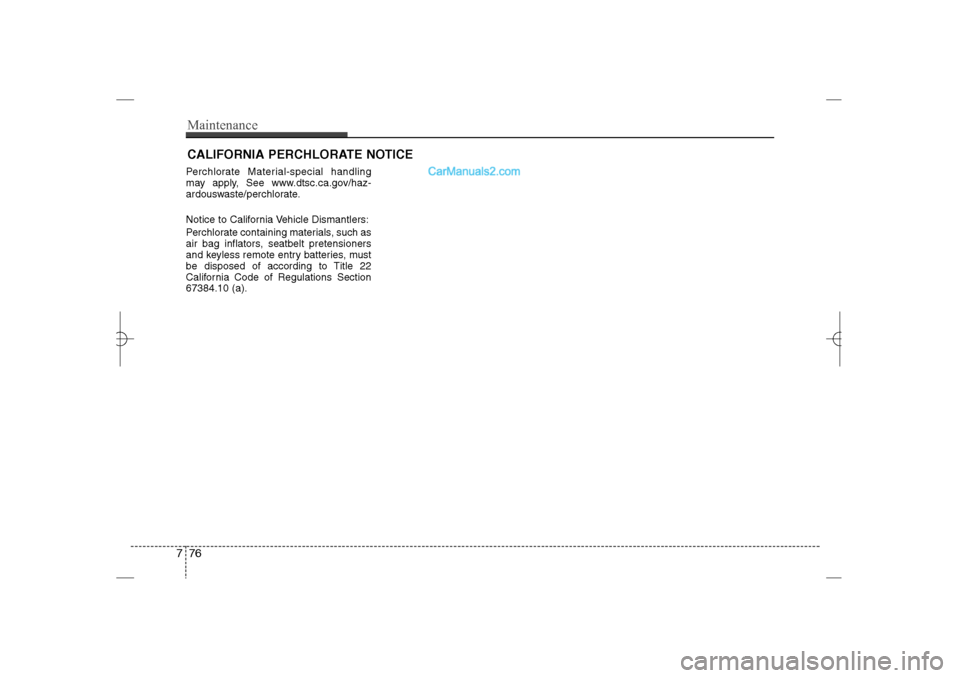
CALIFORNIA PERCHLORATE NOTICEPerchlorate Material-special handling
may apply, See www.dtsc.ca.gov/haz-
ardouswaste/perchlorate.
Notice to California Vehicle Dismantlers:
Perchlorate containing materials, such as
air bag inflators, seatbelt pretensioners
and keyless remote entry batteries, must
be disposed of according to Title 22
California Code of Regulations Section
67384.10 (a).776Maintenance
YF HMA 7.qxp 1/16/2012 6:21 PM Page 76
Page 400 of 410
89
Specifications, Consumer information, Reporting safety defects
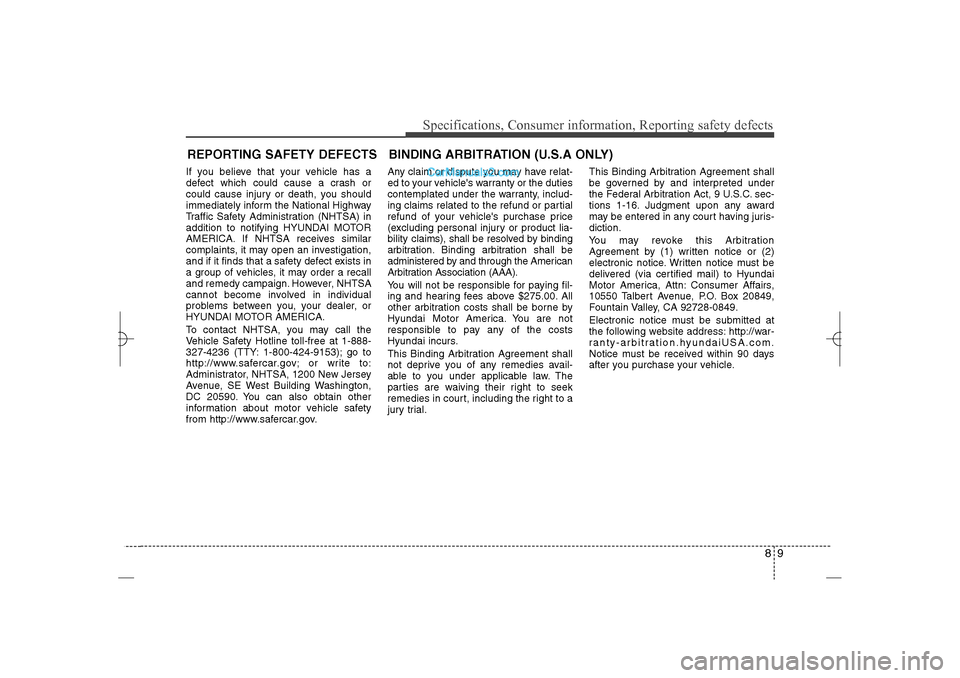
If you believe that your vehicle has a
defect which could cause a crash or
could cause injury or death, you should
immediately inform the National Highway
Traffic Safety Administration (NHTSA) in
addition to notifying HYUNDAI MOTOR
AMERICA. If NHTSA receives similar
complaints, it may open an investigation,
and if it finds that a safety defect exists in
a group of vehicles, it may order a recall
and remedy campaign. However, NHTSA
cannot become involved in individual
problems between you, your dealer, or
HYUNDAI MOTOR AMERICA.
To contact NHTSA, you may call the
Vehicle Safety Hotline toll-free at 1-888-
327-4236 (TTY: 1-800-424-9153); go to
http://www.safercar.gov; or write to:
Administrator, NHTSA, 1200 New Jersey
Avenue, SE West Building Washington,
DC 20590. You can also obtain other
information about motor vehicle safety
from http://www.safercar.gov.Any claim or dispute you may have relat-
ed to your vehicle's warranty or the duties
contemplated under the warranty, includ-
ing claims related to the refund or partial
refund of your vehicle's purchase price
(excluding personal injury or product lia-
bility claims), shall be resolved by binding
arbitration. Binding arbitration shall be
administered by and through the American
Arbitration Association (AAA).
You will not be responsible for paying fil-
ing and hearing fees above $275.00. All
other arbitration costs shall be borne by
Hyundai Motor America. You are not
responsible to pay any of the costs
Hyundai incurs.
This Binding Arbitration Agreement shall
not deprive you of any remedies avail-
able to you under applicable law. The
parties are waiving their right to seek
remedies in court, including the right to a
jury trial.This Binding Arbitration Agreement shall
be governed by and interpreted under
the Federal Arbitration Act, 9 U.S.C. sec-
tions 1-16. Judgment upon any award
may be entered in any court having juris-
diction.
You may revoke this Arbitration
Agreement by (1) written notice or (2)
electronic notice. Written notice must be
delivered (via certified mail) to Hyundai
Motor America, Attn: Consumer Affairs,
10550 Talbert Avenue, P.O. Box 20849,
Fountain Valley, CA 92728-0849.
Electronic notice must be submitted at
the following website address: http://war-
ranty-arbitration.hyundaiUSA.com.
Notice must be received within 90 days
after you purchase your vehicle.REPORTING SAFETY DEFECTS
BINDING ARBITRATION (U.S.A ONLY)
YF HMA 8.qxp 6/20/1999 12:27 PM Page 9
Page 402 of 410
Index2I
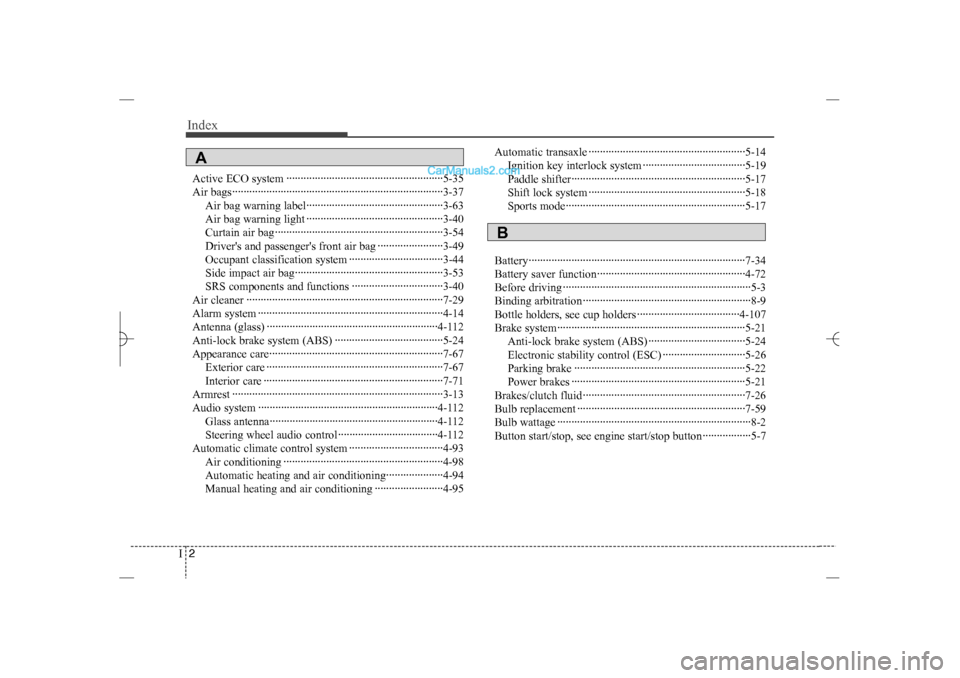
Active ECO system ·······················································5-35
Air bags··········································································3-37
Air bag warning label················································3-63
Air bag warning light ················································3-40
Curtain air bag···························································3-54
Driver's and passenger's front air bag ·······················3-49
Occupant classification system ·································3-44
Side impact air bag····················································3-53
SRS components and functions ································3-40
Air cleaner ·····································································7-29
Alarm system ·································································4-14
Antenna (glass) ····························································4-112
Anti-lock brake system (ABS) ······································5-24
Appearance care·····························································7-67
Exterior care ······························································7-67
Interior care ·······························································7-71
Armrest ··········································································3-13
Audio system ·······························································4-112
Glass antenna···························································4-112
Steering wheel audio control···································4-112
Automatic climate control system ·································4-93
Air conditioning ························································4-98
Automatic heating and air conditioning····················4-94
Manual heating and air conditioning ························4-95Automatic transaxle ·······················································5-14
Ignition key interlock system ····································5-19
Paddle shifter·····························································5-17
Shift lock system ·······················································5-18
Sports mode·······························································5-17
Battery············································································7-34
Battery saver function····················································4-72
Before driving ··································································5-3
Binding arbitration ···························································8-9
Bottle holders, see cup holders ····································4-107
Brake system··································································5-21
Anti-lock brake system (ABS) ··································5-24
Electronic stability control (ESC) ·····························5-26
Parking brake ····························································5-22
Power brakes ·····························································5-21
Brakes/clutch fluid ·························································7-26
Bulb replacement ···························································7-59
Bulb wattage ····································································8-2
Button start/stop, see engine start/stop button·················5-7A
B
YF HMA INDEX.QXP 5/16/2011 5:52 PM Page 2
Page 403 of 410
I3
Index
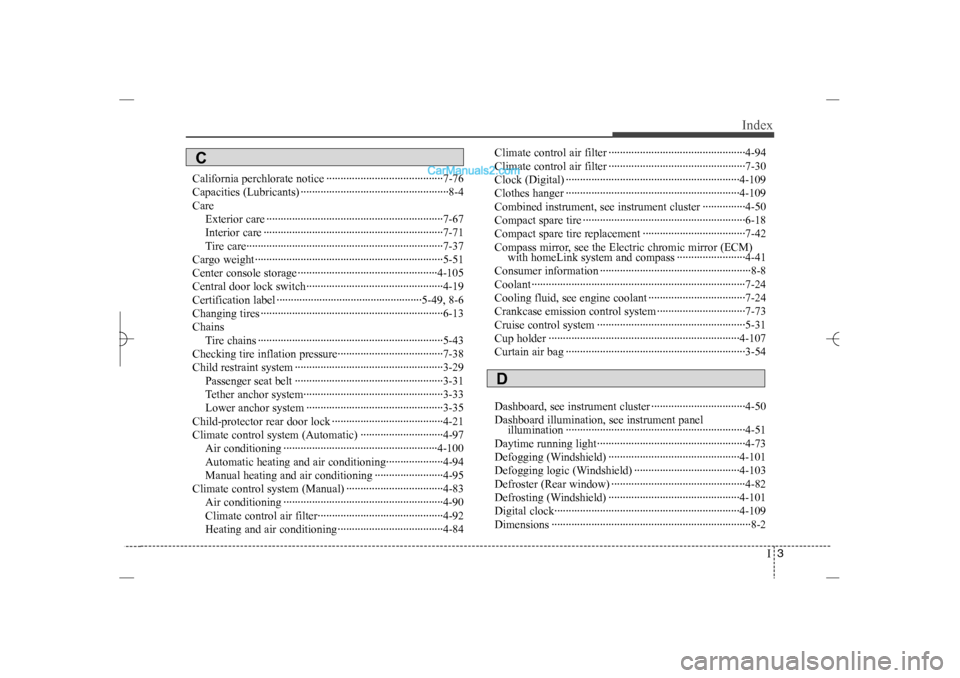
California perchlorate notice ·········································7-76
Capacities (Lubricants) ····················································8-4
Care
Exterior care ······························································7-67
Interior care ·······························································7-71
Tire care·····································································7-37
Cargo weight ··································································5-51
Center console storage ·················································4-105
Central door lock switch················································4-19
Certification label ···················································5-49, 8-6
Changing tires ································································6-13
Chains
Tire chains ·································································5-43
Checking tire inflation pressure·····································7-38
Child restraint system ····················································3-29
Passenger seat belt ····················································3-31
Tether anchor system·················································3-33
Lower anchor system ················································3-35
Child-protector rear door lock ·······································4-21
Climate control system (Automatic) ·····························4-97
Air conditioning ······················································4-100
Automatic heating and air conditioning····················4-94
Manual heating and air conditioning ························4-95
Climate control system (Manual) ··································4-83
Air conditioning ························································4-90
Climate control air filter············································4-92
Heating and air conditioning·····································4-84Climate control air filter ················································4-94
Climate control air filter ················································7-30
Clock (Digital) ·····························································4-109
Clothes hanger ·····························································4-109
Combined instrument, see instrument cluster ···············4-50
Compact spare tire ·························································6-18
Compact spare tire replacement ····································7-42
Compass mirror, see the Electric chromic mirror (ECM)
with homeLink system and compass ························4-41
Consumer information ·····················································8-8
Coolant ···········································································7-24
Cooling fluid, see engine coolant ··································7-24
Crankcase emission control system ·······························7-73
Cruise control system ····················································5-31
Cup holder ···································································4-107
Curtain air bag ·······························································3-54
Dashboard, see instrument cluster ·································4-50
Dashboard illumination, see instrument panel
illumination ·······························································4-51
Daytime running light····················································4-73
Defogging (Windshield) ··············································4-101
Defogging logic (Windshield) ·····································4-103
Defroster (Rear window) ···············································4-82
Defrosting (Windshield) ··············································4-101
Digital clock·································································4-109
Dimensions ······································································8-2C
D
YF HMA INDEX.QXP 5/16/2011 5:52 PM Page 3