eco Hyundai Sonata 2013 Owner's Guide
[x] Cancel search | Manufacturer: HYUNDAI, Model Year: 2013, Model line: Sonata, Model: Hyundai Sonata 2013Pages: 410, PDF Size: 35.93 MB
Page 46 of 410
Safety features of your vehicle28 3
Care of seat beltsSeat belt systems should never be disas-
sembled or modified. In addition, care
should be taken to assure that seat belts
and belt hardware are not damaged by
seat hinges, doors or other abuse.
Periodic inspectionAll seat belts should be inspected peri-
odically for wear or damage of any kind.
Any damaged parts should be replaced
as soon as possible.Keep belts clean and drySeat belts should be kept clean and dry.
If belts become dirty, they can be
cleaned by using a mild soap solution
and warm water. Bleach, dye, strong
detergents or abrasives should not be
used because they may damage and
weaken the fabric.When to replace seat beltsEntire in-use seat belt assembly or
assemblies should be replaced if the
vehicle has been involved in an accident.
This should be done even if no damage
is visible. Additional questions concern-
ing seat belt operation should be directed
to an authorized HYUNDAI dealer.
WARNING
Riding with a reclined seatback
increases your chance of serious
or fatal injuries in the event of a col-
lision or sudden stop. The protec-
tion of your restraint system (seat
belts and air bags) is greatly
reduced by reclining your seat.
Seat belts must be snug against
your hips and chest to work proper-
ly. The more the seatback is
reclined, the greater the chance
that an occupant's hips will slide
under the lap belt causing serious
internal injuries or the occupant's
neck could strike the shoulder belt.
Drivers and passengers should
always sit well back in their seats,
properly belted, and with the seat-
backs upright.
WARNING
When you return the rear seatback
to its upright position after the rear
seatback was folded down, be care-
ful not to damage the seat belt web-
bing or buckle. Be sure that the
webbing or buckle does not get
caught or pinched in the rear seat.
A seat belt with damaged webbing
or buckle will not be as strong and
could possibly fail during a colli-
sion or sudden stop, resulting in
serious injury.
YF HMA 3.qxp 5/16/2011 4:14 PM Page 28
Page 47 of 410
329
Safety features of your vehicleWARNING
To reduce the chance of serious or
fatal injuries:
Children of all ages are safer
when restrained in the rear seat.
A child riding in the front passen-
ger seat can be forcefully struck
by an inflating air bag resulting in
serious or fatal injuries.
Always follow the child restraint
system manufacturer’s instruc-
tions for installation and use of
the child restraint.
Always make sure the child seat
is secured properly in the car and
your child is securely restrained
in the child seat.
Never hold a child in your arms or
lap when riding in a vehicle. The
violent forces created during a
crash will tear the child from your
arms and throw the child against
the car’s interior.
Never put a seat belt over your-
self and a child. During a crash,
the belt could press deep into the
child causing serious internal
injuries.
(Continued)
CHILD RESTRAINT SYSTEMChildren riding in the car should sit in the
rear seat and must always be properly
restrained to minimize the risk of injury in
an accident, sudden stop or sudden
maneuver. According to accident statis-
tics, children are safer when properly
restrained in the rear seats than in the
front seat. Larger children not in a child
restraint should use one of the seat belts
provided.
You should be aware of the specific
requirements in your state. Child and/or
infant safety seats must be properly
placed and installed in the rear seat. You
must use a commercially available child
restraint system that meets the require-
ments of the Federal Motor Vehicle Safety
Standards (FMVSS).
Child restraint systems are designed to be
secured in vehicle seats by lap belts or the
lap belt portion of a lap/shoulder belt, or
by a LATCH system (if equipped).
Children could be injured or killed in a
crash if their restraints are not properly
secured. For small children and babies, a
child seat or infant seat must be used.
Before buying a particular child restraint
system, make sure it fits your car seat
and seat belts, and fits your child. Follow
all the instructions provided by the man-
ufacturer when installing the child
restraint system.
WARNING
A child restraint system must be
placed in the rear seat. Never
install a child or infant seat on the
front passenger's seat. Should an
accident occur and cause the
passenger-side air bag to deploy,
it could severely injure or kill an
infant or child seated in an infant
or child seat. Thus only use a
child restraint in the rear seat of
your vehicle.
A seat belt or child restraint sys-
tem can become very hot if it is
left in a closed vehicle on a sunny
day, even if the outside tempera-
ture does not feel hot. Be sure to
check the seat cover and buckles
before placing a child there.
When the child restraint system
is not in use, store it in the lug-
gage area or fasten it with a seat
belt so that it will not be thrown
forward in the case of a sudden
stop or an accident.
Children may be seriously injured
or killed by an inflating air bag.
All children, even those too large
for child restraints, must ride in
the rear seat.
YF HMA 3.qxp 5/16/2011 4:14 PM Page 29
Page 48 of 410
Safety features of your vehicle30 3
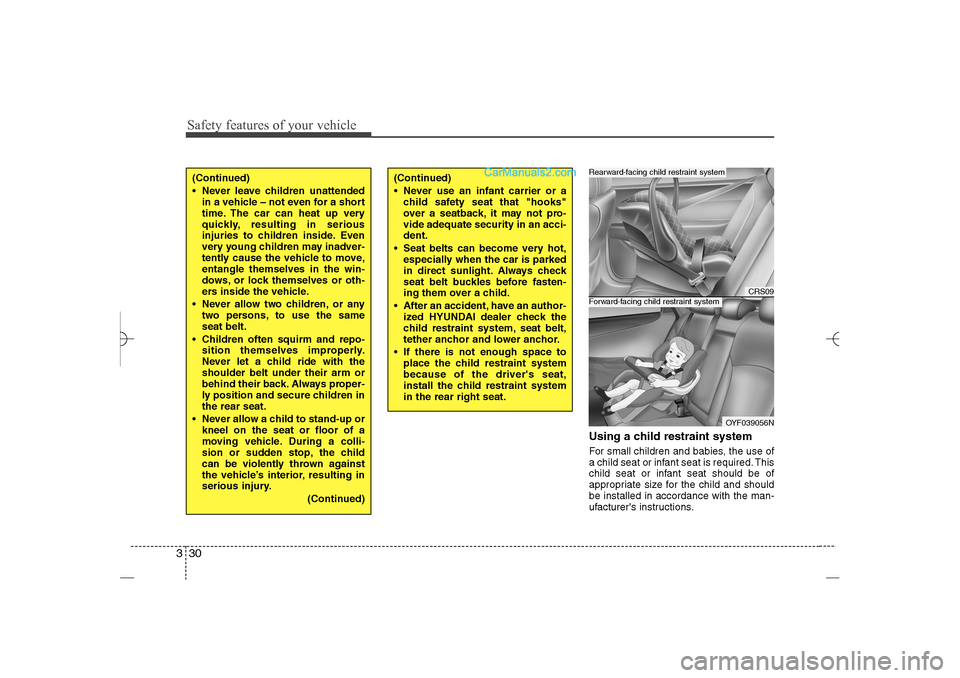
Using a child restraint systemFor small children and babies, the use of
a child seat or infant seat is required. This
child seat or infant seat should be of
appropriate size for the child and should
be installed in accordance with the man-
ufacturer's instructions.
(Continued)
Never leave children unattended
in a vehicle – not even for a short
time. The car can heat up very
quickly, resulting in serious
injuries to children inside. Even
very young children may inadver-
tently cause the vehicle to move,
entangle themselves in the win-
dows, or lock themselves or oth-
ers inside the vehicle.
Never allow two children, or any
two persons, to use the same
seat belt.
Children often squirm and repo-
sition themselves improperly.
Never let a child ride with the
shoulder belt under their arm or
behind their back. Always proper-
ly position and secure children in
the rear seat.
Never allow a child to stand-up or
kneel on the seat or floor of a
moving vehicle. During a colli-
sion or sudden stop, the child
can be violently thrown against
the vehicle’s interior, resulting in
serious injury.
(Continued)
(Continued)
Never use an infant carrier or a
child safety seat that "hooks"
over a seatback, it may not pro-
vide adequate security in an acci-
dent.
Seat belts can become very hot,
especially when the car is parked
in direct sunlight. Always check
seat belt buckles before fasten-
ing them over a child.
After an accident, have an author-
ized HYUNDAI dealer check the
child restraint system, seat belt,
tether anchor and lower anchor.
If there is not enough space to
place the child restraint system
because of the driver's seat,
install the child restraint system
in the rear right seat.
CRS09
OYF039056N
Forward-facing child restraint systemRearward-facing child restraint system
YF HMA 3.qxp 5/16/2011 4:15 PM Page 30
Page 49 of 410
331
Safety features of your vehicle
For safety reasons, we recommend that
the child restraint system be used in the
rear seats.
Since all passenger seat belts move
freely under normal conditions and only
lock under extreme or emergency condi-
tions (emergency locking mode), you
must manually change these seat belts
to the automatic locking mode to secure
a child restraint.
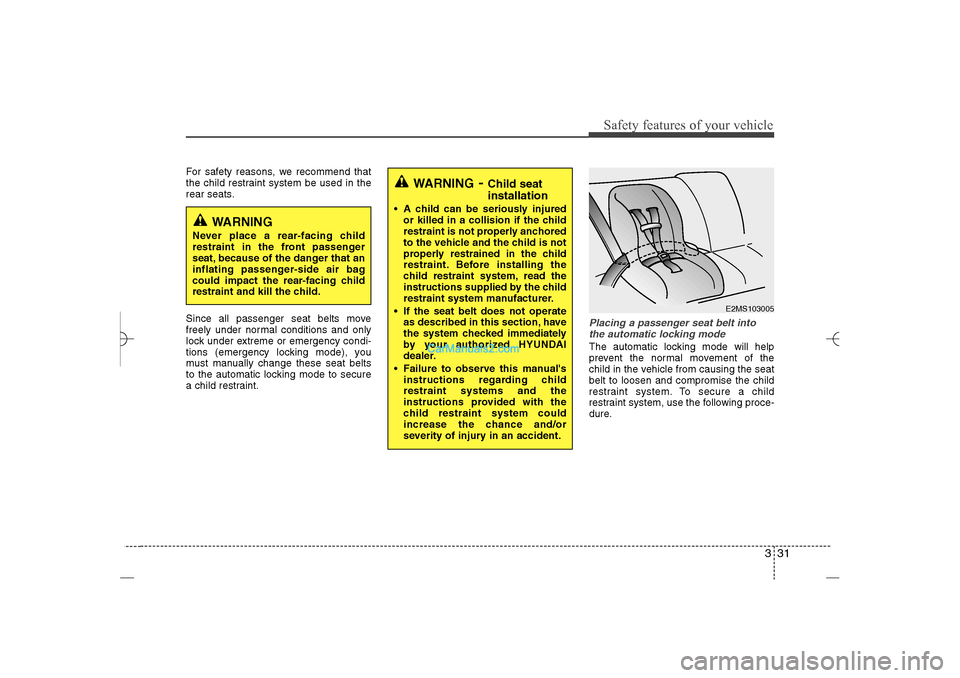
Placing a passenger seat belt into
the automatic locking mode The automatic locking mode will help
prevent the normal movement of the
child in the vehicle from causing the seat
belt to loosen and compromise the child
restraint system. To secure a child
restraint system, use the following proce-
dure.
WARNING
- Child seat
installation
A child can be seriously injured
or killed in a collision if the child
restraint is not properly anchored
to the vehicle and the child is not
properly restrained in the child
restraint. Before installing the
child restraint system, read the
instructions supplied by the child
restraint system manufacturer.
If the seat belt does not operate
as described in this section, have
the system checked immediately
by your authorized HYUNDAI
dealer.
Failure to observe this manual's
instructions regarding child
restraint systems and the
instructions provided with the
child restraint system could
increase the chance and/or
severity of injury in an accident.
WARNING
Never place a rear-facing child
restraint in the front passenger
seat, because of the danger that an
inflating passenger-side air bag
could impact the rear-facing child
restraint and kill the child.
E2MS103005
YF HMA 3.qxp 5/16/2011 4:15 PM Page 31
Page 58 of 410
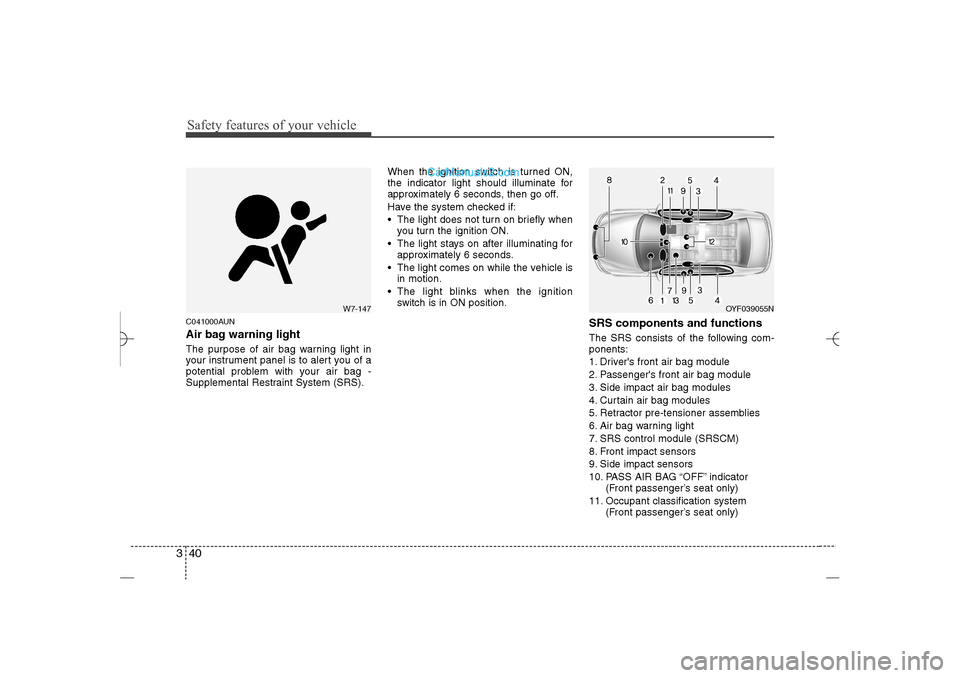
Safety features of your vehicle40 3C041000AUNAir bag warning lightThe purpose of air bag warning light in
your instrument panel is to alert you of a
potential problem with your air bag -
Supplemental Restraint System (SRS).When the ignition switch is turned ON,
the indicator light should illuminate for
approximately 6 seconds, then go off.
Have the system checked if:
The light does not turn on briefly when
you turn the ignition ON.
The light stays on after illuminating for
approximately 6 seconds.
The light comes on while the vehicle is
in motion.
The light blinks when the ignition
switch is in ON position.
SRS components and functionsThe SRS consists of the following com-
ponents:
1. Driver's front air bag module
2. Passenger's front air bag module
3. Side impact air bag modules
4. Curtain air bag modules
5. Retractor pre-tensioner assemblies
6. Air bag warning light
7. SRS control module (SRSCM)
8. Front impact sensors
9. Side impact sensors
10. PASS AIR BAG “OFF” indicator
(Front passenger’s seat only)
11. Occupant classification system
(Front passenger’s seat only)
W7-147
OYF039055N
YF HMA 3.qxp 5/16/2011 4:15 PM Page 40
Page 59 of 410
341
Safety features of your vehicle
12. Driver’s and front passenger’s seat
belt buckle sensors
13. Driver’s seat track position sensor
14. Anchor pre-tensioner
15. Side pressure sensor
The SRSCM continually monitors all
SRS components while the ignition
switch is ON to determine if a crash
impact is severe enough to require air
bag deployment or pre-tensioner seat
belt deployment.
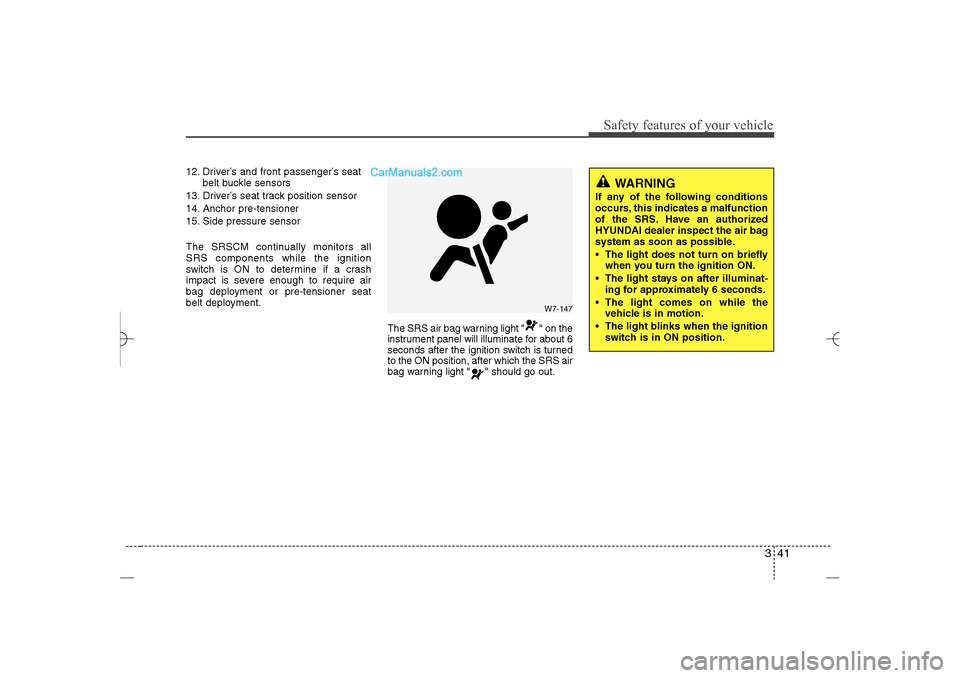
The SRS air bag warning light " " on the
instrument panel will illuminate for about 6
seconds after the ignition switch is turned
to the ON position, after which the SRS air
bag warning light " " should go out.
W7-147
WARNING
If any of the following conditions
occurs, this indicates a malfunction
of the SRS. Have an authorized
HYUNDAI dealer inspect the air bag
system as soon as possible.
The light does not turn on briefly
when you turn the ignition ON.
The light stays on after illuminat-
ing for approximately 6 seconds.
The light comes on while the
vehicle is in motion.
The light blinks when the ignition
switch is in ON position.
YF HMA 3.qxp 5/16/2011 4:15 PM Page 41
Page 61 of 410
343
Safety features of your vehicle
WARNING
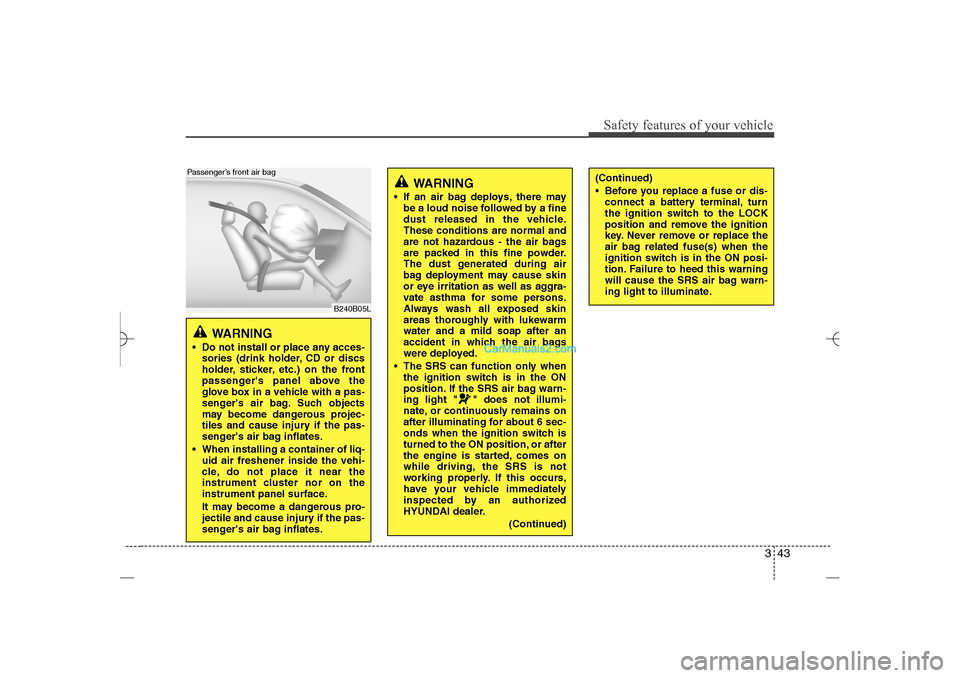
Do not install or place any acces-
sories (drink holder, CD or discs
holder, sticker, etc.) on the front
passenger's panel above the
glove box in a vehicle with a pas-
senger's air bag. Such objects
may become dangerous projec-
tiles and cause injury if the pas-
senger's air bag inflates.
When installing a container of liq-
uid air freshener inside the vehi-
cle, do not place it near the
instrument cluster nor on the
instrument panel surface.
It may become a dangerous pro-
jectile and cause injury if the pas-
senger's air bag inflates.
B240B05L
Passenger’s front air bag
WARNING
If an air bag deploys, there may
be a loud noise followed by a fine
dust released in the vehicle.
These conditions are normal and
are not hazardous - the air bags
are packed in this fine powder.
The dust generated during air
bag deployment may cause skin
or eye irritation as well as aggra-
vate asthma for some persons.
Always wash all exposed skin
areas thoroughly with lukewarm
water and a mild soap after an
accident in which the air bags
were deployed.
The SRS can function only when
the ignition switch is in the ON
position. If the SRS air bag warn-
ing light " " does not illumi-
nate, or continuously remains on
after illuminating for about 6 sec-
onds when the ignition switch is
turned to the ON position, or after
the engine is started, comes on
while driving, the SRS is not
working properly. If this occurs,
have your vehicle immediately
inspected by an authorized
HYUNDAI dealer.
(Continued)
(Continued)
Before you replace a fuse or dis-
connect a battery terminal, turn
the ignition switch to the LOCK
position and remove the ignition
key. Never remove or replace the
air bag related fuse(s) when the
ignition switch is in the ON posi-
tion. Failure to heed this warning
will cause the SRS air bag warn-
ing light to illuminate.
YF HMA 3.qxp 5/16/2011 4:15 PM Page 43
Page 63 of 410
345
Safety features of your vehicle
Always be sure that you and all vehicle
occupants are seated and restrained
properly (sitting upright with the seat in
an upright position, centered on the seat
cushion, with the person's legs comfort-
ably extended, feet on the floor, and
wearing the safety belt properly) for the
most effective protection by the air bag
and the safety belt.
The OCS may not function properly if
the passenger takes actions which can
affect the classification system. These
include:
(1) Failing to sit in an upright position.
(2) Leaning against the door or center
console.
(3) Sitting towards the sides or the
front of the seat.
(4) Putting legs on the dashboard or
resting them on other locations
which reduce the passenger weight
on the front seat.
(5) Improperly wearing the safety belt.
(6) Reclining the seat back.
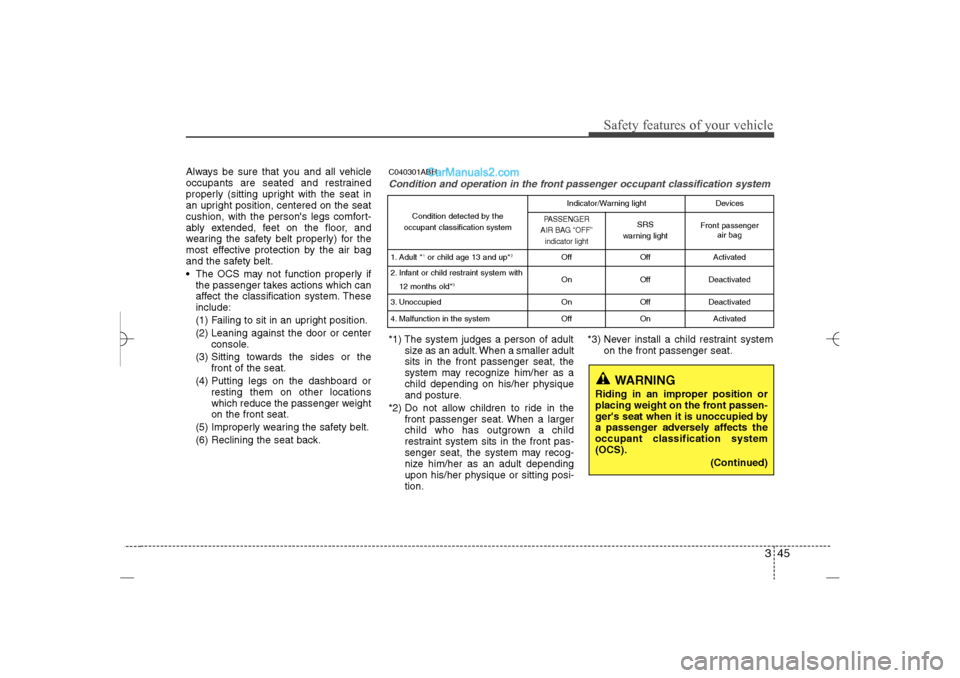
C040301ABHCondition and operation in the front passenger occupant classification system*1) The system judges a person of adult
size as an adult. When a smaller adult
sits in the front passenger seat, the
system may recognize him/her as a
child depending on his/her physique
and posture.
*2) Do not allow children to ride in the
front passenger seat. When a larger
child who has outgrown a child
restraint system sits in the front pas-
senger seat, the system may recog-
nize him/her as an adult depending
upon his/her physique or sitting posi-
tion.*3) Never install a child restraint system
on the front passenger seat.
WARNING
Riding in an improper position or
placing weight on the front passen-
ger's seat when it is unoccupied by
a passenger adversely affects the
occupant classification system
(OCS).
(Continued)
Condition detected by the
occupant classification system
Indicator/Warning light
Devices
PASSENGER
AIR BAG “OFF”
indicator light
SRS
warning light
Front passenger
air bag
1. Adult *
1or child age 13 and up*
2
Off
Off
Activated
2. Infant or child restraint system with
12 months old*
3
On
Off
Deactivated
3. Unoccupied
On
Off
Deactivated
4. Malfunction in the system
Off
On
Activated
YF HMA 3.qxp 5/16/2011 4:15 PM Page 45
Page 65 of 410
347
Safety features of your vehicle
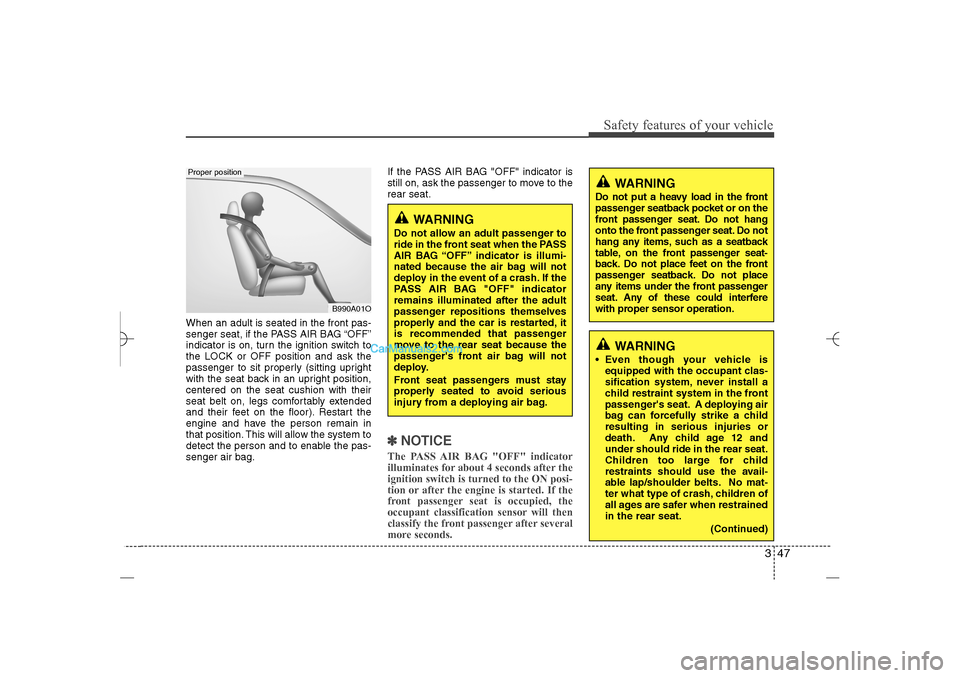
When an adult is seated in the front pas-
senger seat, if the PASS AIR BAG “OFF”
indicator is on, turn the ignition switch to
the LOCK or OFF position and ask the
passenger to sit properly (sitting upright
with the seat back in an upright position,
centered on the seat cushion with their
seat belt on, legs comfortably extended
and their feet on the floor). Restart the
engine and have the person remain in
that position. This will allow the system to
detect the person and to enable the pas-
senger air bag.If the PASS AIR BAG "OFF" indicator is
still on, ask the passenger to move to the
rear seat.
✽ ✽
NOTICEThe PASS AIR BAG "OFF" indicator
illuminates for about 4 seconds after the
ignition switch is turned to the ON posi-
tion or after the engine is started. If the
front passenger seat is occupied, the
occupant classification sensor will then
classify the front passenger after several
more seconds.
B990A01O
WARNING
Do not allow an adult passenger to
ride in the front seat when the PASS
AIR BAG “OFF” indicator is illumi-
nated because the air bag will not
deploy in the event of a crash. If the
PASS AIR BAG "OFF" indicator
remains illuminated after the adult
passenger repositions themselves
properly and the car is restarted, it
is recommended that passenger
move to the rear seat because the
passenger's front air bag will not
deploy.
Front seat passengers must stay
properly seated to avoid serious
injury from a deploying air bag.
Proper position
WARNING
Do not put a heavy load in the front
passenger seatback pocket or on the
front passenger seat. Do not hang
onto the front passenger seat. Do not
hang any items, such as a seatback
table, on the front passenger seat-
back. Do not place feet on the front
passenger seatback. Do not place
any items under the front passenger
seat. Any of these could interfere
with proper sensor operation.
WARNING
Even though your vehicle is
equipped with the occupant clas-
sification system, never install a
child restraint system in the front
passenger's seat. A deploying air
bag can forcefully strike a child
resulting in serious injuries or
death. Any child age 12 and
under should ride in the rear seat.
Children too large for child
restraints should use the avail-
able lap/shoulder belts. No mat-
ter what type of crash, children of
all ages are safer when restrained
in the rear seat.
(Continued)
YF HMA 3.qxp 5/16/2011 4:15 PM Page 47
Page 66 of 410
Safety features of your vehicle48 3
(Continued)
Do not place an electronic device
such as a laptop computer on the
front passenger seat. Its elec-
tronic field may cause the OCS to
switch to the "on" condition and
thus allow the passenger air bag
to deploy needlessly in a colli-
sion, increasing your repair
costs.
A smaller-stature adult in the
front passenger’ seat who is not
seated correctly (for example:
seat excessively reclined, leaning
on the door or center console, or
hips shifted forward in the seat)
can cause a condition where the
occupant classification system
senses less weight than if the
occupant were seated properly
(sitting upright with the seatback
in an upright position, centered
on the seat cushion with their
seat belt on, legs comfortably
extended and their feet on the
floor).
This condition can result in an
adult potentially being misclassi-
fied as a child and illumination of
the PASS AIR BAG "OFF" indica-
tor.
(Continued)
Accident statistics show that
children are safer if they are
restrained in the rear, as opposed
to the front seat. It is recom-
mended that child restraints be
secured in a rear seat, including
an infant riding in a rear-facing
infant seat, a child riding in a for-
ward-facing child seat and an
older child riding in a booster
seat.
Air bags can only be used once –
have an authorized HYUNDAI
dealer replace the air bag imme-
diately after deployment.
The occupant classification sys-
tem may not work properly if
water, coffee or any other liquid
including rain gets on the seat.
Keep the front seat dry at all
times.
(Continued)
If the PASS AIR BAG "OFF" indi-
cator is illuminated when the
front passenger's seat is occu-
pied by an adult and he/she sits
properly (sitting upright with the
seatback in an upright position,
centered on the seat cushion
with their seat belt on, legs com-
fortably extended and their feet
on the floor), have that person sit
in the rear seat.
Do not modify or replace the front
passenger seat. Don't place any-
thing on or attach anything such
as a blanket or seat heater to the
front passenger seat. This can
adversely affect the occupant
classification system.
Do not sit on sharp objects such
as tools when occupying the
front passenger seat. This can
adversely affect the occupant
classification system.
Do not use accessory seat cov-
ers on the front seats.
(Continued)
YF HMA 3.qxp 5/16/2011 4:15 PM Page 48