Wheels Hyundai Sonata 2013 Owner's Guide
[x] Cancel search | Manufacturer: HYUNDAI, Model Year: 2013, Model line: Sonata, Model: Hyundai Sonata 2013Pages: 410, PDF Size: 35.93 MB
Page 357 of 410
Maintenance42 7Compact spare tire replacement A compact spare tire has a shorter
tread life than a regular size tire.
Replace it when you can see the
tread wear indicator bars on the tire.
The replacement compact spare tire
should be the same size and design
tire as the one provided with your
new vehicle and should be mounted
on the same compact spare tire
wheel. The compact spare tire is not
designed to be mounted on a regular
size wheel, and the compact spare
tire wheel is not designed for mount-
ing a regular size tire.Wheel replacement
When replacing the metal wheels for
any reason, make sure the new
wheels are equivalent to the original
factory units in diameter, rim width
and offset.Tire traction
Tire traction can be reduced if you
drive on worn tires, tires that are
improperly inflated or on slippery
road surfaces. Tires should be
replaced when tread wear indicators
appear. To reduce the possibility of
losing control, slow down whenever
there is rain, snow or ice on the road.
Tire maintenance
In addition to proper inflation, correct
wheel alignment helps to decrease
tire wear. If you find a tire is worn
unevenly, have your dealer check the
wheel alignment.
When you have new tires installed,
make sure they are balanced. This
will increase vehicle ride comfort and
tire life. Additionally, a tire should
always be rebalanced if it is removed
from the wheel.
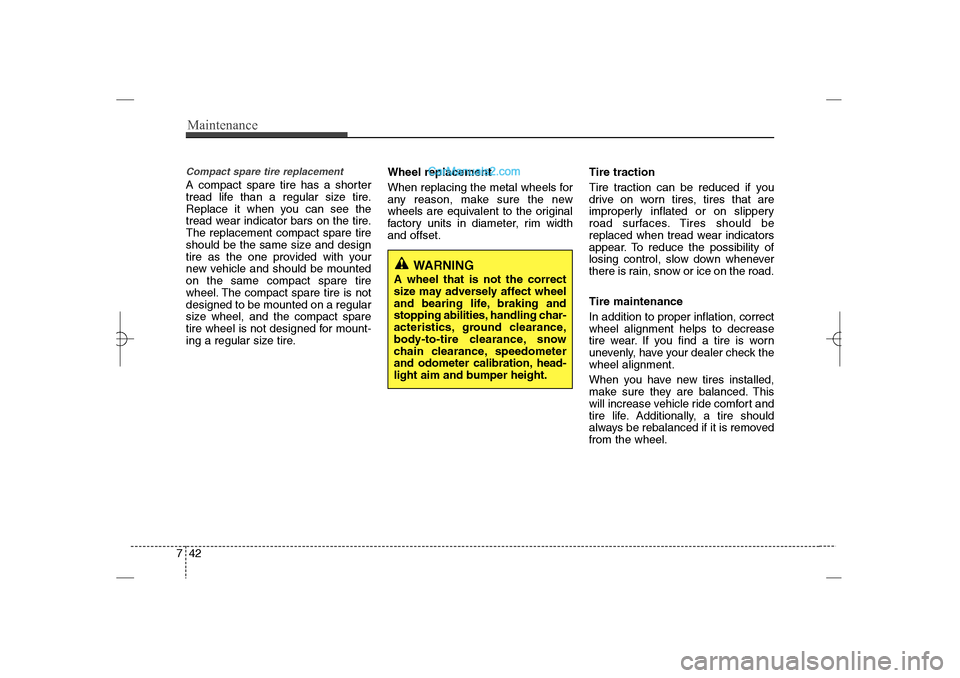
WARNING
A wheel that is not the correct
size may adversely affect wheel
and bearing life, braking and
stopping abilities, handling char-
acteristics, ground clearance,
body-to-tire clearance, snow
chain clearance, speedometer
and odometer calibration, head-
light aim and bumper height.
YF HMA 7.qxp 1/16/2012 6:19 PM Page 42
Page 358 of 410
743
Maintenance
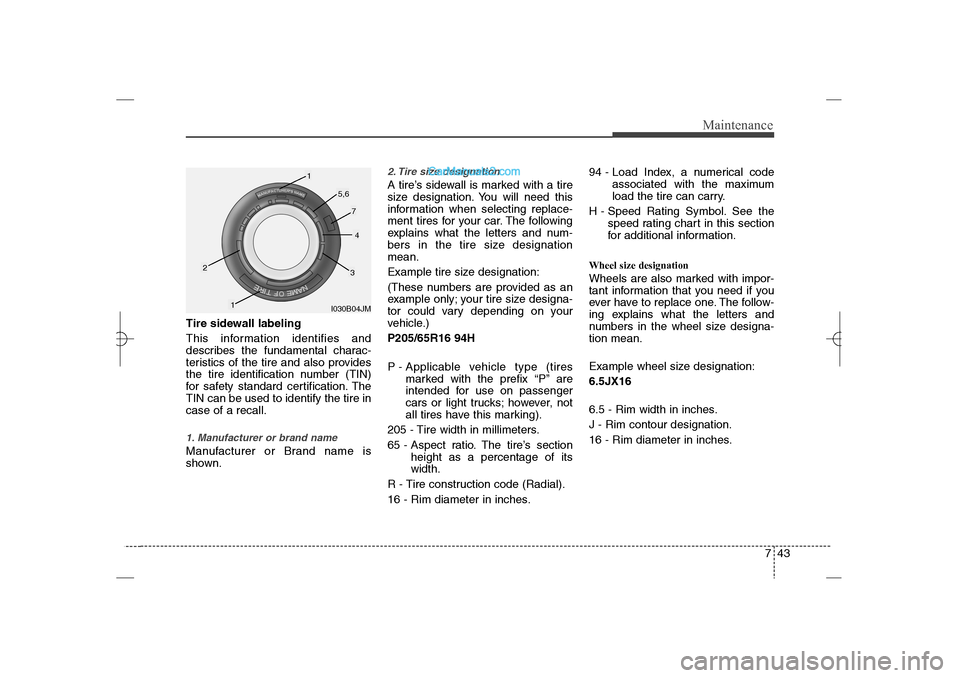
Tire sidewall labeling
This information identifies and
describes the fundamental charac-
teristics of the tire and also provides
the tire identification number (TIN)
for safety standard certification. The
TIN can be used to identify the tire in
case of a recall.1. Manufacturer or brand nameManufacturer or Brand name is
shown.
2. Tire size designation A tire’s sidewall is marked with a tire
size designation. You will need this
information when selecting replace-
ment tires for your car. The following
explains what the letters and num-
bers in the tire size designation
mean.
Example tire size designation:
(These numbers are provided as an
example only; your tire size designa-
tor could vary depending on your
vehicle.)
P205/65R16 94H
P - Applicable vehicle type (tires
marked with the prefix “P’’ are
intended for use on passenger
cars or light trucks; however, not
all tires have this marking).
205 - Tire width in millimeters.
65 - Aspect ratio. The tire’s section
height as a percentage of its
width.
R - Tire construction code (Radial).
16 - Rim diameter in inches.94 - Load Index, a numerical code
associated with the maximum
load the tire can carry.
H - Speed Rating Symbol. See the
speed rating chart in this section
for additional information.
Wheel size designation Wheels are also marked with impor-
tant information that you need if you
ever have to replace one. The follow-
ing explains what the letters and
numbers in the wheel size designa-
tion mean.
Example wheel size designation:
6.5JX16
6.5 - Rim width in inches.
J - Rim contour designation.
16 - Rim diameter in inches.
I030B04JM
1
1
2
34
5,6
7
YF HMA 7.qxp 1/16/2012 6:19 PM Page 43
Page 363 of 410
Maintenance48 7Speed Rating: An alphanumeric
code assigned to a tire indicating the
maximum speed at which a tire can
operate.
Traction: The friction between the
tire and the road surface. The
amount of grip provided.
Tread: The portion of a tire that
comes into contact with the road.
Treadwear Indicators: Narrow
bands, sometimes called "wear
bars," that show across the tread of a
tire when only 2/32 inch of tread
remains.
UTQGS: Uniform Tire Quality
Grading Standards, a tire information
system that provides consumers with
ratings for a tire's traction, tempera-
ture and treadwear. Ratings are
determined by tire manufacturers
using government testing proce-
dures. The ratings are molded into
the sidewall of the tire.
Vehicle Capacity Weight: The num-
ber of designated seating positions
multiplied by 150 lbs. (68 kg) plus the
rated cargo and luggage load.Vehicle Maximum Load on the
Tire: Load on an individual tire due to
curb and accessory weight plus
maximum occupant and cargo
weight.
Vehicle Normal Load on the Tire:
Load on an individual tire that is
determined by distributing to each
axle its share of the curb weight,
accessory weight, and normal occu-
pant weight and dviding by 2.
Vehicle Placard: A label permanent-
ly attached to a vehicle showing the
original equipment tire size and rec-
ommended inflation pressure.
All season tires
HYUNDAI specifies all season tires
on some models to provide good
performance for use all year round,
including snowy and icy road condi-
tions. All season tires are identified
by ALL SEASON and/or M+S (Mud
and Snow) on the tire sidewall. Snow
tires have better snow traction than
all season tires and may be more
appropriate in some areas.Summer tires
HYUNDAI specifies summer tires on
some models to provide superior
performance on dry roads. Summer
tire performance is substantially
reduced in snow and ice. Summer
tires do not have the tire traction rat-
ing M+S (Mud and Snow) on the tire
side wall. if you plan to operate your
vehicle in snowy or icy conditions.
HYUNDAI recommends the use of
snow tires or all season tires on all
four wheels.
Snow tires
If you equip your car with snow tires,
they should be the same size and
have the same load capacity as the
original tires. Snow tires should be
installed on all four wheels; other-
wise, poor handling may result.
Snow tires should carry 4 psi (28
kPa) more air pressure than the
pressure recommended for the stan-
dard tires on the tire label on the dri-
ver's side of the center pillar, or up to
the maximum pressure shown on the
tire sidewall, whichever is less.
YF HMA 7.qxp 1/16/2012 6:19 PM Page 48
Page 364 of 410
749
Maintenance
Do not drive faster than 75 mph (120
km/h) when your car is equipped with
snow tires.
Tire chains
Tire chains, if necessary, should be
installed on the front wheels.
Be sure that the chains are installed
in accordance with the manufactur-
er's instructions.
To minimize tire and chain wear, do
not continue to use tire chains when
they are no longer needed.
Radial-ply tiresRadial-ply tires provide improved
tread life, road hazard resistance and
smoother high speed ride. The radi-
al-ply tires used on this vehicle are of
belted construction, and are selected
to complement the ride and handling
characteristics of your vehicle.
Radial-ply tires have the same load
carrying capacity, as bias-ply or bias
belted tires of the same size, and use
the same recommended inflation
pressure. Mixing of radial-ply tires
with bias-ply or bias belted tires is
not recommended. Any combina-
tions of radial-ply and bias-ply or bias
belted tires when used on the same
vehicle will seriously deteriorate
vehicle handling. The best rule to fol-
low is: Identical radial-ply tires should
always be used as a set of four.
Longer wearing tires can be more
susceptible to irregular tread wear. It
is very important to follow the tire
rotation interval shown in this section
to achieve the tread life potential of
these tires. Cuts and punctures in
radial-ply tires are repairable only in
the tread area, because of sidewall
flexing. Consult your tire dealer for
radial-ply tire repairs.
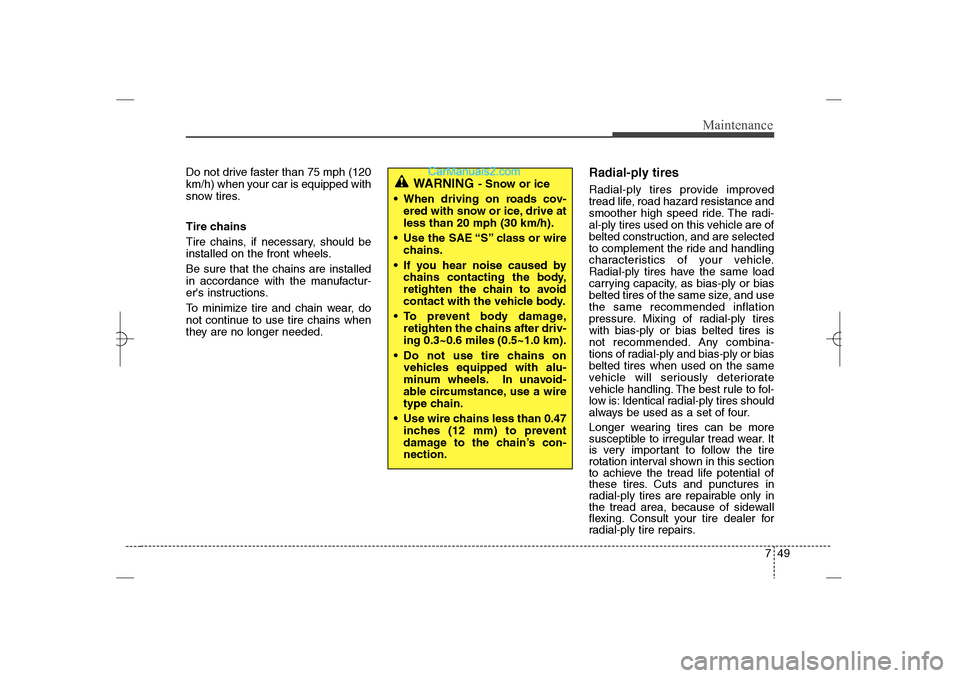
WARNING
- Snow or ice
When driving on roads cov-
ered with snow or ice, drive at
less than 20 mph (30 km/h).
Use the SAE “S” class or wire
chains.
If you hear noise caused by
chains contacting the body,
retighten the chain to avoid
contact with the vehicle body.
To prevent body damage,
retighten the chains after driv-
ing 0.3~0.6 miles (0.5~1.0 km).
Do not use tire chains on
vehicles equipped with alu-
minum wheels. In unavoid-
able circumstance, use a wire
type chain.
Use wire chains less than 0.47
inches (12 mm) to prevent
damage to the chain’s con-
nection.
YF HMA 7.qxp 1/16/2012 6:19 PM Page 49
Page 384 of 410
769
Maintenance
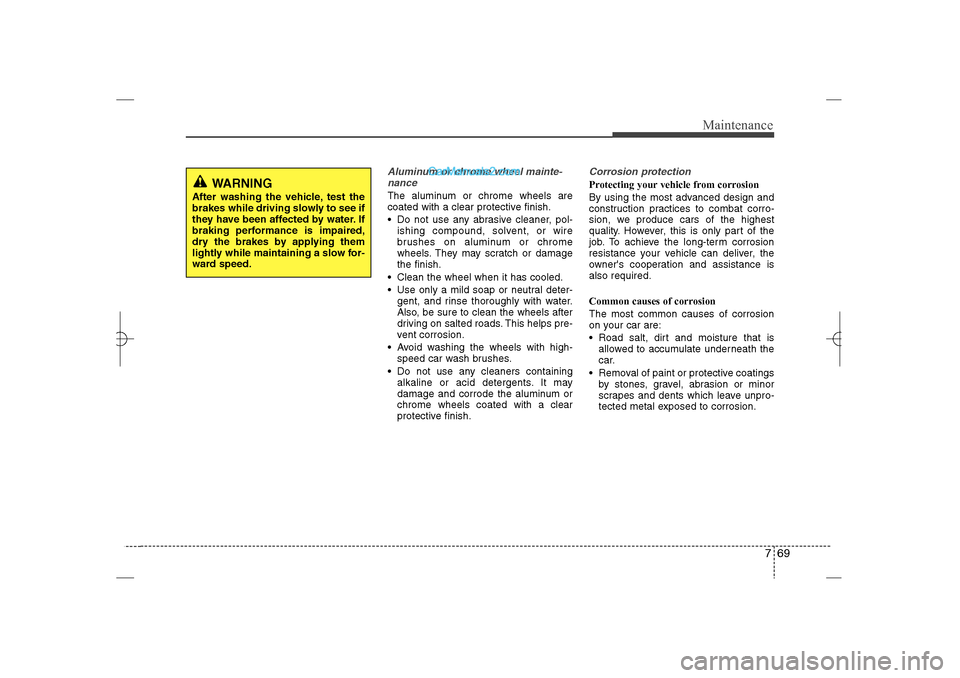
Aluminum or chrome wheel mainte-
nanceThe aluminum or chrome wheels are
coated with a clear protective finish.
Do not use any abrasive cleaner, pol-
ishing compound, solvent, or wire
brushes on aluminum or chrome
wheels. They may scratch or damage
the finish.
Clean the wheel when it has cooled.
Use only a mild soap or neutral deter-
gent, and rinse thoroughly with water.
Also, be sure to clean the wheels after
driving on salted roads. This helps pre-
vent corrosion.
Avoid washing the wheels with high-
speed car wash brushes.
Do not use any cleaners containing
alkaline or acid detergents. It may
damage and corrode the aluminum or
chrome wheels coated with a clear
protective finish.
Corrosion protectionProtecting your vehicle from corrosion
By using the most advanced design and
construction practices to combat corro-
sion, we produce cars of the highest
quality. However, this is only part of the
job. To achieve the long-term corrosion
resistance your vehicle can deliver, the
owner's cooperation and assistance is
also required.
Common causes of corrosion
The most common causes of corrosion
on your car are:
Road salt, dirt and moisture that is
allowed to accumulate underneath the
car.
Removal of paint or protective coatings
by stones, gravel, abrasion or minor
scrapes and dents which leave unpro-
tected metal exposed to corrosion.
WARNING
After washing the vehicle, test the
brakes while driving slowly to see if
they have been affected by water. If
braking performance is impaired,
dry the brakes by applying them
lightly while maintaining a slow for-
ward speed.
YF HMA 7.qxp 1/16/2012 6:21 PM Page 69
Page 392 of 410
8
Dimensions / 8-2
Bulb wattage / 8-2
Tires and wheels / 8-3
Recommended lubricants and capacities / 8-4
Vehicle identification number (VIN) / 8-6
Vehicle certification label / 8-6
Tire specification and pressure label / 8-7
Engine number / 8-7
Consumer information / 8-8
Reporting safety defects / 8-9
Binding arbitration / 8-9
Specifications, Consumer information,
Reporting safety defects
YF HMA 8.qxp 6/20/1999 12:27 PM Page 1
Page 394 of 410
83
Specifications, Consumer information, Reporting safety defects
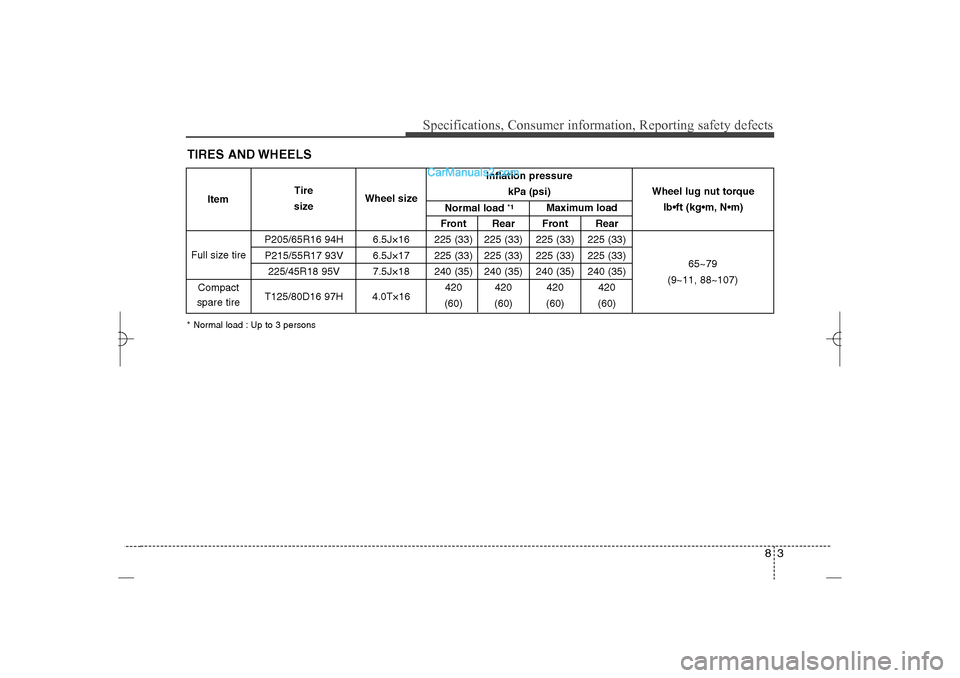
TIRES AND WHEELS* Normal load : Up to 3 persons
Inflation pressure
kPa (psi)
Front Rear Front Rear
P205/65R16 94H 6.5J×16 225 (33) 225 (33) 225 (33) 225 (33)
P215/55R17 93V 6.5J×17 225 (33) 225 (33) 225 (33) 225 (33)
225/45R18 95V 7.5J×18 240 (35) 240 (35) 240 (35) 240 (35)
T125/80D16 97H 4.0T×16420 420 420 420
(60) (60) (60) (60)
Full size tire
Compact
spare tireWheel lug nut torque
lb•ft (kgm, Nm)
65~79
(9~11, 88~107) ItemTire
sizeWheel size
Normal load
*1
Maximum load
YF HMA 8.qxp 6/20/1999 12:27 PM Page 3
Page 409 of 410
I9
Index
Sports mode ···································································5-17
Starting difficulties, see engine will not start ··················6-3
Starting the engine····················································5-6, 5-9
Steering wheel································································4-39
Horn···········································································4-40
Electric power steering··············································4-39
Tilt steering ·······························································4-39
Steering wheel audio control ·······································4-111
Storage compartment ···················································4-105
Center console storage ············································4-105
Glove box ································································4-105
Multi box ·································································4-106
Sunglass holder ·······················································4-106
Sunglass holder ····························································4-106
Sunroof···········································································4-32
Sunvisor ·······································································4-107
Tachometer·····································································4-51
Tether anchor system ·····················································3-33
Theft-alarm system ························································4-14
Tilt steering ····································································4-39
Tire specification and pressure label ·······························8-7
Tire chains······································································5-43
Tire pressure monitoring system (TPMS) ·······················6-7Tires and wheels ·····················································7-37, 8-3
Checking tire inflation pressure ································7-38
Compact spare tire replacement ································7-42
Recommended cold tire inflation pressures ··············7-37
Tire care·····································································7-37
Tire maintenance ·······················································7-42
Tire replacement ························································7-41
Tire rotation ·······························································7-39
Tire sidewall labeling ················································7-43
Tire traction ·······························································7-42
Wheel alignment and tire balance ·····························7-40
Wheel replacement ····················································7-42
Towing ···········································································6-20
Trailer towing ································································5-52
Transaxle
Automatic transaxle ··················································5-14
Manual transaxle ·······················································5-11
Trip computer ································································4-53
Trunk ··············································································4-22
Vehicle break-in process ··················································1-5
Vehicle certification label·······································5-49, 8-6
Vehicle data collection and event data
recorders (EDR) ··························································1-6
Vehicle identification number (VIN) ·······························8-6
Vehicle load limit ···························································5-46
Certification label ······················································5-49T
V
YF HMA INDEX.QXP 5/16/2011 5:52 PM Page 9