radiator cap Hyundai Sonata 2013
[x] Cancel search | Manufacturer: HYUNDAI, Model Year: 2013, Model line: Sonata, Model: Hyundai Sonata 2013Pages: 410, PDF Size: 35.93 MB
Page 341 of 410
Maintenance26 7
Changing the coolantHave coolant changed by an authorized
HYUNDAI dealer according to the
Maintenance Schedule at the beginning
of this section.
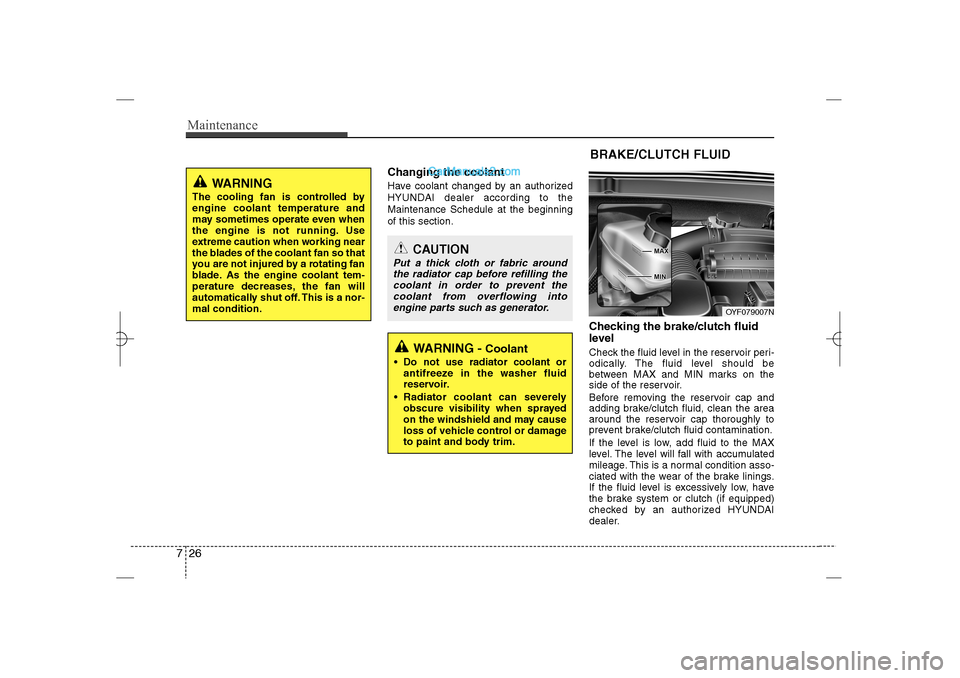
Checking the brake/clutch fluid
level Check the fluid level in the reservoir peri-
odically. The fluid level should be
between MAX and MIN marks on the
side of the reservoir.
Before removing the reservoir cap and
adding brake/clutch fluid, clean the area
around the reservoir cap thoroughly to
prevent brake/clutch fluid contamination.
If the level is low, add fluid to the MAX
level. The level will fall with accumulated
mileage. This is a normal condition asso-
ciated with the wear of the brake linings.
If the fluid level is excessively low, have
the brake system or clutch (if equipped)
checked by an authorized HYUNDAI
dealer.
OYF079007N
BRAKE/CLUTCH FLUID
WARNING -
Coolant
Do not use radiator coolant or
antifreeze in the washer fluid
reservoir.
Radiator coolant can severely
obscure visibility when sprayed
on the windshield and may cause
loss of vehicle control or damage
to paint and body trim.
CAUTION
Put a thick cloth or fabric around
the radiator cap before refilling the
coolant in order to prevent the
coolant from overflowing into
engine parts such as generator.
WARNING
The cooling fan is controlled by
engine coolant temperature and
may sometimes operate even when
the engine is not running. Use
extreme caution when working near
the blades of the coolant fan so that
you are not injured by a rotating fan
blade. As the engine coolant tem-
perature decreases, the fan will
automatically shut off. This is a nor-
mal condition.
YF HMA 7.qxp 1/16/2012 6:18 PM Page 26
Page 395 of 410
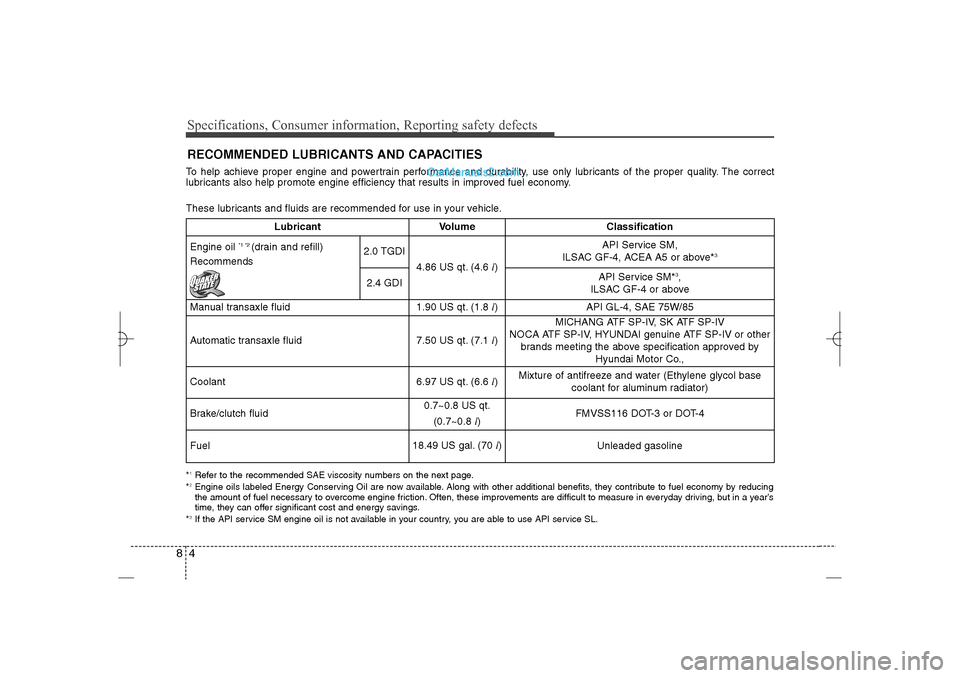
Specifications, Consumer information, Reporting safety defects4 8RECOMMENDED LUBRICANTS AND CAPACITIES To help achieve proper engine and powertrain performance and durability, use only lubricants of the proper quality. The correct
lubricants also help promote engine efficiency that results in improved fuel economy.These lubricants and fluids are recommended for use in your vehicle.*1Refer to the recommended SAE viscosity numbers on the next page.
*2Engine oils labeled Energy Conserving Oil are now available. Along with other additional benefits, they contribute to fuel economy by reducing
the amount of fuel necessary to overcome engine friction. Often, these improvements are difficult to measure in everyday driving, but in a year’s
time, they can offer significant cost and energy savings.
*3If the API service SM engine oil is not available in your country, you are able to use API service SL.
Lubricant
Volume
Classification
Engine oil
*1 *2
(drain and refill)
Recommends
2.0 TGDI
4.86 US qt. (4.6 l)
API Service SM,
ILSAC GF-4, ACEA A5 or above*
3
2.4 GDI
API Service SM*
3,
ILSAC GF-4 or above
Manual transaxle fluid
1.90 US qt. (1.8 l)
API GL-4, SAE 75W/85
Automatic transaxle fluid
7.50 US qt. (7.1 l)
MICHANG ATF SP-IV, SK ATF SP-IV
NOCA ATF SP-IV, HYUNDAI genuine ATF SP-IV or other
brands meeting the above specification approved by
Hyundai Motor Co.,
Coolant
6.97 US qt. (6.6 l)
Mixture of antifreeze and water (Ethylene glycol base
coolant for aluminum radiator)
Brake/clutch fluid
0.7~0.8 US qt.
(0.7~0.8 l)
FMVSS116 DOT-3 or DOT-4
Fuel
18.49 US gal. (70 l)
Unleaded gasoline
YF HMA 8.qxp 6/20/1999 12:27 PM Page 4