warning Hyundai Sonata 2014 Owner's Manual
[x] Cancel search | Manufacturer: HYUNDAI, Model Year: 2014, Model line: Sonata, Model: Hyundai Sonata 2014Pages: 665, PDF Size: 17.43 MB
Page 3 of 665
F3
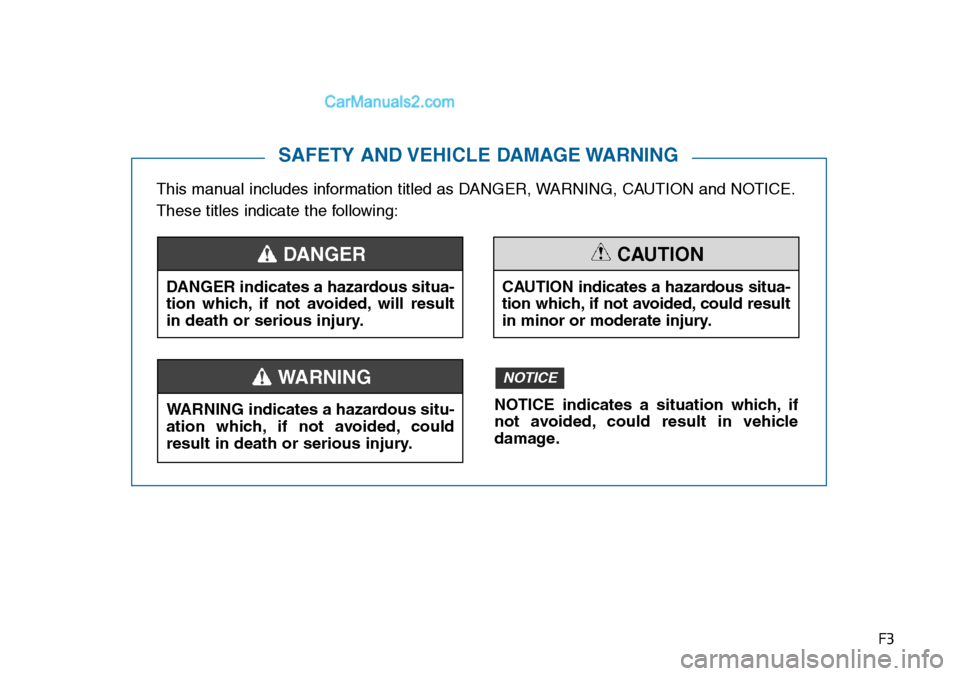
This manual includes information titled as DANGER, WARNING, CAUTION and NOTICE.
These titles indicate the following:
SAFETY AND VEHICLE DAMAGE WARNING
DANGER indicates a hazardous situa-
tion which, if not avoided, will result
in death or serious injury.
DANGER
WARNING indicates a hazardous situ-
ation which, if not avoided, could
result in death or serious injury.
CAUTION indicates a hazardous situa-
tion which, if not avoided, could result
in minor or moderate injury.
CAUTION
NOTICE indicates a situation which, if
not avoided, could result in vehicle
damage.
NOTICEWARNING
Page 5 of 665
We want to help you get the greatest
possible driving pleasure from your
vehicle. Your Owner’s Manual can
assist you in many ways. We strong-
ly recommend that you read the
entire manual. In order to minimize
the chance of death or injury, you
must read the WARNING and CAU-
TION sections in the manual.
Illustrations complement the words
in this manual to best explain how to
enjoy your vehicle. By reading your
manual, you will learn about fea-
tures, important safety information,
and driving tips under various road
conditions.
The general layout of the manual is
provided in the Table of Contents.
Use the index when looking for a
specific area or subject; it has an
alphabetical listing of all information
in your manual.
Sections: This manual has eight
chapters plus an index. Each section
begins with a brief list of contents so
you can tell at a glance if that section
has the information you want.
Yo u r s a f e t y, a n d t h e s a f e t y o f o t h e r s ,
is very important. This Owner's
Manual provides you with many safe-
ty precautions and operating proce-
dures. This information alerts you to
potential hazards that may hurt you
or others, as well as damage to your
vehicle.
Safety messages found on vehicle
labels and in this manual describe
these hazards and what to do to
avoid or reduce the risks.
War nings and instr uctions contained
in this manual are for your safety.
Failure to follow safety warnings and
instructions can lead to serious injury
or death.
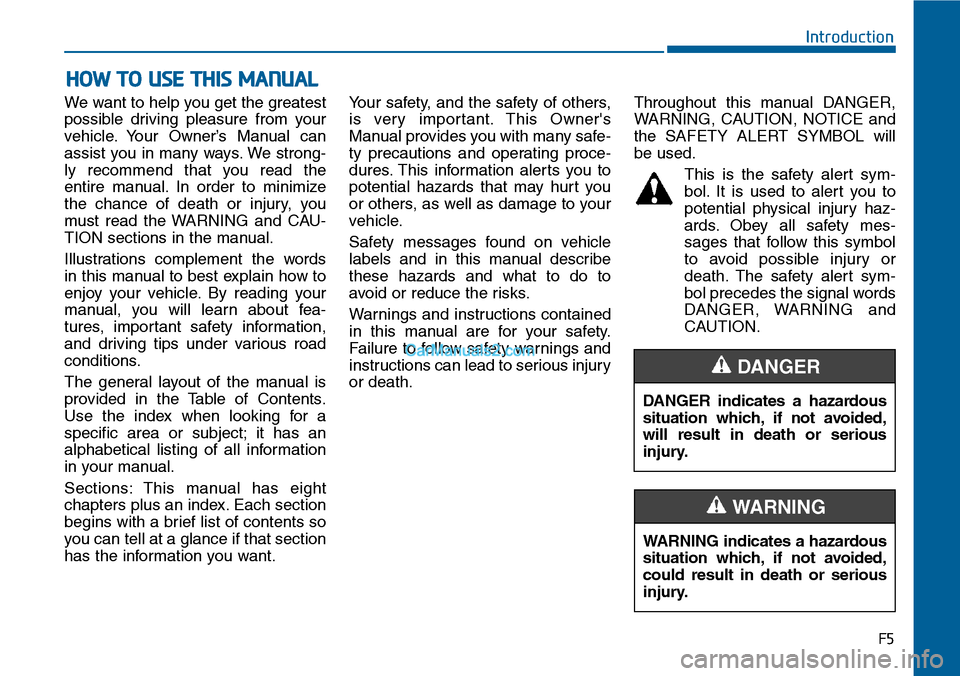
Throughout this manual DANGER,
WARNING, CAUTION, NOTICE and
the SAFETY ALERT SYMBOL will
be used.
This is the safety alert sym-
bol. It is used to alert you to
potential physical injury haz-
ards. Obey all safety mes-
sages that follow this symbol
to avoid possible injury or
death. The safety alert sym-
bol precedes the signal words
DANGER, WARNING and
CAUTION.
HOW TO USE THIS MANUAL
F5
Introduction
DANGER indicates a hazardous
situation which, if not avoided,
will result in death or serious
injury.
DANGER
WA R N I N G i n d i c a t e s a h a z a rd o u s
situation which, if not avoided,
could result in death or serious
injury.
WARNING
Page 6 of 665
F6
Introduction
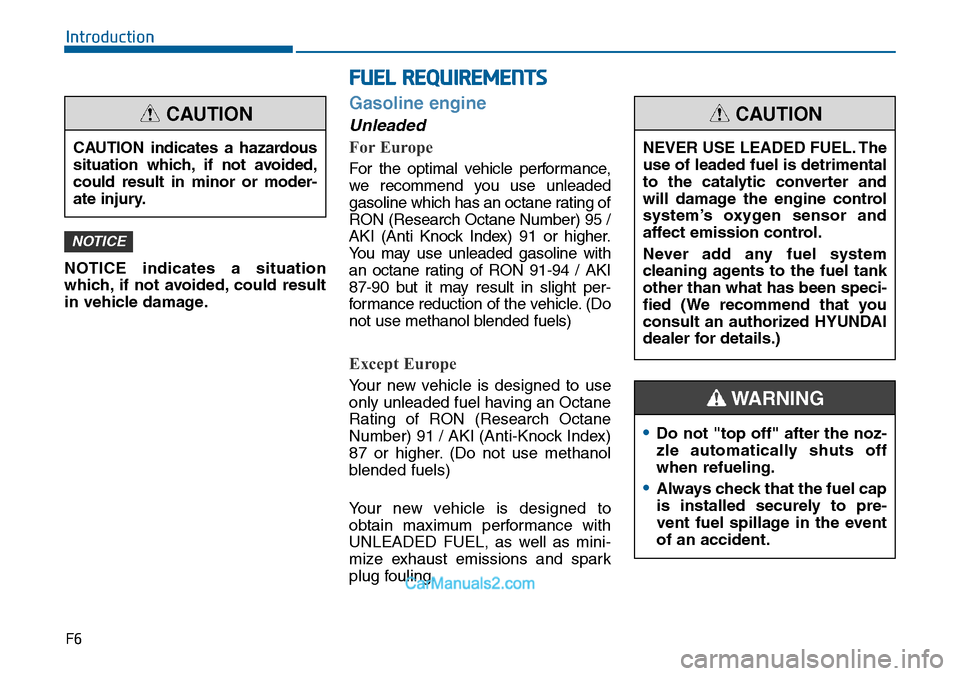
NOTICE indicates a situation
which, if not avoided, could result
in vehicle damage.
Gasoline engine
Unleaded
For Europe
For the optimal vehicle perfor mance,
we recommend you use unleaded
gasoline which has an octane rating of
RON (Research Octane Number) 95 /
AKI (Anti Knock Index) 91 or higher.
Yo u m a y u s e u n l e a d e d g a s o l i n e w i t h
an octane rating of RON 91-94 / AKI
87-90 but it may result in slight per-
for mance reduction of the vehicle. (Do
not use methanol blended fuels)
Except Europe
Yo u r n e w v e h i c l e i s d e s i g n e d t o u s e
only unleaded fuel having an Octane
Rating of RON (Research Octane
Number) 91 / AKI (Anti-Knock Index)
87 or higher. (Do not use methanol
blended fuels)
Yo u r n e w v e h i c l e i s d e s i g n e d t o
obtain maximum performance with
UNLEADED FUEL, as well as mini-
mize exhaust emissions and spark
plug fouling.
NOTICE
•Do not "top off" after the noz-
zle automatically shuts off
when refueling.
•Always check that the fuel cap
is installed securely to pre-
vent fuel spillage in the event
of an accident.
WARNING
NEVER USE LEADED FUEL. The
use of leaded fuel is detrimental
to the catalytic converter and
will damage the engine control
system’s oxygen sensor and
affect emission control.
Never add any fuel system
cleaning agents to the fuel tank
other than what has been speci-
fied (We recommend that you
consult an authorized HYUNDAI
dealer for details.)
CAUTION
CAUTION indicates a hazardous
situation which, if not avoided,
could result in minor or moder-
ate injury.
CAUTION
FUEL REQUIREMENTS
Page 12 of 665
F12F12
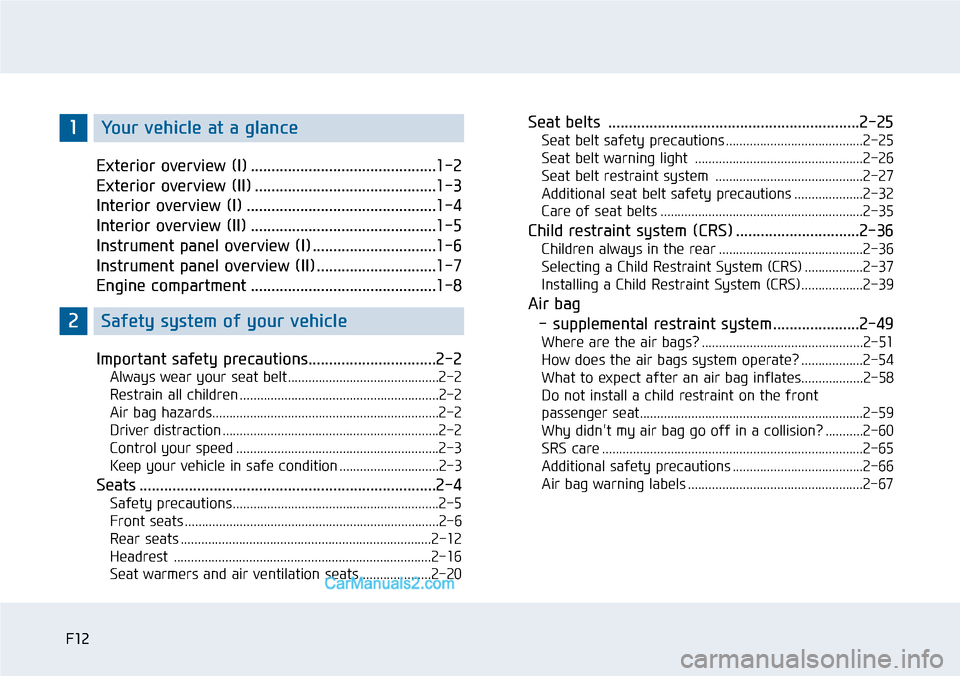
Exterior overview (I) .............................................1-2
Exterior overview (II) ............................................1-3
Interior overview (I) ..............................................1-4
Interior overview (II) .............................................1-5
Instrument panel overview (I) ..............................1-6
Instrument panel overview (II) .............................1-7
Engine compartment .............................................1-8
Important safety precautions...............................2-2
Always wear your seat belt............................................2-2
Restrain all children ..........................................................2-2
Air bag hazards..................................................................2-2
Driver distraction ...............................................................2-2
Control your speed ...........................................................2-3
Keep your vehicle in safe condition .............................2-3
Seats ........................................................................2-4
Safety precautions............................................................2-5
Front seats ..........................................................................2-6
Rear seats .........................................................................2-12
Headrest ...........................................................................2-16
Seat warmers and air ventilation seats.....................2-20
Seat belts .............................................................2-25
Seat belt safety precautions ........................................2-25
Seat belt warning light .................................................2-26
Seat belt restraint system ...........................................2-27
Additional seat belt safety precautions ....................2-32
Care of seat belts ...........................................................2-35
Child restraint system (CRS) ..............................2-36
Children always in the rear ..........................................2-36
Selecting a Child Restraint System (CRS) .................2-37
Installing a Child Restraint System (CRS)..................2-39
Air bag
- supplemental restraint system.....................2-49
Where are the air bags? ...............................................2-51
How does the air bags system operate? ..................2-54
What to expect after an air bag inflates..................2-58
Do not install a child restraint on the front
passenger seat.................................................................2-59
Why didn't my air bag go off in a collision? ...........2-60
SRS care ............................................................................2-65
Additional safety precautions ......................................2-66
Air bag warning labels ...................................................2-67
1Your vehicle at a glance
2Safety system of your vehicle
Page 14 of 665
F14F14
LCD display ...........................................................3-66
LCD modes ........................................................................3-66
Tr i p c o m p u t e r m o d e . . . . . . . . . . . . . . . . . . . . . . . . . . . . . . . . . . . . . . . . . . . . . . . . . . . . . . . 3 - 6 7
Tu r n B y Tu r n ( T B T ) m o d e . . . . . . . . . . . . . . . . . . . . . . . . . . . . . . . . . . . . . . . . . . . . . 3 - 6 8
A/V mode ..........................................................................3-68
Information mode ............................................................3-68
User settings mode.........................................................3-70
Warning messages ..........................................................3-75
Tr i p c o m p u t e r . . . . . . . . . . . . . . . . . . . . . . . . . . . . . . . . . . . . . . . . . . . . . . . . . . . . . . . 3 - 8 3
Overview............................................................................3-83
Tr i p m o d e s . . . . . . . . . . . . . . . . . . . . . . . . . . . . . . . . . . . . . . . . . . . . . . . . . . . . . . . . . . . . . . . . . . . . . . . . 3 - 8 3
Tr i p A / B . . . . . . . . . . . . . . . . . . . . . . . . . . . . . . . . . . . . . . . . . . . . . . . . . . . . . . . . . . . . . . . . . . . . . . . . . . . . . 3 - 8 3
Fuel economy ...................................................................3-84
Warning and indicator lights ..............................3-87
Warning lights ..................................................................3-87
Indicator lights .................................................................3-94
Light .......................................................................3-98
Exterior lights ..................................................................3-98
Welcome system ...........................................................3-105
Interior lights..................................................................3-106
Wipers and washers ..........................................3-111
Windshield wipers ........................................................3-111
Windshield washers ....................................................3-113
Driver assist system ..........................................3-115
Rear view camera .........................................................3-115
Rear parking assist system ........................................3-116
Parking assist system ..................................................3-119
Defroster .............................................................3-122
Rear window defroster ...............................................3-122
Manual climate control system........................3-124
Heating and air conditioning......................................3-125
System operation ..........................................................3-130
System maintenance ....................................................3-132
Checking the amount of air conditioner refrigerant and
compressor lubricant ...................................................3-133
Automatic climate control system ...................3-134
Automatic heating and air conditioning ..................3-135
Manual heating and air conditioning .......................3-136
System operation ..........................................................3-142
System maintenance ....................................................3-145
Checking the amount of air conditioner refrigerant and
compressor lubricant ...................................................3-145
Windshield defrosting and defogging ............3-146
Manual climate control system .................................3-146
Automatic climate control system ............................3-147
Defogging logic..............................................................3-148
Page 18 of 665
F18
Vehicle weight ......................................................5-85
Overloading.......................................................................5-85
Hazard warning flasher ........................................6-2
In case of an emergency while driving ..............6-2
If the engine stalls while driving ...................................6-2
If the engine stalls at a crossroad or crossing .........6-3
If you have a flat tire while driving..............................6-3
If the engine will not start ...................................6-4
If the engine doesn't turn over or turns over
slowly....................................................................................6-4
If the engine turns over normally but doesn't
start.......................................................................................6-4
Jump starting ..........................................................6-4
If the engine overheats ........................................6-8
If you have a flat tire............................................6-9
Jack and tools ..................................................................6-10
Changing tires ..................................................................6-11
Jack label ...........................................................................6-17
EC Declaration of conformity for Jack......................6-18
To w i n g . . . . . . . . . . . . . . . . . . . . . . . . . . . . . . . . . . . . . . . . . . . . . . . . . . . . . . . . . . . . . . . . . . . 6 - 1 9
Towing service .................................................................6-19
Removable towing hook ................................................6-20
Emergency towing ..........................................................6-21
F18
6What to do in an emergency
Page 30 of 665
Safety system of your vehicle
2
Important safety precautions...............................2-2
Always wear your seat belt............................................2-2
Restrain all children ..........................................................2-2
Air bag hazards..................................................................2-2
Driver distraction ...............................................................2-2
Control your speed ...........................................................2-3
Keep your vehicle in safe condition .............................2-3
Seats ........................................................................2-4
Safety precautions............................................................2-5
Front seats ..........................................................................2-6
Rear seats .........................................................................2-12
Headrest ...........................................................................2-16
Seat warmers and air ventilation seats.....................2-20
Seat belts .............................................................2-25
Seat belt safety precautions ........................................2-25
Seat belt warning light .................................................2-26
Seat belt restraint system ...........................................2-27
Additional seat belt safety precautions ....................2-32
Care of seat belts ...........................................................2-35
Child restraint system (CRS) ..............................2-36
Children always in the rear ..........................................2-36
Selecting a Child Restraint System (CRS) .................2-37
Installing a Child Restraint System (CRS)..................2-39
Air bag
- supplemental restraint system.....................2-49
Where are the air bags? ...............................................2-51
How does the air bags system operate? ..................2-54
What to expect after an air bag inflates..................2-58
Do not install a child restraint on the front
passenger seat.................................................................2-59
Why didn't my air bag go off in a collision? ...........2-60
SRS care ............................................................................2-65
Additional safety precautions ......................................2-66
Air bag warning labels ...................................................2-67
This chapter provides you with important information about how to protect yourself and your passengers.
It explains how to properly use your seats and seat belts, and how your air bags work.
Additionally, this chapter explains how to properly restrain infants and children in your vehicle.
Page 31 of 665
2-2
Yo u w i l l f i n d m a n y s a f e t y p r e c a u t i o n s
and recommendations throughout
this section, and throughout this man-
ual. The safety precautions in this sec-
tion are among the most important.
Always wear your seat belt
A seat belt is your best protection in
all types of accidents. Air bags are
designed to supplement seat belts,
not replace them. So even though
your vehicle is equipped with air bags,
ALWAYS make sure you and your
passengers wear your seat belts, and
wear them properly.
Restrain all children
All children under age 13 should ride
in your vehicle properly restrained in
a rear seat, not the front seat. Infants
and small children should be
restrained in an appropriate child
restraint. Larger children should use
a booster seat with the lap/shoulder
belt until they can use the seat belt
properly without a booster seat.
Air bag hazards
While air bags can save lives, they
can also cause serious or fatal
injuries to occupants who sit too
close to them, or who are not prop-
erly restrained. Infants, young chil-
dren, and short adults are at the
greatest risk of being injured by an
inflating air bag. Follow all instruc-
tions and warnings in this manual.
Driver distraction
Driver distraction presents a serious
and potentially deadly danger, espe-
cially for inexperienced drivers. Safety
should be the first concern when
behind the wheel and drivers need to
be aware of the wide array of potential
distractions, such as drowsiness,
reaching for objects, eating, personal
grooming, other passengers, and
using cellular phones.
Drivers can become distracted when
they take their eyes and attention off
the road or their hands off the wheel
to focus on activities other than driv-
ing. To reduce your risk of distraction
and an accident:
•ALWAYS set up your mobile devices
(i.e., MP3 players, phones, naviga-
tion units, etc.) when your vehicle is
parked or safely stopped.
•ONLY use your mobile device when
allowed by laws and conditions per-
mit safe use. NEVER text or email
while driving. Most countries have
laws prohibiting drivers from texting.
Some countries and cities also pro-
hibit drivers from using handheld
phones.
IMPORTANT SAFETY PRECAUTIONS
Safety system of your vehicle
Page 34 of 665
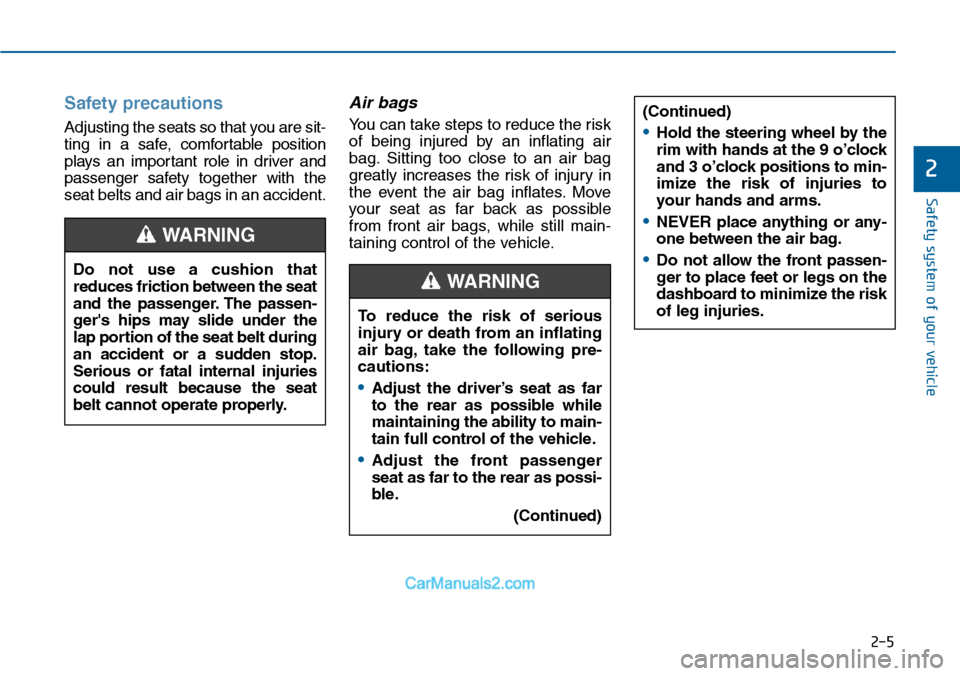
To reduce the risk of serious
injury or death from an inflating
air bag, take the following pre-
cautions:
•Adjust the driver’s seat as far
to the rear as possible while
maintaining the ability to main-
tain full control of the vehicle.
•Adjust the front passenger
seat as far to the rear as possi-
ble.
(Continued)
WARNING
(Continued)
•Hold the steering wheel by the
rim with hands at the 9 o’clock
and 3 o’clock positions to min-
imize the risk of injuries to
your hands and arms.
•NEVER place anything or any-
one between the air bag.
•Do not allow the front passen-
ger to place feet or legs on the
dashboard to minimize the risk
of leg injuries.
2-5
Safety system of your vehicle
2
Safety precautions
Adjusting the seats so that you are sit-
ting in a safe, comfortable position
plays an important role in driver and
passenger safety together with the
seat belts and air bags in an accident.
Air bags
Yo u c a n t a k e s t e p s t o r e d u c e t h e r i s k
of being injured by an inflating air
bag. Sitting too close to an air bag
greatly increases the risk of injury in
the event the air bag inflates. Move
your seat as far back as possible
from front air bags, while still main-
taining control of the vehicle.
Do not use a cushion that
reduces friction between the seat
and the passenger. The passen-
ger's hips may slide under the
lap portion of the seat belt during
an accident or a sudden stop.
Serious or fatal internal injuries
could result because the seat
belt cannot operate properly.
WARNING
Page 35 of 665
2-6
Safety system of your vehicle
Seat belts
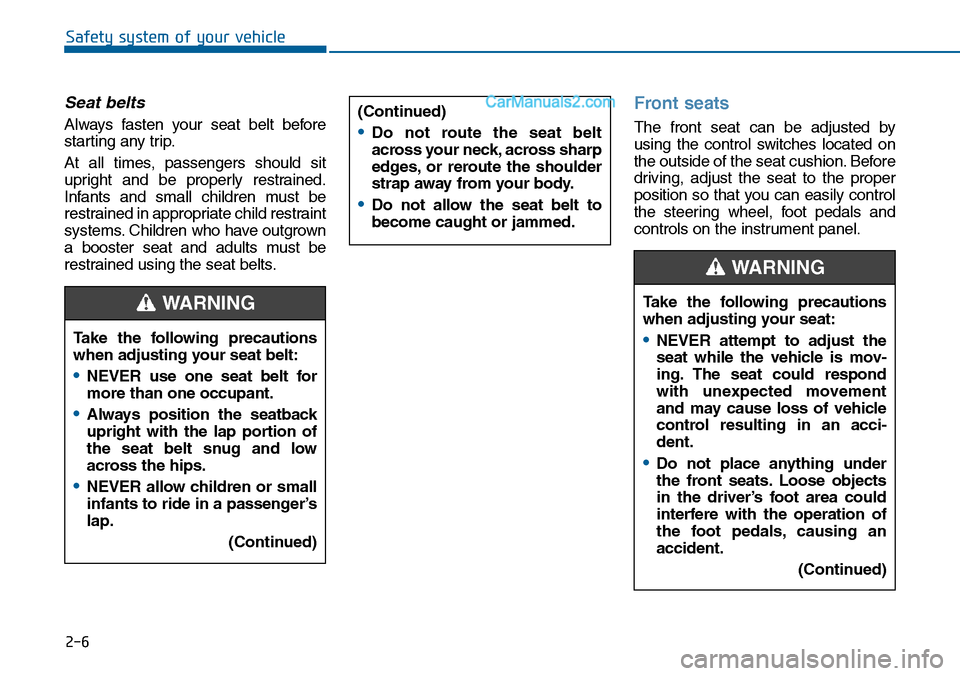
Always fasten your seat belt before
starting any trip.
At all times, passengers should sit
upright and be properly restrained.
Infants and small children must be
restrained in appropriate child restraint
systems. Children who have outgrown
a booster seat and adults must be
restrained using the seat belts.
Front seats
The front seat can be adjusted by
using the control switches located on
the outside of the seat cushion. Before
driving, adjust the seat to the proper
position so that you can easily control
the steering wheel, foot pedals and
controls on the instrument panel.
Ta k e t h e f o l l o w i n g p r e c a u t i o n s
when adjusting your seat belt:
•NEVER use one seat belt for
more than one occupant.
•Always position the seatback
upright with the lap portion of
the seat belt snug and low
across the hips.
•NEVER allow children or small
infants to ride in a passenger’s
lap.
(Continued)
(Continued)
•Do not route the seat belt
across your neck, across sharp
edges, or reroute the shoulder
strap away from your body.
•Do not allow the seat belt to
become caught or jammed.
WARNING Ta k e t h e f o l l o w i n g p r e c a u t i o n s
when adjusting your seat:
•NEVER attempt to adjust the
seat while the vehicle is mov-
ing. The seat could respond
with unexpected movement
and may cause loss of vehicle
control resulting in an acci-
dent.
•Do not place anything under
the front seats. Loose objects
in the driver’s foot area could
interfere with the operation of
the foot pedals, causing an
accident.
(Continued)
WARNING