brake Hyundai Sonata 2014 Owner's Manual
[x] Cancel search | Manufacturer: HYUNDAI, Model Year: 2014, Model line: Sonata, Model: Hyundai Sonata 2014Pages: 665, PDF Size: 17.43 MB
Page 590 of 665

7-33
7
Maintenance
BRAKE/CLUTCH FLUID (IF EQUIPPED)
Checking the brake/clutch
fluid level
Check the fluid level in the reservoir
periodically. The fluid level should be
between MAX and MIN marks on the
side of the reservoir.
Before removing the reservoir cap
and adding brake/clutch fluid, clean
the area around the reservoir cap
thoroughly to prevent brake/clutch
fluid contamination.
If the level is low, add fluid to the
MAX level. The level will fall with
accumulated mileage. This is a nor-
mal condition associated with the
wear of the brake linings.
If the fluid level is excessively low, we
recommend that the system be
checked by an authorized HYUNDAI
dealer.
Information
Use only the specified brake/clutch
fluid. (Refer to “Recommended
lubricants and capacities” in sec-
tion 8.)
Never mix different types of fluid.
Before removing the brake/clutch
filler cap, read the warning on the
cap.
NOTICE
i
OLF074008
In the event the brake/clutch
system requires frequent addi-
tions of fluid, we recommend
that the system be inspected by
an authorized HYUNDAI dealer.
WARNING
Clean filler cap before remov-
ing. Use only DOT3 or DOT4
brake/clutch fluid from a sealed
container.
WARNING
Page 591 of 665

7-34
Maintenance
When changing and adding
brake/clutch fluid, handle it
carefully. Do not let it come in
contact with your eyes. If brake/
clutch fluid should come in con-
tact with your eyes, immediately
flush them with a large quantity
of fresh tap water. Have your
eyes examined by a doctor as
soon as possible.
WARNING
Do not allow brake/clutch fluid
to contact the vehicle's body
paint, as paint damage will
result. Brake/clutch fluid, which
has been exposed to open air
for an extended time should
never be used as its quality can-
not be guaranteed. It should be
disposed of properly. Don't put
in the wrong kind of fluid.
A few drops of mineral-based
oil, such as engine oil, in your
brake/clutch system can dam-
age brake/clutch system parts.
CAUTION
Page 593 of 665

7-36
Maintenance
PARKING BRAKE
Checking the parking brake
Type A
Check whether the stroke is within
specification when the parking brake
pedal is depressed with 20 kg (44 lb,
196N) of force. Also, the parking
brake alone should securely hold the
vehicle on a fairly steep grade. If the
stroke is more or less than specified,
we recommend that the system be
serviced by an authorized HYUNDAI
dealer.
Stroke : 3 notch
Type B
Check the stroke of the parking
brake by counting the number of
“clicks’’ heard while fully applying it
from the released position. Also, the
parking brake alone should securely
hold the vehicle on a fairly steep
grade. If the stroke is more or less
than specified, we recommend that
the system be serviced by an author-
ized HYUNDAI dealer.
Stroke : 5~6 “clicks’’ at a force of
20 kg (44 lbs, 196 N).
ODH053142
OLF054047
Page 606 of 665

7-49
7
Maintenance
Tire rotation
To equalize tread wear, it is recom-
mended that the tires be rotated
ever y 12,000 km (7,500 miles) or
sooner if irregular wear develops.
During rotation, check the tires for
correct balance.
When rotating tires, check for uneven
wear and damage. Abnormal wear is
usually caused by incorrect tire pres-
sure, improper wheel alignment, out-
of-balance wheels, severe braking or
severe cornering. Look for bumps or
bulges in the tread or side of tire.
Replace the tire if you find either of
these conditions. Replace the tire if
fabric or cord is visible. After rotation,
be sure to bring the front and rear tire
pressures to specification and check
lug nut tightness.
Refer to “Tire and wheels” in section
8.
Disc brake pads should be inspected
for wear whenever tires are rotated.
Information
The outside and inside of the
unsymmetrical tire is distinguish-
able. When installing an unsym-
metrical tire, be sure to install the
side marked "outside" face the
outside. If the side marked
"inside" is installed on the out-
side, it will have a bad effect on
vehicle performance.
i
•Do not use the compact spare
tire for tire rotation.
•Do not mix bias ply and radial
ply tires under any circum-
stances. This may cause unusu-
al handling characteristics that
could result in death, severe
injury, or property damage.
WARNING ODH073802
■without a spare tire
Page 608 of 665
7-51
7
Maintenance
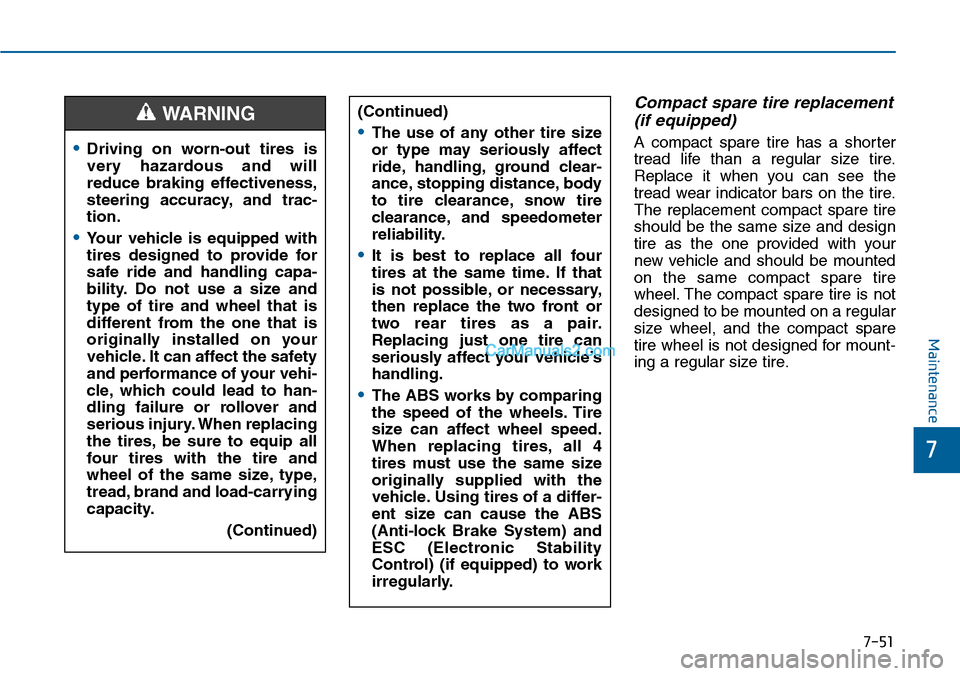
Compact spare tire replacement
(if equipped)
A compact spare tire has a shorter
tread life than a regular size tire.
Replace it when you can see the
tread wear indicator bars on the tire.
The replacement compact spare tire
should be the same size and design
tire as the one provided with your
new vehicle and should be mounted
on the same compact spare tire
wheel. The compact spare tire is not
designed to be mounted on a regular
size wheel, and the compact spare
tire wheel is not designed for mount-
ing a regular size tire.
(Continued)
•The use of any other tire size
or type may seriously affect
ride, handling, ground clear-
ance, stopping distance, body
to tire clearance, snow tire
clearance, and speedometer
reliability.
•It is best to replace all four
tires at the same time. If that
is not possible, or necessary,
then replace the two front or
two rear tires as a pair.
Replacing just one tire can
seriously affect your vehicle’s
handling.
•The ABS works by comparing
the speed of the wheels. Tire
size can affect wheel speed.
When replacing tires, all 4
tires must use the same size
originally supplied with the
vehicle. Using tires of a differ-
ent size can cause the ABS
(Anti-lock Brake System) and
ESC (Electronic Stability
Control) (if equipped) to work
irregularly.
•Driving on worn-out tires is
very hazardous and will
reduce braking effectiveness,
steering accuracy, and trac-
tion.
•Yo u r v e h i c l e i s e q u i p p e d w i t h
tires designed to provide for
safe ride and handling capa-
bility. Do not use a size and
type of tire and wheel that is
different from the one that is
originally installed on your
vehicle. It can affect the safety
and performance of your vehi-
cle, which could lead to han-
dling failure or rollover and
serious injury. When replacing
the tires, be sure to equip all
four tires with the tire and
wheel of the same size, type,
tread, brand and load-carrying
capacity.
(Continued)
WARNING
Page 622 of 665
7-65
7
Maintenance
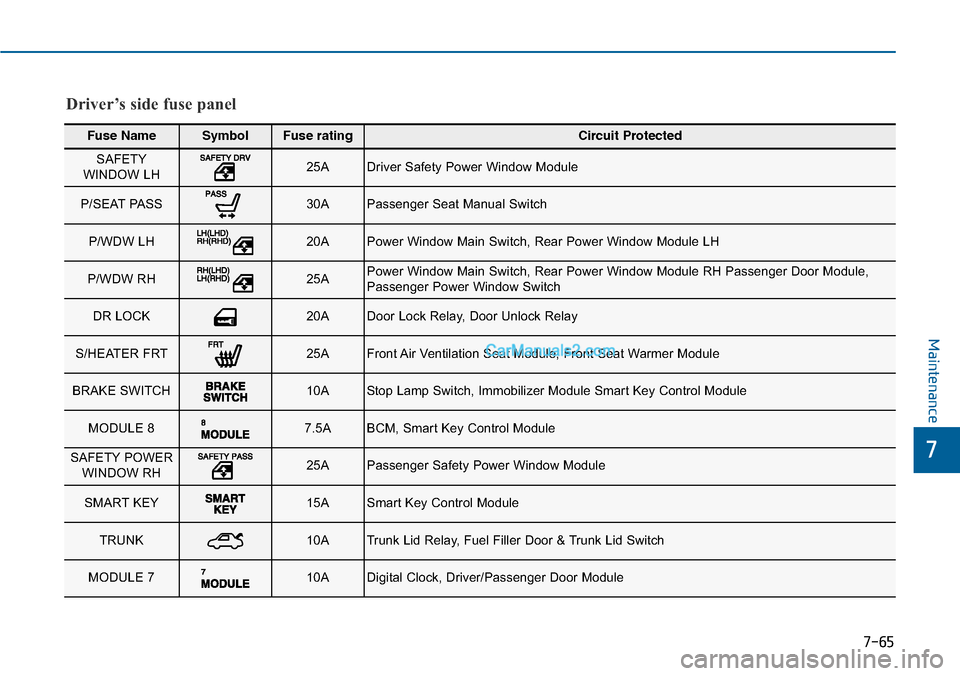
Fuse NameSymbolFuse ratingCircuit Protected
SAFETYWINDOW LH 25ADriver Safety Power Window Module
P/SEAT PASS 30APassenger Seat Manual Switch
P/WDW LH 20APower Window Main Switch, Rear Power Window Module LH
P/WDW RH 25APower Window Main Switch, Rear Power Window Module RH Passenger Door Module,Passenger Power Window Switch
DR LOCK 20ADoor Lock Relay, Door Unlock Relay
S/HEATER FRT25AFront Air Ventilation Seat Module, Front Seat Warmer Module
BRAKE SWITCH 10AStop Lamp Switch, Immobilizer Module Smart Key Control Module
MODULE 8 7.5ABCM, Smart Key Control Module
SAFETY POWERWINDOW RH 25APassenger Safety Power Window Module
SMART KEY15ASmart Key Control Module
TRUNK 10ATrunk Lid Relay, Fuel Filler Door & Trunk Lid Switch
MODULE 7 10ADigital Clock, Driver/Passenger Door Module
Driver’s side fuse panel
Page 629 of 665
7-72
Maintenance
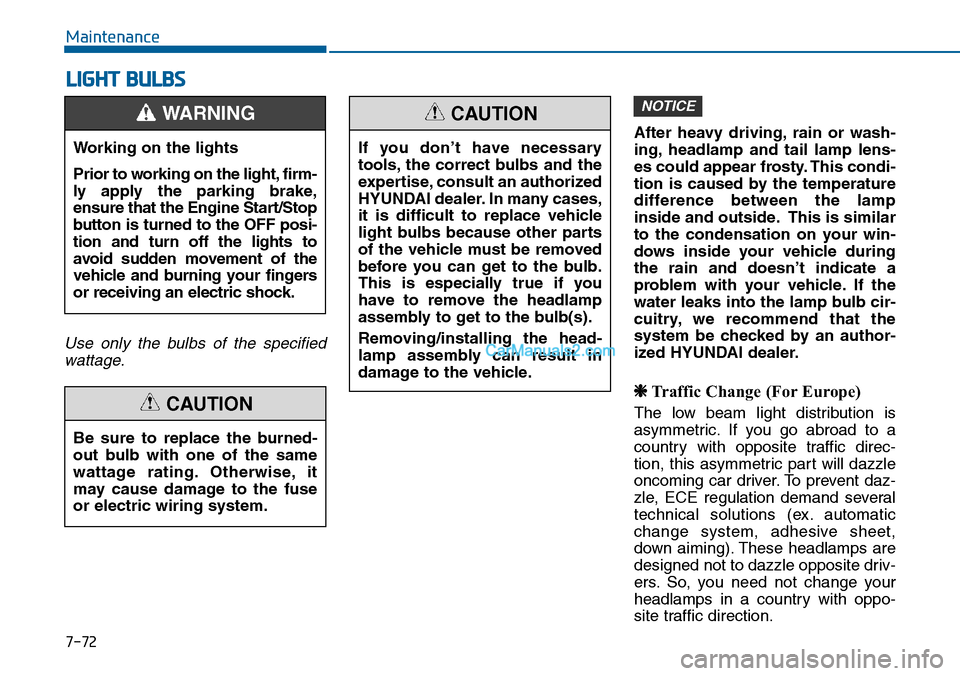
LIGHT BULBS
Use only the bulbs of the specified
wattage.
After heavy driving, rain or wash-
ing, headlamp and tail lamp lens-
es could appear frosty. This condi-
tion is caused by the temperature
difference between the lamp
inside and outside. This is similar
to the condensation on your win-
dows inside your vehicle during
the rain and doesn’t indicate a
problem with your vehicle. If the
water leaks into the lamp bulb cir-
cuitry, we recommend that the
system be checked by an author-
ized HYUNDAI dealer.
❈Traffic Change (For Europe)
The low beam light distribution is
asymmetric. If you go abroad to a
country with opposite traffic direc-
tion, this asymmetric part will dazzle
oncoming car driver. To prevent daz-
zle, ECE regulation demand several
technical solutions (ex. automatic
change system, adhesive sheet,
down aiming). These headlamps are
designed not to dazzle opposite driv-
ers. So, you need not change your
headlamps in a country with oppo-
site traffic direction.
NOTICE
Be sure to replace the burned-
out bulb with one of the same
wattage rating. Otherwise, it
may cause damage to the fuse
or electric wiring system.
CAUTION
If you don’t have necessary
tools, the correct bulbs and the
expertise, consult an authorized
HYUNDAI dealer. In many cases,
it is difficult to replace vehicle
light bulbs because other parts
of the vehicle must be removed
before you can get to the bulb.
This is especially true if you
have to remove the headlamp
assembly to get to the bulb(s).
Removing/installing the head-
lamp assembly can result in
damage to the vehicle.
CAUTION
Working on the lights
Prior to working on the light, firm-
ly apply the parking brake,
ensure that the Engine Start/Stop
button is turned to the OFF posi-
tion and turn off the lights to
avoid sudden movement of the
vehicle and burning your fingers
or receiving an electric shock.
WARNING
Page 645 of 665
7-88
Maintenance
Waxing
Wax the vehicle when water will no
longer bead on the paint.
Always wash and dry the vehicle
before waxing. Use a good quality
liquid or paste wax, and follow the
manufacturer’s instructions. Wax all
metal trim to protect it and to main-
tain its luster. Removing oil, tar, and
similar materials with a spot remover
will usually strip the wax from the fin-
ish. Be sure to re-wax these areas
even if the rest of the vehicle does
not yet need waxing.
Wet brakes
After washing the vehicle, test
the brakes while driving slowly
to see if they have been affected
by water. If braking performance
is impaired, dry the brakes by
applying them lightly while
maintaining a slow forward
speed.
WARNING
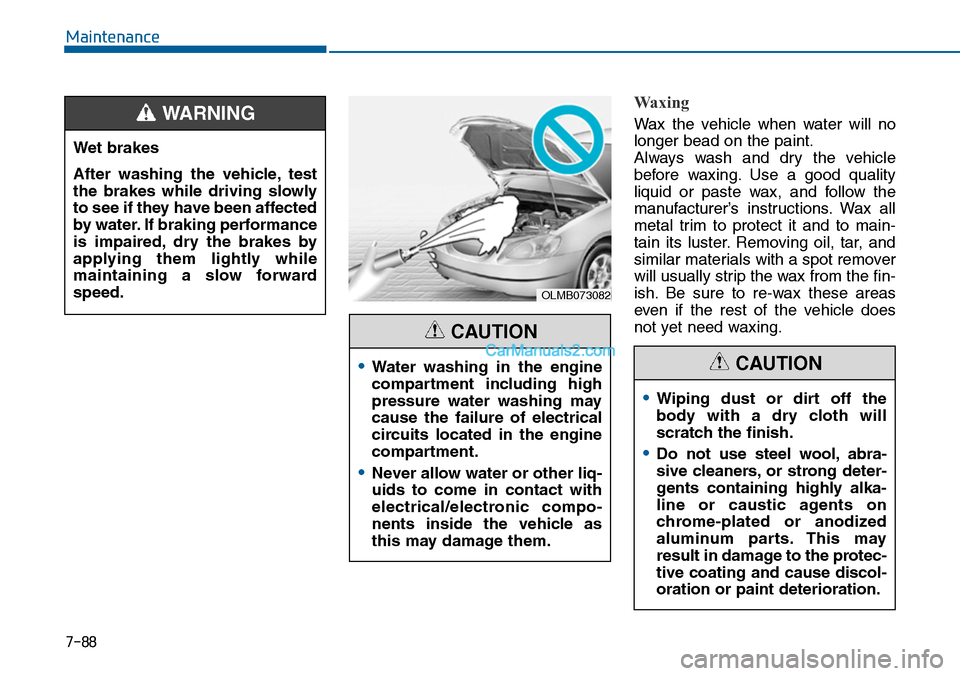
•Water washing in the engine
compartment including high
pressure water washing may
cause the failure of electrical
circuits located in the engine
compartment.
•Never allow water or other liq-
uids to come in contact with
electrical/electronic compo-
nents inside the vehicle as
this may damage them.
CAUTION
•Wiping dust or dirt off the
body with a dry cloth will
scratch the finish.
•Do not use steel wool, abra-
sive cleaners, or strong deter-
gents containing highly alka-
line or caustic agents on
chrome-plated or anodized
aluminum parts. This may
result in damage to the protec-
tive coating and cause discol-
oration or paint deterioration.
CAUTION
OLMB073082
Page 647 of 665
7-90
Maintenance
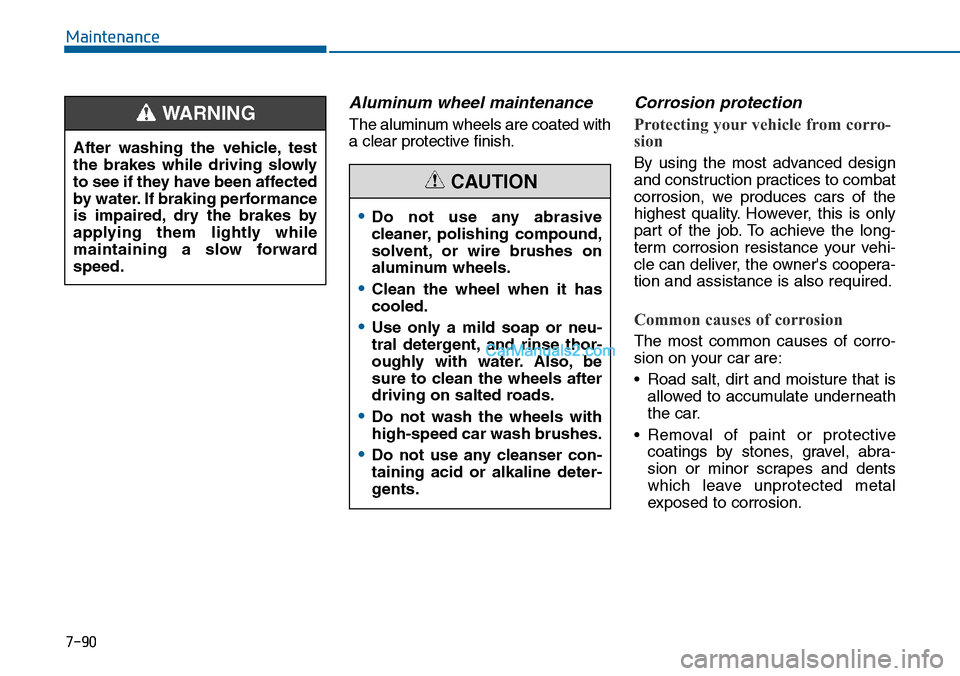
Aluminum wheel maintenance
The aluminum wheels are coated with
a clear protective finish.
Corrosion protection
Protecting your vehicle from corro-
sion
By using the most advanced design
and construction practices to combat
corrosion, we produces cars of the
highest quality. However, this is only
part of the job. To achieve the long-
term corrosion resistance your vehi-
cle can deliver, the owner's coopera-
tion and assistance is also required.
Common causes of corrosion
The most common causes of corro-
sion on your car are:
• Road salt, dirt and moisture that is
allowed to accumulate underneath
the car.
• Removal of paint or protective
coatings by stones, gravel, abra-
sion or minor scrapes and dents
which leave unprotected metal
exposed to corrosion.
After washing the vehicle, test
the brakes while driving slowly
to see if they have been affected
by water. If braking performance
is impaired, dry the brakes by
applying them lightly while
maintaining a slow forward
speed.
WARNING
•Do not use any abrasive
cleaner, polishing compound,
solvent, or wire brushes on
aluminum wheels.
•Clean the wheel when it has
cooled.
•Use only a mild soap or neu-
tral detergent, and rinse thor-
oughly with water. Also, be
sure to clean the wheels after
driving on salted roads.
•Do not wash the wheels with
high-speed car wash brushes.
•Do not use any cleanser con-
taining acid or alkaline deter-
gents.
CAUTION
Page 662 of 665
8-7
8
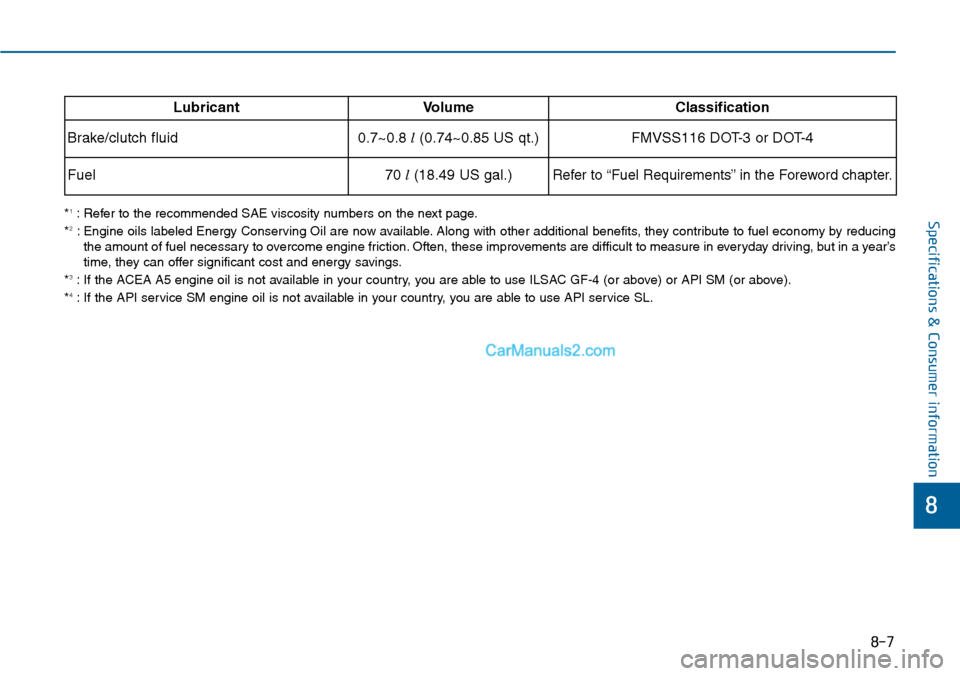
Specifications & Consumer information*1:Refer to the recommended SAE viscosity numbers on the next page.
*2:Engine oils labeled Energy Conserving Oil are now available.Along with other additional benefits, they contribute to fuel economy by reducingthe amount of fuel necessary to overcome engine friction. Often, these improvements are difficult to measure in everyday driving, but in a year’stime, they can offer significant cost and energy savings.
*3:If the ACEA A5 engine oil is not available in your country, you are able to use ILSAC GF-4 (or above) or API SM (or above).
*4:If the API service SM engine oil is not available in your country, you are able to use API service SL.
Lubricant Volume Classification
Brake/clutch fluid0.7~0.8 l(0.74~0.85 US qt.)FMVSS116 DOT-3 or DOT-4
Fuel70 l(18.49 US gal.)Refer to “Fuel Requirements” in the Foreword chapter.