warning Hyundai Sonata 2014 Owner's Manual
[x] Cancel search | Manufacturer: HYUNDAI, Model Year: 2014, Model line: Sonata, Model: Hyundai Sonata 2014Pages: 665, PDF Size: 17.43 MB
Page 545 of 665
6-11
What to do in an emergency
6
Changing tiresFollow these steps to change your
vehicle’s tire:
1. Park on a level, firm surface.
2. Move the shift lever into P (Park,
for automatic transaxle vehicle) or
neutral (for manual transaxle
vehicle), apply the parking brake,
and place the ignition switch in the
LOCK/OFF position.
3. Press the hazard warning flasher
button.
4. Remove the wheel lug nut wrench,
jack, jack handle, and spare tire
from the vehicle.
A vehicle can slip or roll off of a
jack causing serious injury or
death to you or those nearby.
Take the following safety pre-
cautions:
•Do not get under a vehicle
that is supported by a jack.
•NEVER attempt to change a
tire in the lane of traffic.
ALWAYS move the vehicle
completely off the road on
level, firm ground away from
traffic before trying to change
a tire. If you cannot find a
level, firm place off the road,
call a towing service for assis-
tance.
•Be sure to use the jack pro-
vided with the vehicle.
(Continued)
WARNING
(Continued)
•ALWAYS place the jack on the
designated jacking positions
on the vehicle and NEVER on
the bumpers or any other part
of the vehicle for jacking sup-
port.
•Do not start or run the engine
while the vehicle is on the
jack.
•Do not allow anyone to remain
in the vehicle while it is on the
jack.
•Keep children away from the
road and the vehicle.
Page 549 of 665
6-15
What to do in an emergency
6If any of the equipment such as the
jack, lug nuts, studs, or other equip-
ment is damaged or in poor condi-
tion, do not attempt to change the
tire and call for assistance.
Use of compact spare tires
(if equipped)
Compact spare tires are designed for
emergency use only. Drive carefully
on the compact spare tire and
always follow the safety precautions.
Yo u r v e h i c l e h a s m e t r i c t h r e a d s
on the studs and lug nuts. Make
certain during tire changing
that the same nuts that were
removed are reinstalled. If you
have to replace your lug nuts
make sure they have metric
threads to avoid damaging the
studs and ensure the wheel is
properly secured to the hub. We
recommend that you consult an
authorized HYUNDAI dealer for
assistance.
CAUTION
To prevent compact spare tire
failure and loss of control pos-
sibly resulting in an accident:
•Use the compact spare tire
only in an emergency.
•NEVER operate your vehicle
over 80 km/h (50 mph).
•Do not exceed the vehicle’s
maximum load rating or the
load carrying capacity shown
on the sidewall of the com-
pact spare tire.
•Do not use the compact spare
tire continuously. Repair or
replace the original tire as
soon as possible to avoid fail-
ure of the compact spare tire.
WARNING
Page 564 of 665
7-7
7
Maintenance
OWNER MAINTENANCE
The following lists are vehicle checks
and inspections that should be per-
for med by the owner or an authorized
HYUNDAI dealer at the frequencies
indicated to help ensure safe,
dependable operation of your vehicle.
Any adverse conditions should be
brought to the attention of your deal-
er as soon as possible.
These Owner Maintenance vehicle
checks are generally not covered by
warranties and you may be charged
for labor, par ts and lubricants used.
Performing maintenance work
on a vehicle can be dangerous.
If you lack sufficient knowledge
and experience or the proper
tools and equipment to do the
work, we recommend that the
system be serviced by an author-
ized HYUNDAI dealer. ALWAYS
follow these precautions for
performing maintenance work:
•Park your vehicle on level
ground, move the shift lever
into the P (Park, for automatic
transaxle vehicle) position,
apply the parking brake, place
the ignition switch in the
LOCK/OFF position.
•Block the tires (front and back)
to prevent the vehicle from
moving.
Remove loose clothing or jew-
elry that can become entan-
gled in moving parts.
(Continued)
WARNING (Continued)
•If you must run the engine
during maintenance, do so
out doors or in an area with
plenty of ventilation.
•Keep flames, sparks, or smok-
ing materials away from the
battery and fuel-related parts.
Page 565 of 665
7-8
Maintenance
Owner maintenance schedule
When you stop for fuel:
•Check the engine oil level.
•Check coolant level in the engine
coolant reservoir.
•Check the windshield washer fluid
level.
•Check for low or under-inflated
tires.
While operating your vehicle:
•Note any changes in the sound of
the exhaust or any smell of exhaust
fumes in the vehicle.
•Check for vibrations in the steering
wheel. Notice if there is any
increased steering effort or loose-
ness in the steering wheel, or
change in its straight-ahead position.
•Notice if your vehicle constantly
turns slightly or “pulls” to one side
when traveling on smooth, level
road.
•When stopping, listen and check for
unusual sounds, pulling to one side,
increased brake pedal travel or
“hard-to-push” brake pedal.
•If any slipping or changes in the
operation of your transaxle occurs,
check the transaxle fluid level.
•Check the automatic transaxle
P (Park) function.
•Check the parking brake.
•Check for fluid leaks under your vehi-
cle (water dripping from the air con-
ditioning system during or after use
is normal).
At least monthly:
•Check coolant level in the engine
coolant reservoir.
•Check the operation of all exterior
lights, including the stoplights, turn
signals and hazard warning flashers.
•Check the inflation pressures of all
tires including the spare for tires
that are worn, show uneven wear,
or are damaged.
•Check for loose wheel lug nuts.
Be careful when checking your
engine coolant level when the
engine is hot. This may result in
coolant being blown out of the
opening and cause serious
burns and other injuries.
WARNING
Page 581 of 665
7-24
Maintenance
Va c u u m c r a n k c a s e v e n t i l a t i o n
hoses (if equipped)
Inspect the surface of hoses for evi-
dence of heat and/or mechanical
damage. Hard and brittle rubber,
cracking, tears, cuts, abrasions, and
excessive swelling indicate deterio-
ration. Particular attention should be
paid to examine those hose surfaces
nearest to high heat sources, such
as the exhaust manifold.
Inspect the hose routing to assure
that the hoses do not come in con-
tact with any heat source, sharp
edges or moving component which
might cause heat damage or mechan-
ical wear. Inspect all hose connec-
tions, such as clamps and couplings,
to make sure they are secure, and that
no leaks are present. Hoses should be
replaced immediately if there is any
evidence of deterioration or damage.
Air cleaner filter
We recommend that the air cleaner
filter be replaced by an authorized
HYUNDAI dealer.
Spark plugs
Make sure to install new spark plugs
of the correct heat range.
Va l v e cl e a r a n c e ( T h e t a E n g i n e )
Inspect excessive valve noise and/or
engine vibration and adjust if neces-
sary. We recommend that the system
be serviced by an authorized
HYUNDAI dealer.
Cooling system
Check the cooling system parts,
such as radiator, coolant reservoir,
hoses and connections for leakage
and damage. Replace any damaged
parts.
Coolant
The coolant should be changed at
the intervals specified in the mainte-
nance schedule.
Do not disconnect and inspect
spark plugs when the engine is
hot. You may burn yourself.
WARNING
Page 584 of 665
7-27
7
Maintenance
ENGINE OIL
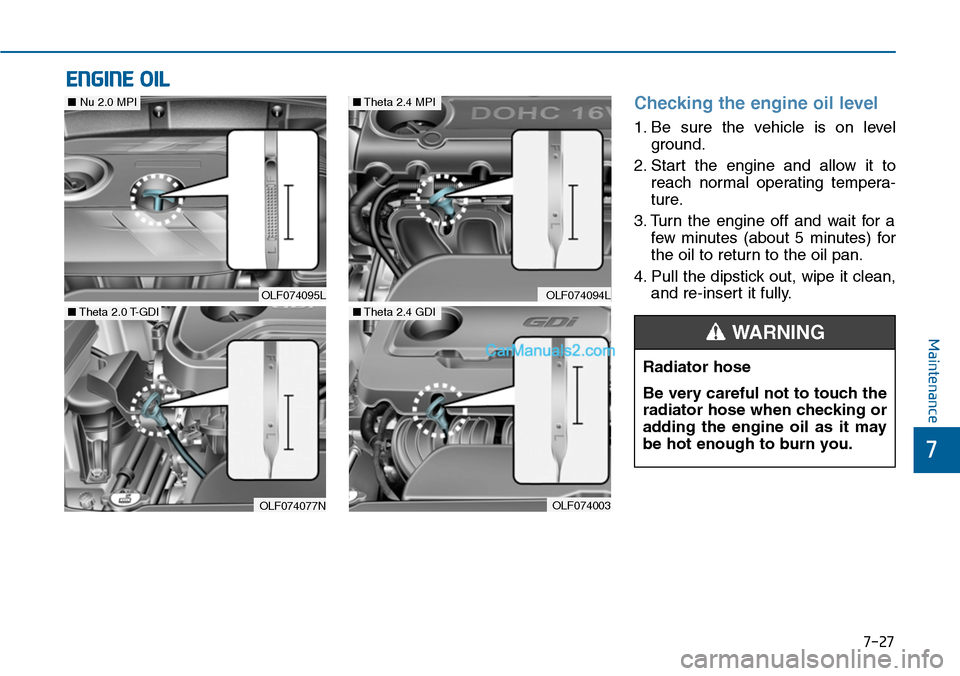
Checking the engine oil level
1. Be sure the vehicle is on level
ground.
2. Start the engine and allow it to
reach normal operating tempera-
ture.
3. Turn the engine off and wait for a
few minutes (about 5 minutes) for
the oil to return to the oil pan.
4. Pull the dipstick out, wipe it clean,
and re-insert it fully.
Radiator hose
Be very careful not to touch the
radiator hose when checking or
adding the engine oil as it may
be hot enough to burn you.
WARNING
OLF074094L
OLF074077N
■Theta 2.0 T-GDI
■Theta 2.4 MPI
OLF074003
■Theta 2.4 GDI
OLF074095L
■Nu 2.0 MPI
Page 586 of 665
7-29
7
Maintenance
Checking the engine oil and
filter
We recommend that the engine oil
and filter be replaced by an author-
ized HYUNDAI dealer.
Used engine oil may cause irri-
tation or cancer of the skin if
left in contact with the skin for
prolonged periods of time. Used
engine oil contains chemicals
that have caused cancer in lab-
oratory animals. Always protect
your skin by washing your
hands thoroughly with soap
and warm water as soon as pos-
sible after handling used oil.
WARNING
Page 587 of 665
7-30
Maintenance
ENGINE COOLANT
The high-pressure cooling system
has a reservoir filled with year-round
antifreeze coolant. The reservoir is
filled at the factory.
Check the antifreeze protection and
coolant concentration level at least
once a year, at the beginning of the
winter season, and before traveling
to a colder climate.
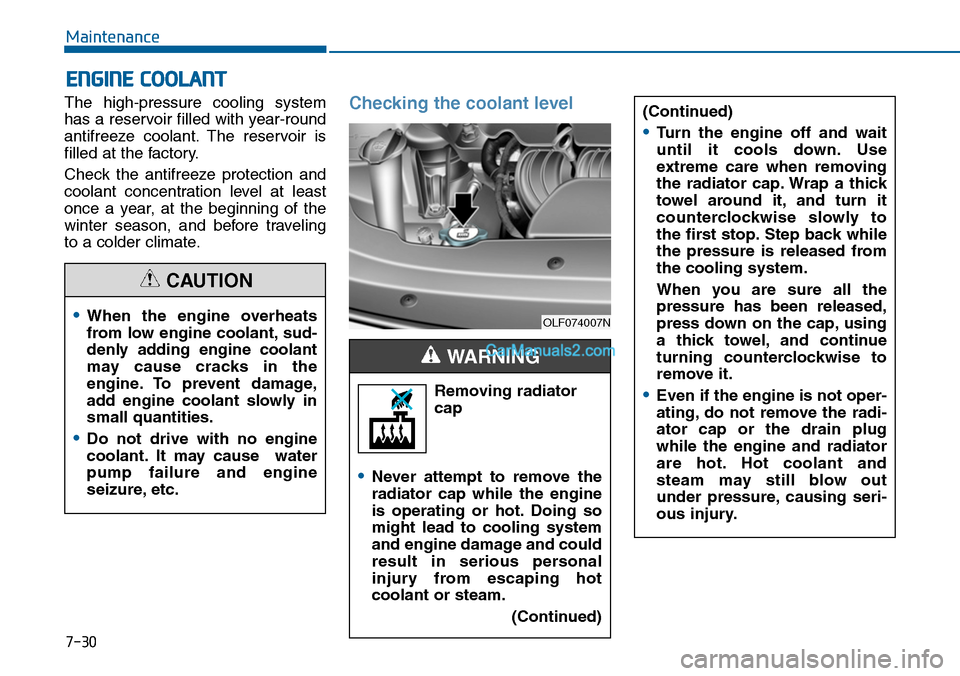
Checking the coolant level
Removing radiator
cap
•Never attempt to remove the
radiator cap while the engine
is operating or hot. Doing so
might lead to cooling system
and engine damage and could
result in serious personal
injury from escaping hot
coolant or steam.
(Continued)
WARNING
(Continued)
•Turn the engine off and wait
until it cools down. Use
extreme care when removing
the radiator cap. Wrap a thick
towel around it, and turn it
counterclockwise slowly to
the first stop. Step back while
the pressure is released from
the cooling system.
When you are sure all the
pressure has been released,
press down on the cap, using
a thick towel, and continue
turning counterclockwise to
remove it.
•Even if the engine is not oper-
ating, do not remove the radi-
ator cap or the drain plug
while the engine and radiator
are hot. Hot coolant and
steam may still blow out
under pressure, causing seri-
ous injury.
•When the engine overheats
from low engine coolant, sud-
denly adding engine coolant
may cause cracks in the
engine. To prevent damage,
add engine coolant slowly in
small quantities.
•Do not drive with no engine
coolant. It may cause water
pump failure and engine
seizure, etc.
CAUTION
OLF074007N
Page 588 of 665
7-31
7
Maintenance
Check the condition and connections
of all cooling system hoses and
heater hoses. Replace any swollen
or deteriorated hoses.
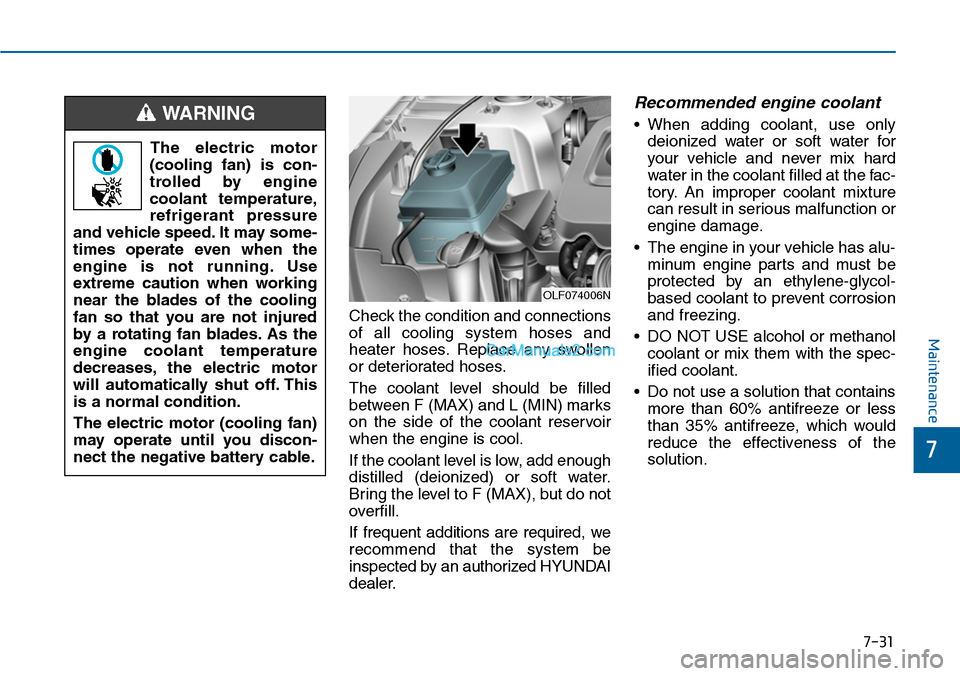
The coolant level should be filled
between F (MAX) and L (MIN) marks
on the side of the coolant reservoir
when the engine is cool.
If the coolant level is low, add enough
distilled (deionized) or soft water.
Bring the level to F (MAX), but do not
overfill.
If frequent additions are required, we
recommend that the system be
inspected by an authorized HYUNDAI
dealer.
Recommended engine coolant
•When adding coolant, use only
deionized water or soft water for
your vehicle and never mix hard
water in the coolant filled at the fac-
tory. An improper coolant mixture
can result in serious malfunction or
engine damage.
•The engine in your vehicle has alu-
minum engine parts and must be
protected by an ethylene-glycol-
based coolant to prevent corrosion
and freezing.
•DO NOT USE alcohol or methanol
coolant or mix them with the spec-
ified coolant.
•Do not use a solution that contains
more than 60% antifreeze or less
than 35% antifreeze, which would
reduce the effectiveness of the
solution.
OLF074006N
The electric motor
(cooling fan) is con-
trolled by engine
coolant temperature,
refrigerant pressure
and vehicle speed. It may some-
times operate even when the
engine is not running. Use
extreme caution when working
near the blades of the cooling
fan so that you are not injured
by a rotating fan blades. As the
engine coolant temperature
decreases, the electric motor
will automatically shut off. This
is a normal condition.
The electric motor (cooling fan)
may operate until you discon-
nect the negative battery cable.
WARNING
Page 589 of 665
7-32
Maintenance
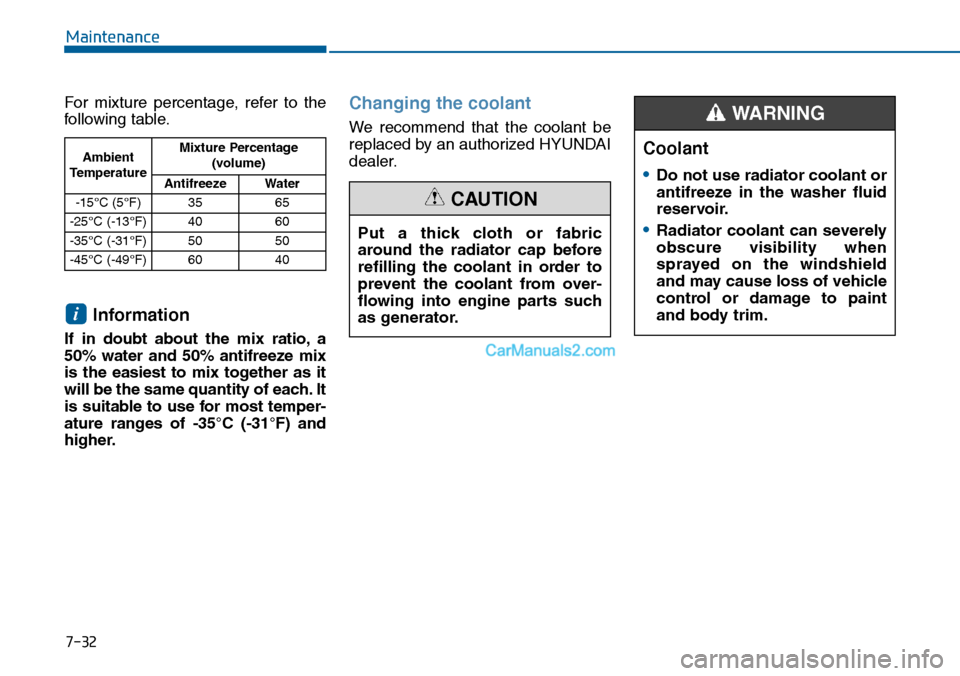
For mixture percentage, refer to the
following table.
Information
If in doubt about the mix ratio, a
50% water and 50% antifreeze mix
is the easiest to mix together as it
will be the same quantity of each. It
is suitable to use for most temper-
ature ranges of -35°C (-31°F) and
higher.
Changing the coolant
We recommend that the coolant be
replaced by an authorized HYUNDAI
dealer.
i
AmbientTemperature
Mixture Percentage (volume)
Antifreeze Water
-15°C (5°F) 35 65
-25°C (-13°F) 40 60
-35°C (-31°F) 50 50
-45°C (-49°F) 60 40
Coolant
•Do not use radiator coolant or
antifreeze in the washer fluid
reservoir.
•Radiator coolant can severely
obscure visibility when
sprayed on the windshield
and may cause loss of vehicle
control or damage to paint
and body trim.
WARNING
Put a thick cloth or fabric
around the radiator cap before
refilling the coolant in order to
prevent the coolant from over-
flowing into engine parts such
as generator.
CAUTION