fuel Hyundai Sonata 2014 Service Manual
[x] Cancel search | Manufacturer: HYUNDAI, Model Year: 2014, Model line: Sonata, Model: Hyundai Sonata 2014Pages: 665, PDF Size: 17.43 MB
Page 565 of 665
7-8
Maintenance
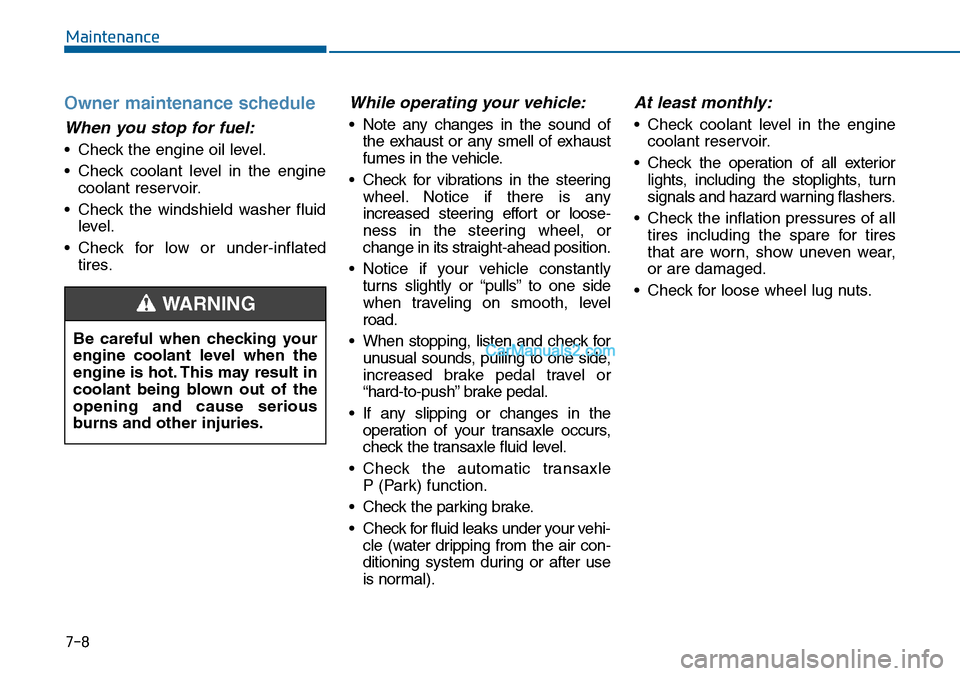
Owner maintenance schedule
When you stop for fuel:
•Check the engine oil level.
•Check coolant level in the engine
coolant reservoir.
•Check the windshield washer fluid
level.
•Check for low or under-inflated
tires.
While operating your vehicle:
•Note any changes in the sound of
the exhaust or any smell of exhaust
fumes in the vehicle.
•Check for vibrations in the steering
wheel. Notice if there is any
increased steering effort or loose-
ness in the steering wheel, or
change in its straight-ahead position.
•Notice if your vehicle constantly
turns slightly or “pulls” to one side
when traveling on smooth, level
road.
•When stopping, listen and check for
unusual sounds, pulling to one side,
increased brake pedal travel or
“hard-to-push” brake pedal.
•If any slipping or changes in the
operation of your transaxle occurs,
check the transaxle fluid level.
•Check the automatic transaxle
P (Park) function.
•Check the parking brake.
•Check for fluid leaks under your vehi-
cle (water dripping from the air con-
ditioning system during or after use
is normal).
At least monthly:
•Check coolant level in the engine
coolant reservoir.
•Check the operation of all exterior
lights, including the stoplights, turn
signals and hazard warning flashers.
•Check the inflation pressures of all
tires including the spare for tires
that are worn, show uneven wear,
or are damaged.
•Check for loose wheel lug nuts.
Be careful when checking your
engine coolant level when the
engine is hot. This may result in
coolant being blown out of the
opening and cause serious
burns and other injuries.
WARNING
Page 569 of 665
Maintenance
7-12
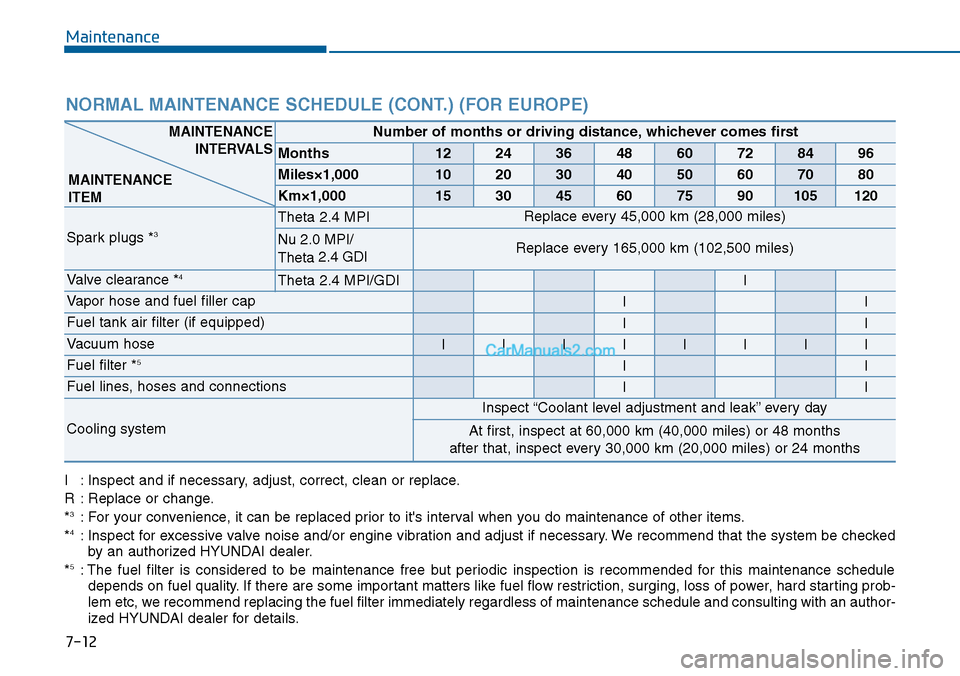
NORMAL MAINTENANCE SCHEDULE (CONT.) (FOR EUROPE)
I:Inspect and if necessary, adjust, correct, clean or replace.
R:Replace or change.
*3:For your convenience, it can be replaced prior to it's interval when you do maintenance of other items.
*4:Inspect for excessive valve noise and/or engine vibration and adjust if necessary.We recommend that the system be checkedby an authorized HYUNDAI dealer.
*5:The fuel filter is considered to be maintenance free but periodic inspection is recommended for this maintenance scheduledepends on fuel quality. If there are some important matters like fuel flow restriction, surging, loss of power, hard starting prob-lem etc, we recommend replacing the fuel filter immediately regardless of maintenance schedule and consulting with an author-ized HYUNDAI dealer for details.
Number of months or driving distance, whichever comes first
Months1224364860728496
Miles×1,0001020304050607080
Km×1,000153045607590105120
Spark plugs *3Theta 2.4 MPIReplace every 45,000 km (28,000 miles)
Nu 2.0 MPI/
Theta 2.4 GDIReplace every 165,000 km (102,500 miles)
Va l ve c l e a r a n c e *4Theta 2.4 MPI/GDII
Va p o r h o s e a n d f u e l f i l l e r c a pII
Fuel tank air filter (if equipped)II
Va c u u m h o s eIIIIIIII
Fuel filter *5II
Fuel lines, hoses and connectionsII
Cooling system
Inspect “Coolant level adjustment and leak” every day
At first, inspect at 60,000 km (40,000 miles) or 48 months
after that, inspect every 30,000 km (20,000 miles) or 24 months
MAINTENANCE
INTERVALS
MAINTENANCE
ITEM
Page 574 of 665
7-17
7
Maintenance
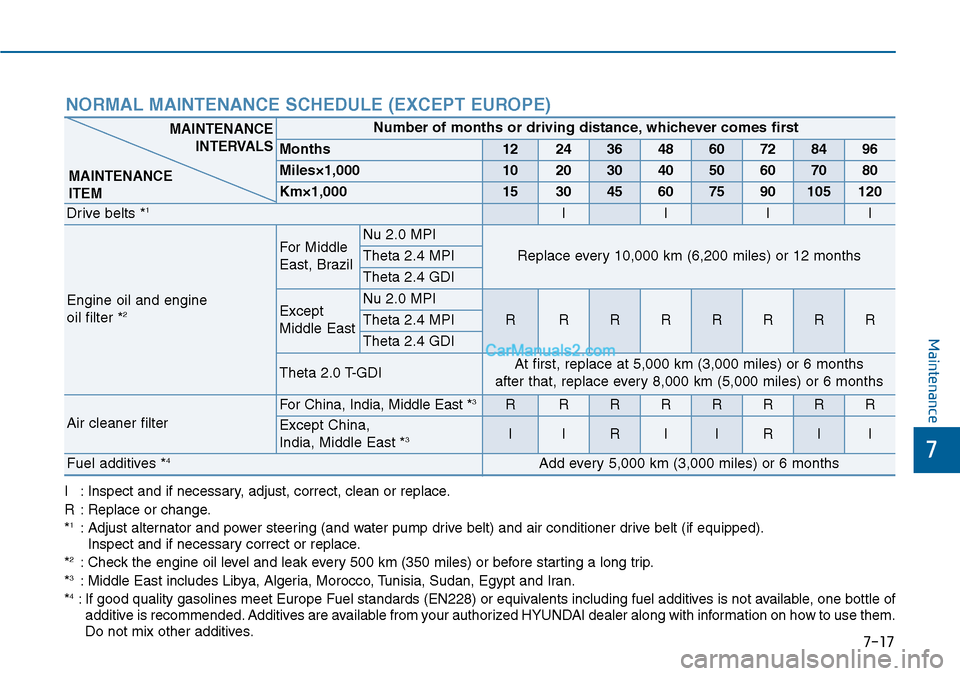
I:Inspect and if necessary, adjust, correct, clean or replace.
R:Replace or change.
*1:Adjust alternator and power steering (and water pump drive belt) and air conditioner drive belt (if equipped).Inspect and if necessary correct or replace.
*2:Check the engine oil level and leak every 500 km (350 miles) or before starting a long trip.
*3:Middle East includes Libya, Algeria, Morocco, Tunisia, Sudan, Egypt and Iran.
*4:If good quality gasolines meet Europe Fuel standards (EN228) or equivalents including fuel additives is not available, one bottle ofadditive is recommended. Additives are available from your authorized HYUNDAI dealer along with information on how to use them.Do not mix other additives.
NORMAL MAINTENANCE SCHEDULE (EXCEPT EUROPE)
Number of months or driving distance, whichever comes first
Months1224364860728496
Miles×1,0001020304050607080
Km×1,000153045607590105120
Drive belts *1IIII
Engine oil and engine
oil filter *2
For Middle
East, Brazil
Nu 2.0 MPI
Replace every 10,000 km (6,200 miles) or 12 monthsTheta 2.4 MPI
Theta 2.4 GDI
Except
Middle East
Nu 2.0 MPI
RRRRRRRRTheta 2.4 MPI
Theta 2.4 GDI
Theta 2.0 T-GDI At first, replace at 5,000 km (3,000 miles) or 6 months
after that, replace every 8,000 km (5,000 miles) or 6 months
Air cleaner filter
For China, India, Middle East *3RRRRRRRR
Except China,
India, Middle East *3IIRIIRII
Fuel additives *4Add every 5,000 km (3,000 miles) or 6 months
MAINTENANCE
INTERVALS
MAINTENANCE
ITEM
Page 575 of 665
Maintenance
7-18
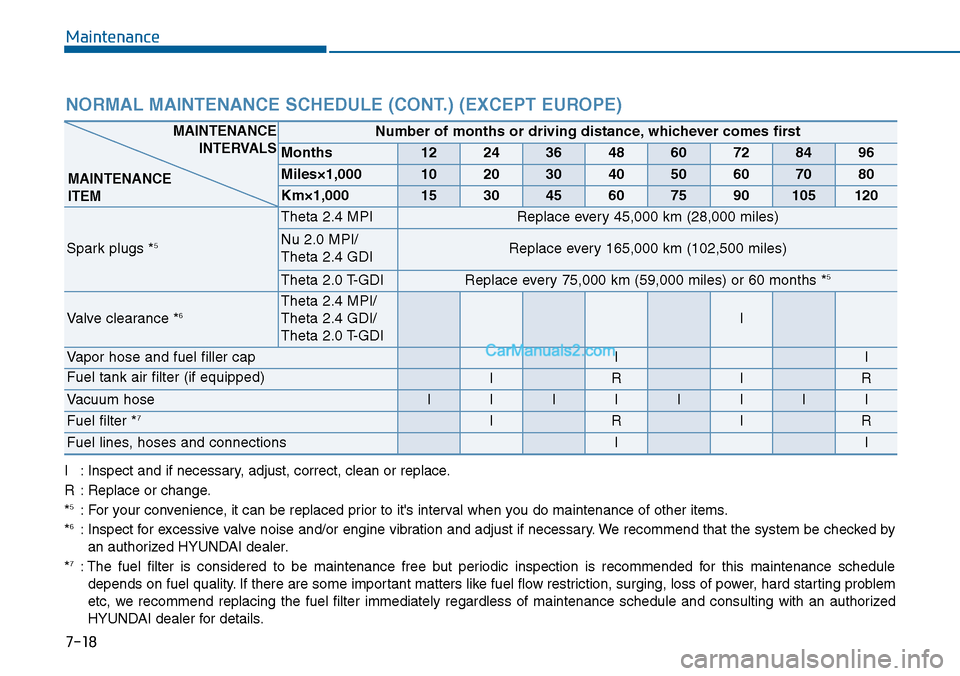
NORMAL MAINTENANCE SCHEDULE (CONT.) (EXCEPT EUROPE)
I:Inspect and if necessary, adjust, correct, clean or replace.
R:Replace or change.
*5:For your convenience, it can be replaced prior to it's interval when you do maintenance of other items.
*6:Inspect for excessive valve noise and/or engine vibration and adjust if necessary.We recommend that the system be checked by
an authorized HYUNDAI dealer.
*7:The fuel filter is considered to be maintenance free but periodic inspection is recommended for this maintenance schedule
depends on fuel quality. If there are some important matters like fuel flow restriction, surging, loss of power, hard starting problem
etc, we recommend replacing the fuel filter immediately regardless of maintenance schedule and consulting with an authorized
HYUNDAI dealer for details.
Number of months or driving distance, whichever comes first
Months1224364860728496
Miles×1,0001020304050607080
Km×1,000153045607590105120
Spark plugs *5
Theta 2.4 MPIReplace every 45,000 km (28,000 miles)
Nu 2.0 MPI/
Theta 2.4 GDIReplace every 165,000 km (102,500 miles)
Theta 2.0 T-GDIReplace every 75,000 km (59,000 miles) or 60 months *5
Va l ve c l e a r a n c e *6Theta 2.4 MPI/
Theta 2.4 GDI/
Theta 2.0 T-GDI
I
Va p o r h o s e a n d f u e l f i l l e r c a pII
Fuel tank air filter (if equipped)IRIR
Va c u u m h o s eIIIIIIII
Fuel filter *7IRIR
Fuel lines, hoses and connectionsII
MAINTENANCE
INTERVALS
MAINTENANCE
ITEM
Page 580 of 665
7-23
7
Maintenance
EXPLANATION OF SCHEDULED MAINTENANCE ITEMS
Engine oil and filter
The engine oil and filter should be
changed at the intervals specified in
the maintenance schedule. If the car
is being driven in severe conditions,
more frequent oil and filter changes
are required.
Drive belts
Inspect all drive belts for evidence of
cuts, cracks, excessive wear or oil
saturation and replace if necessary.
Drive belts should be checked peri-
odically for proper tension and
adjusted as necessary.
Fuel filter (cartridge)
A clogged filter can limit the speed at
which the vehicle may be driven,
damage the emission system and
cause multiple issues such as hard
starting. If an excessive amount of
foreign matter accumulates in the
fuel tank, the filter may require
replacement more frequently.
After installing a new filter, run the
engine for several minutes, and
check for leaks at the connections.
We recommend that the fuel filter be
replaced by an authorized HYUNDAI
dealer.
Fuel lines, fuel hoses and con-
nections
Check the fuel lines, fuel hoses and
connections for leakage and dam-
age. We recommend that the fuel
lines, fuel hoses and connections be
replaced by an authorized HYUNDAI
dealer.
Va p o r h o s e a n d f u e l f i l l e r c a p
The vapor hose and fuel filler cap
should be inspected at those inter-
vals specified in the maintenance
schedule. Make sure that a new
vapor hose or fuel filler cap is cor-
rectly replaced.
When you are inspecting the
belt, place the ignition switch to
the LOCK/OFF or ACC position.
CAUTION
Page 603 of 665
7-46
Maintenance
TIRES AND WHEELS
Tire care
For proper maintenance, safety, and
maximum fuel economy, you must
always maintain recommended tire
inflation pressures and stay within
the load limits and weight distribution
recommended for your vehicle.
Recommended cold tire infla-
tion pressures
All tire pressures (including the
spare) should be checked when the
tires are cold. “Cold Tires” means the
vehicle has not been driven for at
least three hours or driven less than
1.6 km (1 mile).
Recommended pressures must be
maintained for the best ride, top vehi-
cle handling, and minimum tire wear.
For recommended inflation pressure
refer to “Tire and wheels” in section 8.
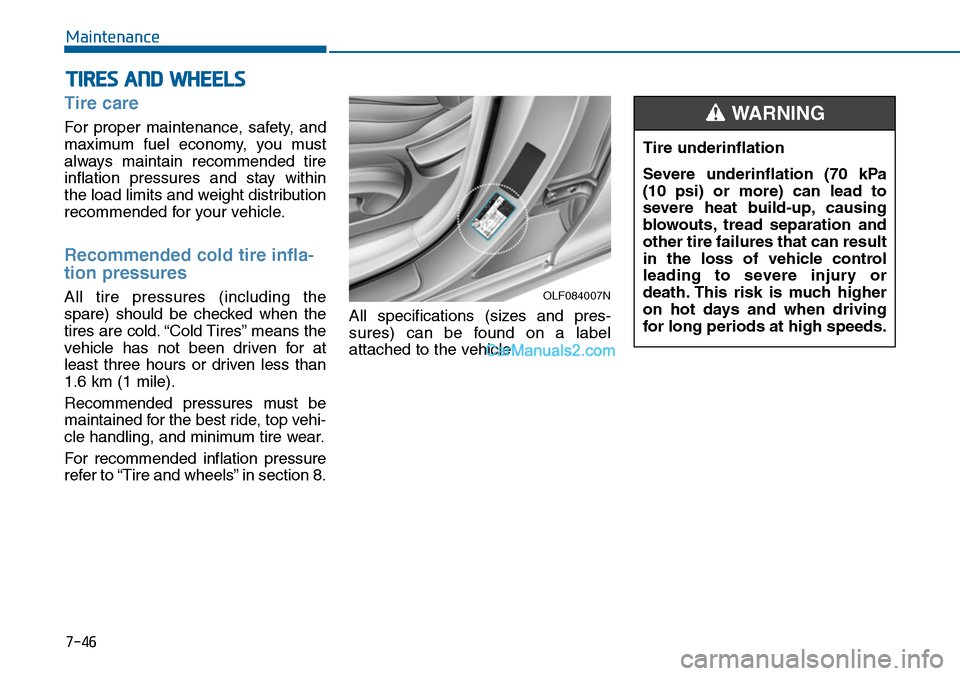
All specifications (sizes and pres-
sures) can be found on a label
attached to the vehicle.
Tire underinflation
Severe underinflation (70 kPa
(10 psi) or more) can lead to
severe heat build-up, causing
blowouts, tread separation and
other tire failures that can result
in the loss of vehicle control
leading to severe injury or
death. This risk is much higher
on hot days and when driving
for long periods at high speeds.
WARNING
OLF084007N
Page 604 of 665
7-47
7
Maintenance
•Underinflation also results in
excessive wear, poor handling
and reduced fuel economy.
Wheel deformation also is
possible. Keep your tire pres-
sures at the proper levels. If a
tire frequently needs refilling,
we recommend that the sys-
tem be checked by an author-
ized HYUNDAI dealer.
•Overinflation produces a
harsh ride, excessive wear at
the center of the tire tread,
and a greater possibility of
damage from road hazards.
CAUTION
•Warm tires normally exceed
recommended cold tire pres-
sures by 28 to 41 kPa (4 to 6
psi). Do not release air from
warm tires to adjust the pres-
sure or the tires will be under-
inflated.
•Be sure to reinstall the tire
inflation valve caps. Without
the valve cap, dirt or moisture
could get into the valve core
and cause air leakage. If a
valve cap is missing, install a
new one as soon as possible.
CAUTION
Tire pressure
Always observe the following:
•Check tire pressure when the
tires are cold. (After vehicle
has been parked for at least
three hours or hasn't been driv-
en more than 1.6 km (1 mile)
since startup.)
•Check the pressure of your
spare tire each time you check
the pressure of other tires.
•Never overload your vehicle.
Be careful not to overload a
vehicle luggage rack if your
vehicle is equipped with one.
•Wo r n , o l d t i r e s c a n c a u s e
accidents. If your tread is
badly worn, or if your tires
have been damaged, replace
them.
CAUTION
Tire inflation
Overinflation or underinflation
can reduce tire life, adversely
affect vehicle handling, and
lead to sudden tire failure. This
could result in loss of vehicle
control and potential injury.
WARNING
Page 622 of 665
7-65
7
Maintenance
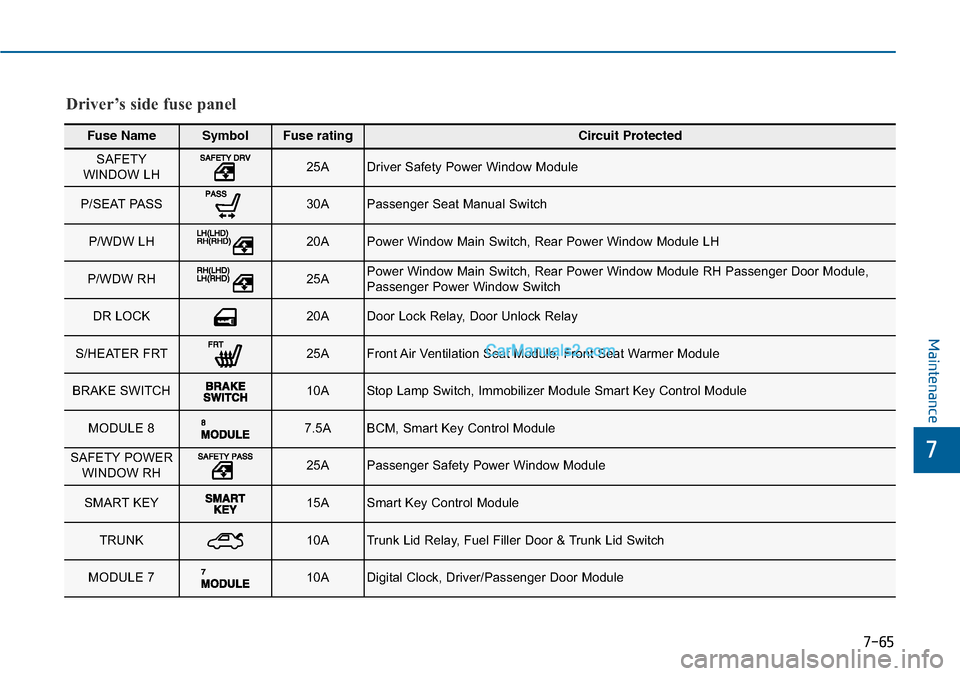
Fuse NameSymbolFuse ratingCircuit Protected
SAFETYWINDOW LH 25ADriver Safety Power Window Module
P/SEAT PASS 30APassenger Seat Manual Switch
P/WDW LH 20APower Window Main Switch, Rear Power Window Module LH
P/WDW RH 25APower Window Main Switch, Rear Power Window Module RH Passenger Door Module,Passenger Power Window Switch
DR LOCK 20ADoor Lock Relay, Door Unlock Relay
S/HEATER FRT25AFront Air Ventilation Seat Module, Front Seat Warmer Module
BRAKE SWITCH 10AStop Lamp Switch, Immobilizer Module Smart Key Control Module
MODULE 8 7.5ABCM, Smart Key Control Module
SAFETY POWERWINDOW RH 25APassenger Safety Power Window Module
SMART KEY15ASmart Key Control Module
TRUNK 10ATrunk Lid Relay, Fuel Filler Door & Trunk Lid Switch
MODULE 7 10ADigital Clock, Driver/Passenger Door Module
Driver’s side fuse panel
Page 625 of 665
7-68
Maintenance
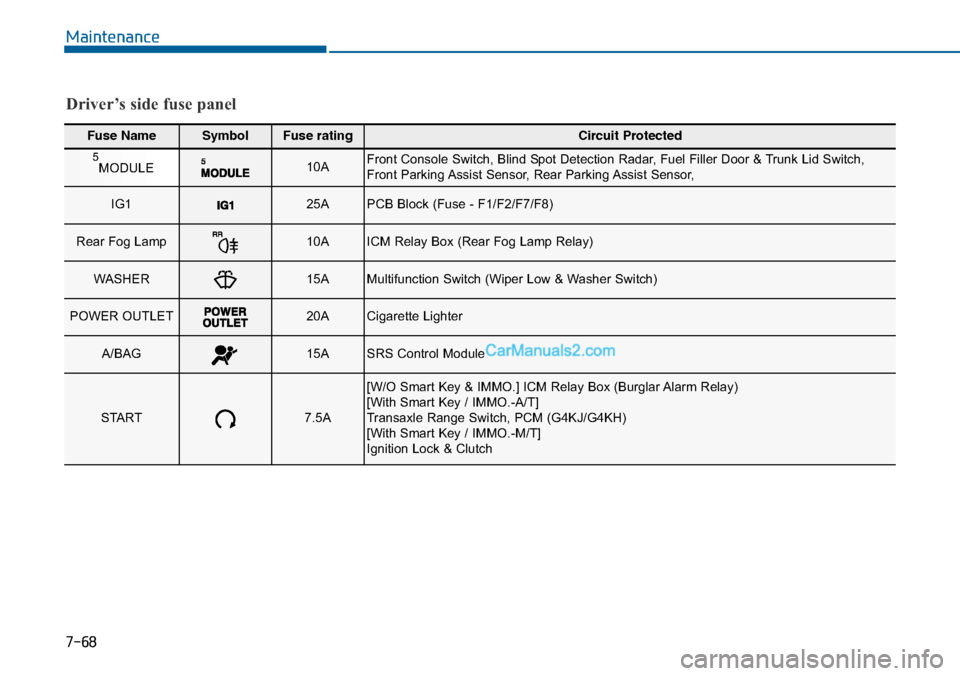
Fuse NameSymbolFuse ratingCircuit Protected
5MODULE10AFront Console Switch, Blind Spot Detection Radar, Fuel Filler Door & Trunk Lid Switch,Front Parking Assist Sensor, Rear Parking Assist Sensor,
IG1 25APCB Block (Fuse - F1/F2/F7/F8)
Rear Fog Lamp 10AICM Relay Box (Rear Fog Lamp Relay)
WASHER 15AMultifunction Switch (Wiper Low & Washer Switch)
POWER OUTLET20ACigarette Lighter
A/BAG 15ASRS Control Module
START7.5A
[W/O Smart Key & IMMO.] ICM Relay Box (Burglar Alarm Relay) [With Smart Key / IMMO.-A/T] Transaxle Range Switch, PCM (G4KJ/G4KH) [With Smart Key / IMMO.-M/T] Ignition Lock & Clutch
Driver’s side fuse panel
Page 646 of 665
7-89
7
Maintenance
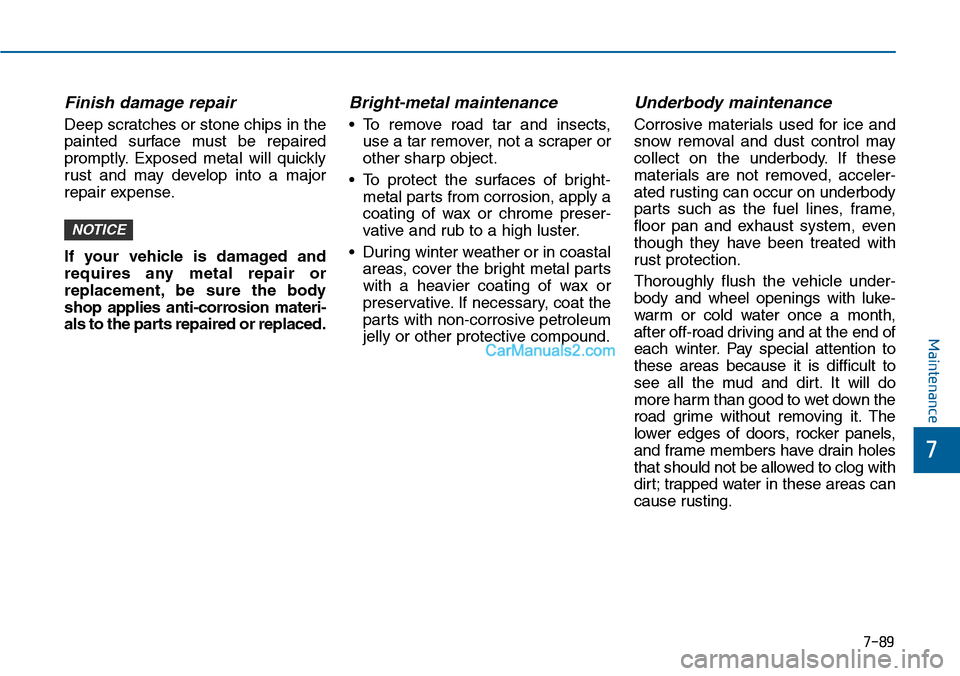
Finish damage repair
Deep scratches or stone chips in the
painted surface must be repaired
promptly. Exposed metal will quickly
rust and may develop into a major
repair expense.
If your vehicle is damaged and
requires any metal repair or
replacement, be sure the body
shop applies anti-corrosion materi-
als to the parts repaired or replaced.
Bright-metal maintenance
•To remove road tar and insects,
use a tar remover, not a scraper or
other sharp object.
•To protect the surfaces of bright-
metal parts from corrosion, apply a
coating of wax or chrome preser-
vative and rub to a high luster.
•During winter weather or in coastal
areas, cover the bright metal parts
with a heavier coating of wax or
preservative. If necessary, coat the
parts with non-corrosive petroleum
jelly or other protective compound.
Underbody maintenance
Corrosive materials used for ice and
snow removal and dust control may
collect on the underbody. If these
materials are not removed, acceler-
ated rusting can occur on underbody
parts such as the fuel lines, frame,
floor pan and exhaust system, even
though they have been treated with
rust protection.
Thoroughly flush the vehicle under-
body and wheel openings with luke-
warm or cold water once a month,
after off-road driving and at the end of
each winter. Pay special attention to
these areas because it is difficult to
see all the mud and dirt. It will do
more harm than good to wet down the
road grime without removing it. The
lower edges of doors, rocker panels,
and frame members have drain holes
that should not be allowed to clog with
dirt; trapped water in these areas can
cause rusting.
NOTICE