fuel Hyundai Sonata 2014 Workshop Manual
[x] Cancel search | Manufacturer: HYUNDAI, Model Year: 2014, Model line: Sonata, Model: Hyundai Sonata 2014Pages: 665, PDF Size: 17.43 MB
Page 652 of 665
7-95
7
Maintenance
EMISSION CONTROL SYSTEM
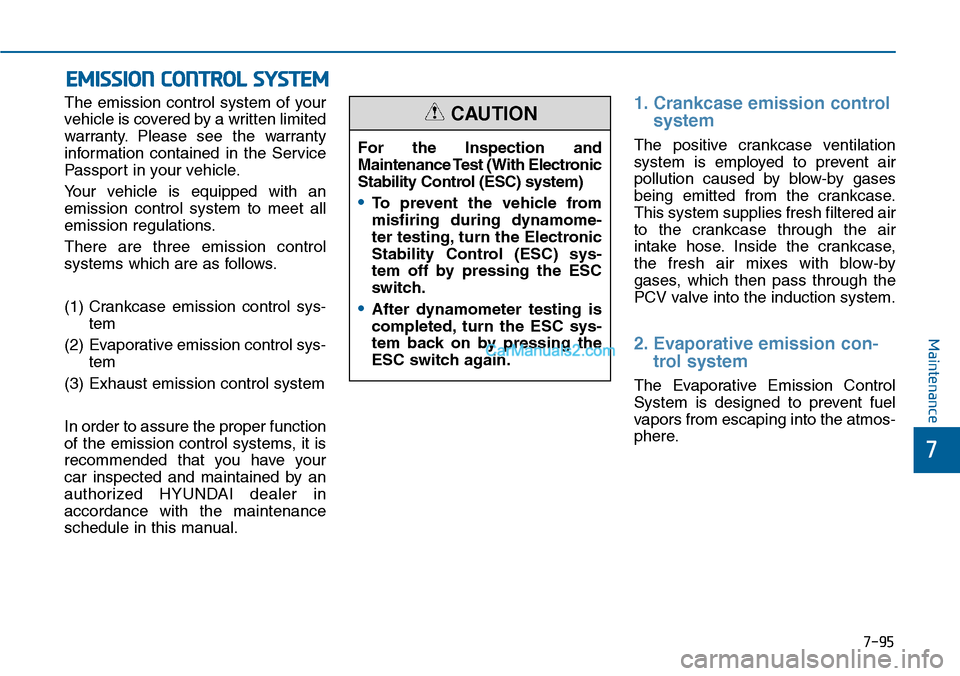
The emission control system of your
vehicle is covered by a written limited
warranty. Please see the warranty
information contained in the Service
Passpor t in your vehicle.
Yo u r v e h i c l e i s e q u i p p e d w i t h a n
emission control system to meet all
emission regulations.
There are three emission control
systems which are as follows.
(1) Crankcase emission control sys-
tem
(2) Evaporative emission control sys-
tem
(3) Exhaust emission control system
In order to assure the proper function
of the emission control systems, it is
recommended that you have your
car inspected and maintained by an
authorized HYUNDAI dealer in
accordance with the maintenance
schedule in this manual.
1. Crankcase emission control
system
The positive crankcase ventilation
system is employed to prevent air
pollution caused by blow-by gases
being emitted from the crankcase.
This system supplies fresh filtered air
to the crankcase through the air
intake hose. Inside the crankcase,
the fresh air mixes with blow-by
gases, which then pass through the
PCV valve into the induction system.
2. Evaporative emission con-
trol system
The Evaporative Emission Control
System is designed to prevent fuel
vapors from escaping into the atmos-
phere.
For the Inspection and
Maintenance Test (With Electronic
Stability Control (ESC) system)
•To prevent the vehicle from
misfiring during dynamome-
ter testing, turn the Electronic
Stability Control (ESC) sys-
tem off by pressing the ESC
switch.
•After dynamometer testing is
completed, turn the ESC sys-
tem back on by pressing the
ESC switch again.
CAUTION
Page 653 of 665
7-96
Maintenance
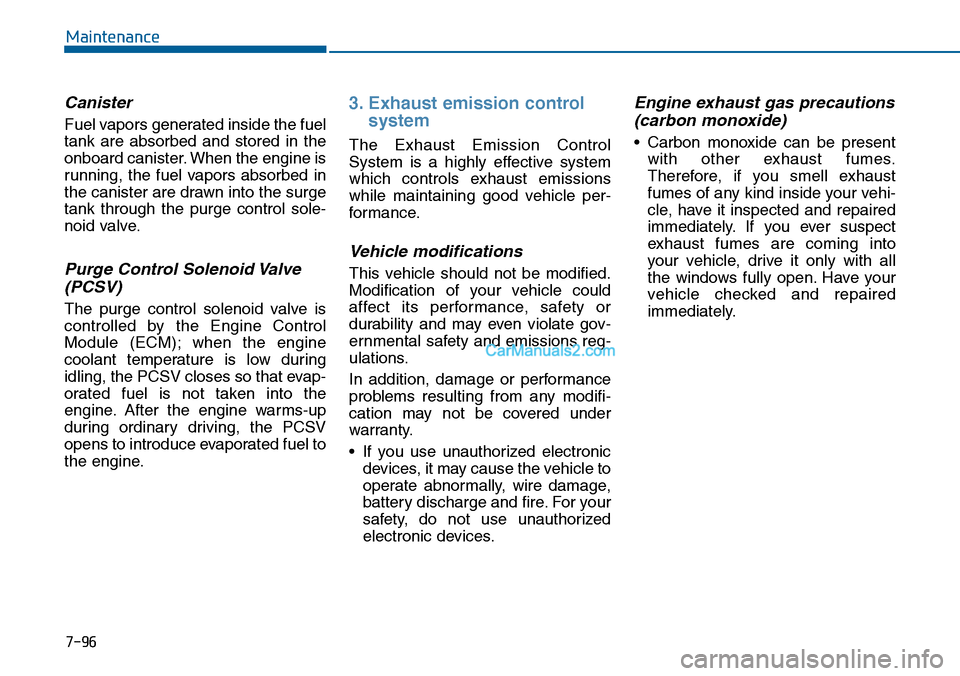
Canister
Fuel vapors generated inside the fuel
tank are absorbed and stored in the
onboard canister. When the engine is
running, the fuel vapors absorbed in
the canister are drawn into the surge
tank through the purge control sole-
noid valve.
Purge Control Solenoid Valve
(PCSV)
The purge control solenoid valve is
controlled by the Engine Control
Module (ECM); when the engine
coolant temperature is low during
idling, the PCSV closes so that evap-
orated fuel is not taken into the
engine. After the engine warms-up
during ordinary driving, the PCSV
opens to introduce evaporated fuel to
the engine.
3. Exhaust emission control
system
The Exhaust Emission Control
System is a highly effective system
which controls exhaust emissions
while maintaining good vehicle per-
formance.
Vehicle modifications
This vehicle should not be modified.
Modification of your vehicle could
affect its performance, safety or
durability and may even violate gov-
ernmental safety and emissions reg-
ulations.
In addition, damage or performance
problems resulting from any modifi-
cation may not be covered under
warranty.
•If you use unauthorized electronic
devices, it may cause the vehicle to
operate abnormally, wire damage,
battery discharge and fire. For your
safety, do not use unauthorized
electronic devices.
Engine exhaust gas precautions
(carbon monoxide)
•Carbon monoxide can be present
with other exhaust fumes.
Therefore, if you smell exhaust
fumes of any kind inside your vehi-
cle, have it inspected and repaired
immediately. If you ever suspect
exhaust fumes are coming into
your vehicle, drive it only with all
the windows fully open. Have your
vehicle checked and repaired
immediately.
Page 655 of 665
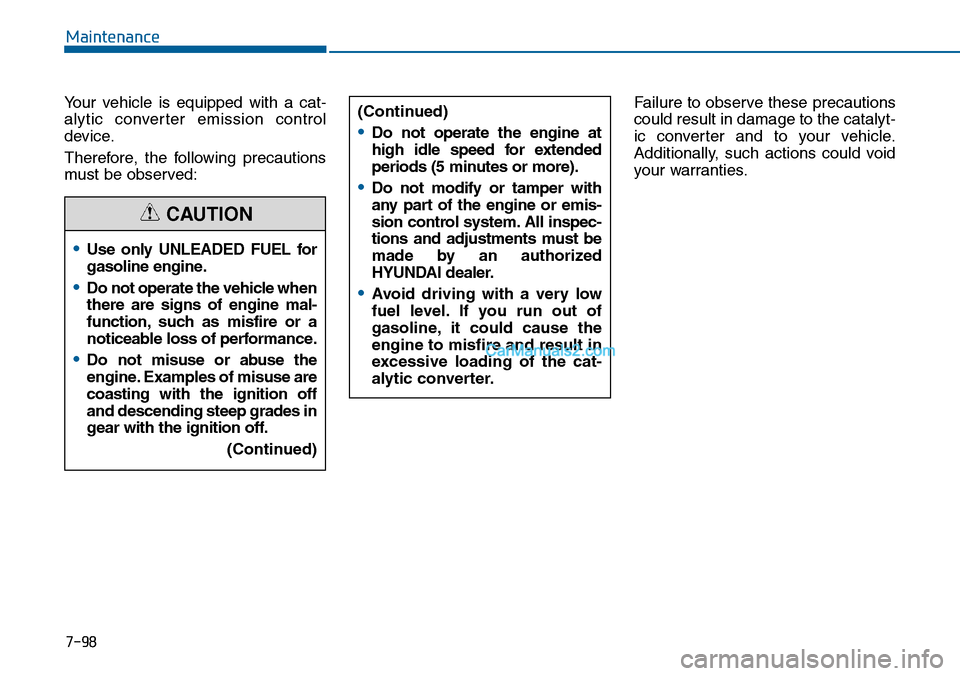
Yo u r v e h i c l e i s e q u i p p e d w i t h a c a t -
alytic converter emission control
device.
Therefore, the following precautions
must be observed:
Failure to observe these precautions
could result in damage to the catalyt-
ic converter and to your vehicle.
Additionally, such actions could void
your warranties.
•Use only UNLEADED FUEL for
gasoline engine.
•Do not operate the vehicle when
there are signs of engine mal-
function, such as misfire or a
noticeable loss of performance.
•Do not misuse or abuse the
engine. Examples of misuse are
coasting with the ignition off
and descending steep grades in
gear with the ignition off.
(Continued)
(Continued)
•Do not operate the engine at
high idle speed for extended
periods (5 minutes or more).
•Do not modify or tamper with
any part of the engine or emis-
sion control system. All inspec-
tions and adjustments must be
made by an authorized
HYUNDAI dealer.
•Avoid driving with a very low
fuel level. If you run out of
gasoline, it could cause the
engine to misfire and result in
excessive loading of the cat-
alytic converter.
CAUTION
Maintenance
7-98
Page 661 of 665
8-6
Specifications & Consumer information
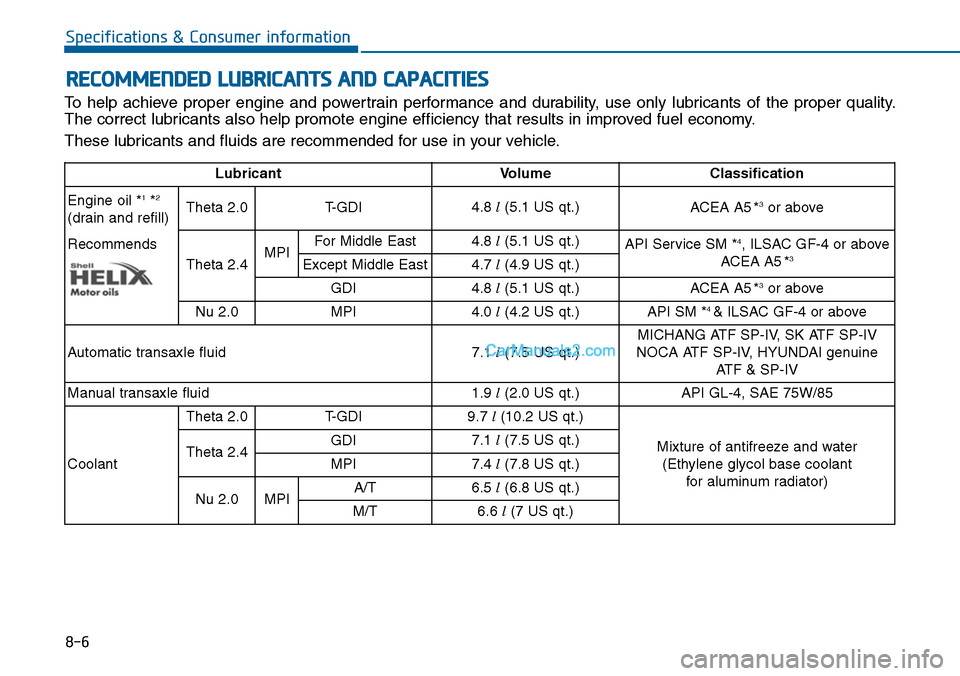
RECOMMENDED LUBRICANTS AND CAPACITIES
To help achieve proper engine and powertrain performance and durability, use only lubricants of the proper quality.
The correct lubricants also help promote engine efficiency that results in improved fuel economy.
These lubricants and fluids are recommended for use in your vehicle.
LubricantVo l u m e C l a s s i f i c a t i o n
Engine oil *1*2
(drain and refill)
Recommends
Theta 2.0 T-GDI4.8l(5.1 US qt.)ACEA A5 *3or above
Theta 2.4MPIFor Middle East4.8l(5.1 US qt.)API Service SM *4, ILSAC GF-4 or above
ACEA A5 *3Except Middle East4.7l(4.9 US qt.)
GDI4.8l(5.1 US qt.)ACEA A5 *3or above
Nu 2.0 MPI4.0l(4.2 US qt.)API SM *4 & ILSAC GF-4 or above
Automatic transaxle fluid7.1l(7.5 US qt.)
MICHANG ATF SP-IV, SK ATF SP-IV
NOCA ATF SP-IV, HYUNDAI genuine
AT F & S P - I V
Manual transaxle fluid1.9l(2.0 US qt.)API GL-4, SAE 75W/85
Coolant
Theta 2.0T- G D I9.7 l(10.2 US qt.)
Mixture of antifreeze and water
(Ethylene glycol base coolant
for aluminum radiator)
Theta 2.4GDI7.1 l(7.5 US qt.)
MPI7.4 l(7.8 US qt.)
Nu 2.0 MPIA/T6.5 l(6.8 US qt.)
M/T6.6 l(7 US qt.)
Page 662 of 665
8-7
8
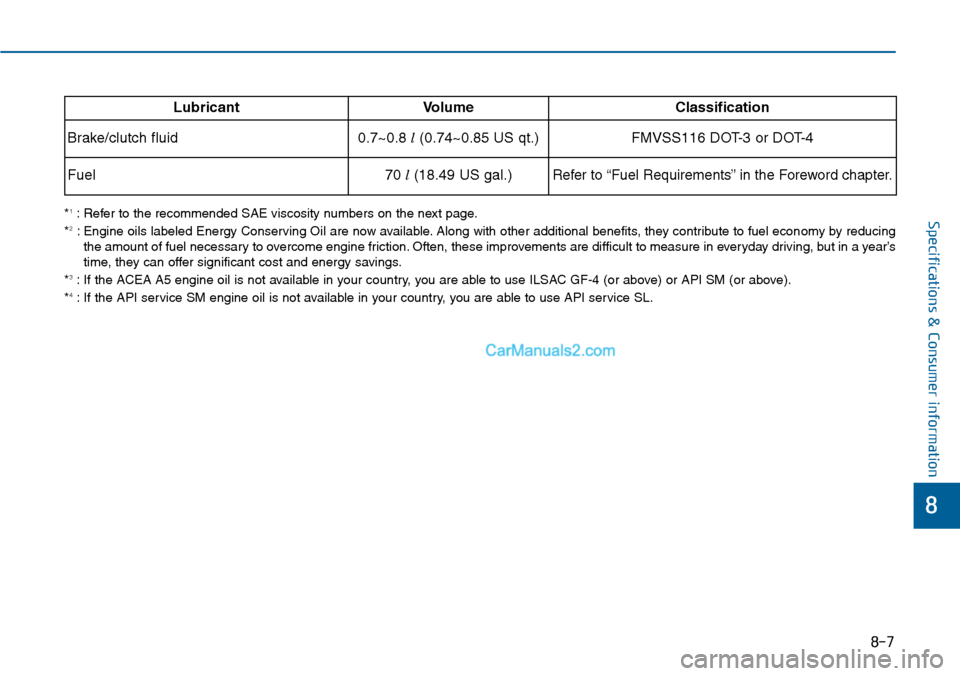
Specifications & Consumer information*1:Refer to the recommended SAE viscosity numbers on the next page.
*2:Engine oils labeled Energy Conserving Oil are now available.Along with other additional benefits, they contribute to fuel economy by reducingthe amount of fuel necessary to overcome engine friction. Often, these improvements are difficult to measure in everyday driving, but in a year’stime, they can offer significant cost and energy savings.
*3:If the ACEA A5 engine oil is not available in your country, you are able to use ILSAC GF-4 (or above) or API SM (or above).
*4:If the API service SM engine oil is not available in your country, you are able to use API service SL.
Lubricant Volume Classification
Brake/clutch fluid0.7~0.8 l(0.74~0.85 US qt.)FMVSS116 DOT-3 or DOT-4
Fuel70 l(18.49 US gal.)Refer to “Fuel Requirements” in the Foreword chapter.
Page 663 of 665
8-8
Specifications & Consumer information
Recommended SAE viscosity
number
Engine oil viscosity (thickness) has
an effect on fuel economy and cold
weather operating (engine start and
engine oil flowability). Lower viscosi-
ty engine oils can provide better fuel
economy and cold weather perform-
ance, however, higher viscosity
engine oils are required for satisfac-
tory lubrication in hot weather. Using
oils of any viscosity other than those
recommended could result in engine
damage.
Always be sure to clean the area
around any filler plug, drain
plug, or dipstick before check-
ing or draining any lubricant.
This is especially important in
dusty or sandy areas and when
the vehicle is used on unpaved
roads. Cleaning the plug and
dipstick areas will prevent dirt
and grit from entering the
engine and other mechanisms
that could be damaged.
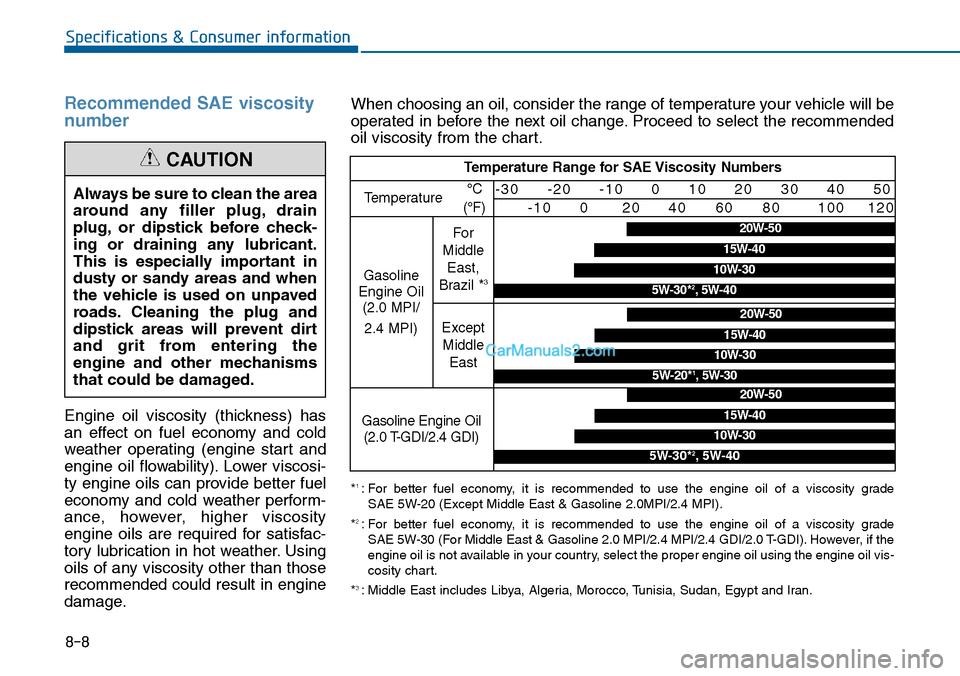
CAUTIONTemperature Range for SAE Viscosity Numbers
Temperature
Gasoline Engine Oil(2.0 MPI/
2.4 MPI)
°C
(°F)
-30 -20 -10 0 10 20 30 40 50
-10 0 20 40 60 80 100 120
*1 :For better fuel economy, it is recommended to use the engine oil of a viscosity grade SAE 5W-20 (Except Middle East & Gasoline 2.0MPI/2.4 MPI).
*2 :For better fuel economy, it is recommended to use the engine oil of a viscosity grade SAE 5W-30 (For Middle East & Gasoline 2.0 MPI/2.4 MPI/2.4 GDI/2.0 T-GDI). However, if theengine oil is not available in your country, select the proper engine oil using the engine oil vis-cosity chart.
*3:Middle East includes Libya, Algeria, Morocco, Tunisia, Sudan, Egypt and Iran.
20W-50
10W-30
15W-40
5W-30*2,5W-40
Gasoline Engine Oil(2.0 T-GDI/2.4 GDI)
For
Middle
East,
Brazil *3
20W-50
10W-30
15W-40
5W-20*1,5W-30
Except
Middle
East
20W-50
10W-30
15W-40
5W-30*2,5W-40
When choosing an oil, consider the range of temperature your vehicle will be
operated in before the next oil change. Proceed to select the recommended
oil viscosity from the chart.