water Hyundai Sonata 2014 Service Manual
[x] Cancel search | Manufacturer: HYUNDAI, Model Year: 2014, Model line: Sonata, Model: Hyundai Sonata 2014Pages: 665, PDF Size: 17.43 MB
Page 600 of 665
7-43
7
Maintenance
(Continued)
If any electrolyte gets
into your eyes, flush
your eyes with clean
water for at least 15 min-
utes and get immediate
medical attention. If elec-
trolyte gets on your skin,
thoroughly wash the
contacted area. If you
feel a pain or a burning
sensation, get medical
attention immediately.
Wear eye protection
when charging or work-
ing near a battery.
Always provide ventila-
tion when working in an
enclosed space.
An inappropriately dis-
posed battery can be
harmful to the environ-
ment and human health.
Dispose the battery
according to your local
law(s) or regulation.
(Continued)
(Continued)
•When lifting a plastic-cased
battery, excessive pressure
on the case may cause battery
acid to leak, resulting in per-
sonal injury. Lift with a battery
carrier or with your hands on
opposite corners.
•Never attempt to recharge the
battery when the battery
cables are connected.
•The electrical ignition system
works with high voltage.
Never touch these compo-
nents with the engine running
or the ignition switch is in the
on position.
Failure to follow the above
warnings can result in serious
bodily injury or death.
If you connect unauthorized
electronic devices to the bat-
tery, the battery may be dis-
charged. Never use unautho-
rized devices.
CAUTION
Page 619 of 665
7-62
Maintenance
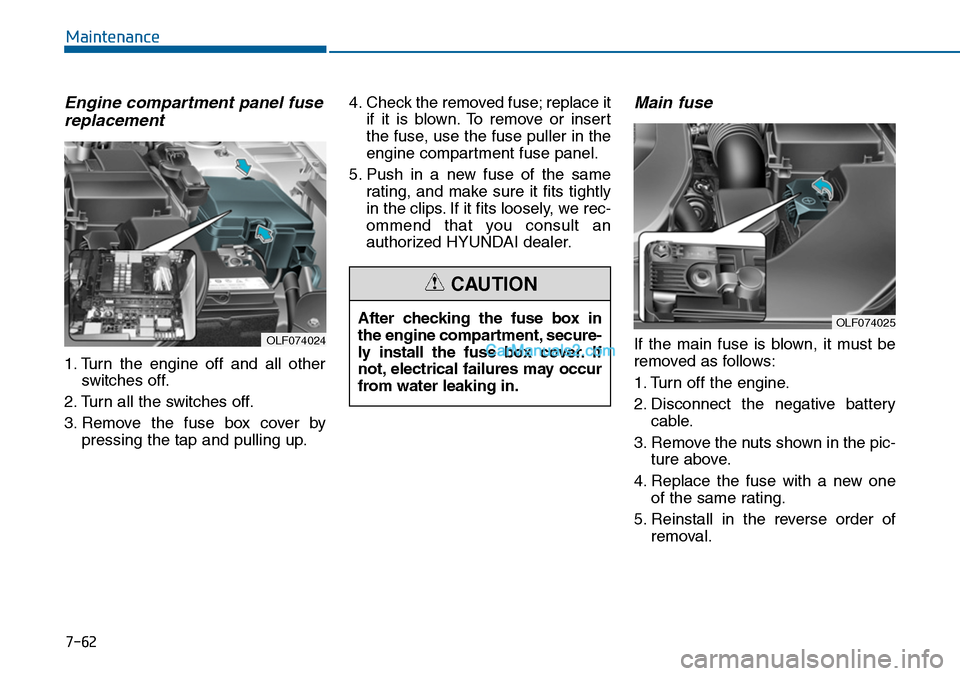
Engine compartment panel fuse
replacement
1. Turn the engine off and all other
switches off.
2. Turn all the switches off.
3. Remove the fuse box cover by
pressing the tap and pulling up.
4. Check the removed fuse; replace it
if it is blown. To remove or insert
the fuse, use the fuse puller in the
engine compartment fuse panel.
5. Push in a new fuse of the same
rating, and make sure it fits tightly
in the clips. If it fits loosely, we rec-
ommend that you consult an
authorized HYUNDAI dealer.
Main fuse
If the main fuse is blown, it must be
removed as follows:
1. Turn off the engine.
2. Disconnect the negative battery
cable.
3. Remove the nuts shown in the pic-
ture above.
4. Replace the fuse with a new one
of the same rating.
5. Reinstall in the reverse order of
removal.
OLF074025After checking the fuse box in
the engine compartment, secure-
ly install the fuse box cover. If
not, electrical failures may occur
from water leaking in.
CAUTION
OLF074024
Page 629 of 665
7-72
Maintenance
LIGHT BULBS
Use only the bulbs of the specified
wattage.
After heavy driving, rain or wash-
ing, headlamp and tail lamp lens-
es could appear frosty. This condi-
tion is caused by the temperature
difference between the lamp
inside and outside. This is similar
to the condensation on your win-
dows inside your vehicle during
the rain and doesn’t indicate a
problem with your vehicle. If the
water leaks into the lamp bulb cir-
cuitry, we recommend that the
system be checked by an author-
ized HYUNDAI dealer.
❈Traffic Change (For Europe)
The low beam light distribution is
asymmetric. If you go abroad to a
country with opposite traffic direc-
tion, this asymmetric part will dazzle
oncoming car driver. To prevent daz-
zle, ECE regulation demand several
technical solutions (ex. automatic
change system, adhesive sheet,
down aiming). These headlamps are
designed not to dazzle opposite driv-
ers. So, you need not change your
headlamps in a country with oppo-
site traffic direction.
NOTICE
Be sure to replace the burned-
out bulb with one of the same
wattage rating. Otherwise, it
may cause damage to the fuse
or electric wiring system.
CAUTION
If you don’t have necessary
tools, the correct bulbs and the
expertise, consult an authorized
HYUNDAI dealer. In many cases,
it is difficult to replace vehicle
light bulbs because other parts
of the vehicle must be removed
before you can get to the bulb.
This is especially true if you
have to remove the headlamp
assembly to get to the bulb(s).
Removing/installing the head-
lamp assembly can result in
damage to the vehicle.
CAUTION
Working on the lights
Prior to working on the light, firm-
ly apply the parking brake,
ensure that the Engine Start/Stop
button is turned to the OFF posi-
tion and turn off the lights to
avoid sudden movement of the
vehicle and burning your fingers
or receiving an electric shock.
WARNING
Page 644 of 665
7-87
7
Maintenance
APPEARANCE CARE
Exterior care
Exterior general caution
It is very important to follow the label
directions when using any chemical
cleaner or polish. Read all warning
and caution statements that appear
on the label.
Finish maintenance
Washing
To help protect your vehicle’s finish
from rust and deterioration, wash it
thoroughly and frequently at least
once a month with lukewarm or cold
water.
If you use your vehicle for off-road
driving, you should wash it after each
off-road trip. Pay special attention to
the removal of any accumulation of
salt, dirt, mud, and other foreign
materials. Make sure the drain holes
in the lower edges of the doors and
rocker panels are kept clear and
clean.
Insects, tar, tree sap, bird droppings,
industrial pollution and similar
deposits can damage your vehicle’s
finish if not removed immediately.
Even prompt washing with plain
water may not completely remove all
these deposits.
A mild soap, safe for use on painted
surfaces, may be used.
After washing, rinse the vehicle thor-
oughly with lukewarm or cold water.
Do not allow soap to dry on the fin-
ish.
•Do not use strong soap,
chemical detergents or hot
water, and do not wash the
vehicle in direct sunlight or
when the body of the vehicle
is warm.
•Be careful when washing the
side windows of your vehicle.
Especially, with high-pressure
water, water may leak through
the windows and wet the inte-
rior.
•To p r e v e n t d a m a g e t o t h e
plastic parts and lamps, do
not clean with chemical sol-
vents or strong detergents.
CAUTION
Page 645 of 665
7-88
Maintenance
Waxing
Wax the vehicle when water will no
longer bead on the paint.
Always wash and dry the vehicle
before waxing. Use a good quality
liquid or paste wax, and follow the
manufacturer’s instructions. Wax all
metal trim to protect it and to main-
tain its luster. Removing oil, tar, and
similar materials with a spot remover
will usually strip the wax from the fin-
ish. Be sure to re-wax these areas
even if the rest of the vehicle does
not yet need waxing.
Wet brakes
After washing the vehicle, test
the brakes while driving slowly
to see if they have been affected
by water. If braking performance
is impaired, dry the brakes by
applying them lightly while
maintaining a slow forward
speed.
WARNING
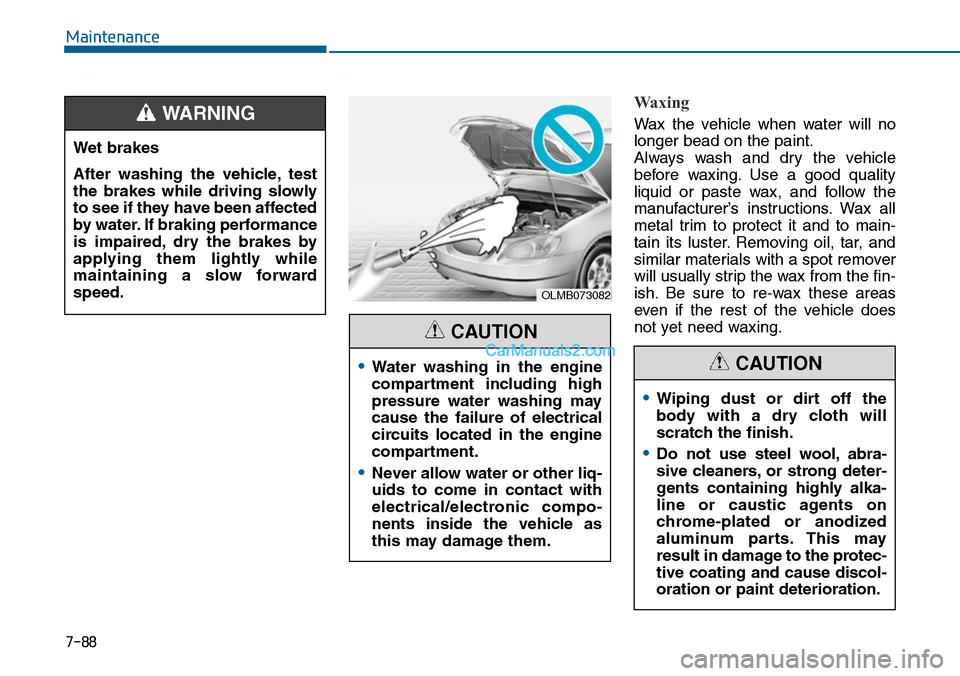
•Water washing in the engine
compartment including high
pressure water washing may
cause the failure of electrical
circuits located in the engine
compartment.
•Never allow water or other liq-
uids to come in contact with
electrical/electronic compo-
nents inside the vehicle as
this may damage them.
CAUTION
•Wiping dust or dirt off the
body with a dry cloth will
scratch the finish.
•Do not use steel wool, abra-
sive cleaners, or strong deter-
gents containing highly alka-
line or caustic agents on
chrome-plated or anodized
aluminum parts. This may
result in damage to the protec-
tive coating and cause discol-
oration or paint deterioration.
CAUTION
OLMB073082
Page 646 of 665
7-89
7
Maintenance
Finish damage repair
Deep scratches or stone chips in the
painted surface must be repaired
promptly. Exposed metal will quickly
rust and may develop into a major
repair expense.
If your vehicle is damaged and
requires any metal repair or
replacement, be sure the body
shop applies anti-corrosion materi-
als to the parts repaired or replaced.
Bright-metal maintenance
•To remove road tar and insects,
use a tar remover, not a scraper or
other sharp object.
•To protect the surfaces of bright-
metal parts from corrosion, apply a
coating of wax or chrome preser-
vative and rub to a high luster.
•During winter weather or in coastal
areas, cover the bright metal parts
with a heavier coating of wax or
preservative. If necessary, coat the
parts with non-corrosive petroleum
jelly or other protective compound.
Underbody maintenance
Corrosive materials used for ice and
snow removal and dust control may
collect on the underbody. If these
materials are not removed, acceler-
ated rusting can occur on underbody
parts such as the fuel lines, frame,
floor pan and exhaust system, even
though they have been treated with
rust protection.
Thoroughly flush the vehicle under-
body and wheel openings with luke-
warm or cold water once a month,
after off-road driving and at the end of
each winter. Pay special attention to
these areas because it is difficult to
see all the mud and dirt. It will do
more harm than good to wet down the
road grime without removing it. The
lower edges of doors, rocker panels,
and frame members have drain holes
that should not be allowed to clog with
dirt; trapped water in these areas can
cause rusting.
NOTICE
Page 647 of 665
7-90
Maintenance
Aluminum wheel maintenance
The aluminum wheels are coated with
a clear protective finish.
Corrosion protection
Protecting your vehicle from corro-
sion
By using the most advanced design
and construction practices to combat
corrosion, we produces cars of the
highest quality. However, this is only
part of the job. To achieve the long-
term corrosion resistance your vehi-
cle can deliver, the owner's coopera-
tion and assistance is also required.
Common causes of corrosion
The most common causes of corro-
sion on your car are:
• Road salt, dirt and moisture that is
allowed to accumulate underneath
the car.
• Removal of paint or protective
coatings by stones, gravel, abra-
sion or minor scrapes and dents
which leave unprotected metal
exposed to corrosion.
After washing the vehicle, test
the brakes while driving slowly
to see if they have been affected
by water. If braking performance
is impaired, dry the brakes by
applying them lightly while
maintaining a slow forward
speed.
WARNING
•Do not use any abrasive
cleaner, polishing compound,
solvent, or wire brushes on
aluminum wheels.
•Clean the wheel when it has
cooled.
•Use only a mild soap or neu-
tral detergent, and rinse thor-
oughly with water. Also, be
sure to clean the wheels after
driving on salted roads.
•Do not wash the wheels with
high-speed car wash brushes.
•Do not use any cleanser con-
taining acid or alkaline deter-
gents.
CAUTION
Page 648 of 665
7-91
7
Maintenance
High-corrosion areas
If you live in an area where your car
is regularly exposed to corrosive
materials, corrosion protection is
particularly important. Some of the
common causes of accelerated cor-
rosion are road salts, dust control
chemicals, ocean air and industrial
pollution.
Moisture breeds corrosion
Moisture creates the conditions in
which corrosion is most likely to
occur. For example, corrosion is
accelerated by high humidity, partic-
ularly when temperatures are just
above freezing. In such conditions,
the corrosive material is kept in con-
tact with the car surfaces by moisture
that is slow to evaporate.
Mud is particularly corrosive
because it is slow to dry and holds
moisture in contact with the vehicle.
Although the mud appears to be dry,
it can still retain the moisture and
promote corrosion.
High temperatures can also acceler-
ate corrosion of parts that are not
properly ventilated so the moisture
can be dispersed. For all these rea-
sons, it is particularly important to
keep your car clean and free of mud
or accumulations of other materials.
This applies not only to the visible
surfaces but particularly to the
underside of the car.
To help prevent corrosion
Yo u c a n h e l p p r e v e n t c o r r o s i o n f r o m
getting started by observing the fol-
lowing:
Keep your car clean
The best way to prevent corrosion is
to keep your car clean and free of
corrosive materials. Attention to the
underside of the car is particularly
important.
• If you live in a high-corrosion area
— where road salts are used, near
the ocean, areas with industrial
pollution, acid rain, etc.—, you
should take extra care to prevent
corrosion. In winter, hose off the
underside of your car at least once
a month and be sure to clean the
underside thoroughly when winter
is over.
• When cleaning underneath the car,
give particular attention to the
components under the fenders and
other areas that are hidden from
view. Do a thorough job; just damp-
ening the accumulated mud rather
than washing it away will acceler-
ate corrosion rather than prevent
it. Water under high pressure and
steam are particularly effective in
removing accumulated mud and
corrosive materials.
Page 649 of 665
7-92
Maintenance
• When cleaning lower door panels,
rocker panels and frame mem-
bers, be sure that drain holes are
kept open so that moisture can
escape and not be trapped inside
to accelerate corrosion.
Keep your garage dry
Don't park your car in a damp, poor-
ly ventilated garage. This creates a
favorable environment for corrosion.
This is particularly true if you wash
your car in the garage or drive it into
the garage when it is still wet or cov-
ered with snow, ice or mud. Even a
heated garage can contribute to cor-
rosion unless it is well ventilated so
moisture is dispersed.
Keep paint and trim in good con-
dition
Scratches or chips in the finish
should be covered with "touch-up"
paint as soon as possible to reduce
the possibility of corrosion. If bare
metal is showing through, the atten-
tion of a qualified body and paint
shop is recommended.
Bird droppings : Bird droppings are
highly corrosive and may damage
painted surfaces in just a few hours.
Always remove bird droppings as
soon as possible.
Don't neglect the interior
Moisture can collect under the floor
mats and carpeting to cause corro-
sion. Check under the mats periodi-
cally to be sure the carpeting is dry.
Use particular care if you carry fertil-
izers, cleaning materials or chemi-
cals in the car.
These should be carried only in
proper containers and any spills or
leaks should be cleaned up, flushed
with clean water and thoroughly
dried.
Page 650 of 665
7-93
7
Maintenance
Interior care
Interior general precautions
Prevent chemicals such as perfume,
cosmetic oil, sun cream, hand clean-
er and air freshener from contacting
the interior parts because they may
cause damage or discoloration. If
they do contact the interior parts,
wipe them off immediately.
See the instructions that follow for
the proper way to clean vinyl.
Cleaning the upholstery and
interior trim
Vinyl
Remove dust and loose dirt from
vinyl with a whisk broom or vacuum
cleaner. Clean vinyl surfaces with a
vinyl cleaner.
Fabric
Remove dust and loose dirt from fab-
ric with a whisk broom or vacuum
cleaner. Clean with a mild soap solu-
tion recommended for upholstery or
carpets. Remove fresh spots imme-
diately with a fabric spot cleaner. If
fresh spots do not receive immediate
attention, the fabric can be stained
and its color can be affected. Also, its
fire-resistant properties can be
reduced if the material is not proper-
ly maintained.
Never allow water or other liq-
uids to come in contact with
electrical/electronic compo-
nents inside the vehicle as this
may damage them.
CAUTION
When cleaning leather products
(steering wheel, seats etc.), use
neutral detergents or low alco-
hol content solutions. If you use
high alcohol content solutions
or acid/alkaline detergents, the
color of the leather may fade or
the surface may get stripped
off.
CAUTION
Using anything but recom-
mended cleaners and proce-
dures may affect the fabric’s
appearance and fire-resistant
properties.
CAUTION