cooling Hyundai Sonata 2015 User Guide
[x] Cancel search | Manufacturer: HYUNDAI, Model Year: 2015, Model line: Sonata, Model: Hyundai Sonata 2015Pages: 603, PDF Size: 14.7 MB
Page 461 of 603
6-7
What to do in an emergency
6
If your temperature gauge indicates
overheating, you experience a loss
of power, or hear loud pinging or
knocking, the engine may be over-
heating. If this happens, you should:
1. Pull off the road and stop as soonas it is safe to do so.
2. Place the shift lever in P (Park) and set the parking brake. If the air
conditioning is ON, turn it OFF.
3. If engine coolant is running out under the vehicle or steam is com-
ing out from the hood, stop the
engine. Do not open the hood until
the coolant has stopped running
or the steaming has stopped. If
there is no visible loss of engine
coolant and no steam, leave the
engine running and check to be
sure the engine cooling fan is
operating. If the fan is not running,
turn the engine off. 4. Check for coolant leaking from the
radiator, hoses or under the vehi-
cle. (If the air conditioning had
been in use, it is normal for cold
water to be draining from it when
you stop.)
5. If engine coolant is leaking out, stop the engine immediately and
call the nearest authorized
HYUNDAI dealer for assistance.
I IF
F
T
T H
H E
E
E
E N
N G
GI
IN
N E
E
O
O V
VE
ER
R H
H E
EA
A T
TS
S
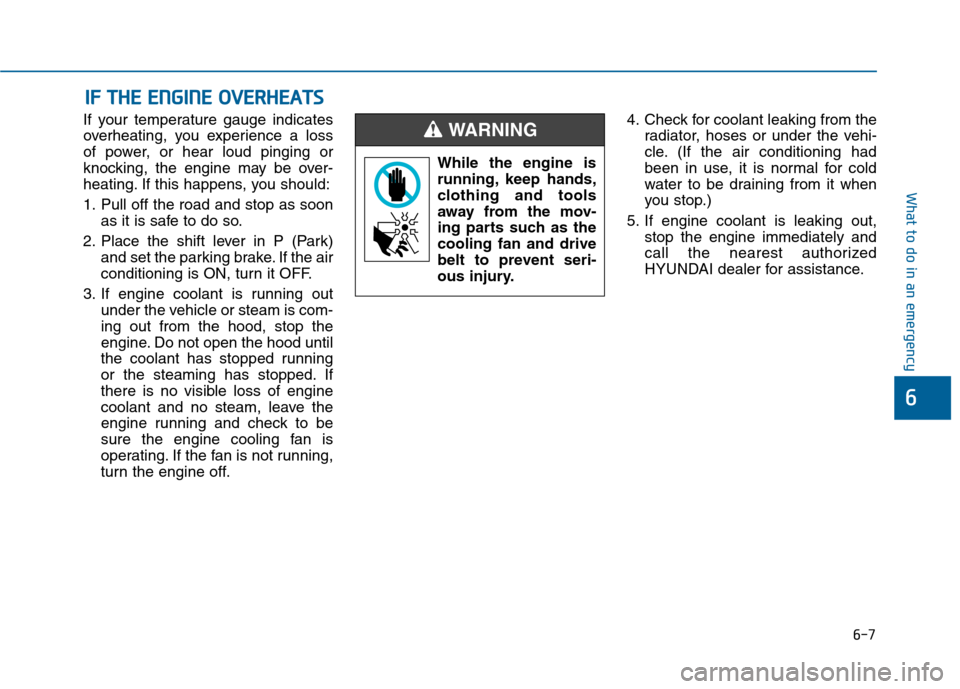
While the engine is
running, keep hands,
clothing and tools
away from the mov-
ing parts such as the
cooling fan and drive
belt to prevent seri-
ous injury.
WARNING
Page 462 of 603
6-8
What to do in an emergency6. If you cannot find the cause of theoverheating, wait until the engine
temperature has returned to nor-
mal. Then, if coolant has been
lost, carefully add coolant to the
reservoir to bring the fluid level in
the reservoir up to the halfway
mark.
7. Proceed with caution, keeping alert for further signs of overheat-
ing. If overheating happens again,
call an authorized HYUNDAI deal-
er for assistance.
Serious loss of coolant indi-
cates a leak in the cooling sys-
tem and should be checked as
soon as possible by an author-
ized HYUNDAI dealer.
CAUTION
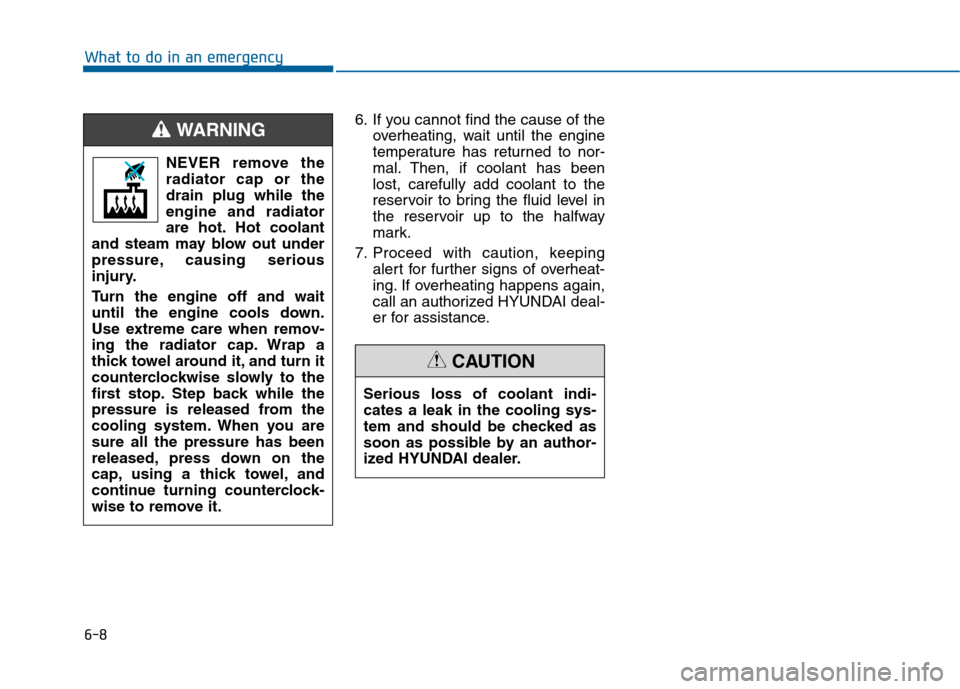
NEVER remove the
radiator cap or the
drain plug while the
engine and radiator
are hot. Hot coolant
and steam may blow out under
pressure, causing serious
injury.
Turn the engine off and wait
until the engine cools down.
Use extreme care when remov-
ing the radiator cap. Wrap a
thick towel around it, and turn it
counterclockwise slowly to the
first stop. Step back while the
pressure is released from the
cooling system. When you are
sure all the pressure has been
released, press down on the
cap, using a thick towel, and
continue turning counterclock-
wise to remove it.
WARNING
Page 487 of 603
7
Maintenance
7
Maintenance
Engine Compartment ............................................7-3
Maintenance Services ...........................................7-6
Owner's Responsibility .....................................................7-6
Owner Maintenance Precautions..................................7-6
Owner Maintenance ..............................................7-7
Owner Maintenance Schedule .......................................7-8
Scheduled Maintenance Services........................7-9
Normal Maintenance Schedule ....................................7-10
Maintenance Under Severe Usage Conditions ........7-20
Explanation of Scheduled Maintenance Items ..7-21
Engine Oil and Filter.......................................................7-21
Drive Belts........................................................................\
.7-21
Fuel Filter ........................................................................\
..7-21
Fuel Lines, Fuel Hoses and Connections ..................7-21
Vapor Hose and Fuel Filler Cap ...................................7-21
Air Cleaner Filter .............................................................7-21
Spark Plugs .......................................................................7\
-21
Valve Clearance ...............................................................7-22
Cooling System ................................................................7-22
Engine Coolant .................................................................7-22
Automatic Transmission Fluid ......................................7-22
Dual Clutch Transmission Fluid ....................................7-22
Brake hoses and Lines ..................................................7-23
Brake Fluid ........................................................................\
7-23
Parking Brake...................................................................7-23Brake Discs, Pads, Calipers and Rotors .....................7-23
Exhaust Pipe and Muffler.............................................7-23
Suspension Mounting Bolts ..........................................7-23
Steering Gear Box, Linkage &
Boots/Lower Arm Ball Joint .........................................7-23
Drive Shafts and Boots .................................................7-23
Air Conditioning Refrigerant ........................................7-23
Engine Oil ..............................................................7-24
Checking the Engine Oil Level .....................................7-24
Checking the Engine Oil and Filter .............................7-26
Engine Coolant .....................................................7-27
Checking the Engine Coolant Level ............................7-27
Changing Engine Coolant ..............................................7-29
Brake Fluid ............................................................7-30
Checking the Brake Fluid Level ...................................7-30
Washer Fluid .........................................................7-31
Checking the Washer Fluid Level................................7-31
Parking Brake .......................................................7-31
Checking the Parking Brake .........................................7-31
Air Cleaner ............................................................7-32
Filter Replacement ..........................................................7-32
Climate Control Air Filter ....................................7-34
Filter Inspection ...............................................................7-34
7
Page 508 of 603
7-22
Maintenance
Valve Clearance (if equipped)
Inspect for excessive valve noise
and/or engine vibration and adjust if
necessary. Have an authorized
HYUNDAI dealer perform the opera-
tion.
Cooling System
Check cooling system components,
such as radiator, coolant reservoir,
hoses and connections for leakage
and damage. Replace any damaged
parts.
Engine Coolant
The coolant should be changed at
the intervals specified in the mainte-
nance schedule.
Automatic Transmission Fluid
Automatic transmission fluid should
not be checked under normal usage
conditions. But in severe conditions,
the fluid should be changed at an
authorized HYUNDAI dealer in accor-
dance to the scheduled maintenance
at the beginning of this chapter.
Automatic transmission fluid
color is basically red.
As the vehicle is driven, the auto-
matic transmission fluid will begin
to look darker. This is a normal
condition and you should not
judge the need to replace the fluid
based upon the changed color.
Dual Clutch Transmission Fluid
Inspect the dual clutch transmission
fluid according to the maintenance
schedule.
NOTICE
The use of a non-specified fluid
could result in transmission
malfunction and failure. Use
only the specified automatic
transmission fluid (refer to
“Recommended Lubricants and
Capacities” in chapter 8).
CAUTION
Page 513 of 603
7-27
7
Maintenance
E
EN
N G
GI
IN
N E
E
C
C O
O O
OL
LA
A N
N T
T
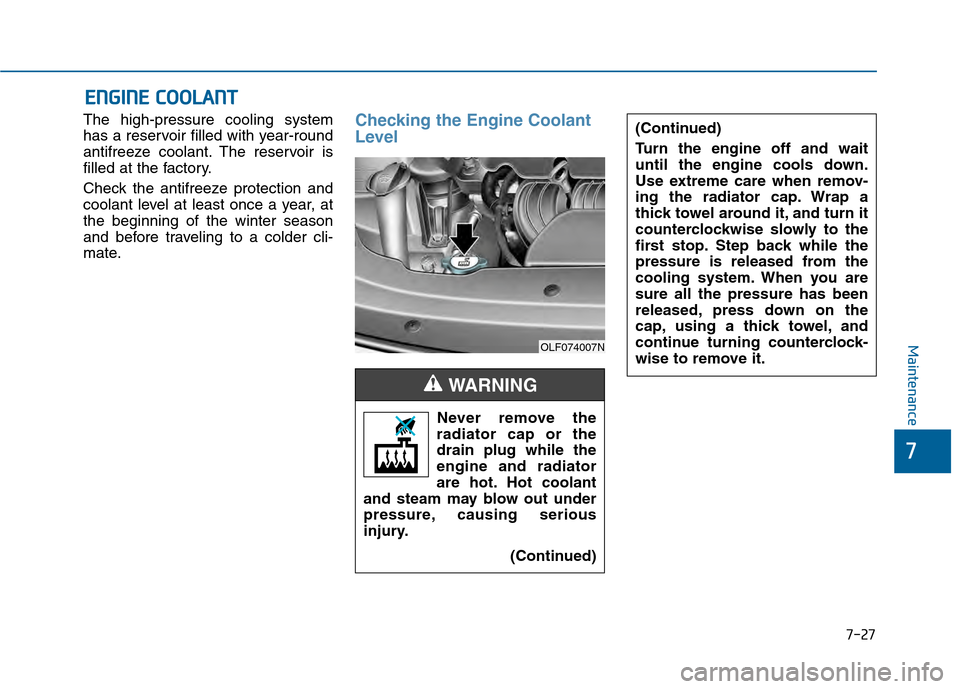
The high-pressure cooling system
has a reservoir filled with year-round
antifreeze coolant. The reservoir is
filled at the factory.
Check the antifreeze protection and
coolant level at least once a year, at
the beginning of the winter season
and before traveling to a colder cli-
mate.Checking the Engine Coolant
Level
Never remove the
radiator cap or the
drain plug while the
engine and radiator
are hot. Hot coolant
and steam may blow out under
pressure, causing serious
injury.
(Continued)
WARNING
(Continued)
Turn the engine off and wait
until the engine cools down.
Use extreme care when remov-
ing the radiator cap. Wrap a
thick towel around it, and turn it
counterclockwise slowly to the
first stop. Step back while the
pressure is released from the
cooling system. When you are
sure all the pressure has been
released, press down on the
cap, using a thick towel, and
continue turning counterclock-
wise to remove it.
OLF074007N
Page 514 of 603
7-28
Maintenance
The electric motor for the cooling fan
is controlled by engine coolant tem-
perature, refrigerant pressure and
vehicle speed. As the engine coolant
temperature decreases, the electric
motor will automatically shut off. This
is a normal condition. If your vehicle
is equipped with GDI, the electric
motor for the cooling fan may begin
to operate at any time and continue
to operate until you disconnect the
negative battery cable. Check the condition and connections
of all cooling system hoses and
heater hoses. Replace any swollen
or deteriorated hoses.
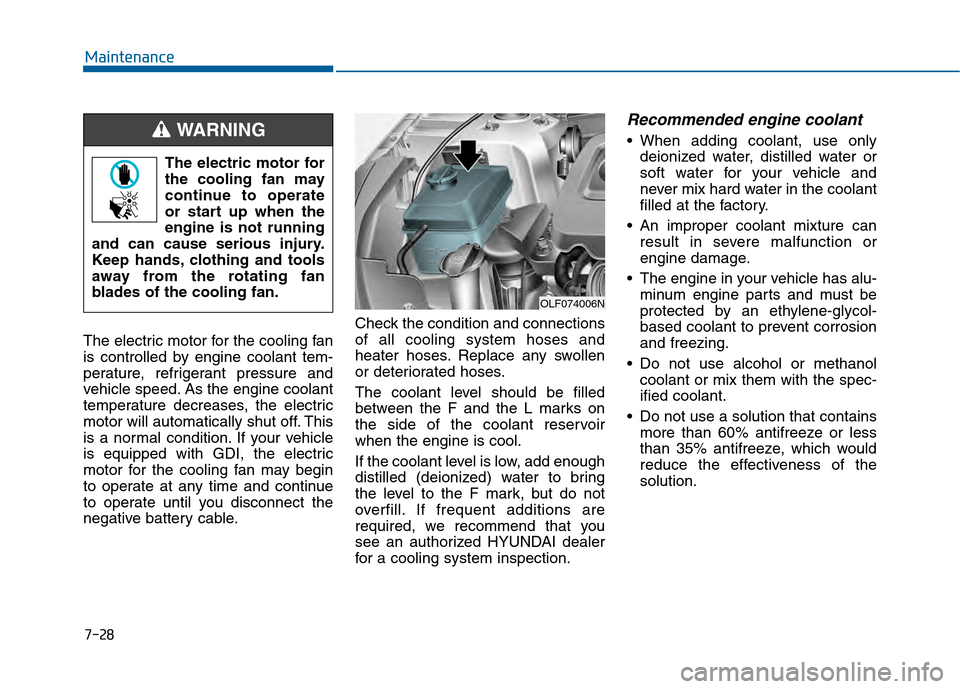
The coolant level should be filled
between the F and the L marks on
the side of the coolant reservoir
when the engine is cool.
If the coolant level is low, add enough
distilled (deionized) water to bring
the level to the F mark, but do not
overfill. If frequent additions are
required, we recommend that you
see an authorized HYUNDAI dealer
for a cooling system inspection.
Recommended engine coolant
When adding coolant, use only
deionized water, distilled water or
soft water for your vehicle and
never mix hard water in the coolant
filled at the factory.
An improper coolant mixture can result in severe malfunction or
engine damage.
The engine in your vehicle has alu- minum engine parts and must be
protected by an ethylene-glycol-
based coolant to prevent corrosion
and freezing.
Do not use alcohol or methanol coolant or mix them with the spec-
ified coolant.
Do not use a solution that contains more than 60% antifreeze or less
than 35% antifreeze, which would
reduce the effectiveness of the
solution.
The electric motor for
the cooling fan may
continue to operate
or start up when the
engine is not running
and can cause serious injury.
Keep hands, clothing and tools
away from the rotating fan
blades of the cooling fan.WARNING
OLF074006N
Page 552 of 603
![Hyundai Sonata 2015 User Guide 7-66
Maintenance
Engine compartment main fuse panel
Fuse NameFuse rating Protected Component
MULTIFUSE
(TYPE A)
IG230A[Without Smart Key] Relay 8 (Start Relay), Ignition Switch,
[With Smart Key] Rela](/img/35/16796/w960_16796-551.png "Hyundai Sonata 2015 User Guide 7-66
Maintenance
Engine compartment main fuse panel
Fuse NameFuse rating Protected Component
MULTIFUSE
(TYPE A)
IG230A[Without Smart Key] Relay 8 (Start Relay), Ignition Switch,
[With Smart Key] Rela")
7-66
Maintenance
Engine compartment main fuse panel
Fuse NameFuse rating Protected Component
MULTIFUSE
(TYPE A)
IG230A[Without Smart Key] Relay 8 (Start Relay), Ignition Switch,
[With Smart Key] Relay 8 (Start Relay), PCB Block (IG2 Relay)
3 TCU40A[G4FJ - DCT] TCM
BLOWER40ARelay 3 (Blower Relay)
1 ABS40AESC Module
REAR HEATED50ARelay 1 (Rear Heated Relay)
1 B+50ASmart Junction Block (IPS2 (4CH), IPS3 (4CH), Fuse - F28/F29)
1 COOLING FAN50A[G4KH/G4FJ] Relay 11 (Cooling Fan Relay), [G4KJ] Relay 12 (Cooling Fan Relay)
2 COOLING FAN60A[G4KH/G4FJ] Relay 12 (Cooling Fan Relay)
1 MDPS80AMDPS Unit (Column Type)
MULTI FUSE
(TYPE B)
2 ABS30AESC Module, Multipurpose Check Connector
IG140A[Without Smart Key] Ignition Switch, [With Smart Key] PCB Block (IG1/ACC Relay)
4 TCU40A[G4FJ - DCT] TCM
3 POWER OUTLET40ARelay 5 (Power Outlet Relay)
2 B+50ASmart Junction Block (IPS1 (4CH), IPS4 (4CH), IPS5 (4CH), Fuse - F36)
5 B+60APCB Block (Engine Control Relay, Fuse - F4/F5/F6/F13/F14/F22)
1 B+60ASmart Junction Block (Power Window Relay, Fuse -
F1/F2/F3/F4/F10/F13/F17/F23/F24/F30)
2 MDPS100AMDPS Unit (Rack Type)
Page 554 of 603
7-68
Maintenance
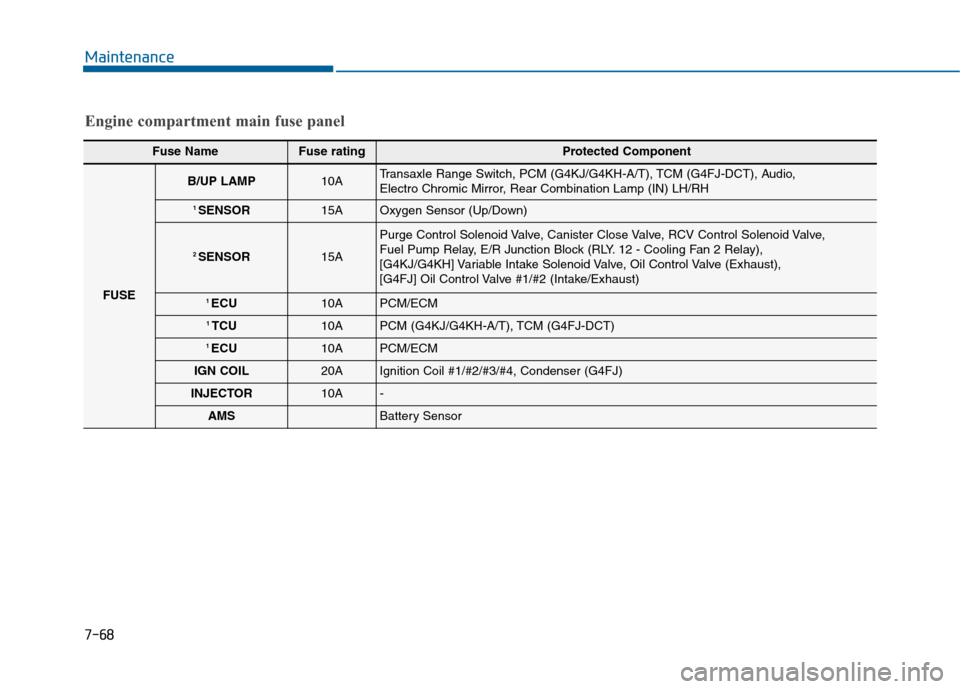
Engine compartment main fuse panel
Fuse Name Fuse rating Protected Component
FUSE
B/UP LAMP10ATransaxle Range Switch, PCM (G4KJ/G4KH-A/T), TCM (G4FJ-DCT), Audio,
Electro Chromic Mirror, Rear Combination Lamp (IN) LH/RH
1 SENSOR15AOxygen Sensor (Up/Down)
2 SENSOR15A
Purge Control Solenoid Valve, Canister Close Valve, RCV Control Solenoid Valve,
Fuel Pump Relay, E/R Junction Block (RLY. 12 - Cooling Fan 2 Relay),
[G4KJ/G4KH] Variable Intake Solenoid Valve, Oil Control Valve (Exhaust),
[G4FJ] Oil Control Valve #1/#2 (Intake/Exhaust)
1 ECU10APCM/ECM
1 TCU10APCM (G4KJ/G4KH-A/T), TCM (G4FJ-DCT)
1 ECU10APCM/ECM
IGN COIL20AIgnition Coil #1/#2/#3/#4, Condenser (G4FJ)
INJECTOR10A-
AMSBattery Sensor
Page 595 of 603
I-4
Climate control air filter .......................................3-133, 145
Climate control air filter (Replacement).........................7-34
Clock ........................................................................\
.....3-155
Clothes hanger ..............................................................3-156
Combined instrument, see instrument cluster ................3-63
Compact spare tire ..........................................................6-20
Consumer information ...................................................8-11
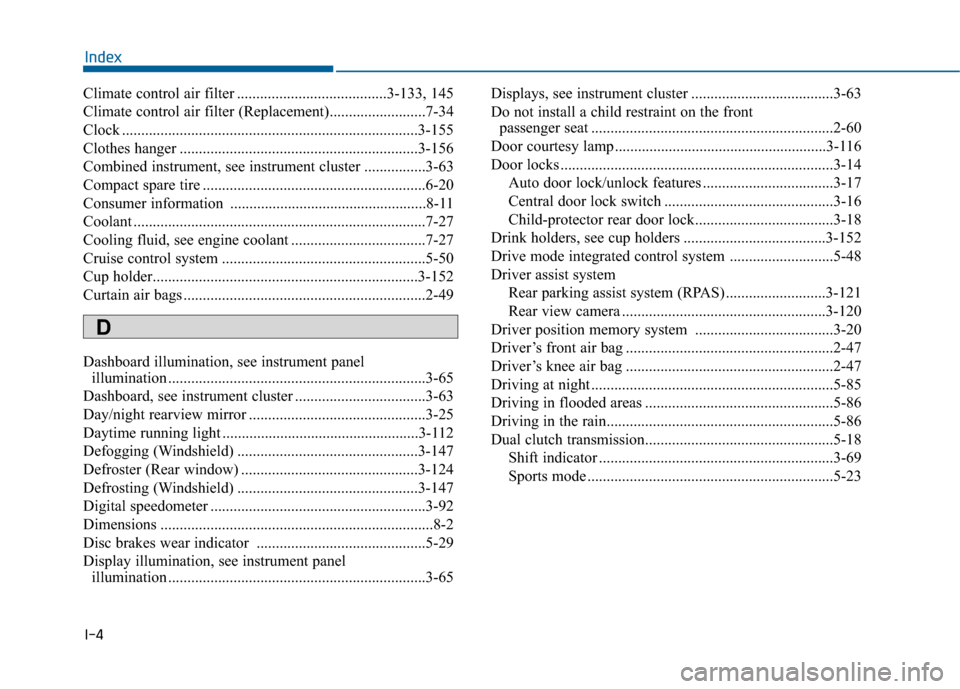
Coolant ........................................................................\
....7-27
Cooling fluid, see engine coolant ...................................7-27
Cruise control system .....................................................5-50
Cup holder.....................................................................3-1\
52
Curtain air bags ...............................................................2-49
Dashboard illumination, see instrument panel illumination ...................................................................3-65
Dashboard, see instrument cluster ..................................3-63
Day/night rearview mirror ..............................................3-25
Daytime running light ...................................................3-112
Defogging (Windshield) ...............................................3-147
Defroster (Rear window) ..............................................3-124
Defrosting (Windshield) ...............................................3-147
Digital speedometer ........................................................3-92
Dimensions .......................................................................8\
-2
Disc brakes wear indicator ............................................5-29
Display illumination, see instrument panel illumination ...................................................................3-65 Displays, see instrument cluster .....................................3-63
Do not install a child restraint on the front
passenger seat ...............................................................2-60
Door courtesy lamp .......................................................3-116
Door locks .......................................................................3\
-14 Auto door lock/unlock features ..................................3-17
Central door lock switch ............................................3-16
Child-protector rear door lock....................................3-18
Drink holders, see cup holders .....................................3-152
Drive mode integrated control system ...........................5-48
Driver assist system Rear parking assist system (RPAS) ..........................3-121
Rear view camera .....................................................3-120
Driver position memory system ....................................3-20
Driver’s front air bag ......................................................2-47
Driver’s knee air bag ......................................................2-47
Driving at night ...............................................................5-85
Driving in flooded areas .................................................5-86
Driving in the rain...........................................................5-86
Dual clutch transmission.................................................5-18 Shift indicator .............................................................3-69
Sports mode ................................................................5-23
Index
D