fuel Hyundai Sonata 2015 Repair Manual
[x] Cancel search | Manufacturer: HYUNDAI, Model Year: 2015, Model line: Sonata, Model: Hyundai Sonata 2015Pages: 603, PDF Size: 14.7 MB
Page 537 of 603
7-51
7
Maintenance
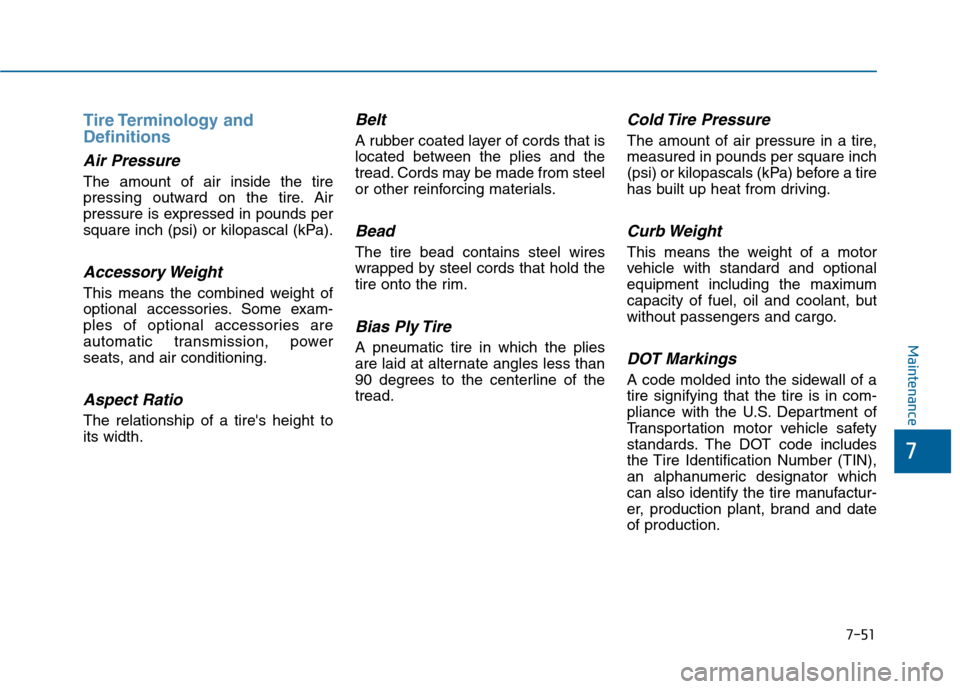
Tire Terminology and
Definitions
Air Pressure
The amount of air inside the tire
pressing outward on the tire. Air
pressure is expressed in pounds per
square inch (psi) or kilopascal (kPa).
Accessory Weight
This means the combined weight of
optional accessories. Some exam-
ples of optional accessories are
automatic transmission, power
seats, and air conditioning.
Aspect Ratio
The relationship of a tire's height to
its width.
Belt
A rubber coated layer of cords that is
located between the plies and the
tread. Cords may be made from steel
or other reinforcing materials.
Bead
The tire bead contains steel wires
wrapped by steel cords that hold the
tire onto the rim.
Bias Ply Tire
A pneumatic tire in which the plies
are laid at alternate angles less than
90 degrees to the centerline of the
tread.
Cold Tire Pressure
The amount of air pressure in a tire,
measured in pounds per square inch
(psi) or kilopascals (kPa) before a tire
has built up heat from driving.
Curb Weight
This means the weight of a motor
vehicle with standard and optional
equipment including the maximum
capacity of fuel, oil and coolant, but
without passengers and cargo.
DOT Markings
A code molded into the sidewall of a
tire signifying that the tire is in com-
pliance with the U.S. Department of
Transportation motor vehicle safety
standards. The DOT code includes
the Tire Identification Number (TIN),
an alphanumeric designator which
can also identify the tire manufactur-
er, production plant, brand and date
of production.
Page 548 of 603
7-62
Maintenance
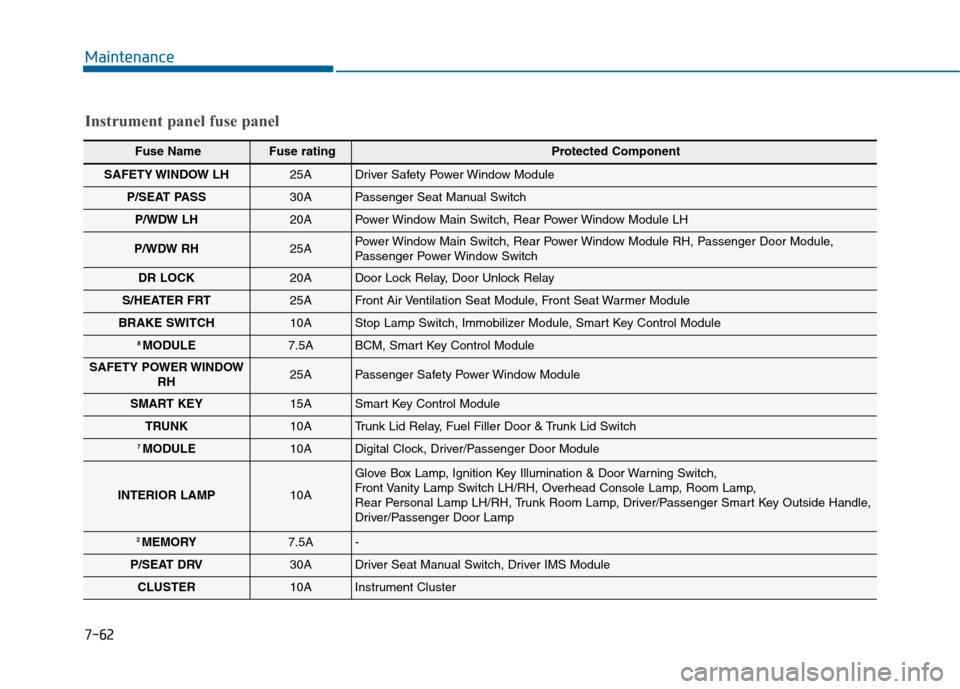
Instrument panel fuse panel
Fuse Name Fuse rating Protected Component
SAFETY WINDOW LH25ADriver Safety Power Window Module
P/SEAT PASS30APassenger Seat Manual Switch
P/WDW LH20APower Window Main Switch, Rear Power Window Module LH
P/WDW RH25APower Window Main Switch, Rear Power Window Module RH, Passenger Door Module,
Passenger Power Window Switch
DR LOCK20ADoor Lock Relay, Door Unlock Relay
S/HEATER FRT25AFront Air Ventilation Seat Module, Front Seat Warmer Module
BRAKE SWITCH10AStop Lamp Switch, Immobilizer Module, Smart Key Control Module
8 MODULE7.5ABCM, Smart Key Control Module
SAFETY POWER WINDOWRH25APassenger Safety Power Window Module
SMART KEY15ASmart Key Control Module
TRUNK10ATrunk Lid Relay, Fuel Filler Door & Trunk Lid Switch
7 MODULE10ADigital Clock, Driver/Passenger Door Module
INTERIOR LAMP10A
Glove Box Lamp, Ignition Key Illumination & Door Warning Switch,
Front Vanity Lamp Switch LH/RH, Overhead Console Lamp, Room Lamp,
Rear Personal Lamp LH/RH, Trunk Room Lamp, Driver/Passenger Smart Key Outside Handle,
Driver/Passenger Door Lamp
2 MEMORY7.5A-
P/SEAT DRV30ADriver Seat Manual Switch, Driver IMS Module
CLUSTER10AInstrument Cluster
Page 550 of 603
7-64
Maintenance
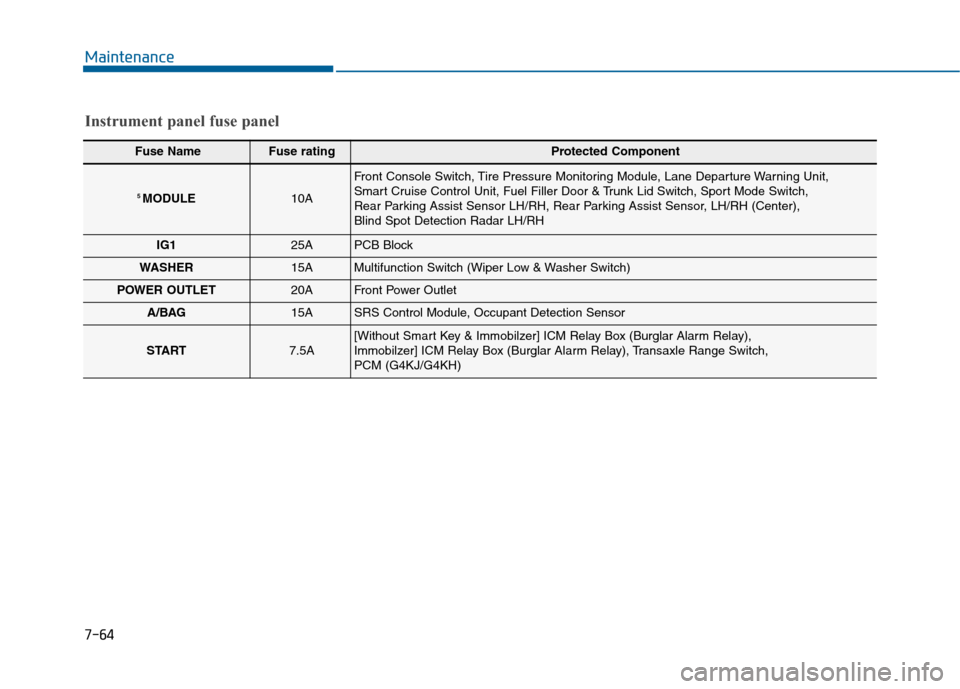
Instrument panel fuse panel
Fuse Name Fuse rating Protected Component
5 MODULE10A
Front Console Switch, Tire Pressure Monitoring Module, Lane Departure Warning Unit,
Smart Cruise Control Unit, Fuel Filler Door & Trunk Lid Switch, Sport Mode Switch,
Rear Parking Assist Sensor LH/RH, Rear Parking Assist Sensor, LH/RH (Center),
Blind Spot Detection Radar LH/RH
IG125APCB Block
WASHER15AMultifunction Switch (Wiper Low & Washer Switch)
POWER OUTLET20AFront Power Outlet
A/BAG15ASRS Control Module, Occupant Detection Sensor
START7.5A[Without Smart Key & Immobilzer] ICM Relay Box (Burglar Alarm Relay),
Immobilzer] ICM Relay Box (Burglar Alarm Relay), Transaxle Range Switch,
PCM (G4KJ/G4KH)
Page 553 of 603
![Hyundai Sonata 2015 Repair Manual 7-67
7
Maintenance
Engine compartment main fuse panel
Fuse Name Fuse rating Protected Component
FUSE
3 E-CVVT20A[G4KJ/G4KH] PCM
2 E-CVVT20A[G4KJ/G4KH] PCM
DEICER20ARelay 5 (Deicer Relay)
H/LAMP HI20A[](/img/35/16796/w960_16796-552.png "Hyundai Sonata 2015 Repair Manual 7-67
7
Maintenance
Engine compartment main fuse panel
Fuse Name Fuse rating Protected Component
FUSE
3 E-CVVT20A[G4KJ/G4KH] PCM
2 E-CVVT20A[G4KJ/G4KH] PCM
DEICER20ARelay 5 (Deicer Relay)
H/LAMP HI20A[")
7-67
7
Maintenance
Engine compartment main fuse panel
Fuse Name Fuse rating Protected Component
FUSE
3 E-CVVT20A[G4KJ/G4KH] PCM
2 E-CVVT20A[G4KJ/G4KH] PCM
DEICER20ARelay 5 (Deicer Relay)
H/LAMP HI20A[With HID] Relay 5 (Head Lamp High Relay)
1 VACUUM PUMP20A[G4KH/G4FJ] Vacuum Pump
1 E-CVVT40A[G4KJ/G4KH] Relay 9 (E-CVVT Relay)
4 B+40ASmart Junction Block (Leak Current Autocut Device Fuse - F15/F21/F22,
Fuse - F5/F6/F7/F12)
A/CON10AA/C Control Module
HEATED MIRROR10AECM (G4FJ), A/C Control Module, Drover/Passenger Power Outside Mirror
2 VACUUM PUMP10A[G4KH/G4FJ] Vacuum Pump
3 ECU10APCM/ECM
1 POWER OUTLET20ACigarette Lighter
FUEL PUMP20AFuel Pump Relay
HORN20AHorn Relay, ICM Relay Box (Burglar Alarm Horn Relay)
WIPER30AFront Wiper (Low) Relay, Front Wiper (High) Relay
2 TCU15ATransaxle Range Switch, TCM (G4FJ-DCT)
3 ABS10AESC Module, MDPS Unit
2 POWER OUTLET20ARear Power Outlet
Page 554 of 603
7-68
Maintenance
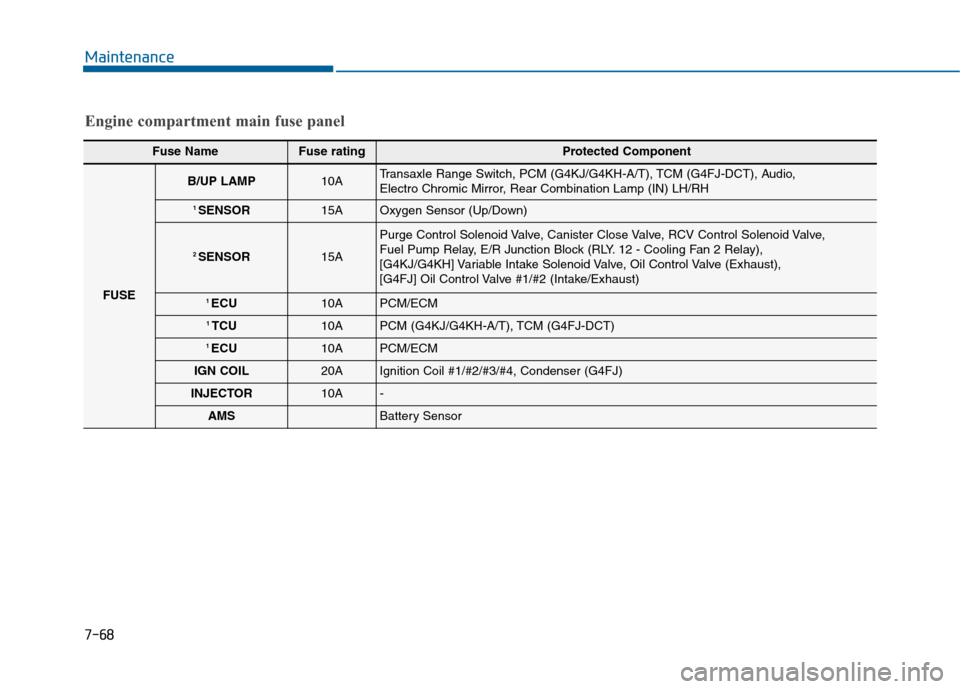
Engine compartment main fuse panel
Fuse Name Fuse rating Protected Component
FUSE
B/UP LAMP10ATransaxle Range Switch, PCM (G4KJ/G4KH-A/T), TCM (G4FJ-DCT), Audio,
Electro Chromic Mirror, Rear Combination Lamp (IN) LH/RH
1 SENSOR15AOxygen Sensor (Up/Down)
2 SENSOR15A
Purge Control Solenoid Valve, Canister Close Valve, RCV Control Solenoid Valve,
Fuel Pump Relay, E/R Junction Block (RLY. 12 - Cooling Fan 2 Relay),
[G4KJ/G4KH] Variable Intake Solenoid Valve, Oil Control Valve (Exhaust),
[G4FJ] Oil Control Valve #1/#2 (Intake/Exhaust)
1 ECU10APCM/ECM
1 TCU10APCM (G4KJ/G4KH-A/T), TCM (G4FJ-DCT)
1 ECU10APCM/ECM
IGN COIL20AIgnition Coil #1/#2/#3/#4, Condenser (G4FJ)
INJECTOR10A-
AMSBattery Sensor
Page 570 of 603
7-84
Maintenance
Finish damage repair
Deep scratches or stone chips in the
painted surface must be repaired
promptly. Exposed metal will quickly
rust and may develop into a major
repair expense.
If your vehicle is damaged and
requires any metal repair or
replacement, be sure the body
shop applies anti-corrosion mate-
rials to the parts repaired or
replaced.
Bright-metal maintenance
To remove road tar and insects,use a tar remover, not a scraper or
other sharp object.
To protect the surfaces of bright- metal parts from corrosion, apply a
coating of wax or chrome preser-
vative and rub to a high luster.
During winter weather or in coastal areas, cover the bright metal parts
with a heavier coating of wax or
preservative. If necessary, coat the
parts with non-corrosive petroleum
jelly or other protective compound.
Underbody maintenance
Corrosive materials used for ice and
snow removal and dust control may
collect on the underbody. If these
materials are not removed, acceler-
ated rusting can occur on underbody
parts such as the fuel lines, frame,
floor pan and exhaust system, even
though they have been treated with
rust protection.
Thoroughly flush the vehicle under-
body and wheel openings with luke-
warm or cold water once a month,
after off-road driving and at the end
of each winter. Pay special attention
to these areas because it is difficult
to see all the mud and dirt. It will do
more harm than good to wet down
the road grime without removing it.
The lower edges of doors, rocker
panels, and frame members have
drain holes that should not be
allowed to clog with dirt; trapped
water in these areas can cause rust-
ing.
NOTICE
Page 575 of 603
7-89
7
Maintenance
E
EM
M I
IS
S S
SI
IO
O N
N
C
C O
O N
NT
TR
R O
O L
L
S
S Y
Y S
ST
T E
EM
M
The emission control system of your
vehicle is covered by a written limited
warranty. Please see the warranty
information contained in the Owner’s
Handbook & Warranty Information
booklet in your vehicle.
Your vehicle is equipped with an
emission control system to meet all
applicable emission regulations.
There are three emission control
systems, as follows.
(1) Crankcase emission control sys-
tem
(2) Evaporative emission control sys- tem
(3) Exhaust emission control system
In order to assure the proper function
of the emission control systems, it is
recommended that you have your
vehicle inspected and maintained by
an authorized HYUNDAI dealer in
accordance with the maintenance
schedule in this manual.1. Crankcase Emission Control System
The positive crankcase ventilation
system is employed to prevent air
pollution caused by blow-by gases
being emitted from the crankcase.
This system supplies fresh filtered air
to the crankcase through the air
intake hose. Inside the crankcase,
the fresh air mixes with blow-by
gases, which then pass through the
PCV valve into the induction system.
2. Evaporative Emission ControlSystem Including Onboard
Refueling Vapor Recovery
(ORVR)
The Evaporative Emission Control
System is designed to prevent fuel
vapors from escaping into the atmos-
phere. The ORVR system is
designed to allow the vapors from
the fuel tank to be loaded into a can-
ister while refueling at the gas sta-
tion, preventing the escape of fuel
vapors into the atmosphere.
For the Inspection and
Maintenance Test (With Electronic
Stability Control (ESC) system)
To prevent the vehicle from
misfiring during dynamome-
ter testing, turn the Electronic
Stability Control (ESC) sys-
tem off by pressing the ESC
switch (ESC OFF light illumi-
nated).
After dynamometer testing is
completed, turn the ESC sys-
tem back on by pressing the
ESC switch again.
CAUTION
Page 576 of 603
7-90
Maintenance
Canister
Fuel vapors generated inside the fuel
tank are absorbed and stored in the
onboard canister. When the engine is
running, the fuel vapors absorbed in
the canister are drawn into the surge
tank through the purge control sole-
noid valve.
Purge Control Solenoid Valve(PCSV)
The purge control solenoid valve is
controlled by the Engine Control
Module (ECM); when the engine
coolant temperature is low during
idling, the PCSV closes so that evap-
orated fuel is not taken into the
engine. After the engine warms-up
during ordinary driving, the PCSV
opens to introduce evaporated fuel to
the engine.
3. Exhaust Emission Control System
The Exhaust Emission Control
System is a highly effective system
which controls exhaust emissions
while maintaining good vehicle per-
formance.
When the engine starts or fails to
start, excessive attempts to restart
the engine may cause damage to the
emission system.
Vehicle modifications
This vehicle should not be modi-
fied. Modification of your vehicle
could affect its performance, safety
or durability and may even violate
governmental safety and emis-
sions regulations.
In addition, damage or performance
problems resulting from any modifi-
cation may not be covered under
warranty.
If you use unauthorized electronic devices, it may cause the vehicle to
operate abnormally, wire damage,
battery discharge and fire. For your
safety, do not use unauthorized
electronic devices.
Engine exhaust (carbon monox-ide) precautions
Carbon monoxide can be present
with other exhaust fumes. If you
smell exhaust fumes of any kind in
your vehicle, drive with all the win-
dows fully open. Have your vehicle
checked and repaired immediately.
Engine exhaust gases contain
carbon monoxide (CO). Though
colorless and odorless, it is
dangerous and could be lethal if
inhaled. Follow the instructions
on this page to avoid CO poi-
soning.
WARNING
Page 578 of 603
7-92
Maintenance
Your vehicle is equipped with a cat-
alytic converter emission control
device.
To prevent damage to the catalytic
converter and to your vehicle, take
the following precautions:
Use only UNLEADED FUEL
for gasoline engines.
Do not operate the vehicle
when there are signs of
engine malfunction, such as
misfire or a noticeable loss of
performance.
Do not misuse or abuse the
engine. Examples of misuse
are coasting with the engine
off and descending steep
grades in gear with the engine
off.
Do not operate the engine at
high idle speed for extended
periods (5 minutes or more). (Continued)
CAUTION
(Continued)
Do not modify or tamper with
any part of the engine or
emission control system. All
inspections and adjustments
must be made by an author-
ized HYUNDAI dealer.
Avoid driving with extremely
low fuel level. If you run out of
gasoline, it could cause the
engine to misfire and result in
excessive loading of the cat-
alytic converter.
Page 585 of 603
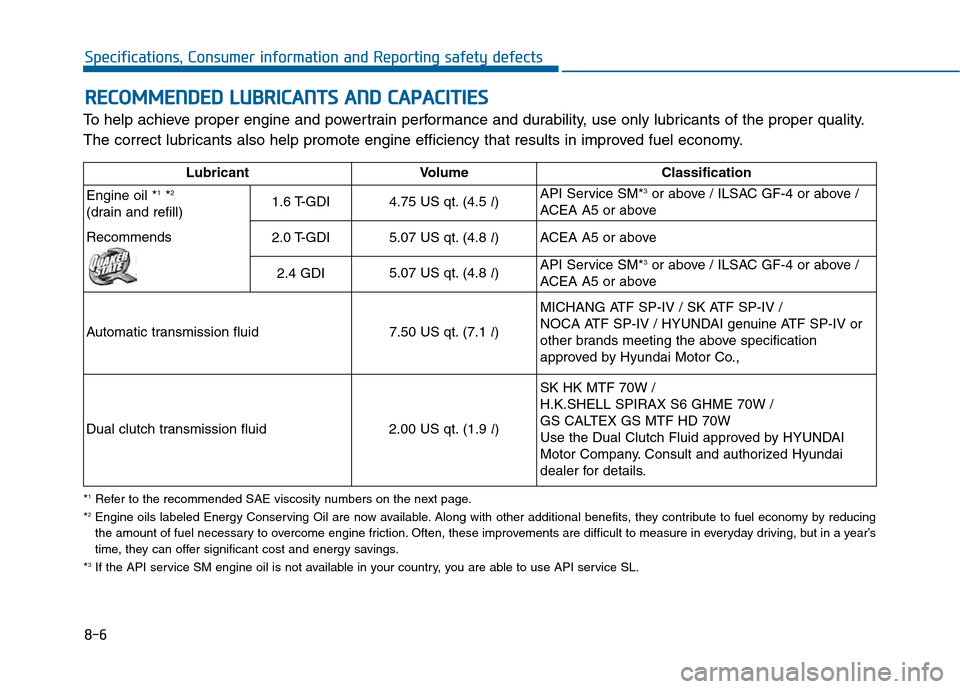
8-6
Specifications, Consumer information and Reporting safety defects
To help achieve proper engine and powertrain performance and durability, use only lubricants of the proper quality.
The correct lubricants also help promote engine efficiency that results in improved fuel economy.
R R E
EC
CO
O M
M M
ME
EN
N D
DE
ED
D
L
L U
U B
BR
RI
IC
C A
A N
N T
TS
S
A
A N
N D
D
C
C A
A P
PA
A C
CI
IT
T I
IE
E S
S
*1Refer to the recommended SAE viscosity numbers on the next page.
*2Engine oils labeled Energy Conserving Oil are now available. Along with other additional benefits, they contribute to fuel econo my by reducing
the amount of fuel necessary to overcome engine friction. Often, these improvements are difficult to measure in everyday driving, but in a year’s
time, they can offer significant cost and energy savings.
*
3If the API service SM engine oil is not available in your country, you are able to use API service SL.
LubricantVolume Classification
Engine oil *
1*2
(drain and refill)
Recommends 1.6 T-GDI4.75 US qt. (4.5
l)API Service SM*3or above / ILSAC GF-4 or above /
ACEA A5 or above
2.0 T-GDI
5.07 US qt. (4.8 l)
ACEA A5 or above
2.4 GDI5.07 US qt. (4.8 l)API Service SM*3or above / ILSAC GF-4 or above /
ACEA A5 or above
Automatic transmission fluid
7.50 US qt. (7.1 l)MICHANG ATF SP-IV / SK ATF SP-IV /
NOCA ATF SP-IV / HYUNDAI genuine ATF SP-IV or
other brands meeting the above specification
approved by Hyundai Motor Co.,
Dual clutch transmission fluid
2.00 US qt. (1.9 l)SK HK MTF 70W /
H.K.SHELL SPIRAX S6 GHME 70W /
GS CALTEX GS MTF HD 70W
Use the Dual Clutch Fluid approved by HYUNDAI
Motor Company. Consult and authorized Hyundai
dealer for details.