weight Hyundai Sonata 2016 - RHD (UK, Australia) User Guide
[x] Cancel search | Manufacturer: HYUNDAI, Model Year: 2016, Model line: Sonata, Model: Hyundai Sonata 2016Pages: 504, PDF Size: 12.45 MB
Page 381 of 504
5-68
Driving your vehicle
If you are considering towing with
your vehicle, you should first check
your country's legal requirements.
Since laws vary, the requirements for
towing trailers, cars, or other types of
vehicles or apparatus may differ. Ask
an authorised HYUNDAI dealer for
further details before towing.
Remember that towing is different
from just driving your vehicle by
itself. Towing means changes in han-
dling, durability, and fuel economy.
Successful, safe trailer towing
requires correct equipment, and it
has to be used properly. Damage to
your vehicle caused by improper
trailer towing is not covered by your
vehicle manufacturer's warranty.
This section contains many time-
tested, important towing tips and
safety rules. Many of these are
important for your safety and that of
your passengers. Please read this
section carefully before you pull a
trailer.
If you decide to pull a trailer?
Here are some important points if
you decide to pull a trailer:
• Do not do any towing with your
vehicle during its first 2,000 km to
allow the engine to properly break
in. Failure to heed this caution may
result in serious engine or
transaxle damage.
• When towing a trailer, be sure to
consult an authorised HYUNDAI
dealer for further information on
additional requirements such as a
towing kit, etc.
• Always drive your vehicle at a mod-
erate speed (less than 100 km/h)
or posted towing speed limit.
• On a long uphill grade, do not
exceed 70 km/h or the posted tow-
ing speed limit, whichever is lower.
TRAILER TOWING
Take the following precautions:
•If you don't use the correct
equipment and/or drive
improperly, you can lose con-
trol of the vehicle when you
are pulling a trailer. For exam-
ple, if the trailer is too heavy,
the braking performance may
be reduced. You and your pas-
sengers could be seriously or
fatally injured. Pull a trailer
only if you have followed all
the steps in this section.
•Before towing, make sure the
total trailer weight, GCW
(Gross Combination Weight),
GVW (Gross Vehicle Weight),
GAW (Gross Axle Weight ) and
trailer tongue load are all with-
in the limits.
WARNING
Page 382 of 504
5-69
Driving your vehicle
5
Trailer weight
How heavy can a trailer safely be? It
should never weigh more than the
maximum trailer weight with trailer
brakes. But even that can be too
heavy.
It depends on how you plan to use
your trailer. For example, speed, alti-
tude, road grades, outside tempera-
ture and how often your vehicle is
used to pull a trailer are all important.
The ideal trailer weight can also
depend on any special equipment
that you have on your vehicle.
Tongue load
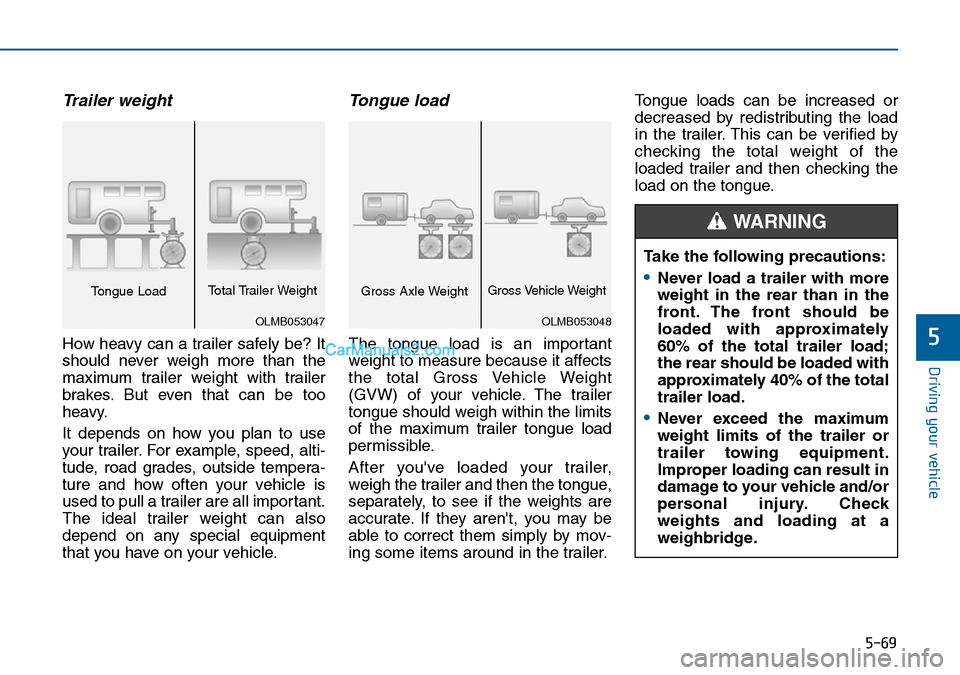
The tongue load is an important
weight to measure because it affects
the total Gross Vehicle Weight
(GVW) of your vehicle. The trailer
tongue should weigh within the limits
of the maximum trailer tongue load
permissible.
After you've loaded your trailer,
weigh the trailer and then the tongue,
separately, to see if the weights are
accurate. If they aren't, you may be
able to correct them simply by mov-
ing some items around in the trailer.Tongue loads can be increased or
decreased by redistributing the load
in the trailer. This can be verified by
checking the total weight of the
loaded trailer and then checking the
load on the tongue.
OLMB053047
Tongue LoadTotal Trailer Weight
OLMB053048
Gross Axle WeightGross Vehicle Weight
Take the following precautions:
•Never load a trailer with more
weight in the rear than in the
front. The front should be
loaded with approximately
60% of the total trailer load;
the rear should be loaded with
approximately 40% of the total
trailer load.
•Never exceed the maximum
weight limits of the trailer or
trailer towing equipment.
Improper loading can result in
damage to your vehicle and/or
personal injury. Check
weights and loading at a
weighbridge.
WARNING
Page 386 of 504
5-73
Driving your vehicle
5
Safety chains
You should always attach chains
between your vehicle and your trail-
er. Cross the safety chains under the
tongue of the trailer so that the
tongue will not drop to the road if it
becomes separated from the towbar.
Instructions about safety chains may
be provided by the towbar manufac-
turer or trailer manufacturer. Follow
the manufacturer's recommendation
for attaching safety chains. Always
leave just enough slack so you can
turn with your trailer. And, never
allow safety chains to drag on the
ground.
Trailer brakes
If your trailer is equipped with a brak-
ing system, make sure it conforms to
your country's regulations and that it
is properly installed and operating
correctly.
If your trailer weighs more than the
maximum trailer weight without trail-
er brakes loaded, then it needs its
own brakes and they must be ade-
quate. Be sure to read and follow the
instructions for the trailer brakes so
you'll be able to install, adjust and
maintain them properly. Be sure not
to tap into your vehicle's brake sys-
tem.
Driving with a trailer
Towing a trailer requires a certain
amount of experience. Before setting
out for the open road, you must get
to know your trailer. Acquaint your-
self with the feel of handling and
braking with the added weight of the
trailer. And always keep in mind that
the vehicle you are driving is now
longer and not nearly as responsive
as your vehicle is by itself.
Before you start, check the trailer
towbar and platform, safety chains,
electrical connector(s), lights, tyres
and brakes.
During your trip, occasionally check
to be sure that the load is secure,
and that the lights and trailer brakes
are still working.
Do not use a trailer with its own
brakes unless you are absolute-
ly certain that you have proper-
ly set up the brake system. This
is not a task for amateurs. Use
an experienced, competent
trailer shop for this work.
WARNING
Page 388 of 504
5-75
Driving your vehicle
5
Driving on hills
Reduce speed and shift to a lower
gear before you start down a long or
steep downgrade. If you don't shift
down, you might have to use your
brakes so much that they would get
overheated and may not operate effi-
ciently.
On a long uphill grade, shift down
and reduce your speed to around 70
km/h to reduce the possibility of
engine and transaxle overheating.
If your trailer weighs more than the
maximum trailer weight without trail-
er brakes and you have an automat-
ic transaxle, you should drive in D
(Drive) when towing a trailer.
Operating your vehicle in D (Drive)
when towing a trailer will minimise
heat build-up and extend the life of
your transaxle.To prevent engine and/or
transaxle overheating:
• When towing a trailer on steep
grades (in excess of 6%) pay
close attention to the engine
coolant temperature gauge to
ensure the engine does not
overheat. If the needle of the
coolant temperature gauge
moves towards "H" (HOT), pull
over and stop as soon as it is
safe to do so, and allow the
engine to idle until it cools
down. You may proceed once the
engine has cooled sufficiently.
• You must decide your vehicle
speed according to the trailer
weight and uphill grade.
NOTICE
Do not connect a trailer lighting
system directly to your vehi-
cle's lighting system. Use an
approved trailer wiring harness.
Failure to do so could result in
damage to the vehicle electrical
system and/or personal injury.
Consult an authorised
HYUNDAI dealer for assistance.
WARNING
Page 391 of 504
5-78
Driving your vehicle
Two labels on your driver's door sill
show how much weight your vehicle
was designed to carry: the Tyre and
Loading Information Label and the
Certification Label.
Before loading your vehicle, famil-
iarise yourself with the following
terms for determining your vehicle's
weight ratings, from the vehicle's
specifications and the Certification
Label:
Base Kerb Weight
This is the weight of the vehicle
including a full tank of fuel and all
standard equipment. It does not
include passengers, cargo, or option-
al equipment.
Vehicle Kerb Weight
This is the weight of your new vehicle
when you picked it up from your deal-
er plus any aftermarket equipment.
Cargo Weight
This figure includes all weight added
to the Base Kerb Weight, including
cargo and optional equipment.GAW (Gross Axle Weight)
This is the total weight placed on
each axle (front and rear) - including
vehicle kerb weight and all payload.
GAWR (Gross Axle Weight Rating)
This is the maximum allowable
weight that can be carried by a single
axle (front or rear). These numbers
are shown on the Certification Label.
The total load on each axle must
never exceed its GAWR.
GVW (Gross Vehicle Weight)
This is the Base Kerb Weight plus
actual Cargo Weight plus passen-
gers.
GVWR (Gross Vehicle Weight
Rating)
This is the maximum allowable
weight of the fully loaded vehicle
(including all options, equipment,
passengers and cargo). The GVWR
is shown on the Certification Label
located on the driver's door sill.
Overloading
VEHICLE WEIGHT
The Gross Axle Weight Rating
(GAWR) and the Gross Vehicle
Weight Rating (GVWR) for your
vehicle are on the Certification
Label attached to the driver's
(or front passenger's) door.
Exceeding these ratings can
cause an accident or vehicle
damage. You can calculate the
weight of your load by weighing
the items (and people) before
putting them in the vehicle. Be
careful not to overload your
vehicle.
WARNING
Page 448 of 504
7-37
7
Maintenance
TYRES AND WHEELS
Tyre care
For proper maintenance, safety, and
maximum fuel economy, you must
always maintain recommended tyre
inflation pressures and stay within
the load limits and weight distribution
recommended for your vehicle.
Recommended cold tyre infla-
tion pressures
All tyre pressures (including the
spare) should be checked when the
tyres are cold. “Cold Tyres” means the
vehicle has not been driven for at
least 3 hours or driven less than 1.6
km.
Recommended pressures must be
maintained for the best ride, top vehi-
cle handling, and minimum tyre wear.
For recommended inflation pressure
refer to “Tyre and wheels” in section
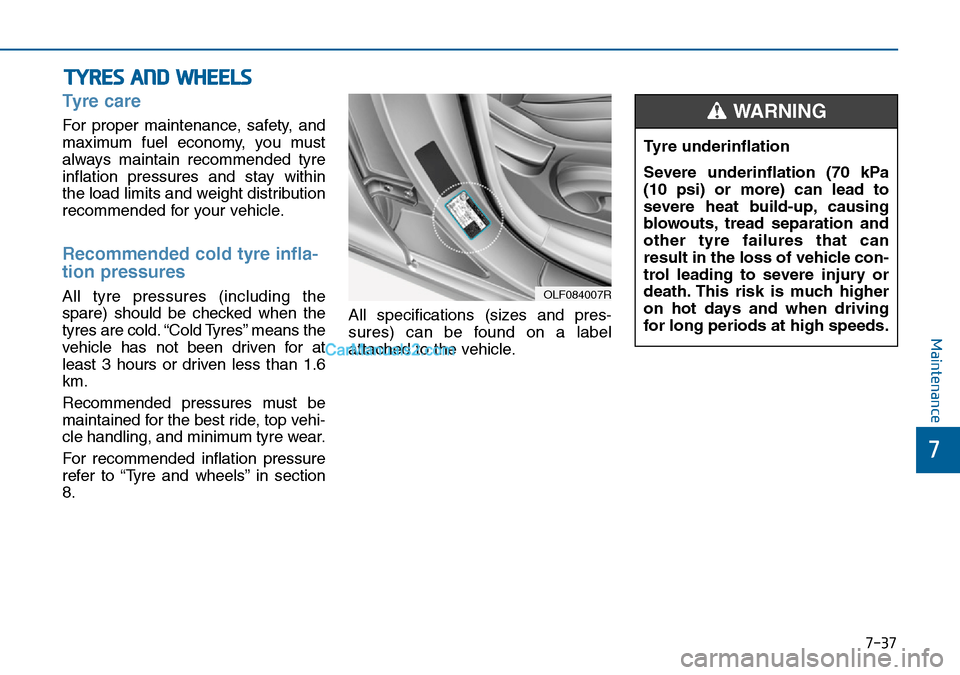
8.All specifications (sizes and pres-
sures) can be found on a label
attached to the vehicle.Tyre underinflation
Severe underinflation (70 kPa
(10 psi) or more) can lead to
severe heat build-up, causing
blowouts, tread separation and
other tyre failures that can
result in the loss of vehicle con-
trol leading to severe injury or
death. This risk is much higher
on hot days and when driving
for long periods at high speeds.
WARNING
OLF084007R
Page 452 of 504
7-41
7
Maintenance
Wheel alignment and tyre bal-
ance
The wheels on your vehicle were
aligned and balanced carefully at the
factory to give you the longest tyre
life and best overall performance.
In most cases, you will not need to
have your wheels aligned again.
However, if you notice unusual tyre
wear or your vehicle pulling one way
or the other, the alignment may need
to be reset.
If you notice your vehicle vibrating
when driving on a smooth road, your
wheels may need to be rebalanced.
Improper wheel weights can
damage your vehicle's aluminium
wheels. Use only approved wheel
weights.
Tyre replacement
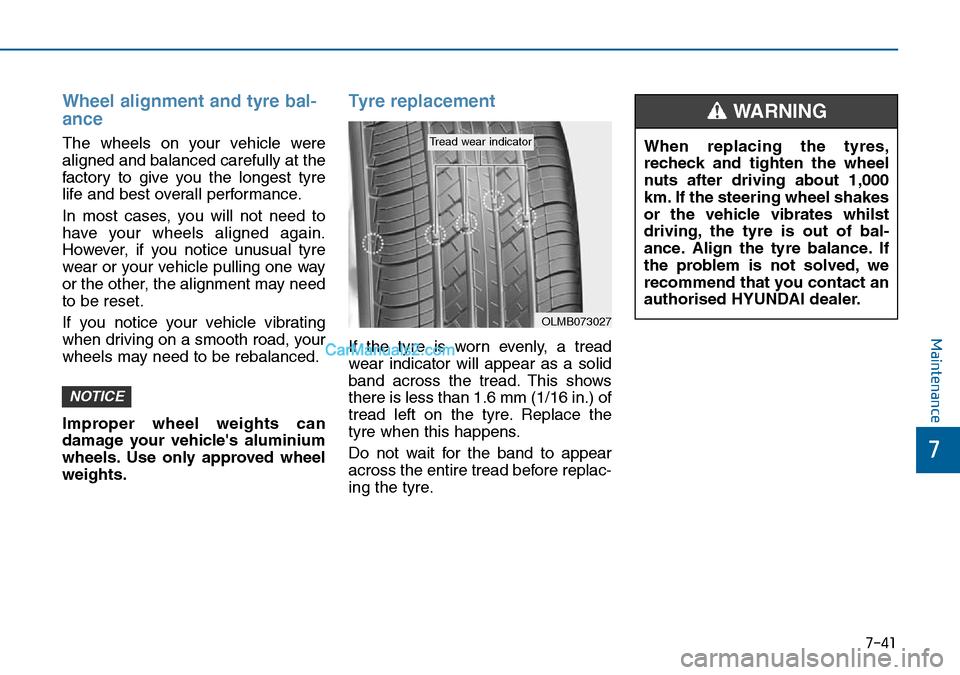
If the tyre is worn evenly, a tread
wear indicator will appear as a solid
band across the tread. This shows
there is less than 1.6 mm (1/16 in.) of
tread left on the tyre. Replace the
tyre when this happens.
Do not wait for the band to appear
across the entire tread before replac-
ing the tyre.
NOTICE
OLMB073027
Tread wear indicatorWhen replacing the tyres,
recheck and tighten the wheel
nuts after driving about 1,000
km. If the steering wheel shakes
or the vehicle vibrates whilst
driving, the tyre is out of bal-
ance. Align the tyre balance. If
the problem is not solved, we
recommend that you contact an
authorised HYUNDAI dealer.
WARNING
Page 496 of 504
8
Specifications & Consumer information
8
Specifications & Consumer information
8
Dimensions ..............................................................8-2
Engine ......................................................................8-2
Bulb wattage ...........................................................8-3
Tyres and wheels ...................................................8-4
Air conditioning system ........................................8-4
Tyre load and speed capacity .............................8-5
Volume and weight ................................................8-5
Recommended lubricants and capacities ...........8-6
Recommended SAE viscosity number ..........................8-7
Vehicle identification number (VIN) ....................8-8
Vehicle certification label .....................................8-8
Tyre specification and pressure label ................8-9
Engine number .......................................................8-9
Air conditioner compressor label ........................8-9
Page 499 of 504
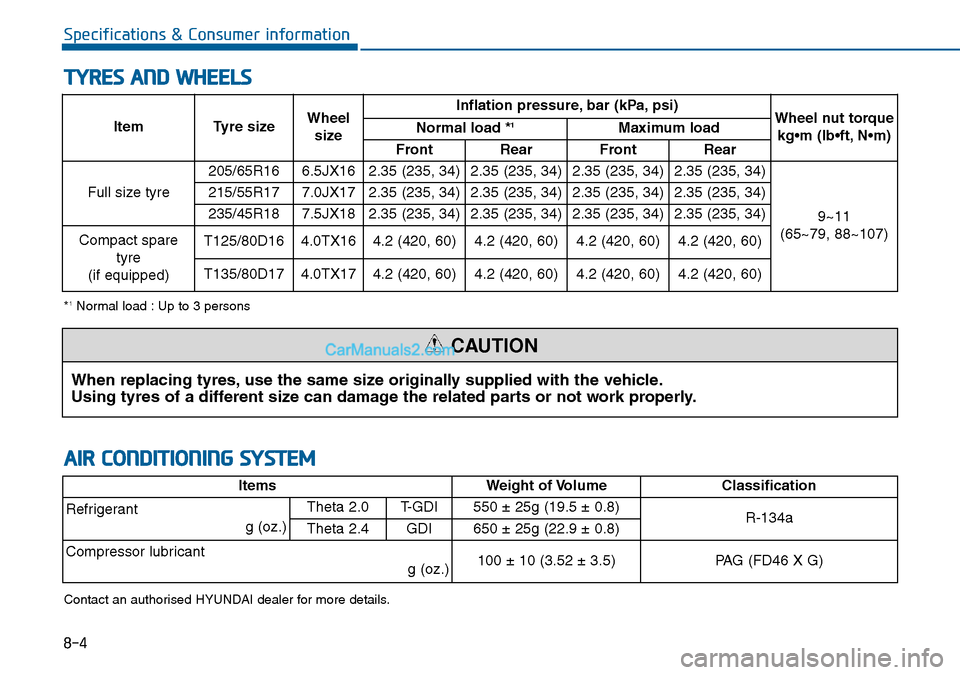
8-4
Specifications & Consumer information
TYRES AND WHEELS
Item Tyre sizeWheel
sizeInflation pressure, bar (kPa, psi)
Wheel nut torque
kg•m (lb•ft, N•m) Normal load *1Maximum load
Front Rear Front Rear
Full size tyre205/65R16 6.5JX16 2.35 (235, 34) 2.35 (235, 34) 2.35 (235, 34) 2.35 (235, 34)
9~11
(65~79, 88~107) 215/55R17 7.0JX17 2.35 (235, 34) 2.35 (235, 34) 2.35 (235, 34) 2.35 (235, 34)
235/45R18 7.5JX18 2.35 (235, 34) 2.35 (235, 34) 2.35 (235, 34) 2.35 (235, 34)
Compact spare
tyre
(if equipped)T125/80D164.0TX164.2 (420, 60)4.2 (420, 60)4.2 (420, 60)4.2 (420, 60)
T135/80D174.0TX174.2 (420, 60)4.2 (420, 60)4.2 (420, 60)4.2 (420, 60)
When replacing tyres, use the same size originally supplied with the vehicle.
Using tyres of a different size can damage the related parts or not work properly.
CAUTION
*1Normal load : Up to 3 persons
AIR CONDITIONING SYSTEM
ItemsWeight of Volume Classification
Refrigerant
g (oz.) Theta 2.0T-GDI550 ± 25g (19.5 ± 0.8)R-134aTheta 2.4GDI650 ± 25g (22.9 ± 0.8)
Compressor lubricant
g (oz.) 100 ± 10 (3.52 ± 3.5)PAG (FD46 X G)
Contact an authorised HYUNDAI dealer for more details.
Page 500 of 504
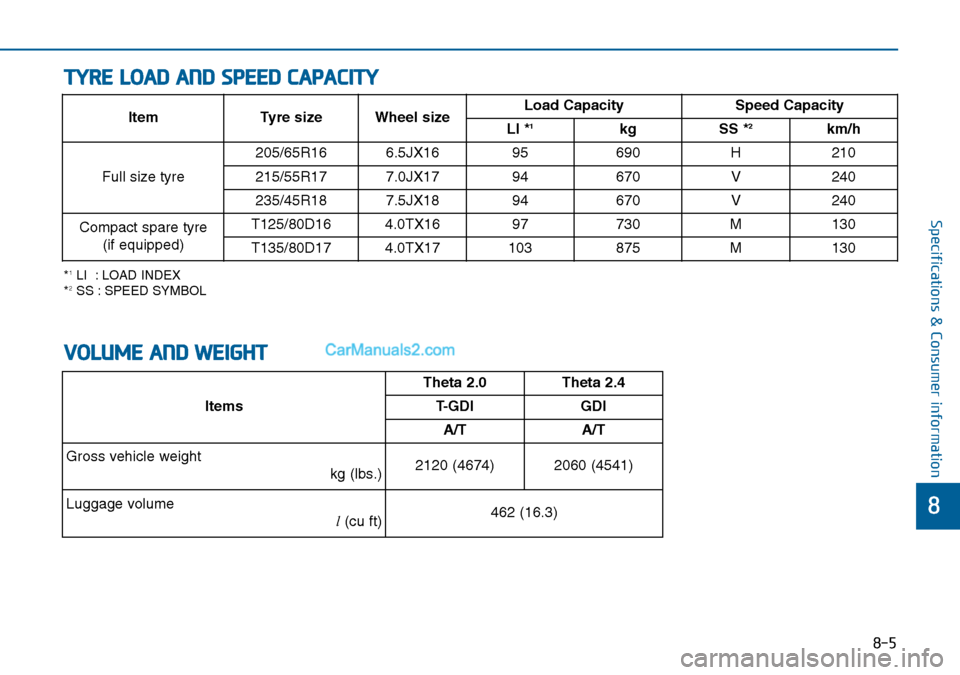
8-5
8
Specifications & Consumer information
TYRE LOAD AND SPEED CAPACITY
*1LI : LOAD INDEX
*2SS : SPEED SYMBOL
Item Tyre size Wheel sizeLoad Capacity Speed Capacity
LI *1kg SS *2km/h
Full size tyre205/65R16 6.5JX16 95 690 H 210
215/55R17 7.0JX17 94 670 V 240
235/45R187.5JX1894670V240
Compact spare tyre
(if equipped)T125/80D164.0TX1697730M130
T135/80D174.0TX17103875M130
VOLUME AND WEIGHT
Items
Theta 2.0Theta 2.4
T-GDIGDI
A/TA/T
Gross vehicle weight
kg (lbs.)2120 (4674)2060 (4541)
Luggage volume
l(cu ft)462 (16.3)