Hood Hyundai Sonata 2020 Owner's Guide
[x] Cancel search | Manufacturer: HYUNDAI, Model Year: 2020, Model line: Sonata, Model: Hyundai Sonata 2020Pages: 537, PDF Size: 14.54 MB
Page 309 of 537
06
6-25
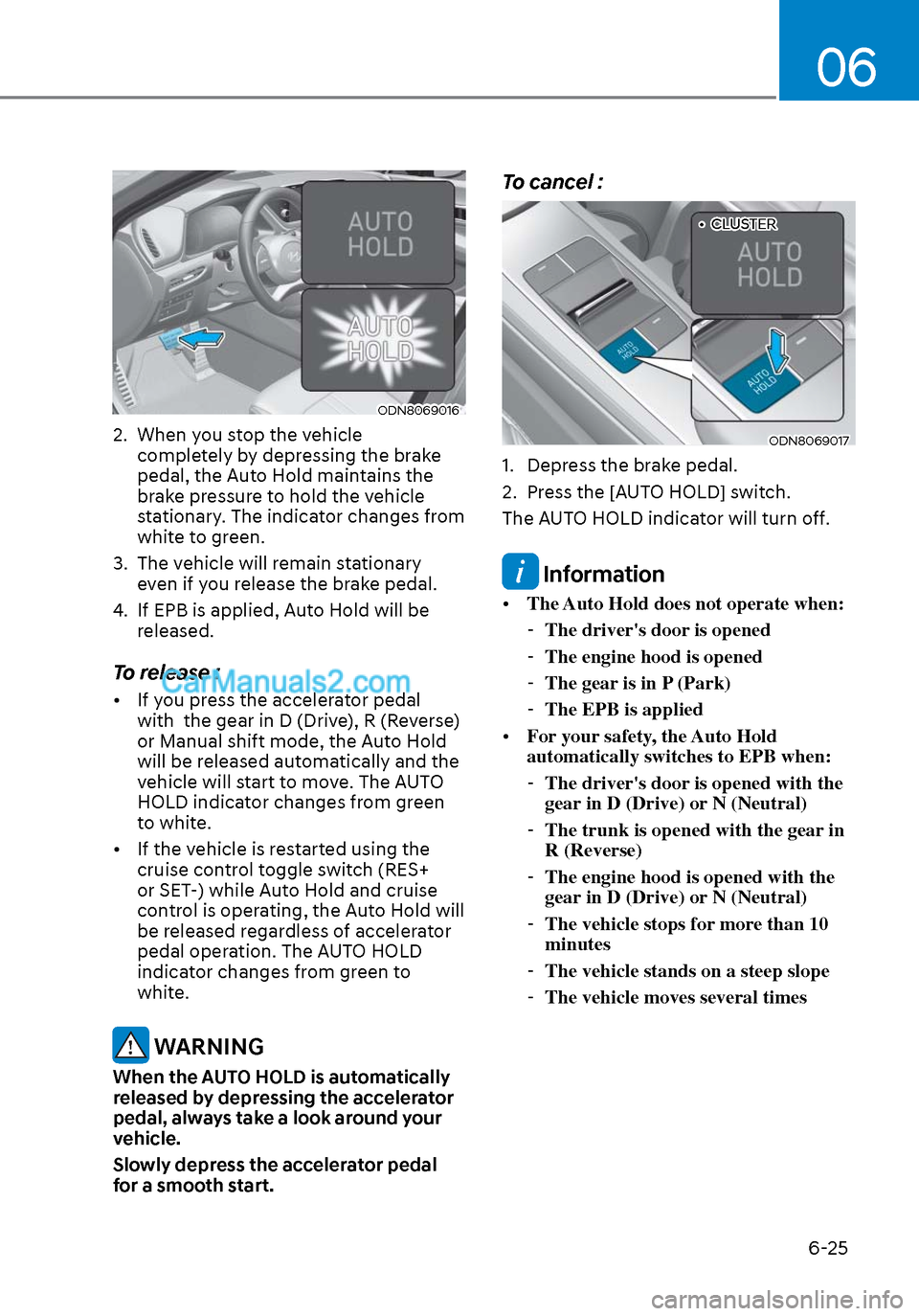
ODN8069016ODN8069016
2. When you stop the vehicle completely by depressing the brake
pedal, the Auto Hold maintains the
brake pressure to hold the vehicle
stationary. The indicator changes from
white to green.
3. The vehicle will remain stationary even if you release the brake pedal.
4. If EPB is applied, Auto Hold will be released.
To release :
• If you press the accelerator pedal with the gear in D (Drive), R (Reverse)
or Manual shift mode, the Auto Hold
will be released automatically and the
vehicle will start to move. The AUTO
HOLD indicator changes from green
to white.
• If the vehicle is restarted using the cruise control toggle switch (RES+
or SET-) while Auto Hold and cruise
control is operating, the Auto Hold will
be released regardless of accelerator
pedal operation. The AUTO HOLD
indicator changes from green to
white.
WARNING
When the AUTO HOLD is automatically
released by depressing the accelerator
pedal, always take a look around your
vehicle.
Slowly depress the accelerator pedal
for a smooth start.
To cancel :
ODN8069017ODN8069017
1. Depress the brake pedal.
2. Press the [AUTO HOLD] switch.
The AUTO HOLD indicator will turn off.
Information
• The Auto Hold does not operate when:
- The driver's door is opened
- The engine hood is opened
- The gear is in P (Park)
- The EPB is applied
• For your safety, the Auto Hold
automatically switches to EPB when:
- The driver's door is opened with the
gear in D (Drive) or N (Neutral)
- The trunk is opened with the gear in
R (Reverse)
- The engine hood is opened with the
gear in D (Drive) or N (Neutral)
- The vehicle stops for more than 10
minutes
- The vehicle stands on a steep slope
- The vehicle moves several times
••CLUSTERCLUSTER
Page 310 of 537
While Driving6-26
In these cases, the parking brake
warning light comes on, the AUTO
HOLD indicator changes from green
to white, and a warning sound and a
message will appear to inform you that
EPB has been automatically engaged.
Before driving off again, press foot
brake pedal, check the surrounding
area near your vehicle and release
parking brake manually with the EPB
switch.
• While operating Auto Hold, you may
hear mechanical noise. However, it is
normal operating noise.
NOTICE
If the AUTO HOLD indicator changes
to yellow, the Auto Hold is not working
properly. Contact an authorized
HYUNDAI dealer.
WARNING
• Depress the accelerator pedal slowly
when you start the vehicle.
• For your safety, cancel the Auto Hold
when you drive downhill, back up the
vehicle or park the vehicle.
NOTICE
If there is a malfunction with the
driver's door or engine hood open
detection system, the Auto Hold may
not work properly.
Contact an authorized HYUNDAI dealer.
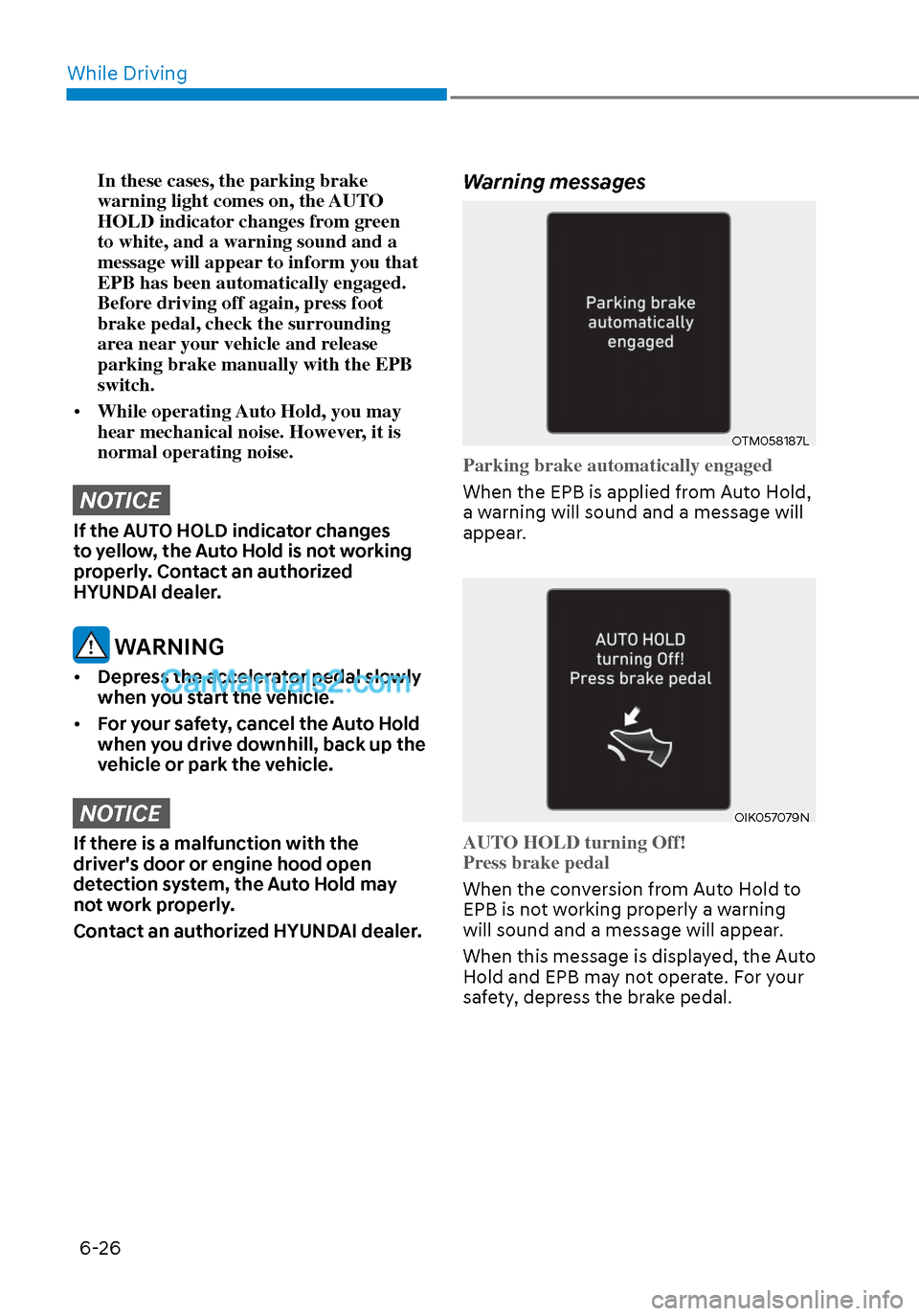
Warning messages
OTM058187LOTM058187L
Parking brake automatically engaged
When the EPB is applied from Auto Hold,
a w
arning will sound and a message will
appear.
OIK057079NOIK057079N
AUTO HOLD turning Off!
Press brake pedal
When the conversion from Auto Hold to
EPB is no
t working properly a warning
will sound and a message will appear.
When this message is displayed, the Auto
Hold and EPB may not operate. For your
safety, depress the brake pedal.
Page 311 of 537
![Hyundai Sonata 2020 Owners Guide 06
6-27
OIK057080LOIK057080L
Press brake pedal to deactivate AUTO
HOLD
If you did not apply the brake pedal when
y
ou release the Auto Hold by pressing
the [AUTO HOLD] switch, a warning will
sound](/img/35/16773/w960_16773-310.png "Hyundai Sonata 2020 Owners Guide 06
6-27
OIK057080LOIK057080L
Press brake pedal to deactivate AUTO
HOLD
If you did not apply the brake pedal when
y
ou release the Auto Hold by pressing
the [AUTO HOLD] switch, a warning will
sound")
06
6-27
OIK057080LOIK057080L
Press brake pedal to deactivate AUTO
HOLD
If you did not apply the brake pedal when
y
ou release the Auto Hold by pressing
the [AUTO HOLD] switch, a warning will
sound and a message will appear.
OTM058159LOTM058159L
AUTO HOLD conditions not met. Close
door and hood.
When you press the [AUTO HOLD]
s
witch, if the driver's door and engine
hood are not closed, a warning will
sound and a message will appear on the
cluster LCD display.
Press the [AUTO HOLD] switch after
closing the driver's door and hood.
Anti-lock Brake System (ABS)
WARNING
An Anti-Lock Braking System (ABS) or
an Electronic Stability Control (ESC)
system will not prevent accidents
due to improper or dangerous driving
maneuvers. Even though vehicle
control is improved during emergency
braking, always maintain a safe
distance between you and objects
ahead of you. Vehicle speeds should
always be reduced during extreme
road conditions. The braking distance
for cars equipped with ABS or ESC
may be longer than for those without
these systems in the following road
conditions.
Drive your vehicle at reduced speeds
during the following conditions:
• Rough, gravel or snow-covered
roads.
• On roads where the road surface is
pitted or has different surface height.
• Tire chains are installed on your
vehicle.
The safety features of an ABS or ESC
equipped vehicle should not be tested
by high speed driving or cornering. This
could endanger the safety of yourself or
others.
ABS is an electronic braking system that
helps prevent a braking skid. ABS allows
the driver to steer and brake at the same
time.
Page 317 of 537
06
6-33
The Idle Stop and Go (ISG) system
automatically and temporarily shuts
down the engine when the vehicle
is stopped and idling to improve fuel
efficiency and reduce exhaust gas
emissions. (i.e. red stop light, stop sign,
and traffic jam).
The engine is automatically started upon
satisfying the starting conditions.
The ISG system is always active, when
the engine is running.
Information
When the engine is automatically started
by the ISG system, some warning
lights (i.e. ABS, ESC, ESC OFF, EPS,
and parking brake warning light) may
illuminate for a few seconds due to the
low battery voltage. However, it does
not indicate a malfunction with the ISG
system.
To Activate the ISG System
Prerequisite for activation
The ISG system operates in the following
situations.
• The driver's seatbelt is fastened
• The driver's door and hood are closed
• The brake vacuum pressure is adequate
• The battery sensor is activated and the battery is sufficiently charged
• Outside temperature is not too low or too high
• The vehicle is driven over a constant speed and stops
• The climate control system satisfies the conditions
• The vehicle is sufficiently warmed up
• The incline is gradual
• The steering wheel is turned less than 180 degrees and then the vehicle
stops
Information
• The ISG system is not
activated, when the
prerequisites to activate
the ISG system are
unsatisfied. In this case,
the ISG OFF button indicator
illuminates, and the auto stop indicator
(
) illuminates in yellow on the
instrument cluster.
• When the above indicator remains
illuminated on the instrument cluster,
have the IGS system checked by an
authorized HYUNDAI dealer.
Auto stop
To stop the engine in idle stop mode
1. Decrease the vehicle speed to 0 mph.
2. Depress the brake pedal with the shift
button in D (Drive) or N (Neutral).
The auto stop indicator (
) illuminates
in green on the instrument cluster, when
the engine stops.
Information
The driving speed must reach at least 3
mph (5 km/h) after an idle stop to stop the
engine in idle stop mode again.
In auto stop mode, when the driver
opens the hood, the ISG system will be
deactivated.
ISG (IDLE STOP AND GO) SYSTEM (IF EQUIPPED)
Page 320 of 537
![Hyundai Sonata 2020 Owners Guide While Driving6-36
Battery Sensor Deactivation
ODN8A069204ODN8A069204
[A] : Battery sensor
The battery sensor is deactivated, when
the battery is disconnected from the
negative pole for maintenance p](/img/35/16773/w960_16773-319.png "Hyundai Sonata 2020 Owners Guide While Driving6-36
Battery Sensor Deactivation
ODN8A069204ODN8A069204
[A] : Battery sensor
The battery sensor is deactivated, when
the battery is disconnected from the
negative pole for maintenance p")
While Driving6-36
Battery Sensor Deactivation
ODN8A069204ODN8A069204
[A] : Battery sensor
The battery sensor is deactivated, when
the battery is disconnected from the
negative pole for maintenance purpose.
In this case, the ISG system is limitedly
operated due to the battery sensor
deactivation. Thus, the driver needs
to take the following procedures to
reactivate the battery sensor after
disconnecting the battery.
Prerequisites to reactivate the
battery sensor
Switch "ON" and "OFF" the ignition one
time. Park the vehicle for a minimum of 4
hours with the hood and all doors closed.
Pay extreme caution not to connect any
accessories (i.e. navigation and black
box) to the vehicle with the engine in the
OFF status. If not, the battery sensor may
not be reactivated.
Information
The ISG system may not operate in the
following situations. - There is a malfunction with the ISG
system.
- The battery is weak.
- The brake vacuum pressure is low.
If this occurs, have the ISG system
checked by an authorized HYUNDAI
dealer.
NOTICE
• Use only a genuine HYUNDAI
Absorbent Glass Mat (AGM) battery
for replacement. If not, the ISG
system may not operate normally.
• Do not recharge the Absorbent Glass
Mat (AGM) battery with a general
battery charger. It may damage or
explode the Absorbent Glass Mat
(AGM) battery.
• Do not remove the battery cap. The
battery electrolyte, which is harmful
to the human body, may leak out.
Page 434 of 537
Emergency Situations7-6
If your temperature gauge indicates
overheating, you experience a loss of
power, or hear loud pinging or knocking,
the engine may be overheating. If this
happens, you should:
1. Pull off the road and stop as soon as it is safe to do so.
2. Place the shift button in P (Park) and set the parking brake. If the air
conditioning is ON, turn it OFF.
3. If engine coolant is running out under the vehicle or steam is coming out
from the hood, stop the engine. Do
not open the hood until the coolant
has stopped running or the steaming
has stopped. If there is no visible
loss of engine coolant and no steam,
leave the engine running and check
to be sure the engine cooling fan is
operating. If the fan is not running,
turn the engine off.
WARNING
While the engine is running,
keep hands, clothing and tools
away from the moving parts
such as the cooling fan and
drive belt to prevent serious
injury.
4. Check for coolant leaking from the radiator, hoses or under the vehicle. (If
the air conditioning had been in use, it
is normal for cold water to be draining
from it when you stop.)
5. If engine coolant is leaking out, stop the engine immediately and call the
nearest authorized HYUNDAI dealer
for assistance.
WARNING
Your vehicle is equipped
with a pressurized coolant
reserve tank. NEVER remove
the engine coolant reservoir
tank/radiator cap or the drain
plug while the engine and
radiator are HOT. Hot coolant
and steam may blow out under
pressure, causing serious
injury.
Turn the engine off and wait until the
engine cools down. Use extreme care
when removing the engine coolant
reservoir tank/radiator cap. Wrap
a towel or thick rag around it, and
turn it counterclockwise slowly to
release some of the pressure from the
system. Step back while the pressure is
released.
When you are sure all the pressure has
been released, continue turning the cap
counterclockwise to remove it.
6. If you cannot find the cause of the overheating, wait until the engine
temperature has returned to normal.
Then, if coolant has been lost,
carefully add coolant to the reservoir
to bring the fluid level in the reservoir
up to the halfway mark.
7. Proceed with caution, keeping alert for further signs of overheating. If
overheating happens again, call
an authorized HYUNDAI dealer for
assistance.
CAUTION
Serious loss of coolant indicates a
leak in the cooling system and should
be checked as soon as possible by an
authorized HYUNDAI dealer.
IF THE ENGINE OVERHEATS
Page 453 of 537
Maintenance8-6
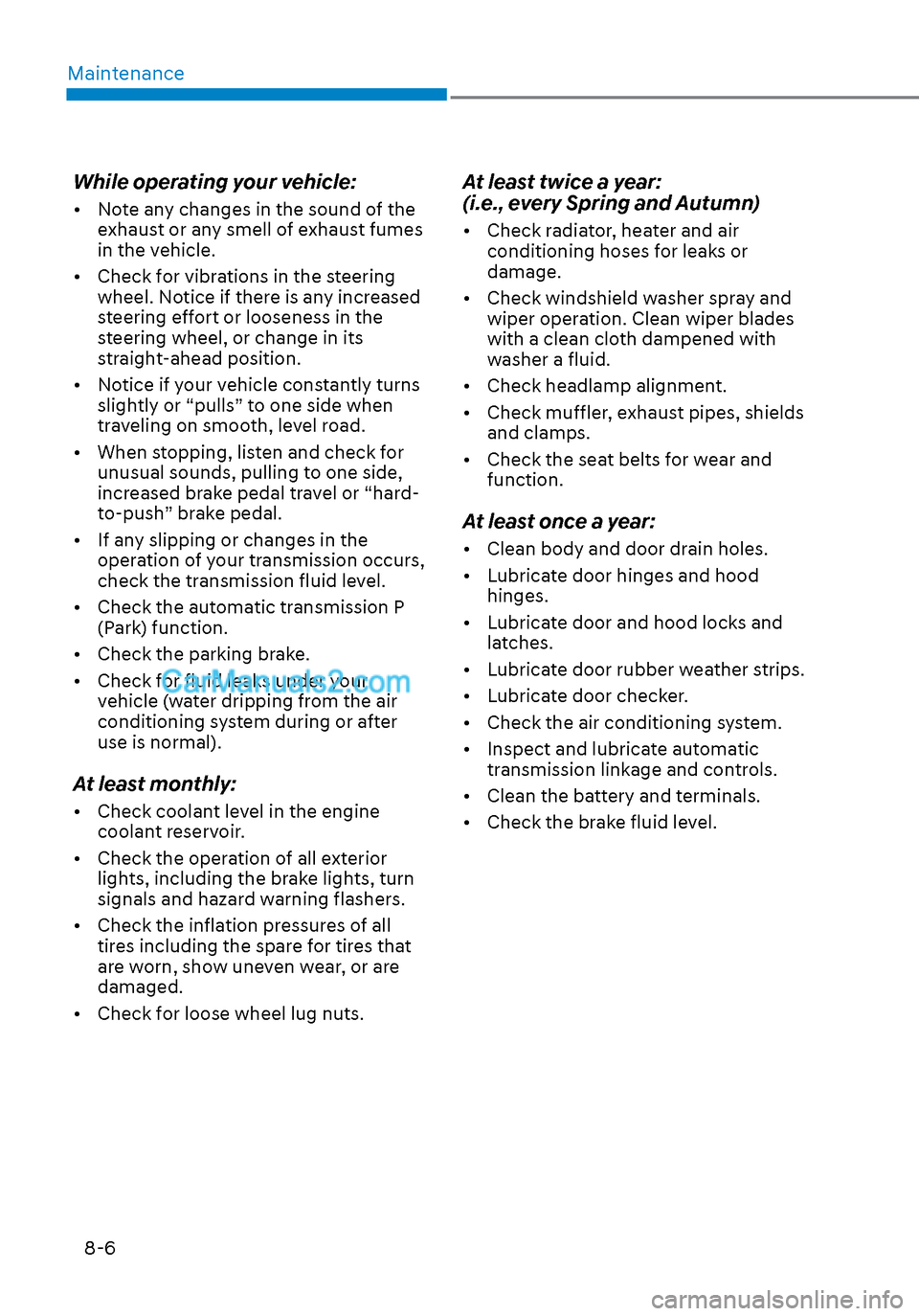
While operating your vehicle:
• Note any changes in the sound of the exhaust or any smell of exhaust fumes
in the vehicle.
• Check for vibrations in the steering wheel. Notice if there is any increased
steering effort or looseness in the
steering wheel, or change in its
straight-ahead position.
• Notice if your vehicle constantly turns slightly or “pulls” to one side when
traveling on smooth, level road.
• When stopping, listen and check for unusual sounds, pulling to one side,
increased brake pedal travel or “hard-
to-push” brake pedal.
• If any slipping or changes in the operation of your transmission occurs,
check the transmission fluid level.
• Check the automatic transmission P (Park) function.
• Check the parking brake.
• Check for fluid leaks under your vehicle (water dripping from the air
conditioning system during or after
use is normal).
At least monthly:
• Check coolant level in the engine coolant reservoir.
• Check the operation of all exterior lights, including the brake lights, turn
signals and hazard warning flashers.
• Check the inflation pressures of all tires including the spare for tires that
are worn, show uneven wear, or are
damaged.
• Check for loose wheel lug nuts.
At least twice a year:
(i.e., every Spring and Autumn)
• Check radiator, heater and air conditioning hoses for leaks or
damage.
• Check windshield washer spray and wiper operation. Clean wiper blades
with a clean cloth dampened with
washer a fluid.
• Check headlamp alignment.
• Check muffler, exhaust pipes, shields and clamps.
• Check the seat belts for wear and function.
At least once a year:
• Clean body and door drain holes.
• Lubricate door hinges and hood hinges.
• Lubricate door and hood locks and latches.
• Lubricate door rubber weather strips.
• Lubricate door checker.
• Check the air conditioning system.
• Inspect and lubricate automatic transmission linkage and controls.
• Clean the battery and terminals.
• Check the brake fluid level.
Page 476 of 537
08
8-29
WIPER BLADES
Blade Inspection
Contamination of either the windshield
or the wiper blades with foreign matter
can reduce the effectiveness of the
windshield wiper functionality. Common
sources of contamination are insects,
tree sap, and hot wax treatments used
by some commercial car washes. If the
blades are not wiping properly, clean
both the window and the blades with a
clean cloth dampened with washer fluid.
NOTICE
To prevent damage to the wiper blades,
arms or other components, do not:
• Use gasoline, kerosene, paint
thinner, or other solvents on or near
them.
• Attempt to move the wipers
manually.
• Use non-specified wiper blades.
Information
Commercial hot waxes applied by
automatic car washes have been known to
make the windshield difficult to clean.
Blade Replacement
When the wipers no longer clean
adequately, the blades may be worn or
cracked, and require replacement.
NOTICE
• In order to prevent damage to the
hood and the wiper arms, the wiper
arms should only be lifted when in
the top wiping position.
• Always return the wiper arms to the
windshield before driving.
NOTICE
The use of a non-specified wiper blade
could result in wiper malfunction and
failure.
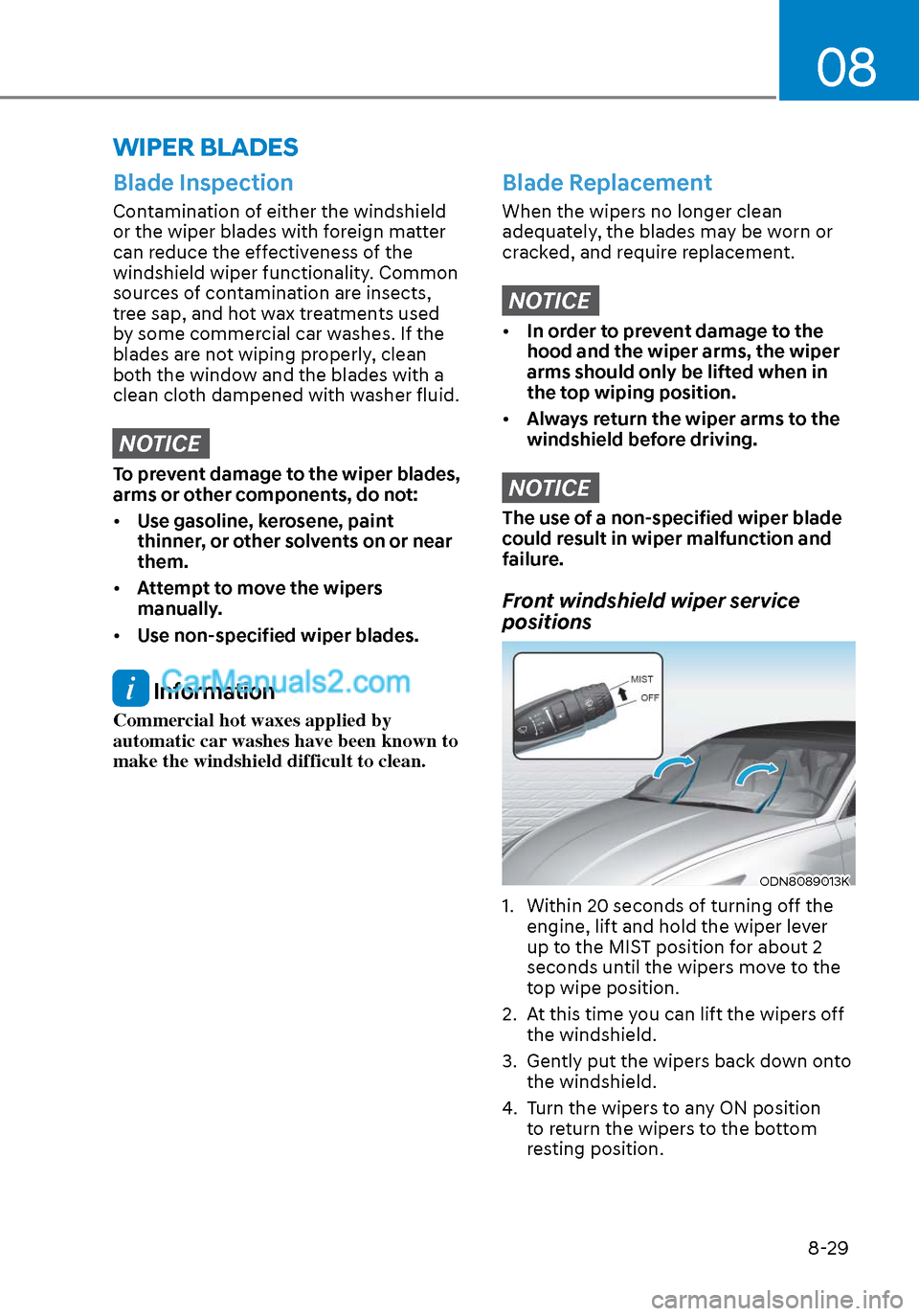
Front windshield wiper service
positions
ODN8089013KODN8089013K
1. Within 20 seconds of turning off the
engine, lift and hold the wiper lever
up to the MIST position for about 2
seconds until the wipers move to the
top wipe position.
2. At this time you can lift the wipers off the windshield.
3. Gently put the wipers back down onto the windshield.
4. Turn the wipers to any ON position to return the wipers to the bottom
resting position.
Page 525 of 537

IndexI-6
Emission control system ........................................................................\
.............. 8-67 Crankcase emission control system ................................................................ 8-68
Evaporative emission control System ............................................................. 8-68
Exhaust emission control system .................................................................... 8-68
Engine compartment ........................................................................\
.............. 2-6, 8-3
Engine compartment panel fuse replacement ...................................................... 8-48
Engine coolant ........................................................................\
............................. 8-21
Engine coolant temperature gauge........................................................................\
. 4-4
Engine number ........................................................................\
............................. 2-14
Engine oil ........................................................................\
..................................... 8-19
Engine specification........................................................................\
....................... 2-7
Engine Start/Stop button ........................................................................\
................ 6-9
Evaporative emission control System .................................................................. 8-68
Event Data Recorder (EDR) ........................................................................\
.......... 1-8
Exhaust emission control system ........................................................................\
. 8-68
Explanation of scheduled maintenance items ...................................................... 8-16
Exterior care........................................................................\
................................. 8-61
Exterior features........................................................................\
........................... 5-64 Hood ...................................................................\
............................................. 5-64
Trunk ...................................................................\
............................................ 5-65
Emergency trunk safety release....................................................................... 5-66
Fuel Filler Door ........................................................................\
....................... 5-70
Exterior overview Front view ........................................................................\
................................. 2-2
Rear view ........................................................................\
.................................. 2-3
F
Flat tire ........................................................................\
......................................... 7-12 Changing spare tire ........................................................................\
................ 7-12
Floor mat anchor(s)........................................................................\
.................... 5-151
Fluid Brake fluid ........................................................................\
............................... 8-24
Washer fluid ........................................................................\
............................ 8-25
Forward Collision-Avoidance Assist (FCA) ....................................................... 6-40 FCA-Junction Turning function ...................................................................... 6-55
Forward/Reverse Parking Distance Warning (PDW) .......................................... 5-99
Page 526 of 537

I
I-7
Front seat adjustment ........................................................................\
..................... 3-5Manual adjustment ........................................................................\
.................... 3-5
Power adjustment ........................................................................\
...................... 3-7
Reclining seatback ........................................................................\
.................... 3-8
Front seat head restraints Adjusting the height up and down .................................................................. 3-12
Removal/Reinstallation .................................................\
.................................. 3-13
Fuel Filler Door ........................................................................\
........................... 5-70
Fuel gauge ........................................................................\
...................................... 4-4
Fuel requirements ........................................................................\
.......................... 1-5 Fuel additives ........................................................................\
............................ 1-6
Fuses ..................................................................\
.................................................. 8-46
Instrument panel fuse replacement.......................................\
........................... 8-47
Engine compartment panel fuse replacement ................................................. 8-48
Fuse/relay panel description ........................................................................\
.... 8-49
G
Gauges and meters ........................................................................\
......................... 4-3
Glove box ........................................................................\
.................................. 5-144
Guide to Hyundai genuine parts ........................................................................\
.... 1-3
H
Hazard warning flasher ........................................................................\
.................. 7-2
Hazardous driving conditions ........................................................................\
.... 6-133
Head restraints ........................................................................\
............................. 3-11 Front seat head restraints ........................................................................\
......... 3-12
Rear seat restraints ........................................................................\
.................. 3-14
Headlamp delay function ........................................................................\
............. 5-79
Headlamp leveling device........................................................................\
............ 5-80
Headlamp position ........................................................................\
....................... 5-75
Head-up display (HUD) ........................................................................\
............... 5-72
Heated steering wheel ........................................................................\
.................. 5-44
High Beam Assist (HBA) ........................................................................\
........... 5-76
High beam operation........................................................................\
.................... 5-75
Highway driving ........................................................................\
........................ 6-135
Highway Driving Assist (HDA) ........................................................................\
6-115
Hill-start assist control (HAC) ........................................................................\
..... 6-32
HomeLink
® system ........................................................................\
...................... 5-47
Hood ...................................................................\
................................................. 5-64