trunk Hyundai Sonata 2020 Owner's Guide
[x] Cancel search | Manufacturer: HYUNDAI, Model Year: 2020, Model line: Sonata, Model: Hyundai Sonata 2020Pages: 537, PDF Size: 14.54 MB
Page 305 of 537
06
6-21
Electronic Parking Brake (EPB)
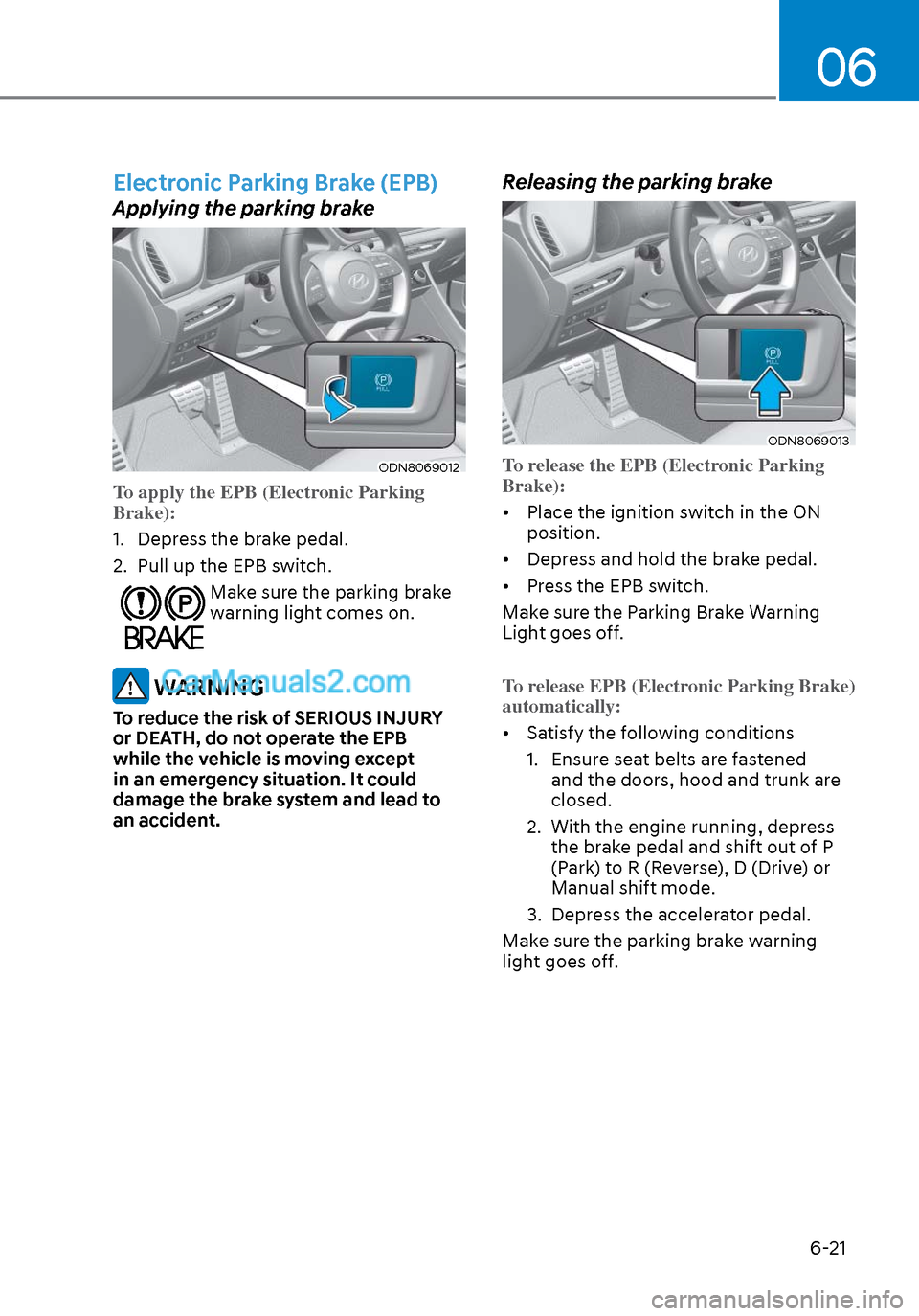
Applying the parking brake
ODN8069012ODN8069012
To apply the EPB (Electronic Parking
Brake):
1. Depress the brake pedal.
2.
Pull up the EPB switch.
Make sure the parking brake
warning light comes on.
WARNING
To reduce the risk of SERIOUS INJURY
or DEATH, do not operate the EPB
while the vehicle is moving except
in an emergency situation. It could
damage the brake system and lead to
an accident.
Releasing the parking brake
ODN8069013ODN8069013
To release the EPB (Electronic Parking
Brake):
• Place the ignition switch in the ON position.
•
Depress and hold the brake pedal.
• Press the EPB switch.
Make sure the Parking Brake Warning
Light goes off.
To release EPB (Electronic Parking Brake)
automatically:
• Satisfy the following conditions 1.
Ensure seat belts are fastened
and the doors, hood and trunk are
closed.
2. With the engine running, depress the brake pedal and shift out of P
(Park) to R (Reverse), D (Drive) or
Manual shift mode.
3. Depress the accelerator pedal.
Make sure the parking brake warning
light goes off.
Page 306 of 537
While Driving6-22
EPB (Electronic Parking Brake) may be
automatically applied when:
• Requested by other systems
• The driver turns the engine off while Auto Hold is operating.
• The vehicle is parked on the slope and the Engine Start/Stop button is in the
OFF position.
• The Engine is turned off when the driver tries to park but the vehicle still
moves a bit.
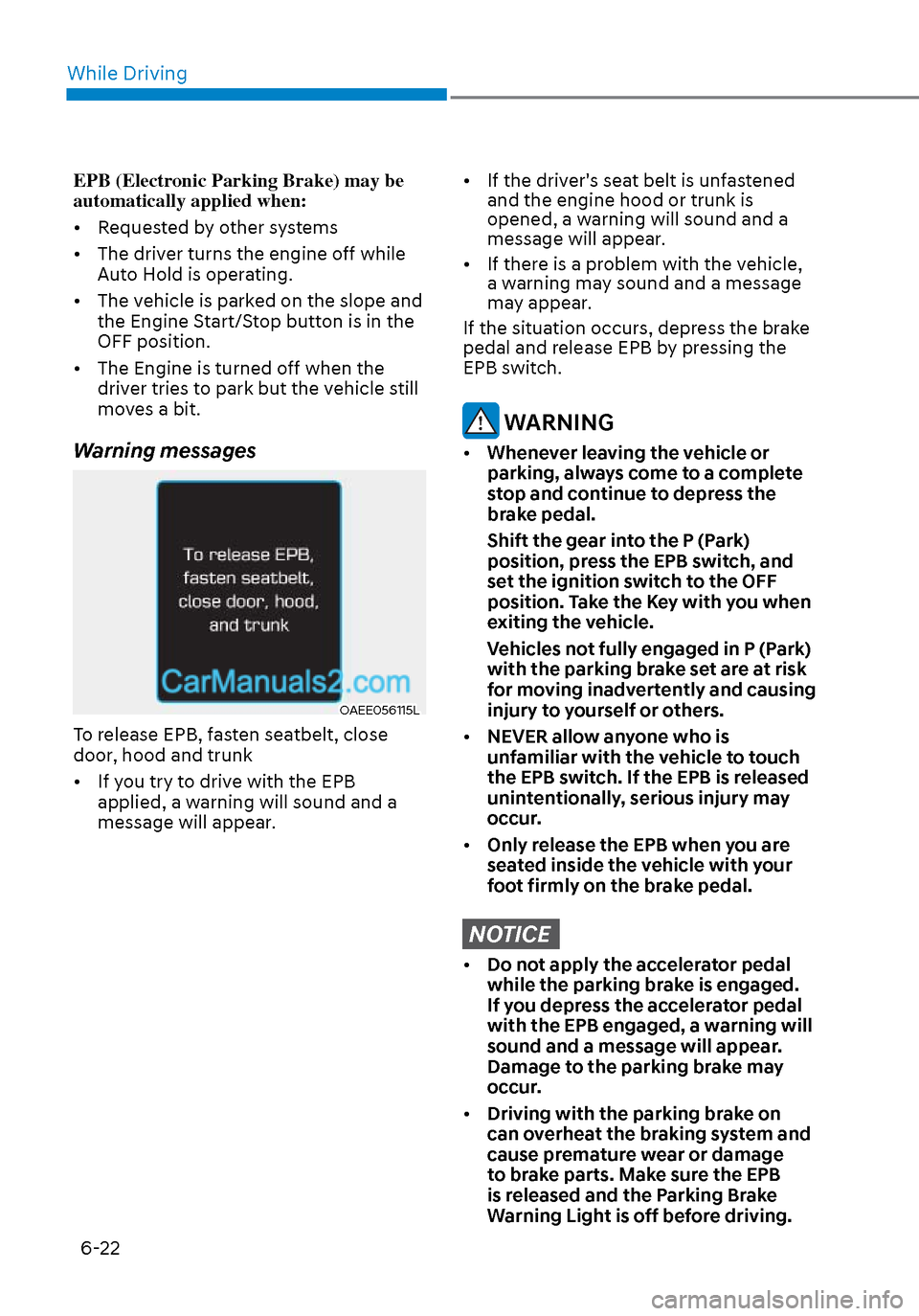
Warning messages
OAEE056115LOAEE056115L
To release EPB, fasten seatbelt, close
door, hood and trunk
• If you try to drive with the EPB applied, a warning will sound and a
message will appear.
• If the driver's seat belt is unfastened and the engine hood or trunk is
opened, a warning will sound and a
message will appear.
• If there is a problem with the vehicle, a warning may sound and a message
may appear.
If the situation occurs, depress the brake
pedal and release EPB by pressing the
EPB switch.
WARNING
• Whenever leaving the vehicle or
parking, always come to a complete
stop and continue to depress the
brake pedal.
Shift the gear into the P (Park) position, press the EPB switch, and
set the ignition switch to the OFF
position. Take the Key with you when
exiting the vehicle.
Vehicles not fully engaged in P (Park) with the parking brake set are at risk
for moving inadvertently and causing
injury to yourself or others.
• NEVER allow anyone who is
unfamiliar with the vehicle to touch
the EPB switch. If the EPB is released
unintentionally, serious injury may
occur.
• Only release the EPB when you are
seated inside the vehicle with your
foot firmly on the brake pedal.
NOTICE
• Do not apply the accelerator pedal
while the parking brake is engaged.
If you depress the accelerator pedal
with the EPB engaged, a warning will
sound and a message will appear.
Damage to the parking brake may
occur.
• Driving with the parking brake on
can overheat the braking system and
cause premature wear or damage
to brake parts. Make sure the EPB
is released and the Parking Brake
Warning Light is off before driving.
Page 309 of 537
06
6-25
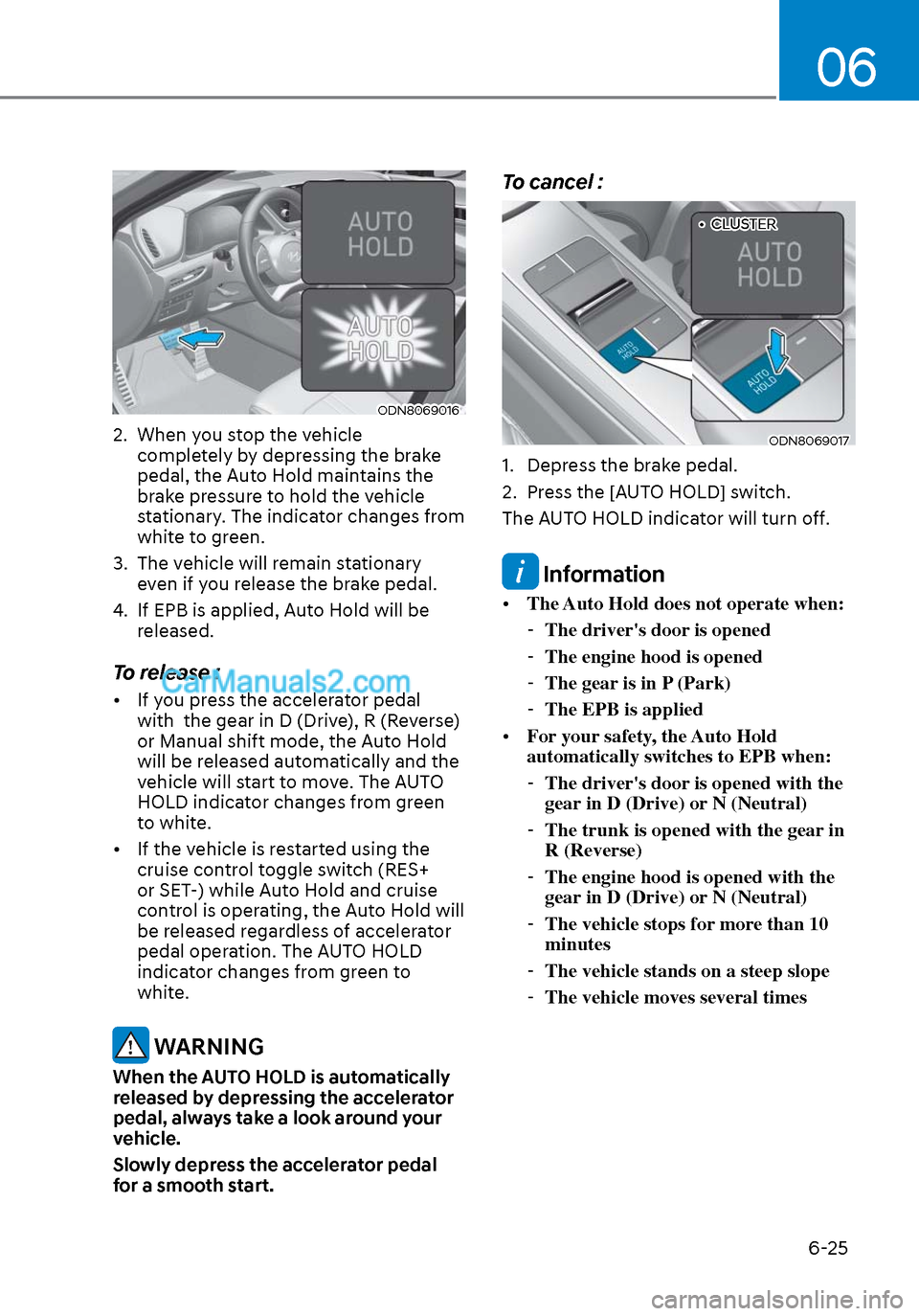
ODN8069016ODN8069016
2. When you stop the vehicle completely by depressing the brake
pedal, the Auto Hold maintains the
brake pressure to hold the vehicle
stationary. The indicator changes from
white to green.
3. The vehicle will remain stationary even if you release the brake pedal.
4. If EPB is applied, Auto Hold will be released.
To release :
• If you press the accelerator pedal with the gear in D (Drive), R (Reverse)
or Manual shift mode, the Auto Hold
will be released automatically and the
vehicle will start to move. The AUTO
HOLD indicator changes from green
to white.
• If the vehicle is restarted using the cruise control toggle switch (RES+
or SET-) while Auto Hold and cruise
control is operating, the Auto Hold will
be released regardless of accelerator
pedal operation. The AUTO HOLD
indicator changes from green to
white.
WARNING
When the AUTO HOLD is automatically
released by depressing the accelerator
pedal, always take a look around your
vehicle.
Slowly depress the accelerator pedal
for a smooth start.
To cancel :
ODN8069017ODN8069017
1. Depress the brake pedal.
2. Press the [AUTO HOLD] switch.
The AUTO HOLD indicator will turn off.
Information
• The Auto Hold does not operate when:
- The driver's door is opened
- The engine hood is opened
- The gear is in P (Park)
- The EPB is applied
• For your safety, the Auto Hold
automatically switches to EPB when:
- The driver's door is opened with the
gear in D (Drive) or N (Neutral)
- The trunk is opened with the gear in
R (Reverse)
- The engine hood is opened with the
gear in D (Drive) or N (Neutral)
- The vehicle stops for more than 10
minutes
- The vehicle stands on a steep slope
- The vehicle moves several times
••CLUSTERCLUSTER
Page 359 of 537
06
6-75
Type AType AType BType B
OTM058087LOTM058087LODN8059289LODN8059289L
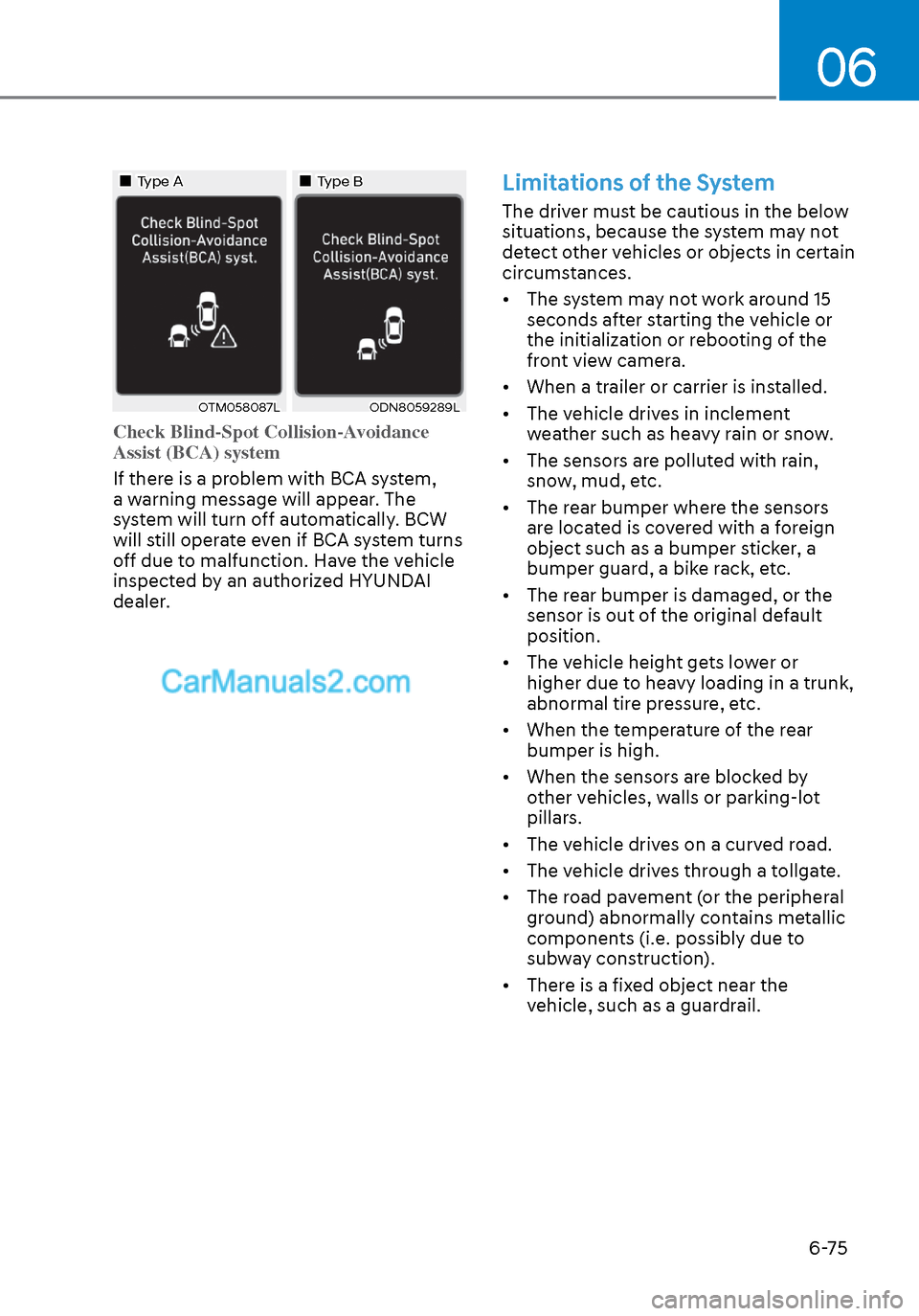
Check Blind-Spot Collision-Avoidance
Assist (BCA) system
If there is a problem with BCA system,
a w
arning message will appear. The
system will turn off automatically. BCW
will still operate even if BCA system turns
off due to malfunction. Have the vehicle
inspected by an authorized HYUNDAI
dealer.
Limitations of the System
The driver must be cautious in the below
situations, because the system may not
detect other vehicles or objects in certain
circumstances.
• The system may not work around 15 seconds after starting the vehicle or
the initialization or rebooting of the
front view camera.
• When a trailer or carrier is installed.
• The vehicle drives in inclement weather such as heavy rain or snow.
• The sensors are polluted with rain, snow, mud, etc.
• The rear bumper where the sensors are located is covered with a foreign
object such as a bumper sticker, a
bumper guard, a bike rack, etc.
• The rear bumper is damaged, or the sensor is out of the original default
position.
• The vehicle height gets lower or higher due to heavy loading in a trunk,
abnormal tire pressure, etc.
• When the temperature of the rear bumper is high.
• When the sensors are blocked by other vehicles, walls or parking-lot
pillars.
• The vehicle drives on a curved road.
• The vehicle drives through a tollgate.
• The road pavement (or the peripheral ground) abnormally contains metallic
components (i.e. possibly due to
subway construction).
• There is a fixed object near the vehicle, such as a guardrail.
Page 413 of 537
06
6-129
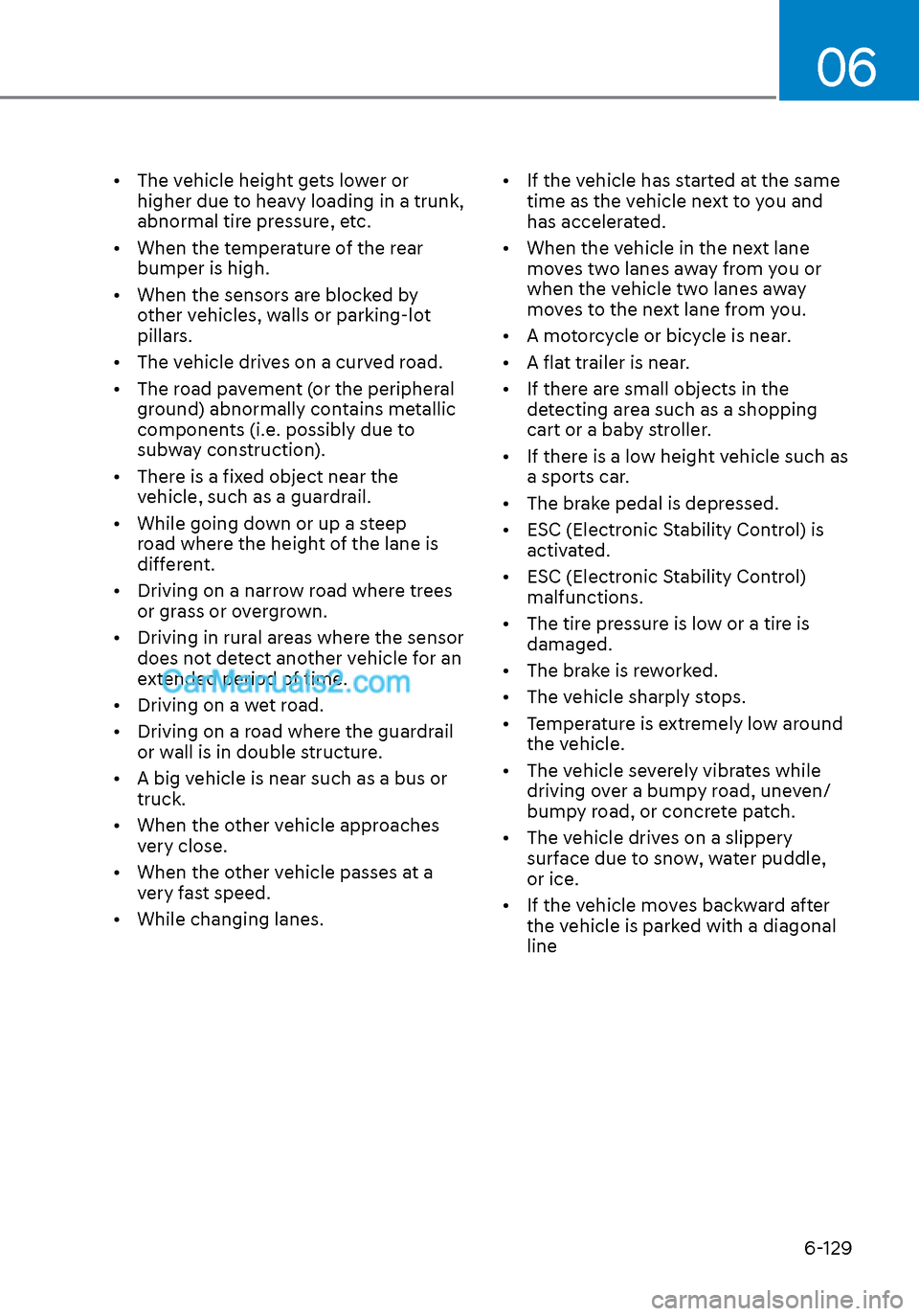
• The vehicle height gets lower or higher due to heavy loading in a trunk,
abnormal tire pressure, etc.
• When the temperature of the rear bumper is high.
• When the sensors are blocked by other vehicles, walls or parking-lot
pillars.
• The vehicle drives on a curved road.
• The road pavement (or the peripheral ground) abnormally contains metallic
components (i.e. possibly due to
subway construction).
• There is a fixed object near the vehicle, such as a guardrail.
• While going down or up a steep road where the height of the lane is
different.
• Driving on a narrow road where trees or grass or overgrown.
• Driving in rural areas where the sensor does not detect another vehicle for an
extended period of time.
• Driving on a wet road.
• Driving on a road where the guardrail or wall is in double structure.
• A big vehicle is near such as a bus or truck.
• When the other vehicle approaches very close.
• When the other vehicle passes at a very fast speed.
• While changing lanes. • If the vehicle has started at the same
time as the vehicle next to you and
has accelerated.
• When the vehicle in the next lane moves two lanes away from you or
when the vehicle two lanes away
moves to the next lane from you.
• A motorcycle or bicycle is near.
• A flat trailer is near.
• If there are small objects in the detecting area such as a shopping
cart or a baby stroller.
• If there is a low height vehicle such as a sports car.
• The brake pedal is depressed.
• ESC (Electronic Stability Control) is activated.
• ESC (Electronic Stability Control) malfunctions.
• The tire pressure is low or a tire is damaged.
• The brake is reworked.
• The vehicle sharply stops.
• Temperature is extremely low around the vehicle.
• The vehicle severely vibrates while driving over a bumpy road, uneven/
bumpy road, or concrete patch.
• The vehicle drives on a slippery surface due to snow, water puddle,
or ice.
• If the vehicle moves backward after the vehicle is parked with a diagonal
line
Page 497 of 537
Maintenance8-50
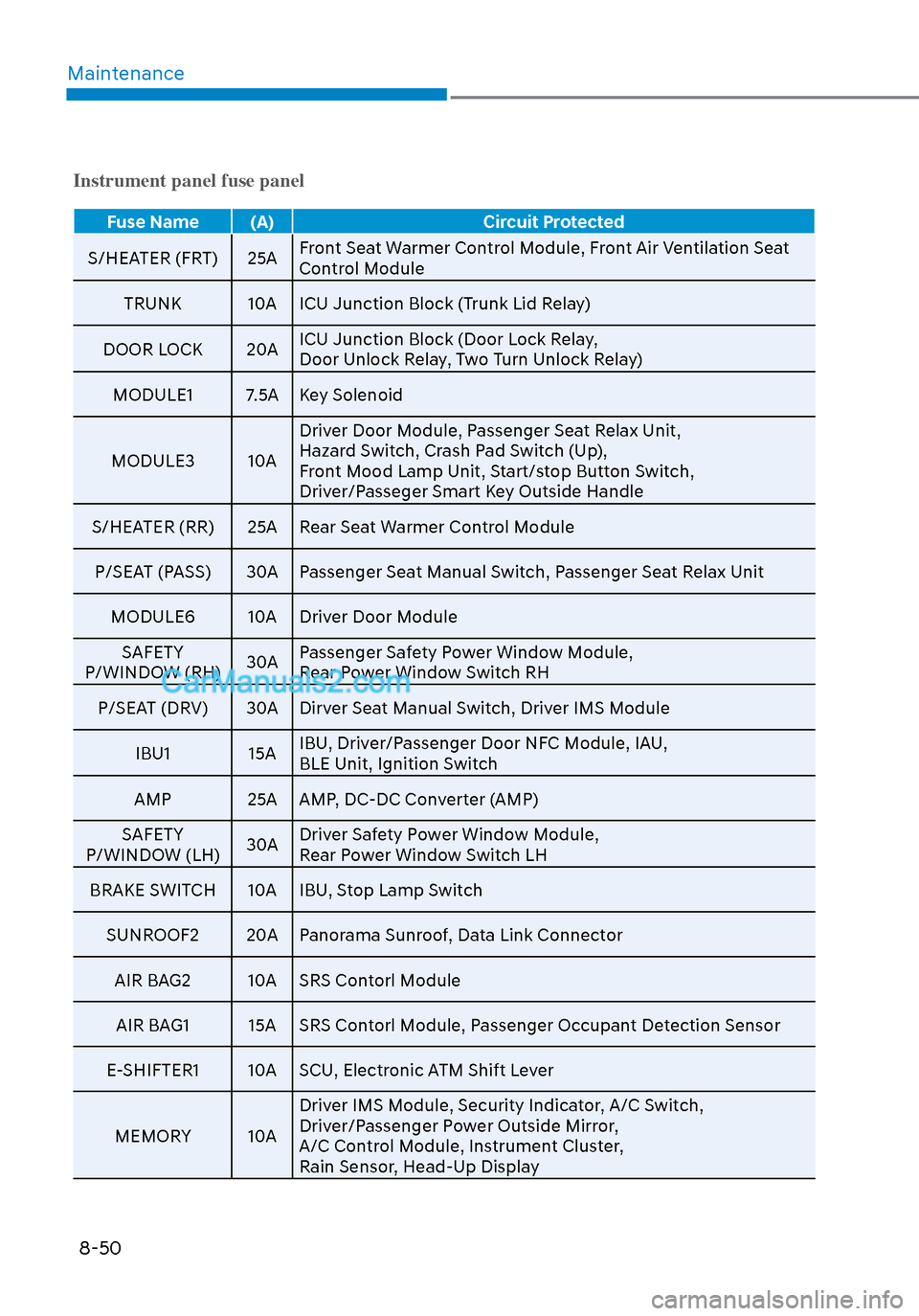
Instrument panel fuse panel
Fuse Name (A) Circuit Protected
S/HEATER (FRT) 25A F
ront Seat Warmer Control Module, Front Air Ventilation Seat
Control Module
TRUNK 10A ICU Junction Block (Trunk Lid Relay)
DOOR LOCK 20A ICU Junction Block (Door Lock Relay,
Door Unlock Relay, Two Turn Unlock Relay)
MODULE1 7.5A Key Solenoid
MODULE3 10A Driver Door Module, Passenger Seat Relax Unit,
Hazard Switch, Crash Pad Switch (Up),
Front Mood Lamp Unit, Start/stop Button Switch,
Driver/Passeger Smart Key Outside Handle
S/HEATER (RR) 25A Rear Seat Warmer Control Module
P/SEAT (PASS) 30A Passenger Seat Manual Switch, Passenger Seat Relax Unit MODULE6 10A Driver Door ModuleSAFETY
P/WINDOW (RH) 30APassenger Safety Power Window Module,
Rear Power Window Switch RH
P/SEAT (DRV) 30A Dirver Seat Manual Switch, Driver IMS Module
IBU1 15A IBU, Driver/Passenger Door NFC Module, IAU,
BLE Unit, Ignition Switch
AMP 25A AMP, DC-DC Converter (AMP)
SAFETY
P/WINDOW (LH) 30ADriver Safety Power Window Module,
Rear Power Window Switch LH
BRAKE SWITCH 10A IBU, Stop Lamp Switch
SUNROOF2 20A Panorama Sunroof, Data Link ConnectorAIR BAG2 10A SRS Contorl ModuleAIR BAG1 15A SRS Contorl Module, Passenger Occupant Detection Sensor
E-SHIFTER1 10A SCU, Electronic ATM Shift Lever
MEMORY 10A Driver IMS Module, Security Indicator, A/C Switch,
Driver/Passenger Power Outside Mirror,
A/C Control Module, Instrument Cluster,
Rain Sensor, Head-Up Display
Page 501 of 537
![Hyundai Sonata 2020 Owners Guide Maintenance8-54
Engine compartment fuse panel
Fuse Name (A) Circuit Protected
FUSE HEA
TED
MIRROR 10ADriver/Passenger Power Outside Mirror, A/C Switch,
A/C Control Module, ECM
ECU5 10A [G4FN] ECM
A](/img/35/16773/w960_16773-500.png "Hyundai Sonata 2020 Owners Guide Maintenance8-54
Engine compartment fuse panel
Fuse Name (A) Circuit Protected
FUSE HEA
TED
MIRROR 10ADriver/Passenger Power Outside Mirror, A/C Switch,
A/C Control Module, ECM
ECU5 10A [G4FN] ECM
A")
Maintenance8-54
Engine compartment fuse panel
Fuse Name (A) Circuit Protected
FUSE HEA
TED
MIRROR 10ADriver/Passenger Power Outside Mirror, A/C Switch,
A/C Control Module, ECM
ECU5 10A [G4FN] ECM
AMS 10A Battery Sensor
FUEL PUMP 1 20A E/R Junction Block (Fuel Pump Relay) A/C 2 10A A/C Control Module
B+4 60A ICU Junction Block (Long Term Load Latch Relay,
Fuse - MODULE3, AIR BAG2, E-SHIFTER1, SUNROOF1,
SUNROOF2, S/HEATER (FRT), TRUNK, BRAKE SWITCH,
DOOR LOCK)
Page 504 of 537
08
8-57
ODN8A089063ODN8A089063
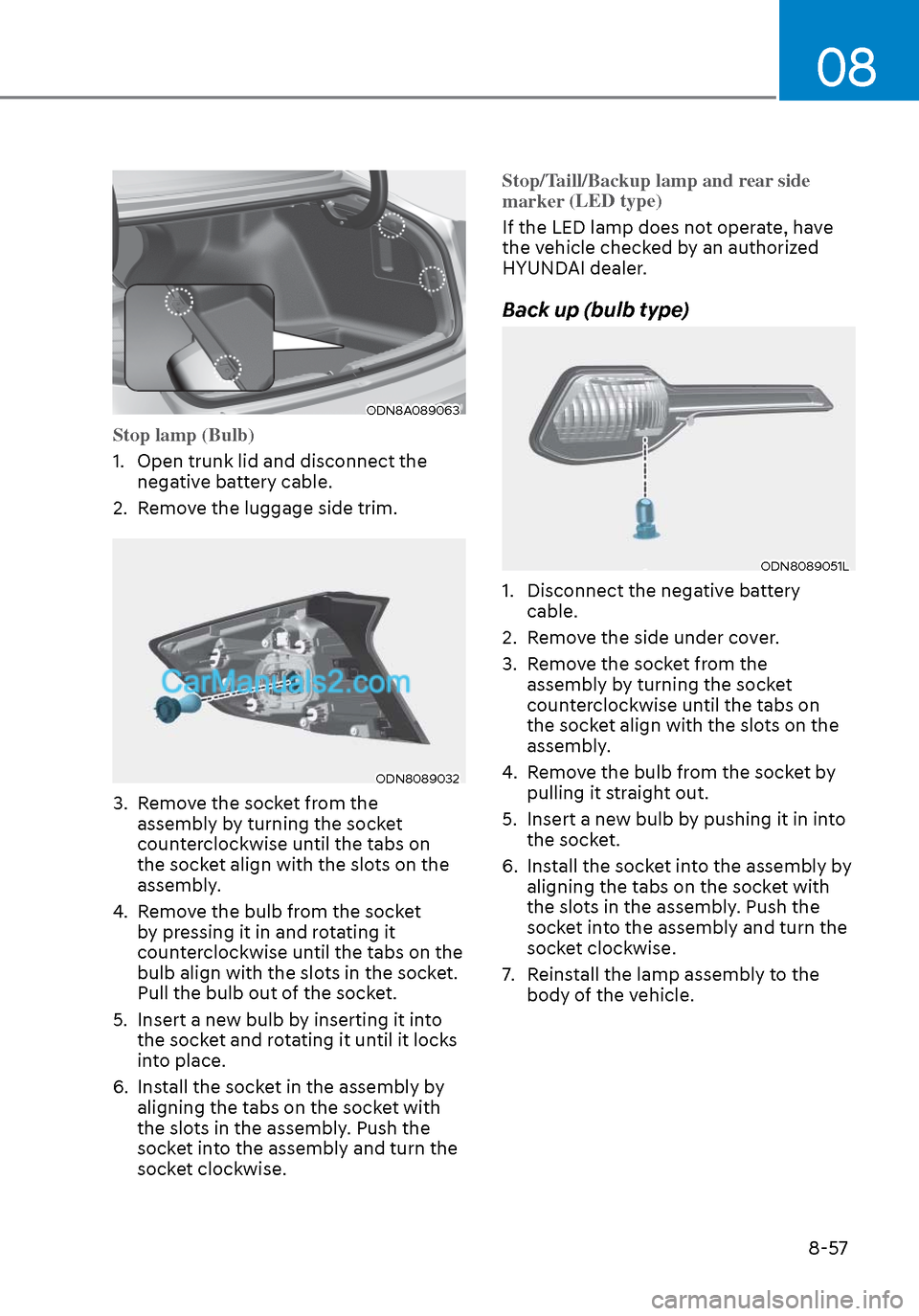
Stop lamp (Bulb)
1. Open trunk lid and disconnect the nega
tive battery cable.
2. Remove the luggage side trim.
ODN8089032ODN8089032
3. Remove the socket from the assembly by turning the socket
counterclockwise until the tabs on
the socket align with the slots on the
assembly.
4. Remove the bulb from the socket by pressing it in and rotating it
counterclockwise until the tabs on the
bulb align with the slots in the socket.
Pull the bulb out of the socket.
5. Insert a new bulb by inserting it into the socket and rotating it until it locks
into place.
6. Install the socket in the assembly by aligning the tabs on the socket with
the slots in the assembly. Push the
socket into the assembly and turn the
socket clockwise. Stop/Taill/Backup lamp and rear side
marker
(LED type)
If the LED lamp does not operate, have
the v
ehicle checked by an authorized
HYUNDAI dealer.
Back up (bulb type)
ODN8089051LODN8089051L
1. Disconnect the negative battery cable.
2. Remove the side under cover.
3. Remove the socket from the assembly by turning the socket
counterclockwise until the tabs on
the socket align with the slots on the
assembly.
4. Remove the bulb from the socket by pulling it straight out.
5. Insert a new bulb by pushing it in into the socket.
6. Install the socket into the assembly by aligning the tabs on the socket with
the slots in the assembly. Push the
socket into the assembly and turn the
socket clockwise.
7. Reinstall the lamp assembly to the body of the vehicle.
Page 506 of 537
08
8-59
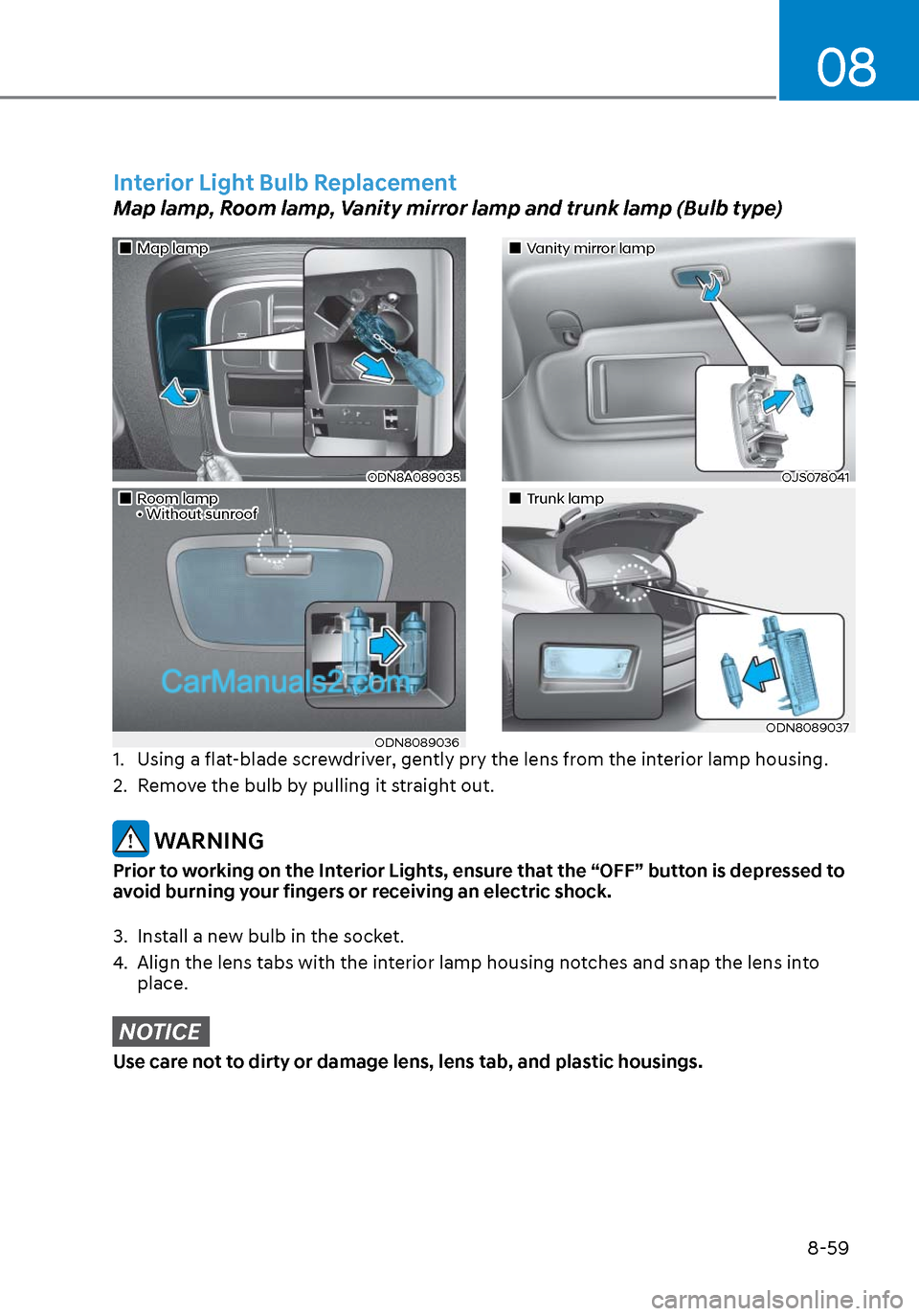
Map lampMap lamp
ODN8A089035ODN8A089035
Room lampRoom lamp• Without sunroof• Without sunroof
ODN8089036ODN8089036
Vanity mirror lampVanity mirror lamp
OJS078041OJS078041
Trunk lampTrunk lamp
ODN8089037ODN8089037
Interior Light Bulb Replacement
Map lamp, Room lamp, Vanity mirror lamp and trunk lamp (Bulb type)
1. Using a flat-blade screwdriver, gently pry the lens from the interior lamp housing.
2. Remove the bulb by pulling it straight out.
WARNING
Prior to working on the Interior Lights, ensure that the “OFF” button is depressed to
avoid burning your fingers or receiving an electric shock.
3. Install a new bulb in the socket.
4. Align the lens tabs with the interior lamp housing notches and snap the lens into place.
NOTICE
Use care not to dirty or damage lens, lens tab, and plastic housings.
Page 524 of 537

I
I-5
Clock ..................................................................\
................................................ 5-150
Clothes hanger ........................................................................\
........................... 5-150
Crankcase emission control system ..................................................................... 8-68
Cup holder ........................................................................\
................................. 5-145
Curtain air bags ........................................................................\
............................ 3-41
D
Daytime running light (DRL) ........................................................................\
...... 5-74
Defroster ..............................................................\
.............................................. 5-142
Dimensions .............................................................\
............................................... 2-7
Door locks ........................................................................\
.................................... 5-31Central door lock/unlock switch ..................................................................... 5-33
Child-protector rear door lock ........................................................................\
. 5-35
Auto door lock/unlock features ....................................................................... 5-34
Operating door locks from outside the vehicle ............................................... 5-31
Operating door locks from inside the vehicle ................................................. 5-32
Rear Occupant Alert (ROA) system ................................................................ 5-36
Drive mode integrated control system ................................................................ 6-37
Drive mode ........................................................................\
.............................. 6-37
Driver Attention Warning (DAW) ...................................................................... 6-79 Leading vehicle departure alert ....................................................................... 6-84
Driver position memory system........................................................................\
... 5-39 Storing positions into memory ........................................................................\
5-39
Easy access function ........................................................................\
............... 5-41
Driver’s air bag ........................................................................\
............................ 3-39
Driving at night ........................................................................\
.......................... 6-134
Driving in flooded areas ........................................................................\
............ 6-135
Driving in the rain ........................................................................\
...................... 6-134
E
Electric Power Steering (EPS) ........................................................................\
..... 5-42
Electronic Stability Control (ESC) ...................................................................... 6-29
Emergency towing ........................................................................\
....................... 7-19
Emergency trunk safety release ........................................................................\
... 5-66