chapter 6 Hyundai Sonata 2020 Manual PDF
[x] Cancel search | Manufacturer: HYUNDAI, Model Year: 2020, Model line: Sonata, Model: Hyundai Sonata 2020Pages: 537, PDF Size: 14.54 MB
Page 466 of 537
08
8-19
Checking the Engine Oil Level
1. Follow all of the oil manufacturer’s precautions.
2. Be sure the vehicle is on the level ground in P (Park) with the parking
brake set. If possible, block the
wheels.
3. Turn the engine on and allow the engine to reach normal operating
temperature.
4. Turn the engine off and wait about five minutes for the oil to return to the
oil pan.
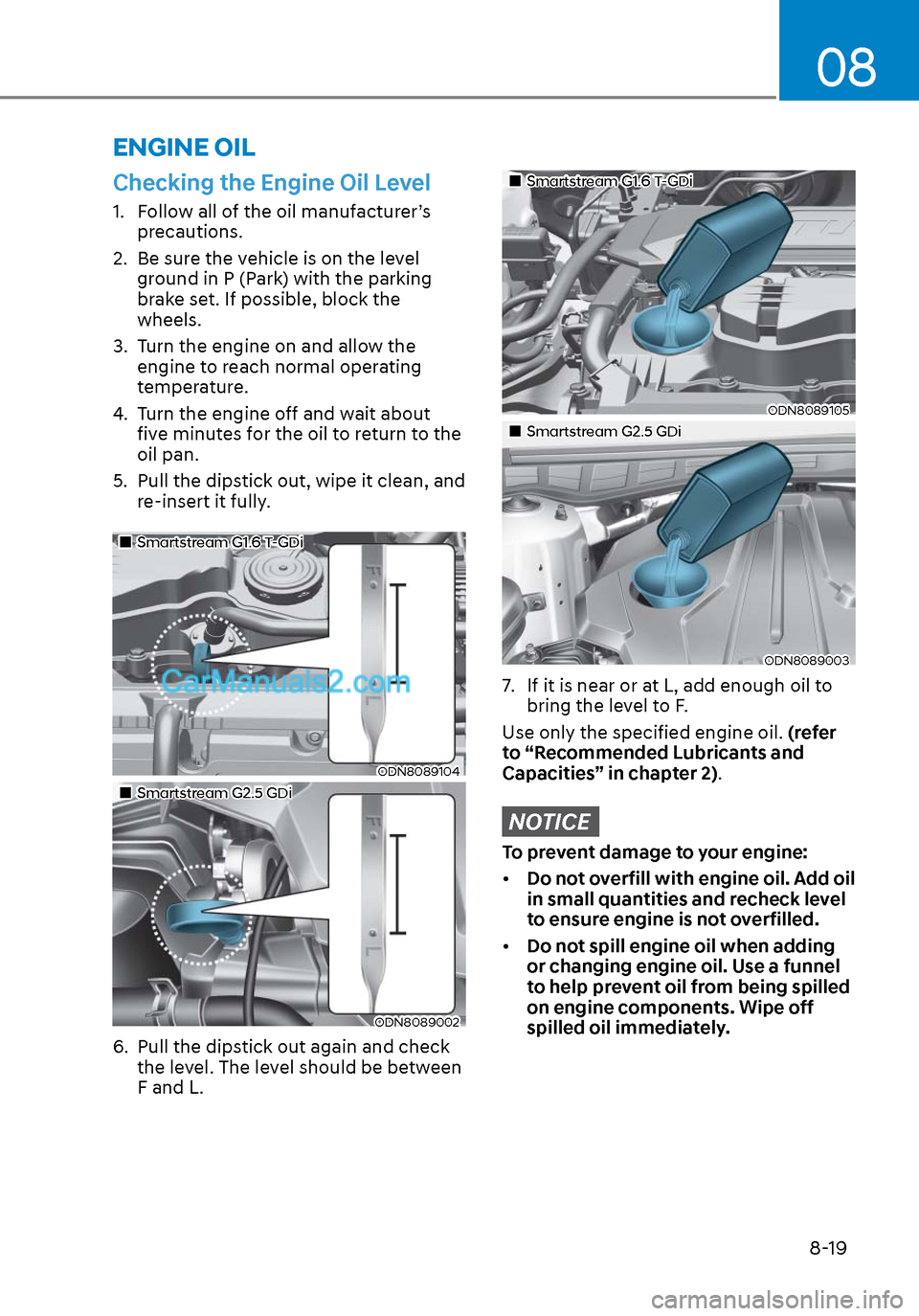
5. Pull the dipstick out, wipe it clean, and re-insert it fully.
Smartstream G1.6 T-GDiSmartstream G1.6 T-GDi
ODN8089104ODN8089104
Smartstream G2.5 GDiSmartstream G2.5 GDi
ODN8089002ODN8089002
6. Pull the dipstick out again and check the level. The level should be between
F and L.
Smartstream G1.6 T-GDiSmartstream G1.6 T-GDi
ODN8089105ODN8089105
Smartstream G2.5 GDiSmartstream G2.5 GDi
ODN8089003ODN8089003
7. If it is near or at L, add enough oil to bring the level to F.
Use only the specified engine oil. (refer
to “Recommended Lubricants and
Capacities” in chapter 2).
NOTICE
To prevent damage to your engine:
• Do not overfill with engine oil. Add oil
in small quantities and recheck level
to ensure engine is not overfilled.
• Do not spill engine oil when adding
or changing engine oil. Use a funnel
to help prevent oil from being spilled
on engine components. Wipe off
spilled oil immediately.
ENGINE OIL
Page 467 of 537
Maintenance8-20
Checking the Engine Oil and
Filter
Have engine oil and filter changed by an
authorized HYUNDAI dealer according
to the Maintenance Schedule at the
beginning of this chapter.
WARNING
CALIFORNIA PROPOSITION 65
WARNING
Engine oil contains chemicals known to
the State of California to cause cancer,
birth defects and reproductive harm.
Used engine oil may cause irritation or
cancer of the skin if left in contact with
the skin for prolonged periods of time.
Always protect your skin by washing
your hands thoroughly with soap and
warm water as soon as possible after
handling used oil.
Page 470 of 537
08
8-23
WARNING
The electric motor for the
cooling fan may continue to
operate or start up when the
engine is not running and can
cause serious injury. Keep
hands, clothing and tools away
from the rotating fan blades of
the cooling fan.
The electric motor for the cooling
fan is controlled by engine coolant
temperature, refrigerant pressure and
vehicle speed. As the engine coolant
temperature decreases, the electric
motor will automatically shut off. This
is a normal condition. If your vehicle is
equipped with GDI, the electric motor
for the cooling fan may begin to operate
at any time and continue to operate until
you disconnect the negative battery
cable.
Changing Engine Coolant
Have coolant changed by an authorized
HYUNDAI dealer according to the
Maintenance Schedule at the beginning
of this chapter.
WARNING
Do not use engine coolant or antifreeze
in the washer fluid reservoir.
Engine coolant can severely obscure
visibility when sprayed on the
windshield and may cause loss of
vehicle control resulting in an accident.
Engine coolant may also cause damage
to paint and body trim.
NOTICE
To prevent damage to engine parts, put
a thick towel around the radiator cap
before refilling the coolant to prevent
the coolant from overflowing into
engine parts, such as the alternator.
Page 471 of 537
Maintenance8-24
Checking the Brake Fluid Level
ODN8089005ODN8089005
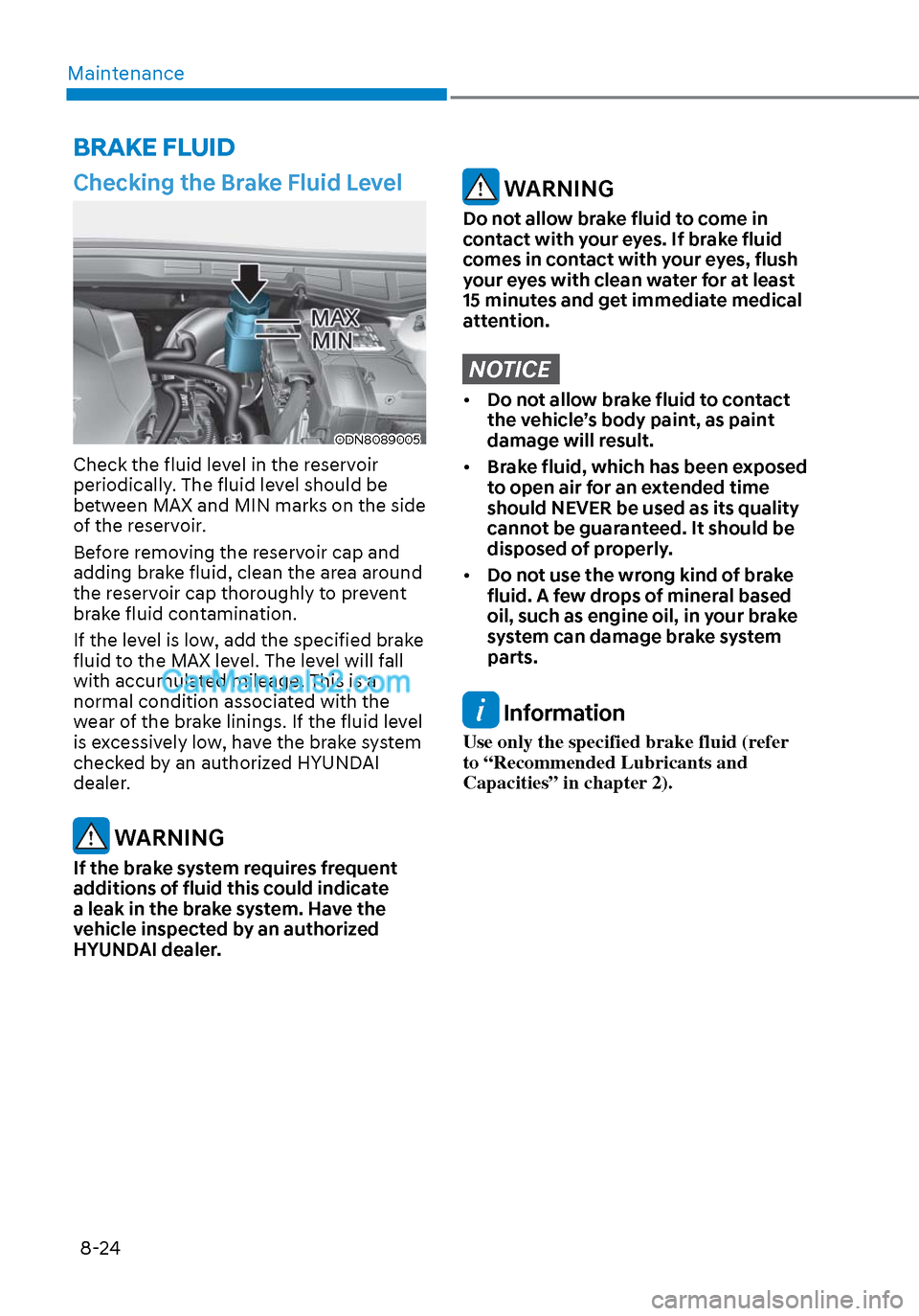
Check the fluid level in the reservoir
periodically. The fluid level should be
between MAX and MIN marks on the side
of the reservoir.
Before removing the reservoir cap and
adding brake fluid, clean the area around
the reservoir cap thoroughly to prevent
brake fluid contamination.
If the level is low, add the specified brake
fluid to the MAX level. The level will fall
with accumulated mileage. This is a
normal condition associated with the
wear of the brake linings. If the fluid level
is excessively low, have the brake system
checked by an authorized HYUNDAI
dealer.
WARNING
If the brake system requires frequent
additions of fluid this could indicate
a leak in the brake system. Have the
vehicle inspected by an authorized
HYUNDAI dealer.
WARNING
Do not allow brake fluid to come in
contact with your eyes. If brake fluid
comes in contact with your eyes, flush
your eyes with clean water for at least
15 minutes and get immediate medical
attention.
NOTICE
• Do not allow brake fluid to contact
the vehicle’s body paint, as paint
damage will result.
• Brake fluid, which has been exposed
to open air for an extended time
should NEVER be used as its quality
cannot be guaranteed. It should be
disposed of properly.
• Do not use the wrong kind of brake
fluid. A few drops of mineral based
oil, such as engine oil, in your brake
system can damage brake system
parts.
Information
Use only the specified brake fluid (refer
to “Recommended Lubricants and
Capacities” in chapter 2).
BRAKE FLUID
Page 474 of 537
08
8-27
1. Pull up the lever (1) on the air cleaner cover and release the lock.
2. Pull up the air cleaner cover (2) and open.
3. Rotate the fixed lever (3) on the filter and loosen the lock.
4. Replace the air cleaner filter.
5. Assemble in reverse order.
Information
If the vehicle is operated in extremely
dusty or sandy areas, replace the element
more often than the usual recommended
intervals (refer to “Maintenance Under
Severe Usage Conditions” in this chapter).
NOTICE
• Do not drive with the air cleaner filter
removed. This will result in excessive
engine wear.
• When removing the air cleaner filter,
be careful that dust or dirt does not
enter the air intake, or damage may
result.
• Use HYUNDAI genuine parts. Use of
non-genuine parts could damage the
air flow sensor.
Page 480 of 537
08
8-33
• The negative battery cable must
be removed first and installed last
when the battery is disconnected.
Disconnect the battery charger in the
following order:
1. Turn off the battery charger main
switch.
2. Unhook the negative clamp from the negative battery terminal.
3. Unhook the positive clamp from the positive battery terminal.
• Always use a genuine HYUNDAI
approved battery when you replace
the battery.
By jump starting
After a jump start from a good battery,
drive the vehicle for 20-30 minutes
before it is shutoff. The vehicle may
not restart if you shut it off before the
battery had a chance to adequately
recharge. See “Jump Starting” in chapter
7 for more information on jump starting
procedures.
Information
An inappropriately disposed
battery can be harmful to
the environment and human
health. Dispose of the battery
according to your local law(s) or
regulations.
Reset Features
The following items may need to be reset
after the battery has been discharged or
the battery has been disconnected. See
chapter 3 or 4 for:
• Power Windows
• Trip Computer
• Climate Control System
• Clock
• Audio System
• Sunroof
Page 481 of 537
Maintenance8-34
WARNING
Tire failure may cause loss of vehicle
control resulting in an accident. To
reduce risk of SERIOUS INJURY or
DEATH, take the following precautions:
• Inspect your tires monthly for proper
inflation as well as wear and damage.
• The recommended cold tire pressure
for your vehicle can be found in this
manual and on the tire label located
on the driver’s side center pillar.
Always use a tire pressure gauge to
measure tire pressure. Tires with
too much or too little pressure wear
unevenly causing poor handling.
• Check the pressure of the spare
every time you check the pressure of
the other tires on your vehicle.
• Replace tires that are worn, show
uneven wear, or are damaged.
Worn tires can cause loss of braking
effectiveness, steering control, or
traction.
• ALWAYS replace tires with the same
type, size, brand, construction and
tread pattern as each tire that was
originally supplied with this vehicle.
Using tires and wheels other than
the recommended sizes could cause
unusual handling characteristics,
poor vehicle control, or negatively
affect your vehicle’s Anti-Lock Brake
System (ABS) resulting in a serious
accident.
Tire Care
For proper maintenance, safety, and
maximum fuel economy, you must
always maintain recommended tire
inflation pressures and stay within the
load limits and weight distribution
recommended for your vehicle.
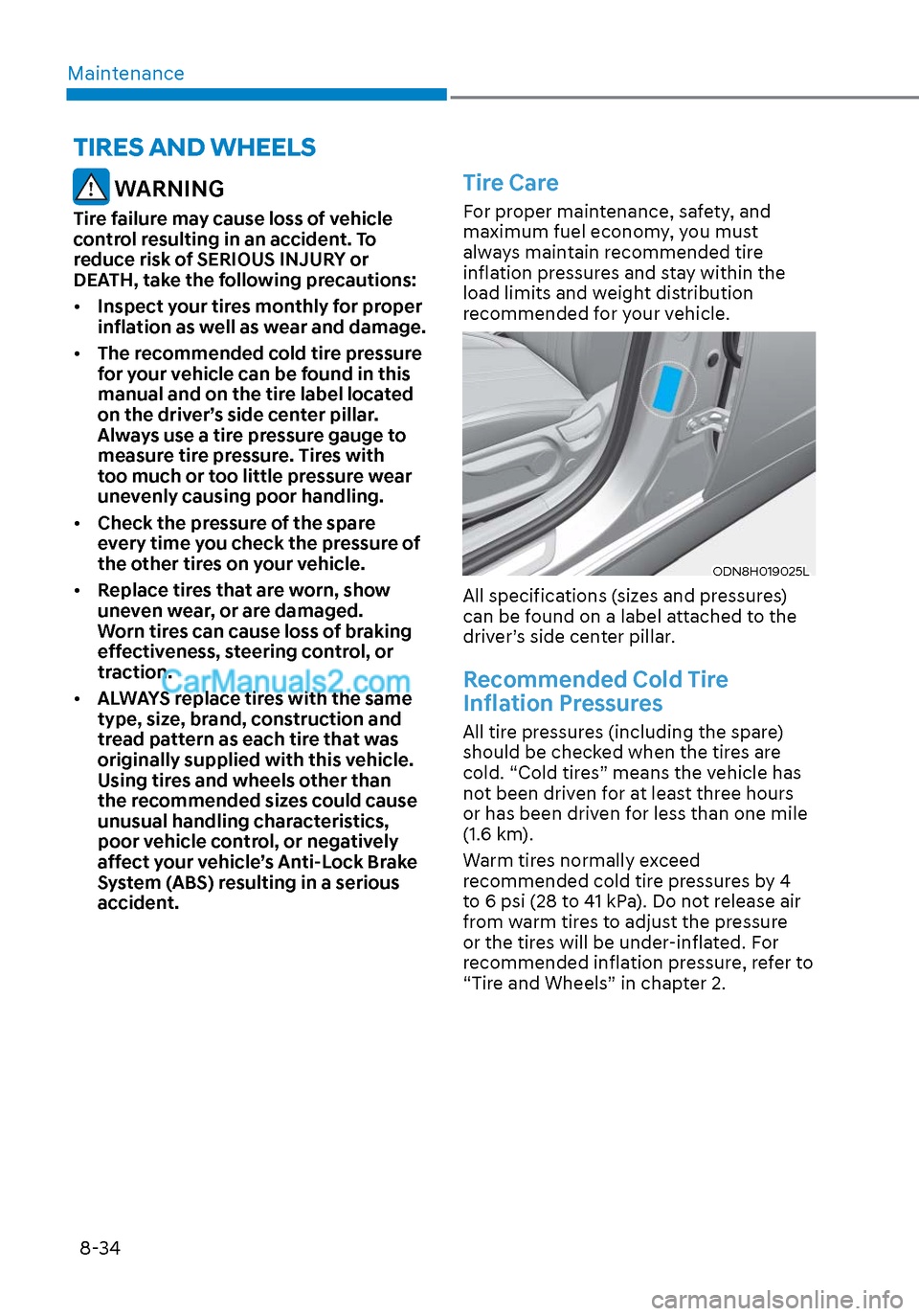
ODN8H019025LODN8H019025L
All specifications (sizes and pressures)
can be found on a label attached to the
driver’s side center pillar.
Recommended Cold Tire
Inflation Pressures
All tire pressures (including the spare)
should be checked when the tires are
cold. “Cold tires” means the vehicle has
not been driven for at least three hours
or has been driven for less than one mile
(1.6 km).
Warm tires normally exceed
recommended cold tire pressures by 4
to 6 psi (28 to 41 kPa). Do not release air
from warm tires to adjust the pressure
or the tires will be under-inflated. For
recommended inflation pressure, refer to
“Tire and Wheels” in chapter 2.
TIRES AND WHEELS
Page 492 of 537
08
8-45
Radial-Ply Tires
Radial-ply tires provide improved tread
life, road hazard resistance and smoother
high speed ride. The radial-ply tires used
on this vehicle are of belted construction,
and are selected to complement the
ride and handling characteristics of your
vehicle.
Radial-ply tires have the same load
carrying capacity, as bias-ply or bias
belted tires of the same size, and use the
same recommended inflation pressure.
Mixing of radial-ply tires with bias-ply or
bias belted tires is not recommended.
Any combinations of radial-ply and bias-
ply or bias belted tires when used on the
same vehicle will seriously deteriorate
vehicle handling. The best rule to follow
is: Identical pairs of radial-ply tires
should always be used as a set for the
front tires and a set for the rear tires.
Longer wearing tires can be more
susceptible to irregular tread wear. It is
very important to follow the tire rotation
interval in this chapter to achieve the
tread life potential of these tires. Cuts
and punctures in radial-ply tires are
repairable only in the tread area, because
of sidewall flexing. Consult your tire
dealer for radial-ply tire repairs.
WARNING
Do not mix bias ply and radial ply tires
under any circumstances. This may
cause unusual handling characteristics
that may cause loss of vehicle control
resulting in an accident.
Low Aspect Ratio Tires
The aspect ratio is lower than 50 on low
aspect ratio tires.
Because low aspect ratio tires are
optimized for handling and braking, their
sidewall is a little stiffer than a standard
tire. Also low aspect ratio tires tend to be
wider and consequently have a greater
contact patch with the road surface. In
some instances they may generate more
road noise compared with standard tires.
CAUTION
Because the sidewall of a low aspect
ratio tire is shorter than a standard tire,
the rim of the wheel and the tire itself
is more easily susceptible to damage.
Use caution when driving and follow
the guidelines below to help minimize
damage to the wheel and tire:
• When driving on a rough road or off
road, drive cautiously because tires
and wheels may be damaged. And
after driving, inspect tires and wheels.
• When passing over a pothole, speed
bump, manhole, or curb stone, drive
slowly so that the tires and wheels
are not damaged.
• If the tire is subjected to a severe
impact, have the tire and wheel
inspected by an authorized HYUNDAI
dealer.
• Inspect the tire condition and
pressure every 1,800 miles
(3,000km).
CAUTION
• It is not easy to recognize tire
damage with your own eyes. But
if there is the slightest hint of tire
damage, have the tire checked or
replaced because the tire damage
may cause air leakage from the tire.
• If the tire is damaged by driving
on a rough road, off road, pothole,
manhole, or curb stone, it will not be
covered by the warranty.