brake HYUNDAI SONATA 2021 Owners Manual
[x] Cancel search | Manufacturer: HYUNDAI, Model Year: 2021, Model line: SONATA, Model: HYUNDAI SONATA 2021Pages: 546, PDF Size: 51.21 MB
Page 446 of 546
07
7-11
Each wheel is equipped with a tire
pressure sensor mounted inside the tire
behind the valve stem (except for the
spare tire). You must use TPMS specific
wheels. It is recommended that you
always have your tires serviced by an
authorized HYUNDAI dealer.
You may not be able to identify a tire
with low pressure by simply looking at it.
Always use a good quality tire pressure
gauge to measure the tire’s inflation
pressure. Please note that a tire that is
hot (from being driven) will have a higher
pressure measurement than a tire that is
cold.
A cold tire means the vehicle has been
sitting for 3 hours and driven for less
than 1 mile (1.6 km) in that 3 hour period.
Allow the tire to cool before measuring
the inflation pressure. Always be sure
the tire is cold before inflating to the
recommended pressure.
WARNING
• The TPMS cannot alert you to severe
and sudden tire damage caused by
external factors such as nails or road
debris.
• If you feel any vehicle instability,
immediately take your foot off
the accelerator, apply the brakes
gradually with light force, and slowly
move to a safe position off the road.
WARNING
Tampering with, modifying, or disabling
the Tire Pressure Monitoring System
(TPMS) components may interfere
with the system’s ability to warn the
driver of low tire pressure conditions
and/or TPMS malfunctions. Tampering
with, modifying, or disabling the Tire
Pressure Monitoring System (TPMS)
components may void the warranty for
that portion of the vehicle.
Information
This device complies with Part 15 of the
FCC rules.
Operation is subject to the following three
conditions:
1.
This device may not cause harmful
interfer
ence.
2.
This device must accept any
interfer
ence received, including
interference that may cause undesired
operation.
3.
Changes or
modifications not expressly
approved by the party responsible
for compliance could void the user’s
authority to operate the equipment.
Page 448 of 546
07
7-13
Changing Tires
WARNING
A vehicle can slip or roll off of a jack
causing serious injury or death to you or
those nearby. Take the following safety
precautions:
• Never place any portion of your body
under a vehicle that is supported by
a jack.
• NEVER attempt to change a tire in
the lane of traffic. ALWAYS move the
vehicle completely off the road on
level, firm ground away from traffic
before trying to change a tire. If you
cannot find a level, firm place off
the road, call a towing service for
assistance.
• Be sure to use the jack provided with
the vehicle.
• ALWAYS place the jack on the
designated jacking positions on the
vehicle and NEVER on the bumpers
or any other part of the vehicle for
jacking support.
• Do not start or run the engine while
the vehicle is on the jack.
• Do not allow anyone to remain in the
vehicle while it is on the jack.
• Keep children away from the road
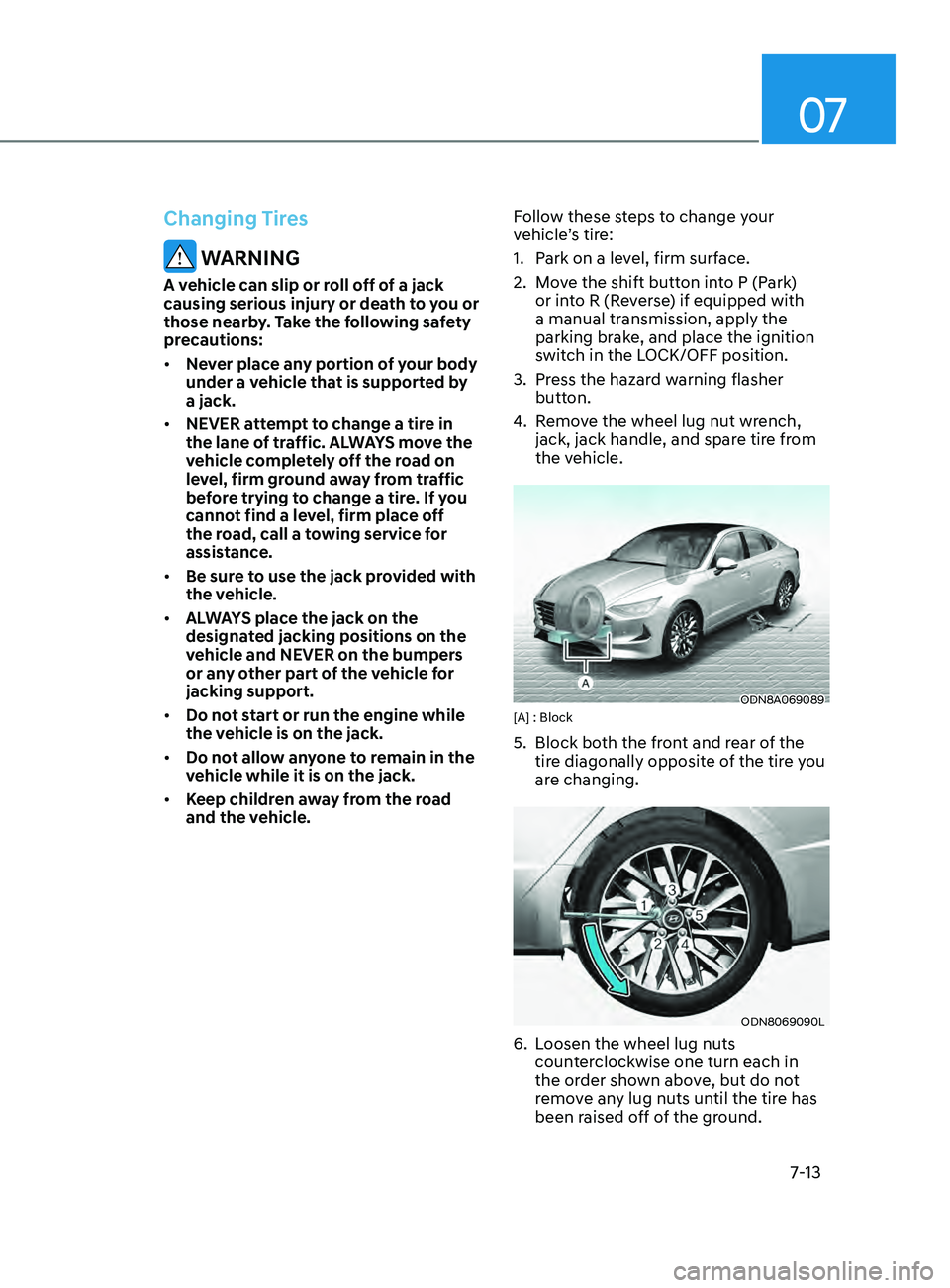
and the vehicle. Follow these steps to change your
vehicle’s tire:
1.
P
ark on a level, firm surface.
2. M ove the shift button into P (Park)
or into R (Reverse) if equipped with
a manual transmission, apply the
parking brake, and place the ignition
switch in the LOCK/OFF position.
3.
Pr
ess the hazard warning flasher
button.
4.
R
emove the wheel lug nut wrench,
jack, jack handle, and spare tire from
the vehicle.
ODN8A069089[A] : Block
5. Block bo th the front and rear of the
tire diagonally opposite of the tire you
are changing.
ODN8069090L
6. Loosen the wheel lug nuts counterclockwise one turn each in
the order shown above, but do not
remove any lug nuts until the tire has
been raised off of the ground.
Page 452 of 546
07
7-17
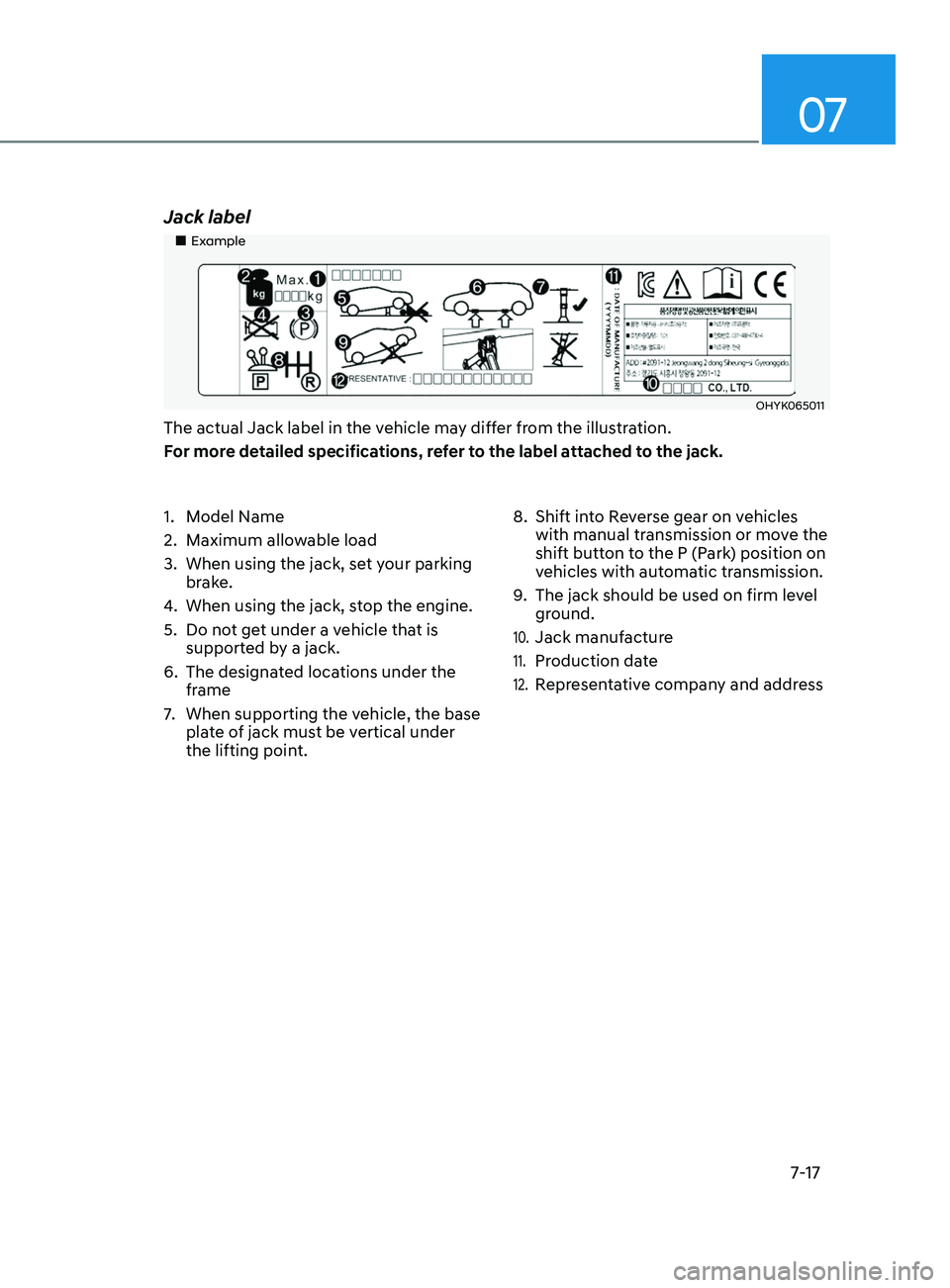
Jack label
„„Example
OHYK065011
The actual Jack label in the vehicle may differ from the illustration.
For more detailed specifications, refer to the label attached to the jack.
1.
M
odel Name
2.
Maximum allo
wable load
3.
When using the jack, se
t your parking
brake.
4.
When using the jack, s
top the engine.
5.
Do no
t get under a vehicle that is
supported by a jack.
6.
The designa
ted locations under the
frame
7.
When supporting the v
ehicle, the base
plate of jack must be vertical under
the lifting point. 8.
Shift in
to Reverse gear on vehicles
with manual transmission or move the
shift button to the P (Park) position on
vehicles with automatic transmission.
9.
The jack should be used on firm le
vel
ground.
10. Jack manufacture
11. Production date
12. Representative company and address
Page 454 of 546
07
7-19
WARNING
If your vehicle is equipped with a
rollover sensor, place the ignition
switch in the LOCK/OFF or ACC position
when the vehicle is being towed.
The side impact and curtain air bag
may deploy if the sensor detects the
situation as a rollover.
When towing your vehicle in an
emergency without wheel dollies:
1.
Place the ignition s
witch in the ACC
position.
2.
Place the shift butt
on in N (Neutral).
3.
R
elease the parking brake.
CAUTION
Failure to place the shift button in N
(Neutral) when being towed with the
front wheels on the ground can cause
internal damage to the transmission.
Emergency Towing
If towing is necessary, we recommend
you have it done by an authorized
HYUNDAI dealer or a commercial tow
truck service.
Page 455 of 546

Engine Compartment ........................................................................\
............8 -3
Maintenance Services ........................................................................\
........... 8-4
Owner’s Responsibility ........................................................................\
.................... 8-4
Owner Main tenance Precautions ........................................................................\
.... 8-4
Owner Maintenance ........................................................................\
.............. 8-5Owner Maintenance Schedule ........................................................................\
........8-5
Scheduled Maintenance Services ................................................................8 -7Normal Maintenance Schedule (Smartstream G1.6 T-GDi) ...................................8-8
Main tenance Under Severe Usage Conditions (Smartstream G1.6 T-GDi) .........8-11
Severe Driving Conditions
........................................................................\
.............. 8-11
Normal Maintenance Schedule (Smartstream G2.5 GDi)
.....................................8-12
Maintenance Under Severe Usage Conditions (Smartstream G2.5 GDi)
................8-15
Severe Driving Conditions
........................................................................\
.............. 8-15
Explanation of Scheduled Maintenance Items ..........................................8- 16
Engine Oil ........................................................................\
............................. 8-19
Checking the Engine Oil Level ........................................................................\
........8- 19
Checking the Engine Oil and Filter ....................................................................... 8-20
Checking the Engine Coolant Level
....................................................................... 8-
21
Engine Coolant ........................................................................\
......................8- 21Changing Engine Coolant ........................................................................\
..............8- 23
Brake Fluid ........................................................................\
............................8 -24Checking the Brake Fluid Level ........................................................................\
.....8 -24
Washer Fluid ........................................................................\
.........................8- 25Checking the Washer Fluid Level ........................................................................\
..8- 25
Air Cleaner ........................................................................\
............................8- 26Filter Replacement ........................................................................\
.........................8- 26
Climate Control Air Filter ........................................................................\
.....8- 28Filter Inspection........................................................................\
.............................. 8-28
Filter replacement
........................................................................\
.......................... 8-28
Wiper Blades ........................................................................\
........................8- 29Blade Inspection ........................................................................\
............................8- 29
Blade Replacement ........................................................................\
........................ 8-29
Battery ........................................................................\
................................... 8- 31For Best Battery Service ........................................................................\
................8- 32
Battery Recharging ........................................................................\
........................ 8-32
Reset Features
........................................................................\
................................ 8-33
Maintenance
8. Maintenance
8
Page 460 of 546
Maintenance
8-6
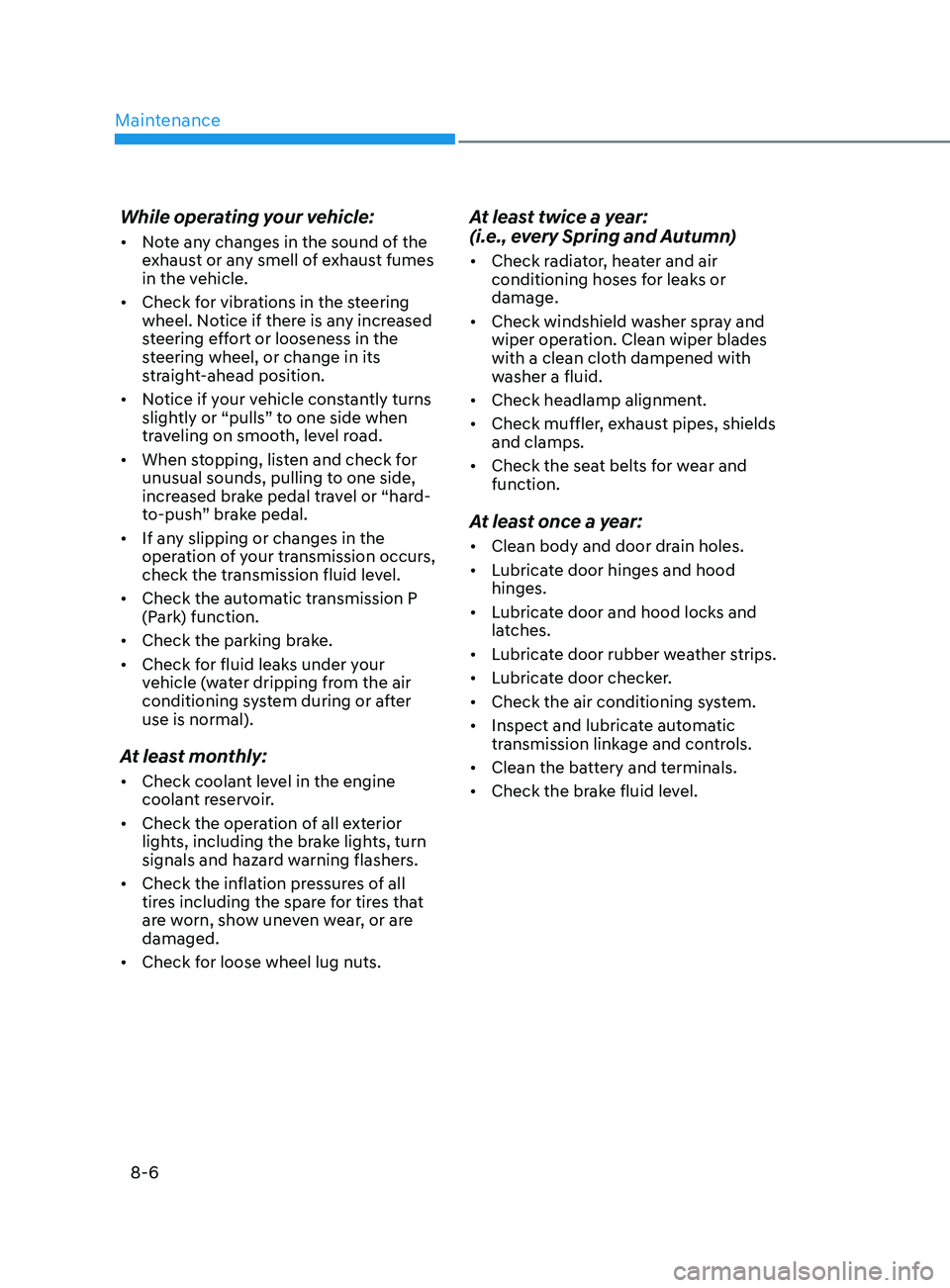
While operating your vehicle:
• Note any changes in the sound of the
exhaust or any smell of exhaust fumes
in the vehicle.
• Check for vibrations in the steering
wheel. Notice if there is any increased
steering effort or looseness in the
steering wheel, or change in its
straight-ahead position.
• Notice if your vehicle constantly turns
slightly or “pulls” to one side when
traveling on smooth, level road.
• When stopping, listen and check for
unusual sounds, pulling to one side,
increased brake pedal travel or “hard-
to-push” brake pedal.
• If any slipping or changes in the
operation of your transmission occurs,
check the transmission fluid level.
• Check the automatic transmission P
(Park) function.
• Check the parking brake.
• Check for fluid leaks under your
vehicle (water dripping from the air
conditioning system during or after
use is normal).
At least monthly:
• Check coolant level in the engine
coolant reservoir.
• Check the operation of all exterior
lights, including the brake lights, turn
signals and hazard warning flashers.
• Check the inflation pressures of all
tires including the spare for tires that
are worn, show uneven wear, or are
damaged.
• Check for loose wheel lug nuts.
At least twice a year:
(i.e., every Spring and Autumn)
• Check radiator, heater and air
conditioning hoses for leaks or
damage.
• Check windshield washer spray and
wiper operation. Clean wiper blades
with a clean cloth dampened with
washer a fluid.
• Check headlamp alignment.
• Check muffler, exhaust pipes, shields
and clamps.
• Check the seat belts for wear and
function.
At least once a year:
• Clean body and door drain holes.
• Lubricate door hinges and hood
hinges.
• Lubricate door and hood locks and
latches.
• Lubricate door rubber weather strips.
• Lubricate door checker.
• Check the air conditioning system.
• Inspect and lubricate automatic
transmission linkage and controls.
• Clean the battery and terminals.
• Check the brake fluid level.
Page 461 of 546
08
8 -7
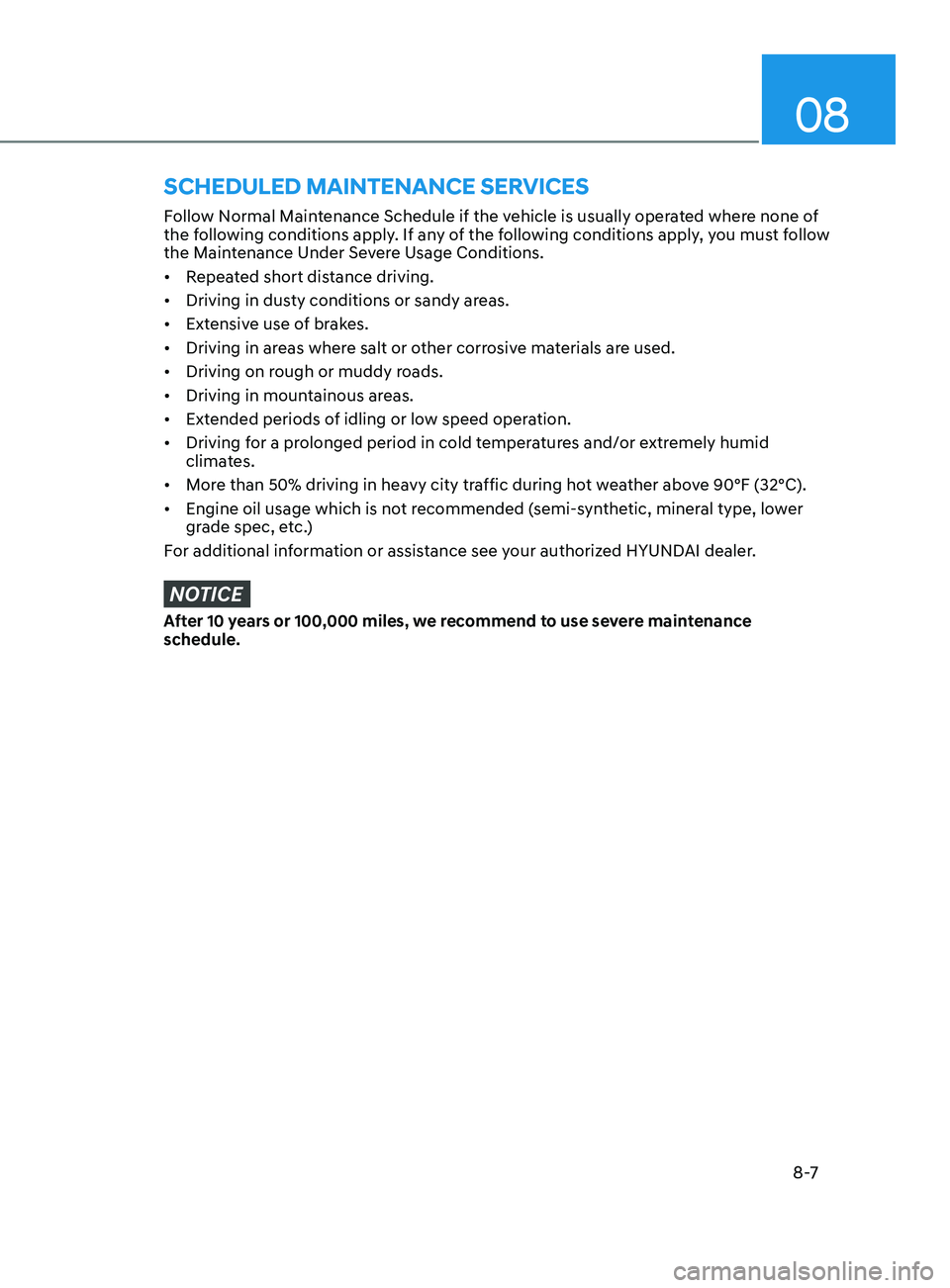
Follow Normal Maintenance Schedule if the vehicle is usually operated where none of
the following conditions apply. If any of the following conditions apply, you must follow
the Maintenance Under Severe Usage Conditions.
• Repeated short distance driving.
• Driving in dusty conditions or sandy areas.
• Extensive use of brakes.
• Driving in areas where salt or other corrosive materials are used.
• Driving on rough or muddy roads.
• Driving in mountainous areas.
• Extended periods of idling or low speed operation.
• Driving for a prolonged period in cold temperatures and/or extremely humid
climates.
• More than 50% driving in heavy city traffic during hot weather above 90°F (32°C).
• Engine oil usage which is not recommended (semi-synthetic, mineral type, lower
grade spec, etc.)
For additional information or assistance see your authorized HYUNDAI dealer.
NOTICE
After 10 years or 100,000 miles, we recommend to use severe maintenance
schedule.
Scheduled Maintenance ServiceS
Page 463 of 546
08
8-9
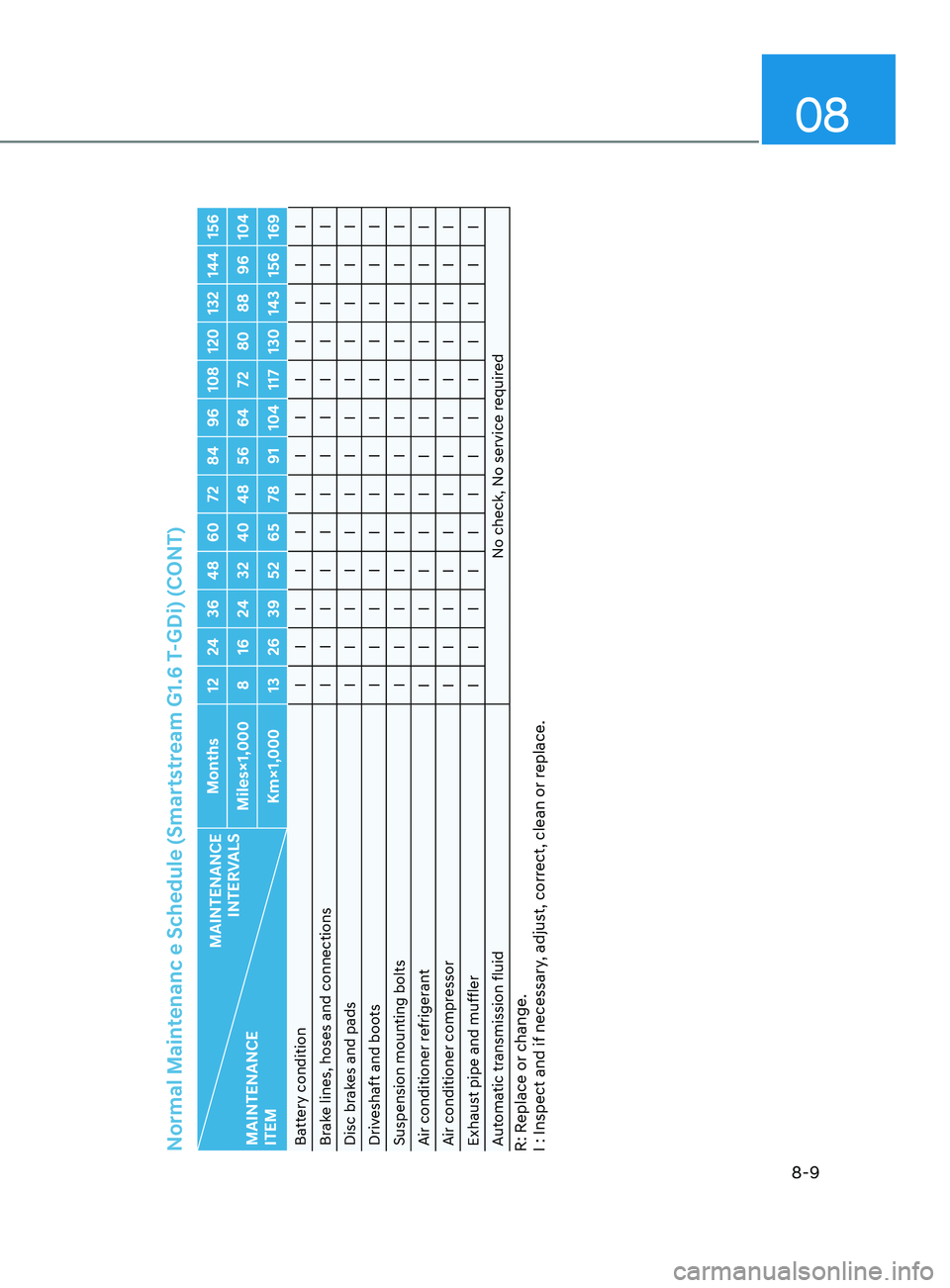
Normal Maintenanc e Schedule (Smartstream G1.6 T-GDi) (CONT)
MAINTENANCE INTERVALS
MAINTENANCE
ITEM Months 12 24 36 48 60 72 84 96 108 120 132 144 156
Miles×1,000 8 16 24 32 40 48 56 64 72 80 88 96 104 Km×1,000 13 26 39 52 65 78 91 104 117 130 143 156 169
Battery condition I I I I I I I I I I I I I
Brake lines, hoses and connections I I I I I I I I I I I I I
Disc brakes and pads I I I I I I I I I I I I I
Driveshaft and boots I I I I I I I I I I I I I
Suspension mounting bolts I I I I I I I I I I I I I
Air conditioner refrigerant I I I I I I I I I I I I I
Air conditioner compressor I I I I I I I I I I I I I
Exhaust pipe and muffler I I I I I I I I I I I I I
Automatic transmission fluid No check, No service requiredR: Replace or change.
I : Inspect and if necessary, adjust, correct, clean or replace.
Page 464 of 546
Maintenance
8-10
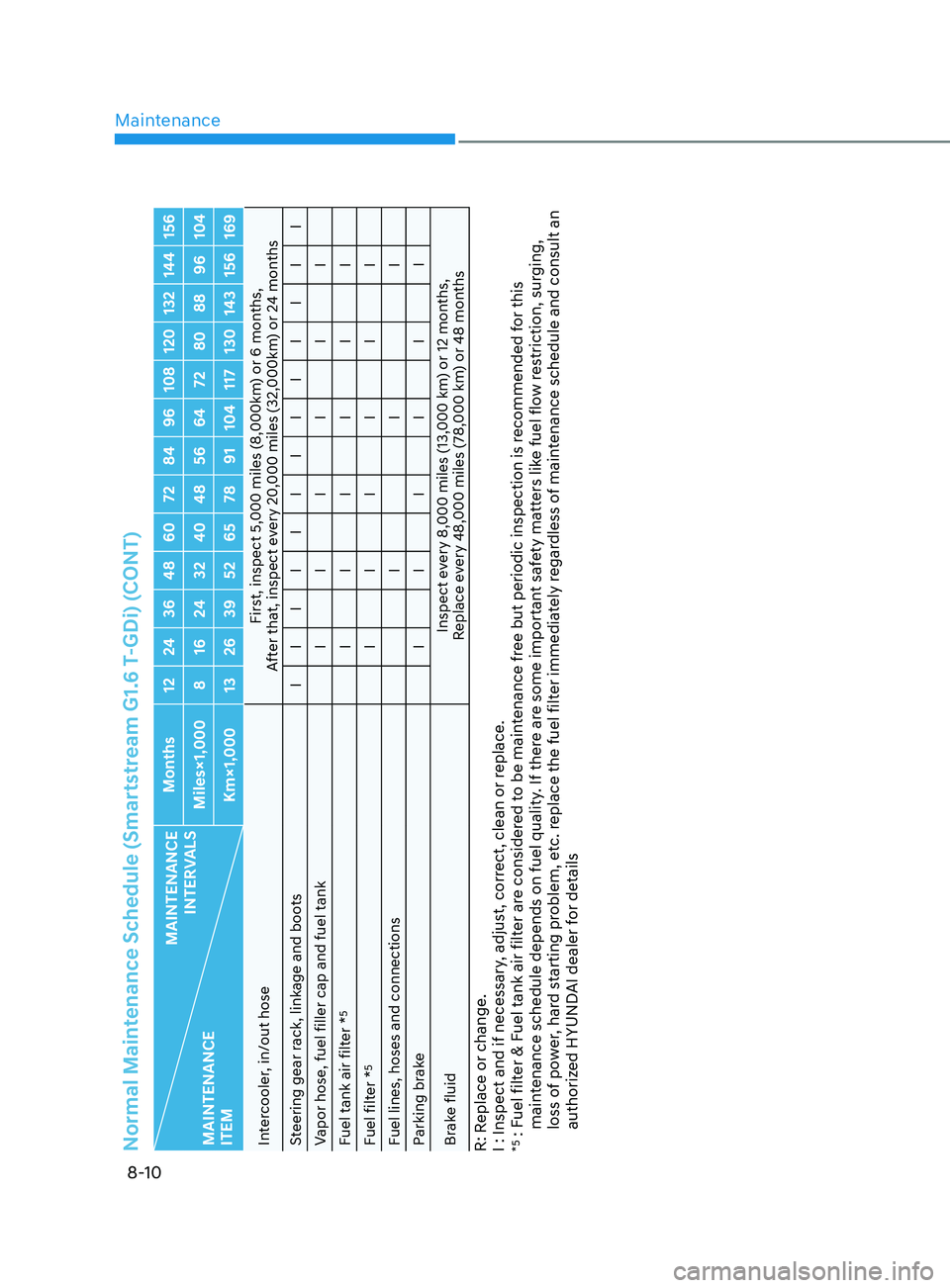
Normal Maintenance Schedule (Smartstream G1.6 T-GDi) (CONT)
MAINTENANCE INTERVALS
MAINTENANCE
ITEM Months 12 24 36 48 60 72 84 96 108 120 132 144 156
Miles×1,000 8 16 24 32 40 48 56 64 72 80 88 96 104 Km×1,000 13 26 39 52 65 78 91 104 117 130 143 156 169
Intercooler, in/out hose First, inspect 5,000 miles (8,000km) or 6 months,
After that, inspect every 20,000 miles (32,000km) or 24 months
Steering gear rack, linkage and boots I I I I I I I I I I I I I
Vapor hose, fuel filler cap and fuel tank I I I I I I
Fuel tank air filter *
5
I I I I I I
Fuel filter *
5
I I I I I I
Fuel lines, hoses and connections III
Parking brake I I I I I I
Brake fluid Inspect every 8,000 miles (13,000 km) or 12 months,
Replace every 48,000 miles (78,000 km) or 48 months
R: Replace or change.
I : Inspect and if necessary, adjust, correct, clean or replace.*5 : Fuel filter & Fuel tank air filter are considered to be maintenance free but periodic inspection is recommended for this
maintenance schedule depends on fuel quality. If there are some important safety matters like fuel flow restriction, surging,
loss of power, hard starting problem, etc. replace the fuel filter immediately regardless of maintenance schedule and consult an
authorized HYUNDAI dealer for details
Page 465 of 546
08
8-11
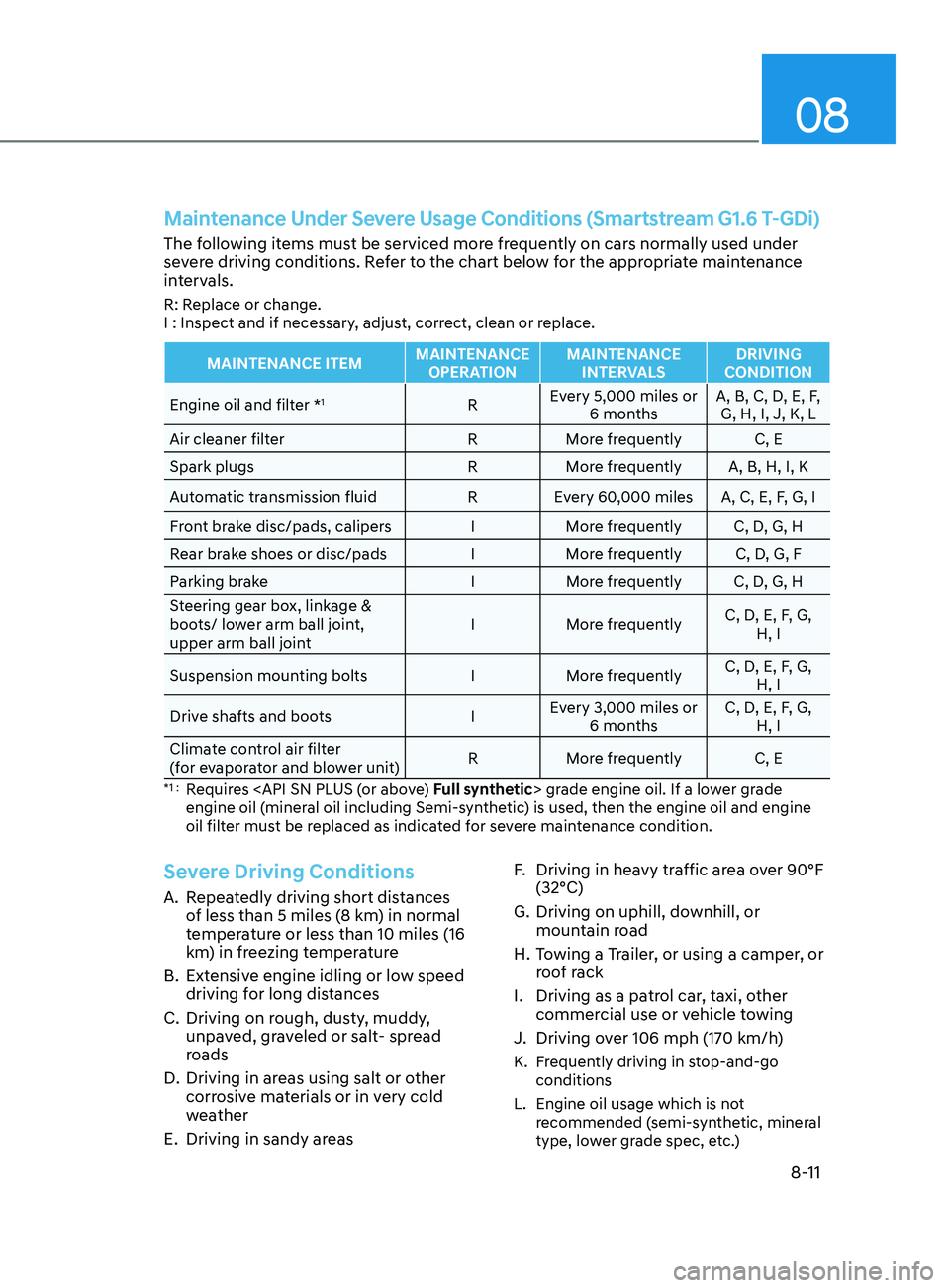
Maintenance Under Severe Usage Conditions (Smartstream G1.6 T-GDi)
The following items must be serviced more frequently on cars normally used under
severe driving conditions. Refer to the chart below for the appropriate maintenance
intervals.
R: Replace or change.
I : Inspect and if necessary, adjust, correct, clean or replace.
MAINTENANCE ITEMMAINTENANCE
OPERATION MAINTENANCE
INTERVALS DRIVING
CONDITION
Engine oil and filter *
1R Every 5,000 miles or
6 months A, B, C, D, E, F,
G, H, I, J, K, L
Air cleaner filter RMore frequently C, E
Spark plugs RMore frequently A, B, H, I, K
Automatic transmission fluid R Every 60,000 miles A, C, E, F, G, I
Front brake disc/pads, calipers I More frequently C, D, G, H
Rear brake shoes or disc/pads IMore frequently C, D, G, F
Parking brake IMore frequently C, D, G, H
Steering gear box, linkage &
boots/ lower arm ball joint,
upper arm ball joint I
More frequently C, D, E, F, G,
H, I
Suspension mounting bolts IMore frequently C, D, E, F, G,
H, I
Drive shafts and boots IEvery 3,000 miles or
6 months C, D, E, F, G,
H, I
Climate control air filter
(for evaporator and blower unit) R
More frequently C, E
*1 : Requires
engine oil (mineral oil including Semi-synthetic) is used, then the engine oil and engine
oil filter must be replaced as indicated for severe maintenance condition.
Severe Driving Conditions
A. Repeatedly driving short distances
of less than 5 miles (8 km) in normal
temperature or less than 10 miles (16
km) in freezing temperature
B.
Ext
ensive engine idling or low speed
driving for long distances
C.
Driving on r
ough, dusty, muddy,
unpaved, graveled or salt- spread
roads
D.
Driving in ar
eas using salt or other
corrosive materials or in very cold
weather
E.
Driving in sandy ar
eas F.
Driving in hea
vy traffic area over 90°F
(32°C)
G. Driving on uphill, do wnhill, or
mountain road
H.
T
owing a Trailer, or using a camper, or
roof rack
I.
Driving as a pa
trol car, taxi, other
commercial use or vehicle towing
J.
Driving o
ver 106 mph (170 km/h)
K. Frequently driving in stop-and-go conditions
L.
E
ngine oil usage which is not
recommended (semi-synthetic, mineral
type, lower grade spec, etc.)