Eco HYUNDAI SONATA 2021 User Guide
[x] Cancel search | Manufacturer: HYUNDAI, Model Year: 2021, Model line: SONATA, Model: HYUNDAI SONATA 2021Pages: 546, PDF Size: 51.21 MB
Page 27 of 546
Vehicle Information2-14
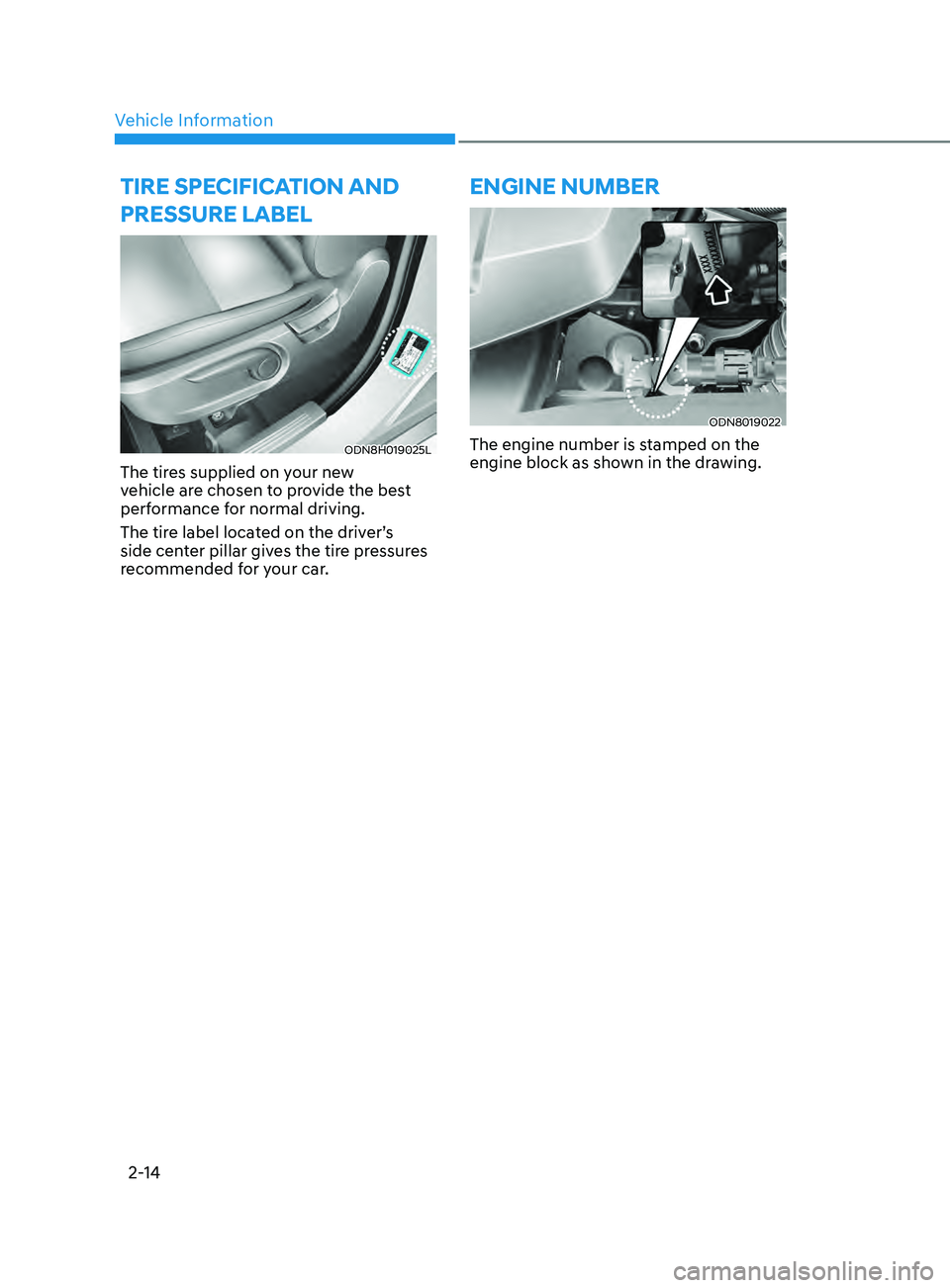
tirE sPECifiCa tion an D
Pr E ssur E l a BE l
ODN8H019025L
The tires supplied on your new
vehicle are chosen to provide the best
performance for normal driving.
The tire label located on the driver’s
side center pillar gives the tire pressures
recommended for your car.
EnginE numBEr
ODN8019022
The engine number is stamped on the
engine block as shown in the drawing.
Page 30 of 546
3-2
You will find many safety precautions
and recommendations throughout this
section, and throughout this manual.
The safety precautions in this section are
among the most important.
Always Wear Your Seat Belt
A seat belt is your best protection in all
types of accidents. Air bags are designed
to supplement seat belts, not replace
them. So even though your vehicle is
equipped with air bags, ALWAYS make
sure you and your passengers wear your
seat belts, and wear them properly.
Restrain All Children
All children under age 13 should ride
in your vehicle properly restrained in a
rear seat, not the front seat. Infants and
small children should be restrained in
an appropriate child restraint. Larger
children should use a booster seat with
the lap/shoulder belt until they can use
the seat belt properly without a booster
seat.
Air Bag Hazards
While air bags can save lives, they can
also cause serious or fatal injuries to
occupants who sit too close to them, or
who are not properly restrained. Infants,
young children, and shorter adults are at
the greatest risk of being injured by an
inflating air bag. Follow all instructions
and warnings in this manual.
Driver Distraction
Driver distraction presents a serious and
potentially deadly danger, especially for
inexperienced drivers. Safety should be
the first concern when behind the wheel,
and drivers need to be aware of the wide
array of potential distractions, such as
drowsiness, reaching for objects, eating,
personal grooming, other passengers,
and using cellular phones.Drivers can become distracted when
they take their eyes and attention off
the road or their hands off the wheel to
focus on activities other than driving. To
reduce your risk of distraction or getting
into an accident:
•
ALWAYS set up your mobile devices
(i.e., MP3 players, phones, navigation
units, etc.) when your vehicle is
parked or safely stopped.
• ONLY use your mobile device when
allowed by laws and when conditions
permit safe use. NEVER text or email
while driving. Most states have laws
prohibiting drivers from texting. Some
states and cities also prohibit drivers
from using handheld phones.
• NEVER let the use of a mobile device
distract you from driving. You have a
responsibility to your passengers and
others on the road to always drive
safely, with your hands on the wheel
as well as your eyes and attention on
the road.
Control Your Speed
Excessive speed is a major factor in crash
injuries and deaths. Generally, the higher
the speed, the greater the risk, but
serious injuries can also occur at lower
speeds. Never drive faster than is safe
for current conditions, regardless of the
maximum speed posted.
Keep Your Vehicle in Safe
Condition
Having a tire blowout or a mechanical
failure can be extremely hazardous. To
reduce the possibility of such problems,
check your tire pressures and condition
frequently, and perform all regularly
scheduled maintenance.
Important Safety precautIonS
Seats & Safety System
Page 32 of 546
3-4
Safety Precautions
Adjusting the seats so that you are sitting
in a safe, comfortable position plays an
important role in driver and passenger
safety together with the seat belts and
air bags in an accident.
WARNING
Do not use a cushion that reduces
friction between the seat and the
passenger. The passenger’s hips may
slide under the lap portion of the seat
belt during an accident or a sudden
stop. Serious or fatal internal injuries
could result because the seat belt
cannot operate properly.
Air bags
You can take steps to reduce the risk
of being injured by an inflating air bag.
Sitting too close to an air bag greatly
increases the risk of injury in the event
the air bag inflates.
The National Highway Traffic Safety
Administration (NHTSA) recommends
that drivers allow at least 10 inches (25
cm) between the center of the steering
wheel and their chest.
WARNING
To reduce the risk of serious injury or
death from an inflating air bag, take the
following precautions:
• Adjust the driver’s seat as far to the
rear as possible while maintaining
the ability to maintain full control of
the vehicle.
• Adjust the front passenger seat as far
to the rear as possible.
• Hold the steering wheel by the rim
with hands at the 9 o’clock and 3
o’clock positions to minimize the risk
of injuries to your hands and arms. •
NEVER place anything or anyone
between the steering wheel and the
air bag.
• Do not allow the front passenger to
place feet or legs on the dashboard
to minimize the risk of leg injuries.
Seat belts
Always fasten your seat belt before
starting any trip.
At all times, passengers should sit
upright and be properly restrained.
Infants and small children must be
restrained in appropriate child restraint
systems. Adults and children who
have outgrown a booster seat must be
restrained using the seat belts.
WARNING
Take the following precautions when
adjusting your seat belt:
• NEVER use one seat belt for more
than one occupant.
• Always position the seatback upright
with the lap portion of the seat belt
snug and low across the hips.
• NEVER allow children or small infants
to ride on a passenger’s lap.
• Do not route the seat belt across your
neck, across sharp edges, or reroute
the shoulder strap away from your
body.
• Do not allow the seat belt to become
caught or jammed.
Seats & Safety System
Page 43 of 546
03
3-15
Seat Warmers and Air Ventilation
Seats
Front seat warmers (if equipped)
Seat warmers are provided to warm the
seats during cold weather.
WARNING
The seat warmers can cause a SERIOUS
BURN, even at low temperatures and
especially if used for long periods of
time.
Passengers must be able to feel if the
seat is becoming too warm so they can
turn it off, if needed.
People who cannot detect temperature
change or pain to the skin should
use extreme caution, especially the
following types of passengers:
• Infants, children, elderly or disabled
persons, or hospital outpatients.
• People with sensitive skin or who
burn easily.
• Fatigued individuals.
• Intoxicated individuals.
• People taking medication that can
cause drowsiness or sleepiness.
WARNING
NEVER place anything on the seat
that insulates against heat when the
seat warmer is in operation, such as a
blanket or seat cushion. This may cause
the seat warmer to overheat, causing a
burn or damage to the seat.
NOTICE
To prevent damage to the seat warmers
and seats:
Never use a solvent such as paint
thinner, benzene, alcohol or gasoline to
clean the seats.
Do not place heavy or sharp objects on
seats equipped with seat warmers.
Do not change the seat cover. It
may damage the seat warmer or air
ventilation system.
Page 44 of 546
3-16
„„Front
ODN8039019
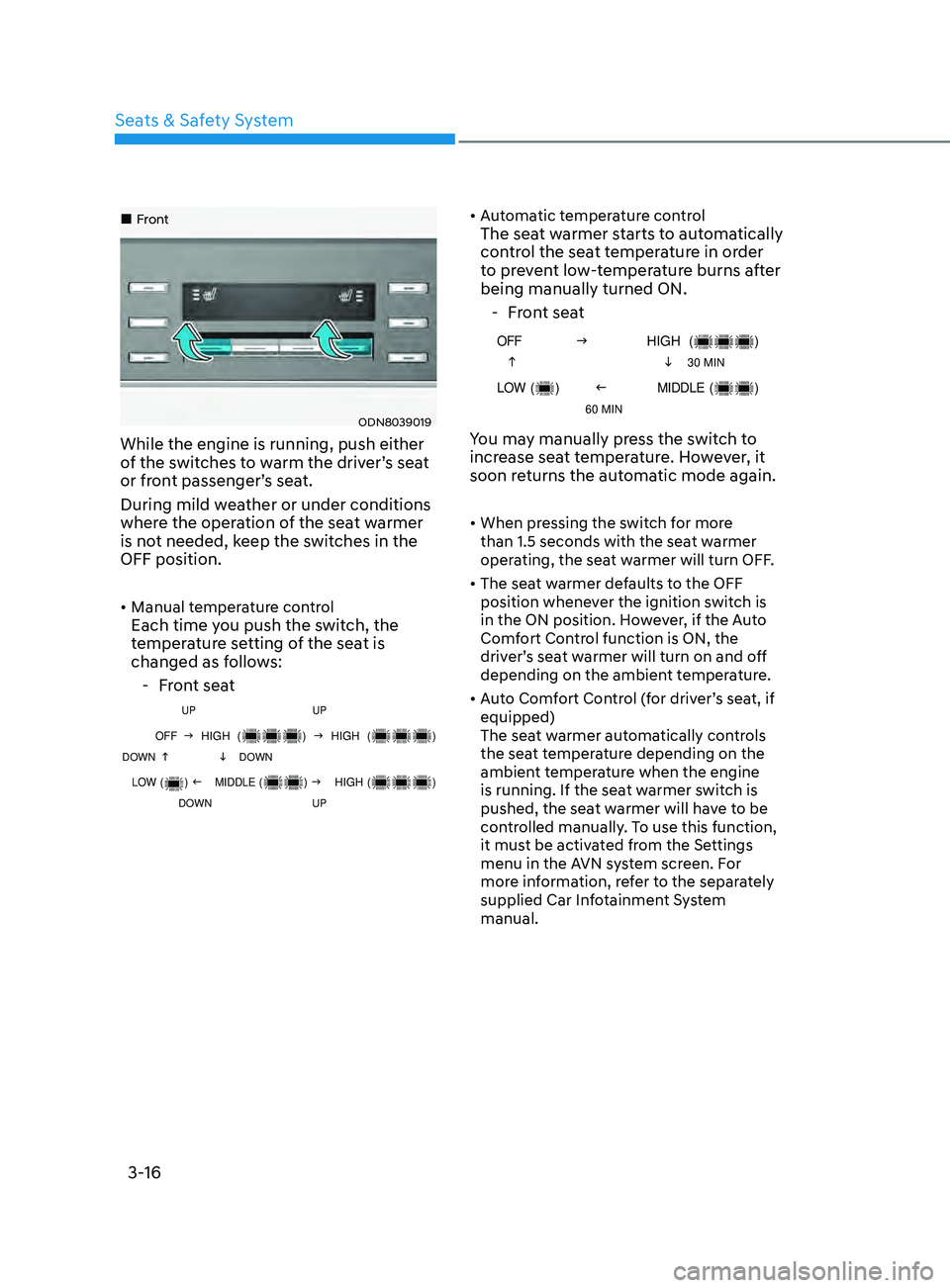
While the engine is running, push either
of the switches to warm the driver’s seat
or front passenger’s seat.
During mild weather or under conditions
where the operation of the seat warmer
is not needed, keep the switches in the
OFF position.
• Manual temperature control Each time you push the switch, the
temperature setting of the seat is
changed as follows:
- F
ront seat
UP UP
OFF g HIGH () g HIGH ()
DOWN h i DOWN
LOW () f MIDDLE () g HIGH ()
DOWN UP
• Automatic temperature control The seat warmer starts to automatically
control the seat temperature in order
to prevent low-temperature burns after
being manually turned ON.
- F
ront seat
OFF g HIGH ()
h i 30 MIN
LOW () f MIDDLE ()
60 MIN
You may manually press the switch to
increase seat temperature. However, it
soon returns the automatic mode again.
• When pressing the switch for more
than 1.5 seconds with the seat warmer
operating, the seat warmer will turn OFF.
• The seat warmer defaults to the OFF
position whenever the ignition switch is
in the ON position. However, if the Auto
Comfort Control function is ON, the
driver’s seat warmer will turn on and off
depending on the ambient temperature.
• Auto Comfort Control (for driver’s seat, if
equipped)
The seat warmer automatically controls
the seat temperature depending on the
ambient temperature when the engine
is running. If the seat warmer switch is
pushed, the seat warmer will have to be
controlled manually. To use this function,
it must be activated from the Settings
menu in the AVN system screen. For
more information, refer to the separately
supplied Car Infotainment System
manual.
Seats & Safety System
Page 45 of 546
03
3-17
Front air ventilation seat
(if equipped)
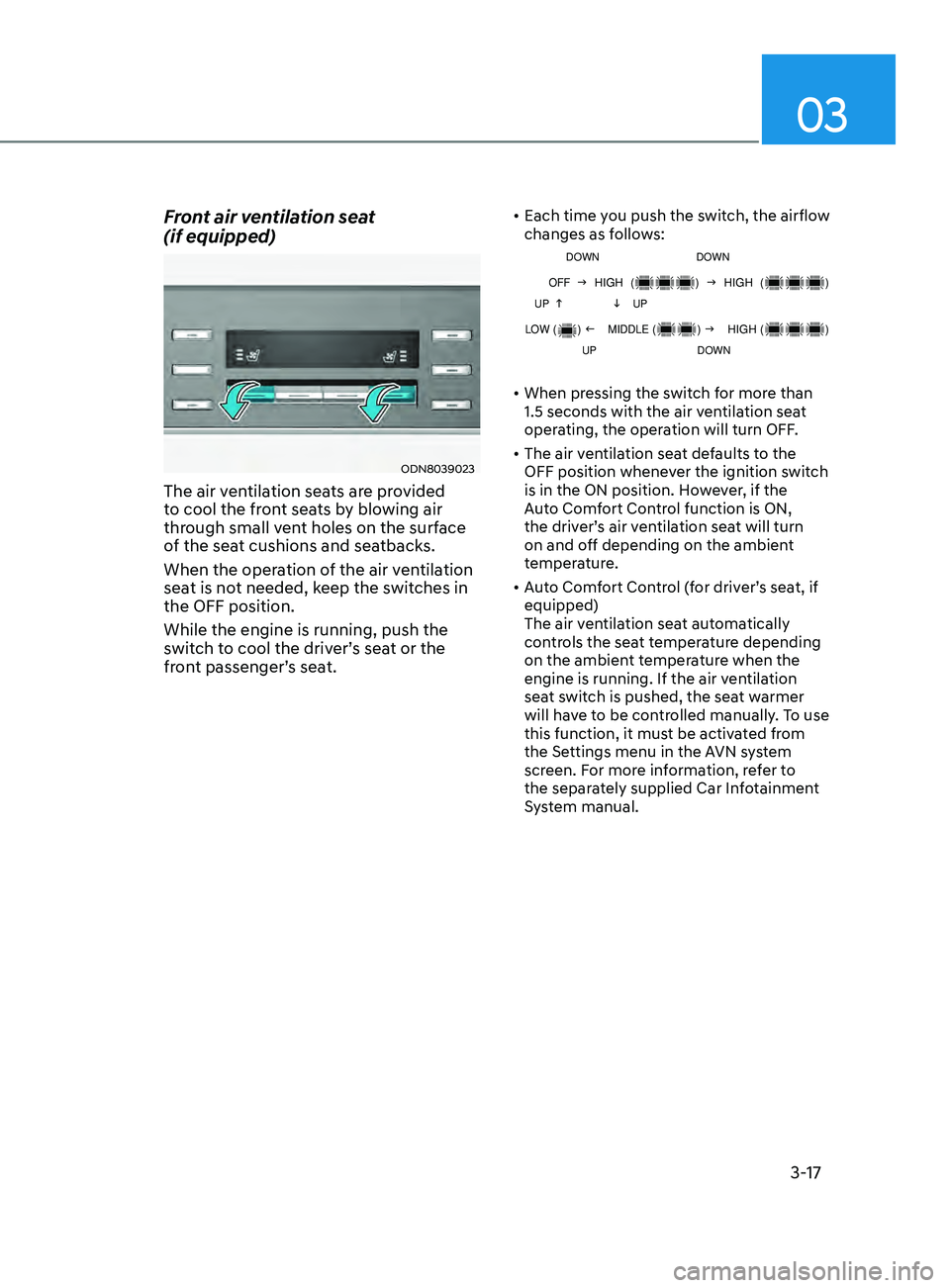
ODN8039023
The air ventilation seats are provided
to cool the front seats by blowing air
through small vent holes on the surface
of the seat cushions and seatbacks.
When the operation of the air ventilation
seat is not needed, keep the switches in
the OFF position.
While the engine is running, push the
switch to cool the driver’s seat or the
front passenger’s seat.
• Each time you push the switch, the airflow
changes as follows:
DOWN DOWN
OFF g HIGH () g HIGH ()
UP h i UP
LOW () f MIDDLE () g HIGH ()
UP DOWN
• When pressing the switch for more than
1.5 seconds with the air ventilation seat
operating, the operation will turn OFF.
• The air ventilation seat defaults to the
OFF position whenever the ignition switch
is in the ON position. However, if the
Auto Comfort Control function is ON,
the driver’s air ventilation seat will turn
on and off depending on the ambient
temperature.
• Auto Comfort Control (for driver’s seat, if
equipped)
The air ventilation seat automatically
controls the seat temperature depending
on the ambient temperature when the
engine is running. If the air ventilation
seat switch is pushed, the seat warmer
will have to be controlled manually. To use
this function, it must be activated from
the Settings menu in the AVN system
screen. For more information, refer to
the separately supplied Car Infotainment
System manual.
Page 46 of 546
3-18
NOTICE
To prevent damage to the air ventilation
seat:
• Use the air ventilation seat ONLY
when the climate control system
is on. Using the air ventilation seat
for prolonged periods of time with
the climate control system off could
cause the air ventilation seat to
malfunction.
• NEVER use a solvent such as paint
thinner, benzene, alcohol or gasoline
to clean the seats.
• Avoid spilling liquids on the surface
of the front seats and seatbacks;
this may cause the air vent holes
to become blocked and not work
properly.
• Do not place materials such as
plastic bags or newspapers under
the seats. They may block the air
intake causing the air vents to not
work properly.
• Do not change the seat covers. It may
damage the air ventilation seat.
• If the air vents do not operate, restart
the vehicle. If there is no change,
have the vehicle inspected by an
authorized HYUNDAI dealer.
Seats & Safety System
Page 48 of 546
3-20
Seat Belt Warning Light
Seat belt warning light
(for driver’s seat)
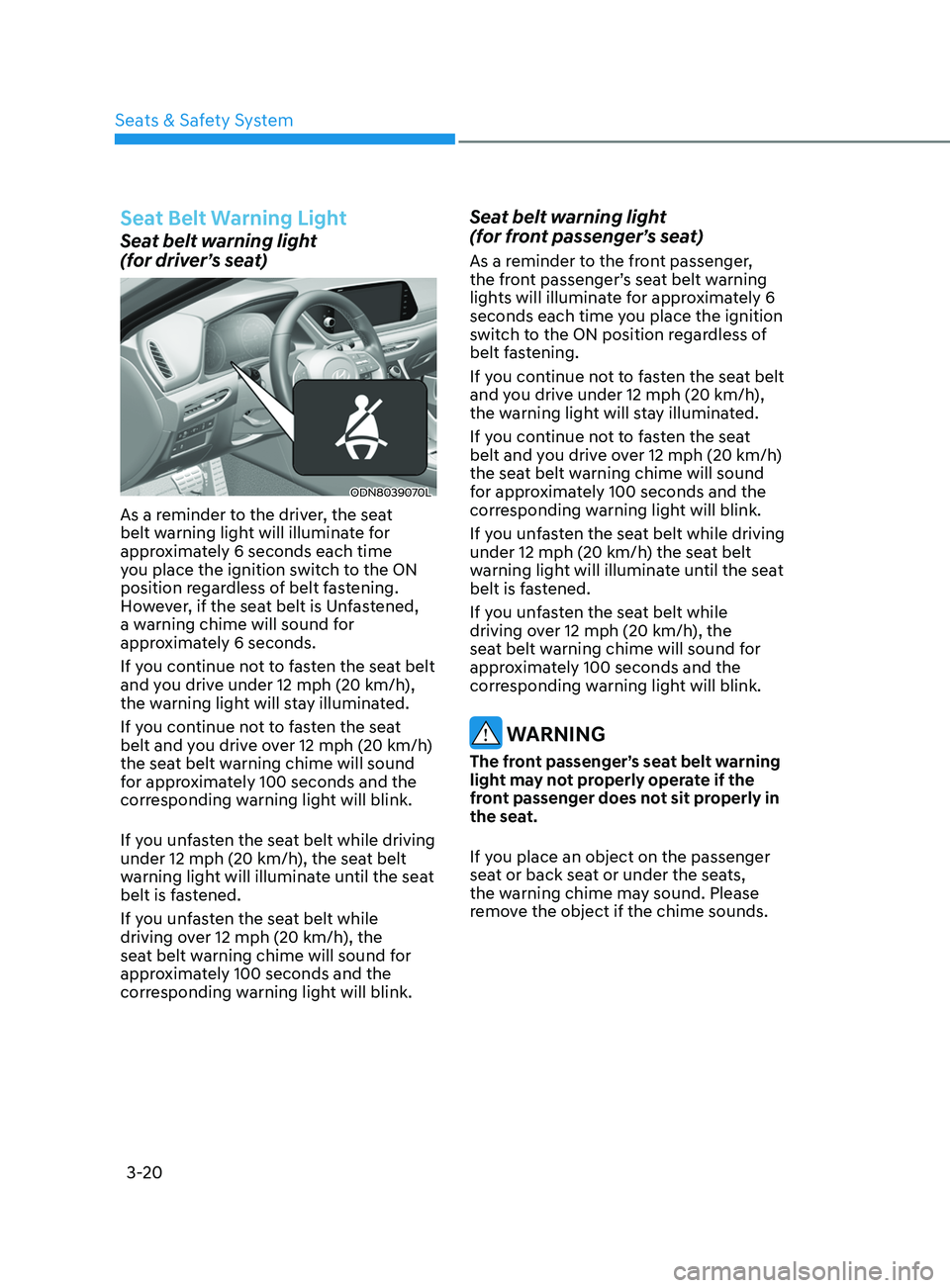
ODN8039070L
As a reminder to the driver, the seat
belt warning light will illuminate for
approximately 6 seconds each time
you place the ignition switch to the ON
position regardless of belt fastening.
However, if the seat belt is Unfastened,
a warning chime will sound for
approximately 6 seconds.
If you continue not to fasten the seat belt
and you drive under 12 mph (20 km/h),
the warning light will stay illuminated.
If you continue not to fasten the seat
belt and you drive over 12 mph (20 km/h)
the seat belt warning chime will sound
for approximately 100 seconds and the
corresponding warning light will blink.
If you unfasten the seat belt while driving
under 12 mph (20 km/h), the seat belt
warning light will illuminate until the seat
belt is fastened.
If you unfasten the seat belt while
driving over 12 mph (20 km/h), the
seat belt warning chime will sound for
approximately 100 seconds and the
corresponding warning light will blink.
Seat belt warning light
(for front passenger’s seat)
As a reminder to the front passenger,
the front passenger’s seat belt warning
lights will illuminate for approximately 6
seconds each time you place the ignition
switch to the ON position regardless of
belt fastening.
If you continue not to fasten the seat belt
and you drive under 12 mph (20 km/h),
the warning light will stay illuminated.
If you continue not to fasten the seat
belt and you drive over 12 mph (20 km/h)
the seat belt warning chime will sound
for approximately 100 seconds and the
corresponding warning light will blink.
If you unfasten the seat belt while driving
under 12 mph (20 km/h) the seat belt
warning light will illuminate until the seat
belt is fastened.
If you unfasten the seat belt while
driving over 12 mph (20 km/h), the
seat belt warning chime will sound for
approximately 100 seconds and the
corresponding warning light will blink.
WARNING
The front passenger’s seat belt warning
light may not properly operate if the
front passenger does not sit properly in
the seat.
If you place an object on the passenger
seat or back seat or under the seats,
the warning chime may sound. Please
remove the object if the chime sounds.
Seats & Safety System
Page 52 of 546
3-24
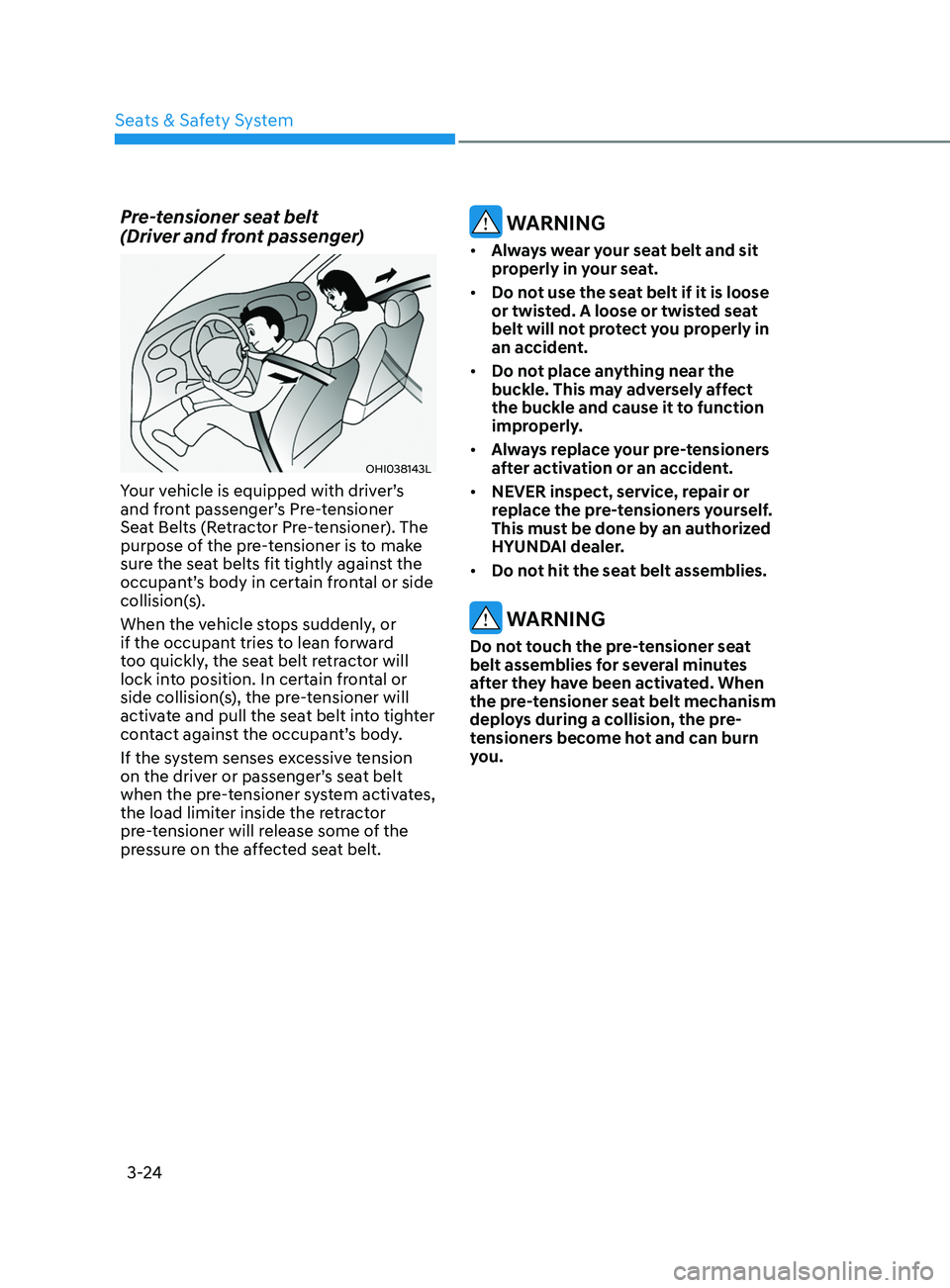
Pre-tensioner seat belt
(Driver and front passenger)
OHI038143L
Your vehicle is equipped with driver’s
and front passenger’s Pre-tensioner
Seat Belts (Retractor Pre-tensioner). The
purpose of the pre-tensioner is to make
sure the seat belts fit tightly against the
occupant’s body in certain frontal or side
collision(s).
When the vehicle stops suddenly, or
if the occupant tries to lean forward
too quickly, the seat belt retractor will
lock into position. In certain frontal or
side collision(s), the pre-tensioner will
activate and pull the seat belt into tighter
contact against the occupant’s body.
If the system senses excessive tension
on the driver or passenger’s seat belt
when the pre-tensioner system activates,
the load limiter inside the retractor
pre-tensioner will release some of the
pressure on the affected seat belt.
WARNING
• Always wear your seat belt and sit
properly in your seat.
• Do not use the seat belt if it is loose
or twisted. A loose or twisted seat
belt will not protect you properly in
an accident.
• Do not place anything near the
buckle. This may adversely affect
the buckle and cause it to function
improperly.
• Always replace your pre-tensioners
after activation or an accident.
• NEVER inspect, service, repair or
replace the pre-tensioners yourself.
This must be done by an authorized
HYUNDAI dealer.
• Do not hit the seat belt assemblies.
WARNING
Do not touch the pre-tensioner seat
belt assemblies for several minutes
after they have been activated. When
the pre-tensioner seat belt mechanism
deploys during a collision, the pre-
tensioners become hot and can burn
you.
Seats & Safety System
Page 53 of 546
03
3-25
OHI038175L
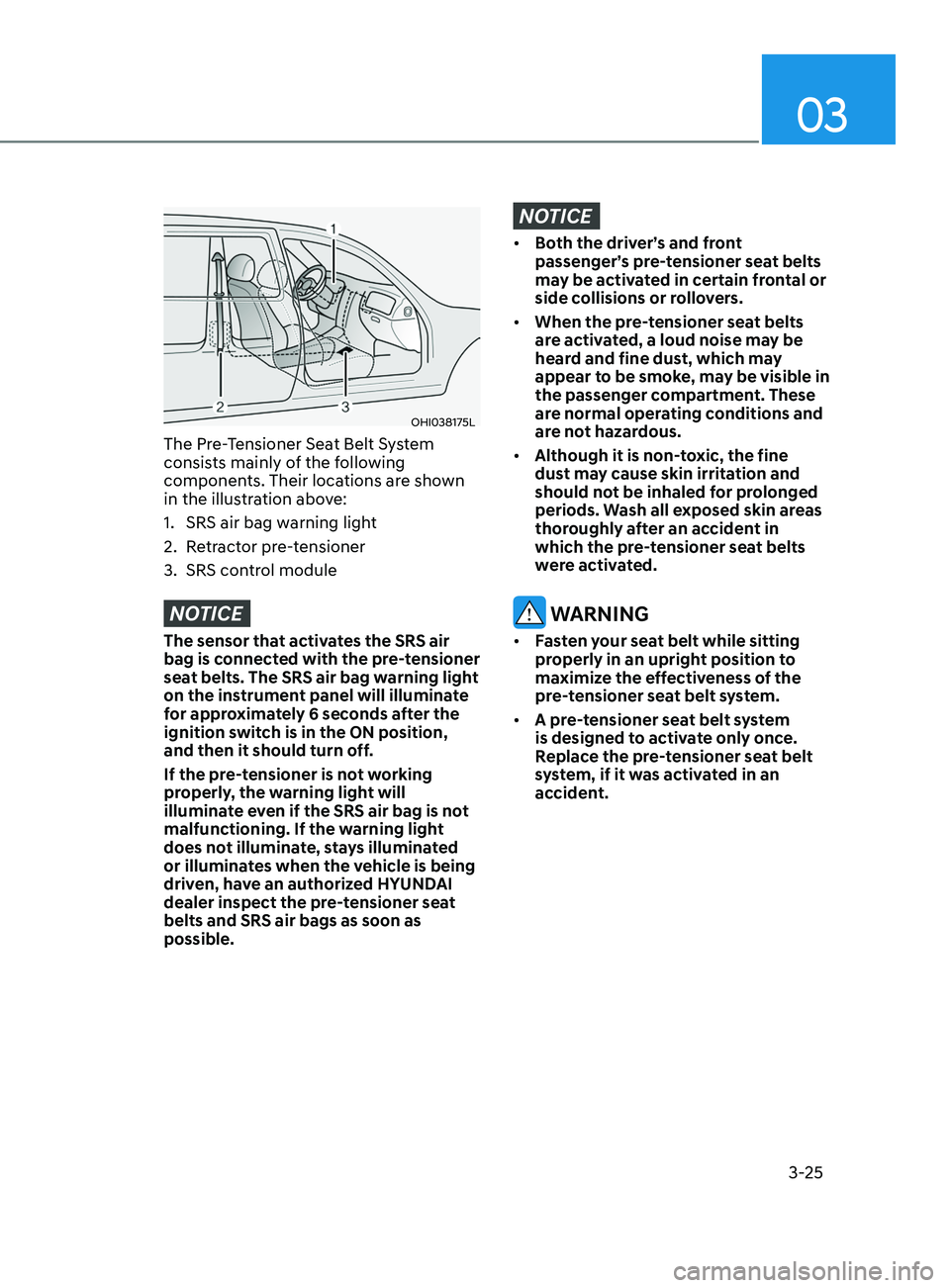
The Pre-Tensioner Seat Belt System
consists mainly of the following
components. Their locations are shown
in the illustration above:
1.
SRS air bag w
arning light
2.
R
etractor pre-tensioner
3.
SRS con
trol module
NOTICE
The sensor that activates the SRS air
bag is connected with the pre-tensioner
seat belts. The SRS air bag warning light
on the instrument panel will illuminate
for approximately 6 seconds after the
ignition switch is in the ON position,
and then it should turn off.
If the pre-tensioner is not working
properly, the warning light will
illuminate even if the SRS air bag is not
malfunctioning. If the warning light
does not illuminate, stays illuminated
or illuminates when the vehicle is being
driven, have an authorized HYUNDAI
dealer inspect the pre-tensioner seat
belts and SRS air bags as soon as
possible.
NOTICE
• Both the driver’s and front
passenger’s pre-tensioner seat belts
may be activated in certain frontal or
side collisions or rollovers.
• When the pre-tensioner seat belts
are activated, a loud noise may be
heard and fine dust, which may
appear to be smoke, may be visible in
the passenger compartment. These
are normal operating conditions and
are not hazardous.
• Although it is non-toxic, the fine
dust may cause skin irritation and
should not be inhaled for prolonged
periods. Wash all exposed skin areas
thoroughly after an accident in
which the pre-tensioner seat belts
were activated.
WARNING
• Fasten your seat belt while sitting
properly in an upright position to
maximize the effectiveness of the
pre-tensioner seat belt system.
• A pre-tensioner seat belt system
is designed to activate only once.
Replace the pre-tensioner seat belt
system, if it was activated in an
accident.