lock HYUNDAI SONATA 2023 Owners Manual
[x] Cancel search | Manufacturer: HYUNDAI, Model Year: 2023, Model line: SONATA, Model: HYUNDAI SONATA 2023Pages: 555, PDF Size: 42.72 MB
Page 486 of 555
Maintenance
8-16
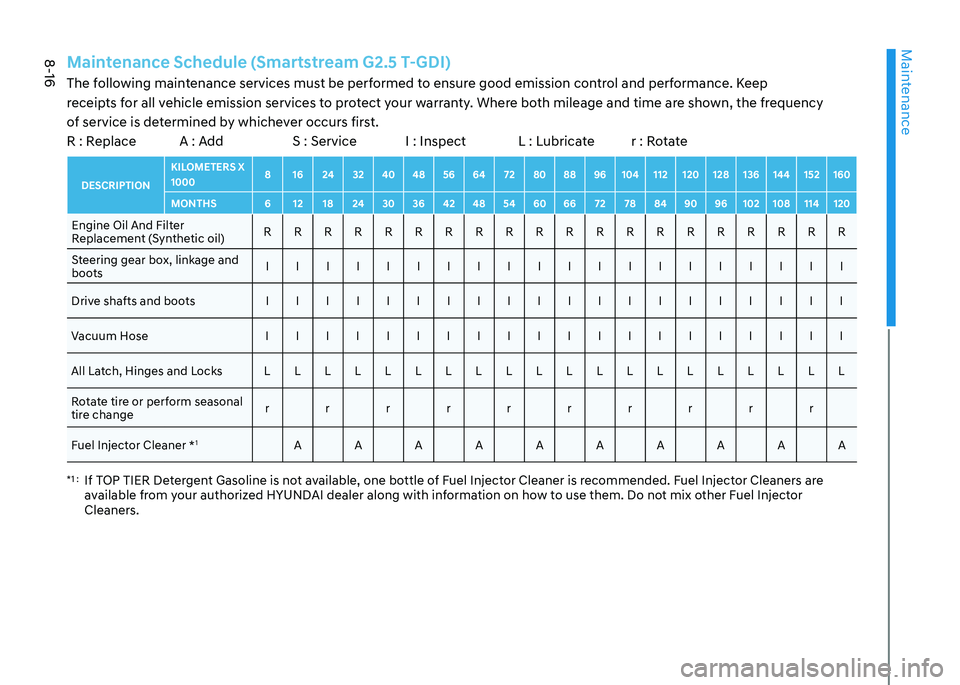
*1 : If TOP TIER Detergent Gasoline is not available, one bottle of Fuel Injector Cleaner is recommended. Fuel Injector Cleaners are
available from your authorized HYUNDAI dealer along with information on how to use them. Do not mix other Fuel Injector
Cleaners.Maintenance Schedule (Smartstream G2.5 T-GDI)The following maintenance services must be performed to ensure good emission control and performance. Keep
receipts for all vehicle emission services to protect your warranty. Where both mileage and time are shown, the frequency
of service is determined by whichever occurs first.
R : Replace A : Add S : Service I : Inspect L : Lubricate r : RotateDESCRIPTION KILOMETERS X 1000
8 16 24 32 40 48 56 64 72 80 88 96 104 112 120 128 136 144 152 160
MONTHS 6 12 18 24 30 36 42 48 54 60 66 72 78 84 90 96 102 108 114 120Engine Oil And Filter
Replacement (Synthetic oil) R R R R R R R R R R R R R R R R R R R R
Steering gear box, linkage and
boots I I I I I I I I I I I I I I I I I I I I
Drive shafts and boots I I I I I I I I I I I I I I I I I I I I
Vacuum Hose I I I I I I I I I I I I I I I I I I I I
All Latch, Hinges and Locks L L L L L L L L L L L L L L L L L L L L
Rotate tire or perform seasonal
tire change r r r r r r r r r r
Fuel Injector Cleaner * 1
A A A A A A A A A A
Page 493 of 555
08
8-23
Checking the Engine Oil Level
Engine oil is used for lubricating,
cooling, and operating various hydraulic
components in the engine. Engine oil
consumption while driving is normal,
and it is necessary to check and refill the
engine oil regularly. Also, check and refill
the oil level within the recommended
maintenance schedule to prevent
deterioration of oil performance.
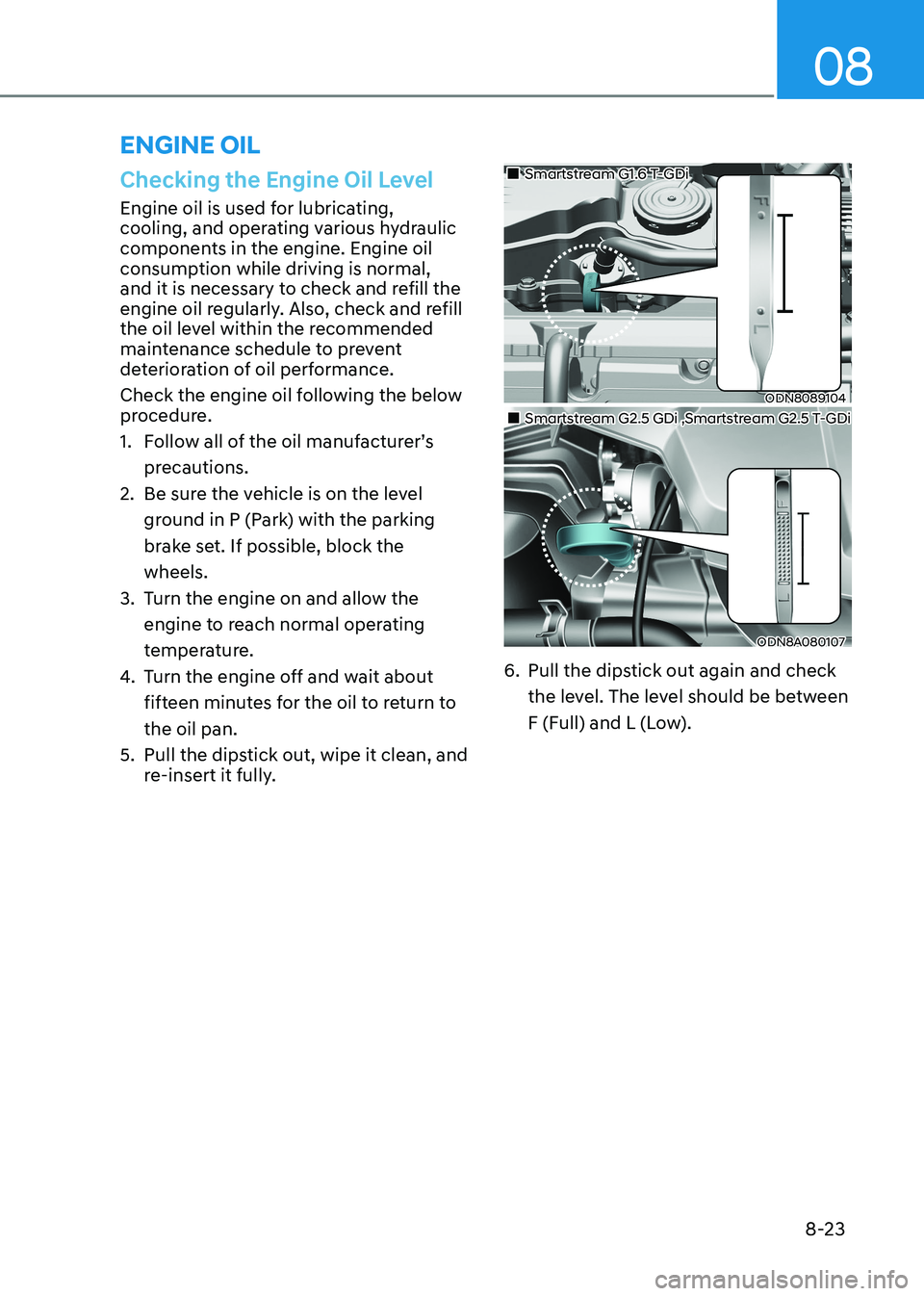
Check the engine oil following the below
procedure.
1. Follow all of the oil manufacturer’sprecautions.
2. Be sure the vehicle is on the level
ground in P (Park) with the parking
brake set. If possible, block thewheels.
3. Turn the engine on and allow the engine to reach normal operating
temperature.
4. Turn the engine off and wait about
fifteen minutes for the oil to return tothe oil pan.
5. Pull the dipstick out, wipe it clean, and re-insert it fully.
ODN8089104
„
„Smartstream G1.6 T-GDi
ODN8A080107
„
„Smartstream G2.5 GDi ,Smartstream G2.5 T-GDi
6. Pull the dipstick out again and check the level. The level should be between
F (Full) and L (Low).
EnginE oiL
Page 497 of 555
08
8-27
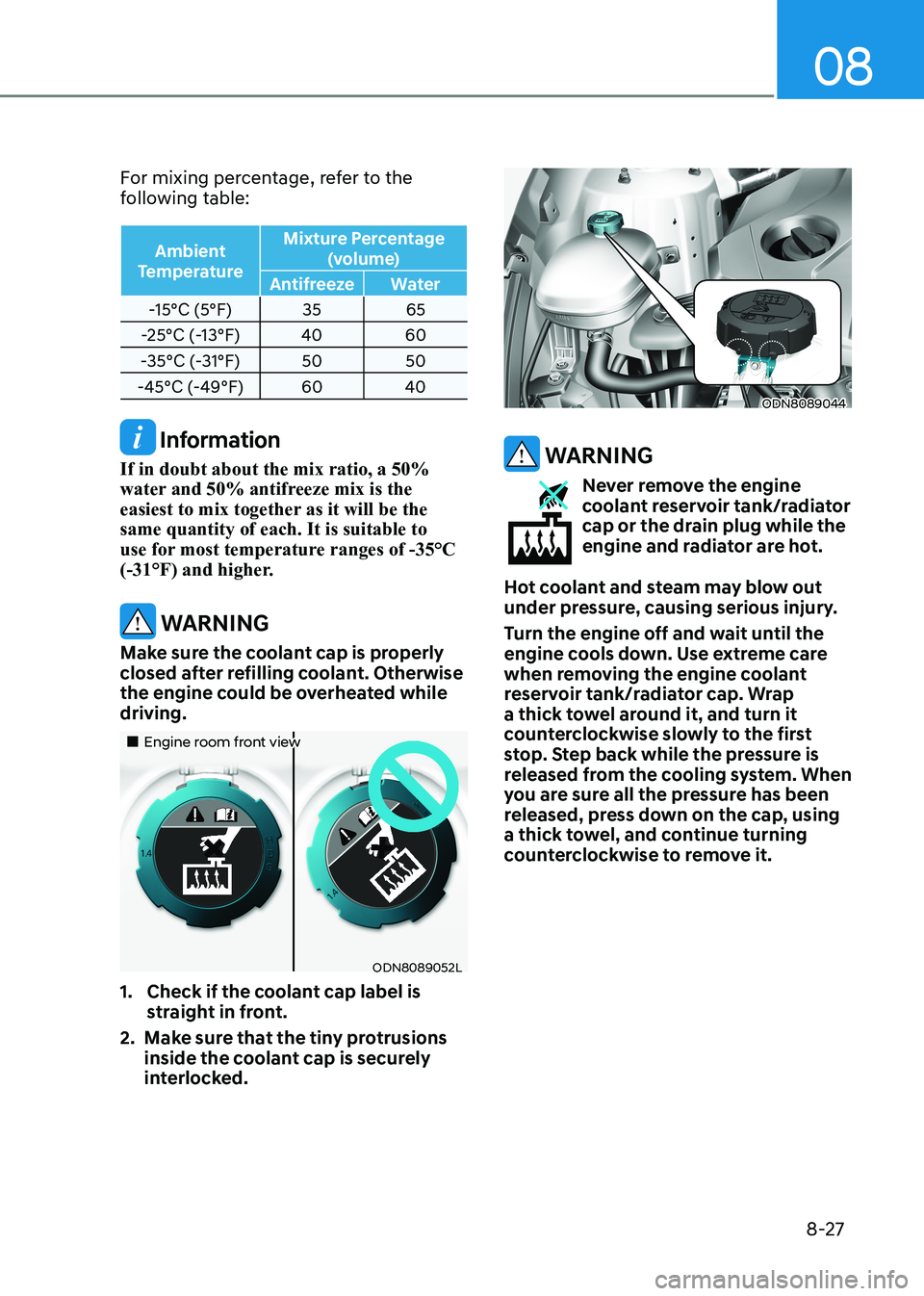
For mixing percentage, refer to the
following table:
Ambient
Temperature Mixture Percentage
(volume)
Antifreeze Water
-15°C (5°F) 35 65
-25°C (-13°F) 40 60
-35°C (-31°F) 50 50
-45°C (-49°F) 60 40
Information
If in doubt about the mix ratio, a 50%
water and 50% antifreeze mix is the
easiest to mix together as it will be the same quantity of each. It is suitable to
use for most temperature ranges of -35°C
(-31°F) and higher.
WARNING
Make sure the coolant cap is properly
closed after refilling coolant. Otherwise
the engine could be overheated while driving.
„„Engine room front view
ODN8089052L
1. Check if the coolant cap label is straight in front.
2. Make sure that the tiny protrusions inside the coolant cap is securely
interlocked.
ODN8089044
WARNING
Never remove the engine
coolant reservoir tank/radiator
cap or the drain plug while the
engine and radiator are hot.
Hot coolant and steam may blow out
under pressure, causing serious injury.
Turn the engine off and wait until the
engine cools down. Use extreme care
when removing the engine coolant
reservoir tank/radiator cap. Wrap
a thick towel around it, and turn it
counterclockwise slowly to the first
stop. Step back while the pressure is
released from the cooling system. When
you are sure all the pressure has been
released, press down on the cap, using
a thick towel, and continue turning
counterclockwise to remove it.
Page 502 of 555
Maintenance
8-32
1. Pull up the lever (1) on the air cleaner cover and release the lock.
2. Pull up the air cleaner cover (2) and open.
3. Rotate the fixed lever (3) on the filter and loosen the lock.
4. Replace the air cleaner filter.
5. Assemble in reverse order.
NOTICE
• Do not drive with the air cleaner filter
removed. This will result in excessive
engine wear.
• When removing the air cleaner filter,
be careful that dust or dirt does not
enter the air intake, or damage may
result.
• Use HYUNDAI genuine parts. Use of
non-genuine parts could damage the
air flow sensor.
Page 503 of 555
08
8-33
CLimatE ControL air fiLtEr
Filter Inspection
The climate control air filter should be
replaced according to the Maintenance
Schedule. If the vehicle is operated
in severely air-polluted cities or on
dusty rough roads for a long period, it
should be inspected more frequently
and replaced earlier. When you replace
the climate control air filter, replace it
performing the following procedure,
and be careful to avoid damaging other
components.
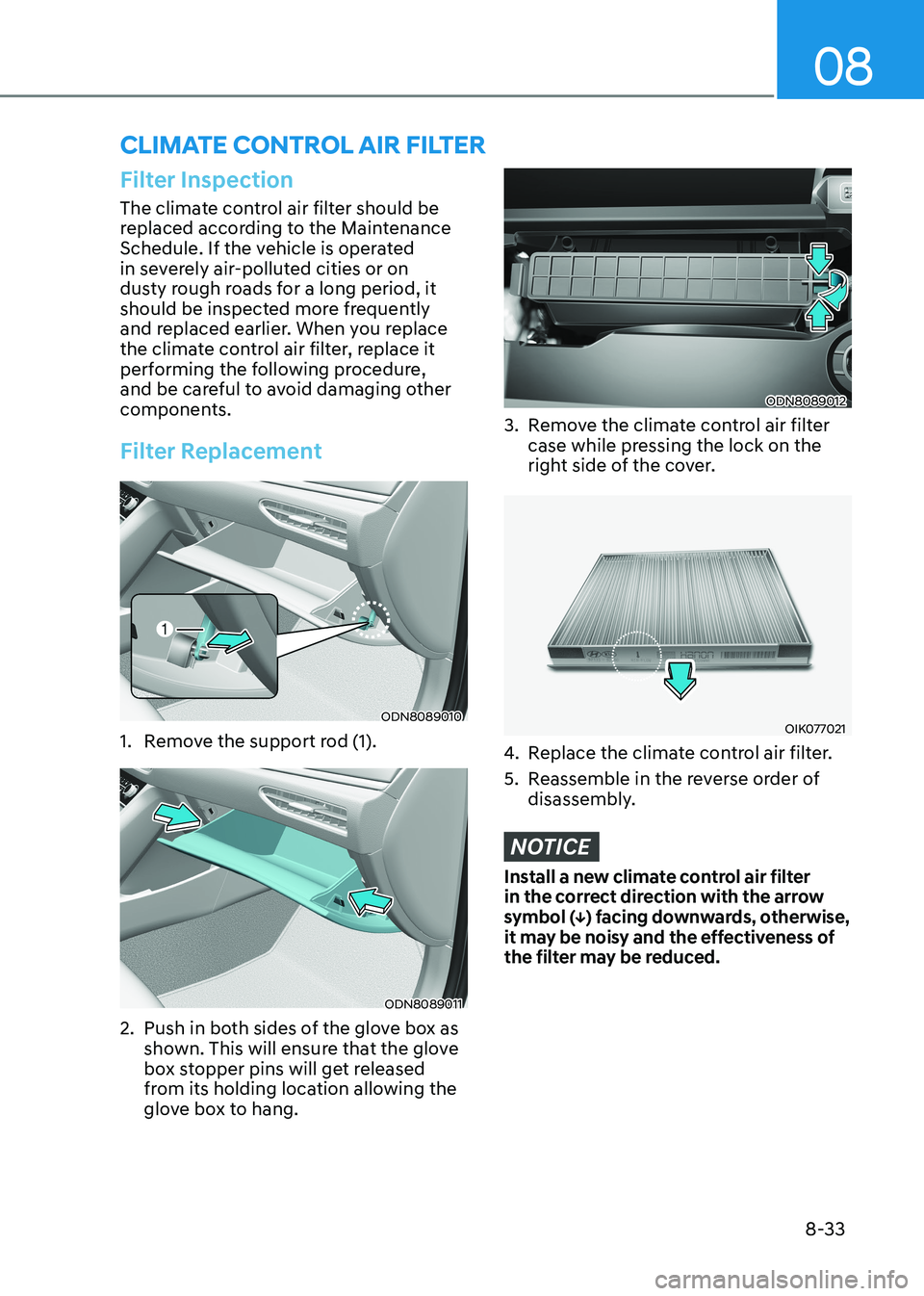
Filter Replacement
ODN8089010
1. Remove the support rod (1).
ODN8089011
2. Push in both sides of the glove box as shown. This will ensure that the glove
box stopper pins will get released
from its holding location allowing the
glove box to hang.
ODN8089012
3. Remove the climate control air filter case while pressing the lock on the
right side of the cover.
OIK077021
4. Replace the climate control air filter.
5. Reassemble in the reverse order of disassembly.
NOTICE
Install a new climate control air filter
in the correct direction with the arrow
symbol (↓) facing downwards, otherwise,
it may be noisy and the effectiveness of
the filter may be reduced.
Page 507 of 555
08
8-37
Battery Recharging
WARNING
Always follow these instructions when
recharging your vehicle’s battery to
avoid the risk of SERIOUS INJURY or
DEATH from explosions or acid burns: • Before performing maintenance or
recharging the battery, turn off all
accessories and place the ignition
switch to the LOCK/OFF position.
• Keep all flames, sparks, or smoking
materials away from the battery.
• Always work outdoors or in an area
with plenty of ventilation.
• Wear eye protection when checking
the battery during charging.
• The battery must be removed from
the vehicle and placed in a well
ventilated area.
• Watch the battery during charging,
and stop or reduce the charging
rate if the battery cells begin boiling
violently.
• Vehicle is equipped with the
Absorbent Glass Mat (AGM) battery.
Do not charge the AGM battery with
a general charger. It may damage
or explode the AGM battery. Only
charge the AGM battery with a
charger that has AGM battery
setting.
• The negative battery cable must
be removed first to disconnect
the battery and installed last
to reconnect with the battery.
Disconnect the battery charger in the
following order:
1. Turn off the battery charger main
switch.
2. Unhook the negative clamp from the negative battery terminal.
3. Unhook the positive clamp from the positive battery terminal.
• Always use a genuine HYUNDAI
approved battery when you replace
the battery. By jump starting
After a jump start, idle the engine
with the headlights ON for 20-30
minutes before shutting the engine
off. The vehicle may not restart if you
shut it off before the battery had a
chance to adequately recharge. See
“Jump Starting” in chapter 7 for more
information on jump starting procedures.
Information
An inappropriately disposed battery can be harmful to
the environment and human health. Dispose of the battery
according to your local law(s) or
regulations.
Reset Features
The following items may need to be reset
after the battery has been discharged or
the battery has been disconnected. See
chapter 3 or 4 for: •
Power Windows
• Trip Computer
• Climate Control System
• Clock
• Audio System
• Sunroof
Page 508 of 555
Maintenance
8-38
WARNING
Tire failure may cause loss of vehicle
control resulting in an accident. To
reduce risk of SERIOUS INJURY or
DEATH, take the following precautions: • Inspect your tires monthly for proper
inflation as well as wear and damage.
• The recommended cold tire pressure
for your vehicle can be found in this
manual and on the tire label located
on the driver’s side center pillar.
Always use a tire pressure gauge to
measure tire pressure. Tires with
too much or too little pressure wear
unevenly causing poor handling.
• Check the pressure of the spare
every time you check the pressure of
the other tires on your vehicle.
• Replace tires that are worn, show
uneven wear, or are damaged.
Worn tires can cause loss of braking
effectiveness, steering control, or
traction.
• ALWAYS replace tires with the same
type, size, brand, construction and
tread pattern as each tire that was
originally supplied with this vehicle.
Using tires and wheels other than
the recommended sizes could cause
unusual handling characteristics,
poor vehicle control, or negatively
affect your vehicle’s Anti-Lock Brake
System (ABS) resulting in a serious
accident.Tire Care
For proper maintenance, safety, and
maximum fuel economy, you must
always maintain recommended tire
inflation pressures and stay within the
load limits and weight distribution
recommended for your vehicle.
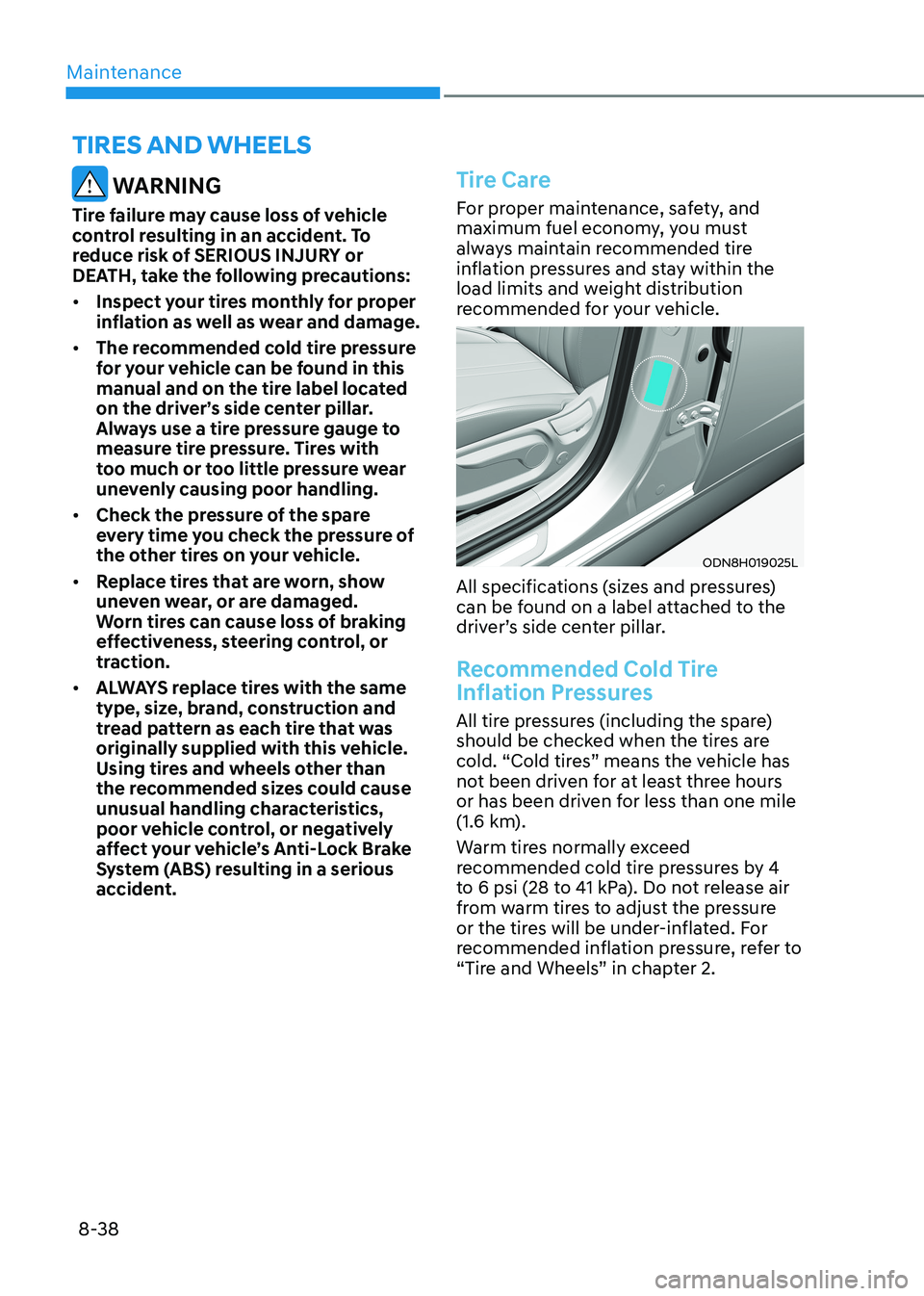
ODN8H019025L
All specifications (sizes and pressures)
can be found on a label attached to the
driver’s side center pillar.
Recommended Cold Tire
Inflation Pressures
All tire pressures (including the spare)
should be checked when the tires are
cold. “Cold tires” means the vehicle has
not been driven for at least three hours
or has been driven for less than one mile
(1.6 km).
Warm tires normally exceed
recommended cold tire pressures by 4
to 6 psi (28 to 41 kPa). Do not release air
from warm tires to adjust the pressure
or the tires will be under-inflated. For
recommended inflation pressure, refer to
“Tire and Wheels” in chapter 2.
tirES anD wHEELS
Page 511 of 555
08
8-41
Tire Replacement
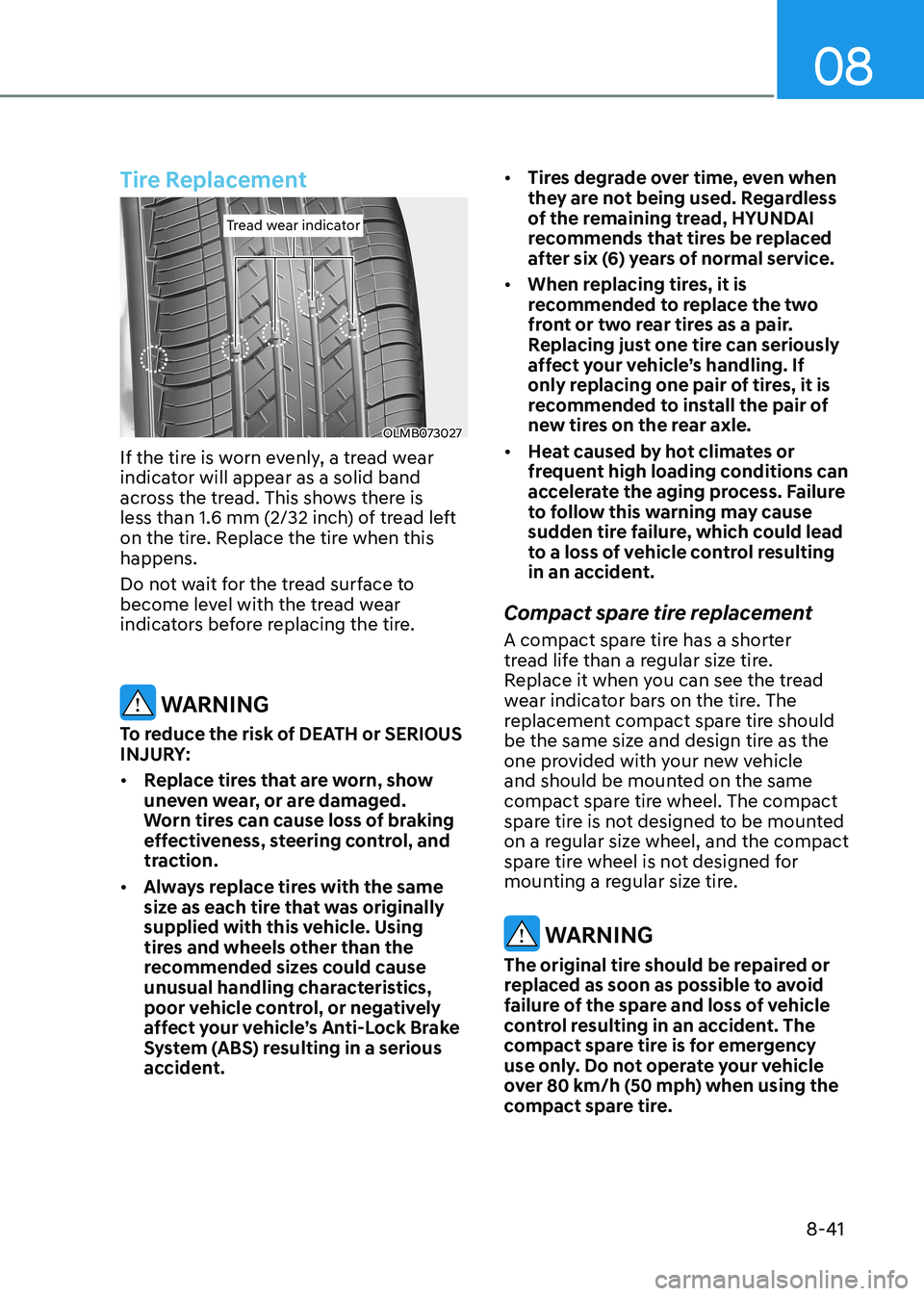
Tread wear indicatorTread wear indicator
OLMB073027
If the tire is worn evenly, a tread wear
indicator will appear as a solid band
across the tread. This shows there is
less than 1.6 mm (2/32 inch) of tread left
on the tire. Replace the tire when this happens.
Do not wait for the tread surface to
become level with the tread wear
indicators before replacing the tire.
WARNING
To reduce the risk of DEATH or SERIOUS
INJURY: • Replace tires that are worn, show
uneven wear, or are damaged.
Worn tires can cause loss of braking
effectiveness, steering control, and
traction.
• Always replace tires with the same
size as each tire that was originally
supplied with this vehicle. Using
tires and wheels other than the
recommended sizes could cause
unusual handling characteristics,
poor vehicle control, or negatively
affect your vehicle’s Anti-Lock Brake
System (ABS) resulting in a serious
accident. •
Tires degrade over time, even when
they are not being used. Regardless
of the remaining tread, HYUNDAI
recommends that tires be replaced
after six (6) years of normal service.
• When replacing tires, it is
recommended to replace the two
front or two rear tires as a pair.
Replacing just one tire can seriously
affect your vehicle’s handling. If
only replacing one pair of tires, it is
recommended to install the pair of
new tires on the rear axle.
• Heat caused by hot climates or
frequent high loading conditions can
accelerate the aging process. Failure
to follow this warning may cause
sudden tire failure, which could lead
to a loss of vehicle control resulting
in an accident.
Compact spare tire replacement
A compact spare tire has a shorter
tread life than a regular size tire.
Replace it when you can see the tread
wear indicator bars on the tire. The
replacement compact spare tire should
be the same size and design tire as the
one provided with your new vehicle
and should be mounted on the same
compact spare tire wheel. The compact
spare tire is not designed to be mounted
on a regular size wheel, and the compact
spare tire wheel is not designed for
mounting a regular size tire.
WARNING
The original tire should be repaired or
replaced as soon as possible to avoid
failure of the spare and loss of vehicle
control resulting in an accident. The
compact spare tire is for emergency
use only. Do not operate your vehicle
over 80 km/h (50 mph) when using the
compact spare tire.
Page 524 of 555
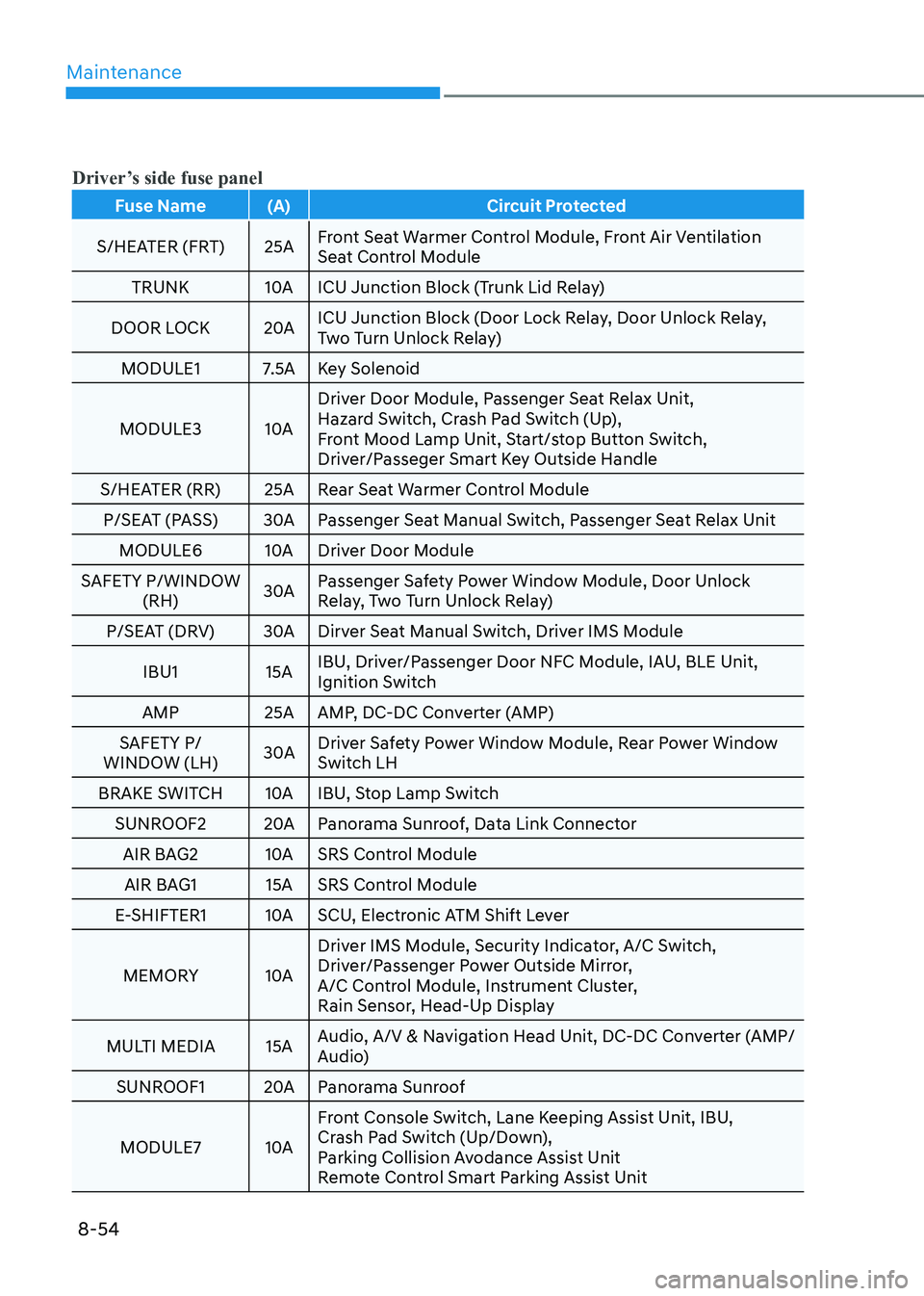
Maintenance
8-54
Driver’s side fuse panel
Fuse Name (A) Circuit Protected
S/HEATER (FRT) 25A Front Seat Warmer Control Module, Front Air Ventilation
Seat Control Module
TRUNK 10A ICU Junction Block (Trunk Lid Relay)
DOOR LOCK 20A ICU Junction Block (Door Lock Relay, Door Unlock Relay,
Two Turn Unlock Relay)
MODULE1 7.5A Key Solenoid
MODULE3 10A Driver Door Module, Passenger Seat Relax Unit,
Hazard Switch, Crash Pad Switch (Up),
Front Mood Lamp Unit, Start/stop Button Switch,
Driver/Passeger Smart Key Outside Handle
S/HEATER (RR) 25A Rear Seat Warmer Control Module P/SEAT (PASS) 30A Passenger Seat Manual Switch, Passenger Seat Relax Unit MODULE6 10A Driver Door Module
SAFETY P/WINDOW (RH) 30A Passenger Safety Power Window Module, Door Unlock
Relay, Two Turn Unlock Relay)
P/SEAT (DRV) 30A Dirver Seat Manual Switch, Driver IMS Module
IBU1 15A IBU, Driver/Passenger Door NFC Module, IAU, BLE Unit,
Ignition Switch
AMP 25A AMP, DC-DC Converter (AMP)
SAFETY P/
WINDOW (LH) 30A Driver Safety Power Window Module, Rear Power Window
Switch LH
BRAKE SWITCH 10A IBU, Stop Lamp Switch SUNROOF2 20A Panorama Sunroof, Data Link Connector
AIR BAG2 10A SRS Control Module AIR BAG1 15A SRS Control Module
E-SHIFTER1 10A SCU, Electronic ATM Shift Lever
MEMORY 10A Driver IMS Module, Security Indicator, A/C Switch,
Driver/Passenger Power Outside Mirror,
A/C Control Module, Instrument Cluster,
Rain Sensor, Head-Up Display
MULTI MEDIA 15A Audio, A/V & Navigation Head Unit, DC-DC Converter (AMP/
Audio)
SUNROOF1 20A Panorama Sunroof
MODULE7 10A Front Console Switch, Lane Keeping Assist Unit, IBU,
Crash Pad Switch (Up/Down),
Parking Collision Avodance Assist Unit
Remote Control Smart Parking Assist Unit
Page 525 of 555
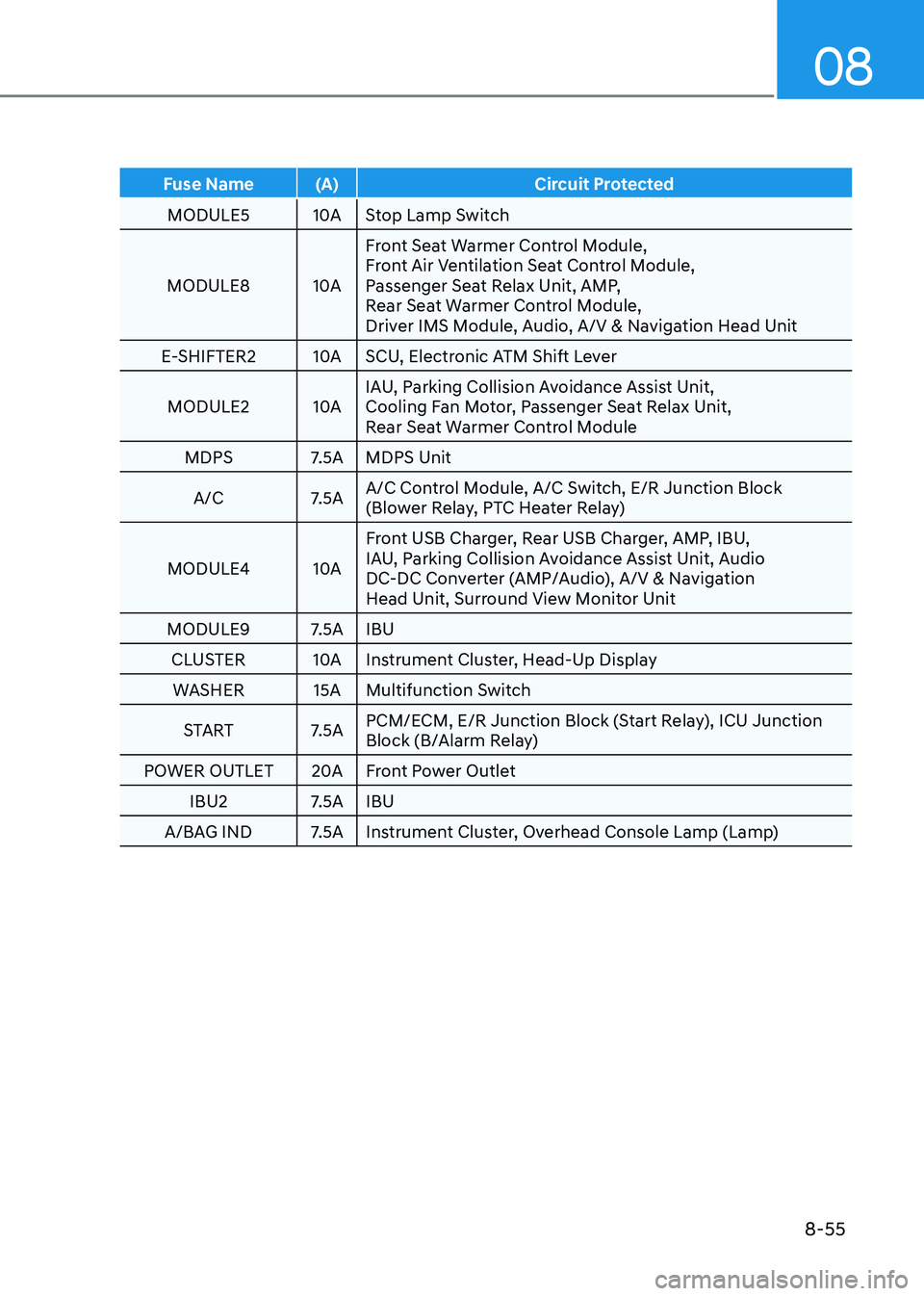
08
8-55
Fuse Name (A) Circuit Protected
MODULE5 10A Stop Lamp Switch
MODULE8 10A Front Seat Warmer Control Module,
Front Air Ventilation Seat Control Module,
Passenger Seat Relax Unit, AMP,
Rear Seat Warmer Control Module,
Driver IMS Module, Audio, A/V & Navigation Head Unit
E-SHIFTER2 10A SCU, Electronic ATM Shift Lever
MODULE2 10A IAU, Parking Collision Avoidance Assist Unit,
Cooling Fan Motor, Passenger Seat Relax Unit,
Rear Seat Warmer Control Module
MDPS 7.5A MDPS Unit
A/C 7.5A A/C Control Module, A/C Switch, E/R Junction Block
(Blower Relay, PTC Heater Relay)
MODULE4 10A Front USB Charger, Rear USB Charger, AMP, IBU,
IAU, Parking Collision Avoidance Assist Unit, Audio
DC-DC Converter (AMP/Audio), A/V & Navigation
Head Unit, Surround View Monitor Unit
MODULE9 7.5A IBU CLUSTER 10A Instrument Cluster, Head-Up Display WASHER 15A Multifunction Switch
START 7.5A PCM/ECM, E/R Junction Block (Start Relay), ICU Junction
Block (B/Alarm Relay)
POWER OUTLET 20A Front Power Outlet IBU2 7.5A IBU
A/BAG IND 7.5A Instrument Cluster, Overhead Console Lamp (Lamp)