engine HYUNDAI SONATA 2023 User Guide
[x] Cancel search | Manufacturer: HYUNDAI, Model Year: 2023, Model line: SONATA, Model: HYUNDAI SONATA 2023Pages: 555, PDF Size: 42.72 MB
Page 25 of 555
Vehicle Information and Reporting Safety Defects
2-14
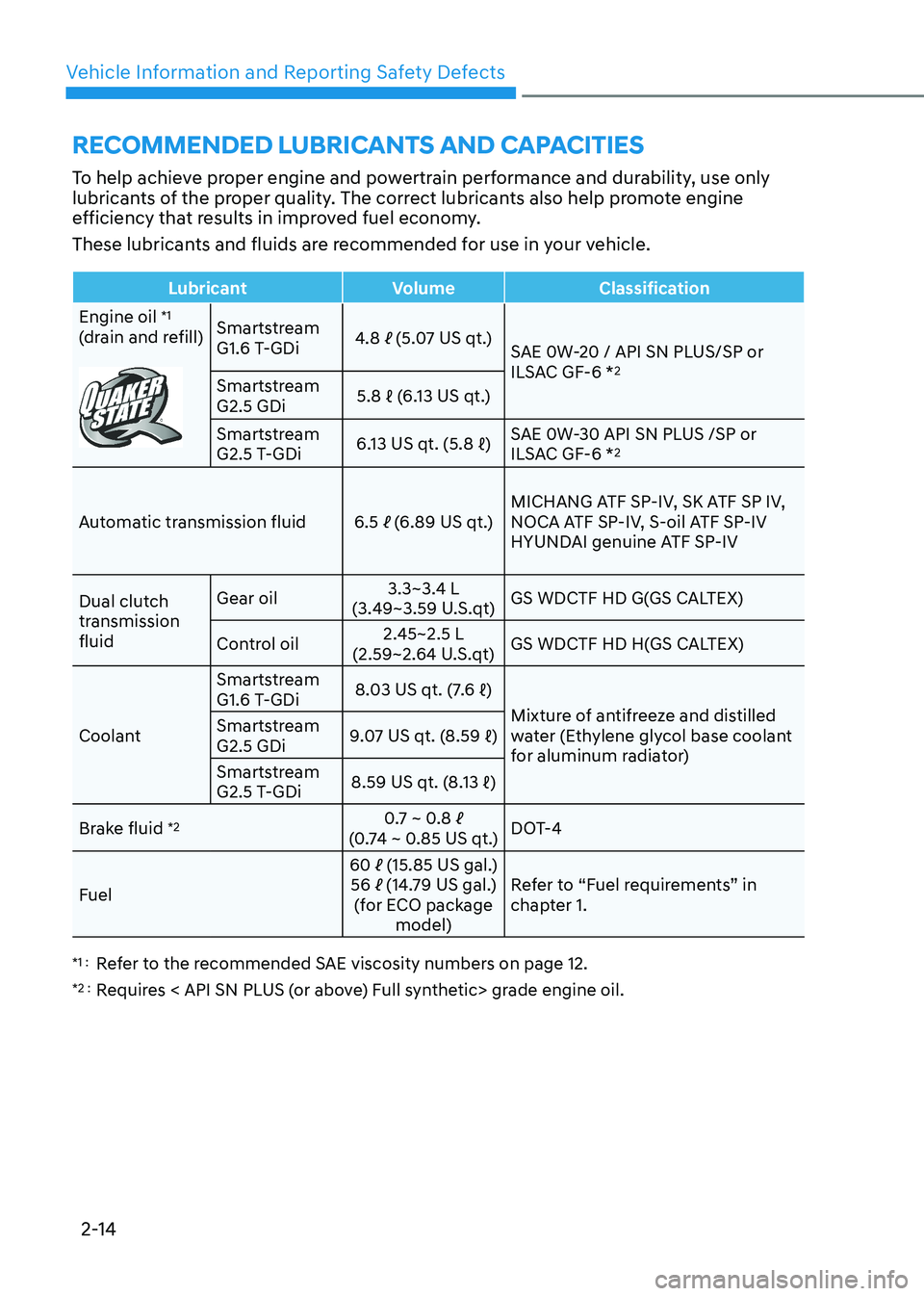
rECommEnDED luBriCants anD CaPaCitiEs
To help achieve proper engine and powertrain performance and durability, use only
lubricants of the proper quality. The correct lubricants also help promote engine
efficiency that results in improved fuel economy.
These lubricants and fluids are recommended for use in your vehicle.
Lubricant Volume Classification
Engine oil *1
(drain and refill) Smartstream
G1.6 T-GDi 4.8
ℓ (5.07 US qt.)
SAE 0W-20 / API SN PLUS/SP or
ILSAC GF-6 *2
Smartstream G2.5 GDi 5.8 ℓ (6.13 US qt.)
Smartstream
G2.5 T-GDi 6.13 US qt. (5.8 ℓ)
SAE 0W-30 API SN PLUS /SP or
ILSAC GF-6 *
2
Automatic transmission fluid 6.5 ℓ (6.89 US qt.) MICHANG ATF SP-IV, SK ATF SP IV,
NOCA ATF SP-IV, S-oil ATF SP-IV
HYUNDAI genuine ATF SP-IV
Dual clutch
transmission fluid Gear oil
3.3~3.4 L
(3.49~3.59 U.S.qt) GS WDCTF HD G(GS CALTEX)
Control oil 2.45~2.5 L
(2.59~2.64 U.S.qt) GS WDCTF HD H(GS CALTEX)
Coolant Smartstream
G1.6 T-GDi
8.03 US qt. (7.6 ℓ)
Mixture of antifreeze and distilled
water (Ethylene glycol base coolant
for aluminum radiator)
Smartstream G2.5 GDi
9.07 US qt. (8.59 ℓ)
Smartstream
G2.5 T-GDi 8.59 US qt. (8.13 ℓ)
Brake fluid *2
0.7 ~ 0.8
ℓ
(0.74 ~ 0.85 US qt.) DOT-4
Fuel 60
ℓ (15.85 US gal.)
56 ℓ (14.79 US gal.)
(for ECO package model) Refer to “Fuel requirements” in
chapter 1.
*1 : Refer to the recommended SAE viscosity numbers on page 12.
*2 : Requires < API SN PLUS (or above) Full synthetic> grade engine oil.
Page 26 of 555
02
2-15
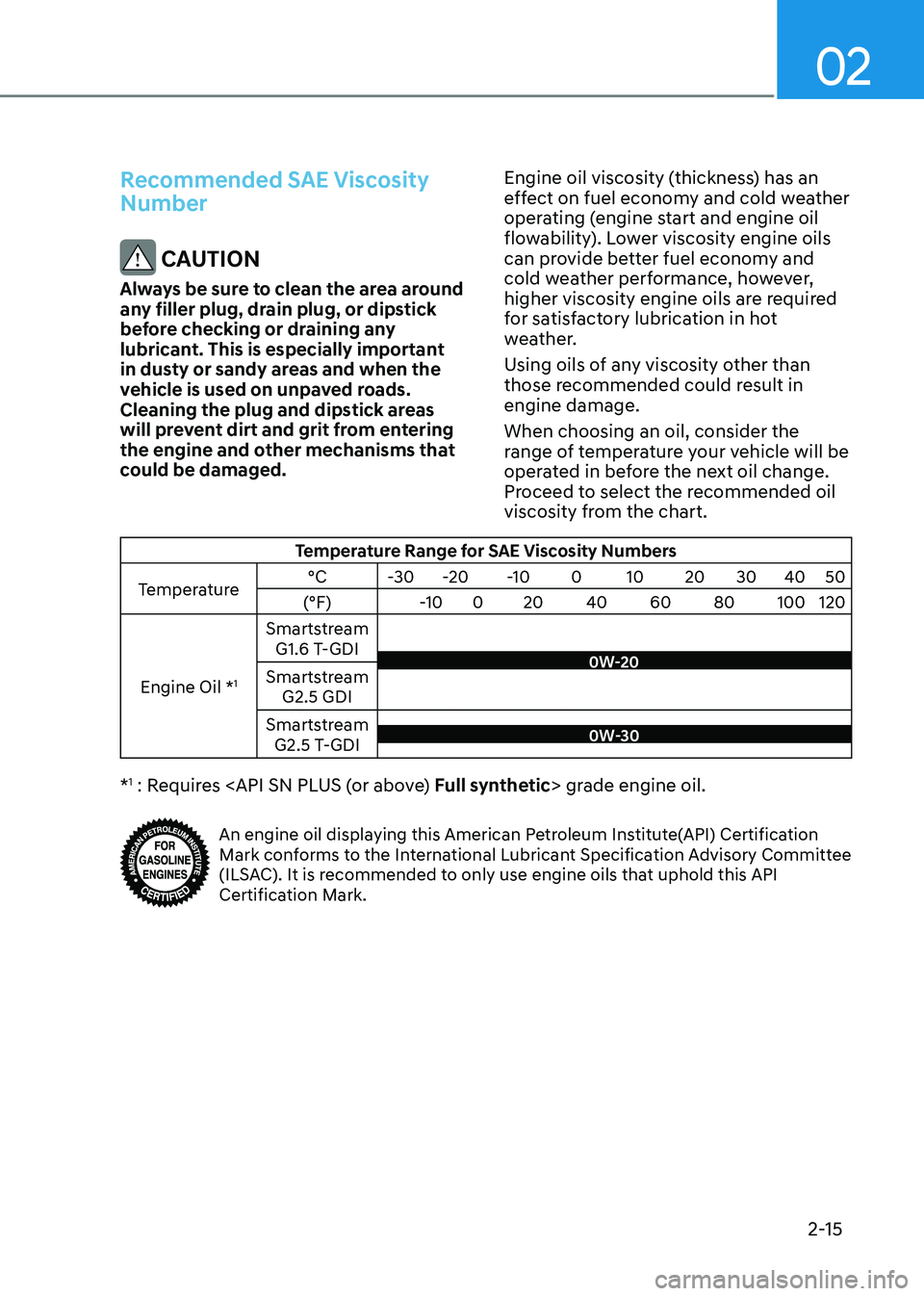
Recommended SAE Viscosity Number
CAUTION
Always be sure to clean the area around
any filler plug, drain plug, or dipstick
before checking or draining any
lubricant. This is especially important
in dusty or sandy areas and when the
vehicle is used on unpaved roads.
Cleaning the plug and dipstick areas
will prevent dirt and grit from entering
the engine and other mechanisms that
could be damaged. Engine oil viscosity (thickness) has an
effect on fuel economy and cold weather
operating (engine start and engine oil
flowability). Lower viscosity engine oils
can provide better fuel economy and
cold weather performance, however,
higher viscosity engine oils are required
for satisfactory lubrication in hot
weather.
Using oils of any viscosity other than
those recommended could result in engine damage. When choosing an oil, consider the
range of temperature your vehicle will be
operated in before the next oil change.
Proceed to select the recommended oil
viscosity from the chart.
Temperature Range for SAE Viscosity Numbers
Temperature °C
-30-20 -10 0 10 20 30 40 50
(°F) -100 20 40 60 80 100 120
Engine Oil * 1Smartstream
G1.6 T-GDI
Smartstream G2.5 GDI
Smartstream G2.5 T-GDI
0W-30
0W-20
* 1
: Requires
An engine oil displaying this American Petroleum Institute(API) Certification
Mark conforms to the International Lubricant Specification Advisory Committee
(ILSAC). It is recommended to only use engine oils that uphold this API
Certification Mark.
Page 28 of 555
02
2-17
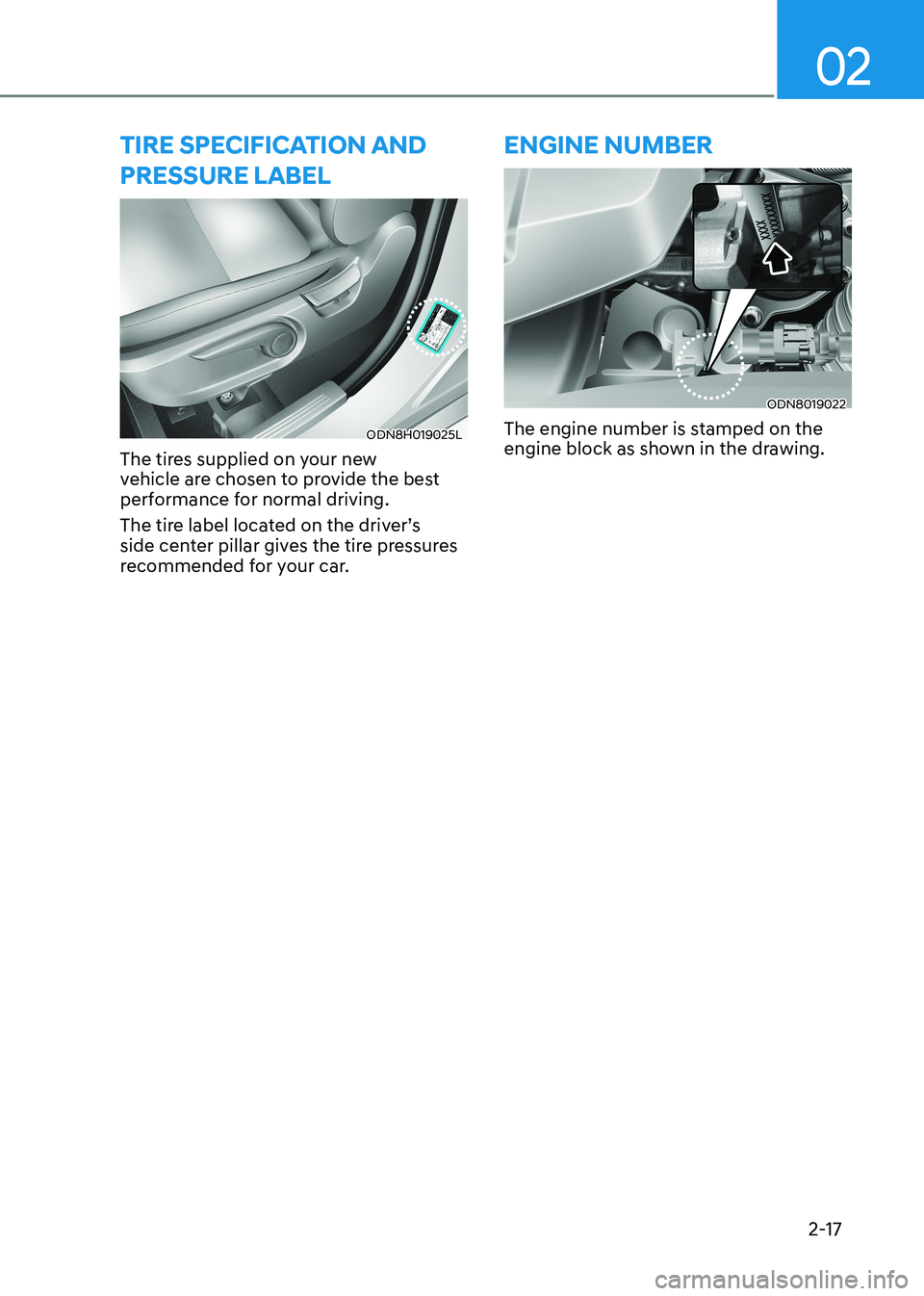
tirE sPECifiCation anD PrEssurE laBEl
ODN8H019025L
The tires supplied on your new
vehicle are chosen to provide the best
performance for normal driving.
The tire label located on the driver’s
side center pillar gives the tire pressures
recommended for your car.
EnginE numBEr
ODN8019022
The engine number is stamped on the
engine block as shown in the drawing.
Page 45 of 555
Seats & Safety System
3-16
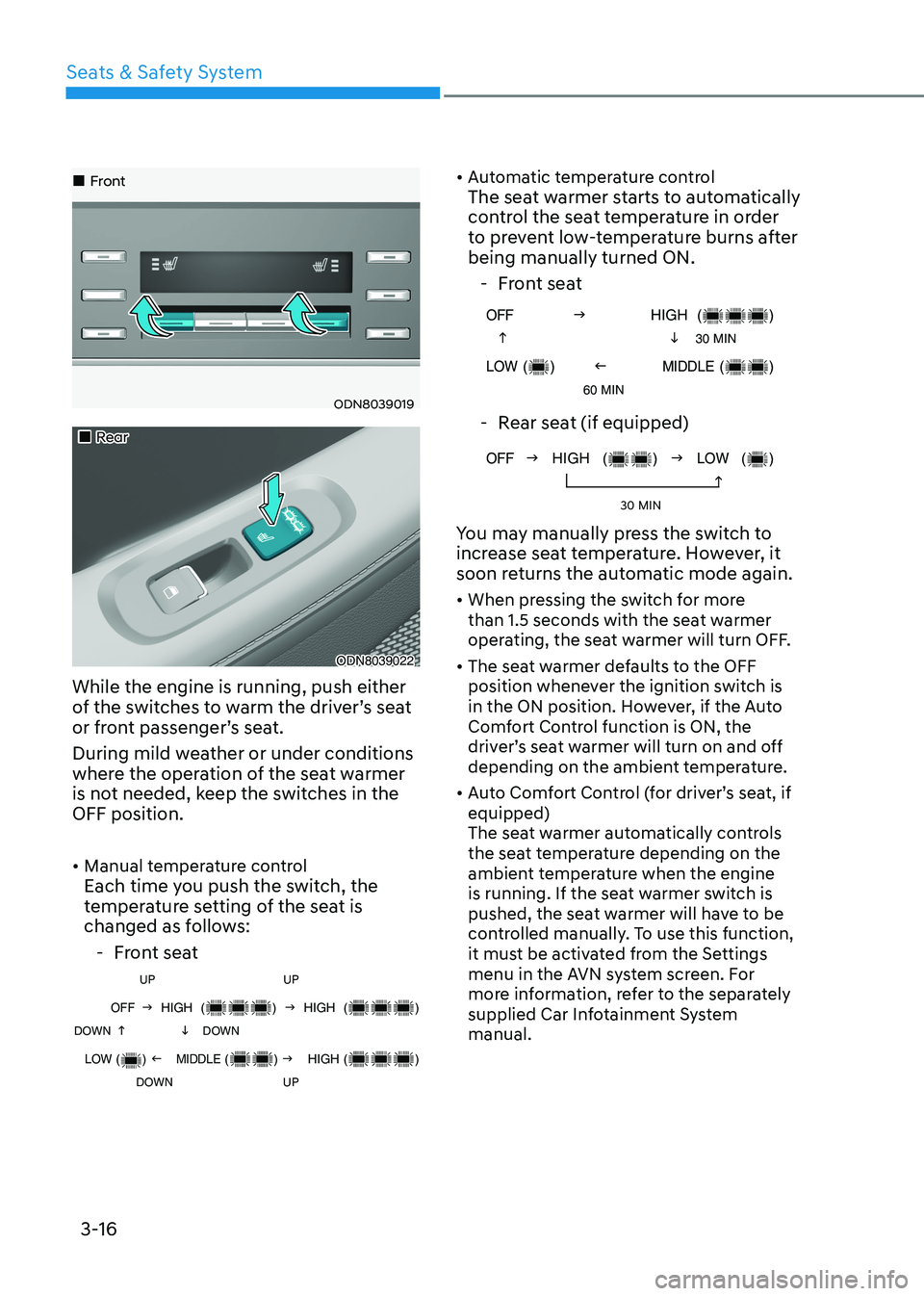
„„Front
ODN8039019
„„Rear
ODN8039022
While the engine is running, push either
of the switches to warm the driver’s seat
or front passenger’s seat.
During mild weather or under conditions
where the operation of the seat warmer
is not needed, keep the switches in the OFF position. • Manual temperature control
Each time you push the switch, the
temperature setting of the seat is
changed as follows:
- Front seat
UP UP
OFF
g HIGH () g HIGH ()
DOWN
h i DOWN
LOW () f MIDDLE () g HIGH ()
DOWN U
P
•
Automatic temperature control
The seat warmer starts to automatically
control the seat temperature in order
to prevent low-temperature burns after being manually turned ON.
- Front seat
OFF g HIGH ()
h i 30 MIN
LOW () f MIDDLE ()
60 MIN
- Rear seat (if equipped)
OFF g HIGH () g LOW ()
h
30 MIN
You may manually press the switch to
increase seat temperature. However, it
soon returns the automatic mode again. • When pressing the switch for more
than 1.5 seconds with the seat warmer
operating, the seat warmer will turn OFF.
• The seat warmer defaults to the OFF
position whenever the ignition switch is
in the ON position. However, if the Auto
Comfort Control function is ON, the
driver’s seat warmer will turn on and off
depending on the ambient temperature.
• Auto Comfort Control (for driver’s seat, if equipped)
The seat warmer automatically controls
the seat temperature depending on the
ambient temperature when the engine
is running. If the seat warmer switch is
pushed, the seat warmer will have to be
controlled manually. To use this function,
it must be activated from the Settings
menu in the AVN system screen. For
more information, refer to the separately
supplied Car Infotainment System manual.
Page 46 of 555
03
3-17
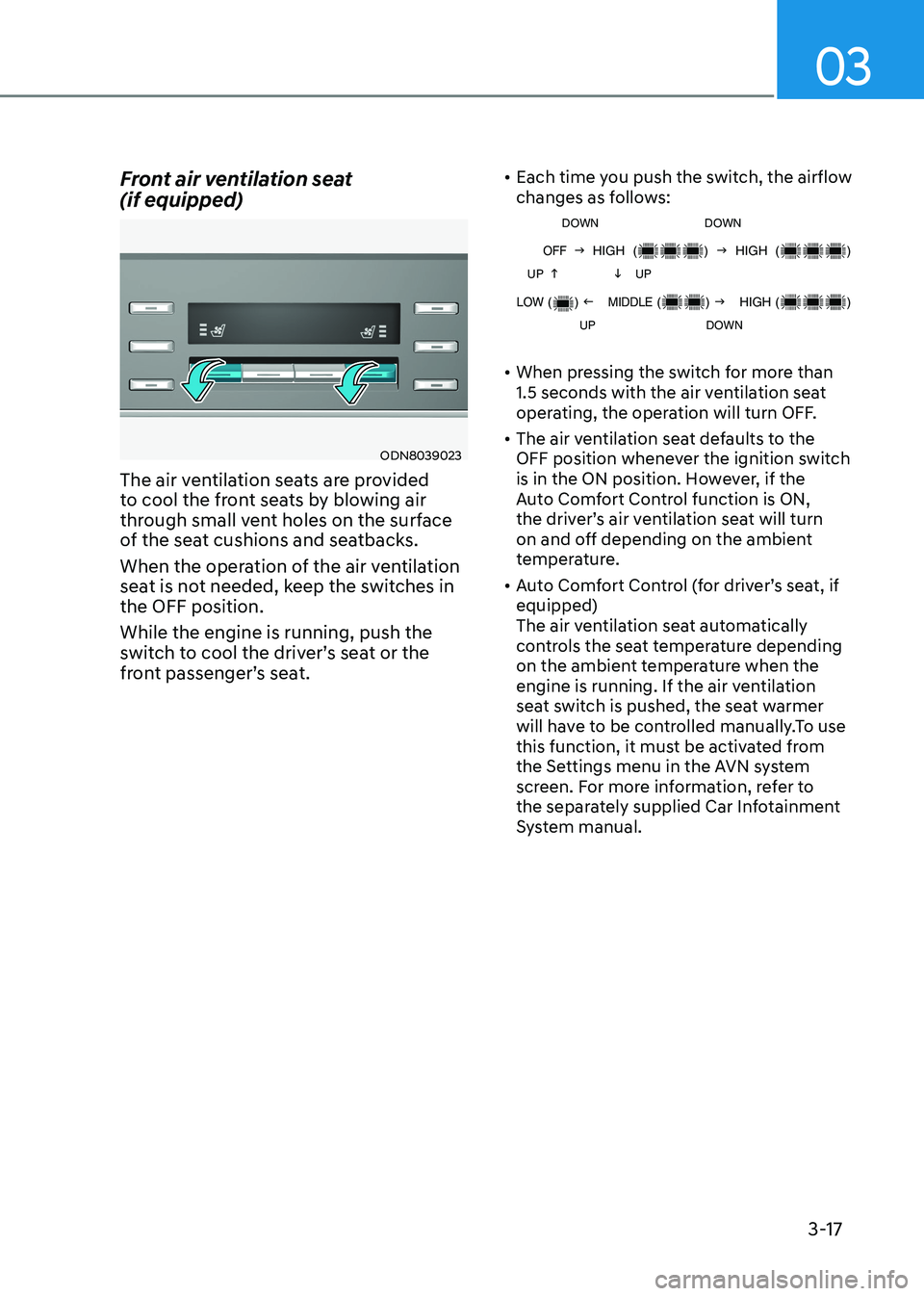
Front air ventilation seat (if equipped)
ODN8039023
The air ventilation seats are provided
to cool the front seats by blowing air
through small vent holes on the surface
of the seat cushions and seatbacks.
When the operation of the air ventilation
seat is not needed, keep the switches in the OFF position. While the engine is running, push the
switch to cool the driver’s seat or the
front passenger’s seat. •
Each time you push the switch, the airflow
changes as follows:
DOWN DOWN
OFF g HIGH () g HIGH ()
UP
h i UP
LOW () f MIDDLE () g HIGH ()
UP DOWN
• When pressing the switch for more than
1.5 seconds with the air ventilation seat
operating, the operation will turn OFF.
• The air ventilation seat defaults to the
OFF position whenever the ignition switch
is in the ON position. However, if the
Auto Comfort Control function is ON,
the driver’s air ventilation seat will turn
on and off depending on the ambient
temperature.
• Auto Comfort Control (for driver’s seat, if equipped)
The air ventilation seat automatically
controls the seat temperature depending
on the ambient temperature when the
engine is running. If the air ventilation
seat switch is pushed, the seat warmer
will have to be controlled manually.To use
this function, it must be activated from
the Settings menu in the AVN system
screen. For more information, refer to
the separately supplied Car Infotainment
System manual.
Page 71 of 555
Seats & Safety System
3-42
WARNING
To reduce the risk of serious injury or
death from an inflating curtain air bag,
take the following precautions: • All seat occupants must wear
seat belts at all times to help keep
occupants positioned properly.
• Properly secure child restraints as far
away from the door as possible.
• Do not place any objects over the air
bag. Also, do not attach any objects
around the area the air bag inflates
such as the door, side door glass,
front and rear pillar, roof side rail.
• Do not hang other objects except
clothes, especially hard or breakable
objects. In an accident, it may cause
vehicle damage or personal injury.
• Do not allow passengers to lean their
heads or bodies onto doors, put their
arms on the doors, stretch their arms
out of the window, or place objects
between the doors and seats.
• Do not open or repair the side curtain air bags.How Does the Air Bag System
Operate?
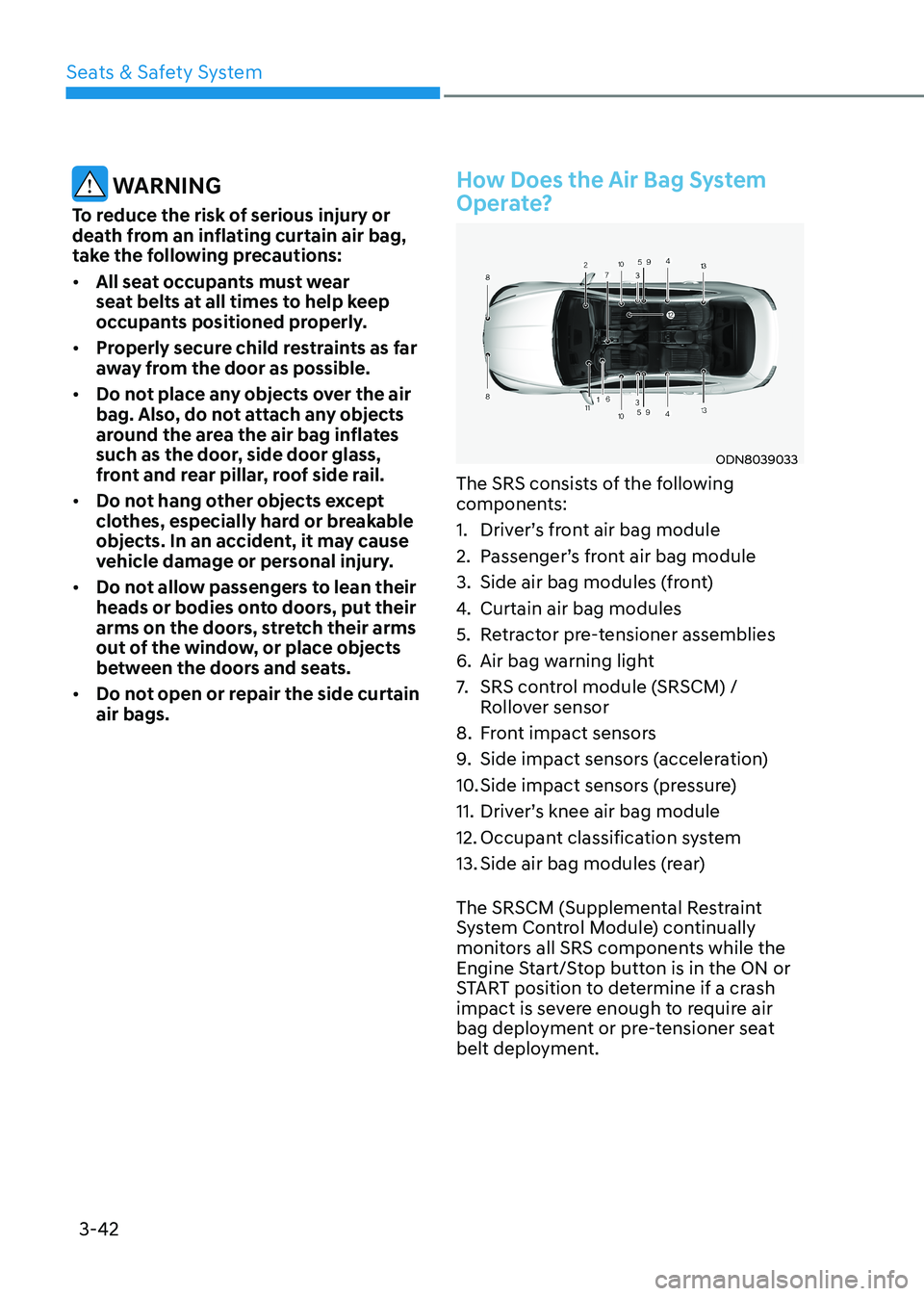
ODN8039033
The SRS consists of the following
components:
1. Driver’s front air bag module
2. Passenger’s front air bag module
3. Side air bag modules (front)
4. Curtain air bag modules
5. Retractor pre-tensioner assemblies
6. Air bag warning light
7. SRS control module (SRSCM) /
Rollover sensor
8. Front impact sensors
9. Side impact sensors (acceleration)
10. Side impact sensors (pressure)
11. Driver’s knee air bag module
12. Occupant classification system
13. Side air bag modules (rear)
The SRSCM (Supplemental Restraint
System Control Module) continually
monitors all SRS components while the
Engine Start/Stop button is in the ON or
START position to determine if a crash
impact is severe enough to require air
bag deployment or pre-tensioner seat
belt deployment.
Page 72 of 555
03
3-43
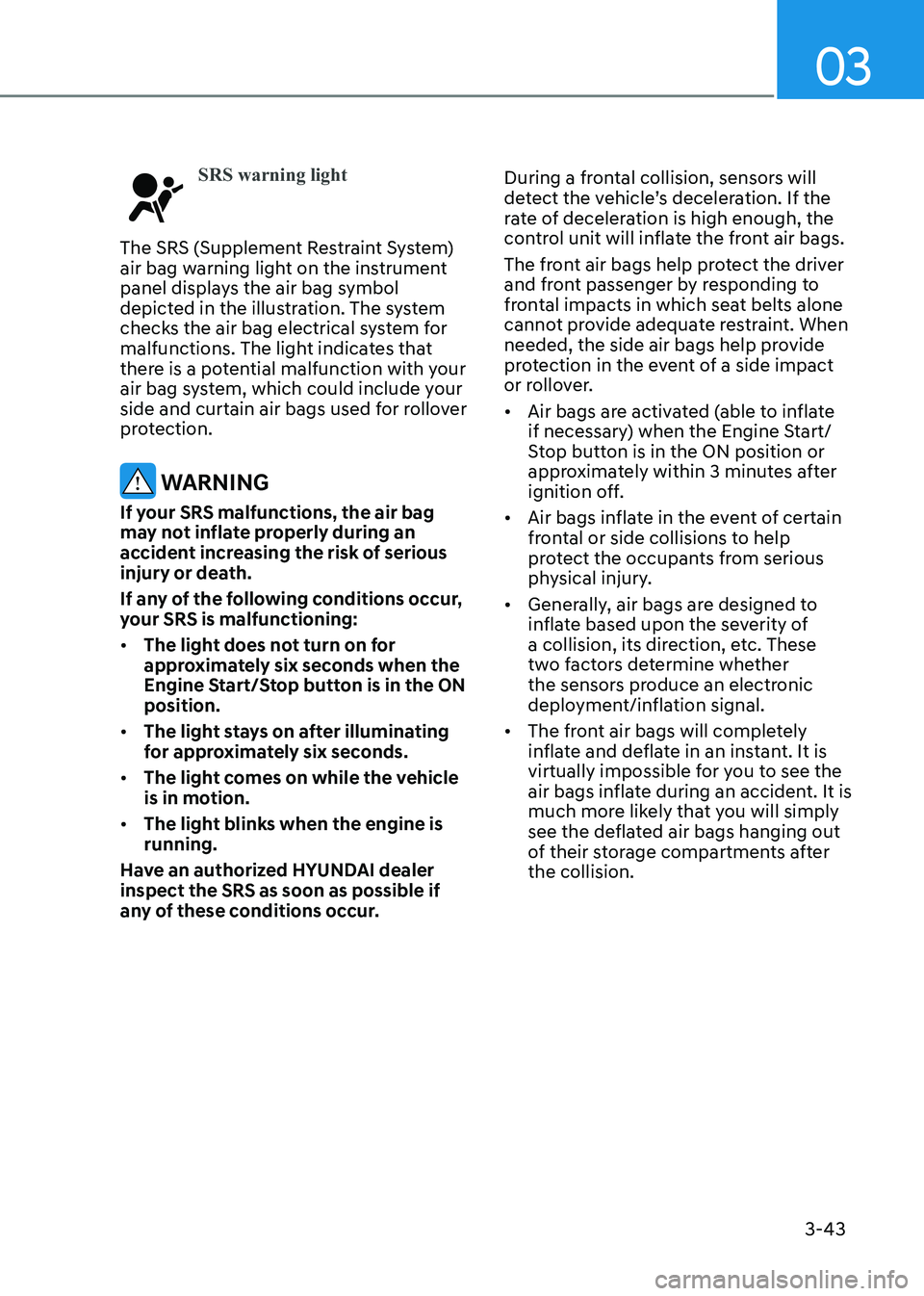
SRS warning light
The SRS (Supplement Restraint System)
air bag warning light on the instrument
panel displays the air bag symbol
depicted in the illustration. The system
checks the air bag electrical system for
malfunctions. The light indicates that
there is a potential malfunction with your
air bag system, which could include your
side and curtain air bags used for rollover
protection.
WARNING
If your SRS malfunctions, the air bag
may not inflate properly during an
accident increasing the risk of serious
injury or death.
If any of the following conditions occur,
your SRS is malfunctioning: • The light does not turn on for
approximately six seconds when the
Engine Start/Stop button is in the ON position.
• The light stays on after illuminating
for approximately six seconds.
• The light comes on while the vehicle
is in motion.
• The light blinks when the engine is running.
Have an authorized HYUNDAI dealer inspect the SRS as soon as possible if
any of these conditions occur. During a frontal collision, sensors will
detect the vehicle’s deceleration. If the
rate of deceleration is high enough, the
control unit will inflate the front air bags.
The front air bags help protect the driver
and front passenger by responding to
frontal impacts in which seat belts alone
cannot provide adequate restraint. When
needed, the side air bags help provide
protection in the event of a side impact
or rollover. •
Air bags are activated (able to inflate
if necessary) when the Engine Start/
Stop button is in the ON position or
approximately within 3 minutes after
ignition off.
• Air bags inflate in the event of certain
frontal or side collisions to help
protect the occupants from serious
physical injury.
• Generally, air bags are designed to
inflate based upon the severity of
a collision, its direction, etc. These
two factors determine whether
the sensors produce an electronic
deployment/inflation signal.
• The front air bags will completely
inflate and deflate in an instant. It is
virtually impossible for you to see the
air bags inflate during an accident. It is
much more likely that you will simply
see the deflated air bags hanging out
of their storage compartments after the collision.
Page 80 of 555
03
3-51
OHI038118
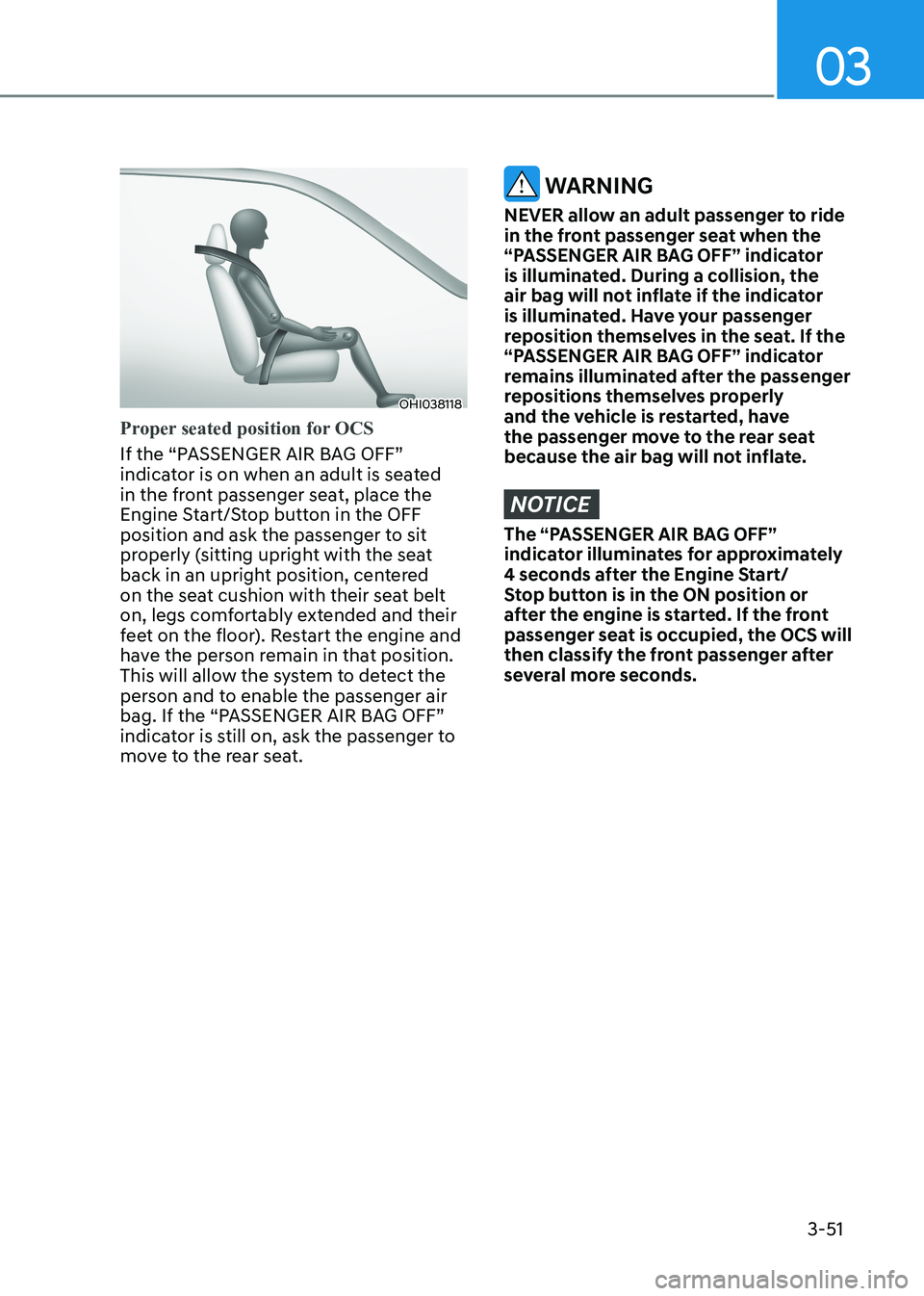
Proper seated position for OCS
If the “PASSENGER AIR BAG OFF”
indicator is on when an adult is seated
in the front passenger seat, place the
Engine Start/Stop button in the OFF
position and ask the passenger to sit
properly (sitting upright with the seat
back in an upright position, centered
on the seat cushion with their seat belt
on, legs comfortably extended and their
feet on the floor). Restart the engine and
have the person remain in that position.
This will allow the system to detect the
person and to enable the passenger air
bag. If the “PASSENGER AIR BAG OFF”
indicator is still on, ask the passenger to
move to the rear seat.
WARNING
NEVER allow an adult passenger to ride
in the front passenger seat when the
“PASSENGER AIR BAG OFF” indicator
is illuminated. During a collision, the
air bag will not inflate if the indicator
is illuminated. Have your passenger
reposition themselves in the seat. If the
“PASSENGER AIR BAG OFF” indicator
remains illuminated after the passenger
repositions themselves properly
and the vehicle is restarted, have
the passenger move to the rear seat
because the air bag will not inflate.
NOTICE
The “PASSENGER AIR BAG OFF”
indicator illuminates for approximately
4 seconds after the Engine Start/
Stop button is in the ON position or
after the engine is started. If the front
passenger seat is occupied, the OCS will
then classify the front passenger after
several more seconds.
Page 86 of 555
03
3-57
Additional Safety Precautions
Passengers should not move out of
or change seats while the vehicle is
moving. A passenger who is not wearing
a seat belt during a crash or emergency
stop can be thrown against the inside of
the vehicle, against other occupants, or
be ejected from the vehicle.
Do not use any accessories on seat belts. Devices claiming to improve
occupant comfort or reposition the seat
belt can reduce the protection provided
by the seat belt and increase the chance
of serious injury in a crash.
Do not modify the front seats.
Modification of the front seats could
interfere with the operation of the
supplemental restraint system sensing
components or side air bags.
Do not place items under the front
seats. Placing items under the front seats
could interfere with the operation of the
supplemental restraint system sensing
components and wiring harnesses.
Do not cause impact to the doors.
Impact to the doors when the Engine
Start/Stop button is in the ON position
may cause the air bags to inflate.
Modifications to accommodate disabilities. If you require modification
to your vehicle to accommodate a
disability, contact the HYUNDAI Auto
Canada at 1-888-216-2626.
Adding equipment to or modifying
your air bag equipped vehicle
If you modify your vehicle by changing
your vehicle’s frame, bumper system,
front end or side sheet metal or ride
height, this may affect the operation of
your vehicle’s air bag system.
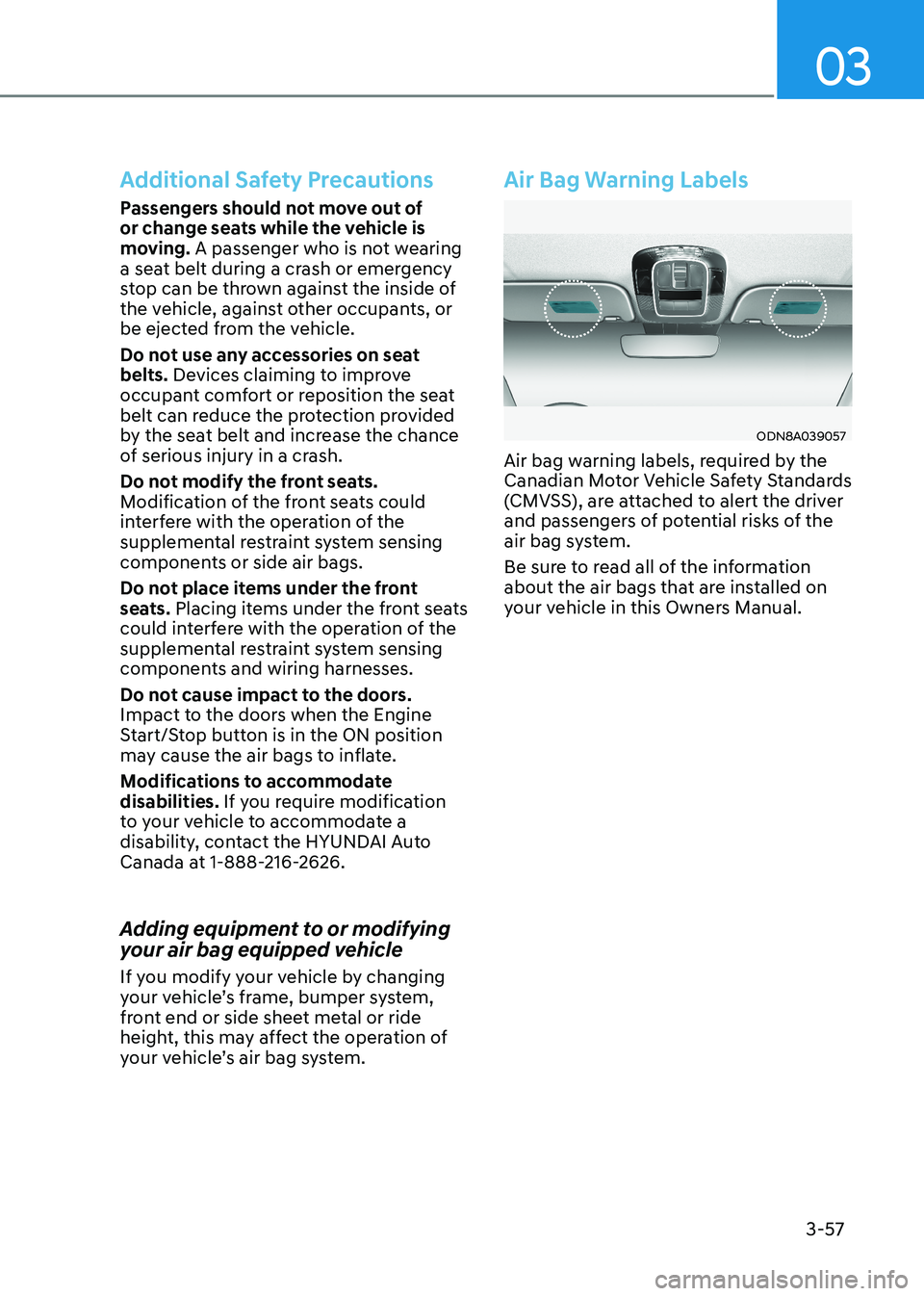
Air Bag Warning Labels
ODN8A039057
Air bag warning labels, required by the
Canadian Motor Vehicle Safety Standards
(CMVSS), are attached to alert the driver
and passengers of potential risks of the
air bag system.
Be sure to read all of the information
about the air bags that are installed on
your vehicle in this Owners Manual.
Page 88 of 555
4-2
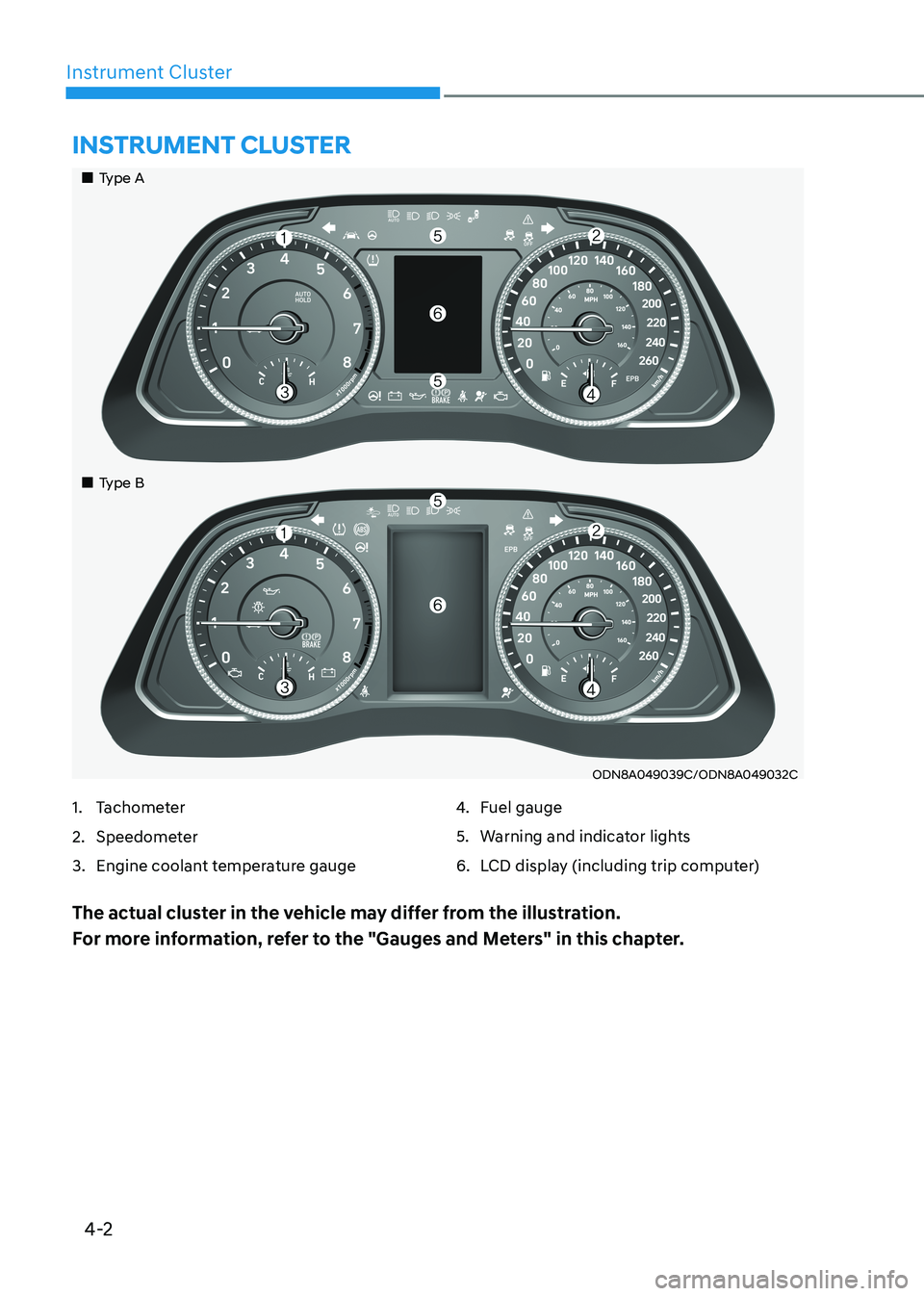
Instrument Cluster
ODN8A049039C/ODN8A049032C
Instrument Cluster
1. Tachometer
2. Speedometer
3. Engine coolant temperature gauge4.
Fuel gauge
5. Warning and indicator lights
6. LCD display (including trip computer)
The actual cluster in the vehicle may differ from the illustration.
For more information, refer to the "Gauges and Meters" in this chapter.
„„Type A
„
„Type B