check engine light HYUNDAI SONATA 2023 Owner's Manual
[x] Cancel search | Manufacturer: HYUNDAI, Model Year: 2023, Model line: SONATA, Model: HYUNDAI SONATA 2023Pages: 555, PDF Size: 42.72 MB
Page 470 of 555
Emergency Situations
7-22
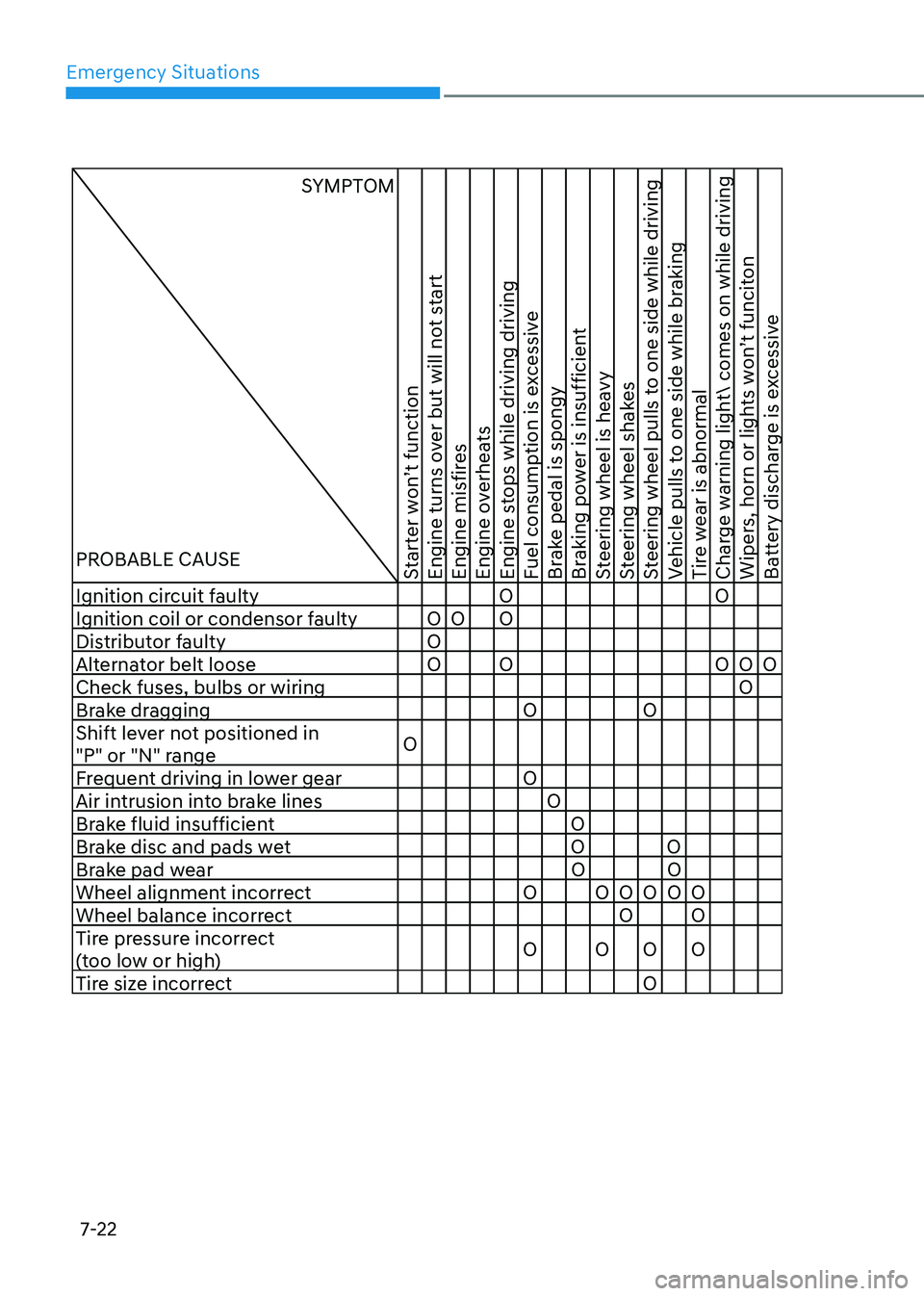
SYMPTOM
PROBABLE CAUSE
Starter won’t function
Engine turns over but will not start
Engine misfires
Engine overheats
Engine stops while driving driving
Fuel consumption is excessive
Brake pedal is spongy
Braking power is insufficient
Steering wheel is heavy
Steering wheel shakes
Steering wheel pulls to one side while driving
Vehicle pulls to one side while braking
Tire wear is abnormal
Charge warning light comes on while driving
Wipers, horn or lights won’t funciton
Battery discharge is excessive
Ignition circuit faulty O O Ignition coil or condensor faulty O O O
Distributor faulty O
Alternator belt loose O O O O O Check fuses, bulbs or wiring O
Brake dragging O O
Shift lever not positioned in
"P" or "N" range O
Frequent driving in lower gear O
Air intrusion into brake lines O
Brake fluid insufficient O
Brake disc and pads wet O O
Brake pad wear O O
Wheel alignment incorrect O O O O O O Wheel balance incorrect O O
Tire pressure incorrect
(too low or high) O O O O
Tire size incorrect O
Page 472 of 555
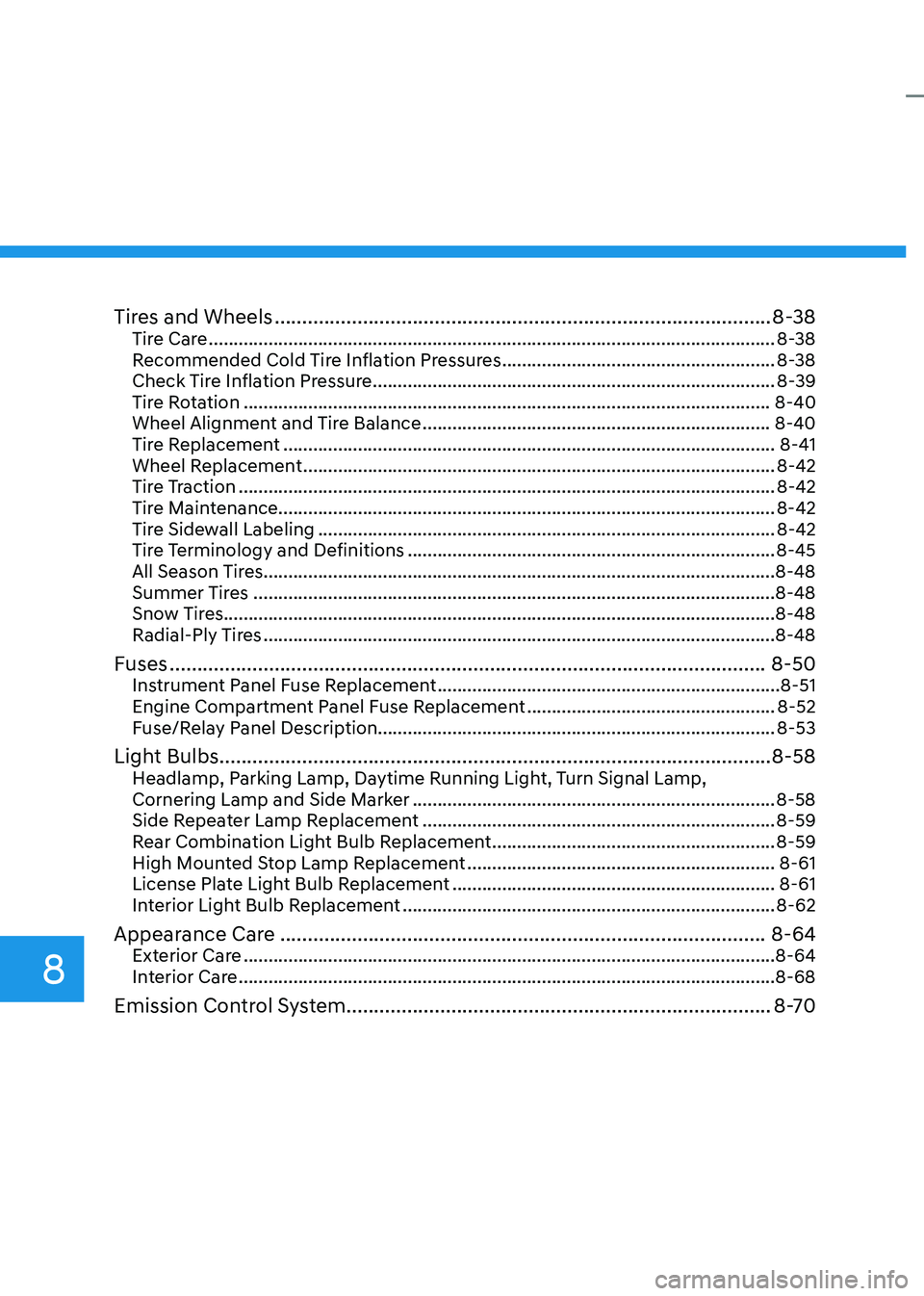
Tires and Wheels .......................................................................................... 8-38
Tire Care .................................................................................................................. 8-38
Recommended Cold Tire Inflation Pressures .......................................................8-38
Check Tire Inflation Pressure ................................................................................. 8-39
Tire Rotation .......................................................................................................... 8-40
Wheel Alignment and Tire Balance ...................................................................... 8-40
Tire Replacement ................................................................................................... 8-41
Wheel Replacement ............................................................................................... 8-42
Tire Traction ............................................................................................................ 8-42
Tire Maintenance.................................................................................................... 8-42
Tire Sidewall Labeling ............................................................................................ 8-42
Tire Terminology and Definitions .......................................................................... 8-45
All Season Tires ....................................................................................................... 8-48
Summer Tires ......................................................................................................... 8-48
Snow Tires...............................................................................................................8-48
Radial-Ply Tires ....................................................................................................... 8-48
Fuses ............................................................................................................ 8-50
Instrument Panel Fuse Replacement ..................................................................... 8-51
Engine Compartment Panel Fuse Replacement ..................................................8-52
Fuse/Relay Panel Description................................................................................ 8-53
Light Bulbs .................................................................................................... 8-58
Headlamp, Parking Lamp, Daytime Running Light, Turn Signal Lamp,
Cornering Lamp and Side Marker ......................................................................... 8-58
Side Repeater Lamp Replacement ....................................................................... 8-59
Rear Combination Light Bulb Replacement .........................................................8-59
High Mounted Stop Lamp Replacement ..............................................................8-61
License Plate Light Bulb Replacement ................................................................. 8-61
Interior Light Bulb Replacement ........................................................................... 8-62
Appearance Care ........................................................................................ 8-64
Exterior Care ........................................................................................................... 8-64
Interior Care ............................................................................................................ 8-68
Emission Control System ............................................................................. 8-70
8
Page 477 of 555
08
8 -7
While operating your vehicle: •
Note any changes in the sound of the
exhaust or any smell of exhaust fumes
in the vehicle.
• Check for vibrations in the steering
wheel. Notice if there is any increased
steering effort or looseness in the
steering wheel, or change in its
straight-ahead position.
• Notice if your vehicle constantly turns
slightly or “pulls” to one side when
traveling on smooth, level road.
• When stopping, listen and check for
unusual sounds, pulling to one side,
increased brake pedal travel or “hard-
to-push” brake pedal.
• If any slipping or changes in the
operation of your transmission occurs,
check the transmission fluid level.
• Check the automatic transmission P
(Park) function.
• Check the parking brake.
• Check for fluid leaks under your
vehicle (water dripping from the air
conditioning system during or after use is normal).
At least monthly: • Check coolant level in the engine
coolant reservoir.
• Check the operation of all exterior
lights, including the brake lights, turn
signals and hazard warning flashers.
• Check the inflation pressures of all
tires including the spare for tires that
are worn, show uneven wear, or are damaged.
• Check for loose wheel lug nuts. At least twice a year:
(i.e., every Spring and Autumn) •
Check radiator, heater and air
conditioning hoses for leaks or damage.
• Check windshield washer spray and
wiper operation. Clean wiper blades
with a clean cloth dampened with
washer a fluid.
• Check headlamp alignment.
• Check muffler, exhaust pipes, shields and clamps.
• Check the seat belts for wear and function.
At least once a year: • Clean body and door drain holes.
• Lubricate door hinges and hood hinges.
• Lubricate door and hood locks and
latches.
• Lubricate door rubber weather strips.
• Lubricate door checker.
• Check the air conditioning system.
• Inspect and lubricate automatic
transmission linkage and controls.
• Clean the battery and terminals.
• Check the brake fluid level.
Page 495 of 555
08
8-25
Checking the Engine Oil and
Filter
• Have engine oil and filter changed
by an authorized HYUNDAI dealer
according to the Maintenance
Schedule at the beginning of this
chapter.
• If the maintenance schedule to
replace engine oil is exceeded,
the engine oil performance may
deteriorate, and the engine condition
may be affected. Therefore, replace
the engine oil according to the
maintenance schedule.
• To keep the engine in optimal
condition, use the recommended
engine oil and filter. If the
recommended engine oil and filter are
not used, replace it according to the
maintenance schedule under severe usage conditions.
• The purpose of the maintenance
schedule for engine oil replacement
is to prevent oil deterioration and it is
irrelevant to oil consumption. Check
and refill engine oil regularly.
WARNING
Used engine oil may cause irritation or
cancer of the skin if left in contact with
the skin for prolonged periods of time.
Always protect your skin by washing
your hands thoroughly with soap and
warm water as soon as possible after handling used oil.
Information
When the oil pressure is low due to insufficient engine oil, the Engine
Oil Pressure (
) warning light will
illuminate. In addition, the enhanced
engine protection system, which limits
the engine’s power is activated and the
Malfunction Indicator Lamp (
) will
illuminate when the vehicle is driven in
this state continuously. When oil pressure
is restored, the Engine Oil Pressure warning light will turn off and the engine
power will no longer be limited.
However, for gasoline 2.5 turbo engine,
when the oil pressure is restored, the warning light and the enhanced engine
protection system will turn off after the
engine is restarted.
CAUTION
The engine oil is very hot immediately
after the vehicle has been driven and
can cause burns during replacement.
Replace the engine oil after the engine
oil has cooled down.
Page 507 of 555
08
8-37
Battery Recharging
WARNING
Always follow these instructions when
recharging your vehicle’s battery to
avoid the risk of SERIOUS INJURY or
DEATH from explosions or acid burns: • Before performing maintenance or
recharging the battery, turn off all
accessories and place the ignition
switch to the LOCK/OFF position.
• Keep all flames, sparks, or smoking
materials away from the battery.
• Always work outdoors or in an area
with plenty of ventilation.
• Wear eye protection when checking
the battery during charging.
• The battery must be removed from
the vehicle and placed in a well
ventilated area.
• Watch the battery during charging,
and stop or reduce the charging
rate if the battery cells begin boiling
violently.
• Vehicle is equipped with the
Absorbent Glass Mat (AGM) battery.
Do not charge the AGM battery with
a general charger. It may damage
or explode the AGM battery. Only
charge the AGM battery with a
charger that has AGM battery
setting.
• The negative battery cable must
be removed first to disconnect
the battery and installed last
to reconnect with the battery.
Disconnect the battery charger in the
following order:
1. Turn off the battery charger main
switch.
2. Unhook the negative clamp from the negative battery terminal.
3. Unhook the positive clamp from the positive battery terminal.
• Always use a genuine HYUNDAI
approved battery when you replace
the battery. By jump starting
After a jump start, idle the engine
with the headlights ON for 20-30
minutes before shutting the engine
off. The vehicle may not restart if you
shut it off before the battery had a
chance to adequately recharge. See
“Jump Starting” in chapter 7 for more
information on jump starting procedures.
Information
An inappropriately disposed battery can be harmful to
the environment and human health. Dispose of the battery
according to your local law(s) or
regulations.
Reset Features
The following items may need to be reset
after the battery has been discharged or
the battery has been disconnected. See
chapter 3 or 4 for: •
Power Windows
• Trip Computer
• Climate Control System
• Clock
• Audio System
• Sunroof
Page 520 of 555
Maintenance
8-50
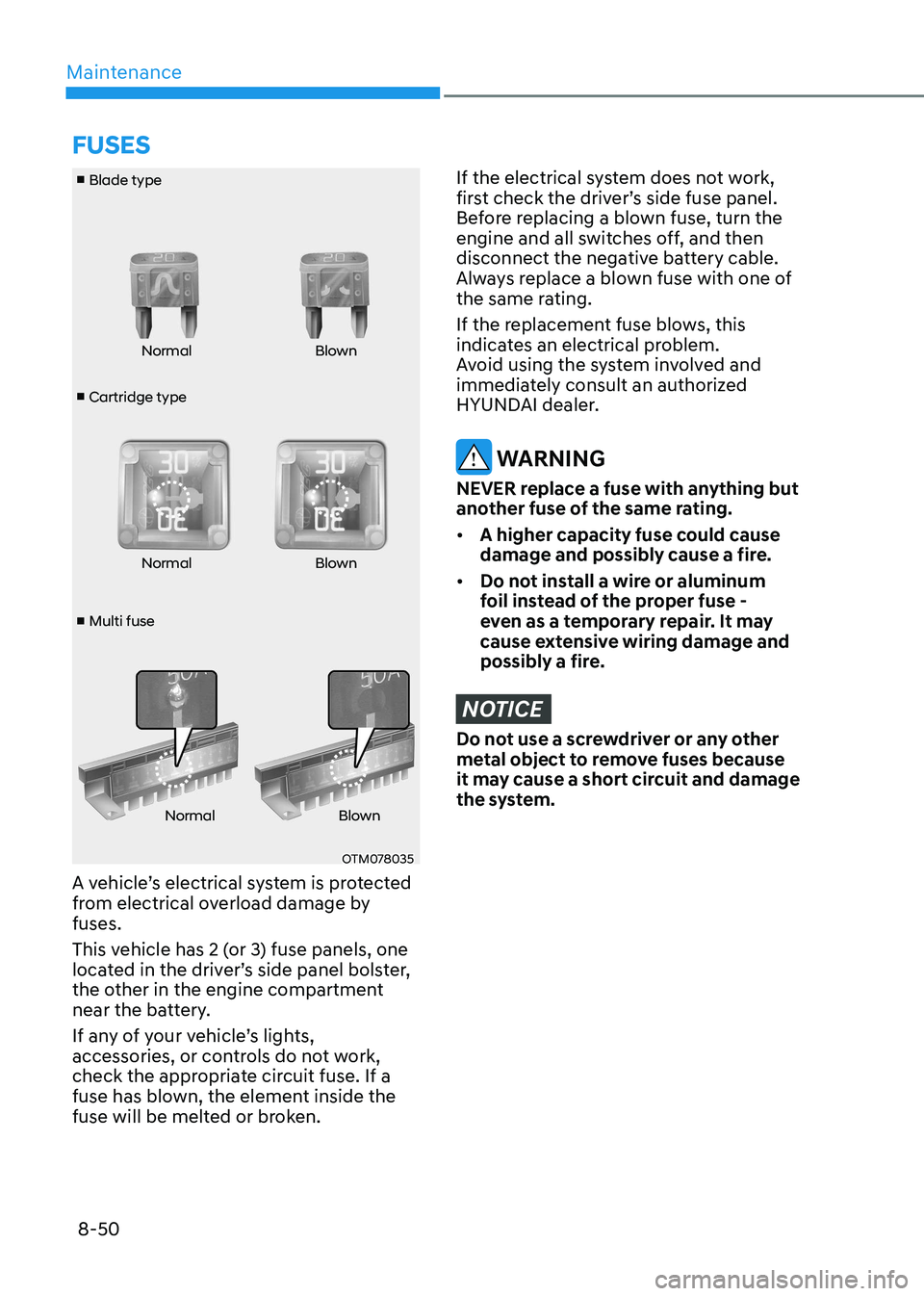
■ Cartridge type
■ Blade type
■ Multi fuse Normal Blown
Normal Blown
Normal Blown
OTM078035
A vehicle’s electrical system is protected
from electrical overload damage by fuses.
This vehicle has 2 (or 3) fuse panels, one
located in the driver’s side panel bolster,
the other in the engine compartment
near the battery.
If any of your vehicle’s lights,
accessories, or controls do not work,
check the appropriate circuit fuse. If a
fuse has blown, the element inside the
fuse will be melted or broken.
If the electrical system does not work,
first check the driver’s side fuse panel.
Before replacing a blown fuse, turn the
engine and all switches off, and then
disconnect the negative battery cable.
Always replace a blown fuse with one of
the same rating.
If the replacement fuse blows, this
indicates an electrical problem.
Avoid using the system involved and
immediately consult an authorized
HYUNDAI dealer.
WARNING
NEVER replace a fuse with anything but
another fuse of the same rating. • A higher capacity fuse could cause
damage and possibly cause a fire.
• Do not install a wire or aluminum
foil instead of the proper fuse -
even as a temporary repair. It may
cause extensive wiring damage and
possibly a fire.
NOTICE
Do not use a screwdriver or any other
metal object to remove fuses because
it may cause a short circuit and damage
the system.
fUSES