maintenance schedule HYUNDAI SONATA 2023 Owner's Manual
[x] Cancel search | Manufacturer: HYUNDAI, Model Year: 2023, Model line: SONATA, Model: HYUNDAI SONATA 2023Pages: 555, PDF Size: 42.72 MB
Page 490 of 555
Maintenance
8-20
Engine Oil and Filter
The engine oil and filter should be
changed at the intervals specified in the
maintenance schedule.
Drive Belts
Inspect all drive belts for evidence
of cuts, cracks, excessive wear or oil
saturation and replace if necessary. Drive
belts should be checked periodically
for proper tension and adjusted as
necessary.
Fuel Filter
A clogged-up fuel filter may limit the
vehicle driving speed, damage the
emission system, and cause the hard
starting. When a considerable amount
of foreign substances are accumulated
in the fuel tank, the fuel filter should be
replaced.
Upon installing a new fuel filter, operate
the engine for several minutes, and
check the connections for any leakages.
Fuel filters should be installed by an
authorized HYUNDAI dealer.
Fuel Lines, Fuel Hoses and Connections
Check the fuel lines, fuel hoses and
connections for leakage and damage.
Have an authorized HYUNDAI dealer
replace any damaged or leaking parts
immediately.
Vapor Hose and Fuel Filler Cap
The vapor hose and fuel filler cap should
be inspected at those intervals specified
in the maintenance schedule. Make sure
a new vapor hose or fuel filler cap is
correctly replaced.
Air Cleaner Filter
A genuine HYUNDAI air cleaner filter
is recommended when the filter is
replaced.
Spark Plugs
Make sure to install new spark plugs of
the correct heat range.
Cooling System
Check cooling system components, such
as radiator, coolant reservoir, hoses and
connections for leakage and damage.
Replace any damaged parts.
ExpLanation of SCHEDULED maintEnanCE itEmS
Page 491 of 555
08
8-21
Engine Coolant
The coolant should be changed at the
intervals specified in the maintenance schedule.
Automatic Transmission Fluid
Automatic Transmission Fluid should
be replaced by an authorized HYUNDAI
dealer at the intervals specified in the
maintenance schedule.
Information
Automatic transmission fluid color is red
when new. As the vehicle is driven, the automatic transmission fluid will begin to look
darker. This is a normal condition and you
should not judge the need to replace the
fluid based upon the changed color.
NOTICE
The use of a non-specified fluid could
result in transmission malfunction
and failure. Use only the specified
automatic transmission fluid (refer
to “Recommended Lubricants and
Capacities” in chapter 2).
Brake Hoses and Lines
Visually check for proper installation,
chafing, cracks, deterioration and any
leakage. Replace any deteriorated or
damaged parts immediately.
Brake Fluid
Check the brake fluid level in the brake
fluid reservoir. The level should be
between the MIN and the MAX marks
on the side of the reservoir. Use only
hydraulic brake fluid conforming to DOT
4 specification.
Parking Brake
Inspect the parking brake system
including the parking brake pedal and cables.
Dual clutch transmission fluid (if equipped)
Inspect the dual clutch transmission fluid
according to the maintenance schedule.
Brake Discs, Pads, Calipers and
Rotors
Check the pads for excessive wear, discs
for run out and wear, and calipers for
fluid leakage.
Exhaust Pipe and Muffler
Visually inspect the exhaust pipes,
muffler and hangers for cracks,
deterioration, or damage. Start
the engine and listen carefully for
any exhaust gas leakage. Tighten
connections or replace parts as
necessary.
Page 493 of 555
08
8-23
Checking the Engine Oil Level
Engine oil is used for lubricating,
cooling, and operating various hydraulic
components in the engine. Engine oil
consumption while driving is normal,
and it is necessary to check and refill the
engine oil regularly. Also, check and refill
the oil level within the recommended
maintenance schedule to prevent
deterioration of oil performance.
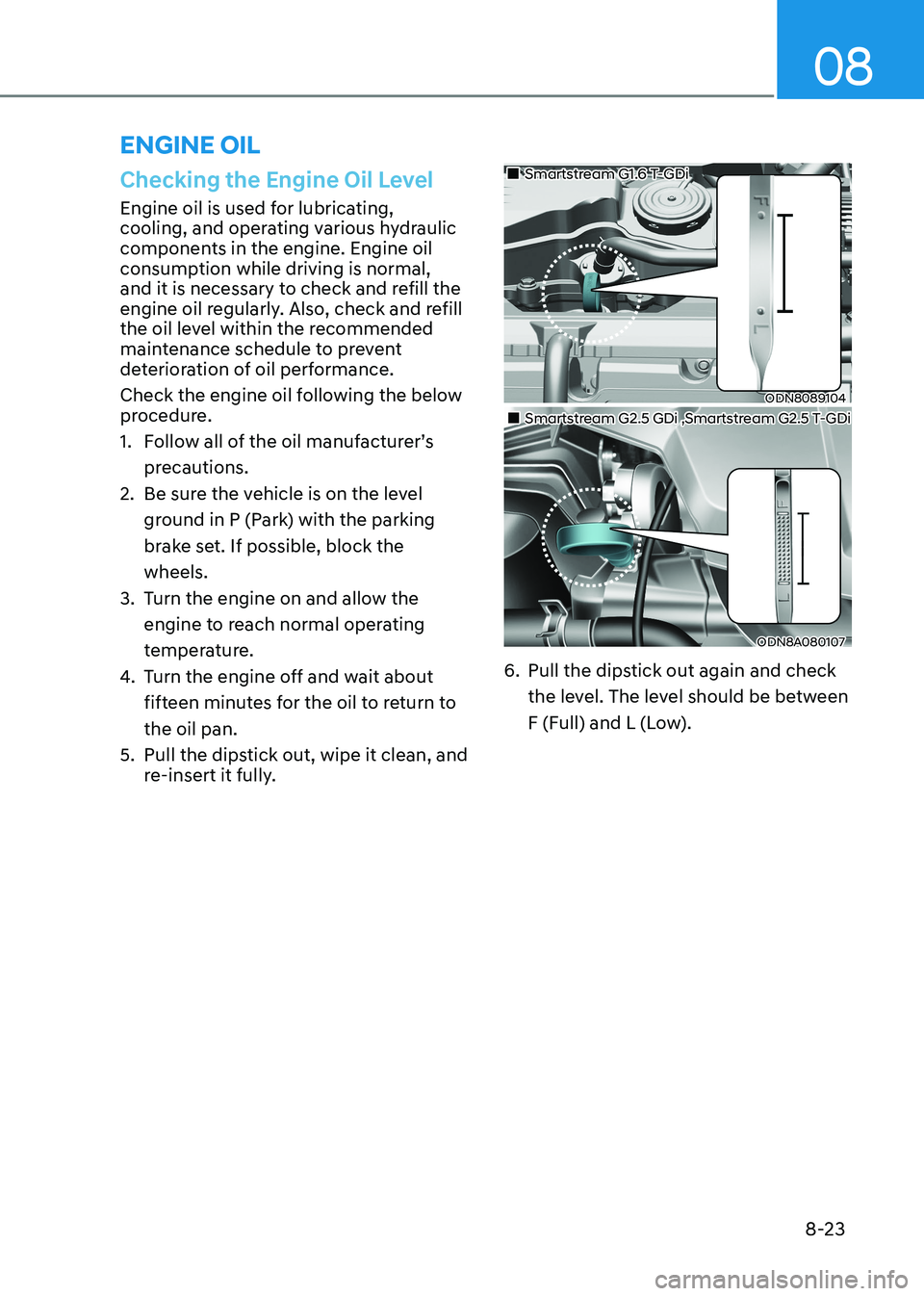
Check the engine oil following the below
procedure.
1. Follow all of the oil manufacturer’sprecautions.
2. Be sure the vehicle is on the level
ground in P (Park) with the parking
brake set. If possible, block thewheels.
3. Turn the engine on and allow the engine to reach normal operating
temperature.
4. Turn the engine off and wait about
fifteen minutes for the oil to return tothe oil pan.
5. Pull the dipstick out, wipe it clean, and re-insert it fully.
ODN8089104
„
„Smartstream G1.6 T-GDi
ODN8A080107
„
„Smartstream G2.5 GDi ,Smartstream G2.5 T-GDi
6. Pull the dipstick out again and check the level. The level should be between
F (Full) and L (Low).
EnginE oiL
Page 495 of 555
08
8-25
Checking the Engine Oil and
Filter
• Have engine oil and filter changed
by an authorized HYUNDAI dealer
according to the Maintenance
Schedule at the beginning of this
chapter.
• If the maintenance schedule to
replace engine oil is exceeded,
the engine oil performance may
deteriorate, and the engine condition
may be affected. Therefore, replace
the engine oil according to the
maintenance schedule.
• To keep the engine in optimal
condition, use the recommended
engine oil and filter. If the
recommended engine oil and filter are
not used, replace it according to the
maintenance schedule under severe usage conditions.
• The purpose of the maintenance
schedule for engine oil replacement
is to prevent oil deterioration and it is
irrelevant to oil consumption. Check
and refill engine oil regularly.
WARNING
Used engine oil may cause irritation or
cancer of the skin if left in contact with
the skin for prolonged periods of time.
Always protect your skin by washing
your hands thoroughly with soap and
warm water as soon as possible after handling used oil.
Information
When the oil pressure is low due to insufficient engine oil, the Engine
Oil Pressure (
) warning light will
illuminate. In addition, the enhanced
engine protection system, which limits
the engine’s power is activated and the
Malfunction Indicator Lamp (
) will
illuminate when the vehicle is driven in
this state continuously. When oil pressure
is restored, the Engine Oil Pressure warning light will turn off and the engine
power will no longer be limited.
However, for gasoline 2.5 turbo engine,
when the oil pressure is restored, the warning light and the enhanced engine
protection system will turn off after the
engine is restarted.
CAUTION
The engine oil is very hot immediately
after the vehicle has been driven and
can cause burns during replacement.
Replace the engine oil after the engine
oil has cooled down.
Page 498 of 555
Maintenance
8-28
WARNING
The electric motor for the
cooling fan may continue to
operate or start up when the
engine is not running and can
cause serious injury. Keep
hands, clothing and tools away
from the rotating fan blades of
the cooling fan.
The electric motor for the cooling
fan is controlled by engine coolant
temperature, refrigerant pressure and
vehicle speed. As the engine coolant
temperature decreases, the electric
motor will automatically shut off. This
is a normal condition. If your vehicle is
equipped with GDI, the electric motor
for the cooling fan may begin to operate
at any time and continue to operate until
you disconnect the negative battery cable.
Changing Engine Coolant
Have coolant changed by an authorized
HYUNDAI dealer according to the
Maintenance Schedule at the beginning
of this chapter.
WARNING
Do not use engine coolant or antifreeze
in the washer fluid reservoir.
Engine coolant can severely obscure
visibility when sprayed on the
windshield and may cause loss of
vehicle control resulting in an accident.
Engine coolant may also cause damage
to paint and body trim.
NOTICE
To prevent damage to engine parts, put
a thick towel around the radiator cap
before refilling the coolant to prevent
the coolant from overflowing into
engine parts, such as the alternator.
Page 503 of 555
08
8-33
CLimatE ControL air fiLtEr
Filter Inspection
The climate control air filter should be
replaced according to the Maintenance
Schedule. If the vehicle is operated
in severely air-polluted cities or on
dusty rough roads for a long period, it
should be inspected more frequently
and replaced earlier. When you replace
the climate control air filter, replace it
performing the following procedure,
and be careful to avoid damaging other
components.
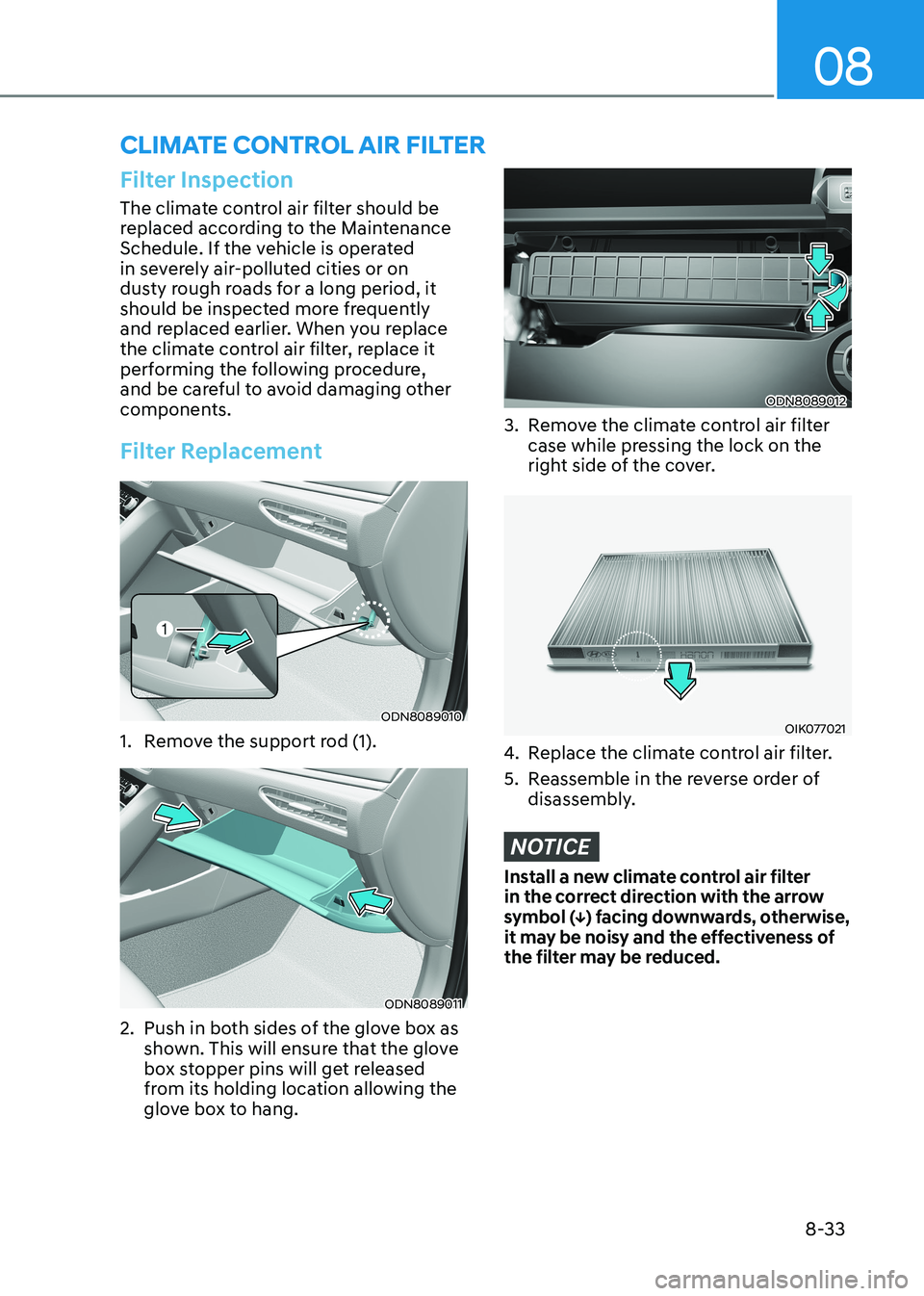
Filter Replacement
ODN8089010
1. Remove the support rod (1).
ODN8089011
2. Push in both sides of the glove box as shown. This will ensure that the glove
box stopper pins will get released
from its holding location allowing the
glove box to hang.
ODN8089012
3. Remove the climate control air filter case while pressing the lock on the
right side of the cover.
OIK077021
4. Replace the climate control air filter.
5. Reassemble in the reverse order of disassembly.
NOTICE
Install a new climate control air filter
in the correct direction with the arrow
symbol (↓) facing downwards, otherwise,
it may be noisy and the effectiveness of
the filter may be reduced.
Page 510 of 555
Maintenance
8-40
Tire Rotation
To equalize tread wear, HYUNDAI
recommends that the tires be rotated
according to the maintenance schedule
or sooner if irregular wear develops.
During rotation, check the tires for
correct balance.
When rotating tires, check for uneven
wear and damage. Abnormal wear is
usually caused by incorrect tire pressure,
improper wheel alignment, out-of-
balance wheels, severe braking or severe
cornering. Look for bumps or bulges in
the tread or side of the tire. Replace the
tire if you find any of these conditions.
Replace the tire if fabric or cord is visible.
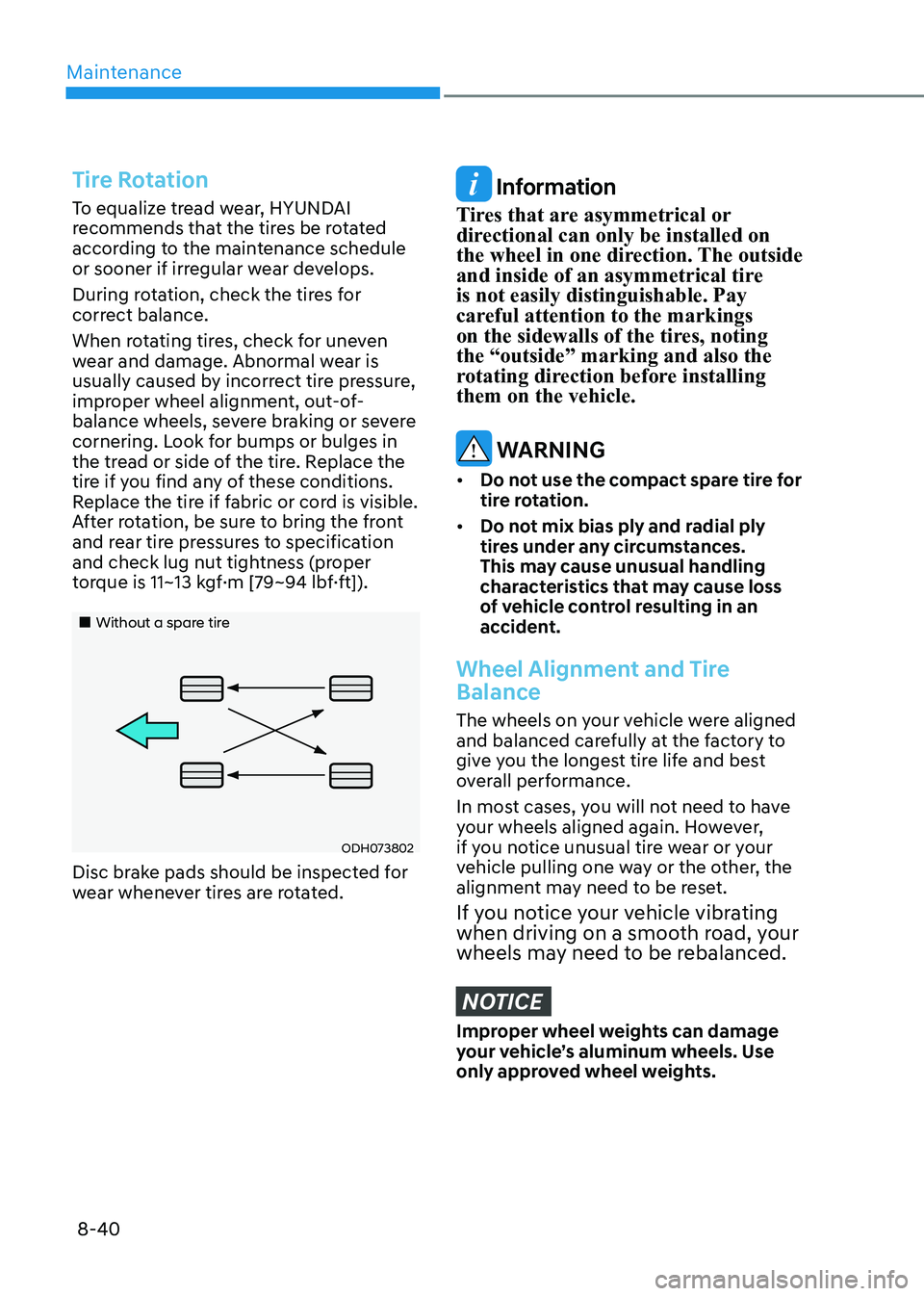
After rotation, be sure to bring the front
and rear tire pressures to specification
and check lug nut tightness (proper
torque is 11~13 kgf·m [79~94 lbf·ft]).
„„Without a spare tire
ODH073802
Disc brake pads should be inspected for
wear whenever tires are rotated.
Information
Tires that are asymmetrical or
directional can only be installed on
the wheel in one direction. The outside
and inside of an asymmetrical tire is not easily distinguishable. Pay
careful attention to the markings
on the sidewalls of the tires, noting the “outside” marking and also the
rotating direction before installing them on the vehicle.
WARNING
• Do not use the compact spare tire for
tire rotation.
• Do not mix bias ply and radial ply
tires under any circumstances.
This may cause unusual handling
characteristics that may cause loss
of vehicle control resulting in an
accident.
Wheel Alignment and Tire
Balance
The wheels on your vehicle were aligned
and balanced carefully at the factory to
give you the longest tire life and best
overall performance.
In most cases, you will not need to have
your wheels aligned again. However,
if you notice unusual tire wear or your
vehicle pulling one way or the other, the
alignment may need to be reset.
If you notice your vehicle vibrating
when driving on a smooth road, your
wheels may need to be rebalanced.
NOTICE
Improper wheel weights can damage
your vehicle’s aluminum wheels. Use
only approved wheel weights.
Page 540 of 555
Maintenance
8-70
Cleaning the seat belt webbing
Clean the belt webbing with any
mild soap solution recommended for
cleaning upholstery or carpet. Follow
the instructions provided with the soap.
Do not bleach or re-dye the webbing
because this may weaken the seat belt.
Cleaning the interior window glass
If the interior glass surfaces of the
vehicle become hazy (that is, covered
with an oily, greasy or waxy film), they
should be cleaned with glass cleaner.
Follow the directions on the glass cleaner
container.
NOTICE
Do not scrape or scratch the inside of
the rear window. This may result in
damage to the rear window defroster grid.
EmiSSion ControL
SyStEm
The emission control system of your
vehicle is covered by a written limited
warranty. Please see the warranty
information contained in the Service
Passport in your vehicle.
Your vehicle is equipped with an
emission control system to meet all
applicable emission regulations. There
are three emission control systems, as
follows.
(1) Crankcase emission control system
(2) Evaporative emission control system
(3) Exhaust emission control system
In order to ensure the proper function
of the emission control systems, it
is recommended that you have your
vehicle inspected and maintained
by an authorized HYUNDAI dealer in
accordance with the maintenance schedule in this manual.
NOTICE
For the Inspection and Maintenance
Test (with Electronic Stability Control
(ESC) system) • To prevent the vehicle from misfiring
during dynamometer testing, turn
the Electronic Stability Control
(ESC) system off by pressing the ESC
switch (ESC OFF light illuminated).
• After dynamometer testing is
completed, turn the ESC system back
on by pressing the ESC switch again.
Page 547 of 555
I
I-5
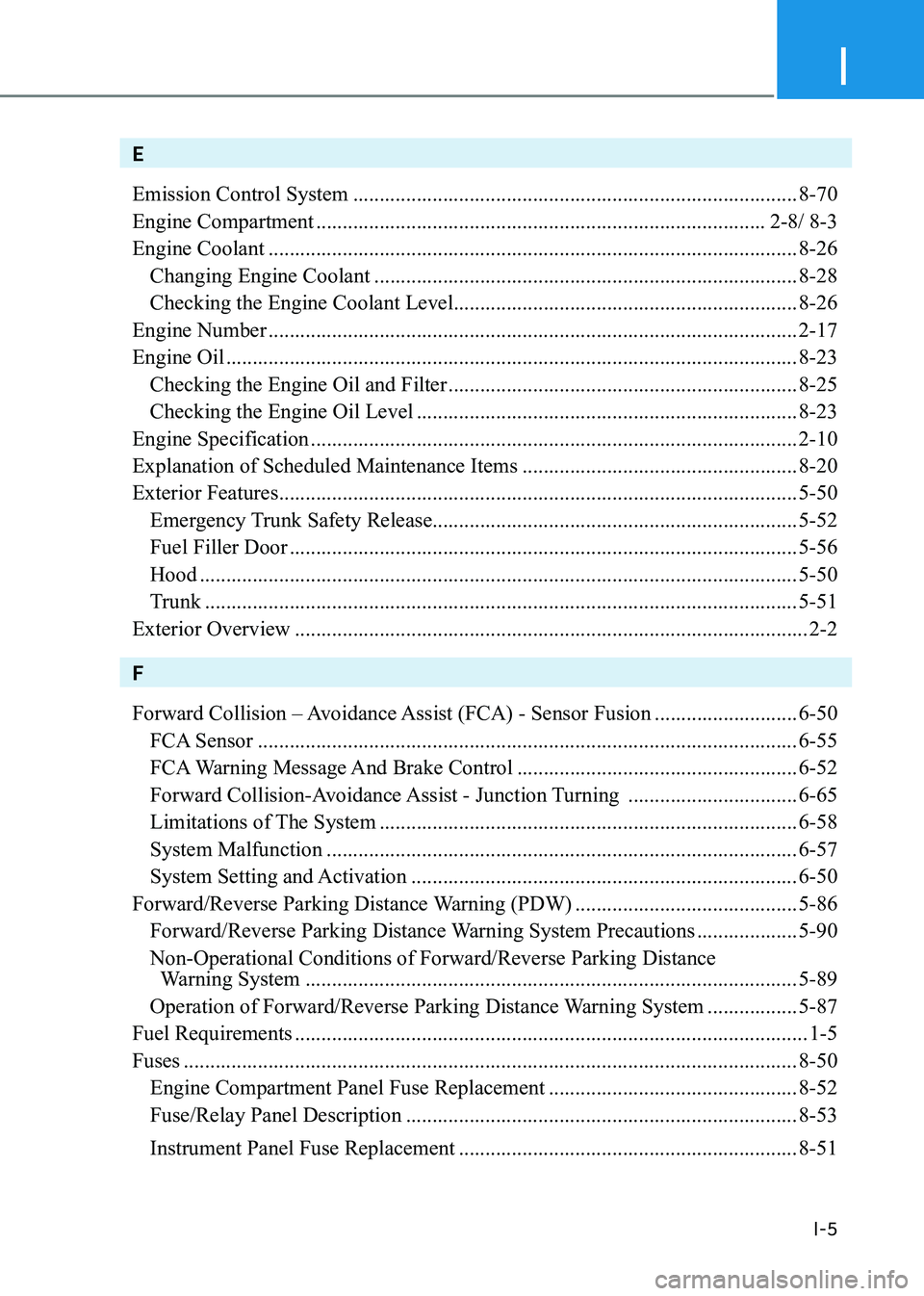
E Emission Control System .................................................................................... 8-70
Engine Compartment ..................................................................................... 2-8/ 8-3
Engine Coolant .................................................................................................... 8-26
Changing Engine Coolant ................................................................................ 8-28
Checking the Engine Coolant Level ................................................................. 8-26
Engine Number .................................................................................................... 2-17
Engine Oil ............................................................................................................ 8-23
Checking the Engine Oil and Filter .................................................................. 8-25
Checking the Engine Oil Level ........................................................................ 8-23
Engine Specification ............................................................................................ 2-10
Explanation of Scheduled Maintenance Items ....................................................8-20
Exterior Features .................................................................................................. 5-50
Emergency Trunk Safety Release..................................................................... 5-52
Fuel Filler Door ................................................................................................ 5-56
Hood ................................................................................................................. 5-50
Trunk ................................................................................................................ 5-51
Exterior Overview ................................................................................................. 2-2
F
Forward Collision – Avoidance Assist (FCA) - Sensor Fusion ...........................6-50
FCA Sensor ...................................................................................................... 6-55
FCA Warning Message And Brake Control .....................................................6-52
Forward Collision-Avoidance Assist - Junction Turning ................................6-65
Limitations of The System ............................................................................... 6-58
System Malfunction ......................................................................................... 6-57
System Setting and Activation ......................................................................... 6-50
Forward/Reverse Parking Distance Warning (PDW) ..........................................5-86
Forward/Reverse Parking Distance Warning System Precautions ...................5-90
Non-Operational Conditions of Forward/Reverse Parking Distance
Warning System ............................................................................................. 5-89
Operation of Forward/Reverse Parking Distance Warning System .................5-87
Fuel Requirements ................................................................................................. 1-5
Fuses .................................................................................................................... 8-50
Engine Compartment Panel Fuse Replacement ...............................................8-52
Fuse/Relay Panel Description .......................................................................... 8-53
Instrument Panel Fuse Replacement ................................................................ 8-51
Page 551 of 555
I
I-9
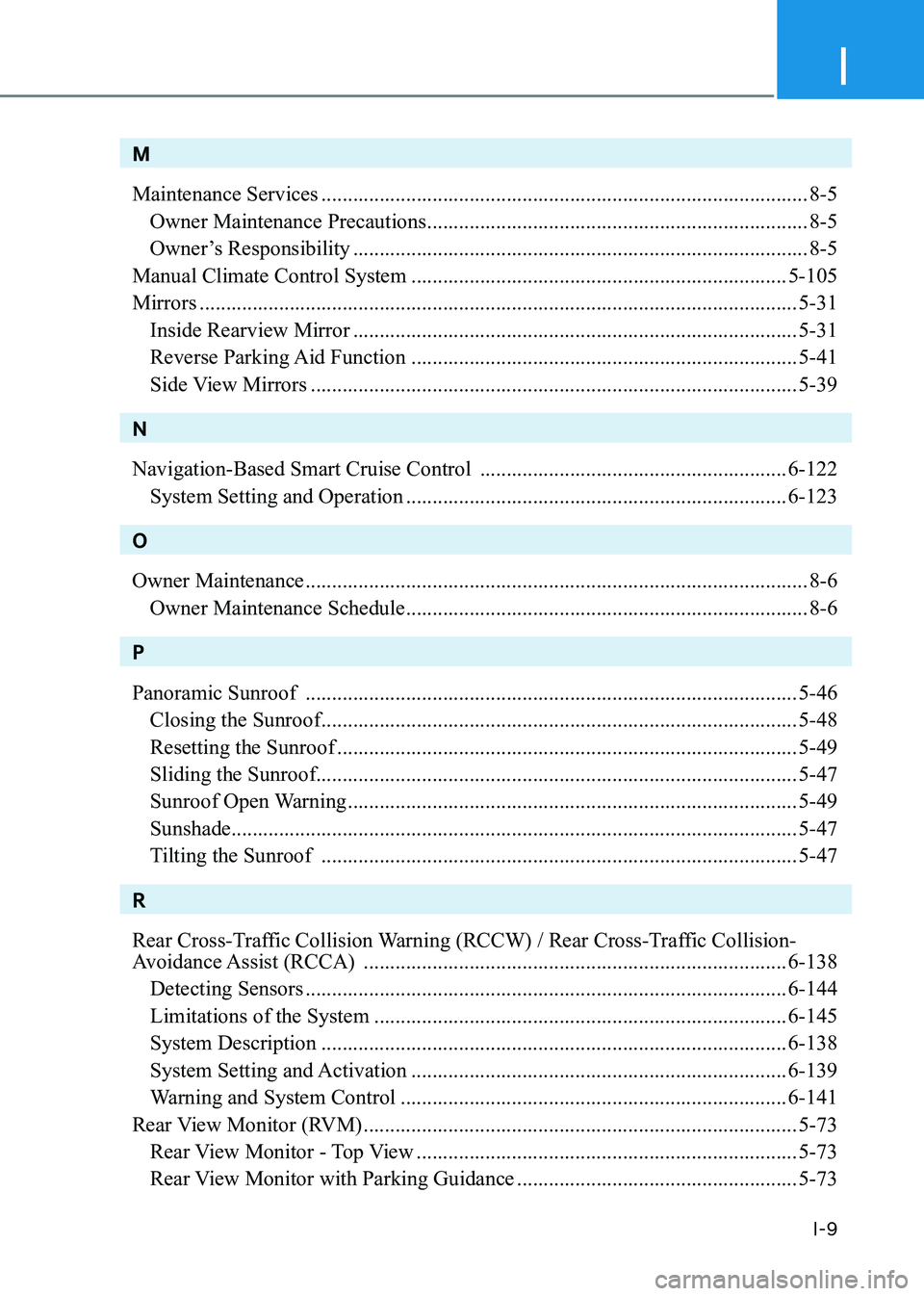
M Maintenance Services ............................................................................................ 8-5
Owner Maintenance Precautions ........................................................................ 8-5
Owner’s Responsibility ...................................................................................... 8-5
Manual Climate Control System ....................................................................... 5-105
Mirrors ................................................................................................................. 5-31
Inside Rearview Mirror .................................................................................... 5-31
Reverse Parking Aid Function ......................................................................... 5-41
Side View Mirrors ............................................................................................ 5-39
NNavigation-Based Smart Cruise Control ..........................................................6-122
System Setting and Operation ........................................................................ 6-123
OOwner Maintenance ............................................................................................... 8-6
Owner Maintenance Schedule ............................................................................ 8-6
PPanoramic Sunroof ............................................................................................. 5-46
Closing the Sunroof .......................................................................................... 5-48
Resetting the Sunroof ....................................................................................... 5-49
Sliding the Sunroof........................................................................................... 5-47
Sunroof Open Warning ..................................................................................... 5-49
Sunshade ........................................................................................................... 5-47
Tilting the Sunroof .......................................................................................... 5-47
R
Rear Cross-Traffic Collision Warning (RCCW) / Rear Cross-Traffic Collision-
Avoidance Assist (RCCA) ................................................................................ 6-138
Detecting Sensors ........................................................................................... 6-144
Limitations of the System .............................................................................. 6-145
System Description ........................................................................................ 6-138
System Setting and Activation ....................................................................... 6-139
Warning and System Control ......................................................................... 6-141
Rear View Monitor (RVM) .................................................................................. 5-73
Rear View Monitor - Top View ........................................................................ 5-73
Rear View Monitor with Parking Guidance .....................................................5-73