warning Hyundai Sonata
[x] Cancel search | Manufacturer: HYUNDAI, Model Year: , Model line: , Model:Pages: 276, PDF Size: 12.9 MB
Page 247 of 276
7
EMISSION CONTROL SYSTEMS
3
!
!
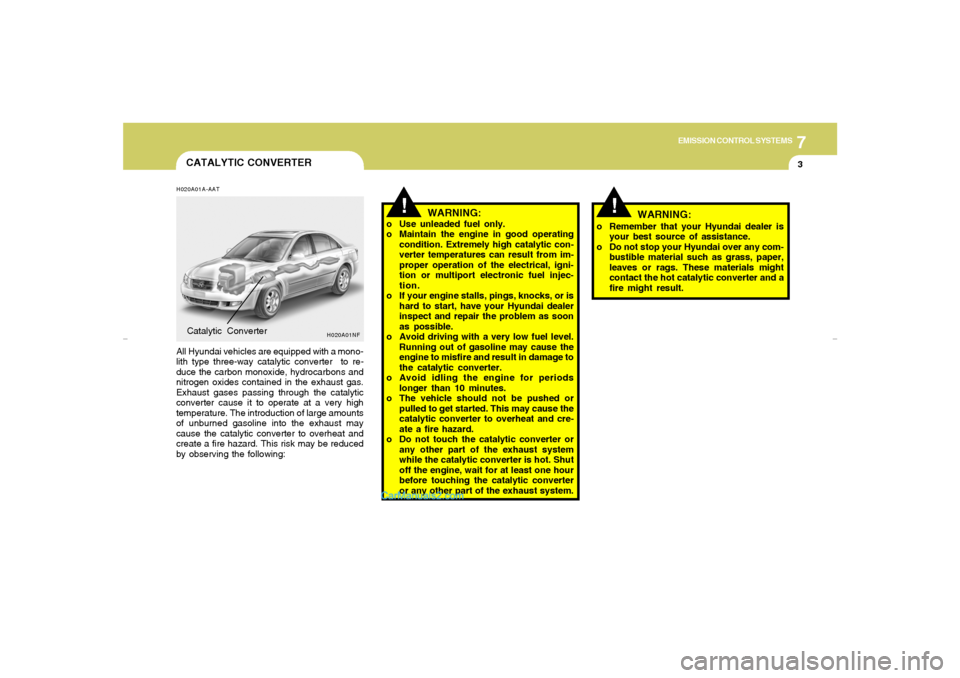
CATALYTIC CONVERTERH020A01A-AATAll Hyundai vehicles are equipped with a mono-
lith type three-way catalytic converter to re-
duce the carbon monoxide, hydrocarbons and
nitrogen oxides contained in the exhaust gas.
Exhaust gases passing through the catalytic
converter cause it to operate at a very high
temperature. The introduction of large amounts
of unburned gasoline into the exhaust may
cause the catalytic converter to overheat and
create a fire hazard. This risk may be reduced
by observing the following:Catalytic Converter
WARNING:
o Use unleaded fuel only.
o Maintain the engine in good operating
condition. Extremely high catalytic con-
verter temperatures can result from im-
proper operation of the electrical, igni-
tion or multiport electronic fuel injec-
tion.
o If your engine stalls, pings, knocks, or is
hard to start, have your Hyundai dealer
inspect and repair the problem as soon
as possible.
o Avoid driving with a very low fuel level.
Running out of gasoline may cause the
engine to misfire and result in damage to
the catalytic converter.
o Avoid idling the engine for periods
longer than 10 minutes.
o The vehicle should not be pushed or
pulled to get started. This may cause the
catalytic converter to overheat and cre-
ate a fire hazard.
o Do not touch the catalytic converter or
any other part of the exhaust system
while the catalytic converter is hot. Shut
off the engine, wait for at least one hour
before touching the catalytic converter
or any other part of the exhaust system.
H020A01NF
o Remember that your Hyundai dealer is
your best source of assistance.
o Do not stop your Hyundai over any com-
bustible material such as grass, paper,
leaves or rags. These materials might
contact the hot catalytic converter and a
fire might result.
WARNING:
nfhma-7.p653/9/2005, 10:29 AM 3
Page 250 of 276
8
CONSUMER INFORMATION, REPORTING SAFETY DEFECTS & BINDING ARBITRATION OF WARRANTY CLAIMS
3
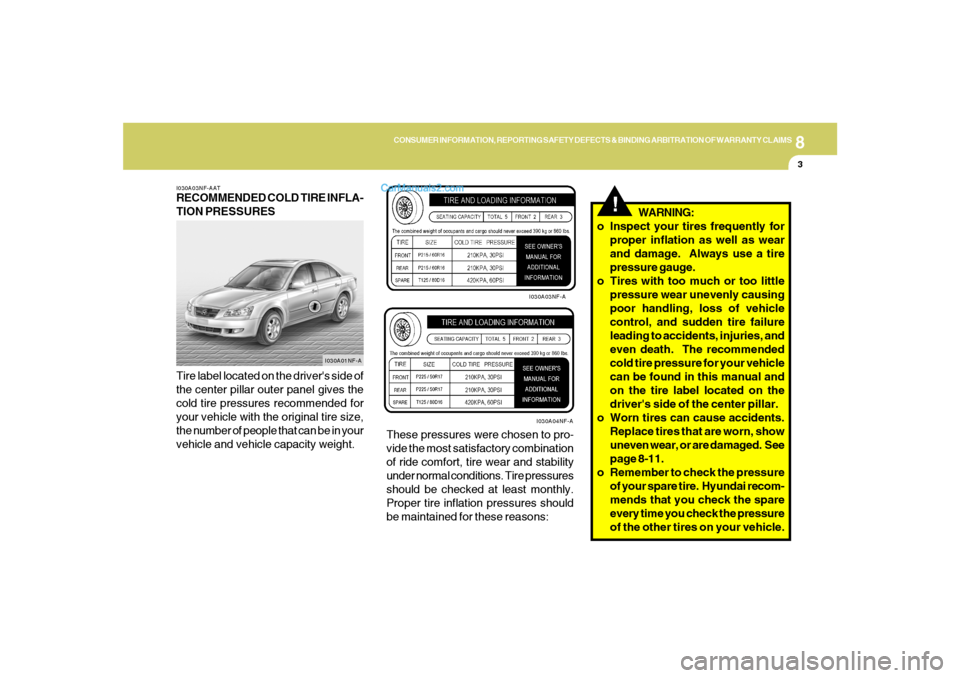
I030A03NF-AATRECOMMENDED COLD TIRE INFLA-
TION PRESSURES
Tire label located on the driver's side of
the center pillar outer panel gives the
cold tire pressures recommended for
your vehicle with the original tire size,
the number of people that can be in your
vehicle and vehicle capacity weight.These pressures were chosen to pro-
vide the most satisfactory combination
of ride comfort, tire wear and stability
under normal conditions. Tire pressures
should be checked at least monthly.
Proper tire inflation pressures should
be maintained for these reasons:
I030A01NF-AI030A03NF-A
I030A04NF-A
!
WARNING:
o Inspect your tires frequently for
proper inflation as well as wear
and damage. Always use a tire
pressure gauge.
o Tires with too much or too little
pressure wear unevenly causing
poor handling, loss of vehicle
control, and sudden tire failure
leading to accidents, injuries, and
even death. The recommended
cold tire pressure for your vehicle
can be found in this manual and
on the tire label located on the
driver's side of the center pillar.
o Worn tires can cause accidents.
Replace tires that are worn, show
uneven wear, or are damaged. See
page 8-11.
o Remember to check the pressure
of your spare tire. Hyundai recom-
mends that you check the spare
every time you check the pressure
of the other tires on your vehicle.
Page 251 of 276
8
CONSUMER INFORMATION, REPORTING SAFETY DEFECTS & BINDING ARBITRATION OF WARRANTY CLAIMS4
!
I035A01JM-AATCHECKING TIRE INFLATION PRES-
SURE
Check your tires once a month or more.
Also, check the tire pressure of the
spare tire.
How to Check
Use a good quality gauge to check tire
pressure. You cannot tell if your tires
are properly inflated simply by looking
at them. Radial tires may look properly
inflated even when they're underinflated.
Check the tire's inflation pressure when
the tires are cold. - "Cold" means your
vehicle has been sitting for at least
three hours or driven no more than 1
mile (1.6 km). CAUTION:
Always observe the following:
o Check pressures when the tires
are cold. (After the vehicle has
been parked for at least three hours
or hasn't been driven more than 1
mile (1.6 km) since starting up.)
o Check the pressure of your spare
tire each time you check the pres-
sure of other tires.
o Worn, old tires can cause acci-
dents. If your tread is badly worn,
or if your tires have been dam-
aged, replace them.
!
NOTE:
o Underinflation also results in ex-
cessive wear, poor handling and
reduced fuel economy. Wheel de-
formation also is possible. Keep
your tire pressures at the proper
levels. If a tire frequently needs
refilling, have it checked by your
Hyundai Dealer.
o Overinflation produces a harsh
ride, excessive wear at the center
of the tire tread, and a greater
possibility of damage from road
hazards.
WARNING:
Overinflation or underinflation can
reduce the tire life, adversely affect
vehicle handling, and lead to sud-
den tire failure. This could rusult in
loss of vehicle control and potential
injury.
Page 257 of 276
8
CONSUMER INFORMATION, REPORTING SAFETY DEFECTS & BINDING ARBITRATION OF WARRANTY CLAIMS
10
I070A01A-AATTIRE BALANCING
A tire that is out of balance may affect
handling and tire wear. The tires on your
Hyundai were balanced before the car
was delivered but may need balancing
again during the years you own the car.
Whenever a tire is dismounted for re-
pair, it should be rebalanced before
being reinstalled on the car.
!
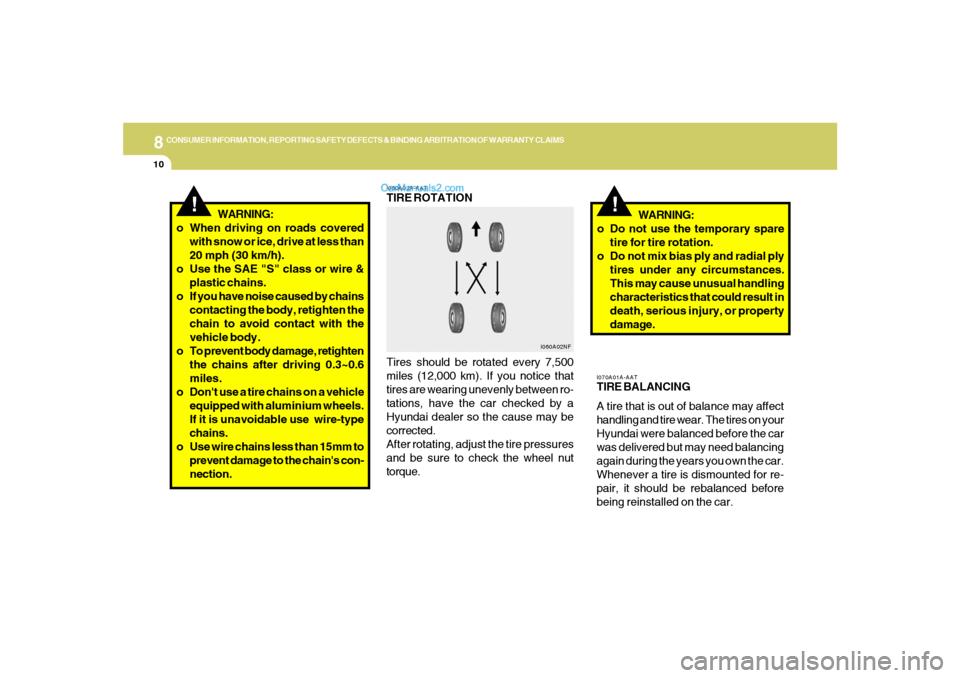
I060A02A-AATTIRE ROTATION
Tires should be rotated every 7,500
miles (12,000 km). If you notice that
tires are wearing unevenly between ro-
tations, have the car checked by a
Hyundai dealer so the cause may be
corrected.
After rotating, adjust the tire pressures
and be sure to check the wheel nut
torque.WARNING:
o Do not use the temporary spare
tire for tire rotation.
o Do not mix bias ply and radial ply
tires under any circumstances.
This may cause unusual handling
characteristics that could result in
death, serious injury, or property
damage.
I060A02NF
!
WARNING:
o When driving on roads covered
with snow or ice, drive at less than
20 mph (30 km/h).
o Use the SAE "S" class or wire &
plastic chains.
o If you have noise caused by chains
contacting the body, retighten the
chain to avoid contact with the
vehicle body.
o To prevent body damage, retighten
the chains after driving 0.3~0.6
miles.
o Don't use a tire chains on a vehicle
equipped with aluminium wheels.
If it is unavoidable use wire-type
chains.
o Use wire chains less than 15mm to
prevent damage to the chain's con-
nection.
Page 258 of 276
8
CONSUMER INFORMATION, REPORTING SAFETY DEFECTS & BINDING ARBITRATION OF WARRANTY CLAIMS
11
!
WARNING:
To reduce the chance or serious or
fatal injuries from an accident caused
by tire failure or loss of vehicle con-
trol:
o Replace tires that are worn, show
uneven wear, or are damaged.
Worn tires can cause loss of brak-
ing effectiveness, steering con-
trol, and traction.
o Do not drive your vehicle with too
little or too much pressure in your
tires. This can lead to uneven
wear and tire failure.
o When replacing tires, never mix
radial and bias-ply tires on the
same car. You must replace all
tires (including the spare) if mov-
ing from radial to bias-ply tires.
HNF5015 I090A03JM-AAT
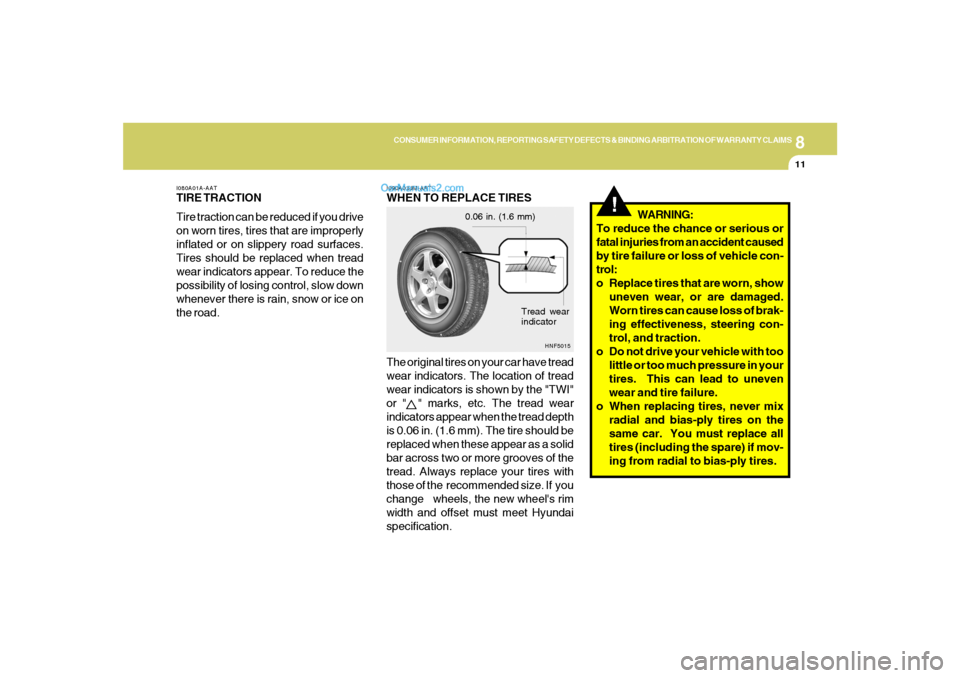
WHEN TO REPLACE TIRES
The original tires on your car have tread
wear indicators. The location of tread
wear indicators is shown by the "TWI"
or " " marks, etc. The tread wear
indicators appear when the tread depth
is 0.06 in. (1.6 mm). The tire should be
replaced when these appear as a solid
bar across two or more grooves of the
tread. Always replace your tires with
those of the recommended size. If you
change wheels, the new wheel's rim
width and offset must meet Hyundai
specification.
Tread wear
indicator 0.06 in. (1.6 mm)
I080A01A-AATTIRE TRACTION
Tire traction can be reduced if you drive
on worn tires, tires that are improperly
inflated or on slippery road surfaces.
Tires should be replaced when tread
wear indicators appear. To reduce the
possibility of losing control, slow down
whenever there is rain, snow or ice on
the road.
Page 259 of 276
8
CONSUMER INFORMATION, REPORTING SAFETY DEFECTS & BINDING ARBITRATION OF WARRANTY CLAIMS
12
!
!
I090B02JM-AATTIRE MAINTENANCE
In addition to proper inflation, correct
wheel alignment helps to decrease tire
wear. If you find a tire is worn unevenly,
have your dealer check the wheel align-
ment.
When you have new tires installed,
make sure they are balanced. This will
increase vehicle ride comfort and tire
life. Additionally, a tire shoud always be
rebalanced if it is removed from the
wheel. o Using tires and wheel other than
the recommended sizes could
cause unusual handling charac-
teristics and poor vehicle control,
resulting in a serious accident.
o Wheels that do not meet Hyundai's
specifications may fit poorly and
result in damage to the vehicle or
unusual handling and poor ve-
hicle control.WARNING: WARNING:
o Underinflated or overinflated tires
can cause poor handling, loss of
vehicle control, and sudden tire
failure leading to accidents, inju-
ries, and even death. Always check
tires are properly inflated before
driving. Refer to pages 2-22 and 8-
3 for proper tire pressures and
further information.
o Driving on tires with no or insuffi-
cient tread is dangerous. Worn-
out tires can result in loss of ve-
hicle control, collisions, and in-
jury and even death. Worn-out
tires should be replaced as soon
as possible and should never be
used for driving. Always check
tire tread before driving your car.
Refer to this page for further infor-
mation and tread limits.
Page 261 of 276
8
CONSUMER INFORMATION, REPORTING SAFETY DEFECTS & BINDING ARBITRATION OF WARRANTY CLAIMS
14
Traction AA, A, B, C - The traction
grades, from highest to lowest, are AA,
A, B, and C. Those grades represent
the tire's ability to stop on wet pave-
ment as measured under controlled
conditions on specified government test
surfaces of asphalt and concrete. A tire
marked C may have poor traction per-
formance.
!
WARNING:
The traction grade assigned to this
tire is based on straight-ahead brak-
ing traction tests, and does not in-
clude acceleration, cornering, hy-
droplaning, or peak traction charac-
teristics.
CONSUMER INFORMATIONI130A01A-AATThis consumer information has been prepared
in accordance with regulations issued by the
National Highway Traffic Safety Administration
of the U.S. Department of Transportation. It
provides the purchasers and/or prospective
purchasers of Hyundai automobiles with infor-
mation on uniform tire quality grading. Your
Hyundai dealer will help answer any questions
you may have as you read this information.
I130B04A-AATTire Quality Grading
Department of Transportation quality
grades - All passenger vehicle tires
must conform to Federal Safety Stan-
dards in addition to these grades. These
quality grades are molded on the
sidewall.
Treadwear - The treadwear grade is a
comparative rating based on the wear
rate of the tire when tested under con-
trolled conditions on a specified gov-
ernment test course. For example, a
tire graded 150 would wear one and a
half (1 - 1/2) times as well on the
government course as a tire graded
100. The relative performance of tires
depends upon the actual conditions of
their use, however, and may depart
significantly from the norm due to varia-
tions in driving habits, service prac-
tices and differences in road character-
istics and climate.
Page 262 of 276
8
CONSUMER INFORMATION, REPORTING SAFETY DEFECTS & BINDING ARBITRATION OF WARRANTY CLAIMS
15
Temperature A, B, C - The tempera-
ture grades are A (the highest), B, and
C, representing the tire's resistance to
the generation of heat and its ability to
dissipate heat when tested under con-
trolled conditions on a specified indoor
laboratory test wheel. Sustained high
temperature can cause the material of
the tire to degenerate and reduce tire
life, and excessive temperature can
lead to sudden tire failure. The grade C
corresponds to a level of performance
which all passenger car tires must meet
under the Federal Motor Vehicle Safety
Standard No. 109. Grades B and A
represent higher levels of performance
on the laboratory test wheel than the
minimum required by law.
!
WARNING:
The temperature grade for this tire is
established for a tire that is properly
inflated and not overloaded. Exces-
sive speed, underinflation, or exces-
sive loading, either separately or in
combination, can cause heat buildup
and possible tire failure.
Uniform Tire Quality Grading - Qual-
ity grades can be found on the tire
sidewall between the tread shoulder
and the maximum section width.
For example :
Treadwear 200 Traction AA Tempera-
ture A
I130D04A-AATHyundai motor vehicles are designed and manu-
factured to meet or exceed all applicable safety
standards.
For your safety, however, we strongly urge you
to read and follow all directions in this Owner's
Manual, particularly the information under the
headings "NOTE", "CAUTION" and "WARN-
ING".
If, after reading this manual, you have any
questions regarding the operation of your ve-
hicle, please contact your nearest Hyundai
Motor America Regional Office as listed below:
Eastern Region : Connecticut, Delaware,
Maine, Maryland, Massachusetts, New Hamp-
shire, New Jersey, New York, Pennsylvanina,
Rhode Island, Vermont, Virginia, West Virginia.
Eastern Region
1100 Cranbury South River Road
Jamesburg, NJ 08831
(800) 633-5151
Page 271 of 276
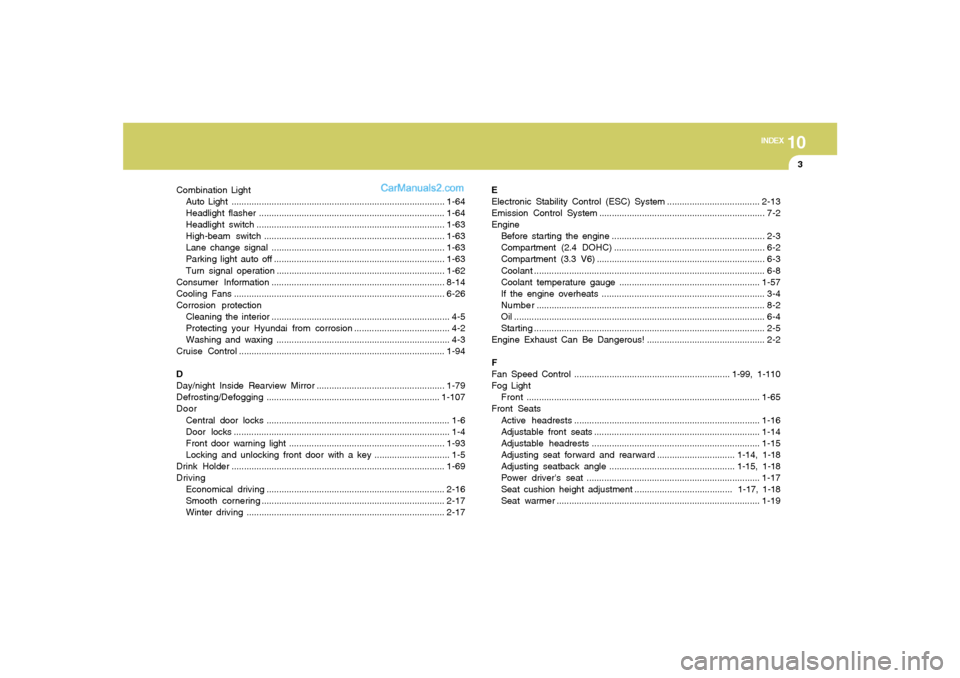
10
INDEX
3
Combination Light
Auto Light .....................................................................................1-64
Headlight flasher..........................................................................1-64
Headlight switch...........................................................................1-63
High-beam switch........................................................................1-63
Lane change signal.....................................................................1-63
Parking light auto off ....................................................................1-63
Turn signal operation...................................................................1-62
Consumer Information .....................................................................8-14
Cooling Fans....................................................................................6-26
Corrosion protection
Cleaning the interior....................................................................... 4-5
Protecting your Hyundai from corrosion ...................................... 4-2
Washing and waxing ..................................................................... 4-3
Cruise Control..................................................................................1-94
D
Day/night Inside Rearview Mirror ...................................................1-79
Defrosting/Defogging.....................................................................1-107
Door
Central door locks......................................................................... 1-6
Door locks ...................................................................................... 1-4
Front door warning light ..............................................................1-93
Locking and unlocking front door with a key.............................. 1-5
Drink Holder.....................................................................................1-69
Driving
Economical driving.......................................................................2-16
Smooth cornering.........................................................................2-17
Winter driving...............................................................................2-17E
Electronic Stability Control (ESC) System.....................................2-13
Emission Control System.................................................................. 7-2
Engine
Before starting the engine ............................................................. 2-3
Compartment (2.4 DOHC) ............................................................ 6-2
Compartment (3.3 V6)................................................................... 6-3
Coolant............................................................................................ 6-8
Coolant temperature gauge ........................................................1-57
If the engine overheats ................................................................. 3-4
Number........................................................................................... 8-2
Oil .................................................................................................... 6-4
Starting............................................................................................ 2-5
Engine Exhaust Can Be Dangerous!............................................... 2-2
F
Fan Speed Control.............................................................. 1-99, 1-110
Fog Light
Front
.............................................................................................1-65
Front Seats
Active headrests ..........................................................................1-16
Adjustable front seats ..................................................................1-14
Adjustable headrests...................................................................1-15
Adjusting seat forward and rearward............................... 1-14, 1-18
Adjusting seatback angle.................................................. 1-15, 1-18
Power driver's seat .....................................................................1-17
Seat cushion height adjustment....................................... 1-17, 1-18
Seat warmer.................................................................................1-19
Page 272 of 276
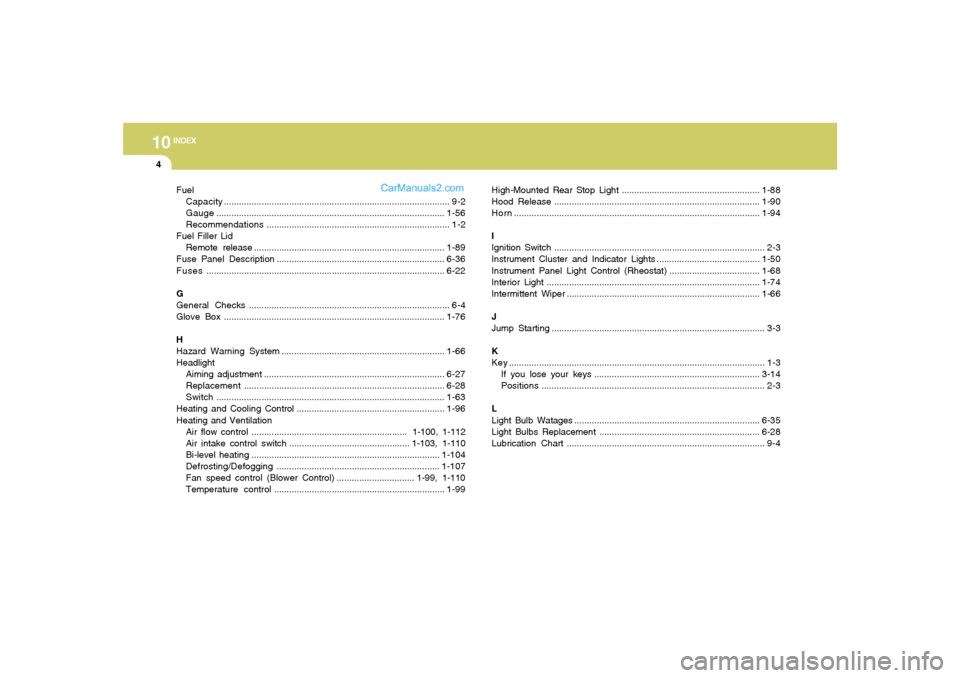
10
INDEX
4
Fuel
Capacity.......................................................................................... 9-2
Gauge...........................................................................................1-56
Recommendations......................................................................... 1-2
Fuel Filler Lid
Remote release............................................................................1-89
Fuse Panel Description...................................................................6-36
Fuses ...............................................................................................6-22
G
General Checks................................................................................ 6-4
Glove Box........................................................................................1-76
H
Hazard Warning System .................................................................1-66
Headlight
Aiming adjustment........................................................................6-27
Replacement................................................................................6-28
Switch...........................................................................................1-63
Heating and Cooling Control ...........................................................1-96
Heating and Ventilation
Air flow control.............................................................. 1-100, 1-112
Air intake control switch................................................ 1-103, 1-110
Bi-level heating...........................................................................1-104
Defrosting/Defogging.................................................................1-107
Fan speed control (Blower Control) ............................... 1-99, 1-110
Temperature control....................................................................1-99High-Mounted Rear Stop Light .......................................................1-88
Hood Release..................................................................................1-90
Horn..................................................................................................1-94
I
Ignition Switch.................................................................................... 2-3
Instrument Cluster and Indicator Lights .........................................1-50
Instrument Panel Light Control (Rheostat)....................................1-68
Interior Light.....................................................................................1-74
Intermittent Wiper.............................................................................1-66
J
Jump Starting..................................................................................... 3-3
K
Key ...................................................................................................... 1-3
If you lose your keys ..................................................................3-14
Positions......................................................................................... 2-3
L
Light Bulb Watages..........................................................................6-35
Light Bulbs Replacement................................................................
6-28
Lubrication Chart............................................................................... 9-4