seats Hyundai Sonata
[x] Cancel search | Manufacturer: HYUNDAI, Model Year: , Model line: , Model:Pages: 276, PDF Size: 12.9 MB
Page 47 of 276
1
FEATURES OF YOUR HYUNDAI
33
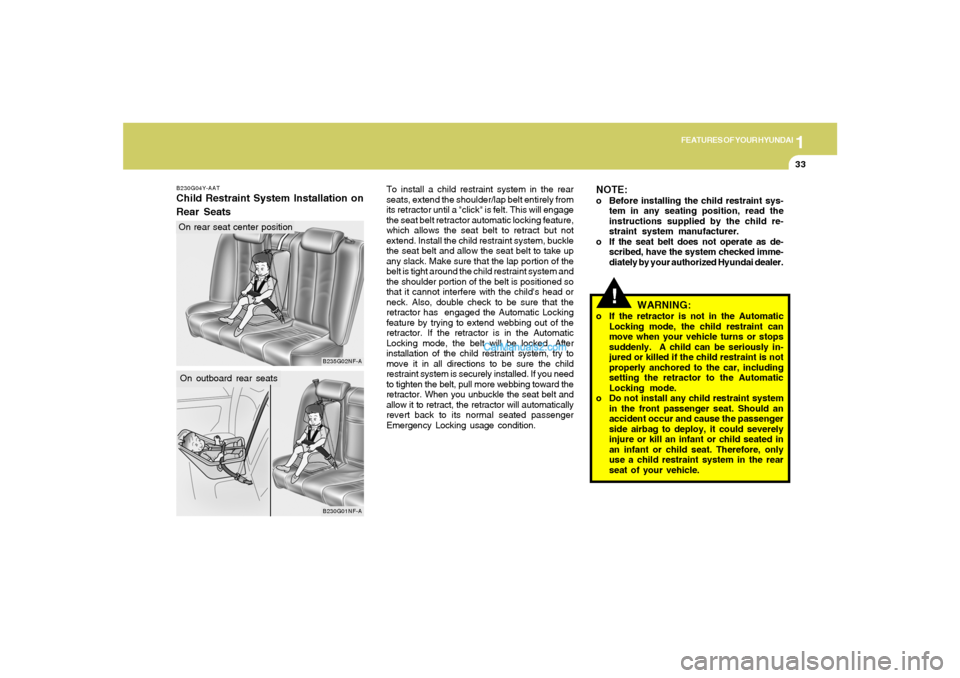
B230G04Y-AATChild Restraint System Installation on
Rear Seats
B230G01NF-A
On outboard rear seats
B235G02NF-A
On rear seat center positionTo install a child restraint system in the rear
seats, extend the shoulder/lap belt entirely from
its retractor until a "click" is felt. This will engage
the seat belt retractor automatic locking feature,
which allows the seat belt to retract but not
extend. Install the child restraint system, buckle
the seat belt and allow the seat belt to take up
any slack. Make sure that the lap portion of the
belt is tight around the child restraint system and
the shoulder portion of the belt is positioned so
that it cannot interfere with the child's head or
neck. Also, double check to be sure that the
retractor has engaged the Automatic Locking
feature by trying to extend webbing out of the
retractor. If the retractor is in the Automatic
Locking mode, the belt will be locked. After
installation of the child restraint system, try to
move it in all directions to be sure the child
restraint system is securely installed. If you need
to tighten the belt, pull more webbing toward the
retractor. When you unbuckle the seat belt and
allow it to retract, the retractor will automatically
revert back to its normal seated passenger
Emergency Locking usage condition.
!
WARNING:
o If the retractor is not in the Automatic
Locking mode, the child restraint can
move when your vehicle turns or stops
suddenly. A child can be seriously in-
jured or killed if the child restraint is not
properly anchored to the car, including
setting the retractor to the Automatic
Locking mode.
o Do not install any child restraint system
in the front passenger seat. Should an
accident occur and cause the passenger
side airbag to deploy, it could severely
injure or kill an infant or child seated in
an infant or child seat. Therefore, only
use a child restraint system in the rear
seat of your vehicle.NOTE:o Before installing the child restraint sys-
tem in any seating position, read the
instructions supplied by the child re-
straint system manufacturer.
o If the seat belt does not operate as de-
scribed, have the system checked imme-
diately by your authorized Hyundai dealer.
Page 51 of 276
1
FEATURES OF YOUR HYUNDAI
37
B240A01NF
The SRS uses sensors to gather information
about the driver's and front passenger's seat
position, the driver's and front passenger's seat
belt usage and impact severity.
The driver's and front passenger's seat track
position sensors, which are installed on the seat
track, determine if the seats are fore or aft of a
reference position. The seat belt buckle sen-
sors determine if the driver and front passenger's
seat belts are fastened. These sensors provide
the ability to control the SRS deployment based
on how close the driver's seat is to the steering
wheel, how close the passenger's seat is to the
instrument panel, whether or not the seat belts
are fastened, and how severe the impact is.
The advanced SRS offers the ability to control
the airbag inflation with two levels. A first stage
level is provided for moderate-severity impacts.
A second stage level is provided for more
severe impacts.
According to the impact severity, seating posi-
tion and seat belt usage, the SRSCM(SRS
Control Module) controls the airbag inflation.
Failure to properly wear seat belts can increase
the risk or severity of injury in an accident.
CAUTION:
If a seat track position sensor or an occu-
pant classification system is not working
properly, the SRS airbag warning light on
the instrument panel will illuminate be-
cause the SRS airbag warning light is con-
nected with the seat track position sensor
and the occupant classification system. If
the SRS airbag warning light does not illu-
minate when the ignition key is turned to
the "ON" position, remains illuminated af-
ter approximately 6 seconds when the igni-
tion key is turned to the "ON" position, or
if it illuminates while the vehicle is being
driven, have an authorized Hyundai dealer
inspect the advanced SRS airbag system as
soon as possible.
!
AIR
BAG
Additionally, your Hyundai is equipped with an
occupant classification system in the front
passenger's seat. The occupant classification
system detects the presence of a passenger in
the front passenger's seat and will turn off the
front passenger's airbag under certain condi-
tions. For more detail, see "Occupant Classifi-
cation System" later in this section.
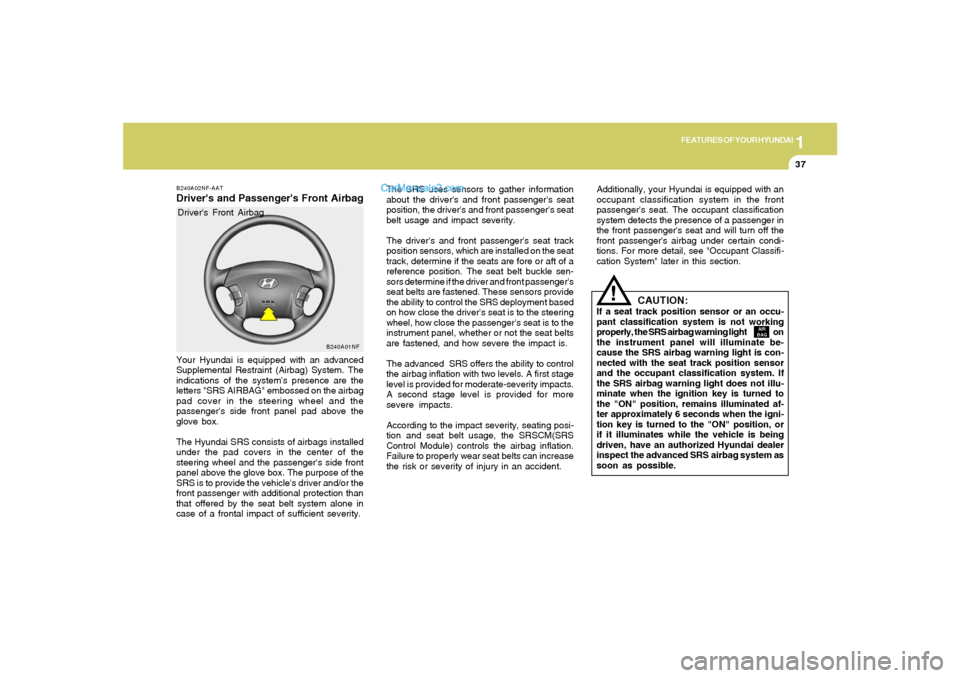
B240A02NF-AATDriver's and Passenger's Front AirbagYour Hyundai is equipped with an advanced
Supplemental Restraint (Airbag) System. The
indications of the system's presence are the
letters "SRS AIRBAG" embossed on the airbag
pad cover in the steering wheel and the
passenger's side front panel pad above the
glove box.
The Hyundai SRS consists of airbags installed
under the pad covers in the center of the
steering wheel and the passenger's side front
panel above the glove box. The purpose of the
SRS is to provide the vehicle's driver and/or the
front passenger with additional protection than
that offered by the seat belt system alone in
case of a frontal impact of sufficient severity.Driver's Front Airbag
Page 52 of 276
1FEATURES OF YOUR HYUNDAI38
!
!
WARNING:
Always use seat belts and child restraints –
every trip, every time, everyone! Airbags
inflate with considerable force and in the
blink of an eye. Seat belts help keep occu-
pants in proper position to obtain maxi-
mum benefit from the airbag. Even with
advanced airbags, improperly and unbelted
occupants can be severely injured when
the airbag inflates. Always follow the pre-
cautions about seat belts, airbags and oc-
cupant safety contained in this manual.
To reduce the chance of serious or fatal
injuries and receive the maximum safety
benefit from your restraint system:
o Never place a child in any child or booster
seat in the front seat (see child restraints
1-28).
o ABC – Always Buckle Children in the
back seat. It is the safest place for
children of any age to ride
o Front and side impact airbags can injure
occupants improperly positioned in the
front seats
o Move your seat as far back as practical
from the front airbags, while still main-
taining control of the vehicle.
o Never sit or lean unnecessarily close to
the front or side airbags
!
WARNING:
o Modification to the seat structure can
adversely affect the seat track position
sensor and cause the airbag to deploy at
a different level than should be pro-
vided.
o Do not place any objects underneath the
front seats as they could damage the
seat track position sensor or interfere
with the occupant classification sys-
tem.
o Do not place any objects that may cause
magnetic fields near the front seat. These
may cause a malfunction of the seat
track position sensor.NOTE:o Be sure to read information about the
SRS on the labels provided on the back-
side of the sun visor and in the glove box.
o Advanced airbags are combined with
pre-tensioner seat belts to help provide
enhanced occupant protection in fron-
tal crashes. Front airbags are not in-
tended to deploy in collisions in which
sufficient protection can be provided by
the pre-tensioner seat belt.
o If you are considering modification of
your vehicle due to a disability, please
contact the Hyundai Customer Assis-
tance Center at 1-800-633-5151.o Never lean against the door or center
console – always sit in an upright posi-
tion
o Do not allow a passenger to ride in the
front seat when the “Passenger Airbag
OFF” indicator is illuminated, because
the airbag will not deploy in the event of
a moderate or severe frontal crash.
o Never place objects over or near any
airbag module (front or side impact
airbags), because these objects can in-
jure passengers in a crash
o Never place covers, blankets or after-
market seat warmers on the passenger
seat as these may interfere with the
occupant classification system
o Do not tamper or disconnect SRS wiring
or other components. Injuries could
result from inadvertent deployment or
failure of the airbag to deploy in a crash.
o If the SRS airbag warning light (see pg 1-
52) remains illuminated while the vehicle
is being driven, have an authorized
Hyundai dealer inspect the airbag sys-
tem as soon as possible.
o Airbags can only be used once – have an
authorized Hyundai dealer replace the
airbag immediately after deployment.
WARNING:
Page 60 of 276
1FEATURES OF YOUR HYUNDAI46
!
WARNING:
o Do not modify or replace the front pas-
senger seat. Don't place anything on or
attach anything such as a blanket or
after market seat heater to the front
passenger seat. This can adversely af-
fect the occupant classification system.
o Do not sit on sharp objects such as tools
when occupying the front passenger
seat. This can adversely affect the occu-
pant classification system.
o Do not use accessory seat covers on the
front seats.
o Accident statistics show that children
are safer if they are restrained in the rear,
as opposed to the front seat. It is recom-
mended that child restraints be secured
in a rear seat, including an infant riding
in a rear-facing infant seat, a child riding
in a forward-facing child seat and an
older child riding in a booster seat.
o Airbags can only be used once – have an
authorized Hyundai dealer replace the
airbag immediately after deployment.
!
WARNING:
o A smaller-stature adult who is not seated
correctly (for example: seat excessively
reclined, leaning on the center console,
or hips shifted forward in the seat) can
cause a condition where the advanced
frontal airbag system senses less weight
than if the occupant were seated prop-
erly (sitting upright with the seatback in
an upright position, centered on the seat
cushion with their seat belt on, legs
comfortably extended and their feet on
the floor). This condition can result in an
adult potentially being misclassified and
illumination of the "PASSENGER AIR
BAG OFF" indicator.
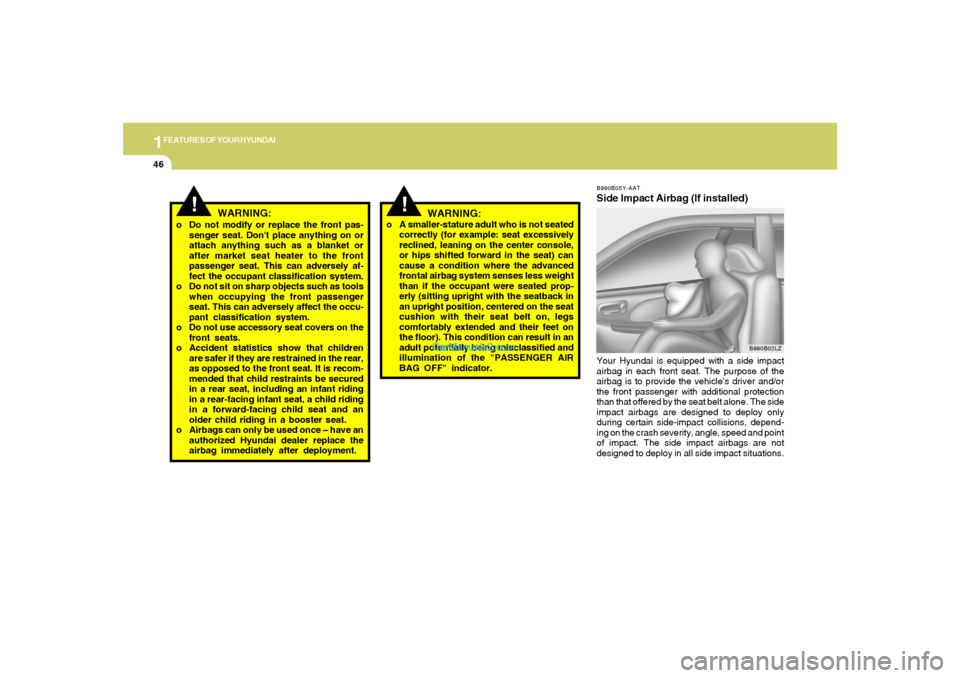
B990B05Y-AATSide Impact Airbag (If installed)Your Hyundai is equipped with a side impact
airbag in each front seat. The purpose of the
airbag is to provide the vehicle's driver and/or
the front passenger with additional protection
than that offered by the seat belt alone. The side
impact airbags are designed to deploy only
during certain side-impact collisions, depend-
ing on the crash severity, angle, speed and point
of impact. The side impact airbags are not
designed to deploy in all side impact situations.
B990B02LZ
Page 63 of 276
1
FEATURES OF YOUR HYUNDAI
49
B240D02NF-AATAdditional Safety PrecautionsoNever let passengers ride in the cargo
area (trunk) or on top of a folded-down
back seat. All occupants should sit upright,
fully back in their seats with their seat belts
on and their feet on the floor.
oPassengers should not move out of or
change seats while the vehicle is mov-
ing. A passenger who is not wearing a seat
belt during a crash or emergency stop can
be thrown against the inside of the vehicle,
against other occupants, or out of the ve-
hicle.
oEach seat belt is designed to restrain one
occupant. If more than one person uses the
same seat belt, they could be seriously
injured or killed in a collision.
oDo not use any accessories on seat
belts. Devices claiming to improve occu-
pant comfort or reposition the seat belt can
reduce the protection provided by the seat
belt and increase the chance of serious
injury in a crash.oPassengers should not place hard or
sharp objects between themselves and
the airbags. Carrying hard or sharp objects
on your lap or in your mouth can result in
injuries if an airbag inflates.
oKeep occupants away from the airbag
covers. All occupants should sit upright, fully
back in their seats with their seat belts on and
their feet on the floor. If occupants are too
close to the airbag covers, they could be
injured if the airbags inflate.
oDo not attach or place objects on or near
the airbag covers. Any object attached to
or placed on the front or side impact airbag
covers could interfere with the proper opera-
tion of the airbags.
oDo not modify the front seats. Modifica-
tion of the front seats could interfere with the
operation of the supplemental restraint sys-
tem sensing components or side impact
airbags.
oDo not place items under the front seats.
Placing items under the front seats could
interfere with the operation of the supple-
mental restraint system sensing compo-
nents and wiring harnesses.
!
WARNING:
o Sitting improperly or out of position can
cause occupants to be shifted too close
to a deploying airbag, strike the interior
structure or be thrown from the vehicle
resulting in serious injury or death.
o Always sit upright with the seatback in
an upright position, centered on the seat
cushion with your seat belt on, legs
comfortably extended and your feet on
the floor. oNever hold an infant or child on your lap.
The infant or child could be seriously injured
or killed in the event of a crash. All infants and
children should be properly restrained in
appropriate child safety seats or seat belts
in the rear seat.Adding Equipment to or Modifying Your
Airbag-Equipped Vehicle.If you modify your vehicle by changing your
vehicle's frame, bumper system, front end or
side sheet metal or ride height, this may affect
the operation of your vehicle's airbag system.
Page 85 of 276
1
FEATURES OF YOUR HYUNDAI
71
!SUNROOFB460A02Y-AAT(If Installed)
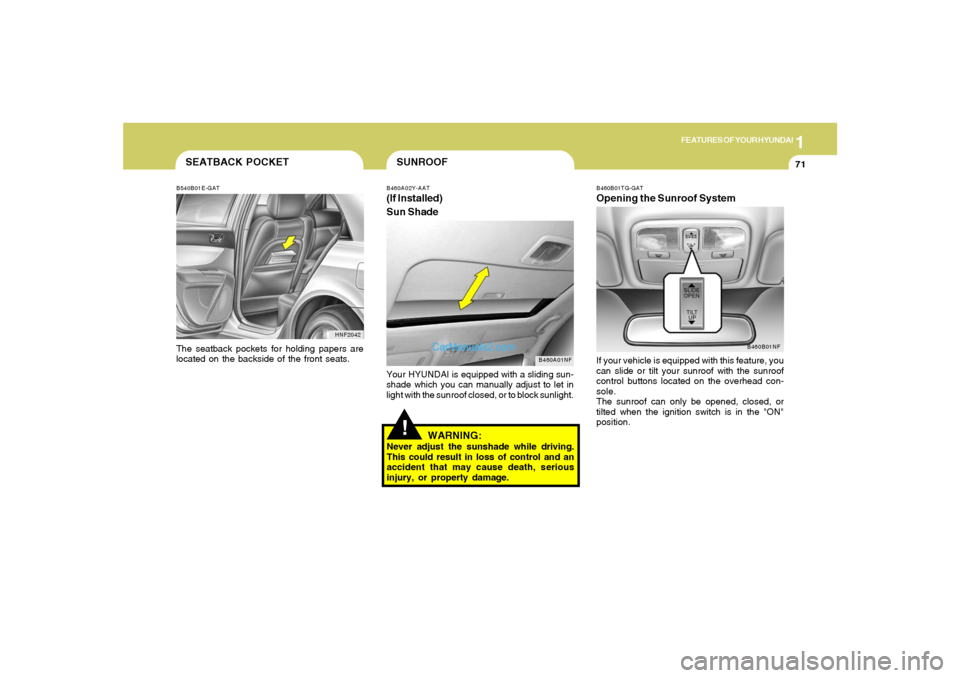
Sun Shade
B460A01NF
Your HYUNDAI is equipped with a sliding sun-
shade which you can manually adjust to let in
light with the sunroof closed, or to block sunlight.
WARNING:
Never adjust the sunshade while driving.
This could result in loss of control and an
accident that may cause death, serious
injury, or property damage.
B460B01TG-GATOpening the Sunroof SystemIf your vehicle is equipped with this feature, you
can slide or tilt your sunroof with the sunroof
control buttons located on the overhead con-
sole.
The sunroof can only be opened, closed, or
tilted when the ignition switch is in the "ON"
position.
B460B01NF
SEATBACK POCKETB540B01E-GAT
HNF2042The seatback pockets for holding papers are
located on the backside of the front seats.
Page 175 of 276
2
DRIVING YOUR HYUNDAI
28
!
WARNING:
Items you carry inside your vehicle
can strike and injure people in a
sudden stop or turn, or in a crash.
o Put things in the cargo area of
your vehicle. Try to spread the
weight evenly.
o Never stack items, like suitcases,
inside the vehicle above the tops
of the seats.
o Do not leave an unsecured child
restraint in your vehicle.
o When you carry something inside
the vehicle, secure it.
o Do not drive with a seat folded
down unless necessary. NOTE:
o Overloading your vehicle may
cause damage. Repairs would not
be covered by your warranty. Do
not overload your vehicle.
o Using heavier suspension com-
ponents to get added durability
might not change your weight rat-
ings. Ask your dealer to help you
load your vehicle the right way.
The label will help you decide how much
cargo and installed equipment your
vehicle can carry.
If you carry items inside your vehicle –
like suitcases, tools, packages, or any-
thing else – they move as fast as the
vehicle goes. If you have to stop or turn
quickly, or if there is a crash, the items
will keep going and can cause an injury
if they strike the driver or a passenger.
Page 254 of 276
8
CONSUMER INFORMATION, REPORTING SAFETY DEFECTS & BINDING ARBITRATION OF WARRANTY CLAIMS
7
I030D01JM-AATTIRE TERMINOLOGY AND DEFINI-
TIONS
Air Pressure: The amount of air inside
the tire pressing outward on the tire. Air
pressure is expressed in pounds per
square inch (psi) or kilopascal (kPa).
Accessory Weight: This means the
combined weight of optional accesso-
ries. Some examples of optional ac-
cessories are, automatic transmission,
power seats, and air conditioning.
Aspect Ratio: The relationship of a
tire's height to its width.
Belt: A rubber coated layer of cords that
is located between the plies and the
tread. Cords may be made from steel or
other reinforcing materials.
Bead: The tire bead contains steel
wires wrapped by steel cords that hold
the tire onto the rim.
Bias Ply Tire: A pneumatic tire in which
the plies are laid at alternate angles
less than 90 degrees to the centerline of
the tread.Cold Tire Pressure: The amount of air
pressure in a tire, measured in pounds
per square inch (psi) or kilopascals
(kPa) before a tire has built up heat from
driving.
Curb Weight: This means the weight of
a motor vehicle with standard and op-
tional equipment including the maxi-
mum capacity of fuel, oil and coolant,
but without passengers and cargo.
DOT Markings: A code molded into the
sidewall of a tire signifying that the tire
is in compliance with the U.S. Depart-
ment of Transportation motor vehicle
safety standards. The DOT code in-
cludes the Tire Identification Number
(TIN), an alphanumeric designator which
can also identify the tire manufacturer,
production plant, brand and date of
production.
GVWR: Gross Vehicle Weight Rating
GAWR FRT: Gross Axle Weight Rating
for the front Axle.
GAWR RR: Gross Axle Weight Rating
for the rear axle.Intended Outboard Sidewall: The side
of an asymmetrical tire, that must al-
ways face outward when mounted on a
vehicle.
Kilopascal (kPa): The metric unit for
air pressure.
Load Index: An assigned number rang-
ing from 1 to 279 that corresponds to
the load carrying capacity of a tire.
Maximum Inflation Pressure: The
maximum air pressure to which a cold
tire may be inflated. The maximum air
pressure is molded onto the sidewall.
Maximum Load Rating: The load rat-
ing for a tire at the maximum permis-
sible inflation pressure for that tire.
Maximum Loaded Vehicle Weight:
The sum of curb weight; accessory
weight; vehicle capacity weight; and
production options weight.
Normal Occupant Weight: The num-
ber of occupants a vehicle is designed
to seat multiplied by 150 pounds (68
kg).
Page 271 of 276
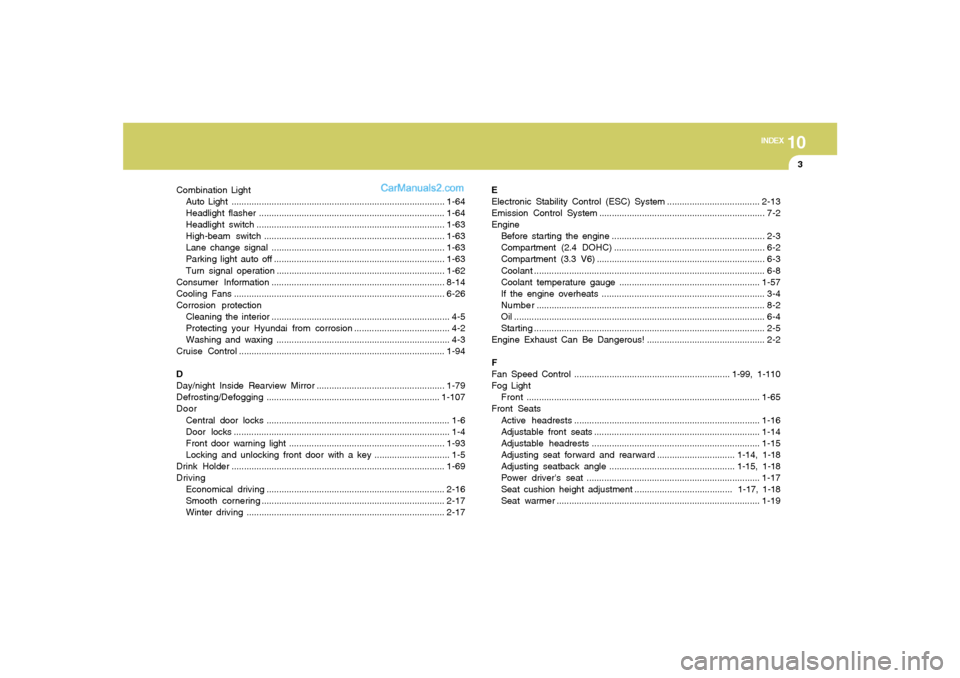
10
INDEX
3
Combination Light
Auto Light .....................................................................................1-64
Headlight flasher..........................................................................1-64
Headlight switch...........................................................................1-63
High-beam switch........................................................................1-63
Lane change signal.....................................................................1-63
Parking light auto off ....................................................................1-63
Turn signal operation...................................................................1-62
Consumer Information .....................................................................8-14
Cooling Fans....................................................................................6-26
Corrosion protection
Cleaning the interior....................................................................... 4-5
Protecting your Hyundai from corrosion ...................................... 4-2
Washing and waxing ..................................................................... 4-3
Cruise Control..................................................................................1-94
D
Day/night Inside Rearview Mirror ...................................................1-79
Defrosting/Defogging.....................................................................1-107
Door
Central door locks......................................................................... 1-6
Door locks ...................................................................................... 1-4
Front door warning light ..............................................................1-93
Locking and unlocking front door with a key.............................. 1-5
Drink Holder.....................................................................................1-69
Driving
Economical driving.......................................................................2-16
Smooth cornering.........................................................................2-17
Winter driving...............................................................................2-17E
Electronic Stability Control (ESC) System.....................................2-13
Emission Control System.................................................................. 7-2
Engine
Before starting the engine ............................................................. 2-3
Compartment (2.4 DOHC) ............................................................ 6-2
Compartment (3.3 V6)................................................................... 6-3
Coolant............................................................................................ 6-8
Coolant temperature gauge ........................................................1-57
If the engine overheats ................................................................. 3-4
Number........................................................................................... 8-2
Oil .................................................................................................... 6-4
Starting............................................................................................ 2-5
Engine Exhaust Can Be Dangerous!............................................... 2-2
F
Fan Speed Control.............................................................. 1-99, 1-110
Fog Light
Front
.............................................................................................1-65
Front Seats
Active headrests ..........................................................................1-16
Adjustable front seats ..................................................................1-14
Adjustable headrests...................................................................1-15
Adjusting seat forward and rearward............................... 1-14, 1-18
Adjusting seatback angle.................................................. 1-15, 1-18
Power driver's seat .....................................................................1-17
Seat cushion height adjustment....................................... 1-17, 1-18
Seat warmer.................................................................................1-19