flat tire Hyundai Sonata
[x] Cancel search | Manufacturer: HYUNDAI, Model Year: , Model line: , Model:Pages: 205, PDF Size: 19.98 MB
Page 138 of 205
3- 8 WHAT TO DO IN AN EMERGENCY
!
WARNING:Do not get under the car when it is sup-
ported by the jack! This is very dangerous
as the vehicle could fall and cause serious
injury or death. No one should stay in the
car while the jack is being used.
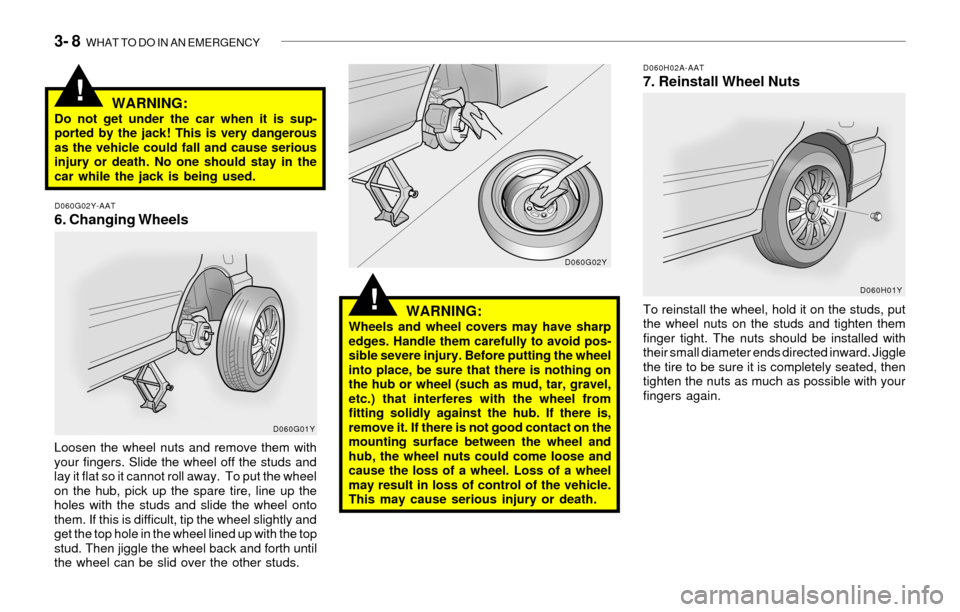
D060G02Y-AAT6. Changing Wheels
D060H02A-AAT7. Reinstall Wheel Nuts
Loosen the wheel nuts and remove them with
your fingers. Slide the wheel off the studs and
lay it flat so it cannot roll away. To put the wheel
on the hub, pick up the spare tire, line up the
holes with the studs and slide the wheel onto
them. If this is difficult, tip the wheel slightly and
get the top hole in the wheel lined up with the top
stud. Then jiggle the wheel back and forth until
the wheel can be slid over the other studs.
WARNING:Wheels and wheel covers may have sharp
edges. Handle them carefully to avoid pos-
sible severe injury. Before putting the wheel
into place, be sure that there is nothing on
the hub or wheel (such as mud, tar, gravel,
etc.) that interferes with the wheel from
fitting solidly against the hub. If there is,
remove it. If there is not good contact on the
mounting surface between the wheel and
hub, the wheel nuts could come loose and
cause the loss of a wheel. Loss of a wheel
may result in loss of control of the vehicle.
This may cause serious injury or death.To reinstall the wheel, hold it on the studs, put
the wheel nuts on the studs and tighten them
finger tight. The nuts should be installed with
their small diameter ends directed inward. Jiggle
the tire to be sure it is completely seated, then
tighten the nuts as much as possible with your
fingers again.
D060G01YD060G02Y
D060H01Y
!
Page 139 of 205
WHAT TO DO IN AN EMERGENCY 3- 9
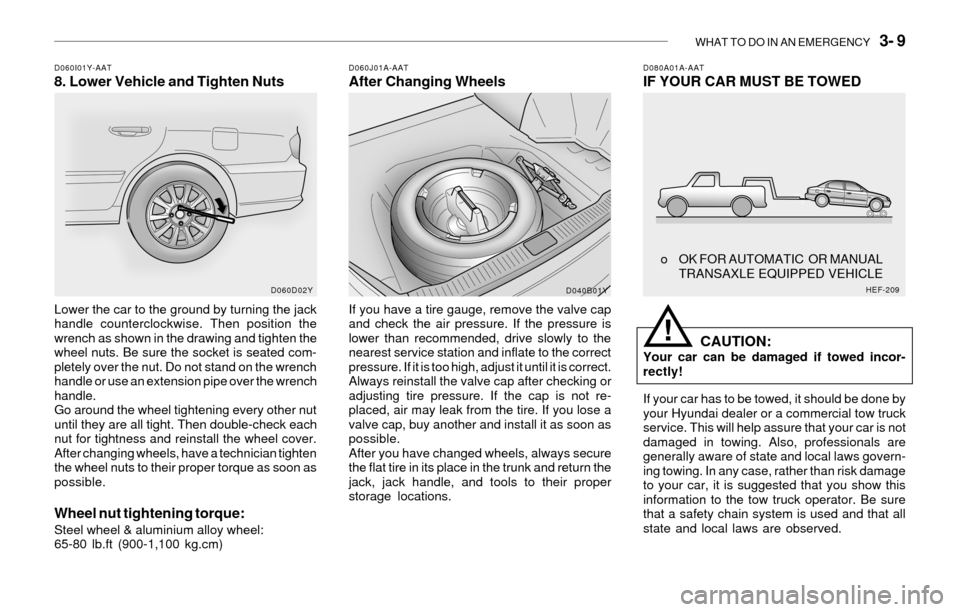
D080A01A-AATIF YOUR CAR MUST BE TOWEDD060I01Y-AAT8. Lower Vehicle and Tighten NutsD060J01A-AATAfter Changing Wheels
Lower the car to the ground by turning the jack
handle counterclockwise. Then position the
wrench as shown in the drawing and tighten the
wheel nuts. Be sure the socket is seated com-
pletely over the nut. Do not stand on the wrench
handle or use an extension pipe over the wrench
handle.
Go around the wheel tightening every other nut
until they are all tight. Then double-check each
nut for tightness and reinstall the wheel cover.
After changing wheels, have a technician tighten
the wheel nuts to their proper torque as soon as
possible.
Wheel nut tightening torque:Steel wheel & aluminium alloy wheel:
65-80 lb.ft (900-1,100 kg.cm)If you have a tire gauge, remove the valve cap
and check the air pressure. If the pressure is
lower than recommended, drive slowly to the
nearest service station and inflate to the correct
pressure. If it is too high, adjust it until it is correct.
Always reinstall the valve cap after checking or
adjusting tire pressure. If the cap is not re-
placed, air may leak from the tire. If you lose a
valve cap, buy another and install it as soon as
possible.
After you have changed wheels, always secure
the flat tire in its place in the trunk and return the
jack, jack handle, and tools to their proper
storage locations.
CAUTION:Your car can be damaged if towed incor-
rectly!
If your car has to be towed, it should be done by
your Hyundai dealer or a commercial tow truck
service. This will help assure that your car is not
damaged in towing. Also, professionals are
generally aware of state and local laws govern-
ing towing. In any case, rather than risk damage
to your car, it is suggested that you show this
information to the tow truck operator. Be sure
that a safety chain system is used and that all
state and local laws are observed.
!
o OK FOR AUTOMATIC OR MANUAL
TRANSAXLE EQUIPPED VEHICLE
D060D02Y
D040B01YHEF-209
Page 181 of 205
6- 26 DO-IT-YOURSELF MAINTENANCE
!
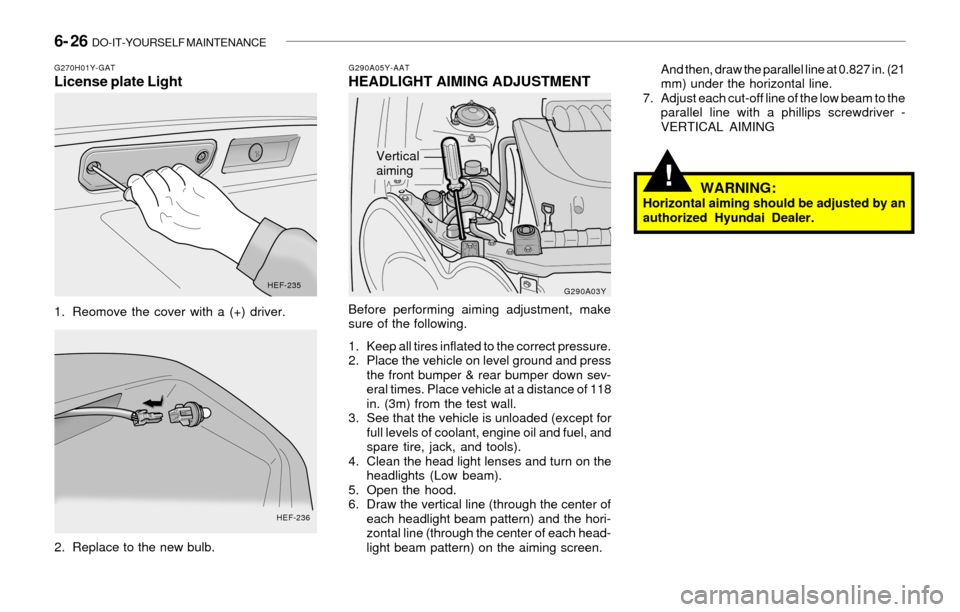
G290A05Y-AATHEADLIGHT AIMING ADJUSTMENT
Before performing aiming adjustment, make
sure of the following.
1. Keep all tires inflated to the correct pressure.
2. Place the vehicle on level ground and press
the front bumper & rear bumper down sev-
eral times. Place vehicle at a distance of 118
in. (3m) from the test wall.
3. See that the vehicle is unloaded (except for
full levels of coolant, engine oil and fuel, and
spare tire, jack, and tools).
4. Clean the head light lenses and turn on the
headlights (Low beam).
5. Open the hood.
6. Draw the vertical line (through the center of
each headlight beam pattern) and the hori-
zontal line (through the center of each head-
light beam pattern) on the aiming screen.And then, draw the parallel line at 0.827 in. (21
mm) under the horizontal line.
7. Adjust each cut-off line of the low beam to the
parallel line with a phillips screwdriver -
VERTICAL AIMING
WARNING:Horizontal aiming should be adjusted by an
authorized Hyundai Dealer.
G290A03Y
G270H01Y-GATLicense plate Light
1. Reomove the cover with a (+) driver.
2. Replace to the new bulb.
HEF-235
HEF-236
Vertical
aiming
Page 189 of 205

8. CONSUMER INFORMATION
Vehicle Identification Number (VIN) ................................................. 8-2
Engine number ................................................................................. 8-2
Recommended inflation pressures ................................................... 8-2
Snow tires ........................................................................................ 8-3
Tire chains ....................................................................................... 8-3
Tire rotation ...................................................................................... 8-3
Tire balancing ................................................................................... 8-4
Tire traction ...................................................................................... 8-4
When to replace tires ....................................................................... 8-4
Spare tire and tools .......................................................................... 8-5
8
Page 190 of 205
8- 2 CONSUMER INFORMATION & REPORTING SAFETY DEFECTS
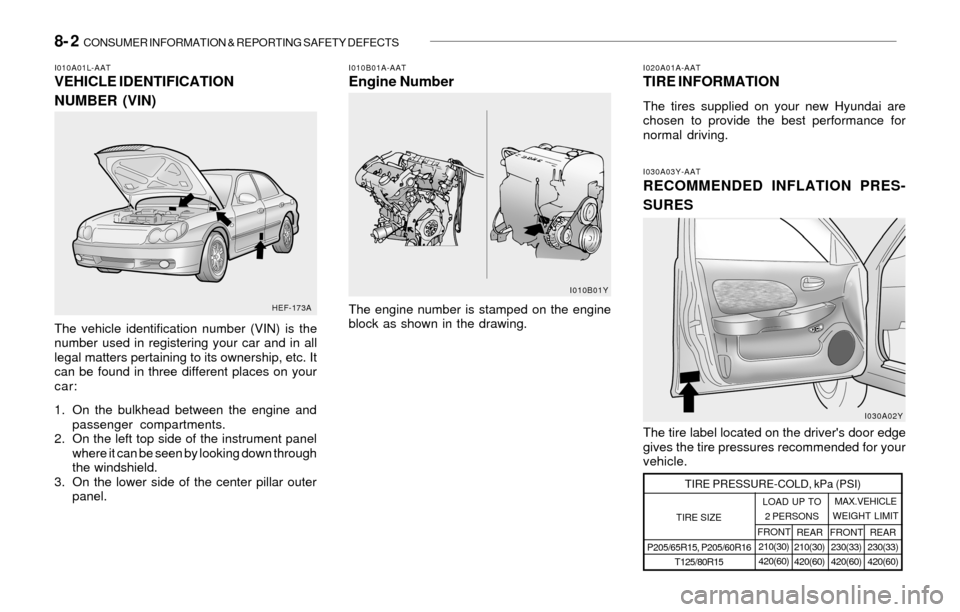
I030A03Y-AATRECOMMENDED INFLATION PRES-
SURES
I020A01A-AATTIRE INFORMATION
The tires supplied on your new Hyundai are
chosen to provide the best performance for
normal driving.
I010B01A-AATEngine NumberI010A01L-AATVEHICLE IDENTIFICATION
NUMBER (VIN)
The vehicle identification number (VIN) is the
number used in registering your car and in all
legal matters pertaining to its ownership, etc. It
can be found in three different places on your
car:
1. On the bulkhead between the engine and
passenger compartments.
2. On the left top side of the instrument panel
where it can be seen by looking down through
the windshield.
3. On the lower side of the center pillar outer
panel.The engine number is stamped on the engine
block as shown in the drawing.
The tire label located on the driver's door edge
gives the tire pressures recommended for your
vehicle.
TIRE SIZE
TIRE PRESSURE-COLD, kPa (PSI)
P205/65R15, P205/60R16
T125/80R15REAR
210(30)
420(60)FRONT
230(33)
420(60) LOAD UP TO
2 PERSONSMAX.VEHICLE
WEIGHT LIMIT
REAR
230(33)
420(60) FRONT
210(30)
420(60)
HEF-173AI010B01Y
I030A02Y
Page 191 of 205
CONSUMER INFORMATION & REPORTING SAFETY DEFECTS 8- 3
!
!
I050A02Y-AATTIRE CHAINS
Tire chains, if necessary, should be installed on
the front wheels. Be sure that the chains are the
proper size and that they are installed in accor-
dance with the manufacturer's instructions.
To minimize tire and chain wear, do not continue
to use tire chains when they are no longer
needed.
I040A01S-AATSNOW TIRES
If you equip your car with snow tires, they should
be the same size and have the same load
capacity as the original tires. Snow tires should
be installed on all four wheels; otherwise, poor
handling may result.
Snow tires should carry 4 psi (28 kPa) more air
pressure than the pressure recommended for
the standard tires on the tire label on the driver's
door edge , or up to the maximum pressure
shown on the tire sidewall whichever is less.
Do not drive faster than 75 mph (120 km/h)
when your car is equipped with snow tires. These pressures were chosen to provide the
most satisfactory combination of ride comfort,
tire wear and stability under normal conditions.
Tire pressures should be checked at least
monthly. Proper tire inflation pressures should
be maintained for these reasons:
o Lower-than-recommended tire pressures
cause uneven tread wear and poor handling.
o Higher-than-recommended tire pressures
increase the chance of damage from im-
pacts and cause uneven tread wear.
!
WARNING:When driving on roads covered with snow
or ice, drive at less than 20 mph (30 km/h).
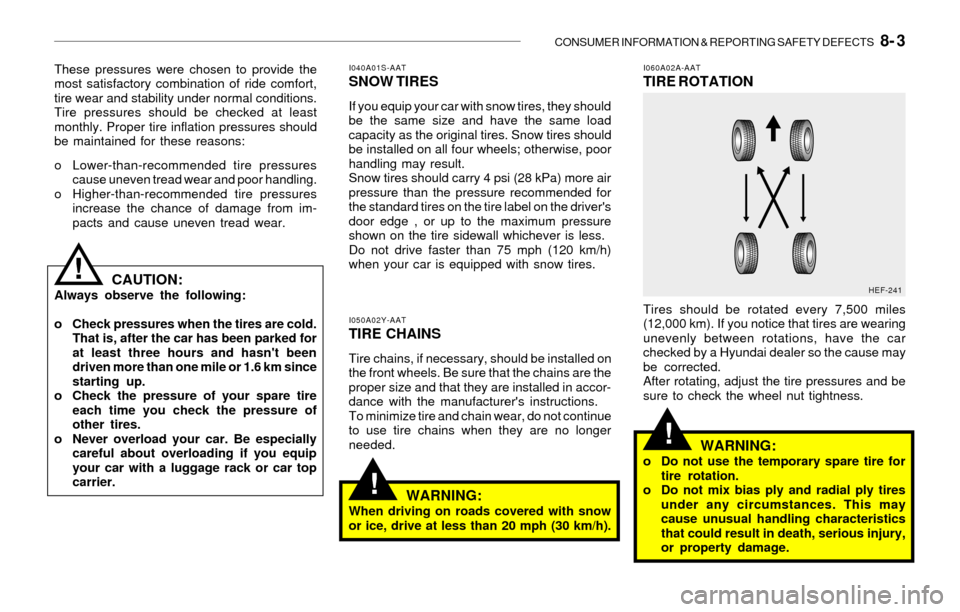
I060A02A-AATTIRE ROTATION
Tires should be rotated every 7,500 miles
(12,000 km). If you notice that tires are wearing
unevenly between rotations, have the car
checked by a Hyundai dealer so the cause may
be corrected.
After rotating, adjust the tire pressures and be
sure to check the wheel nut tightness.
CAUTION:Always observe the following:
o Check pressures when the tires are cold.
That is, after the car has been parked for
at least three hours and hasn't been
driven more than one mile or 1.6 km since
starting up.
o Check the pressure of your spare tire
each time you check the pressure of
other tires.
o Never overload your car. Be especially
careful about overloading if you equip
your car with a luggage rack or car top
carrier.
WARNING:o Do not use the temporary spare tire for
tire rotation.
o Do not mix bias ply and radial ply tires
under any circumstances. This may
cause unusual handling characteristics
that could result in death, serious injury,
or property damage.
HEF-241
Page 192 of 205
8- 4 CONSUMER INFORMATION & REPORTING SAFETY DEFECTS
!
!
I080A01A-AAT
TIRE TRACTION
Tire traction can be reduced if you drive on worn
tires, tires that are improperly inflated or on
slippery road surfaces. Tires should be re-
placed when tread wear indicators appear. To
reduce the possibility of losing control, slow
down whenever there is rain, snow or ice on the
road.
I070A01A-AATTIRE BALANCING
A tire that is out of balance may affect handling
and tire wear. The tires on your Hyundai were
balanced before the car was delivered but may
need balancing again during the years you own
the car.
Whenever a tire is dismounted for repair, it
should be rebalanced before being reinstalled
on the car.
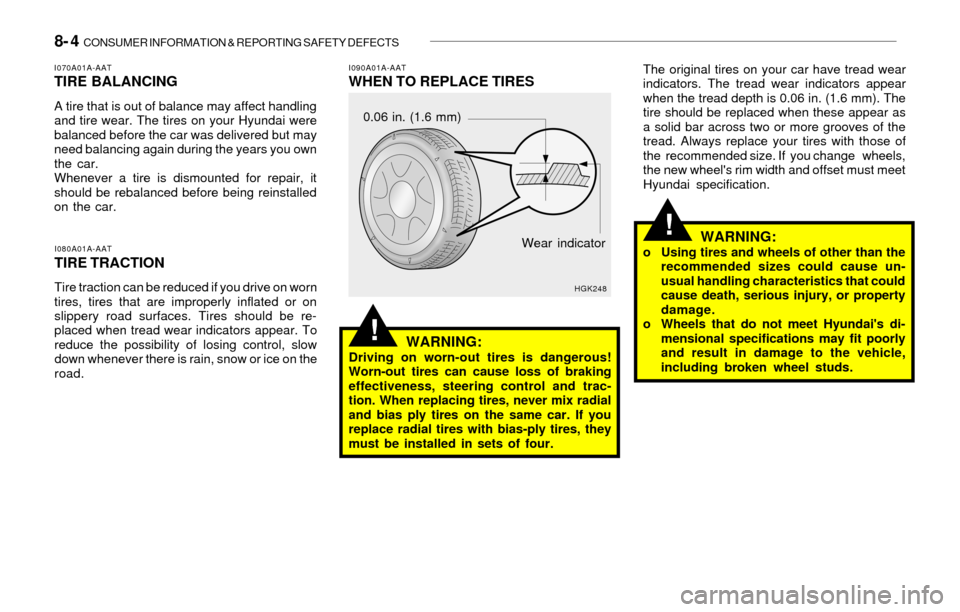
I090A01A-AATWHEN TO REPLACE TIRES
WARNING:
Driving on worn-out tires is dangerous!
Worn-out tires can cause loss of braking
effectiveness, steering control and trac-
tion. When replacing tires, never mix radial
and bias ply tires on the same car. If you
replace radial tires with bias-ply tires, they
must be installed in sets of four.The original tires on your car have tread wear
indicators. The tread wear indicators appear
when the tread depth is 0.06 in. (1.6 mm). The
tire should be replaced when these appear as
a solid bar across two or more grooves of the
tread. Always replace your tires with those of
the recommended size. If you change wheels,
the new wheel's rim width and offset must meet
Hyundai specification.
WARNING:o Using tires and wheels of other than the
recommended sizes could cause un-
usual handling characteristics that could
cause death, serious injury, or property
damage.
o Wheels that do not meet Hyundai's di-
mensional specifications may fit poorly
and result in damage to the vehicle,
including broken wheel studs.
HGK248
0.06 in. (1.6 mm)
Wear indicator
Page 194 of 205
8- 6 CONSUMER INFORMATION & REPORTING SAFETY DEFECTS
!
I130D01A-AATHyundai motor vehicles are designed and manu-
factured to meet or exceed all applicable safety
standards.
For your safety, however, we strongly urge you
to read and follow all directions in this Owner's
Manual, particularly the information under the
headings "NOTE", "CAUTION" and "WARN-
ING".
If, after reading this manual, you have any
questions regarding the operation of your ve-
hicle, please contact your nearest Hyundai
Motor America Regional Office as listed below:
Eastern Region : Connecticut, Delaware, Maine,
Maryland, Massachusetts, New Hampshire,
New Jersey, New York, Pennsylvanina, Rhode
Island, Vermont, Virginia, West Virginia.
Eastern Region
1100 Cranbury South River Road
Jamesburg, NJ 08831
(800) 633-5151
Southern Region: Alabama, Arkansas, Florida,
Georgia, Louisiana, Mississippi, North Caro-
lina, South Carolina, Oklahoma, Tennessee,
Texas. Traction AA, A, B, C - The traction grades,
from highest to lowest, are AA, A, B, and C.
Those grades represent the tire's ability to stop
on wet pavement as measured under controlled
conditions on specified government test sur-
faces of asphalt and concrete. A tire marked C
may have poor traction performance.
WARNING:The traction grade assigned to this tire is
based on straight-ahead braking traction
tests, and does not include acceleration,
cornering, hydroplaning, or peak traction
characteristics.
Temperature A, B, C - The temperature grades
are A (the highest), B, and C, representing the
tire's resistance to the generation of heat and
its ability to dissipate heat when tested under
controlled conditions on a specified indoor labo-
ratory test wheel. Sustained high temperature
can cause the material of the tire to degenerate
and reduce tire life, and excessive temperature
can lead to sudden tire failure. The grade C
corresponds to a level of performance which all
passenger car tires must meet under the Fed-
eral Motor Vehicle Safety Standard No. 109.
Grades B and A represent higher levels of
performance on the laboratory test wheel than
the minimum required by law.
WARNING:The temperature grade for this tire is estab-
lished for a tire that is properly inflated and
not overloaded. Excessive speed,
underinflation, or excessive loading, either
separately or in combination, can cause
heat buildup and possible tire failure.
!
Page 204 of 205

INDEX 10- 5
T
Tachometer.......................................................................................1-39
Theft-Alarm system ............................................................................ 1-6
Tires
Balancing ........................................................................................ 8-4
Chains............................................................................................ 8-3
Changing a flat tire ......................................................................... 3-5
If you have a flat tire ....................................................................... 3-5
Information ...................................................................................... 8-2
Pressure......................................................................................... 8-2
Replacement.................................................................................. 8-4
Rotation .......................................................................................... 8-3
Snow tires ....................................................................................... 8-3
Spare tire ........................................................................................ 3-4
Traction.......................................................................................... 8-4
Towing
A trailer (or vehicle) ......................................................................2-16
Emergency...................................................................................3-11
If your car must be towed .............................................................. 3-9
Traction Control System ...................................................................2-11
Transaxle
Automatic ........................................................................................ 2-7
Automatic transaxle fluid checking ..............................................6-12
Manual ............................................................................................ 2-5
Manual transaxle oil checking .....................................................6-12
Trip Computer ...................................................................................1-40
Trip Odometer ...................................................................................1-39
Trunk Lid ...........................................................................................1-56V
Vehicle Identification Number ............................................................. 8-2
W
Warning Lights ...................................................................... 1-35 ~ 1-38
Windows
Manual ............................................................................................ 1-9
Power............................................................................................. 1-9
Windshield Wiper and Washer ..........................................................1-42
Windshield Wiper Blades ..................................................................6-11
Page 205 of 205

Seoul KoreaPrinting: FEB. 10, 2002
Publication No.: A38O-EU32I
Printed in Korea
SERVICE STATION INFORMATION
FUEL:
UNLEADED gasoline only
Pump Octane Rating of 87 (Research Octane Number 91) or higher.
FUEL TANK CAPACITY
US.gal (Imp.gal., liter) 17.2 (14.3, 65)
TIRE PRESSURE:
See the label on the driver's side of the center pillar outer panel.
OTHER TIRE INFORMATION:
See pages 8-2 through 8-6
HOOD RELEASE:
Pull handle under left side of dash.
ENGINE OIL:
API grade SH, SG or SG/CD multigrade and fuel efficient oil. Use SAE
10W-30, 10W-40 or 10W-50 if normal temperatures are above -10°F
(-23°C). For other viscosity recommendations, see page 6-5 or 9-4.
MANUAL TRANSAXLE:
HYUNDAI GENUINE PARTS MTF 75W/90 (API GL-4) Oil level
should be up to filler-bolt hole in housing beside differential.
AUTOMATIC TRANSAXLE:
Apply the parking brake, with the engine running, shift the selector
lever through all ranges and return to “N” (Neutral) position. Then
check the level of fluid on the dipstick. Use only HYUNDAI GENU-
INE ATF available at your dealer or DIAMOND ATF SP-III or SK
ATF SP-III.
QUICK INDEX
o Car will not start ....................................................................... 3-2
o Flat tire ..................................................................................... 3-5
o Warning light/chime comes on .............................................. 1-35
o Engine overheats ...................................................................... 3-3
o Towing of your vehicle ............................................................. 3-9
o Starting the engine ................................................................... 2-3
o Driving tips for first 1,200 miles (2,000 km) .......................... 1-3
o Scheduled maintenance ............................................................ 5-4
o Reporting safety defects ........................................................... 8-7