towing Hyundai Sonata
[x] Cancel search | Manufacturer: HYUNDAI, Model Year: , Model line: , Model:Pages: 380, PDF Size: 7.97 MB
Page 39 of 380
Safety features of your vehicle22
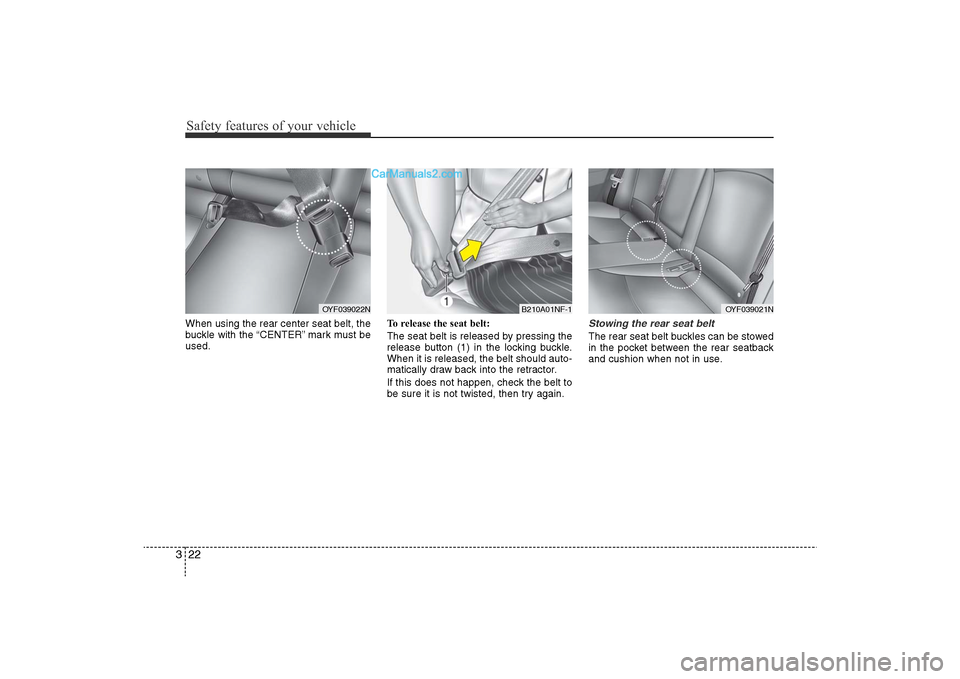
3When using the rear center seat belt, the
buckle with the “CENTER” mark must be
used. To release the seat belt:
The seat belt is released by pressing the
release button (1) in the locking buckle.
When it is released, the belt should auto-
matically draw back into the retractor.
If this does not happen, check the belt to
be sure it is not twisted, then try again.
Stowing the rear seat belt The rear seat belt buckles can be stowed
in the pocket between the rear seatback
and cushion when not in use.
OYF039022N
B210A01NF-1
OYF039021N
YF hma 3.qxp 11/25/2009 4:56 PM Page 22
Page 217 of 380
5
Before driving / 5-3
Key / 5-4
Engine start/stop button / 5-7
Manual transaxle /5-11
Automatic transaxle / 5-14
Brake system / 5-21
Cruise control system / 5-31
Economical operation / 5-35
Special driving conditions / 5-37
Winter driving / 5-41
Vehicle load limit / 5-45
Vehicle weight / 5-50
Trailer towing / 5-51
Driving your vehicle
YF hma 5.qxp 11/25/2009 5:41 PM Page 1
Page 262 of 380
Driving your vehicle46
5Towing capacity:We do not recommend using this
vehicle for trailer towing.Cargo capacity:The cargo capacity of your vehicle
will increase or decrease depending
on the weight and the number of
occupants.
Steps For Determining Correct Load
Limit -1. Locate the statement "The com- bined weight of occupants and
cargo should never exceed XXX
kg or XXX lbs.'' on your vehicle's
placard.
2. Determine the combined weight of the driver and passengers that will
be riding in your vehicle.
3. Subtract the combined weight of the driver and passengers from
XXX kg or XXX lbs.
4. The resulting figure equals the available amount of cargo and lug-
gage load capacity. For example, if
the "XXX" amount equals 1400
lbs. and there will be five 150 lb
passengers in your vehicle, the
amount of available cargo and lug-
gage load capacity is 650 lbs.
(1400-750 (5 x 150) = 650 lbs.) 5. Determine the combined weight of
luggage and cargo being loaded
on the vehicle. That weight may
not safely exceed the available
cargo and luggage load capacity
calculated in Step 4.
6. If your vehicle will be towing a trail- er, load from your trailer will be
transferred to your vehicle. Consult
this manual to determine how this
reduces the available cargo and
luggage load capacity of your
vehicle.
✽NOTICEWe do not recommend using this
vehicle for trailer towing.
YF hma 5.qxp 11/25/2009 5:50 PM Page 46
Page 267 of 380
551
Driving your vehicle
We do not recommend using this
vehicle for trailer towing.TRAILER TOWING
YF hma 5.qxp 11/25/2009 5:51 PM Page 51
Page 268 of 380
6
Road warning / 6-2
In case of an emergency while driving / 6-2
If the engine will not start / 6-3
Emergency starting / 6-4
If the engine overheats / 6-6
Tire pressure monitoring system (TPMS) / 6-7
If you have a flat tire / 6-12
Towing / 6-20
What to do in an emergency
YF HMA 6.QXP 11/25/2009 1:57 PM Page 1
Page 271 of 380
What to do in an emergency4
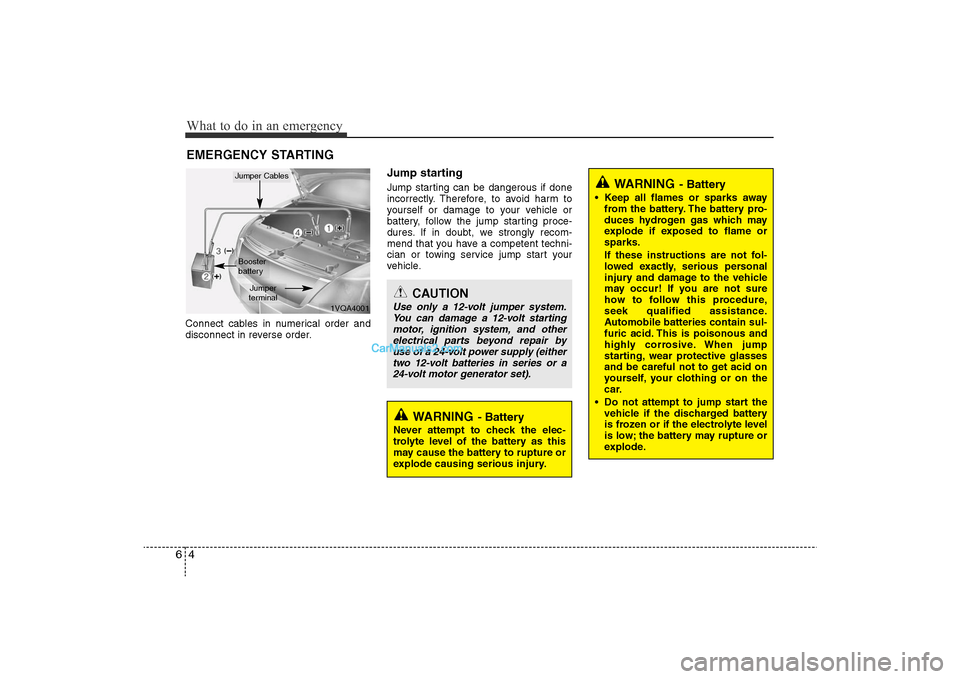
6EMERGENCY STARTINGConnect cables in numerical order and
disconnect in reverse order.
Jump starting Jump starting can be dangerous if done
incorrectly. Therefore, to avoid harm to
yourself or damage to your vehicle or
battery, follow the jump starting proce-
dures. If in doubt, we strongly recom-
mend that you have a competent techni-
cian or towing service jump start your
vehicle.
CAUTION
Use only a 12-volt jumper system.
You can damage a 12-volt starting motor, ignition system, and otherelectrical parts beyond repair by use of a 24-volt power supply (eithertwo 12-volt batteries in series or a24-volt motor generator set).
WARNING
- Battery
• Keep all flames or sparks away from the battery. The battery pro-
duces hydrogen gas which may
explode if exposed to flame or
sparks.
If these instructions are not fol-
lowed exactly, serious personal
injury and damage to the vehicle
may occur! If you are not sure
how to follow this procedure,
seek qualified assistance.
Automobile batteries contain sul-
furic acid. This is poisonous and
highly corrosive. When jump
starting, wear protective glasses
and be careful not to get acid on
yourself, your clothing or on the
car.
• Do not attempt to jump start the vehicle if the discharged battery
is frozen or if the electrolyte level
is low; the battery may rupture or
explode.
WARNING
- Battery
Never attempt to check the elec-
trolyte level of the battery as this
may cause the battery to rupture or
explode causing serious injury.
1VQA4001
Jumper
terminal
Jumper CablesBooster
battery
YF HMA 6.QXP 11/25/2009 1:58 PM Page 4
Page 287 of 380
What to do in an emergency20
6
HXD02HXD03
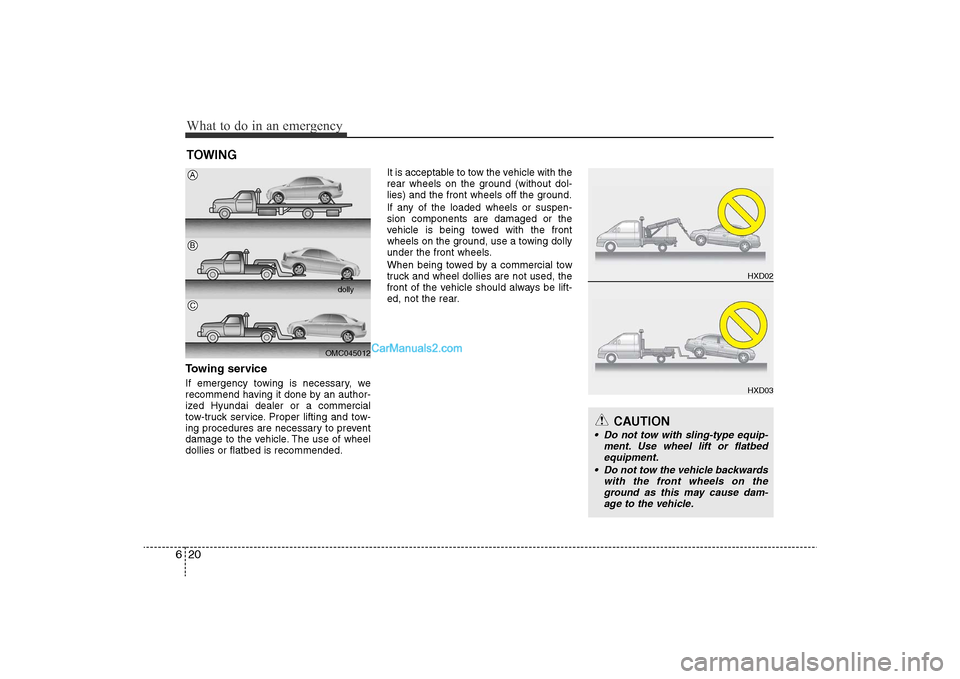
TOWINGTowing serviceIf emergency towing is necessary, we
recommend having it done by an author-
ized Hyundai dealer or a commercial
tow-truck service. Proper lifting and tow-
ing procedures are necessary to prevent
damage to the vehicle. The use of wheel
dollies or flatbed is recommended. It is acceptable to tow the vehicle with the
rear wheels on the ground (without dol-
lies) and the front wheels off the ground.
If any of the loaded wheels or suspen-
sion components are damaged or the
vehicle is being towed with the front
wheels on the ground, use a towing dolly
under the front wheels.
When being towed by a commercial tow
truck and wheel dollies are not used, the
front of the vehicle should always be lift-
ed, not the rear.
OMC045012
dolly
A
B
C
CAUTION
• Do not tow with sling-type equip-
ment. Use wheel lift or flatbedequipment.
• Do not tow the vehicle backwards with the front wheels on theground as this may cause dam-age to the vehicle.
YF HMA 6.QXP 11/25/2009 1:59 PM Page 20
Page 288 of 380
621
What to do in an emergency
When towing your vehicle in an emer-
gency without wheel dollies :
1. Set the ignition switch in the ACC posi-tion.
2. Place the shift lever in N (Neutral).
3. Release the parking brake.
CAUTION
Failure to place the transaxle shift lever in N (Neutral) may cause inter-nal damage to the transaxle.
YF HMA 6.QXP 11/25/2009 1:59 PM Page 21
Page 305 of 380
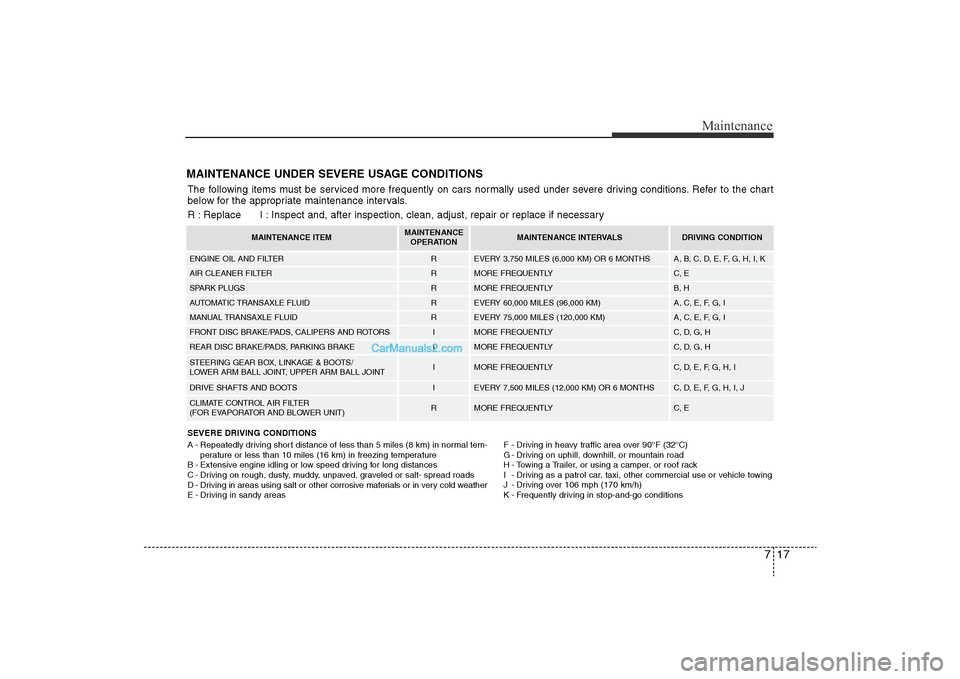
717
Maintenance
MAINTENANCE UNDER SEVERE USAGE CONDITIONSSEVERE DRIVING CONDITIONS
A - Repeatedly driving short distance of less than 5 miles (8 km) in normal tem-perature or less than 10 miles (16 km) in freezing temperature
B - Extensive engine idling or low speed driving for long distances
C - Driving on rough, dusty, muddy, unpaved, graveled or salt- spread roads
D - Driving in areas using salt or other corrosive materials or in very cold weather
E - Driving in sandy areas F - Driving in heavy traffic area over 90°F (32°C)
G - Driving on uphill, downhill, or mountain road
H - Towing a Trailer, or using a camper, or roof rack
I - Driving as a patrol car, taxi, other commercial use or vehicle towing
J - Driving over 106 mph (170 km/h)
K - Frequently driving in stop-and-go conditionsThe following items must be serviced more frequently on cars normally used under severe driving conditions. Refer to the chart
below for the appropriate maintenance intervals.
R : Replace I : Inspect and, after inspection, clean, adjust, repair or replace if neces\
sary
MAINTENANCE ITEM
MAINTENANCE
OPERATION
MAINTENANCE INTERVALS
DRIVING CONDITION
ENGINE OIL AND FILTER
R
EVERY 3,750 MILES (6,000 KM) OR 6 MONTHS
A, B, C, D, E, F, G, H, I, K
AIR CLEANER FILTER
R
MORE FREQUENTLY
C, E
SPARK PLUGS
R
MORE FREQUENTLY
B, H
AUTOMATIC TRANSAXLE FLUID
R
EVERY 60,000 MILES (96,000 KM)
A, C, E, F, G, I
MANUAL TRANSAXLE FLUID
R
EVERY 75,000 MILES (120,000 KM)
A, C, E, F, G, I
FRONT DISC BRAKE/PADS, CALIPERS AND ROTORS
I
MORE FREQUENTLY
C, D, G, H
REAR DISC BRAKE/PADS, PARKING BRAKE
I
MORE FREQUENTLY
C, D, G, H
STEERING GEAR BOX, LINKAGE & BOOTS/
LOWER ARM BALL JOINT, UPPER ARM BALL JOINT
I
MORE FREQUENTLY
C, D, E, F, G, H, I
DRIVE SHAFTS AND BOOTS
I
EVERY 7,500 MILES (12,000 KM) OR 6 MONTHS
C, D, E, F, G, H, I, J
CLIMATE CONTROL AIR FILTER
(FOR EVAPORATOR AND BLOWER UNIT)
R
MORE FREQUENTLY
C, E
YF HMA 7.QXP 11/25/2009 1:45 PM Page 17
Page 379 of 380

I9
Index
Sports mode ··················\
··················\
··················\
·············5-17
Starting difficulties, see engine will not start ··················\
6-3
Starting the engine··················\
··················\
················5-6, 5-9\
Steering wheel···············\
··················\
··················\
·············4-35Horn··················\
··················\
··················\
··················\
···4-36
Electric power steering··················\
··················\
··········4-35
Tilt steering ··················\
··················\
··················\
·········4-35
Steering wheel audio control ··················\
··················\
···4-104
Storage compartment ··················\
··················\
·················4-98\
Center console storage ··················\
··················\
··········4-98
Glove box ··················\
··················\
··················\
············4-98
Multi box ··················\
··················\
··················\
·············4-99
Sunglass holder ··················\
··················\
··················\
···4-99
Sunglass holder ··················\
··················\
··················\
········4-99
Sunroof··················\
··················\
··················\
··················\
···4-32
Sunvisor ··················\
··················\
··················\
·················4-10\
0
Tachometer··················\
··················\
··················\
···············4-47
Tether anchor system ··················\
··················\
·················3-33\
Theft-alarm system ··················\
··················\
··················\
··4-14
Tilt steering ··················\
··················\
··················\
··············4-35
Tire specification and pressure label ··················\
·············8-7
Tire chains··················\
··················\
··················\
················5-42
Tire pressure monitoring system (TPMS) ··················\
·····6-7 Tires and wheels ··················\
··················\
·················7-36\
, 8-3
Checking tire inflation pressure ··················\
··············7-37
Compact spare tire replacement ··················\
··············7-41
Recommended cold tire inflation pressures ··············7-36
Tire care··················\
··················\
··················\
···············7-36
Tire maintenance ··················\
··················\
··················\
·7-41
Tire replacement ··················\
··················\
··················\
··7-40
Tire rotation ··················\
··················\
··················\
·········7-38
Tire sidewall labeling ··················\
··················\
············7-42
Tire traction ··················\
··················\
··················\
·········7-41
Wheel alignment and tire balance ··················\
···········7-39
Wheel replacement ··················\
··················\
················7-41
Towing ··················\
··················\
··················\
··················\
···6-20
Trailer towing ··················\
··················\
··················\
··········5-51
Transaxle Automatic transaxle ··················\
··················\
··············5-14
Manual transaxle ··················\
··················\
··················\
·5-11
Trip computer ··················\
··················\
··················\
··········4-49
Trunk ··················\
··················\
··················\
··················\
······4-22
Vehicle break-in process ··················\
··················\
··············1-5
Vehicle certification label··················\
··················\
···5-48, 8-6
Vehicle data collection and event data recorders (EDR) ··················\
··················\
··················\
····1-6
Vehicle identification number (VIN) ··················\
·············8-6
Vehicle load limit ··················\
··················\
··················\
·····5-45 Certification label ··················\
··················\
··················\
5-48T
V
YF HMA INDEX.QXP 1/13/2010 2:11 PM Page 9