start Hyundai Sonata Hybrid 2012 Owner's Manual
[x] Cancel search | Manufacturer: HYUNDAI, Model Year: 2012, Model line: Sonata Hybrid, Model: Hyundai Sonata Hybrid 2012Pages: 403, PDF Size: 7.86 MB
Page 353 of 403
Maintenance
60
7
LIGHT BULBS
Use only bulbs of the specified wattage.
✽
✽
NOTICE
After heavy, driving rain or washing,
headlight and taillight lenses could
appear frosty. This condition is caused by
the temperature difference between the
lamp inside and outside. This is similar
to the condensation on your windows
inside your vehicle during the rain and
doesn’t indicate a problem with your
vehicle. If the water leaks into the lamp
bulb circuitry, have the vehicle checked
by an authorized HYUNDAI dealer.WARNING - Working on
the lights
Prior to working on the light, firmly
apply the parking brake, ensure
that the engine start/stop button is
turned to the LOCK position and
turn off the lights to avoid sudden
movement of the vehicle and burn-
ing your fingers or receiving an
electric shock.
CAUTION
Be sure to replace the burned-out
bulb with one of the same wattagerating. Otherwise, it may causedamage to the fuse or electric wiring system.
CAUTION
If you don’t have necessary tools,the correct bulbs and the expertise,consult an authorized HYUNDAIdealer. In many cases, it is difficultto replace vehicle light bulbsbecause other parts of the vehicle must be removed before you canget to the bulb. This is especiallytrue if you have to remove the head-light assembly to
get to the bulb(s).
Removing/installingthe headlight
assembly can result in damage to the vehicle.
WARNING
When you replace the bulb of front-
light, be careful the HPCU system,
high voltage cable (orange color)
and high voltage components for
hybrid.
It is very dangerous because the
HPCU has the high voltage. Always
pay strongly attention to your
hands. If not, it may result in the
electric shock or burns.
Page 365 of 403
Maintenance
72
7
High-corrosion areas
If you live in an area where your car is
regularly exposed to corrosive materials,
corrosion protection is particularly impor-
tant. Some of the common causes of
accelerated corrosion are road salts,
dust control chemicals, ocean air and
industrial pollution. Moisture breeds corrosion
Moisture creates the conditions in which
corrosion is most likely to occur. For
example, corrosion is accelerated by
high humidity, particularly when tempera-
tures are just above freezing. In such
conditions, the corrosive material is kept
in contact with the car surfaces by mois-
ture that is slow to evaporate.
Mud is particularly corrosive because it is
slow to dry and holds moisture in contact
with the vehicle. Although the mud
appears to be dry, it can still retain the
moisture and promote corrosion.
High temperatures can also accelerate
corrosion of parts that are not properly
ventilated so the moisture can be dis-
persed. For all these reasons, it is par-
ticularly important to keep your car clean
and free of mud or accumulations of
other materials. This applies not only to
the visible surfaces but particularly to the
underside of the car.To help prevent corrosion
You can help prevent corrosion from get-
ting started by observing the following:
Keep your car clean
The best way to prevent corrosion is to
keep your car clean and free of corrosive
materials. Attention to the underside of
the car is particularly important.
If you live in a high-corrosion area —
where road salts are used, near the
ocean, areas with industrial pollution,
acid rain, etc.—, you should take extra
care to prevent corrosion. In winter,
hose off the underside of your car at
least once a month and be sure to
clean the underside thoroughly when
winter is over.
Page 370 of 403
777
Maintenance
Do not operate the engine in confinedor closed areas (such as garages) any
more than what is necessary to move
the vehicle in or out of the area.
When the vehicle is stopped in an open area for more than a short time
with the engine running, adjust the
ventilation system (as needed) to draw
outside air into the vehicle.
Never sit in a parked or stopped vehi- cle for any extended time with the
engine running.
When the engine stalls or fails to start, excessive attempts to restart the
engine may cause damage to the
emission control system.Operating precautions for catalyticconverters (if equipped)
Your vehicle is equipped with a catalytic
converter emission control device.
Therefore, the following precautions
must be observed:
Use only UNLEADED FUEL for gaso- line engines.
Do not operate the vehicle when there are signs of engine malfunction, such
as misfire or a noticeable loss of per-
formance. Do not misuse or abuse the engine.
Examples of misuse are coasting with
the ignition off and descending steep
grades in gear with the ignition off.
Do not operate the engine at high idle speed for extended periods (5 minutes
or more).
Do not modify or tamper with any part of the engine or emission control sys-
tem. All inspections and adjustments
must be made by an authorized
HYUNDAI dealer.
Avoid driving with a extremely low fuel level. Running out of fuel could cause
the engine to misfire, damaging the
catalytic converter.
Failure to observe these precautions
could result in damage to the catalytic
converter and to your vehicle.
Additionally, such actions could void your
warranties.
WARNING- Fire
A hot exhaust system can ignite
flammable items under your vehi-
cle. Do not park, idle, or drive the
vehicle over or near flammable
objects, such as grass, vegetation,
paper, leaves, etc.
Page 377 of 403
Specifications, Consumer information, Reporting safety defects
68
Recommended SAE viscosity
number Engine oil viscosity (thickness) has an
effect on fuel economy and cold weather
operating (engine start and engine oil
flowability). Lower viscosity engine oils
can provide better fuel economy and cold
weather performance, however, higher
viscosity engine oils are required for sat-
isfactory lubrication in hot weather. Using
oils of any viscosity other than those rec-
ommended could result in engine dam-
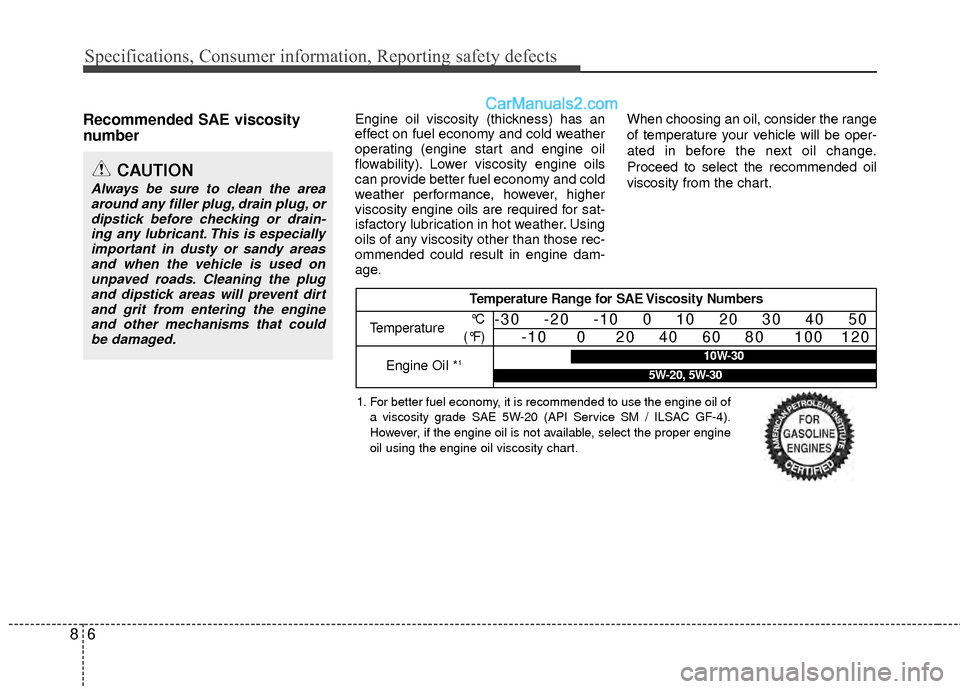
age.When choosing an oil, consider the range
of temperature your vehicle will be oper-
ated in before the next oil change.
Proceed to select the recommended oil
viscosity from the chart.
CAUTION
Always be sure to clean the area
around any filler plug, drain plug, ordipstick before checking or drain- ing any lubricant. This is especiallyimportant in dusty or sandy areasand when the vehicle is used onunpaved roads. Cleaning the plugand dipstick areas will prevent dirtand grit from entering the engineand other mechanisms that couldbe damaged.
Temperature Range for SAE Viscosity Numbers
Temperature
Engine Oil *
1
°C
(°F)-30 -20 -10 0 10 20 30 40 50 -10 0 20 40 60 80 100 120
1. For better fuel economy, it is recommended to use the engine oil of
a viscosity grade SAE 5W-20 (API Service SM / ILSAC GF-4).
However, if the engine oil is not available, select the proper engine
oil using the engine oil viscosity chart.
10W-30
5W-20, 5W-30
Page 382 of 403
HYUNDAI HYBRID SYSTEM / 2
SONATA HEV ENERGY FLOW / 4
STARTING THE HYBRID VEHICLE / 6
THE COMPONENTS OF HYBRID VEHICLE / 7
Hybrid system quick reference
Page 383 of 403
H2
Hyundai Hybrid Electric Vehicle (HEV)
uses a gasoline engine and an electric
motor for power. The electric motor is
run from a 280V high voltage HEV bat-
tery.
HEV computer decides according to
drive condition when to use engine
from when to use the electric motor or
even both at times.
Fuel is saved when the engine is not
running at idle at times or the vehicle
is driven by the electric motor from
the HEV battery.
The charge of the HEV battery has to
be maintained so at times the engine
becomes a generator which includes
when stopped at idle. Charging also
occurs when decelerating or by
regenerative braking.Display of Hybrid system
Many displays provide information about
the hybrid system, such as, ECO level
and ECO score.
Through the ECO LEVEL, the driver under-
stands the situation of economical driving.
If the driver drives the vehicle with eco-
nomical driving, the ECO LEVEL rises.
And it means the CO2 emission reduction.
In TOTAL ECO SCORE, when you get the
maximum step of ECO LEVEL, ECO sys-
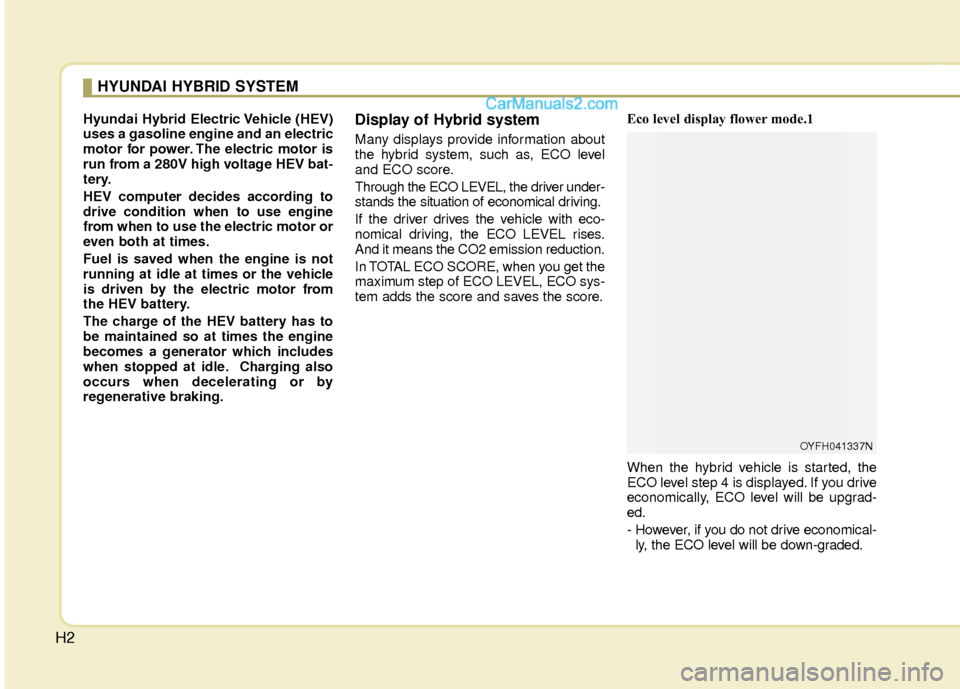
tem adds the score and saves the score.Eco level display flower mode.1
When the hybrid vehicle is started, the
ECO level step 4 is displayed. If you drive
economically, ECO level will be upgrad-
ed.
- However, if you do not drive economical-
ly, the ECO level will be down-graded.
HYUNDAI HYBRID SYSTEM
OYFH041337N
Page 387 of 403
H6
Starting the engine
1. Carry the smart key or leave it insidethe vehicle.
2. Make sure the parking brake is firmly applied.
3. Place the shift lever in the P(Park) position. In N(Neutral) position, you
can not start the vehicle.
4. Depress the brake pedal.
5. Press the engine start/stop button.
6. In extremely cold weather or after the vehicle has not been operated for sev-
eral days, let the engine warm up with-
out depressing the accelerator.
Whether the engine is cold or warm, it
should be started without depressing
the accelerator.
if it is far away from you, the engine
may not start.
in the ACC or ON position, if any door
is open, the system checks for the
smart key. If the smart key is not in
the vehicle, the warning, "Key is not
in vehicle" will come on, and if all
doors are closed, the chime will also
sound for about 5 seconds. The indi-
cator will turn off while the vehicle is
moving. Keep the smart key in the
vehicle when using the ACC position
or if the vehicle engine is on. IF the starting procedure is followed,
the "READY" symbol on the instru-
ment cluster will turn on. For more
details, Please check chapter 5.
ECONOMICAL and SAFE OPERA-
TION of Hybrid system
Drive smoothly. Accelerate at a mod-
erate rate and maintain a steady cruis-
ing speed. Don't make "jack-rabbit"
starts. Don't race between stoplights.
Avoid heavy traffic whenever possible.
Always maintain a safe distance from
other vehicles so you can avoid unnec-
essary braking. This also reduces
brake wear.
The regenerative brake generates energy when the vehicle decelerates.
When the hybrid battery power is low, the hybrid system automatically
recharges the hybrid battery.
When the engine runs in "N" position, the hybrid system can not generate
electricity. The hybrid battery cannot
recharge in "N" position. Please check
chapter 5.
✽ ✽ NOTICE
In the hybrid system, the engine auto-
matically runs and stops. If the hybrid
system operates, the "READY" symbol
is illuminated.
In the following situation, the engine
may operate automatically.
- When the engine is ready to run
- When the hybrid battery is charged
- Depending on the temperature condi-
tion of the hybrid battery
STARTING THE HYBRID VEHICLE (SMART KEY)
Page 388 of 403
H7
THE COMPONENTS OF HYBRID VEHICLE
OYFH021001N-1
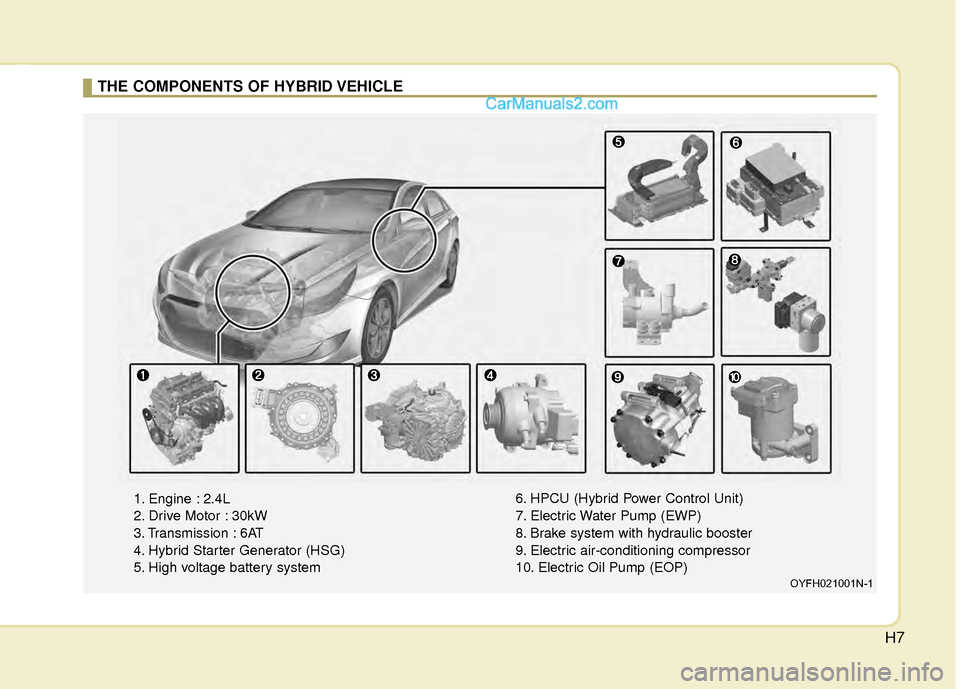
1. Engine : 2.4L
2. Drive Motor : 30kW
3. Transmission : 6AT
4. Hybrid Starter Generator (HSG)
5. High voltage battery system6. HPCU (Hybrid Power Control Unit)
7. Electric Water Pump (EWP)
8. Brake system with hydraulic booster
9. Electric air-conditioning compressor
10. Electric Oil Pump (EOP)
Page 392 of 403
H11
The special features of hybrid
vehicle.
Hybrid vehicles sound different than
gasoline engine vehicles. When the
hybrid system operates, you may hear a
sound from the hybrid battery system
behind the rear seat. If you apply the
accelerator pedal rapidly, you may hear a
sound. when you apply the brake pedal,
you may hear a sound from the regener-
ative brake system. When the hybrid sys-
tem is turned off or on, you may hear a
sound in the engine compartment. If you
depress the brake pedal repeatedly
when the hybrid system is turned on, you
may hear a sound in the engine com-
partment. None of these sounds indicate
a problem. They are characteristics of
hybrid vehicles.
If any of following occur, it's not a unnor-
mal condition even if you may hear a
motor sound in the engine compartment.
- After turning off the hybrid system, thebrake pedal is released.
- When the hybrid system is turned off, the brake pedal is applied.
- When the driver door is opened. When the hybrid system is turned on, the
engine may run or not. In this situation,
you may feel a vibration. This does not
indicate a malfunction. If the "READY"
symbol is turned on, the hybrid system
starts. Even if the engine is off, you can
operate the vehicle.
WARNING
The hybrid system contains many
electronic components. High volt-
age components like cables and
other parts may emit electromag-
netic waves. Even if the electro-
magnetic cover blocks electromag-
netic emissions, electromagnetic
waves may have an effect on elec-
tronic appliances. If you park the
vehicle for a long time, the hybrid
system will discharge. You need to
drive the vehicle several times per
month. We recommend driving at
least 1 hour or 10 miles when you
drive the vehicle. If the hybrid bat-
tery is discharged and if it is impos-
sible to jump start the vehicle con-
tact your Hyundai dealer.
WARNING
When you start the hybrid system
in the "P" transmission position,
the "READY" symbol is illuminat-
ed in the cluster. The driver can
drive the vehicle even if the
engine is stopped.
When you leave the vehicle, you should turn off the hybrid system
or shift into the "P" position. If
you depress the accelerator
pedal by mistake and the vehicle
is not in the "P" position, the
vehicle will move abruptly. This
may result in serious injury or
death.
Page 394 of 403
H13
If An Accident OccursWhen the hybrid vehicle shuts off
When the high voltage battery dis-
charged, 12-volt battery discharged, or
fuel tank is empty, the hybrid system may
not operate while driving. If the Hybrid
system is not operated, do the following;
1. Reduce the vehicle speed gradually.
Pull your vehicle off the road as safe
area.
2. Shift the transmission into "P" position.
3. Turn on the hazard warning flashers.
4. Set the start button at OFF, and try to start the Hybrid system by applying the
brake pedal and pushing the start but-
ton.
5. If the Hybrid system will not operate, refer to "EMERGENCY STARTING" in
chapter 6.
When you try to jump start the vehicle,
confirm the fuel level and exact proce-
dure of jump start. For details, see the
"EMERGENCY STARING" in chapter 6.
If the fuel level is low, do not try to drive
the vehicle on battery power. The high
voltage battery may be discharged and
the Hybrid system will turn off.
WARNING
After parking the vehicle, shift the transmission into "P" position.
Turn off the hybrid system. Push
the button again to turn off.
For your safety, do not touch high voltage cables, connectors and
package modules.
Exposed cables or wires maybe visible inside or outside of the
vehicle. Never touch the wires or
cables, because an electrical
shock may occur causing injury or
death.
If a fire occurs, never use water to put out a fire. For safety, use an
extinguisher for electrical fires
with proper chemicals and evacu-
ate immediately.
If you need towing, refer to chapter 6.
WARNING
When you pull your vehicle off the
road as safe area, open the door
when the vehicle completely stops.