towing Hyundai Sonata Hybrid 2012 Owner's Manual
[x] Cancel search | Manufacturer: HYUNDAI, Model Year: 2012, Model line: Sonata Hybrid, Model: Hyundai Sonata Hybrid 2012Pages: 403, PDF Size: 7.86 MB
Page 223 of 403
5
Before driving / 5-3
Engine start/stop button / 5-5
Automatic transaxle / 5-9
Brake system / 5-14
Cruise control system / 5-24
Economical operation / 5-28
Special driving conditions / 5-30
Winter driving / 5-34
Vehicle load limit / 5-38
Vehicle weight / 5-43
Trailer towing / 5-44
Driving your vehicle
Page 261 of 403
539
Driving your vehicle
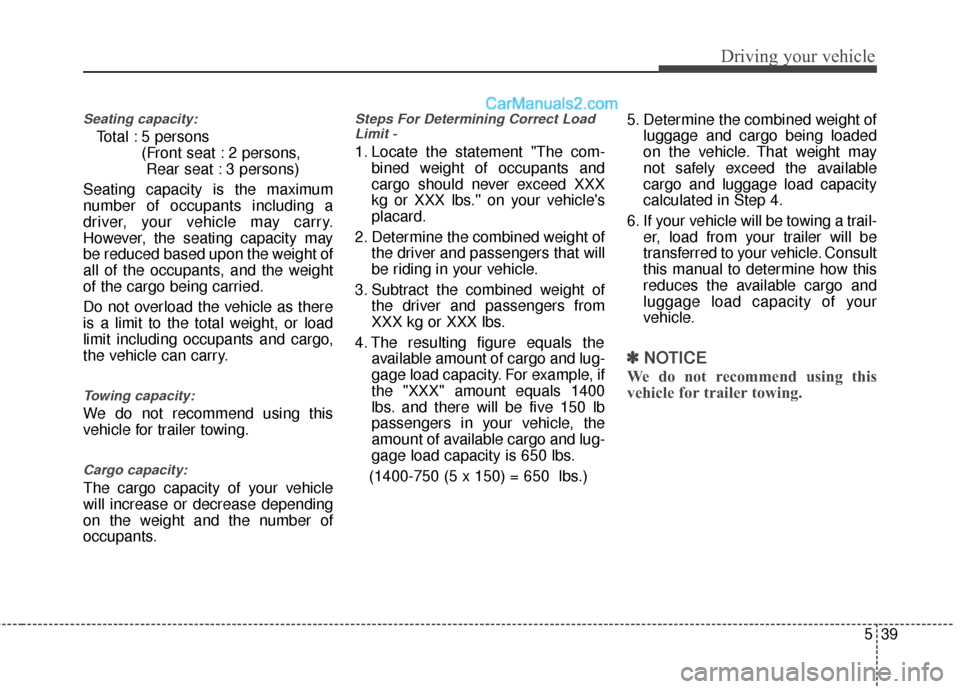
Seating capacity:
Total : 5 persons (Front seat : 2 persons, Rear seat : 3 persons)
Seating capacity is the maximum
number of occupants including a
driver, your vehicle may carry.
However, the seating capacity may
be reduced based upon the weight of
all of the occupants, and the weight
of the cargo being carried.
Do not overload the vehicle as there
is a limit to the total weight, or load
limit including occupants and cargo,
the vehicle can carry.
Towing capacity:
We do not recommend using this
vehicle for trailer towing.
Cargo capacity:
The cargo capacity of your vehicle
will increase or decrease depending
on the weight and the number of
occupants.
Steps For Determining Correct Load Limit -
1. Locate the statement "The com- bined weight of occupants and
cargo should never exceed XXX
kg or XXX lbs.'' on your vehicle's
placard.
2. Determine the combined weight of the driver and passengers that will
be riding in your vehicle.
3. Subtract the combined weight of the driver and passengers from
XXX kg or XXX lbs.
4. The resulting figure equals the available amount of cargo and lug-
gage load capacity. For example, if
the "XXX" amount equals 1400
lbs. and there will be five 150 lb
passengers in your vehicle, the
amount of available cargo and lug-
gage load capacity is 650 lbs.
(1400-750 (5 x 150) = 650 lbs.) 5. Determine the combined weight of
luggage and cargo being loaded
on the vehicle. That weight may
not safely exceed the available
cargo and luggage load capacity
calculated in Step 4.
6. If your vehicle will be towing a trail- er, load from your trailer will be
transferred to your vehicle. Consult
this manual to determine how this
reduces the available cargo and
luggage load capacity of your
vehicle.
✽ ✽NOTICE
We do not recommend using this
vehicle for trailer towing.
Page 266 of 403
Driving your vehicle
44
5
We do not recommend using this
vehicle for trailer towing.
TRAILER TOWING
Page 267 of 403
6
Road warning / 6-2
In case of an emergency while driving / 6-2
If the engine will not start / 6-3
Emergency starting / 6-4
If the engine overheats / 6-7
Tire pressure monitoring system (TPMS) / 6-8
If you have a flat tire / 6-13
If you have a flat tire (with TireMobilityKit) / 6-21
Towing / 6-27
What to do in an emergency
Page 270 of 403
What to do in an emergency
46
EMERGENCY STARTING
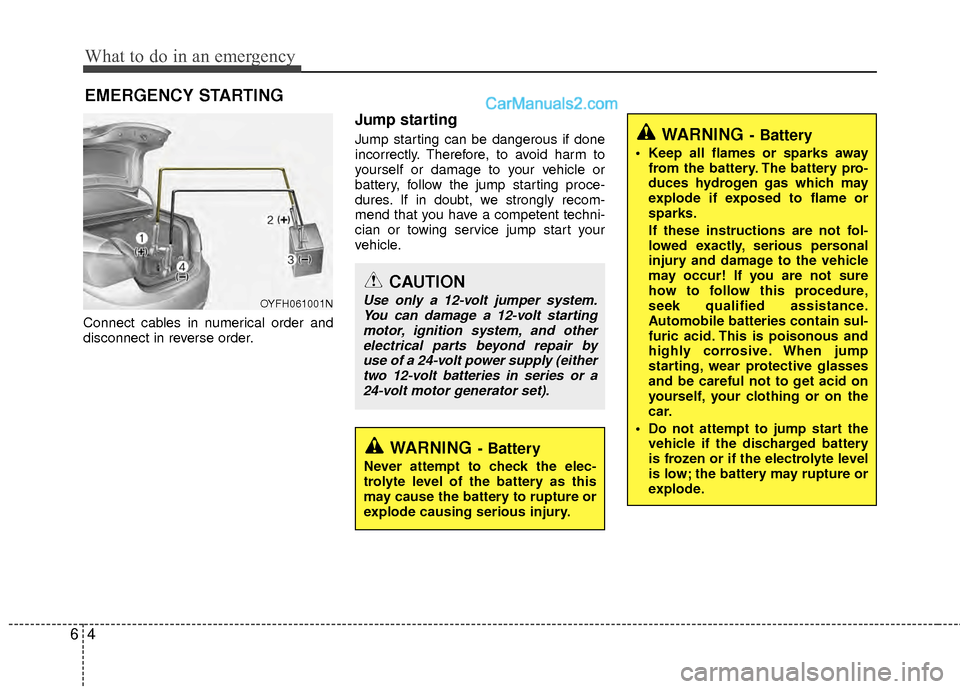
Connect cables in numerical order and
disconnect in reverse order.
Jump starting
Jump starting can be dangerous if done
incorrectly. Therefore, to avoid harm to
yourself or damage to your vehicle or
battery, follow the jump starting proce-
dures. If in doubt, we strongly recom-
mend that you have a competent techni-
cian or towing service jump start your
vehicle.
CAUTION
Use only a 12-volt jumper system.You can damage a 12-volt starting motor, ignition system, and otherelectrical parts beyond repair byuse of a 24-volt power supply (eithertwo 12-volt batteries in series or a24-volt motor generator set).
WARNING- Battery
• Keep all flames or sparks away from the battery. The battery pro-
duces hydrogen gas which may
explode if exposed to flame or
sparks.
If these instructions are not fol-
lowed exactly, serious personal
injury and damage to the vehicle
may occur! If you are not sure
how to follow this procedure,
seek qualified assistance.
Automobile batteries contain sul-
furic acid. This is poisonous and
highly corrosive. When jump
starting, wear protective glasses
and be careful not to get acid on
yourself, your clothing or on the
car.
Do not attempt to jump start the vehicle if the discharged battery
is frozen or if the electrolyte level
is low; the battery may rupture or
explode.
WARNING- Battery
Never attempt to check the elec-
trolyte level of the battery as this
may cause the battery to rupture or
explode causing serious injury.
OYFH061001N
Page 292 of 403
What to do in an emergency
26
6
Technical Data
System voltage: DC 12 V
Working voltage: DC 10 - 15 V
Amperage rating: max. 15 A
Suitable for use at temperatures:
-22 ~ +158°F (-30 ~ +70°C)
Max. working pressure: 87 psi (6 bar)
Size
Compressor: 6.6 x 5.9 x 2.7 in. (168 x 150 x 68 mm)
Sealant bottle: 4.1 x ø 3.3 in. (104 x ø 85 mm)
Compressor weight: 2.31 lbs (1.05 kg)
Sealant volume: 18.3 cu. in. (300 ml)
Sealant warranty:
5 years (sealant.)
WARNING
The tire inflation pressure must
be at least 200 kPa (29 psi). If it is
not, do not continue driving. Call
for road side service or towing.
CAUTION
If the inflation pressure is notmaintained, drive the vehicle asecond time, refer to Distributingthe sealant. Then repeat steps 1to 4.
Use of the TireMobilityKit maybe ineffectual for tire damagelarger than approximately 4 mm(0.16 in).
Please contact the nearestHYUNDAI A/S center, or a work-shop that works according toHYUNDAI repair procedureswith correspondingly trainedpersonnel if the tire cannot bemade roadworthy with theTireMobilityKit.
WARNING
It is important to replace the
sealant compound bottle after it
is used in case of another tire
emergency. Sealing compound
and spare parts can be
obtained and replaced at an
authorized vehicle or tire dealer.
And, empty sealing compound
bottles, liquid residue from the
sealing compound should be
disposed of at an authorized
HYUNDAI dealer or in accor-
dance with local waste disposal
regulations for safe disposal.
Page 293 of 403
627
What to do in an emergency
TOWING
Towing service
If emergency towing is necessary, we
recommend having it done by an author-
ized Hyundai dealer or a commercial
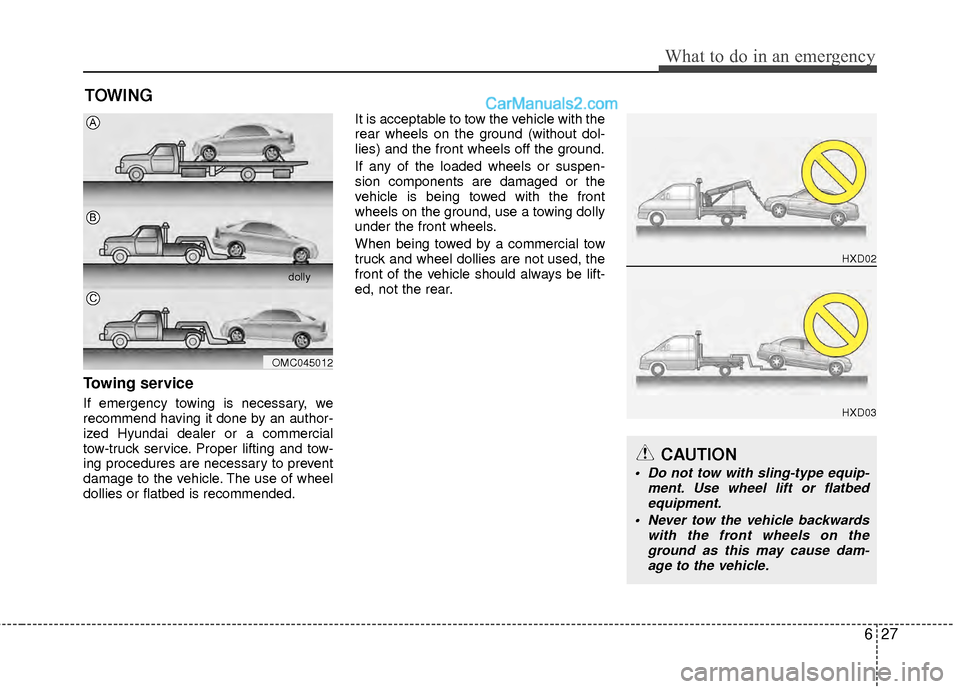
tow-truck service. Proper lifting and tow-
ing procedures are necessary to prevent
damage to the vehicle. The use of wheel
dollies or flatbed is recommended.It is acceptable to tow the vehicle with the
rear wheels on the ground (without dol-
lies) and the front wheels off the ground.
If any of the loaded wheels or suspen-
sion components are damaged or the
vehicle is being towed with the front
wheels on the ground, use a towing dolly
under the front wheels.
When being towed by a commercial tow
truck and wheel dollies are not used, the
front of the vehicle should always be lift-
ed, not the rear.
OMC045012
dolly
A
B
C
CAUTION
Do not tow with sling-type equip-
ment. Use wheel lift or flatbedequipment.
Never tow the vehicle backwards with the front wheels on theground as this may cause dam-age to the vehicle.
HXD02
HXD03
Page 311 of 403
Maintenance
18
7
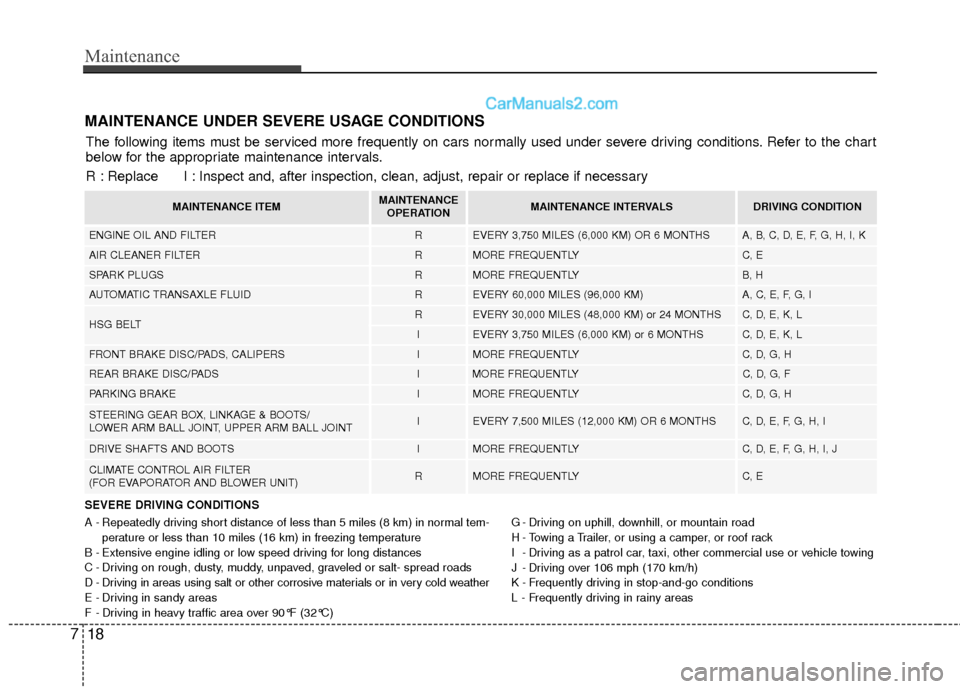
MAINTENANCE UNDER SEVERE USAGE CONDITIONS
SEVERE DRIVING CONDITIONS
A - Repeatedly driving short distance of less than 5 miles (8 km) in normal tem-
perature or less than 10 miles (16 km) in freezing temperature
B - Extensive engine idling or low speed driving for long distances
C - Driving on rough, dusty, muddy, unpaved, graveled or salt- spread roads
D - Driving in areas using salt or other corrosive materials or in very cold weather
E - Driving in sandy areas
F - Driving in heavy traffic area over 90°F (32°C) G - Driving on uphill, downhill, or mountain road
H - Towing a Trailer, or using a camper, or roof rack
I - Driving as a patrol car, taxi, other commercial use or vehicle towing
J - Driving over 106 mph (170 km/h)
K - Frequently driving in stop-and-go conditions
L - Frequently driving in rainy areas
The following items must be serviced more frequently on cars normally used under severe driving conditions. Refer to the chart
below for the appropriate maintenance intervals.
R : Replace I : Inspect and, after inspection, clean, adjust, repair or replace if neces\
sary
MAINTENANCE ITEMMAINTENANCE
OPERATIONMAINTENANCE INTERVALSDRIVING CONDITION
ENGINE OIL AND FILTERREVERY 3,750 MILES (6,000 KM) OR 6 MONTHSA, B, C, D, E, F, G, H, I, K
AIR CLEANER FILTERRMORE FREQUENTLYC, E
SPARK PLUGSRMORE FREQUENTLYB, H
AUTOMATIC TRANSAXLE FLUIDREVERY 60,000 MILES (96,000 KM) A, C, E, F, G, I
HSG BELT REVERY 30,000 MILES (48,000 KM) or 24 MONTHS C, D, E, K, L
IEVERY 3,750 MILES (6,000 KM) or 6 MONTHS C, D, E, K, L
FRONT BRAKE DISC/PADS, CALIPERSIMORE FREQUENTLYC, D, G, H
REAR BRAKE DISC/PADSIMORE FREQUENTLYC, D, G, F
PARKING BRAKEIMORE FREQUENTLYC, D, G, H
STEERING GEAR BOX, LINKAGE & BOOTS/
LOWER ARM BALL JOINT, UPPER ARM BALL JOINTIEVERY 7,500 MILES (12,000 KM) OR 6 MONTHSC, D, E, F, G, H, I
DRIVE SHAFTS AND BOOTSIMORE FREQUENTLYC, D, E, F, G, H, I, J
CLIMATE CONTROL AIR FILTER
(FOR EVAPORATOR AND BLOWER UNIT)RMORE FREQUENTLYC, E
Page 394 of 403
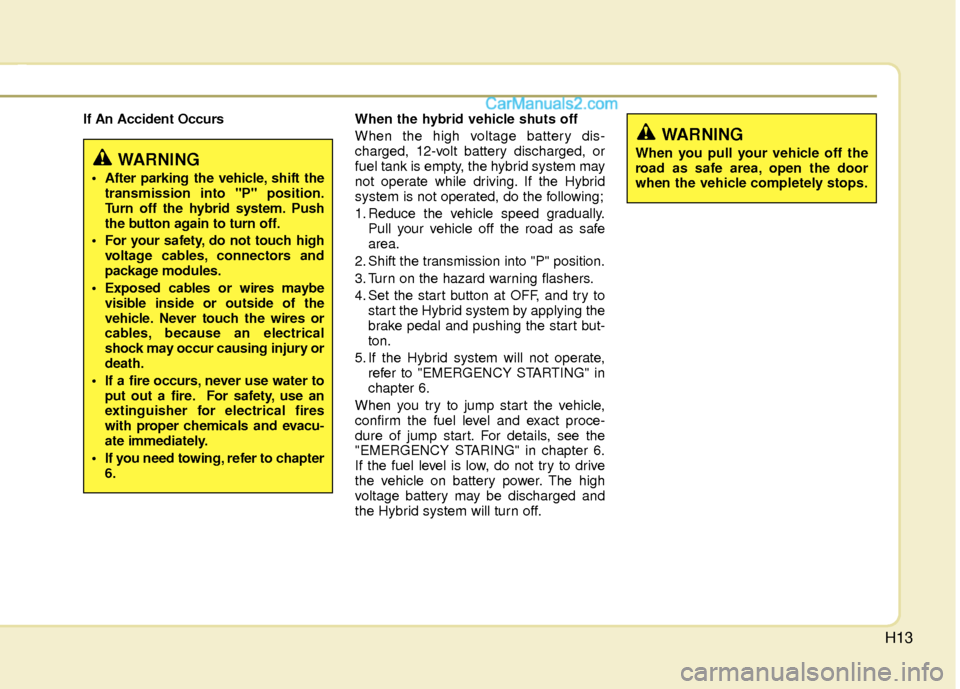
H13
If An Accident OccursWhen the hybrid vehicle shuts off
When the high voltage battery dis-
charged, 12-volt battery discharged, or
fuel tank is empty, the hybrid system may
not operate while driving. If the Hybrid
system is not operated, do the following;
1. Reduce the vehicle speed gradually.
Pull your vehicle off the road as safe
area.
2. Shift the transmission into "P" position.
3. Turn on the hazard warning flashers.
4. Set the start button at OFF, and try to start the Hybrid system by applying the
brake pedal and pushing the start but-
ton.
5. If the Hybrid system will not operate, refer to "EMERGENCY STARTING" in
chapter 6.
When you try to jump start the vehicle,
confirm the fuel level and exact proce-
dure of jump start. For details, see the
"EMERGENCY STARING" in chapter 6.
If the fuel level is low, do not try to drive
the vehicle on battery power. The high
voltage battery may be discharged and
the Hybrid system will turn off.
WARNING
After parking the vehicle, shift the transmission into "P" position.
Turn off the hybrid system. Push
the button again to turn off.
For your safety, do not touch high voltage cables, connectors and
package modules.
Exposed cables or wires maybe visible inside or outside of the
vehicle. Never touch the wires or
cables, because an electrical
shock may occur causing injury or
death.
If a fire occurs, never use water to put out a fire. For safety, use an
extinguisher for electrical fires
with proper chemicals and evacu-
ate immediately.
If you need towing, refer to chapter 6.
WARNING
When you pull your vehicle off the
road as safe area, open the door
when the vehicle completely stops.
Page 403 of 403

I9
Index
Tires and wheels ··················\
··················\
··················\
········8-4
Towing ··················\
··················\
··················\
··················\
···6-27
Trailer towing ··················\
··················\
··················\
··········5-44
TransaxleAutomatic transaxle ··················\
··················\
················5-9
Trip computer ··················\
··················\
··················\
··········4-44
Trunk ··················\
··················\
··················\
··················\
······4-15
Trunk overview ··················\
··················\
··················\
··········2-5
Using the tire mobility kit ··················\
··················\
·········6-24
Vehicle break-in process ··················\
··················\
··············1-5
Vehicle certification label ··················\
··················\
············8-7
Vehicle data collection and event data recorders (EDR)·1-6
Vehicle identification number (VIN) ··················\
·············8-7
Vehicle load limit ··················\
··················\
··················\
·····5-38 Certification label ··················\
··················\
··················\
5-41
Vehicle weight ··················\
··················\
··················\
·········5-43 Base curb weight ··················\
··················\
··················\
·5-43
Cargo weight ··················\
··················\
··················\
·······5-43
GAW (Gross axle weight) ··················\
··················\
·····5-43
GAWR (Gross axle weight rating)··················\
··········5-43
GVW (Gross vehicle weight)··················\
··················\
5-43
GVWR (Gross vehicle weight rating) ··················\
····5-43 Warning and indicators ··················\
··················\
··············4-53
Washer fluid ··················\
··················\
··················\
·············7-28
Weight ··················\
··················\
··················\
··················\
····5-43
Base curb weight ··················\
··················\
··················\
·5-43
Cargo weight ··················\
··················\
··················\
·······5-43
GAW (Gross axle weight) ··················\
··················\
·····5-43
GAWR (Gross axle weight rating)··················\
··········5-43
GVW (Gross vehicle weight)··················\
··················\
5-43
GVWR (Gross vehicle weight rating) ··················\
····5-43
Wheel alignment and tire balance ··················\
···············7-40
Wheel replacement ··················\
··················\
··················\
··7-42
Windows ··················\
··················\
··················\
··················\
4-17 Auto down window ··················\
··················\
···············4-18
Auto up/down window ··················\
··················\
··········4-19
Power window lock button ··················\
··················\
···4-20
Windshield defrosting and defogging··················\
········4-102 Defogging logic··················\
··················\
··················\
·4-104
Winter driving ··················\
··················\
··················\
··········5-34 Snow tires ··················\
··················\
··················\
············5-34
Tire chains ··················\
··················\
··················\
···········5-35
Wiper blades ··················\
··················\
··················\
············7-32
Wipers and washers ··················\
··················\
··················\
·4-74
U
V
W