engine Hyundai Sonata Hybrid 2015 Owner's Manual
[x] Cancel search | Manufacturer: HYUNDAI, Model Year: 2015, Model line: Sonata Hybrid, Model: Hyundai Sonata Hybrid 2015Pages: 543, PDF Size: 25.53 MB
Page 452 of 543
723
Maintenance
Changing the engine oil and filter
Have engine oil and filter changed by an
authorized HYUNDAI dealer according to
the Maintenance Schedule at the begin-
ning of this section.
CALIFORNIA PROPOSI-
TION 65 WARNING
Engine oil contains chemicals
known to the State of California to
cause cancer, birth defects, and
reproductive harm.
Used engine oil may cause irrita-
tion or cancer of the skin if left in
contact with the skin for prolonged
periods of time. Used engine oil
contains chemicals that have
caused cancer in laboratory ani-
mals. Always protect your skin by
washing your hands thoroughly
with soap and warm water as soon
as possible after handling used oil.
Page 453 of 543
Maintenance
24
7
COOLANT
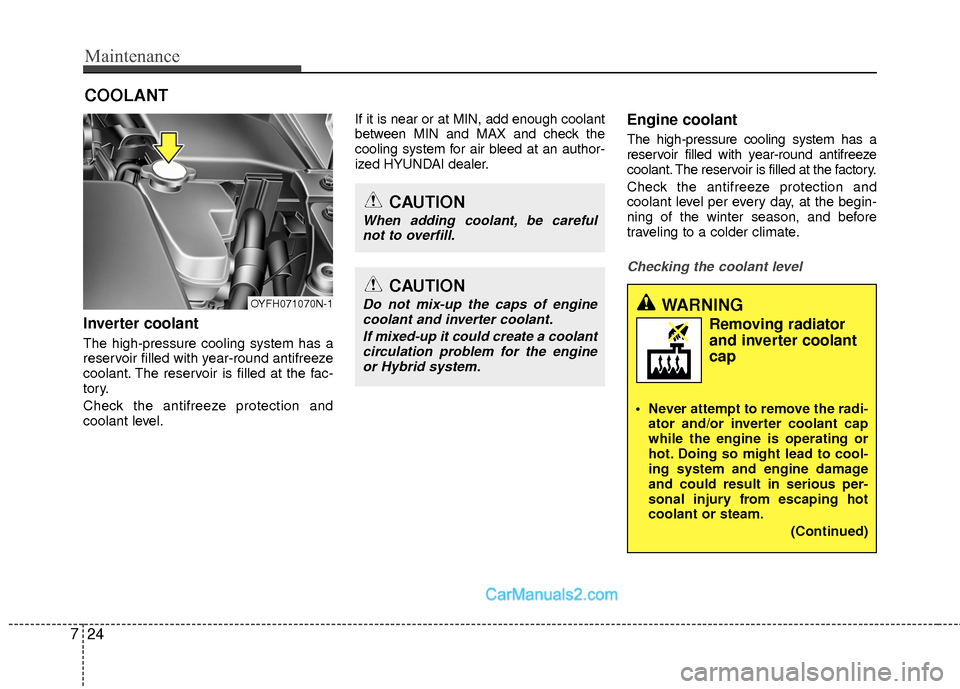
Inverter coolant
The high-pressure cooling system has a
reservoir filled with year-round antifreeze
coolant. The reservoir is filled at the fac-
tory.
Check the antifreeze protection and
coolant level. If it is near or at MIN, add enough coolant
between MIN and MAX and check the
cooling system for air bleed at an author-
ized HYUNDAI dealer.
Engine coolant
The high-pressure cooling system has a
reservoir filled with year-round antifreeze
coolant. The reservoir is filled at the factory.
Check the antifreeze protection and
coolant level per every day, at the begin-
ning of the winter season, and before
traveling to a colder climate.
Checking the coolant level
CAUTION
Do not mix-up the caps of engine
coolant and inverter coolant.
If mixed-up it could create a coolantcirculation problem for the engineor Hybrid system.
CAUTION
When adding coolant, be carefulnot to overfill.
WARNING
Removing radiator
and inverter coolant
cap
Never attempt to remove the radi- ator and/or inverter coolant cap
while the engine is operating or
hot. Doing so might lead to cool-
ing system and engine damage
and could result in serious per-
sonal injury from escaping hot
coolant or steam.
(Continued)
OYFH071070N-1
Page 454 of 543
725
Maintenance
Check the condition and connections of
all cooling system hoses and heater
hoses. Replace any swollen or deterio-
rated hoses.
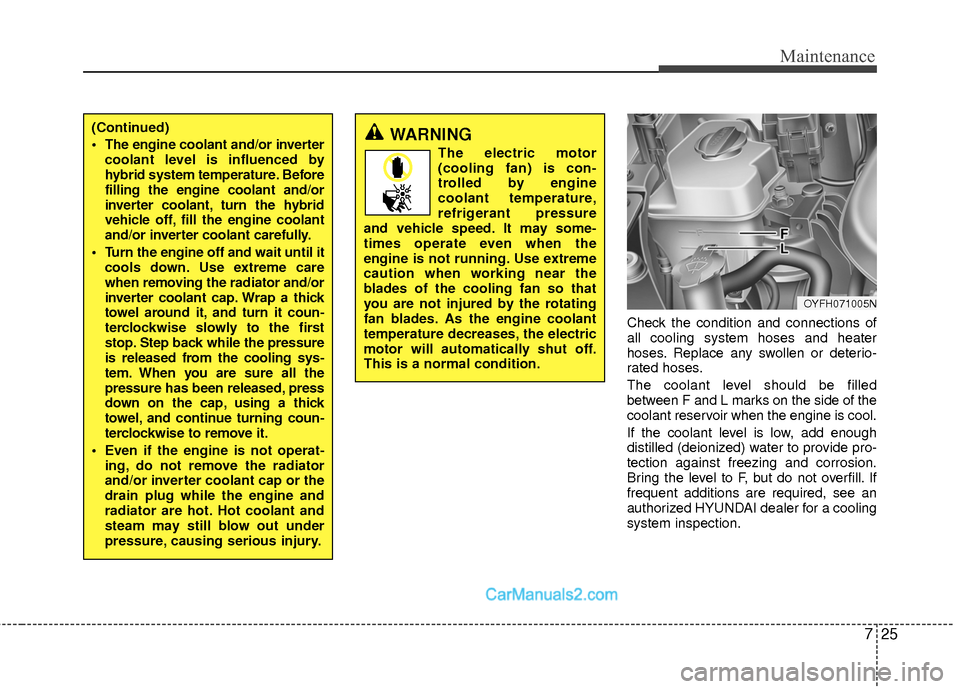
The coolant level should be filled
between F and L marks on the side of the
coolant reservoir when the engine is cool.
If the coolant level is low, add enough
distilled (deionized) water to provide pro-
tection against freezing and corrosion.
Bring the level to F, but do not overfill. If
frequent additions are required, see an
authorized HYUNDAI dealer for a cooling
system inspection.
OYFH071005N
(Continued)
The engine coolant and/or invertercoolant level is influenced by
hybrid system temperature. Before
filling the engine coolant and/or
inverter coolant, turn the hybrid
vehicle off, fill the engine coolant
and/or inverter coolant carefully.
Turn the engine off and wait until it cools down. Use extreme care
when removing the radiator and/or
inverter coolant cap. Wrap a thick
towel around it, and turn it coun-
terclockwise slowly to the first
stop. Step back while the pressure
is released from the cooling sys-
tem. When you are sure all the
pressure has been released, press
down on the cap, using a thick
towel, and continue turning coun-
terclockwise to remove it.
Even if the engine is not operat- ing, do not remove the radiator
and/or inverter coolant cap or the
drain plug while the engine and
radiator are hot. Hot coolant and
steam may still blow out under
pressure, causing serious injury.WARNING
The electric motor
(cooling fan) is con-
trolled by engine
coolant temperature,
refrigerant pressure
and vehicle speed. It may some-
times operate even when the
engine is not running. Use extreme
caution when working near the
blades of the cooling fan so that
you are not injured by the rotating
fan blades. As the engine coolant
temperature decreases, the electric
motor will automatically shut off.
This is a normal condition.
Page 455 of 543

Maintenance
26
7
Recommended engine and inverter
coolant
When adding coolant, use only deion- ized water or soft water for your vehicle
and never mix hard water in the
coolant filled at the factory. An improp-
er coolant mixture can result in serious
malfunction or engine damage.
The engine in your vehicle has aluminum engine parts and must be protected by
an ethylene-glycol-based coolant to pre-
vent corrosion and freezing.
DO NOT USE alcohol or methanol coolant or mix them with the specified
coolant.
Do not use a solution that contains more than 60% antifreeze or less than
35% antifreeze, which would reduce
the effectiveness of the solution.
For mixture percentage, refer to the fol-
lowing table.
Changing the coolant
Have engine and inverter coolant
changed by an authorized HYUNDAI
dealer according to the Maintenance
Schedule at the beginning of this section.
WARNING - Radiator cap &
Inverter coolant cap
Do not remove the radiator cap and
/or inverter coolant cap when the
engine and radiator are hot.
Scalding hot coolant and steam
may blow out under pressure caus-
ing serious injury.
WARNING -Coolant
Do not use radiator coolant or
antifreeze in the washer fluid
reservoir.
Radiator coolant can severely obscure visibility when sprayed
on the windshield and may cause
loss of vehicle control or damage
to paint and body trim.
CAUTION
Put a thick cloth or fabric aroundthe radiator and/or inverter cap before refilling the coolant in orderto prevent the coolant from over- flowing into engine parts such asthe generator.
5°F (-15°C) 35 65
-13°F (-25°C) 40 60
-31°F (-35°C) 50 50
-49°F (-45°C) 60 40
Ambient
Temperature Mixture Percentage (volume)
Antifreeze Water
OYFH071006N-1
OYFH071070N-1
Radiator cap
Inverter coolant cap
Page 456 of 543
727
Maintenance
BRAKE FLUID
Checking the brake fluid level
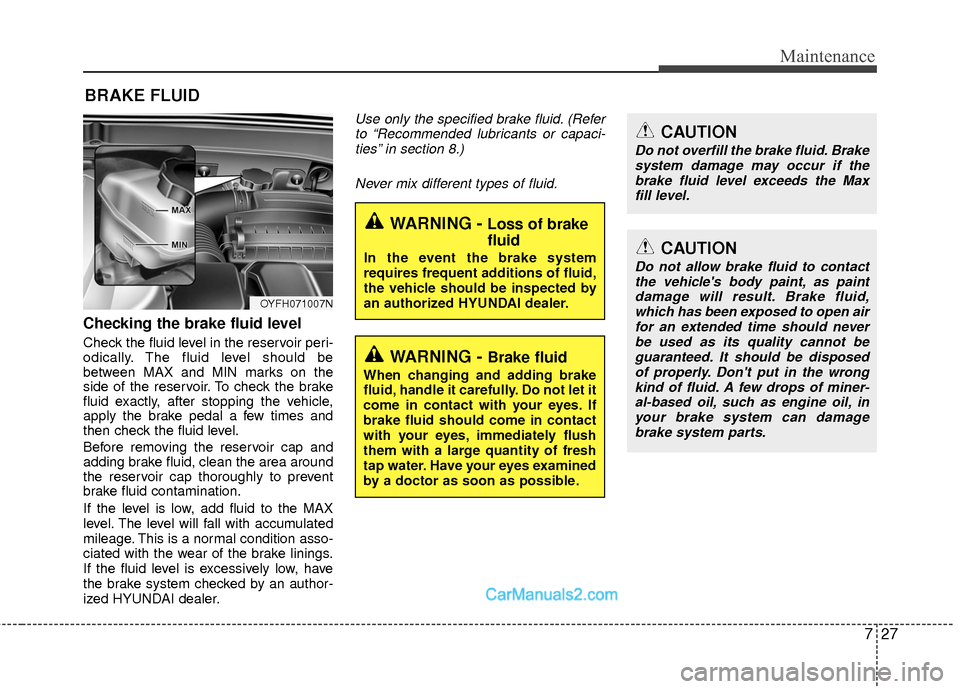
Check the fluid level in the reservoir peri-
odically. The fluid level should be
between MAX and MIN marks on the
side of the reservoir. To check the brake
fluid exactly, after stopping the vehicle,
apply the brake pedal a few times and
then check the fluid level.
Before removing the reservoir cap and
adding brake fluid, clean the area around
the reservoir cap thoroughly to prevent
brake fluid contamination.
If the level is low, add fluid to the MAX
level. The level will fall with accumulated
mileage. This is a normal condition asso-
ciated with the wear of the brake linings.
If the fluid level is excessively low, have
the brake system checked by an author-
ized HYUNDAI dealer.
Use only the specified brake fluid. (Referto “Recommended lubricants or capaci-ties” in section 8.)
Never mix different types of fluid.
WARNING - Brake fluid
When changing and adding brake
fluid, handle it carefully. Do not let it
come in contact with your eyes. If
brake fluid should come in contact
with your eyes, immediately flush
them with a large quantity of fresh
tap water. Have your eyes examined
by a doctor as soon as possible.
WARNING - Loss of brake
fluid
In the event the brake system
requires frequent additions of fluid,
the vehicle should be inspected by
an authorized HYUNDAI dealer.CAUTION
Do not allow brake fluid to contactthe vehicle's body paint, as paintdamage will result. Brake fluid,which has been exposed to open air for an extended time should neverbe used as its quality cannot be guaranteed. It should be disposedof properly. Don't put in the wrongkind of fluid. A few drops of miner- al-based oil, such as engine oil, inyour brake system can damage brake system parts.
CAUTION
Do not overfill the brake fluid. Brakesystem damage may occur if thebrake fluid level exceeds the Max fill level.
OYFH071007N
Page 459 of 543

Maintenance
30
7
Replace the filter according to the
Maintenance Schedule.
If the vehicle is operated in extremely
dusty or sandy areas, replace the ele-ment more often than the usual recom-mended intervals. (Refer to“Maintenance under severe usage condi-tions” in this section.)
Filter inspection
The climate control air filter should be
replaced according to the Maintenance
Schedule. If the vehicle is operated in
severely air-polluted cities or on dusty
rough roads for a long period, it should
be inspected more frequently and
replaced earlier. When you replace the
climate control air filter, replace it by per-
forming the following procedure, and be
careful to avoid damaging other compo-
nents.
Filter replacement
1. Open the glove box and remove the support strap (1).
CAUTION
Do not drive with the air cleaner removed; this will result in exces-sive engine wear.
When removing the air cleaner fil- ter, be careful that dust or dirtdoes not enter the air intake, ordamage may result.
Use a HYUNDAI genuine part. Use of non-genuine parts could dam-age the air flow sensor.
CLIMATE CONTROL AIR FILTER
OYF079014
Page 464 of 543

735
Maintenance
12V Battery recharging
Your vehicle has a maintenance-free,
calcium-based battery.
If the 12V battery becomes dischargedin a short time (because, for example,
the headlights or interior lights were
left on while the vehicle was not in
use), jump start it from another vehi-
cle’s 12V battery or recharge it by slow
charging (trickle) for 10 hours.
If the 12V battery gradually discharges because of high electric load while the
vehicle is being used, recharge it at 20-
30A for two hours.CALIFORNIA PROPOSI-
TION 65 WARNING
Battery posts, terminals, and relat-
ed accessories contain lead and
lead compounds, chemicals known
to the State of California to cause
cancer, birth defects and reproduc-
tive harm. Batteries also contain
other chemicals known to the State
of California to cause cancer. Wash
hands after handling.
CAUTION
When you don’t use the vehicle
for a long time in the low temper-ature, remove the 12V battery andstore it indoors.
Always charge the 12V battery fully to prevent 12V battery casedamage in low temperatures.
If you connect unauthorized elec- tronic devices to the 12V battery,the 12V battery may be dis- charged. Never use unauthorizeddevices.
(Continued)
When lifting a plastic-cased bat- tery, excessive pressure on the
case may cause battery acid to
leak, resulting in personal injury.
Lift with a battery carrier or with
your hands on opposite corners.
Never attempt to recharge the battery when the battery cables
are connected.
The electrical ignition system works with high voltage. Never
touch these components with the
engine running or the engine
start/stop button positioned on.
Failure to follow the above warn-
ings can result in serious bodily
injury or death.
Page 465 of 543
Maintenance
36
7
Reset items
Items should be reset after the 12V bat-
tery has been discharged or the 12V bat-
tery has been disconnected.
Auto up/down window (See section 4)
Sunroof (See section 4)
Trip computer (See section 4)
Climate control system
(See section 4)
Clock (See section 4)
Audio (See section 4)WARNING
Before performing maintenance or recharging the 12V battery,
turn off all accessories and stop
the engine.
The negative battery cable must be removed first and installed
last when the 12V battery is dis-
connected.
Operation related to the 12V bat- tery should be done in an author-
ized HYUNDAI dealer.
WARNING- Recharging12V battery
When recharging the battery,
observe the following precautions:
The battery must be removed
from the vehicle and placed in an
area with good ventilation.
Do not allow cigarettes, sparks, or flame near the battery.
Watch the battery during charg- ing, and stop or reduce the charg-
ing rate if the battery cells begin
gassing (boiling) violently or if
the temperature of the electrolyte
of any cell exceeds 120°F (49°C).
Wear eye protection when check- ing the battery during charging.
Disconnect the battery charger in the following order.
1. Turn off the battery charger main switch.
2. Unhook the negative clamp from the negative battery terminal.
3. Unhook the positive clamp from the positive battery terminal.
Page 480 of 543
751
Maintenance
FUSES
A vehicle’s electrical system is protected
from electrical overload damage by fuses.
This vehicle has 2 fuse panels, one locat-
ed in the driver’s side panel bolster, the
other in the engine compartment.
If any of your vehicle’s lights, accessories,
or controls do not work, check the appro-
priate circuit fuse. If a fuse has blown, the
element inside the fuse will be melted.
If the electrical system does not work,
first check the driver’s side fuse panel.Always replace a blown fuse with one of
the same rating.
If the replacement fuse blows, this indi-
cates an electrical problem. Avoid using
the system involved and immediately
consult an authorized HYUNDAI dealer.
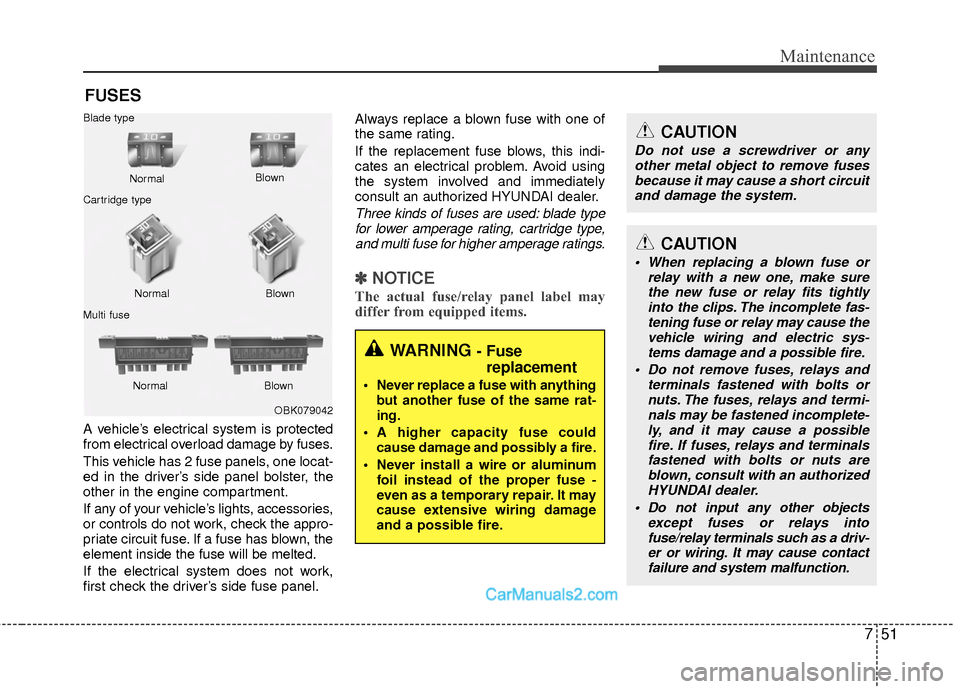
Three kinds of fuses are used: blade type
for lower amperage rating, cartridge type,and multi fuse for higher amperage ratings.
✽ ✽ NOTICE
The actual fuse/relay panel label may
differ from equipped items.
WARNING - Fuse
replacement
Never replace a fuse with anything
but another fuse of the same rat-
ing.
A higher capacity fuse could cause damage and possibly a fire.
Never install a wire or aluminum foil instead of the proper fuse -
even as a temporary repair. It may
cause extensive wiring damage
and a possible fire.
CAUTION
Do not use a screwdriver or anyother metal object to remove fusesbecause it may cause a short circuit and damage the system.
CAUTION
When replacing a blown fuse or relay with a new one, make surethe new fuse or relay fits tightly into the clips. The incomplete fas-tening fuse or relay may cause the vehicle wiring and electric sys-tems damage and a possible fire.
Do not remove fuses, relays and terminals fastened with bolts ornuts. The fuses, relays and termi-nals may be fastened incomplete- ly, and it may cause a possiblefire. If fuses, relays and terminals fastened with bolts or nuts areblown, consult with an authorized HYUNDAI dealer.
Do not input any other objects except fuses or relays intofuse/relay terminals such as a driv-er or wiring. It may cause contact failure and system malfunction.
OBK079042
Normal
Normal
Blade type
Cartridge type
Multi fuse Blown
Blown
Normal Blown
Page 481 of 543
Maintenance
52
7
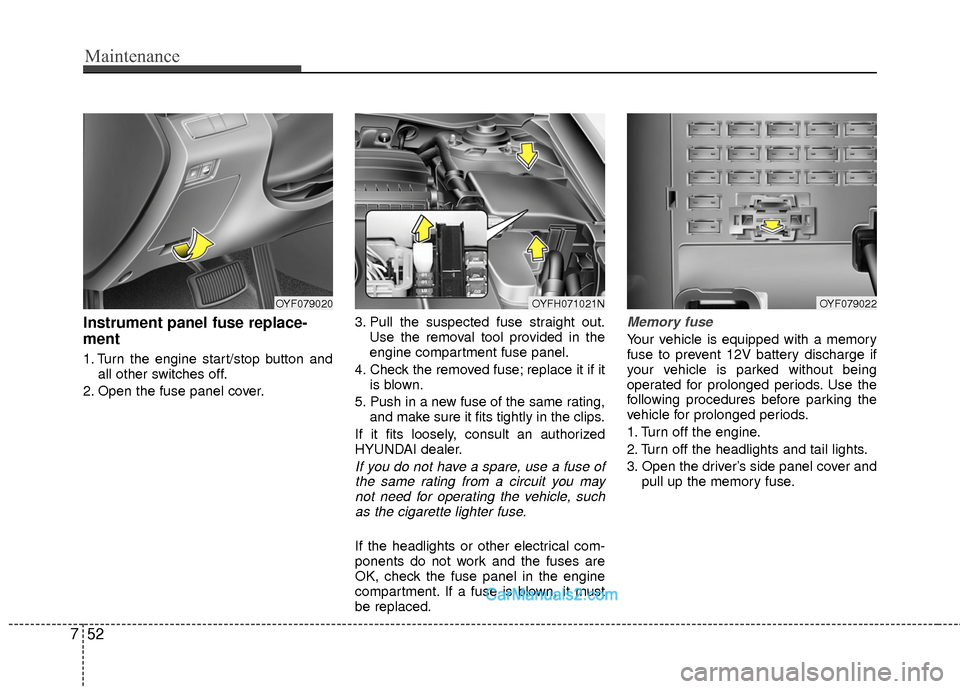
Instrument panel fuse replace-
ment
1. Turn the engine start/stop button and
all other switches off.
2. Open the fuse panel cover. 3. Pull the suspected fuse straight out.
Use the removal tool provided in the
engine compartment fuse panel.
4. Check the removed fuse; replace it if it is blown.
5. Push in a new fuse of the same rating, and make sure it fits tightly in the clips.
If it fits loosely, consult an authorized
HYUNDAI dealer.
If you do not have a spare, use a fuse of the same rating from a circuit you maynot need for operating the vehicle, suchas the cigarette lighter fuse.
If the headlights or other electrical com-
ponents do not work and the fuses are
OK, check the fuse panel in the engine
compartment. If a fuse is blown, it must
be replaced.
Memory fuse
Your vehicle is equipped with a memory
fuse to prevent 12V battery discharge if
your vehicle is parked without being
operated for prolonged periods. Use the
following procedures before parking the
vehicle for prolonged periods.
1. Turn off the engine.
2. Turn off the headlights and tail lights.
3. Open the driver’s side panel cover and pull up the memory fuse.
OYF079020OYFH071021NOYF079022