engine Hyundai Sonata Hybrid 2015 Owner's Manual
[x] Cancel search | Manufacturer: HYUNDAI, Model Year: 2015, Model line: Sonata Hybrid, Model: Hyundai Sonata Hybrid 2015Pages: 543, PDF Size: 25.53 MB
Page 482 of 543
753
Maintenance
✽
✽NOTICE
• If the memory fuse is pulled up from
the fuse panel, the warning chime,
audio, clock and interior lamps, etc.,
will not operate. Some items must be
reset after replacement. Refer to
“Battery” in this section.
• Even though the memory fuse is pulled up, the battery can still be dis-
charged by operation of the head-
lights or other electrical devices.
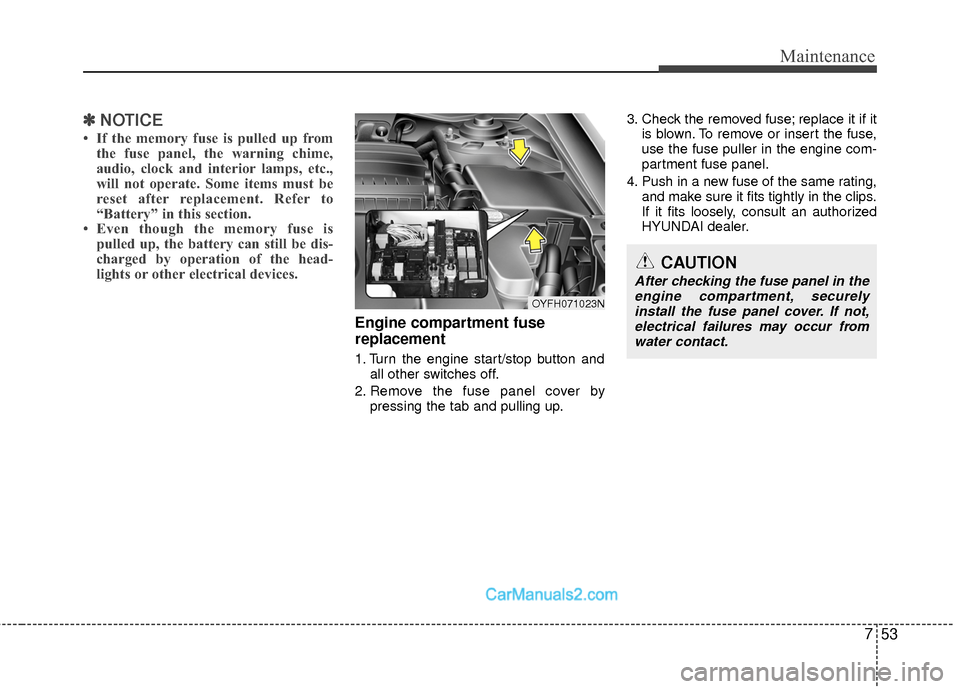
Engine compartment fuse
replacement
1. Turn the engine start/stop button and
all other switches off.
2. Remove the fuse panel cover by pressing the tab and pulling up. 3. Check the removed fuse; replace it if it
is blown. To remove or insert the fuse,
use the fuse puller in the engine com-
partment fuse panel.
4. Push in a new fuse of the same rating, and make sure it fits tightly in the clips.
If it fits loosely, consult an authorized
HYUNDAI dealer.
OYFH071023N
CAUTION
After checking the fuse panel in theengine compartment, securelyinstall the fuse panel cover. If not, electrical failures may occur fromwater contact.
Page 483 of 543
Maintenance
54
7
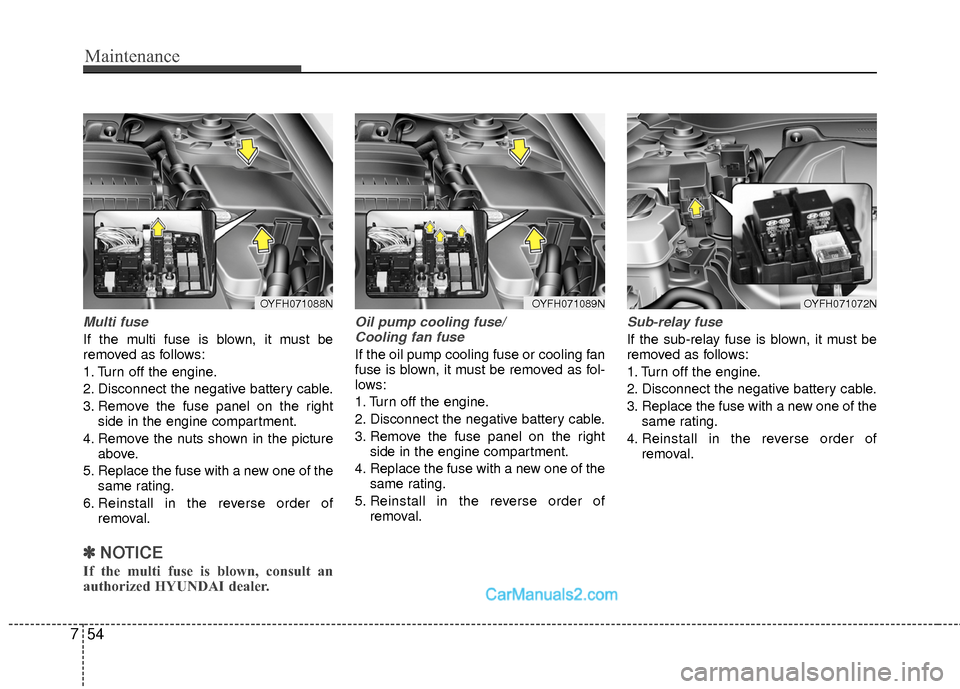
Multi fuse
If the multi fuse is blown, it must be
removed as follows:
1. Turn off the engine.
2. Disconnect the negative battery cable.
3. Remove the fuse panel on the right
side in the engine compartment.
4. Remove the nuts shown in the picture above.
5. Replace the fuse with a new one of the same rating.
6. Reinstall in the reverse order of removal.
✽ ✽NOTICE
If the multi fuse is blown, consult an
authorized HYUNDAI dealer.
Oil pump cooling fuse/
Cooling fan fuse
If the oil pump cooling fuse or cooling fan
fuse is blown, it must be removed as fol-
lows:
1. Turn off the engine.
2. Disconnect the negative battery cable.
3. Remove the fuse panel on the right side in the engine compartment.
4. Replace the fuse with a new one of the same rating.
5. Reinstall in the reverse order of removal.
Sub-relay fuse
If the sub-relay fuse is blown, it must be
removed as follows:
1. Turn off the engine.
2. Disconnect the negative battery cable.
3. Replace the fuse with a new one of thesame rating.
4. Reinstall in the reverse order of removal.
OYFH071088NOYFH071089NOYFH071072N
Page 484 of 543
755
Maintenance
Inner fuse panelEngine compartment fuse panel
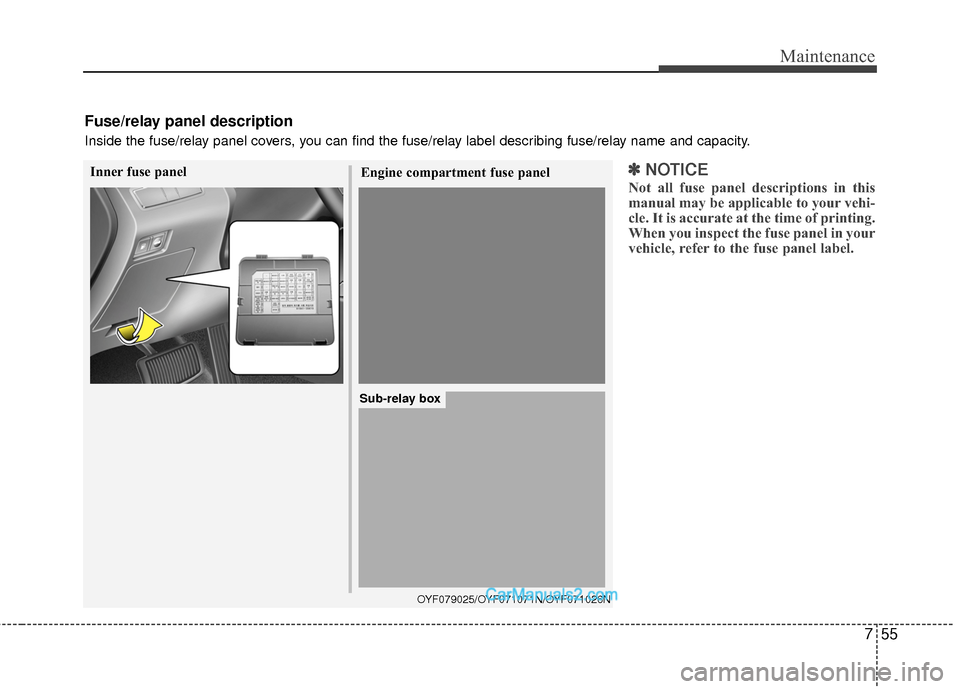
Fuse/relay panel description
Inside the fuse/relay panel covers, you can find the fuse/relay label describing fuse/relay name and capacity.
OYF079025/OYF071071N/OYF071026N
Sub-relay box
✽
✽NOTICE
Not all fuse panel descriptions in this
manual may be applicable to your vehi-
cle. It is accurate at the time of printing.
When you inspect the fuse panel in your
vehicle, refer to the fuse panel label.
Page 487 of 543
Maintenance
58
7
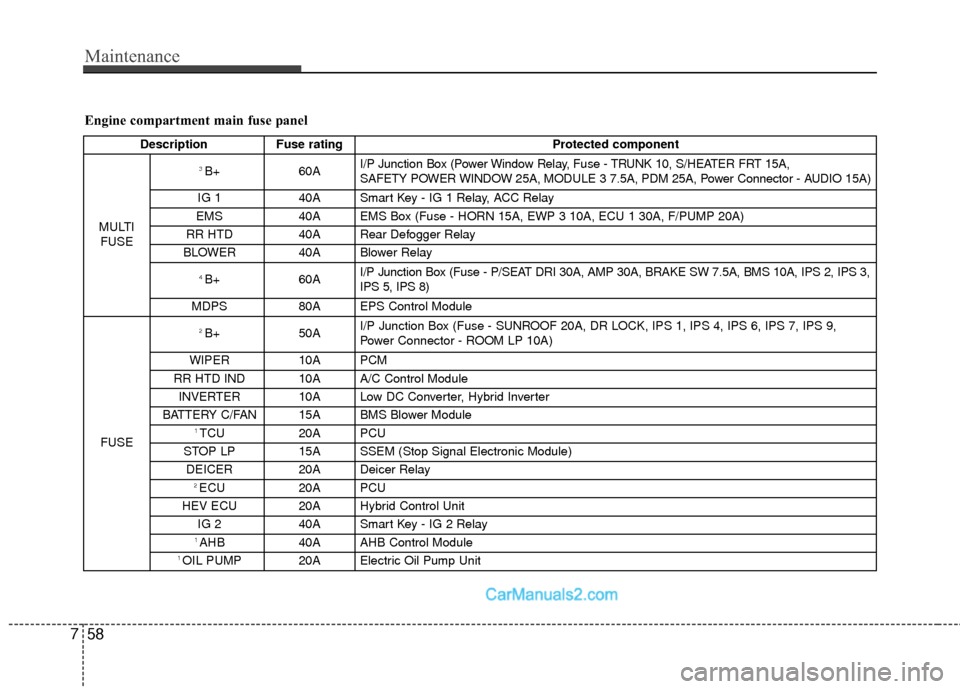
Engine compartment main fuse panel
Description Fuse rating Protected component
MULTI FUSE
3 B+ 60AI/P Junction Box (Power Window Relay, Fuse - TRUNK 10, S/HEATER FRT 15A,
SAFETY POWER WINDOW 25A, MODULE 3 7.5A, PDM 25A, Power Connector - AUDIO 15A)
IG 1 40A Smart Key - IG 1 Relay, ACC Relay
EMS 40A EMS Box (Fuse - HORN 15A, EWP 3 10A, ECU 1 30A, F/PUMP 20A)
RR HTD 40A Rear Defogger Relay
BLOWER 40A Blower Relay
4 B+60AI/P Junction Box (Fuse - P/SEAT DRI 30A, AMP 30A, BRAKE SW 7.5A, BMS 10A, IPS 2, IPS 3,
IPS 5, IPS 8)
MDPS 80A EPS Control Module
FUSE
2 B+ 50AI/P Junction Box (Fuse - SUNROOF 20A, DR LOCK, IPS 1, IPS 4, IPS 6, IPS 7, IPS 9,
Power Connector - ROOM LP 10A)
WIPER 10A PCM
RR HTD IND 10A A/C Control Module INVERTER 10A Low DC Converter, Hybrid Inverter
BATTERY C/FAN 15A BMS Blower Module
1 TCU 20A PCU
STOP LP 15A SSEM (Stop Signal Electronic Module)
DEICER 20A Deicer Relay
2 ECU 20A PCU
HEV ECU 20A Hybrid Control Unit
IG 2 40A Smart Key - IG 2 Relay
1 AHB 40A AHB Control Module1 OIL PUMP 20A Electric Oil Pump Unit
Page 488 of 543
759
Maintenance
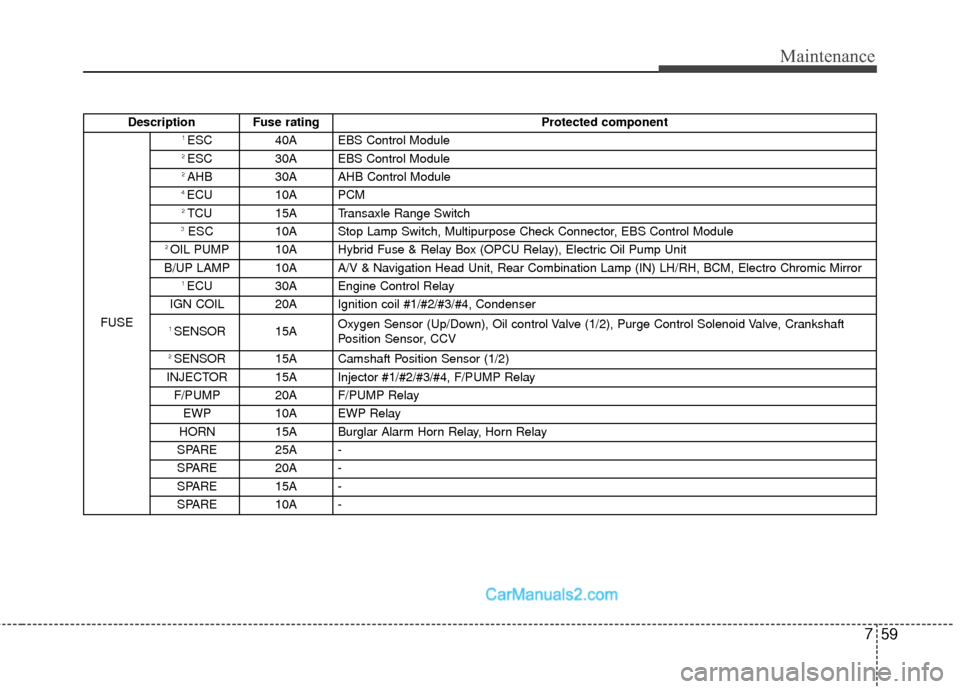
Description Fuse ratingProtected component
FUSE1 ESC 40A EBS Control Module2 ESC 30A EBS Control Module2 AHB 30A AHB Control Module4 ECU 10A PCM2 TCU 15A Transaxle Range Switch3ESC 10A Stop Lamp Switch, Multipurpose Check Connector, EBS Control Module2 OIL PUMP 10A Hybrid Fuse & Relay Box (OPCU Relay), Electric Oil Pump Unit
B/UP LAMP 10A A/V & Navigation Head Unit, Rear Combination Lamp (IN) LH/RH, BCM, Electro Chr\
omic Mirror
1 ECU 30A Engine Control Relay
IGN COIL 20A Ignition coil #1/#2/#3/#4, Condenser
1 SENSOR 15A Oxygen Sensor (Up/Down), Oil control Valve (1/2), Purge Control Solenoid Valve, Crankshaft
Position Sensor, CCV
2 SENSOR 15A Camshaft Position Sensor (1/2)
INJECTOR 15A Injector #1/#2/#3/#4, F/PUMP Relay F/PUMP 20A F/PUMP Relay EWP 10A EWP Relay
HORN 15A Burglar Alarm Horn Relay, Horn Relay
SPARE 25A -
SPARE 20A -
SPARE 15A -
SPARE 10A -
Page 489 of 543
Maintenance
60
7
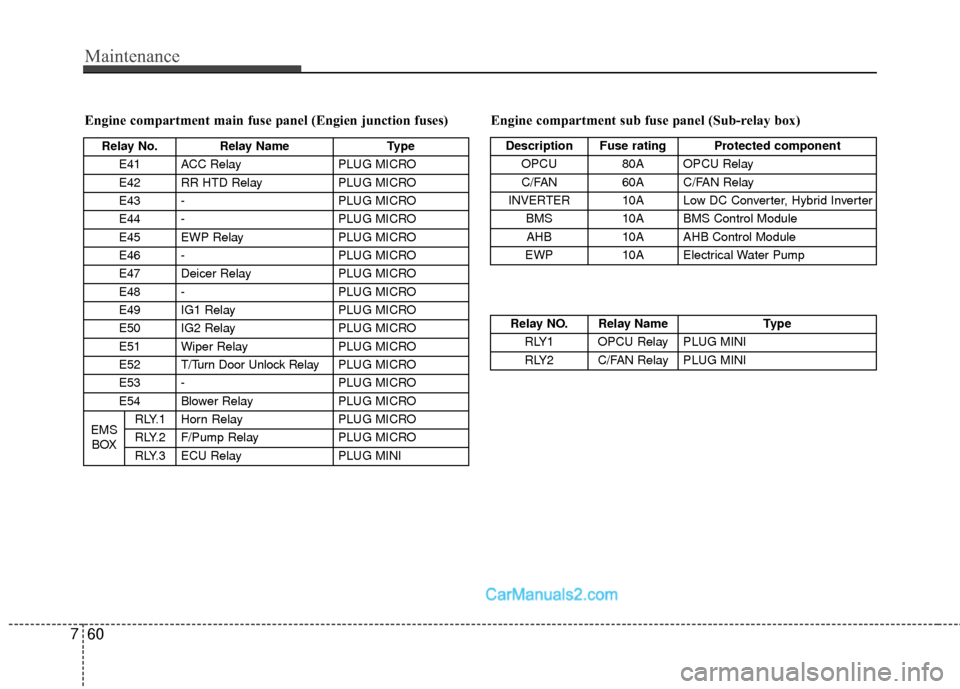
Engine compartment sub fuse panel (Sub-relay box)
Engine compartment main fuse panel (Engien junction fuses)
Description Fuse rating Protected component
OPCU 80A OPCU Relay
C/FAN 60A C/FAN Relay
INVERTER 10A Low DC Converter, Hybrid Inverter BMS 10A BMS Control Module
AHB 10A AHB Control Module
EWP 10A Electrical Water Pump
Relay NO. Relay Name Type
RLY1 OPCU Relay PLUG MINI
RLY2 C/FAN Relay PLUG MINI
Relay No. Relay Name Type
E41 ACC Relay PLUG MICRO
E42 RR HTD Relay PLUG MICRO
E43 - PLUG MICRO
E44 - PLUG MICRO
E45 EWP Relay PLUG MICRO
E46 - PLUG MICRO
E47 Deicer Relay PLUG MICRO
E48 - PLUG MICRO
E49 IG1 Relay PLUG MICRO
E50 IG2 Relay PLUG MICRO
E51 Wiper Relay PLUG MICRO
E52 T/Turn Door Unlock Relay PLUG MICRO
E53 - PLUG MICRO
E54 Blower Relay PLUG MICRO
EMS BOX RLY.1 Horn Relay
PLUG MICRO
RLY.2 F/Pump Relay PLUG MICRO
RLY.3 ECU Relay PLUG MINI
Page 490 of 543
761
Maintenance
LIGHT BULBS
Use only bulbs of the specified wattage.
✽
✽NOTICE
After heavy, driving rain or washing,
headlight and taillight lenses could
appear frosty. This condition is caused by
the temperature difference between the
lamp inside and outside. This is similar
to the condensation on your windows
inside your vehicle during the rain and
doesn’t indicate a problem with your
vehicle. If the water leaks into the lamp
bulb circuitry, have the vehicle checked
by an authorized HYUNDAI dealer.
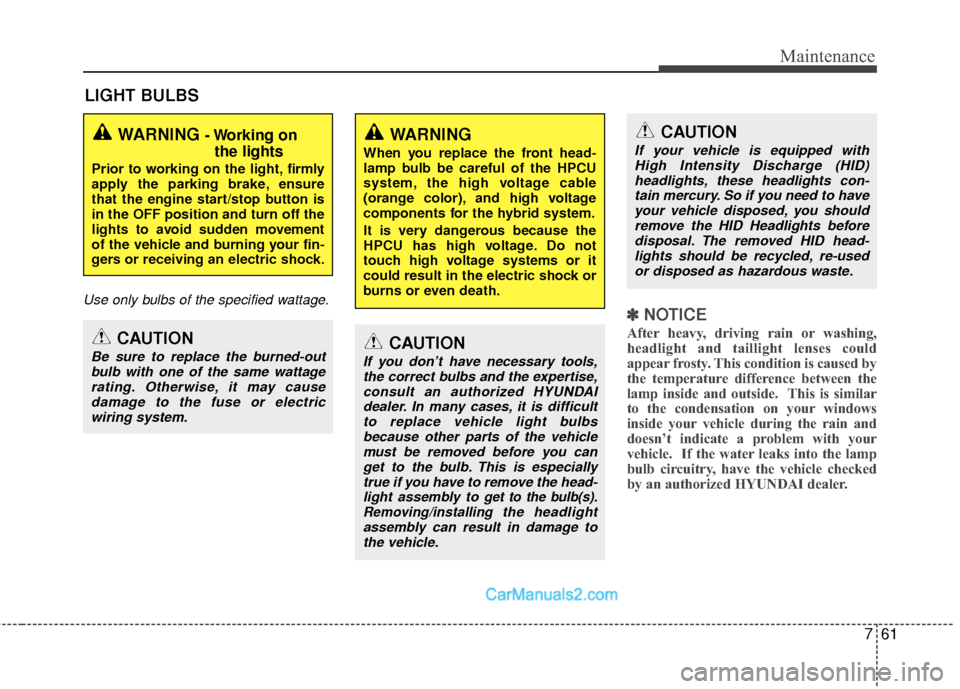
WARNING - Working on
the lights
Prior to working on the light, firmly
apply the parking brake, ensure
that the engine start/stop button is
in the OFF position and turn off the
lights to avoid sudden movement
of the vehicle and burning your fin-
gers or receiving an electric shock.
CAUTION
Be sure to replace the burned-out
bulb with one of the same wattagerating. Otherwise, it may causedamage to the fuse or electricwiring system.CAUTION
If you don’t have necessary tools,the correct bulbs and the expertise,consult an authorized HYUNDAIdealer. In many cases, it is difficultto replace vehicle light bulbsbecause other parts of the vehicle must be removed before you canget to the bulb. This is especiallytrue if you have to remove the head-light assembly to
get to the bulb(s).
Removing/installingthe headlight
assembly can result in damage to the vehicle.
WARNING
When you replace the front head-
lamp bulb be careful of the HPCU
system, the high voltage cable
(orange color), and high voltage
components for the hybrid system.
It is very dangerous because the
HPCU has high voltage. Do not
touch high voltage systems or it
could result in the electric shock or
burns or even death.
CAUTION
If your vehicle is equipped withHigh Intensity Discharge (HID)headlights, these headlights con- tain mercury. So if you need to haveyour vehicle disposed, you shouldremove the HID Headlights before disposal. The removed HID head-lights should be recycled, re-used or disposed as hazardous waste.
Page 500 of 543
771
Maintenance
APPEARANCE CARE
Exterior care
Exterior general caution
It is very important to follow the label
directions when using any chemical
cleaner or polish. Read all warning and
caution statements that appear on the
label.
Finish maintenance
Washing
To help protect your vehicle’s finish from
rust and deterioration, wash it thoroughly
and frequently at least once a month with
lukewarm or cold water.
If you use your vehicle for off-road driv-
ing, you should wash it after each off-
road trip. Pay special attention to the
removal of any accumulation of salt, dirt,
mud, and other foreign materials. Make
sure the drain holes in the lower edges of
the doors and rocker panels are kept
clear and clean.
Insects, tar, tree sap, bird droppings,
industrial pollution and similar deposits
can damage your vehicle’s finish if not
removed immediately.
Even prompt washing with plain water
may not completely remove all these
deposits. A mild soap, safe for use on
painted surfaces, may be used.After washing, rinse the vehicle thor-
oughly with lukewarm or cold water. Do
not allow soap to dry on the finish.
CAUTION
Do not use strong soap, chemical
detergents or hot water, and donot wash the vehicle in directsunlight or when the body of thevehicle is warm.
Be careful when washing the side windows of your vehicle.Especially, with high-pressure water, water may leak through thewindows and wet the interior.
To prevent damage to the plastic parts and lamps, do not cleanwith chemical solvents or strongdetergents.
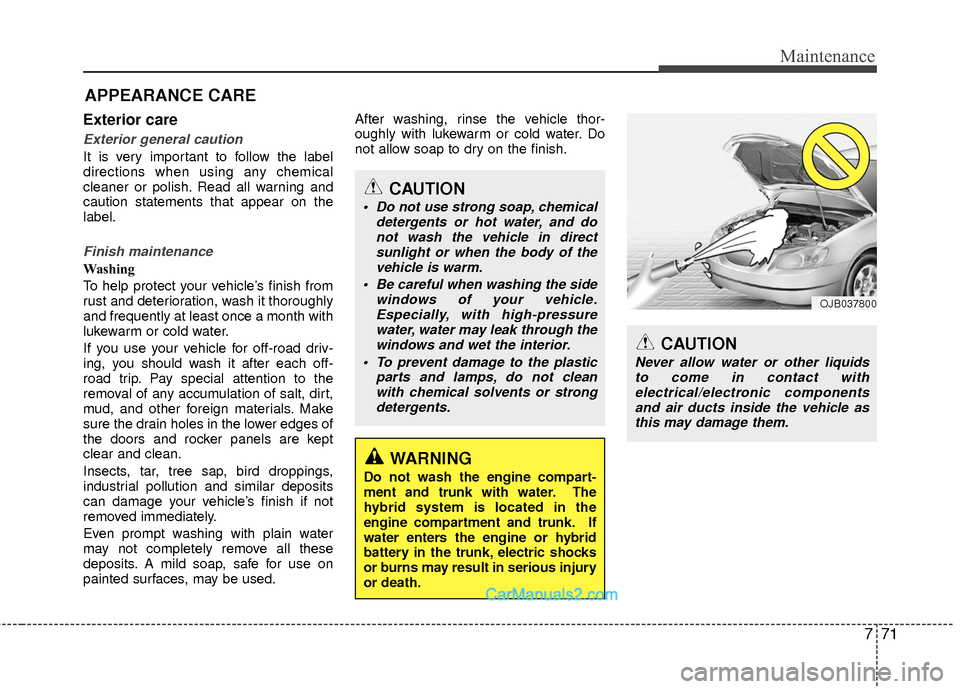
WARNING
Do not wash the engine compart-
ment and trunk with water. The
hybrid system is located in the
engine compartment and trunk. If
water enters the engine or hybrid
battery in the trunk, electric shocks
or burns may result in serious injury
or death.
CAUTION
Never allow water or other liquidsto come in contact withelectrical/electronic components and air ducts inside the vehicle asthis may damage them.
OJB037800
Page 505 of 543
Maintenance
76
7
Cleaning the upholstery and interior
trim
Vinyl
Remove dust and loose dirt from vinyl
with a whisk broom or vacuum cleaner.
Clean vinyl surfaces with a vinyl cleaner.
Fabric
Remove dust and loose dirt from fabric
with a whisk broom or vacuum cleaner.
Clean with a mild soap solution recom-
mended for upholstery or carpets.
Remove fresh spots immediately with a
fabric spot cleaner. If fresh spots do not
receive immediate attention, the fabric
can be stained and its color can be
affected. Also, its fire-resistant properties
can be reduced if the material is not
properly maintained.
Cleaning the lap/shoulder belt web-bing
Clean the belt webbing with any mild
soap solution recommended for cleaning
upholstery or carpet. Follow the instruc-
tions provided with the soap. Do not
bleach or re-dye the webbing because
this may weaken it.
Cleaning the interior window glass
If the interior glass surfaces of the vehi-
cle become fogged (that is, covered with
an oily, greasy or waxy film), they should
be cleaned with glass cleaner. Follow the
directions on the glass cleaner container.
CAUTION
Using anything but recommendedcleaners and procedures may affect the fabric’s appearance and fire-resistant properties.
CAUTION
Do not scrape or scratch the inside of the rear window. This may resultin damage to the rear window defroster grid.
WARNING
Do not wash the engine compart-
ment and trunk with water. The
hybrid system is located in the
engine compartment and trunk. If
water enters the engine or hybrid
battery in the trunk, electric shocks
or burns may result in serious injury
or death.
Page 506 of 543
777
Maintenance
EMISSION CONTROL SYSTEM
The emission control system of your
vehicle is covered by a written limited
warranty. Please see the warranty infor-
mation contained in the Owner’s
Handbook & Warranty Information book-
let in your vehicle.
Your vehicle is equipped with an emis-
sion control system to meet all applicable
emission regulations.
There are three emission control sys-
tems, as follows.
(1) Crankcase emission control system
(2) Evaporative emission control system
(3) Exhaust emission control system
In order to assure the proper function of
the emission control systems, it is rec-
ommended that you have your car
inspected and maintained by an author-
ized HYUNDAI dealer in accordance with
the maintenance schedule in this manu-
al.Caution for the Inspection and
Maintenance Test (With Electronic
Stability Control (ESC) system)
To prevent the vehicle from misfir-
ing during dynamometer testing,
turn the Electronic Stability Control
(ESC) system off by pressing the
ESC switch.
After dynamometer testing is com- pleted, turn the ESC system back on
by pressing the ESC switch again.
1. Crankcase emission control system
The positive crankcase ventilation sys-
tem is employed to prevent air pollution
caused by blow-by gases being emitted
from the crankcase. This system supplies
fresh filtered air to the crankcase through
the air intake hose. Inside the crankcase,
the fresh air mixes with blow-by gases,
which then pass through the PCV valve
into the induction system.
2. Evaporative emission control(including ORVR: Onboard
Refueling Vapor Recovery)
system
The Evaporative Emission Control
System is designed to prevent fuel vapors
from escaping into the atmosphere.
(The ORVR system is designed to allow
the vapors from the fuel tank to be
loaded into a canister while refueling at
the gas station, preventing the escape of
fuel vapors into the atmosphere.)
Canister
Fuel vapors generated inside the fuel
tank are absorbed and stored in the
onboard canister. When the engine is
running, the fuel vapors absorbed in the
canister are drawn into the surge tank
through the purge control solenoid valve.
Purge Control Solenoid Valve (PCSV)
The purge control solenoid valve is con-
trolled by the Engine Control Module
(ECM); when the engine coolant tempera-
ture is low during idling, the PCSV closes
so that evaporated fuel is not taken into
the engine. After the engine warms-up
during ordinary driving, the PCSV opens
to introduce evaporated fuel to the engine.