check engine Hyundai Sonata Hybrid 2015 Repair Manual
[x] Cancel search | Manufacturer: HYUNDAI, Model Year: 2015, Model line: Sonata Hybrid, Model: Hyundai Sonata Hybrid 2015Pages: 543, PDF Size: 25.53 MB
Page 490 of 543
761
Maintenance
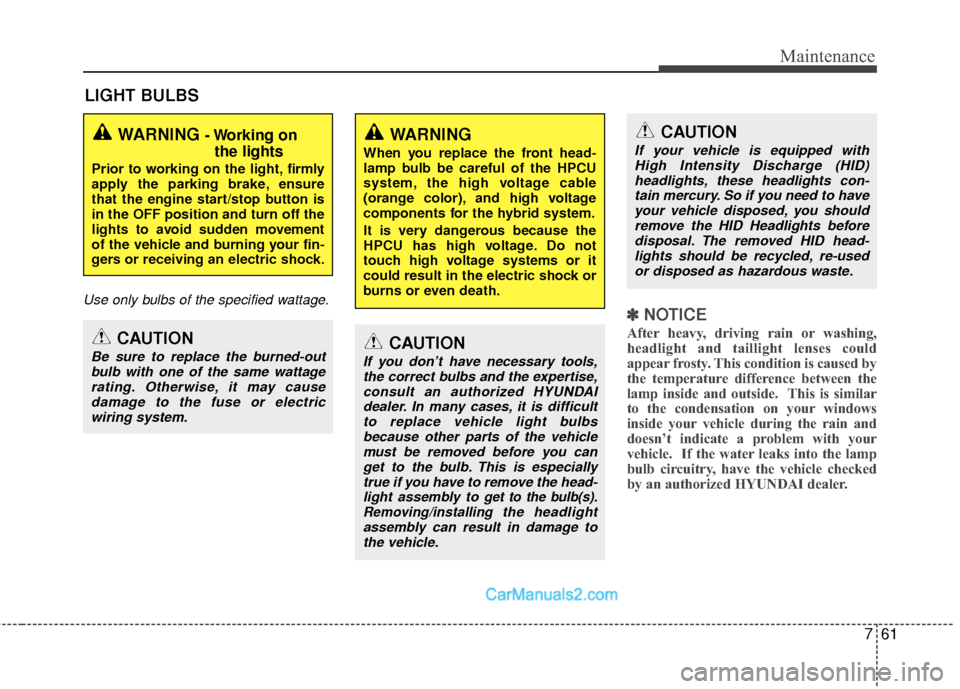
LIGHT BULBS
Use only bulbs of the specified wattage.
✽
✽NOTICE
After heavy, driving rain or washing,
headlight and taillight lenses could
appear frosty. This condition is caused by
the temperature difference between the
lamp inside and outside. This is similar
to the condensation on your windows
inside your vehicle during the rain and
doesn’t indicate a problem with your
vehicle. If the water leaks into the lamp
bulb circuitry, have the vehicle checked
by an authorized HYUNDAI dealer.
WARNING - Working on
the lights
Prior to working on the light, firmly
apply the parking brake, ensure
that the engine start/stop button is
in the OFF position and turn off the
lights to avoid sudden movement
of the vehicle and burning your fin-
gers or receiving an electric shock.
CAUTION
Be sure to replace the burned-out
bulb with one of the same wattagerating. Otherwise, it may causedamage to the fuse or electricwiring system.CAUTION
If you don’t have necessary tools,the correct bulbs and the expertise,consult an authorized HYUNDAIdealer. In many cases, it is difficultto replace vehicle light bulbsbecause other parts of the vehicle must be removed before you canget to the bulb. This is especiallytrue if you have to remove the head-light assembly to
get to the bulb(s).
Removing/installingthe headlight
assembly can result in damage to the vehicle.
WARNING
When you replace the front head-
lamp bulb be careful of the HPCU
system, the high voltage cable
(orange color), and high voltage
components for the hybrid system.
It is very dangerous because the
HPCU has high voltage. Do not
touch high voltage systems or it
could result in the electric shock or
burns or even death.
CAUTION
If your vehicle is equipped withHigh Intensity Discharge (HID)headlights, these headlights con- tain mercury. So if you need to haveyour vehicle disposed, you shouldremove the HID Headlights before disposal. The removed HID head-lights should be recycled, re-used or disposed as hazardous waste.
Page 507 of 543

Maintenance
78
7
3. Exhaust emission control
system
The Exhaust Emission Control System is
a highly effective system which controls
exhaust emissions while maintaining
good vehicle performance.
Vehicle modifications
This vehicle should not be modified.
Modification of your vehicle could
affect its performance, safety or dura-
bility and may even violate governmen-
tal safety and emissions regulations.
In addition, damage or performance
problems resulting from any modification
may not be covered under warranty.
If you use unauthorized electronic devices, it may cause the vehicle to
operate abnormally. It may also cause
wire damage, battery discharge and
fire. For your safety, do not use unau-
thorized electronic devices.
Engine exhaust gas precautions (car-bon monoxide)
Carbon monoxide can be present with other exhaust fumes. Therefore, if you
smell exhaust fumes of any kind inside
your vehicle, have it inspected and
repaired immediately. If you ever sus-
pect exhaust fumes are coming into
your vehicle, drive it only with all the
windows fully open. Have your vehicle
checked and repaired immediately.
WARNING- Exhaust
Engine exhaust gases contain car-
bon monoxide (CO). Though color-
less and odorless, it is dangerous
and could be lethal if inhaled.
Follow the instructions on this
page to avoid CO poisoning.
CALIFORNIA PROPOSI-
TION 65 WARNING
Engine exhaust and a wide variety
of automobile components and
parts, including components found
in the interior furnishings in a vehi-
cle, contain or emit chemicals
known to the State of California to
cause cancer and birth defects and
reproductive harm. In addition, cer-
tain fluids contained in vehicles
and certain products of component
wear contain or emit chemicals
known to the State of California to
cause cancer and birth defects or
other reproductive harm.
Page 515 of 543

Specifications, Consumer information, Reporting safety defects
68
Recommended SAE viscosity
number Engine oil viscosity (thickness) has an
effect on fuel economy and cold weather
operating (engine start and engine oil
flowability). Lower viscosity engine oils
can provide better fuel economy and cold
weather performance, however, higher
viscosity engine oils are required for sat-
isfactory lubrication in hot weather. Using
oils of any viscosity other than those rec-
ommended could result in engine dam-
age.When choosing an oil, consider the range
of temperature your vehicle will be oper-
ated in before the next oil change.
Proceed to select the recommended oil
viscosity from the chart.
CAUTION
Always be sure to clean the area
around any filler plug, drain plug, ordipstick before checking or drain- ing any lubricant. This is especiallyimportant in dusty or sandy areasand when the vehicle is used onunpaved roads. Cleaning the plugand dipstick areas will prevent dirtand grit from entering the engineand other mechanisms that couldbe damaged.
Temperature Range for SAE Viscosity Numbers
Temperature
Engine Oil *
1
°C
(°F)-30 -20 -10 0 10 20 30 40 50 -10 0 20 40 60 80 100 120
1. For better fuel economy, it is recommended to use the engine oil of
a viscosity grade SAE 5W-20 (API Service SM / ILSAC GF-4).
However, if the engine oil is not available, select the proper engine
oil using the engine oil viscosity chart.
20W-50
15W-40
10W-30
5W-20, 5W-30
Page 522 of 543

I3
Index
Brakes fluid··················\
··················\
·············· ·7-27
Bulb replacement ··················\
··················\
······· ·7-61
Bulb wattage ··················\
··················\
··············8-3
Button start/stop, see engine start/stop button ············5-5
California perchlorate notice ··················\
·············7-80
Camera (Rear view) ··················\
··················\
···· ·4-70
Capacities (Lubricants) ··················\
··················\
··8-5
Capacity/Weight ··················\
··················\
··········8-2
Care Exterior care ··················\
··················\
········· ·7-71
Interior care ··················\
··················\
·········· ·7-75
Tire care ··················\
··················\
·············· ·7-37
Cargo weight ··················\
··················\
············ ·5-43
Center console storage ··················\
··················\
·4-119
Central door lock switch ··················\
················· ·4-12
Certification label ··················\
··················\
······· ·5-41
Certification label ··················\
··················\
·········8-7
Chains Tire chains ··················\
··················\
············ ·5-35
Changing tires (with spare tire) ··················\
··········6-15
Checking tire inflation pressure ··················\
·········7-38
Child restraint system ··················\
··················\
·· ·3-27
Lower anchor system ··················\
················· ·3-33
Seat belt ··················\
··················\
··············· ·3-29
Tether anchor system ··················\
················· ·3-31Child-protector rear door lock
··················\
···········4-14
Climate control air filter ············4-93, 4-104, 4-115, 7-30
Clock (Digital) ··················\
··················\
········· ·4-123
Clothes hanger ··················\
··················\
········· ·4-123
Combined instrument, see instrument cluster ···········4-40
Compact spare tire (with spare tire) ··················\
·····6-15
Compact spare tire replacement ··················\
·········7-42
Components of the tire mobility kit ··················\
·····6-24
Consumer information ··················\
··················\
··· ·8-9
Coolant ··················\
··················\
··················\
· ·7-24
Cooling fluid, see engine coolant ··················\
·······7-24
Crankcase emission control system ··················\
·····7-77
Cruise control system ··················\
··················\
·· ·5-24
Cup holder ··················\
··················\
··············4-121
Curtain air bag ··················\
··················\
·········· ·3-53
Dashboard illumination,
see instrument panel illumination··················\
···· ·4-41
Dashboard, see instrument cluster ··················\
·······4-40
Defogging (Windshield) ··················\
················ ·4-116
Defogging logic (Windshield) ··················\
··········4-117
Defroster (Rear window) ··················\
················ ·4-81
Defrosting (Windshield) ··················\
················ ·4-116
Digital clock ··················\
··················\
··········· ·4-123
Dimensions ··················\
··················\
·················8-3
Display illumination, see instrument panel illumination · 4-41
C
D
Page 532 of 543
H3
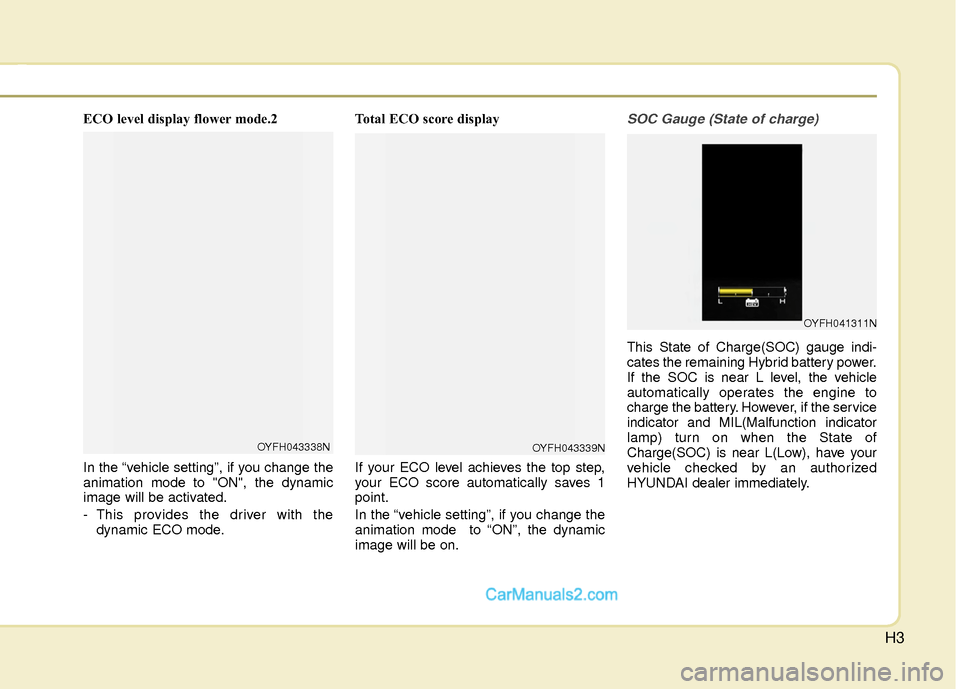
ECO level display flower mode.2
In the “vehicle setting”, if you change the
animation mode to "ON", the dynamic
image will be activated.
- This provides the driver with thedynamic ECO mode. Total ECO score display
If your ECO level achieves the top step,
your ECO score automatically saves 1
point.
In the “vehicle setting”, if you change the
animation mode to “ON”, the dynamic
image will be on.SOC Gauge (State of charge)
This State of Charge(SOC) gauge indi-
cates the remaining Hybrid battery power.
If the SOC is near L level, the vehicle
automatically operates the engine to
charge the battery. However, if the service
indicator and MIL(Malfunction indicator
lamp) turn on when the State of
Charge(SOC) is near L(Low), have your
vehicle checked by an authorized
HYUNDAI dealer immediately.
OYFH043338NOYFH043339N
OYFH041311N
Page 535 of 543
H6
Starting the engine
1. Carry the smart key or leave it insidethe vehicle.
2. Make sure the parking brake is firmly applied.
3. Place the shift lever in the P(Park) position. In N(Neutral) position, you
can not start the vehicle.
4. Depress the brake pedal.
5. Press the engine start/stop button.
6. In extremely cold weather or after the vehicle has not been operated for sev-
eral days, let the engine warm up with-
out depressing the accelerator.
Whether the engine is cold or warm, it
should be started without depressing
the accelerator.
if it is far away from you, the engine
may not start.
in the ACC or ON position, if any door
is open, the system checks for the
smart key. If the smart key is not in
the vehicle, the warning, "Key is not
in vehicle" will come on, and if all
doors are closed, the chime will also
sound for about 5 seconds. The indi-
cator will turn off while the vehicle is
moving. Keep the smart key in the
vehicle when using the ACC position
or if the vehicle engine is on. If the starting procedure is followed,
the "READY" symbol on the instru-
ment cluster will turn on. For more
details, please check Chapter 5.
ECONOMICAL and SAFE OPERA-
TION of Hybrid system
Drive smoothly. Accelerate at a moder-
ate rate and maintain a steady cruising
speed. Don't make "jack-rabbit" starts.
Don't race between stoplights.
Avoid heavy traffic whenever possible.
Always maintain a safe distance from
other vehicles so you can avoid unnec-
essary braking. This also reduces
brake wear.
The regenerative brake generates energy when the vehicle decelerates.
When the hybrid battery power is low, the hybrid system automatically
recharges the hybrid battery.
When the engine runs in "N" position, the hybrid system can not generate
electricity. The hybrid battery cannot
recharge in "N" position. Please check
Chapter 5.
✽ ✽ NOTICE
In the hybrid system, the engine auto-
matically runs and stops. If the hybrid
system operates, the "READY" symbol
is illuminated.
In the following situation, the engine
may operate automatically.
- When the engine is ready to run
- When the hybrid battery is charged
- Depending on the temperature condi-
tion of the hybrid battery
STARTING THE HYBRID VEHICLE (SMART KEY)
WARNING
To avoid serious injury, turn off
ignition and be sure "READY" lamp
is off before working under hood.
Engine may start unexpectedly.
Page 538 of 543
H9
WARNING
Do not disassemble or assemblethe high voltage battery system.
Doing so may result in electric
shock causing death or serious
injury.
If you disassemble or assemble hybrid system components
improperly, it may damage the
performance and reliability of
your vehicle.
If electrolyte comes in contact with your body, clothes or eyes,
immediately flush with a large
quantity of fresh tap water. Have
your eyes examined by a doctor
as soon as possible.
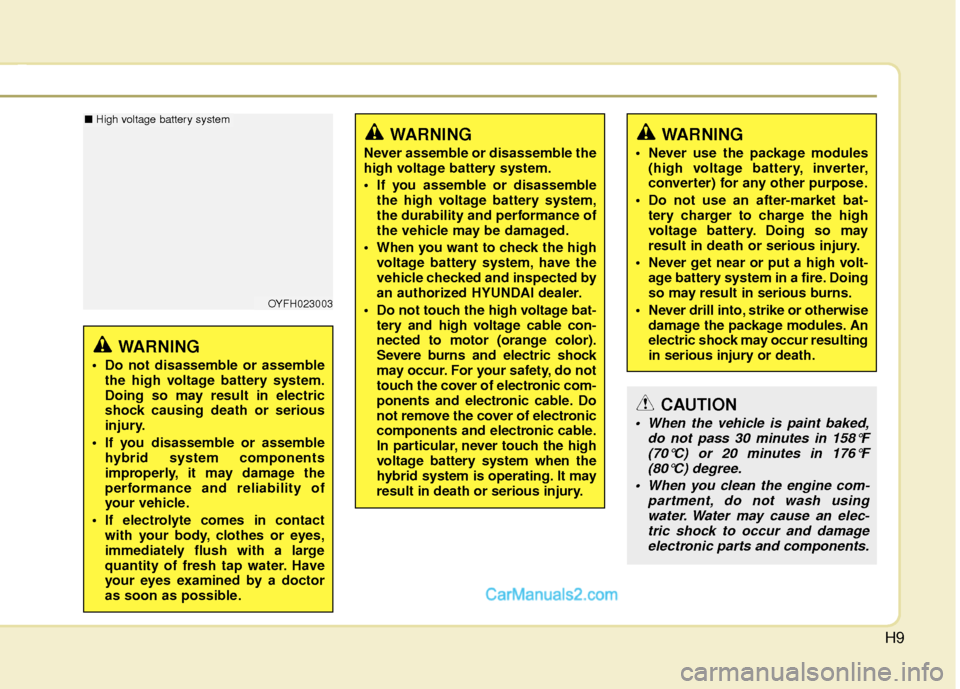
WARNING
Never assemble or disassemble the
high voltage battery system.
If you assemble or disassemblethe high voltage battery system,
the durability and performance of
the vehicle may be damaged.
When you want to check the high voltage battery system, have the
vehicle checked and inspected by
an authorized HYUNDAI dealer.
Do not touch the high voltage bat- tery and high voltage cable con-
nected to motor (orange color).
Severe burns and electric shock
may occur. For your safety, do not
touch the cover of electronic com-
ponents and electronic cable. Do
not remove the cover of electronic
components and electronic cable.
In particular, never touch the high
voltage battery system when the
hybrid system is operating. It may
result in death or serious injury.
OYFH023003
WARNING
Never use the package modules(high voltage battery, inverter,
converter) for any other purpose.
Do not use an after-market bat- tery charger to charge the high
voltage battery. Doing so may
result in death or serious injury.
Never get near or put a high volt- age battery system in a fire. Doing
so may result in serious burns.
Never drill into, strike or otherwise damage the package modules. An
electric shock may occur resulting
in serious injury or death.
CAUTION
When the vehicle is paint baked, do not pass 30 minutes in 158°F(70°C) or 20 minutes in 176°F (80°C) degree.
When you clean the engine com- partment, do not wash usingwater. Water may cause an elec-tric shock to occur and damageelectronic parts and components.
■ High voltage battery system