check engine Hyundai Sonata Hybrid 2016 Repair Manual
[x] Cancel search | Manufacturer: HYUNDAI, Model Year: 2016, Model line: Sonata Hybrid, Model: Hyundai Sonata Hybrid 2016Pages: 708, PDF Size: 25.92 MB
Page 624 of 708
7-60
Maintenance
F
FU
U S
SE
E S
S
A vehicle’s electrical system is pro-
tected from electrical overload dam-
age by fuses.
This vehicle has 2 (or 3) fuse panels,
one located in the driver’s side panel
bolster, the other in the engine com-
partment near the battery.
If any of your vehicle’s lights, acces-
sories, or controls do not work, check
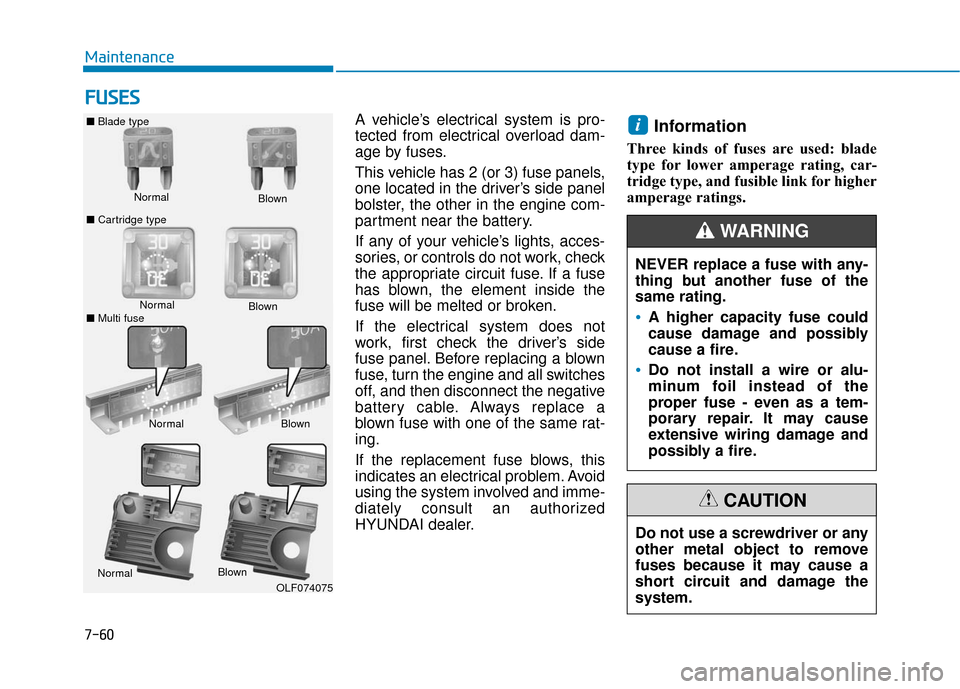
the appropriate circuit fuse. If a fuse
has blown, the element inside the
fuse will be melted or broken.
If the electrical system does not
work, first check the driver’s side
fuse panel. Before replacing a blown
fuse, turn the engine and all switches
off, and then disconnect the negative
battery cable. Always replace a
blown fuse with one of the same rat-
ing.
If the replacement fuse blows, this
indicates an electrical problem. Avoid
using the system involved and imme-
diately consult an authorized
HYUNDAI dealer.Information
Three kinds of fuses are used: blade
type for lower amperage rating, car-
tridge type, and fusible link for higher
amperage ratings.
i
Normal
■
Blade type
■ Cartridge type Blown
Normal Blown
Normal Blown
OLF074075
Do not use a screwdriver or any
other metal object to remove
fuses because it may cause a
short circuit and damage the
system.
CAUTION
NEVER replace a fuse with any-
thing but another fuse of the
same rating.
A higher capacity fuse could
cause damage and possibly
cause a fire.
Do not install a wire or alu-
minum foil instead of the
proper fuse - even as a tem-
porary repair. It may cause
extensive wiring damage and
possibly a fire.
WARNING
Normal Blown
■ Multi fuse
Page 625 of 708
7-61
7
Maintenance
Instrument panel fuse replace-
ment
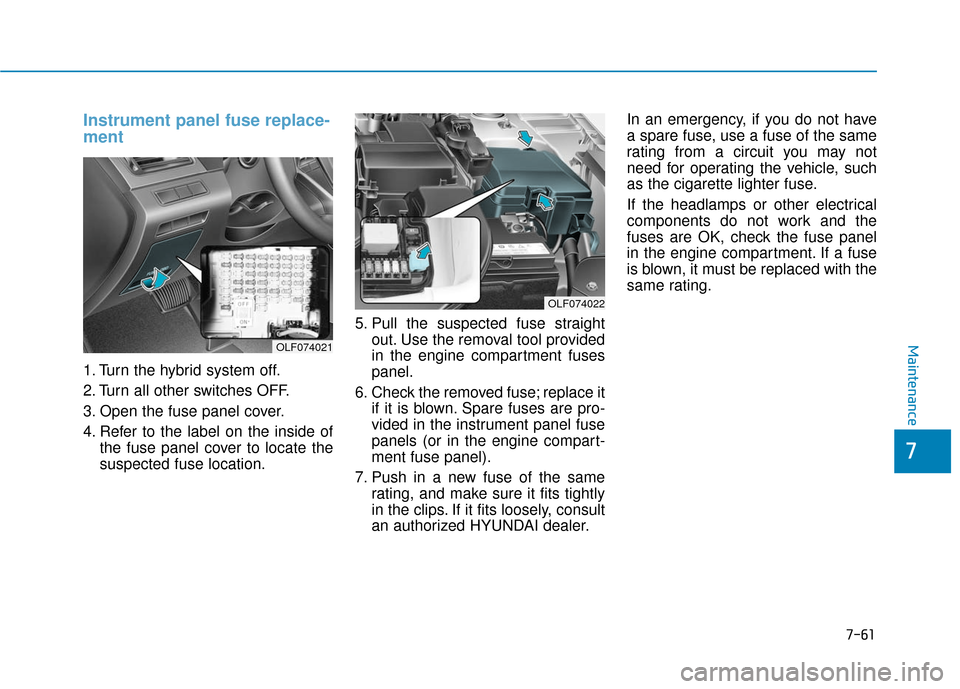
1. Turn the hybrid system off.
2. Turn all other switches OFF.
3. Open the fuse panel cover.
4. Refer to the label on the inside ofthe fuse panel cover to locate the
suspected fuse location. 5. Pull the suspected fuse straight
out. Use the removal tool provided
in the engine compartment fuses
panel.
6. Check the removed fuse; replace it if it is blown. Spare fuses are pro-
vided in the instrument panel fuse
panels (or in the engine compart-
ment fuse panel).
7. Push in a new fuse of the same rating, and make sure it fits tightly
in the clips. If it fits loosely, consult
an authorized HYUNDAI dealer. In an emergency, if you do not have
a spare fuse, use a fuse of the same
rating from a circuit you may not
need for operating the vehicle, such
as the cigarette lighter fuse.
If the headlamps or other electrical
components do not work and the
fuses are OK, check the fuse panel
in the engine compartment. If a fuse
is blown, it must be replaced with the
same rating.
OLF074021
OLF074022
Page 626 of 708
7-62
Maintenance
Fuse switch
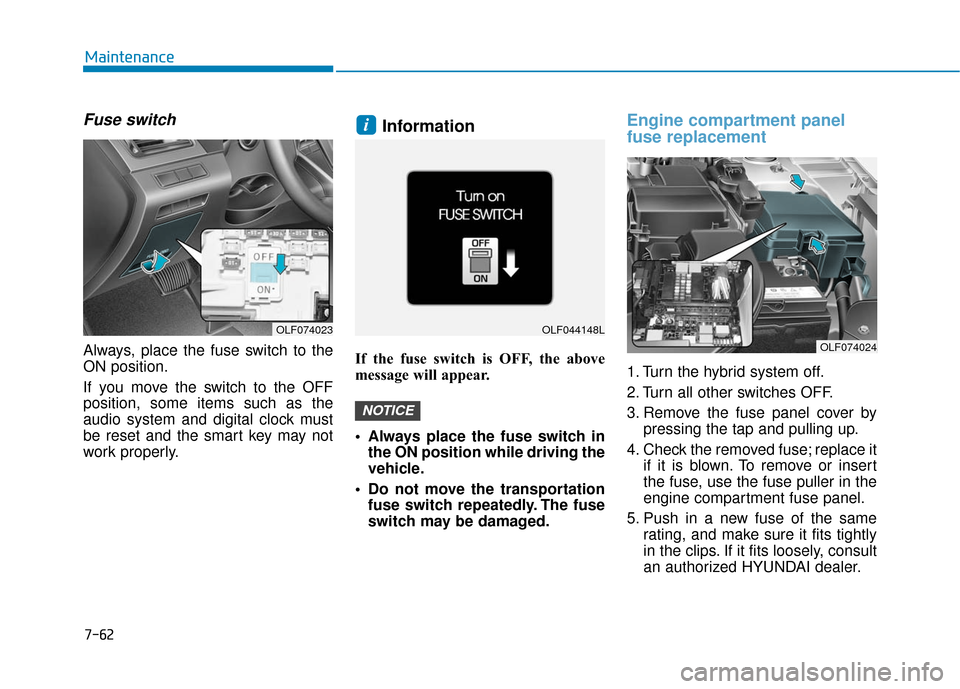
Always, place the fuse switch to the
ON position.
If you move the switch to the OFF
position, some items such as the
audio system and digital clock must
be reset and the smart key may not
work properly.
Information
If the fuse switch is OFF, the above
message will appear.
Always place the fuse switch inthe ON position while driving the
vehicle.
Do not move the transportation fuse switch repeatedly. The fuse
switch may be damaged.
Engine compartment panel
fuse replacement
1. Turn the hybrid system off.
2. Turn all other switches OFF.
3. Remove the fuse panel cover by pressing the tap and pulling up.
4. Check the removed fuse; replace it if it is blown. To remove or insert
the fuse, use the fuse puller in the
engine compartment fuse panel.
5. Push in a new fuse of the same rating, and make sure it fits tightly
in the clips. If it fits loosely, consult
an authorized HYUNDAI dealer.
NOTICE
i
OLF074023OLF044148L
OLF074024
Page 658 of 708
7-94
Maintenance
Canister
Fuel vapors generated inside the fuel
tank are absorbed and stored in the
onboard canister. When the engine is
running, the fuel vapors absorbed in
the canister are drawn into the surge
tank through the purge control sole-
noid valve.
Purge Control Solenoid Valve(PCSV)
The purge control solenoid valve is
controlled by the Engine Control
Module (ECM); when the engine
coolant temperature is low during
idling, the PCSV closes so that evap-
orated fuel is not taken into the
engine. After the engine warms-up
during ordinary driving, the PCSV
opens to introduce evaporated fuel to
the engine.
3. Exhaust emission control system
The Exhaust Emission Control
System is a highly effective system
which controls exhaust emissions
while maintaining good vehicle per-
formance.
When the engine starts or fails to
start, excessive attempts to restart
the engine may cause damage to the
emission system.
Vehicle modifications
This vehicle should not be modi-
fied. Modification of your vehicle
could affect its performance, safety
or durability and may even violate
governmental safety and emis-
sions regulations.
In addition, damage or performance
problems resulting from any modifi-
cation may not be covered under
warranty.
If you use unauthorized electronic devices, it may cause the vehicle to
operate abnormally, wire damage,
battery discharge and fire. For your
safety, do not use unauthorized
electronic devices.
Engine exhaust (carbon monox-ide) precautions
Carbon monoxide can be present
with other exhaust fumes. If you
smell exhaust fumes of any kind in
your vehicle, drive with all the win-
dows fully open. Have your vehicle
checked and repaired immediately.
Engine exhaust gases contain
carbon monoxide (CO). Though
colorless and odorless, it is
dangerous and could be lethal if
inhaled. Follow the instructions
on this page to avoid CO poi-
soning.
WARNING
Page 668 of 708
8-7
88
Specifications, Consumer information and Reporting safety defects
Recommended SAE viscosity
number
Always be sure to clean the area
around any filler plug, drain
plug, or dipstick before check-
ing or draining any lubricant.
This is especially important in
dusty or sandy areas and when
the vehicle is used on unpaved
roads. Cleaning the plug and
dipstick areas will prevent dirt
and grit from entering the
engine and other mechanisms
that could be damaged.
CAUTION
Engine oil viscosity (thickness) has an effect on fuel economy and cold
weather operating (engine start and engine oil flowability). Lower viscosity
engine oils can provide better fuel economy and cold weather performance,
however, higher viscosity engine oils are required for satisfactory lubrication
in hot weather. Using oils of any viscosity other than those recommended
could result in engine damage.
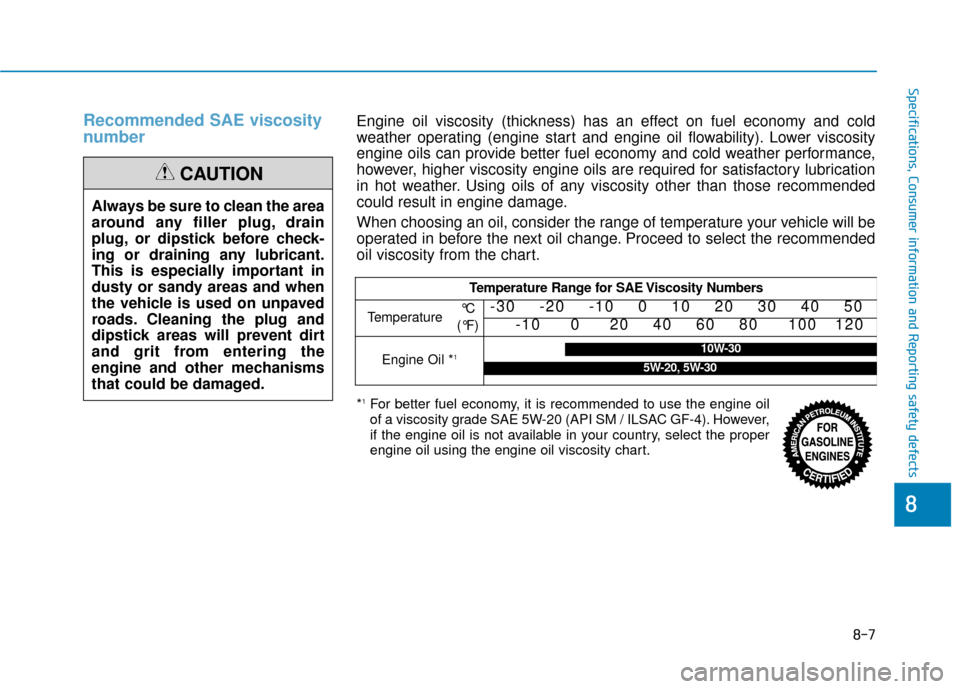
When choosing an oil, consider the range of temperature your vehicle will be
operated in before the next oil change. Proceed to select the recommended
oil viscosity from the chart.
Temperature Range for SAE Viscosity Numbers
Temperature -30 -20 -10 0 10 20 30 40 50
-10 0 20 40 60 80 100 120
Engine Oil *110W-30
5W-20, 5W-30
°C
(°F)
*1For better fuel economy, it is recommended to use the engine oil
of a viscosity grade SAE 5W-20 (API SM / ILSAC GF-4). However,
if the engine oil is not available in your country, select the proper
engine oil using the engine oil viscosity chart.
Page 675 of 708

I-3
Back-up lamp ..................................................................7-83
Battery ........................................................................\
.....7-41
Battery saver function ...................................................3-113
Before driving ...................................................................5-3
Blind spot detection system (BSD) ................................5-70
Bluetooth
®Wireless Technology Hands-Free...................4-4
Brake fluid ......................................................................7-\
33
Brake system ...................................................................5-19 Disc brakes wear indicator ........................................5-20
Electronic parking brake (EPB) .................................5-22
Foot parking brake .....................................................5-20
Power brakes ..............................................................5-19
Anti-lock brake system (ABS) ...................................5-32
Auto hold ....................................................................5-28\
Electronic stability control (ESC) ..............................5-34
Hill-start assist control (HAC) ...................................5-39
Vehicle Stability Management ...................................5-37
Bulb replacement ............................................................7-73
Bulb wattage .....................................................................8-3\
Button start/stop, see engine start/stop button ..................5-4 California perchlorate notice ..........................................7-97
Capacities (Lubricants) .....................................................8-6
Care
Exterior care ...............................................................7-86
Interior care ................................................................7-91
Tire care ......................................................................7-\
44
Center console storage ..................................................3-145
Central door lock switch .................................................3-10
Certification label .............................................................8-8
Chains Tire chains ..................................................................5-83
Checking tire inflation pressure ......................................7-46
Child restraint system (CRS) ..........................................2-36 Children always in the rear ........................................2-36
Installing a Child Restraint System (CRS) ................2-39
Lower anchors and tether for children (LATCH) system .....................................................2-40
Securing with lap/shoulder belt..................................2-44
Securing with Tether anchors .....................................2-43
Selecting a Child Restraint System (CRS).................2-37
Child-protector rear door lock ........................................3-12
Climate control air filter ......................................3-139, 7-37
Clock ........................................................................\
.....3-150
I
Index
BC
Page 686 of 708
H3
D
DI
IS
S P
P L
LA
A Y
Y
O
O F
F
H
H Y
Y B
BR
RI
ID
D
S
S Y
Y S
ST
T E
EM
M
Gauges
Hybrid System Gauge
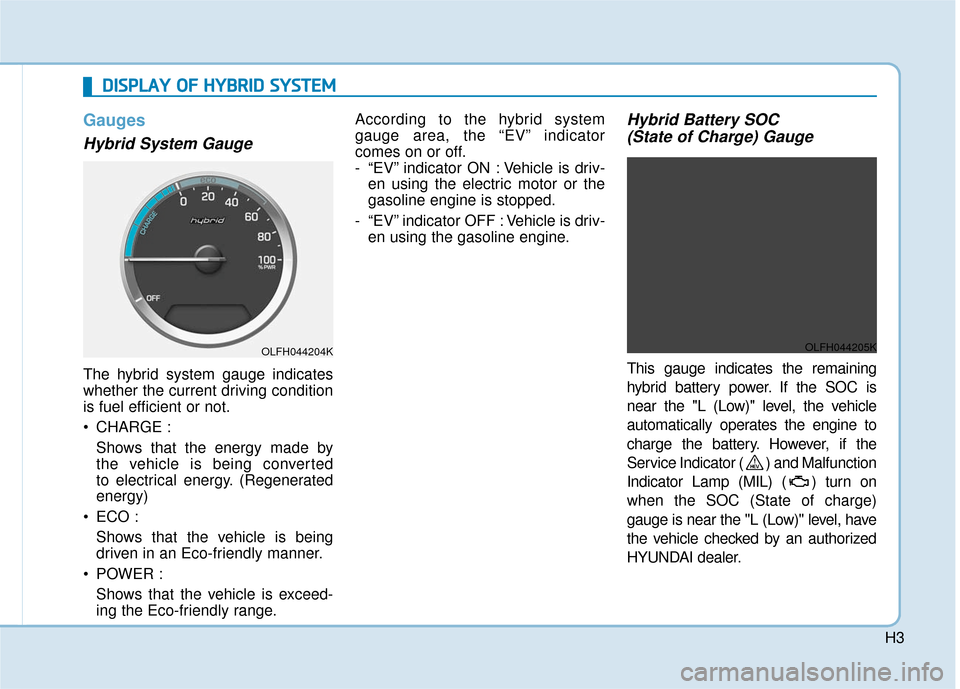
The hybrid system gauge indicates
whether the current driving condition
is fuel efficient or not.
• CHARGE :
Shows that the energy made by
the vehicle is being converted
to electrical energy. (Regenerated
energy)
ECO : Shows that the vehicle is being
driven in an Eco-friendly manner.
POWER : Shows that the vehicle is exceed-
ing the Eco-friendly range. According to the hybrid system
gauge area, the “EV” indicator
comes on or off.
- “EV” indicator ON : Vehicle is driv-
en using the electric motor or the
gasoline engine is stopped.
- “EV” indicator OFF : Vehicle is driv- en using the gasoline engine.
Hybrid Battery SOC (State of Charge) Gauge
This gauge indicates the remaining
hybrid battery power. If the SOC is
near the "L (Low)" level, the vehicle
automatically operates the engine to
charge the battery. However, if the
Service Indicator ( ) and Malfunction
Indicator Lamp (MIL) ( ) turn on
when the SOC (State of charge)
gauge is near the "L (Low)" level, have
the vehicle checked by an authorized
HYUNDAI dealer.
OLFH044204KOLFH044205K
Page 688 of 708
H5
Regenerative
Brake Warning
Light
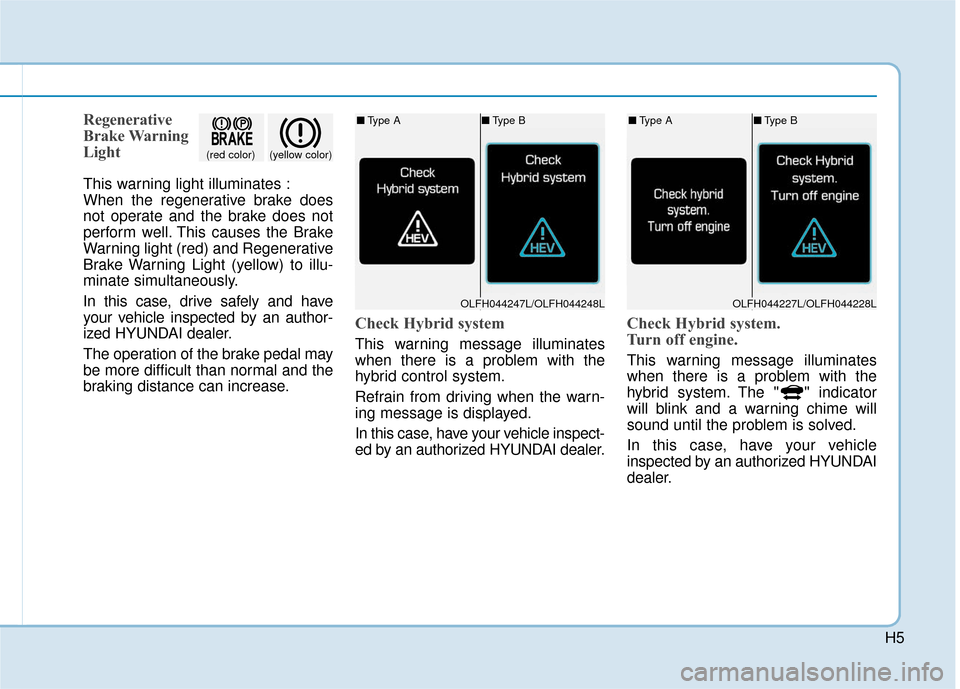
This warning light illuminates :
When the regenerative brake does
not operate and the brake does not
perform well. This causes the Brake
Warning light (red) and Regenerative
Brake Warning Light (yellow) to illu-
minate simultaneously.
In this case, drive safely and have
your vehicle inspected by an author-
ized HYUNDAI dealer.
The operation of the brake pedal may
be more difficult than normal and the
braking distance can increase.
Check Hybrid system
This warning message illuminates
when there is a problem with the
hybrid control system.
Refrain from driving when the warn-
ing message is displayed.
In this case, have your vehicle inspect-
ed by an authorized HYUNDAI dealer.
Check Hybrid system.
Turn off engine.
This warning message illuminates
when there is a problem with the
hybrid system. The " " indicator
will blink and a warning chime will
sound until the problem is solved.
In this case, have your vehicle
inspected by an authorized HYUNDAI
dealer.
(red color) (yellow color)
OLFH044247L/OLFH044248L
■Type A ■Type B
OLFH044227L/OLFH044228L
■Type A ■Type B
Page 689 of 708
H6
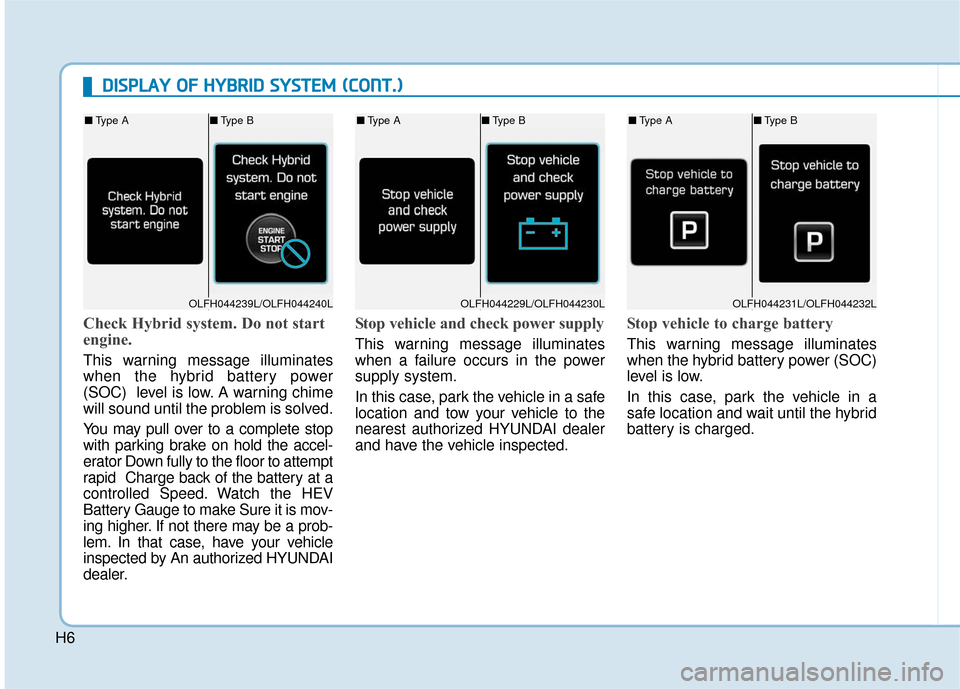
Check Hybrid system. Do not start
engine.
This warning message illuminates
when the hybrid battery power
(SOC) level is low. A warning chime
will sound until the problem is solved.
You may pull over to a complete stop
with parking brake on hold the accel-
erator Down fully to the floor to attempt
rapid Charge back of the battery at a
controlled Speed. Watch the HEV
Battery Gauge to make Sure it is mov-
ing higher. If not there may be a prob-
lem. In that case, have your vehicle
inspected by An authorized HYUNDAI
dealer.
Stop vehicle and check power supply
This warning message illuminates
when a failure occurs in the power
supply system.
In this case, park the vehicle in a safe
location and tow your vehicle to the
nearest authorized HYUNDAI dealer
and have the vehicle inspected.
Stop vehicle to charge battery
This warning message illuminates
when the hybrid battery power (SOC)
level is low.
In this case, park the vehicle in a
safe location and wait until the hybrid
battery is charged.
D DI
IS
S P
P L
LA
A Y
Y
O
O F
F
H
H Y
Y B
BR
RI
ID
D
S
S Y
Y S
ST
T E
EM
M
(
( C
C O
O N
NT
T.
.)
)
OLFH044229L/OLFH044230L
■ Type A ■Type B
OLFH044231L/OLFH044232L
■Type A ■Type B
OLFH044239L/OLFH044240L
■Type A ■Type B
Page 691 of 708
H8
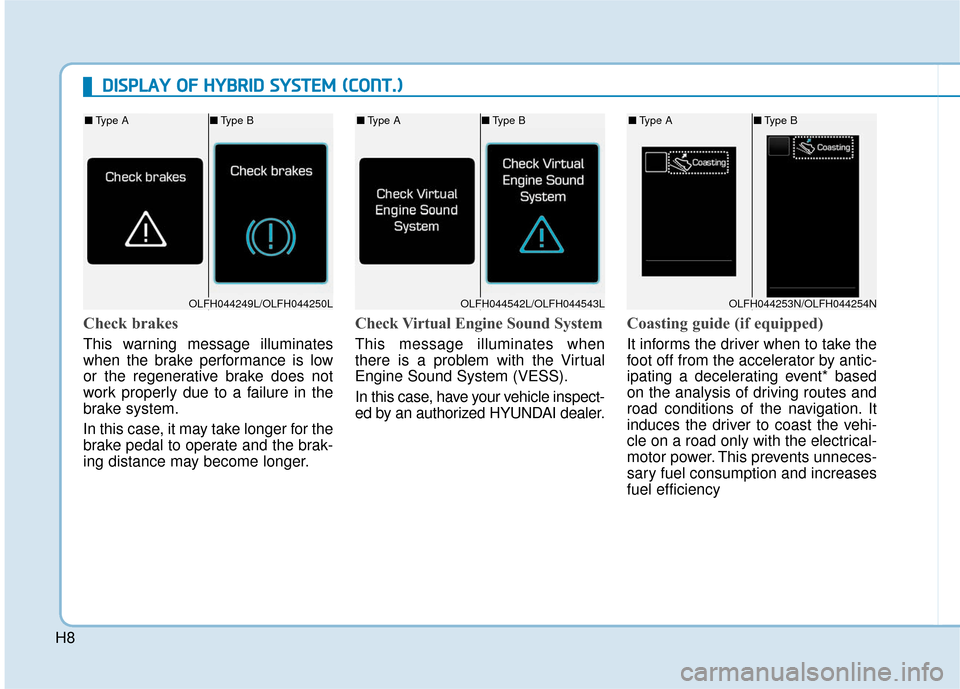
Check brakes
This warning message illuminates
when the brake performance is low
or the regenerative brake does not
work properly due to a failure in the
brake system.
In this case, it may take longer for the
brake pedal to operate and the brak-
ing distance may become longer.
Check Virtual Engine Sound System
This message illuminates when
there is a problem with the Virtual
Engine Sound System (VESS).
In this case, have your vehicle inspect-
ed by an authorized HYUNDAI dealer.
Coasting guide (if equipped)
It informs the driver when to take the
foot off from the accelerator by antic-
ipating a decelerating event* based
on the analysis of driving routes and
road conditions of the navigation. It
induces the driver to coast the vehi-
cle on a road only with the electrical-
motor power. This prevents unneces-
sary fuel consumption and increases
fuel efficiency
D DI
IS
S P
P L
LA
A Y
Y
O
O F
F
H
H Y
Y B
BR
RI
ID
D
S
S Y
Y S
ST
T E
EM
M
(
( C
C O
O N
NT
T.
.)
)
OLFH044542L/OLFH044543L
■ Type A ■Type B
OLFH044249L/OLFH044250L
■Type A ■Type B
OLFH044253N/OLFH044254N
■Type A ■Type B