coolant HYUNDAI SONATA HYBRID 2019 User Guide
[x] Cancel search | Manufacturer: HYUNDAI, Model Year: 2019, Model line: SONATA HYBRID, Model: HYUNDAI SONATA HYBRID 2019Pages: 546, PDF Size: 78.75 MB
Page 409 of 546
6-7
What to do in an emergency
6
If your engine coolant temperature
gauge indicates overheating, you
experience a loss of power, or hear
loud pinging or knocking, the engine
may be overheating. If this happens,
you should:
1. Turn ON the hazard warning flash-er, pull off the road and stop as
soon as it is safe to do so.
2. Place the shift lever in P (Park) and set the parking brake.
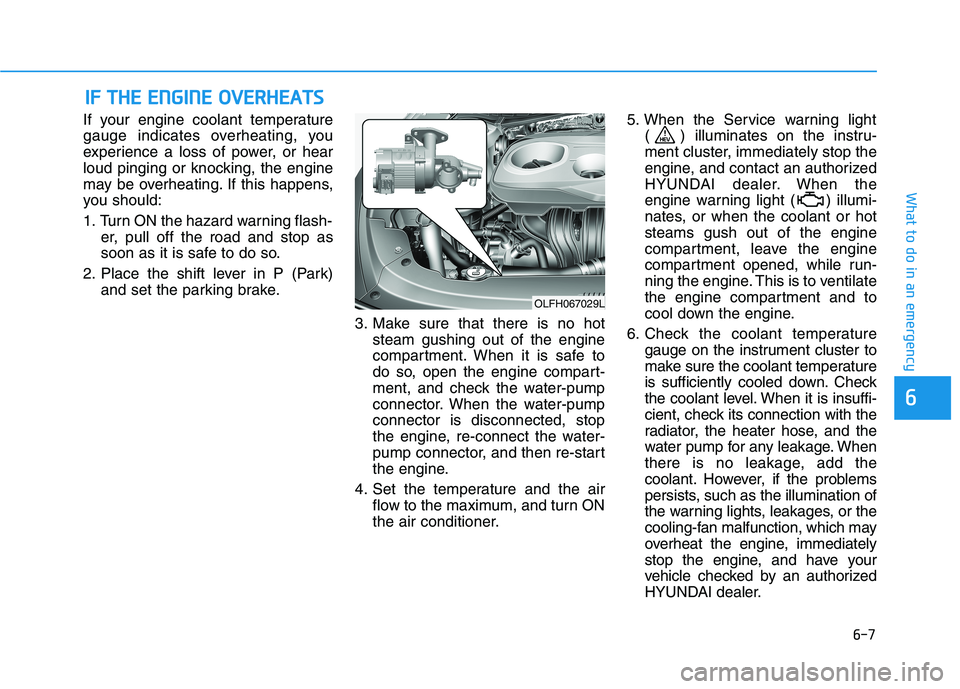
3. Make sure that there is no hotsteam gushing out of the engine
compartment. When it is safe to
do so, open the engine compart-
ment, and check the water-pump
connector. When the water-pumpconnector is disconnected, stop
the engine, re-connect the water-
pump connector, and then re-start
the engine.
4. Set the temperature and the air flow to the maximum, and turn ON
the air conditioner. 5. When the Service warning light
( ) illuminates on the instru-
ment cluster, immediately stop the
engine, and contact an authorized
HYUNDAI dealer. When the
engine warning light ( ) illumi-
nates, or when the coolant or hotsteams gush out of the engine
compartment, leave the engine
compartment opened, while run-
ning the engine. This is to ventilate
the engine compartment and to
cool down the engine.
6. Check the coolant temperature gauge on the instrument cluster to
make sure the coolant temperature
is sufficiently cooled down. Check
the coolant level. When it is insuffi-
cient, check its connection with the
radiator, the heater hose, and the
water pump for any leakage. When
there is no leakage, add the
coolant. However, if the problems
persists, such as the illumination of
the warning lights, leakages, or the
cooling-fan malfunction, which may
overheat the engine, immediately
stop the engine, and have your
vehicle checked by an authorized
HYUNDAI dealer.
IIFF TT HH EE EE NN GGIINN EE OO VVEERR HH EEAA TTSS
OLFH067029L
Page 410 of 546
6-8
What to do in an emergency
7. If you cannot find the cause of theoverheating, wait until the engine
temperature has returned to nor-
mal. Then, if coolant has beenlost, carefully add coolant to the
reservoir to bring the fluid level in
the reservoir up to the halfway
mark.
8. Proceed with caution, keeping alert for further signs of overheat-
ing. If overheating happens again,
call an authorized HYUNDAI deal-
er for assistance.
Serious loss of coolant indi-cates a leak in the cooling sys-
tem and should be checked as
soon as possible by an author-
ized HYUNDAI dealer.
CAUTION
The electric motor for
the cooling fan may
continue to operate
or start up when theengine is not running
and can cause serious injury.
Keep hands, clothing and tools
away from the rotating fan
blades of the cooling fan.
WARNING
Your vehicle is equipped with a pres-
surized coolant
reserve tank. NEVER
remove the coolant
reserve tank cap or the radiatordrain plug while the engine and
radiator are HOT. Hot coolant
and steam may blow out under
pressure, causing serious
injury.
Turn the engine off and wait
until the engine cools down.
Use extreme care when remov-
ing the coolant reserve tank
cap. Wrap a towel or thick rag
around it, and turn it counter-
clockwise slowly to release
some of the pressure from the
system. Step back while thepressure is released.
When you are sure all the pres-
sure has been released, contin-ue turning the cap counter-
clockwise to remove it.
WARNING
Page 437 of 546
6-35
What to do in an emergency
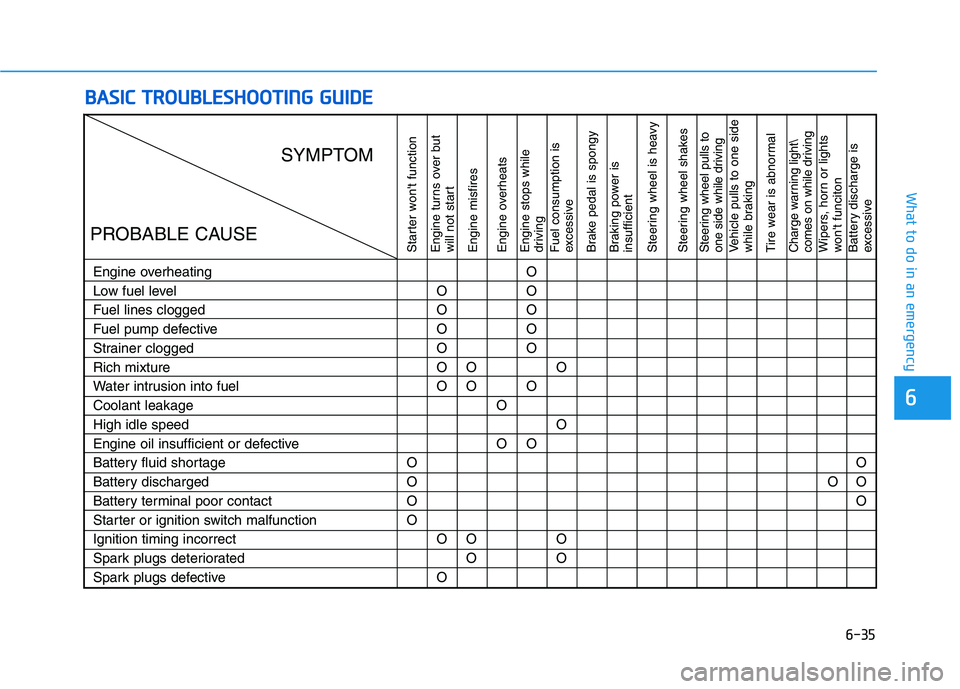
BBAA SSIICC TT RR OO UUBBLLEE SSHH OO OOTTIINN GG GG UU IIDD EE
6
Starter won't function
Engine turns over but
will not start Engine misfires
Engine overheats Engine stops while
driving Fuel consumption is
excessive
Brake pedal is spongy
Braking power is insufficient
Steering wheel is heavy
Steering wheel shakesSteering wheel pulls to
one side while drivingVehicle pulls to one side
while braking
Tire wear is abnormalCharge warning light\
comes on while drivingWipers, horn or lights
won't funciton
Battery discharge is
excessive
Engine overheating
Low fuel levelFuel lines clogged
Fuel pump defective
Strainer cloggedRich mixture
Water intrusion into fuelCoolant leakageHigh idle speed
Engine oil insufficient or defective
Battery fluid shortage
Battery discharged
Battery terminal poor contact
Starter or ignition switch malfunctionIgnition timing incorrect
Spark plugs deteriorated
Spark plugs defective OOOOOOOOOO O O
O O O O
O OO OOOO O O
OO O O
O
OOO
SYMPTOM
PROBABLE CAUSE
Page 439 of 546
7
Maintenance
7
Maintenance
Engine compartment .............................................7-3
Maintenance services ...........................................7-4Owner's responsibility ......................................................7-4
Owner maintenance precautions ..................................7-4
Owner maintenance ...............................................7-5 Owner maintenance schedule ........................................7-6
Scheduled maintenance services.........................7-8 Normal maintenance schedule .......................................7-9
Maintenance under severe usage conditions ..........7-13
Explanation of scheduled maintenance items .. 7-15
Engine oil ..............................................................7-18 Checking the engine oil level .......................................7-18
Checking the engine oil and filter ..............................7-19
Engine coolant/Inverter coolant .......................7-20 Checking the engine/inverter coolant level .............7-20
Changing engine coolant...............................................7-23
Hybrid starter & generator (HSG) belt.............7-23 Checking the hybrid starter &
generator (HSG) belt ......................................................7-23
Brake fluid ............................................................7-24 Checking the brake fluid level .....................................7-24
Washer fluid .........................................................7-25 Checking the washer fluid level ..................................7-25 Parking brake .......................................................7-25
Checking the parking brake .........................................7-25
Air cleaner ............................................................7-26 Filter replacement ...........................................................7-26
Climate control air filter .....................................7-28 Filter inspection ...............................................................7-28
Wiper blades .........................................................7-30 Blade inspection ..............................................................7-30
Blade replacement ..........................................................7-30
Battery...................................................................7-32 For best battery service................................................7-33
Battery recharging .........................................................7-33
Reset features .................................................................7-34
Tires and wheels ..................................................7-35 Tire care ............................................................................7-35
Recommended cold tire inflation pressures.............7-36
Check tire inflation pressure........................................7-37
Tire rotation .....................................................................7-38
Wheel alignment and tire balance ..............................7-39
Tire replacement .............................................................7-39
Wheel replacement .........................................................7-40
Tire traction ......................................................................7-40
7
Page 441 of 546
7-3
7
Maintenance
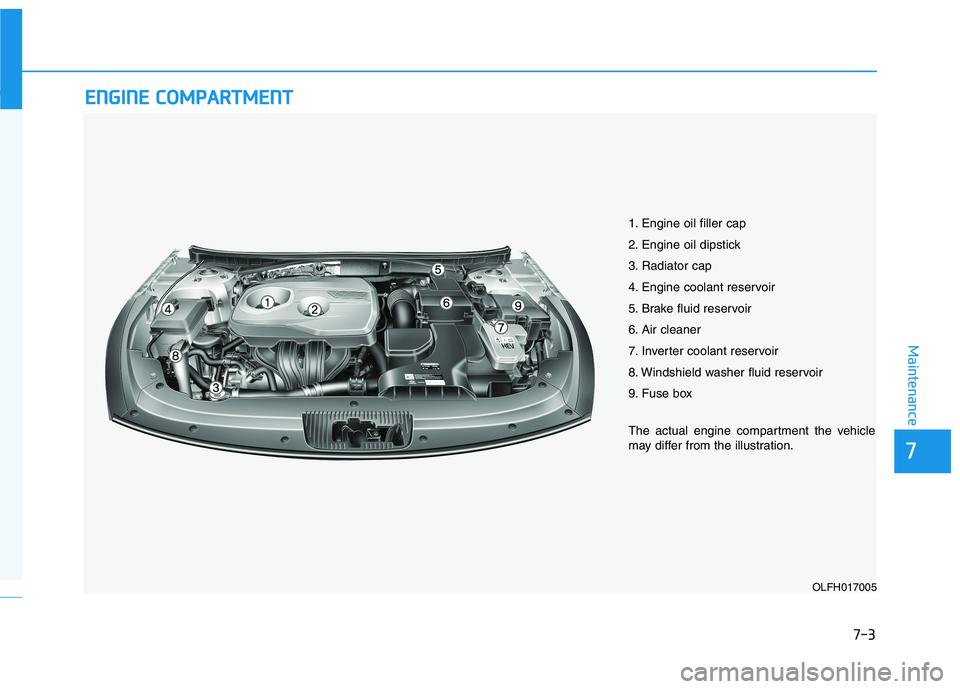
EENN GGIINN EE CC OO MM PPAA RRTTMM EENN TT
1. Engine oil filler cap
2. Engine oil dipstick
3. Radiator cap
4. Engine coolant reservoir
5. Brake fluid reservoir
6. Air cleaner
7. Inverter coolant reservoir
8. Windshield washer fluid reservoir
9. Fuse box
The actual engine compartment the vehicle
may differ from the illustration.
OLFH017005
Page 444 of 546
7-6
Maintenance
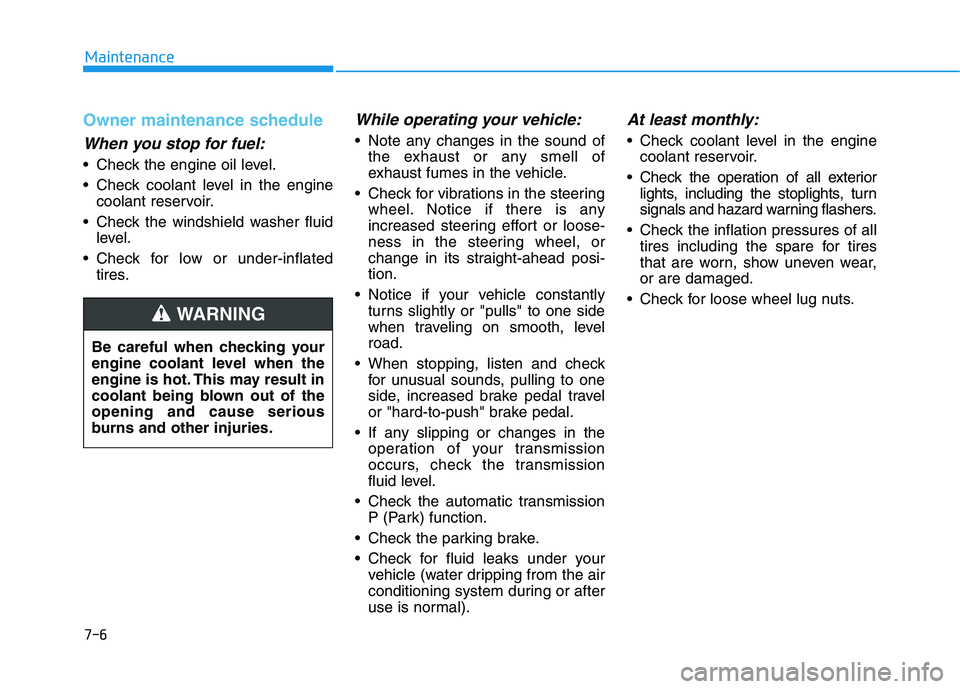
Owner maintenance schedule
When you stop for fuel:
Check the engine oil level.
Check coolant level in the enginecoolant reservoir.
Check the windshield washer fluid level.
Check for low or under-inflated tires.
While operating your vehicle:
Note any changes in the sound ofthe exhaust or any smell of
exhaust fumes in the vehicle.
Check for vibrations in the steering wheel. Notice if there is any
increased steering effort or loose-
ness in the steering wheel, or
change in its straight-ahead posi-tion.
Notice if your vehicle constantly turns slightly or "pulls" to one side
when traveling on smooth, levelroad.
When stopping, listen and check for unusual sounds, pulling to one
side, increased brake pedal travel
or "hard-to-push" brake pedal.
If any slipping or changes in the operation of your transmission
occurs, check the transmission
fluid level.
Check the automatic transmission P (Park) function.
Check the parking brake.
Check for fluid leaks under your vehicle (water dripping from the air
conditioning system during or after
use is normal).
At least monthly:
Check coolant level in the enginecoolant reservoir.
Check the operation of all exterior lights, including the stoplights, turn
signals and hazard warning flashers.
Check the inflation pressures of all tires including the spare for tires
that are worn, show uneven wear,or are damaged.
Check for loose wheel lug nuts.
Be careful when checking your
engine coolant level when the
engine is hot. This may result in
coolant being blown out of theopening and cause serious
burns and other injuries.
WARNING
Page 449 of 546
7-11
7
Maintenance
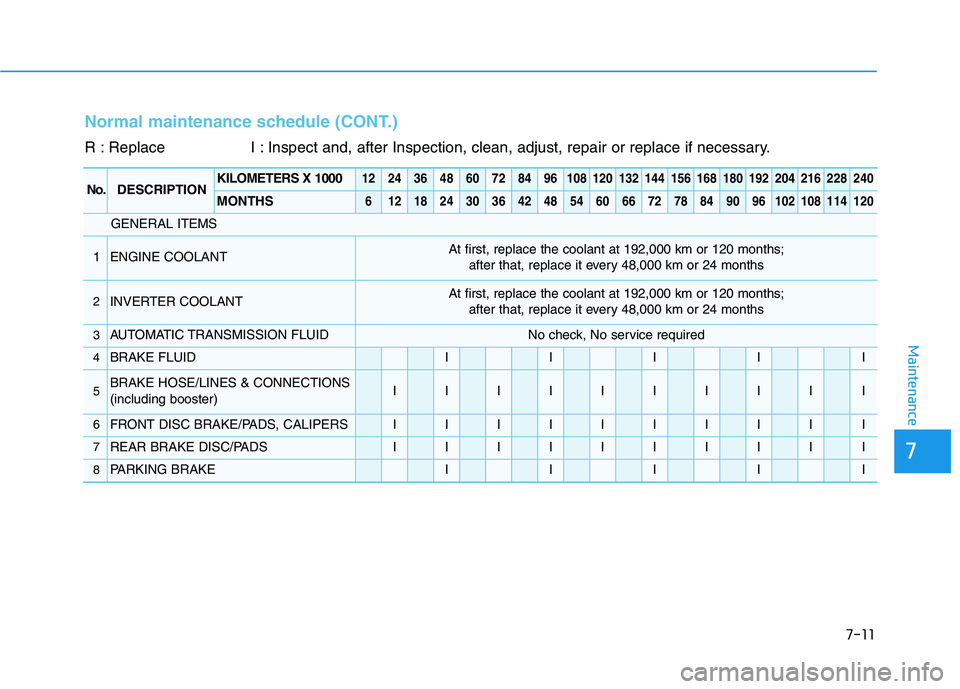
Normal maintenance schedule (CONT.)
R : Replace I : Inspect and, after Inspection, clean, adjust, repair or replace if necessary.
No.DESCRIPTIONKILOMETERS X 10001224364860728496108120132144156168180192204216228240
MONTHS6121824303642485460667278849096102108114120
GENERAL ITEMS
1ENGINE COOLANTAt first, replace the coolant at 192,000 km or 120 months;after that, replace it every 48,000 km or 24 months
2INVERTER COOLANTAt first, replace the coolant at 192,000 km or 120 months;
after that, replace it every 48,000 km or 24 months
3AUTOMATIC TRANSMISSION FLUIDNo check, No service required
4BRAKE FLUIDIIIII
5BRAKE HOSE/LINES & CONNECTIONS (including booster)IIIIIIIIII
6FRONT DISC BRAKE/PADS, CALIPERSIIIIIIIIII
7REAR BRAKE DISC/PADSIIIIIIIIII
8PARKING BRAKEIIIII
Page 454 of 546
7-16
Maintenance
Cooling system
Check cooling system components,
such as radiator, coolant reservoir,
hoses and connections for leakage
and damage. Replace any damaged
parts.
Engine coolant/Inverter coolant
The coolant should be changed at
the intervals specified in the mainte-
nance schedule.
Automatic transmission fluid
Automatic transmission fluid should
not be checked under normal usage
conditions. But in severe conditions,the fluid should be changed at an
authorized HYUNDAI dealer inaccordance to the scheduled mainte-nance at the beginning of this chap-
ter.
Automatic transmission fluid
color is basically red.
As the vehicle is driven, the auto- matic transmission fluid will begin
to look darker. This is a normal
condition and you should not
judge the need to replace the fluid
based upon the changed color.
Brake hoses and lines
Visually check for proper installation,
chafing, cracks, deterioration and
any leakage. Replace any deteriorat-
ed or damaged parts immediately.
Brake fluid
Check brake fluid level in the brake
fluid reservoir. The level should be
between the MIN and the MAX
marks on the side of the reservoir.
Use only hydraulic brake fluid con-
forming to DOT 3 or DOT 4 specifi-cation.
Parking brake
Inspect the parking brake system
including the parking brake pedal
and cables.
NOTICE
The use of a non-specified fluid could result in transmission
malfunction and failure. Use
only the specified automatic
transmission fluid (refer to"Recommended Lubricants and
Capacities" in chapter 8).
CAUTION
Page 458 of 546
7-20
MaintenanceE
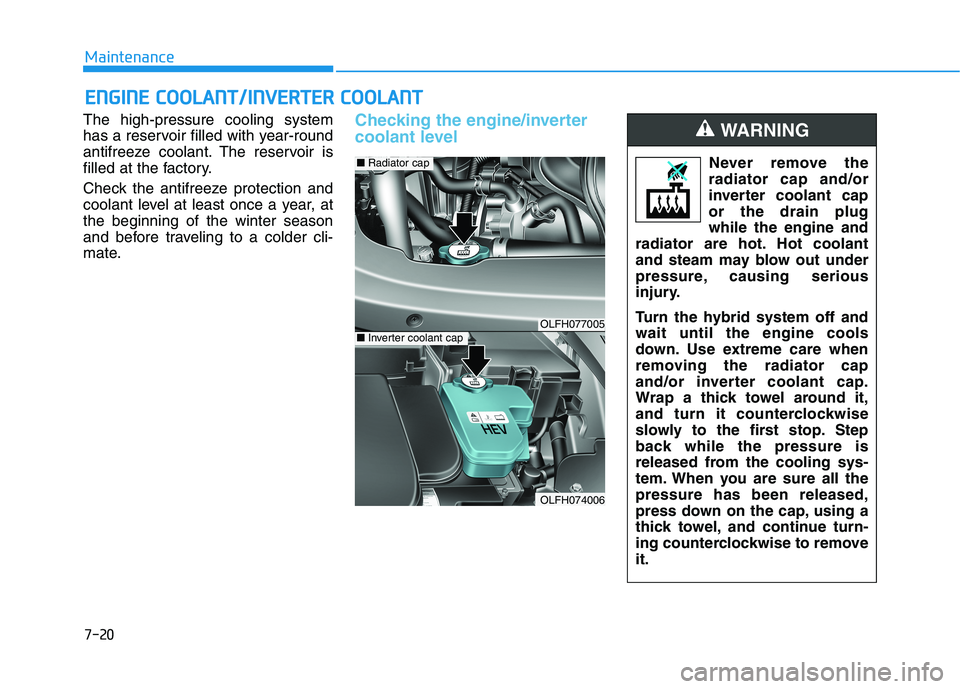
E NN GGIINN EE CC OO OO LLAA NN TT//IINN VVEERR TTEERR CC OO OO LLAA NN TT
The high-pressure cooling system
has a reservoir filled with year-round
antifreeze coolant. The reservoir is
filled at the factory.
Check the antifreeze protection and
coolant level at least once a year, atthe beginning of the winter season
and before traveling to a colder cli-
mate.Checking the engine/inverter
coolant level
OLFH077005
OLFH074006
■Radiator cap
■Inverter coolant cap
Never remove the
radiator cap and/or
inverter coolant capor the drain plugwhile the engine and
radiator are hot. Hot coolant
and steam may blow out under
pressure, causing serious
injury.
Turn the hybrid system off and wait until the engine cools
down. Use extreme care when
removing the radiator cap
and/or inverter coolant cap.
Wrap a thick towel around it,
and turn it counterclockwise
slowly to the first stop. Step
back while the pressure is
released from the cooling sys-
tem. When you are sure all thepressure has been released,
press down on the cap, using a
thick towel, and continue turn-
ing counterclockwise to removeit.
WARNING
Page 459 of 546
7-21
7
Maintenance
Information
The engine coolant and/or inverter
coolant level is influenced by the
hybrid system temperature. Before
checking or refilling the engine
coolant and/or inverter coolant, turn
the hybrid vehicle off. The electric motor for the cooling fan
is controlled by engine coolant tem-
perature, refrigerant pressure and
vehicle speed. As the engine coolant
temperature decreases, the electric
motor will automatically shut off. This
is a normal condition. If your vehicle
is equipped with GDI, the electric
motor for the cooling fan may begin
to operate at any time and continue
to operate until you disconnect the
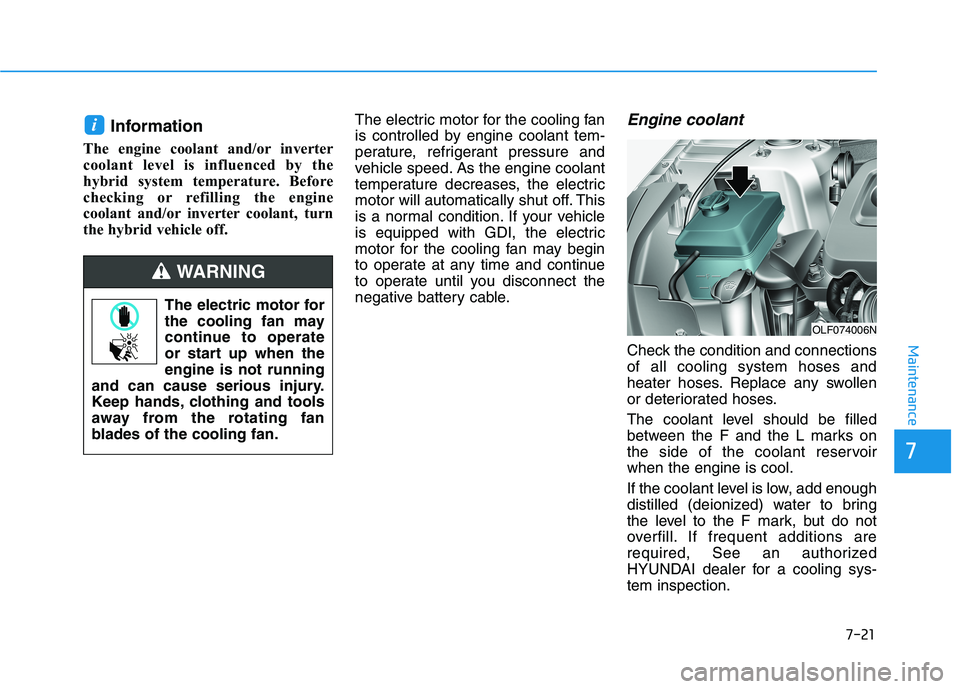
negative battery cable.Engine coolant
Check the condition and connectionsof all cooling system hoses and
heater hoses. Replace any swollen
or deteriorated hoses.
The coolant level should be filled
between the F and the L marks on
the side of the coolant reservoirwhen the engine is cool.
If the coolant level is low, add enough
distilled (deionized) water to bring
the level to the F mark, but do not
overfill. If frequent additions are
required, See an authorized
HYUNDAI dealer for a cooling sys-tem inspection.
i
The electric motor for
the cooling fan may
continue to operate
or start up when theengine is not running
and can cause serious injury.
Keep hands, clothing and tools
away from the rotating fan
blades of the cooling fan.
WARNING
OLF074006N