engine HYUNDAI SONATA HYBRID 2019 Owners Manual
[x] Cancel search | Manufacturer: HYUNDAI, Model Year: 2019, Model line: SONATA HYBRID, Model: HYUNDAI SONATA HYBRID 2019Pages: 546, PDF Size: 78.75 MB
Page 526 of 546
7-88
Maintenance
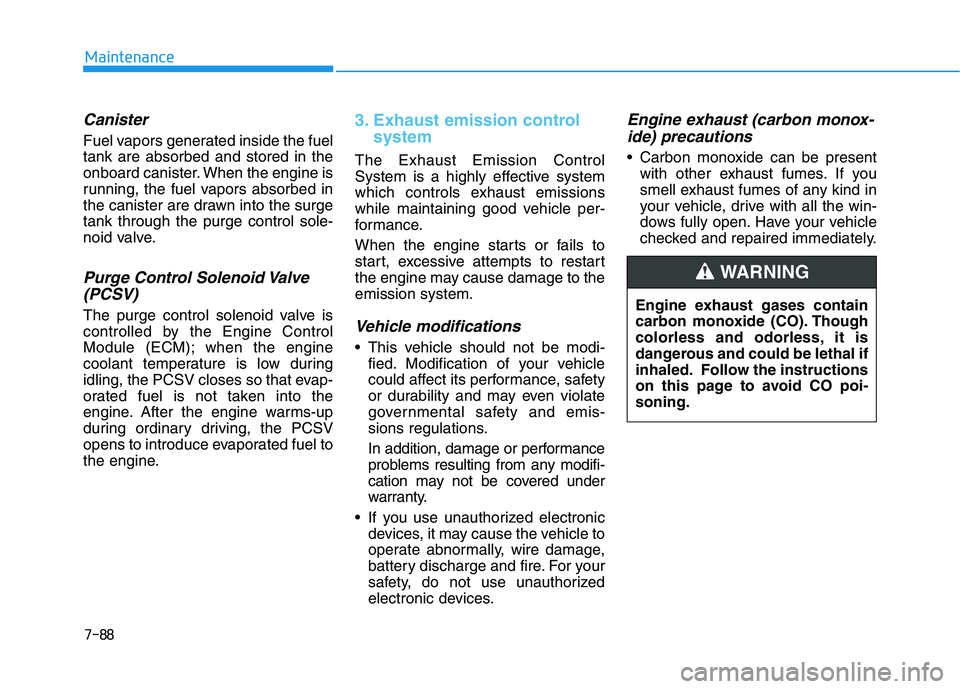
Canister
Fuel vapors generated inside the fuel tank are absorbed and stored in the
onboard canister. When the engine is
running, the fuel vapors absorbed in
the canister are drawn into the surgetank through the purge control sole-
noid valve.
Purge Control Solenoid Valve(PCSV)
The purge control solenoid valve is
controlled by the Engine Control
Module (ECM); when the engine
coolant temperature is low during
idling, the PCSV closes so that evap-
orated fuel is not taken into the
engine. After the engine warms-up
during ordinary driving, the PCSV
opens to introduce evaporated fuel to
the engine.
3. Exhaust emission control system
The Exhaust Emission Control
System is a highly effective system
which controls exhaust emissions
while maintaining good vehicle per-
formance.
When the engine starts or fails to
start, excessive attempts to restart
the engine may cause damage to theemission system.
Vehicle modifications
This vehicle should not be modi-fied. Modification of your vehicle
could affect its performance, safety
or durability and may even violate
governmental safety and emis-
sions regulations.
In addition, damage or performance
problems resulting from any modifi-
cation may not be covered under
warranty.
If you use unauthorized electronic devices, it may cause the vehicle to
operate abnormally, wire damage,
battery discharge and fire. For your
safety, do not use unauthorized
electronic devices.
Engine exhaust (carbon monox-
ide) precautions
Carbon monoxide can be present with other exhaust fumes. If you
smell exhaust fumes of any kind in
your vehicle, drive with all the win-
dows fully open. Have your vehicle
checked and repaired immediately.
Engine exhaust gases contain
carbon monoxide (CO). Though
colorless and odorless, it is
dangerous and could be lethal if
inhaled. Follow the instructions
on this page to avoid CO poi-soning.
WARNING
Page 527 of 546
7-89
7
Maintenance
Do not operate the engine in con-fined or closed areas (such as
garages) any more than what is
necessary to move the vehicle in orout of the area.
When the vehicle is stopped in an open area for more than a short
time with the engine running,
adjust the ventilation system (as
needed) to draw outside air into the
vehicle.
Never sit in a parked or stopped vehicle for any extended time with
the engine running.
When the engine stalls or fails to start, excessive attempts to restart
the engine may cause damage tothe emission control system.Operating precautions for cat-
alytic converters (if equipped)Your vehicle is equipped with a cat-
alytic converter emission control
device.
To prevent damage to the catalytic
converter and to your vehicle, take
the following precautions:
The exhaust system and cat-
alytic converter are very hot
during and immediately after
the engine has been running. To
avoid SERIOUS INJURY or
DEATH:
Do not park, idle, or drive the
vehicle over or near flamma-
ble objects, such as grass,
vegetation, paper, leaves, etc.
A hot exhaust system can
ignite flammable items under
your vehicle.
Keep away from the exhaust
system and catalytic convert-
er or you may get burned.
Also, Do not remove the heat
sink around the exhaust sys-
tem, do not seal the bottom of
the vehicle, and do not coat
the vehicle for corrosion con-
trol. It may present a fire risk
under certain conditions.
WARNING
Page 528 of 546
7-90
Maintenance
Use only UNLEADED FUEL
for gasoline engines.
Do not operate the vehicle when there are signs of
engine malfunction, such as
misfire or a noticeable loss of
performance.
Do not misuse or abuse the
engine. Examples of misuse
are coasting with the hybridsystem off and descending
steep grades in gear with the
engine off.
Do not operate the engine at
high idle speed for extended
periods (5 minutes or more). (Continued)
CAUTION(Continued)
Do not modify or tamper with
any part of the engine or
emission control system. Allinspections and adjustments
must be made by an author-
ized HYUNDAI dealer.
Avoid driving with extremely
low fuel level. If you run out of
gasoline, it could cause theengine to misfire and result in
excessive loading of the cat-
alytic converter.
Page 529 of 546
888
Specifications & Consumer information
8
Specifications & Consumer information
8
Dimensions ..............................................................8-2
Engine ......................................................................8-2
Bulb wattage ...........................................................8-3
Tires and wheels ....................................................8-4
Volume and weight ................................................8-5
Air conditioning system ........................................8-5
Recommended lubricants and capacities ...........8-6Recommended SAE viscosity number ..........................8-7
Vehicle identification number (VIN) ....................8-8
Vehicle certification label .....................................8-8
Tire specification and pressure label .................8-9
Engine number .......................................................8-9
Page 534 of 546
8-6
Specifications & Consumer information
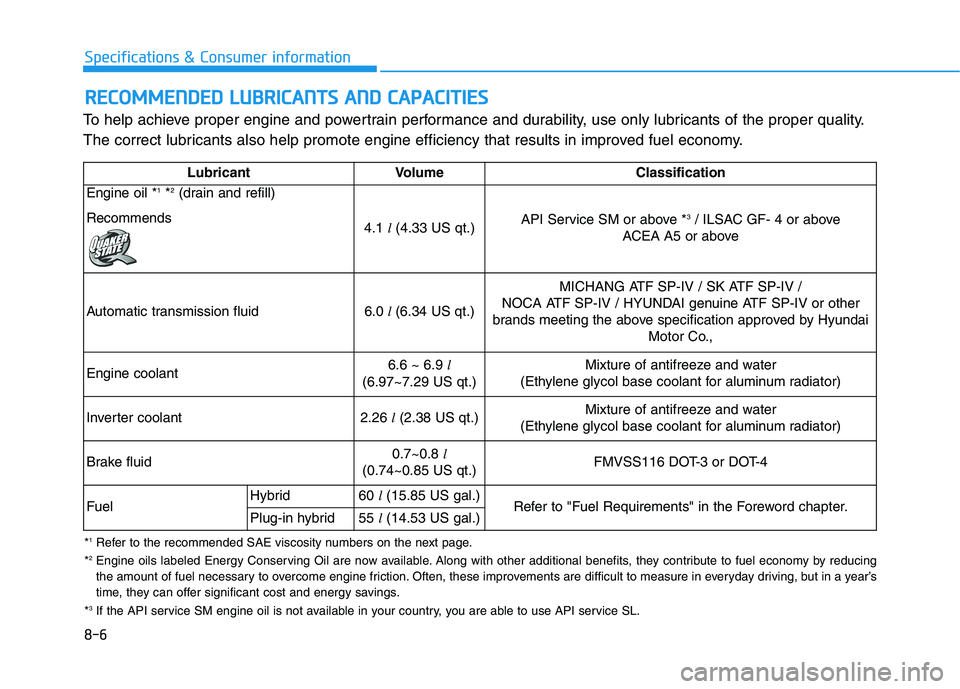
To help achieve proper engine and powertrain performance and durability, use only lubricants of the proper quality.
The correct lubricants also help promote engine efficiency that results in improved fuel economy.
RREECCOO MM MMEENN DDEEDD LL UU BBRRIICC AA NN TTSS AA NN DD CC AA PPAA CCIITT IIEE SS
*1
Refer to the recommended SAE viscosity numbers on the next page.
* 2
Engine oils labeled Energy Conserving Oil are now available. Along with other additional benefits, they contribute to fuel econo my by reducing
the amount of fuel necessary to overcome engine friction. Often, these improvements are difficult to measure in everyday driving, but in a year’s
time, they can offer significant cost and energy savings.
* 3
If the API service SM engine oil is not available in your country, you are able to use API service SL. Lubricant
Volume Classification
Engine oil * 1
*2
(drain and refill)
Recommends
4.1 l(4.33 US qt.) API Service SM or above *
3
/ ILSAC GF- 4 or above
ACEA A5 or above
Automatic transmission fluid
6.0 l (6.34 US qt.) MICHANG ATF SP-IV / SK ATF SP-IV /
NOCA ATF SP-IV / HYUNDAI genuine ATF SP-IV or other
brands meeting the above specification approved by Hyundai Motor Co.,
Engine coolant6.6 ~ 6.9 l
(6.97~7.29 US qt.)Mixture of antifreeze and water
(Ethylene glycol base coolant for aluminum radiator)
Inverter coolant
2.26 l(2.38 US qt.) Mixture of antifreeze and water
(Ethylene glycol base coolant for aluminum radiator)
Brake fluid
0.7~0.8 l
(0.74~0.85 US qt.) FMVSS116 DOT-3 or DOT-4
FuelHybrid60
l(15.85 US gal.)Refer to "Fuel Requirements" in the Foreword chapter.Plug-in hybrid55 l(14.53 US gal.)
Page 535 of 546
Recommended SAE viscosity
number
Always be sure to clean the area
around any filler plug, drain
plug, or dipstick before check-
ing or draining any lubricant.
This is especially important in
dusty or sandy areas and when
the vehicle is used on unpaved
roads. Cleaning the plug and
dipstick areas will prevent dirt
and grit from entering the
engine and other mechanisms
that could be damaged.
CAUTION
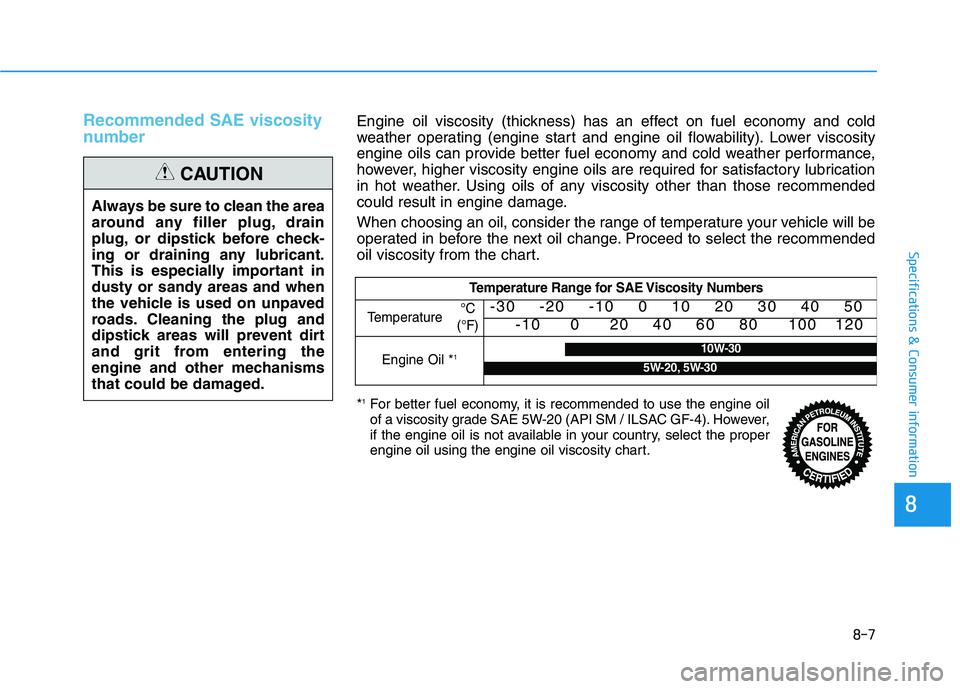
Engine oil viscosity (thickness) has an effect on fuel economy and cold
weather operating (engine start and engine oil flowability). Lower viscosity
engine oils can provide better fuel economy and cold weather performance,
however, higher viscosity engine oils are required for satisfactory lubrication
in hot weather. Using oils of any viscosity other than those recommended
could result in engine damage.
When choosing an oil, consider the range of temperature your vehicle will be
operated in before the next oil change. Proceed to select the recommended
oil viscosity from the chart.
Temperature Range for SAE Viscosity Numbers
Temperature -30 -20 -10 0 10 20 30 40 50
-10 0 20 40 60 80 100 120
Engine Oil *110W-30
5W-20, 5W-30
°C
(°F)
* 1
For better fuel economy, it is recommended to use the engine oil
of a viscosity grade SAE 5W-20 (API SM / ILSAC GF-4). However,
if the engine oil is not available in your country, select the proper
engine oil using the engine oil viscosity chart.
8-7
88
Specifications & Consumer information
Page 537 of 546
8-9
88
Specifications & Consumer information
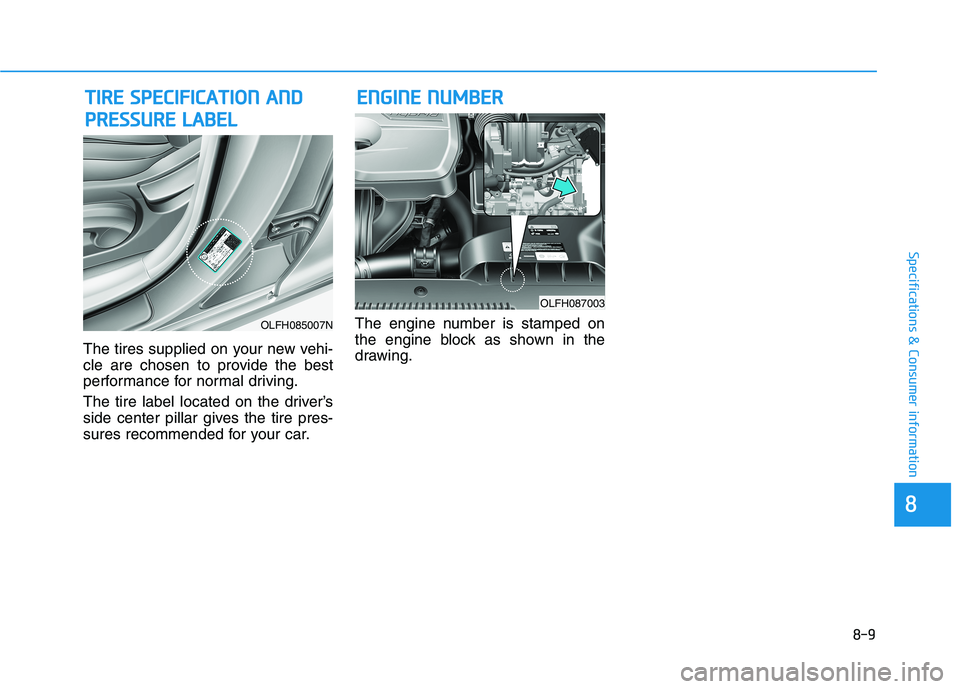
The tires supplied on your new vehi-
cle are chosen to provide the best
performance for normal driving.
The tire label located on the driver’s
side center pillar gives the tire pres-
sures recommended for your car.The engine number is stamped on
the engine block as shown in the
drawing.
EE
NN GGIINN EE NN UU MM BBEERR
TT IIRR EE SS PP EECCIIFF IICC AA TTIIOO NN AA NN DD
P
P RR EESSSS UU RREE LL AA BBEELL
OLFH085007N
OLFH087003
Page 541 of 546
I-4
Driver Attention Alert system (DAA) ............................5-62
Resetting the system ...................................................5-64
System malfunction ....................................................5-64
System setting and activation .....................................5-62
System standby...........................................................5-64
Driver position memory system .....................................3-14 Easy Access Function .................................................3-15
Storing Positions into Memory ..................................3-14
Driving the Hybrid/Plug-in Hybrid Vehicle ....................H22
Changing plug-in hybrid mode ...................................H26
Energy flow.................................................................H38
Hybrid System Gauge .................................................H24
Special features ...........................................................H23
Starting the vehicle .....................................................H22
Warning and indicator lights.......................................H27
Warning messages.......................................................H28
Emission control system .................................................7-87 Crankcase emission control system ...........................7-87
Evaporative emission control system including onboard refueling vapor recovery (ORVR) ............7-87
Exhaust emission control system ...............................7-88
Engine ...............................................................................8-2
Engine compartment..................................................1-6, 7-3
Engine coolant/Inverter coolant ......................................7-20
Changing engine coolant ............................................7-23
Checking the engine/inverter coolant level................7-20 Engine number ..................................................................8-9
Engine oil ........................................................................7-18
Checking the engine oil and filter ..............................7-19
Checking the engine oil level .....................................7-18
Engine start/stop button ....................................................5-5
Engine Stop/Start button positions ...............................5-7
Illuminated Engine Start/Stop button ...........................5-6
Starting the hybrid system............................................5-9
Explanation of scheduled maintenance items.................7-15
Exterior features..............................................................3-39 Fuel Filler Door (Hybrid) ...........................................3-46
Fuel Filler Door (Plug-in hybrid) ...............................3-50
Hood ...........................................................................3-39
Smart Trunk ................................................................3-43
Trunk ..........................................................................3-40
Exterior overview (I) ........................................................1-2
Exterior overview (II) .......................................................1-3
Fuses ...............................................................................7-51 Engine compartment panel fuse replacement ............7-54
Fuse/relay panel description .......................................7-56
Instrument panel fuse replacement.............................7-52
Index
E
F
Page 542 of 546
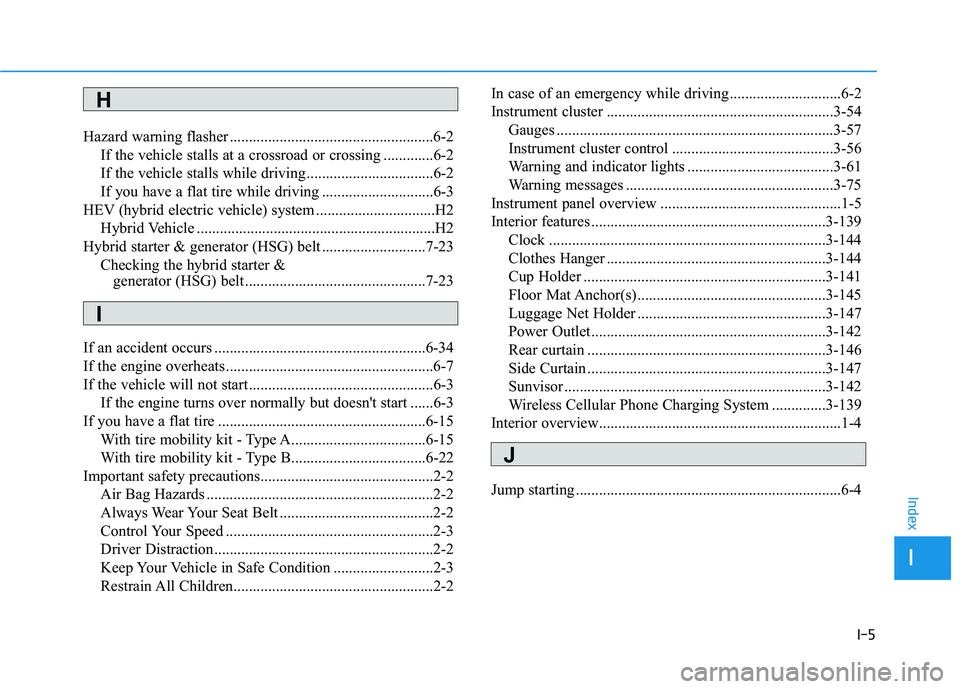
I-5
Hazard warning flasher .....................................................6-2
If the vehicle stalls at a crossroad or crossing .............6-2
If the vehicle stalls while driving .................................6-2
If you have a flat tire while driving .............................6-3
HEV (hybrid electric vehicle) system ...............................H2 Hybrid Vehicle ..............................................................H2
Hybrid starter & generator (HSG) belt ...........................7-23 Checking the hybrid starter & generator (HSG) belt ...............................................7-23
If an accident occurs .......................................................6-34
If the engine overheats ......................................................6-7
If the vehicle will not start ................................................6-3 If the engine turns over normally but doesn't start ......6-3
If you have a flat tire ......................................................6-15 With tire mobility kit - Type A...................................6-15
With tire mobility kit - Type B...................................6-22
Important safety precautions.............................................2-2
Air Bag Hazards ...........................................................2-2
Always Wear Your Seat Belt ........................................2-2
Control Your Speed ......................................................2-3
Driver Distraction.........................................................2-2
Keep Your Vehicle in Safe Condition ..........................2-3
Restrain All Children....................................................2-2 In case of an emergency while driving .............................6-2
Instrument cluster ...........................................................3-54
Gauges ........................................................................3-57
Instrument cluster control ..........................................3-56
Warning and indicator lights ......................................3-61
Warning messages ......................................................3-75
Instrument panel overview ...............................................1-5
Interior features .............................................................3-139 Clock ........................................................................3-144
Clothes Hanger .........................................................3-144
Cup Holder ...............................................................3-141
Floor Mat Anchor(s) .................................................3-145
Luggage Net Holder .................................................3-147
Power Outlet.............................................................3-142
Rear curtain ..............................................................3-146
Side Curtain ..............................................................3-147
Sunvisor ....................................................................3-142
Wireless Cellular Phone Charging System ..............3-139
Interior overview...............................................................1-4
Jump starting .....................................................................6-4
I
Index
H
I
J