engine HYUNDAI SONATA HYBRID 2019 Owner's Manual
[x] Cancel search | Manufacturer: HYUNDAI, Model Year: 2019, Model line: SONATA HYBRID, Model: HYUNDAI SONATA HYBRID 2019Pages: 546, PDF Size: 78.75 MB
Page 46 of 546
H35
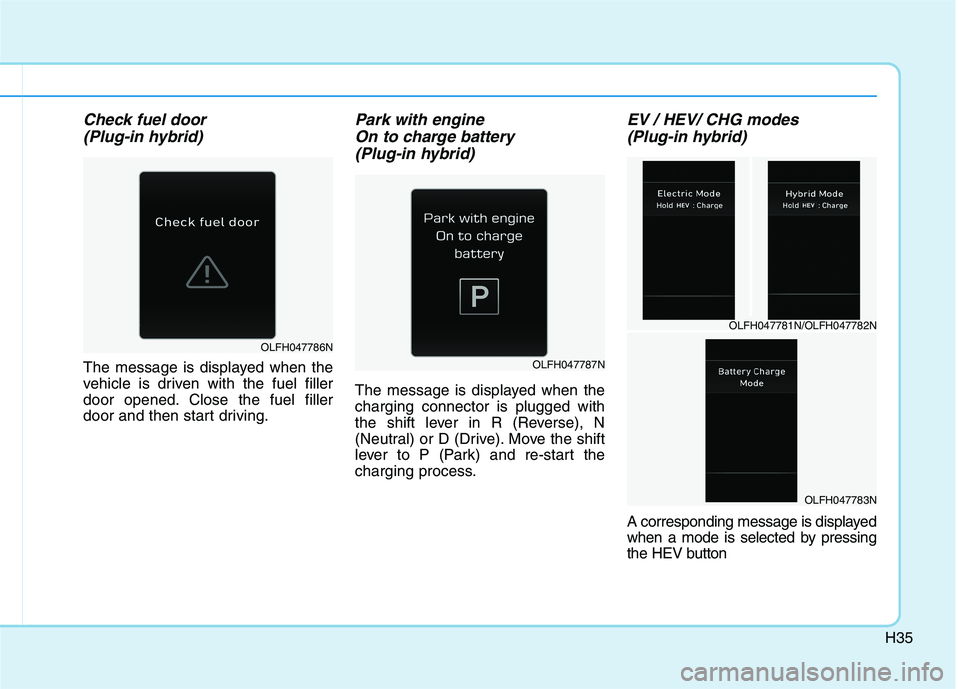
Check fuel door(Plug-in hybrid)
The message is displayed when the
vehicle is driven with the fuel filler
door opened. Close the fuel filler
door and then start driving.
Park with engine On to charge battery
(Plug-in hybrid)
The message is displayed when thecharging connector is plugged with
the shift lever in R (Reverse), N
(Neutral) or D (Drive). Move the shift
lever to P (Park) and re-start the
charging process.
EV / HEV/ CHG modes (Plug-in hybrid)
A corresponding message is displayed
when a mode is selected by pressing
the HEV button
OLFH047787N
OLFH047786N
OLFH047783N
OLFH047781N/OLFH047782N
Page 48 of 546
H37
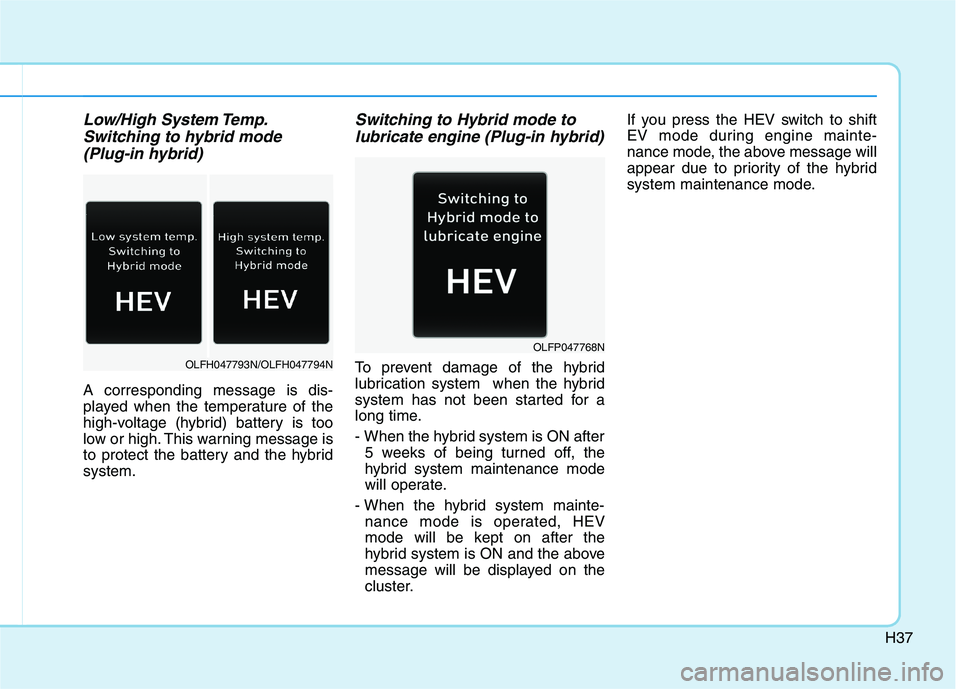
Low/High System Temp.Switching to hybrid mode
(Plug-in hybrid)
A corresponding message is dis-
played when the temperature of the
high-voltage (hybrid) battery is too
low or high. This warning message is
to protect the battery and the hybridsystem.
Switching to Hybrid mode to lubricate engine (Plug-in hybrid)
To prevent damage of the hybrid
lubrication system when the hybrid
system has not been started for a
long time.
- When the hybrid system is ON after 5 weeks of being turned off, the
hybrid system maintenance mode
will operate.
- When the hybrid system mainte- nance mode is operated, HEV
mode will be kept on after the
hybrid system is ON and the above
message will be displayed on the
cluster. If you press the HEV switch to shift
EV mode during engine mainte-
nance mode, the above message will
appear due to priority of the hybrid
system maintenance mode.OLFH047793N/OLFH047794N
OLFP047768N
Page 49 of 546
H38
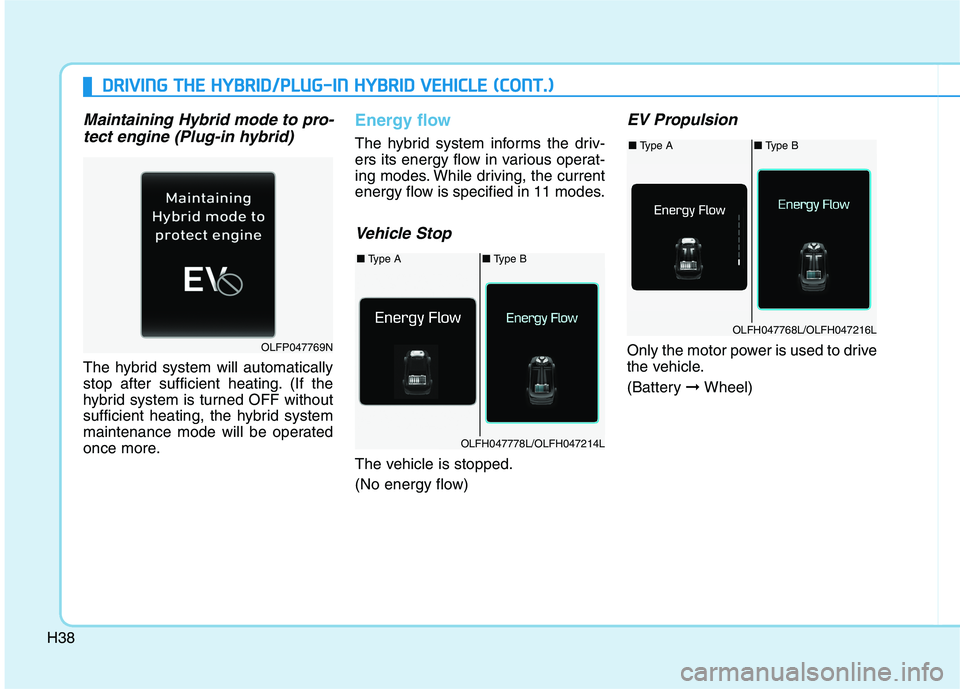
Maintaining Hybrid mode to pro-tect engine (Plug-in hybrid)
The hybrid system will automatically
stop after sufficient heating. (If the
hybrid system is turned OFF without
sufficient heating, the hybrid system
maintenance mode will be operated
once more.
Energy flow
The hybrid system informs the driv-
ers its energy flow in various operat-
ing modes. While driving, the current
energy flow is specified in 11 modes.
Vehicle Stop
The vehicle is stopped.
(No energy flow)
EV Propulsion
Only the motor power is used to drive
the vehicle.
(Battery ➞Wheel)
■ Type A■ Type B
OLFH047778L/OLFH047214L
OLFP047769N
DDRRIIVV IINN GG TT HH EE HH YY BBRRIIDD //PP LLUU GG--IINN HH YY BBRRIIDD VV EEHH IICC LLEE (( CC OO NNTT..))
■ Type A■ Type B
OLFH047768L/OLFH047216L
Page 50 of 546
H39
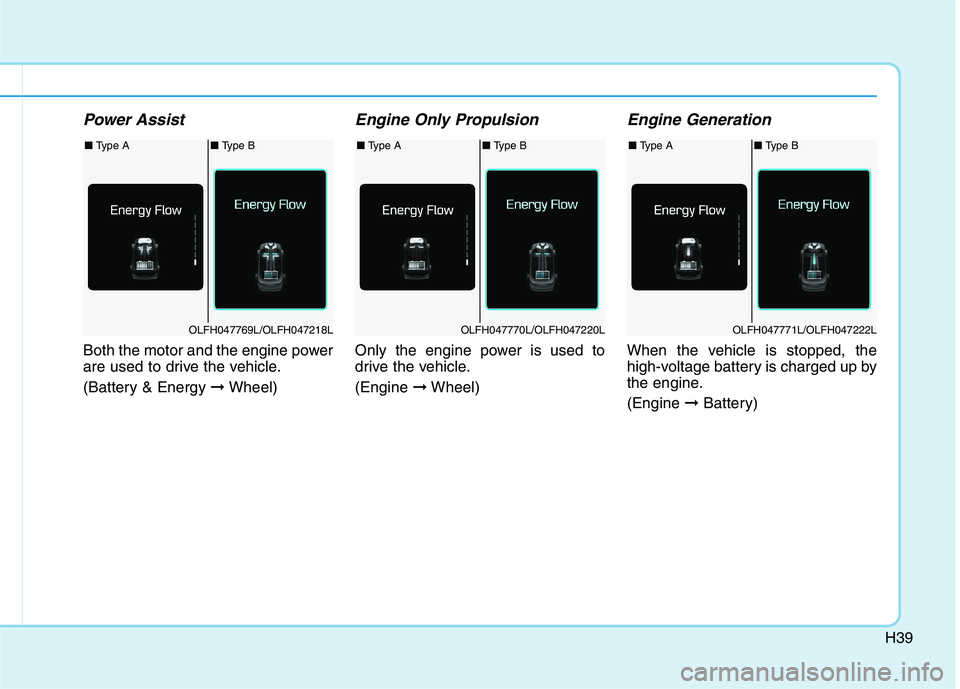
Power Assist
Both the motor and the engine power
are used to drive the vehicle.
(Battery & Energy ➞Wheel)
Engine Only Propulsion
Only the engine power is used to
drive the vehicle. (Engine ➞Wheel)
Engine Generation
When the vehicle is stopped, the
high-voltage battery is charged up by
the engine. (Engine ➞Battery)
■ Type A■ Type B
OLFH047769L/OLFH047218L
■ Type A■ Type B
OLFH047770L/OLFH047220L
■ Type A■ Type B
OLFH047771L/OLFH047222L
Page 51 of 546
H40
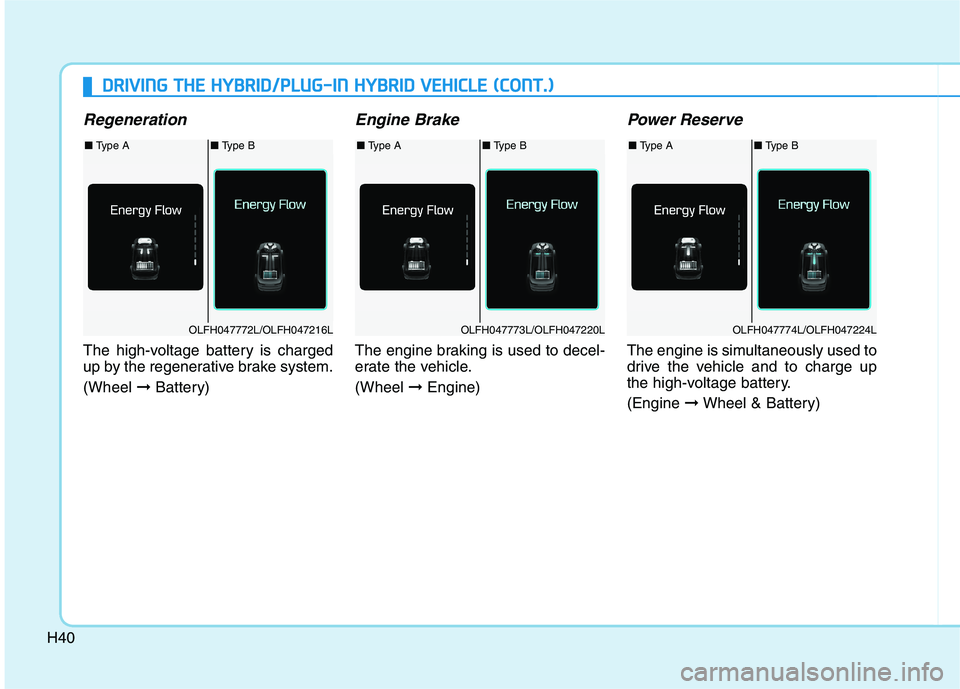
Regeneration
The high-voltage battery is charged
up by the regenerative brake system. (Wheel ➞Battery)
Engine Brake
The engine braking is used to decel-
erate the vehicle. (Wheel ➞Engine)
Power Reserve
The engine is simultaneously used to
drive the vehicle and to charge up
the high-voltage battery. (Engine ➞Wheel & Battery)
■ Type A■ Type B
OLFH047772L/OLFH047216L
■ Type A■ Type B
OLFH047773L/OLFH047220L
DDRRIIVV IINN GG TT HH EE HH YY BBRRIIDD //PP LLUU GG--IINN HH YY BBRRIIDD VV EEHH IICC LLEE (( CC OO NNTT..))
■ Type A■ Type B
OLFH047774L/OLFH047224L
Page 52 of 546
H41
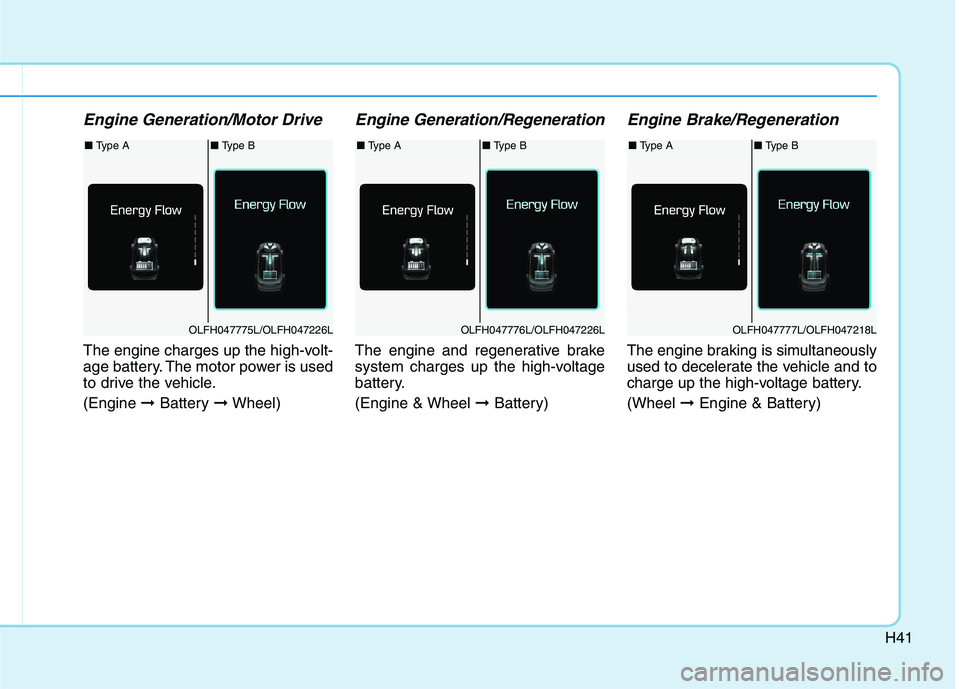
Engine Generation/Motor Drive
The engine charges up the high-volt-
age battery. The motor power is used
to drive the vehicle. (Engine ➞Battery ➞Wheel)
Engine Generation/Regeneration
The engine and regenerative brake
system charges up the high-voltage
battery.
(Engine & Wheel ➞Battery)
Engine Brake/Regeneration
The engine braking is simultaneously
used to decelerate the vehicle and to
charge up the high-voltage battery. (Wheel ➞Engine & Battery)
■ Type A■ Type B
OLFH047775L/OLFH047226L
■ Type A■ Type B
OLFH047776L/OLFH047226L
■ Type A■ Type B
OLFH047777L/OLFH047218L
Page 53 of 546
H42
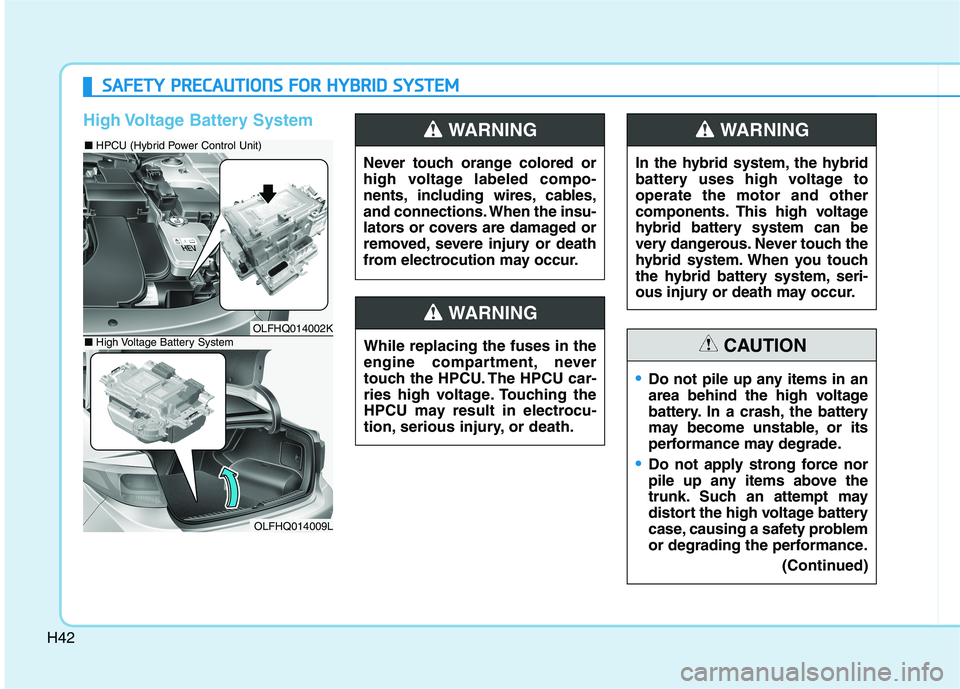
High Voltage Battery System
OLFHQ014002K
OLFHQ014009L
■ HPCU (Hybrid Power Control Unit)
■ High Voltage Battery System Never touch orange colored or
high voltage labeled compo-
nents, including wires, cables,
and connections. When the insu-
lators or covers are damaged or
removed, severe injury or death
from electrocution may occur.
WARNING
While replacing the fuses in the
engine compartment, never
touch the HPCU. The HPCU car-
ries high voltage. Touching the
HPCU may result in electrocu-
tion, serious injury, or death.
WARNING
In the hybrid system, the hybrid
battery uses high voltage tooperate the motor and other
components. This high voltage
hybrid battery system can be
very dangerous. Never touch the
hybrid system. When you touch
the hybrid battery system, seri-
ous injury or death may occur.
WARNING
Do not pile up any items in an
area behind the high voltage
battery. In a crash, the battery
may become unstable, or its
performance may degrade.
Do not apply strong force nor
pile up any items above the
trunk. Such an attempt may
distort the high voltage battery
case, causing a safety problem
or degrading the performance.
(Continued)
CAUTION
SSAA FFEE TT YY PP RR EECCAA UU TTIIOO NNSS FF OO RR HH YY BBRRIIDD SS YY SSTT EEMM
Page 55 of 546
H44
SSAA FFEE TT YY PP RR EECCAA UU TTIIOO NNSS FF OO RR HH YY BBRRIIDD SS YY SSTT EEMM (( CC OO NNTT..))
When the vehicle is paint baked,
do not bake over 30 minutes in
70°C (158°F) or 20 minutes in
80°C (176°F) degree.
Do not wash the engine compart- ment, using water. Water may
cause an electric shock and may
damage electronic components.
NOTICE
Never assemble or disassemble
the high voltage battery system.
If you assemble or disassem-
ble the high voltage battery
system, the durability and per-
formance of the vehicle may be
damaged.
When you want to check the
high voltage battery system,
have the vehicle checked and
inspected by an authorized
HYUNDAI dealer.
Do not touch the high voltage
battery and high voltage cable
connected to motor (orange
color). Severe burns and elec-
tric shock may occur. For your
safety, do not touch the cover
of electronic components and
electronic cable. Do not remove
the cover of electronic compo-
nents and electronic cable. In
particular, never touch the high
voltage battery system when
the hybrid system in operation.
It may result in death or serious
injury.
WARNING
Never use the package mod-
ules (high voltage battery,
inverter and converter) for any
other purpose.
Do not use an unauthorized
battery charger to charge the
high voltage battery. Doing so
may result in death or serious
injury.
Never place the high voltage
system near or in a fire.
Never drill into or strike the
package module. Otherwise, it
may be damaged. An electric
shock may occur, resulting in
serious injury or death.
WARNING
Page 60 of 546
H49
When the hybrid vehicle shuts off
When the high voltage battery is dis-
charged, when the 12-volt battery isdischarged, or when the fuel tank is
empty, the hybrid system may not
operate while driving. When the
Hybrid system does not operate, do
the followings:
1.Gradually reduce the vehiclespeed. Pull over your vehicle off
the road in a safe area.
2.Locate the shift lever in P (Park).
3. Turn ON the hazard warning flashers.
4.Turn OFF the Engine Start/Stop button, and try to start the hybrid system, while depressing the
brake pedal and pressing the
Engine Start/Stop button. 5.When the hybrid system still does
not operate, refer to "EMERGENCY
STARTING" in the chapter 6.
Before jump-starting the vehicle,
check the fuel level and the exact
procedure to jump start. For further
details, refer to "EMERGENCY
STARTING" in the chapter 6. When
the fuel level is low, do not attempt
to drive the vehicle only with the
battery power. The high voltage bat-
tery may be discharged, and the
hybrid system will turn OFF.
Page 61 of 546
Your vehicle at a glance
1
Your vehicle at a glance
1Exterior overview (I) .............................................1-2
Exterior overview (II) ............................................1-3
Interior overview ....................................................1-4
Instrument panel overview ...................................1-5
Engine compartment .............................................1-6