engine oil HYUNDAI SONATA HYBRID 2019 Owners Manual
[x] Cancel search | Manufacturer: HYUNDAI, Model Year: 2019, Model line: SONATA HYBRID, Model: HYUNDAI SONATA HYBRID 2019Pages: 546, PDF Size: 78.75 MB
Page 66 of 546
1-6
Your vehicle at a glanceE
E NN GGIINN EE CC OO MM PPAA RRTTMM EENN TT
OLFH017005
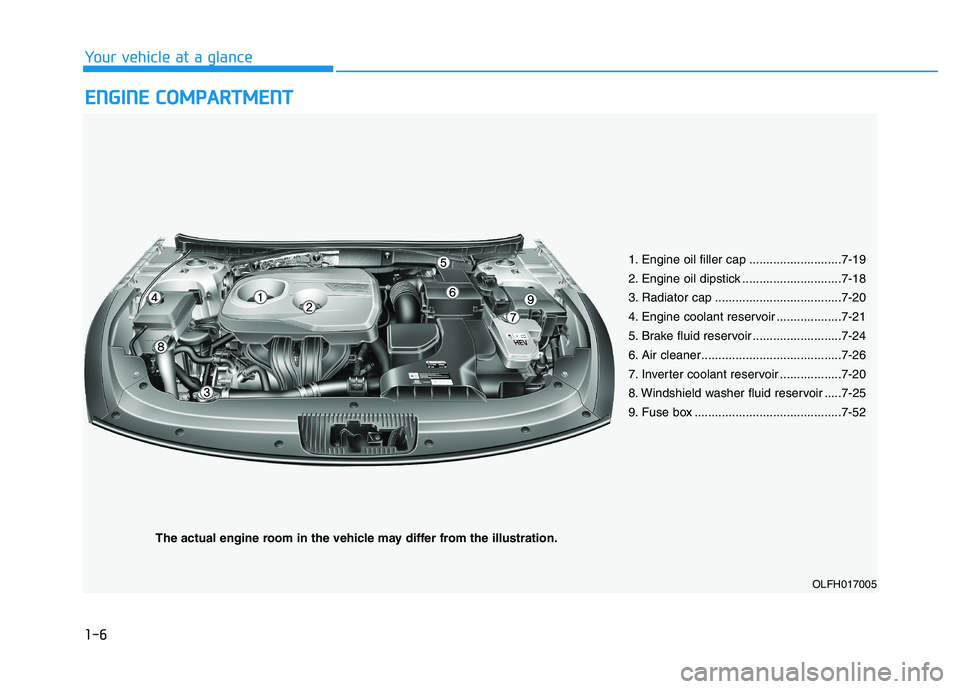
1. Engine oil filler cap ...........................7-19
2. Engine oil dipstick .............................7-18
3. Radiator cap .....................................7-20
4. Engine coolant reservoir ...................7-21
5. Brake fluid reservoir ..........................7-24
6. Air cleaner.........................................7-26
7. Inverter coolant reservoir ..................7-20
8. Windshield washer fluid reservoir .....7-25
9. Fuse box ...........................................7-52
The actual engine room in the vehicle may differ from the illustration.
Page 203 of 546
3-67
Convenient features of your vehicle
3
Engine Oil PressureWarning Light
This warning light illuminates:
When the Engine Start/Stop button is in the ON position.
- It remains on until the engine isstarted.
When the engine oil pressure is low.
When the engine oil pressure is low,
follow the below procedures:
1. Carefully drive to the nearest safe location and stop your vehicle.
2. Turn OFF the engine and check the engine oil level (For more
information, refer to the
"Engine Oil" in the chapter 7) .If
the level is low, add engine oil.
When the warning light remains ON after adding engine oil and
restarting the engine, or when
engine oil refilling is unavailable,
turn OFF the engine. These indi-
cate a mechanical problem, which
needs to be repaired before driv-ing. In this case, have your vehicle
inspected by an authorized
HYUNDAI dealer.
When the Engine Oil Pressure
Warning Light illuminates, turn
OFF the engine, and check the
engine oil level, in an attempt to
prevent severe engine damage.These should be done as soon as
it is safe to do so. When the oil
level is low, add the engine oil to
the proper level and start the
engine again. When the light stays
ON, while running the engine,
immediately turn OFF the engine.
In this case, have your vehicle
inspected by an authorized
HYUNDAI dealer.
Low Fuel Level Warning Light
This warning light illuminates:
When the fuel tank is nearly empty.
Add fuel as soon as possible.
Driving with the Low Fuel Level warning light on or with the fuel
level below "E (Empty)" maycause the engine to misfire and
damage the catalytic converter.
Driving the vehicle in EV mode after fuel runs out may damage
the hybrid battery.
NOTICE
NOTICE
Page 293 of 546
5-3
Driving your vehicle
5
Carbon monoxide (CO) gas is toxic. Breathing CO can cause unconsciousness and death.
Engine exhaust contains carbon monoxide which cannot be seen or smelled.
Do not inhale engine exhaust.
If at any time you smell engine exhaust inside the vehicle, open the windows immediately. Exposure to CO can cause
unconsciousness and death by asphyxiation.
Be sure the exhaust system does not leak.
The exhaust system should be checked whenever the vehicle is raised to change the oil or for any other purpose. If
you hear a change in the sound of the exhaust or if you drive over something that strikes the underneath side of the
vehicle, have the exhaust system checked as soon as possible by an authorized HYUNDAI dealer.
Do not run the engine in an enclosed area.
Letting the engine idle in your garage, even with the garage door open, is a hazardous practice. Run the engine only
long enough to start the engine and to move the vehicle out of the garage.
Avoid idling the engine for prolonged periods with people inside the vehicle.
If it is necessary to idle the engine for a prolonged period with people inside the vehicle , be sure to do so only in an
open area with the air intake set at "Fresh" and fan control set to high so fresh air is drawn into the interior.
Keep the air intakes clear.
To assure proper operation of the ventilation system, keep the ventilation air intakes located in front of the windshield
clear of snow, ice, leaves, or other obstructions.
If you must drive with the trunk open:
Close all windows.
Open instrument panel air vents.
Set the air intake control at "Fresh", the air flow control at "Floor" or "Face", and the fan control set to high.
WARNING
Page 393 of 546
5-103
Driving your vehicle
5
Highway driving
Tires
Adjust the tire inflation, as specified.
Under-inflation may overheat or
damage the tires.
Do not install worn-out or damaged
tires, which may reduce traction or
fail the braking operation.Information
Never over-inflate your tires above the
maximum inflation pressure, as speci-
fied on your tires.
Fuel, engine coolant and engine oil
Driving at higher speeds on the high-
way consumes more fuel and is less
efficient than driving at a slower,
more moderate speed. Maintain a
moderate speed in order to conserve
fuel when driving on the highway.
Be sure to check both the engine
coolant level and the engine oil
before driving.
Drive belt
A loose or damaged drive belt may
overheat the engine.
i
Page 437 of 546
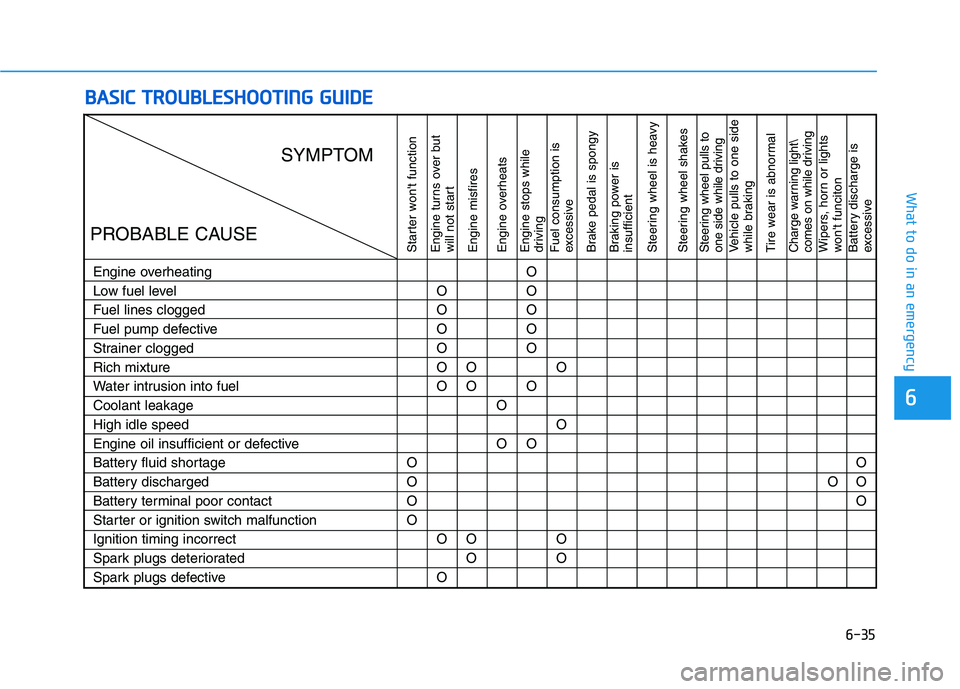
6-35
What to do in an emergency
BBAA SSIICC TT RR OO UUBBLLEE SSHH OO OOTTIINN GG GG UU IIDD EE
6
Starter won't function
Engine turns over but
will not start Engine misfires
Engine overheats Engine stops while
driving Fuel consumption is
excessive
Brake pedal is spongy
Braking power is insufficient
Steering wheel is heavy
Steering wheel shakesSteering wheel pulls to
one side while drivingVehicle pulls to one side
while braking
Tire wear is abnormalCharge warning light\
comes on while drivingWipers, horn or lights
won't funciton
Battery discharge is
excessive
Engine overheating
Low fuel levelFuel lines clogged
Fuel pump defective
Strainer cloggedRich mixture
Water intrusion into fuelCoolant leakageHigh idle speed
Engine oil insufficient or defective
Battery fluid shortage
Battery discharged
Battery terminal poor contact
Starter or ignition switch malfunctionIgnition timing incorrect
Spark plugs deteriorated
Spark plugs defective OOOOOOOOOO O O
O O O O
O OO OOOO O O
OO O O
O
OOO
SYMPTOM
PROBABLE CAUSE
Page 438 of 546
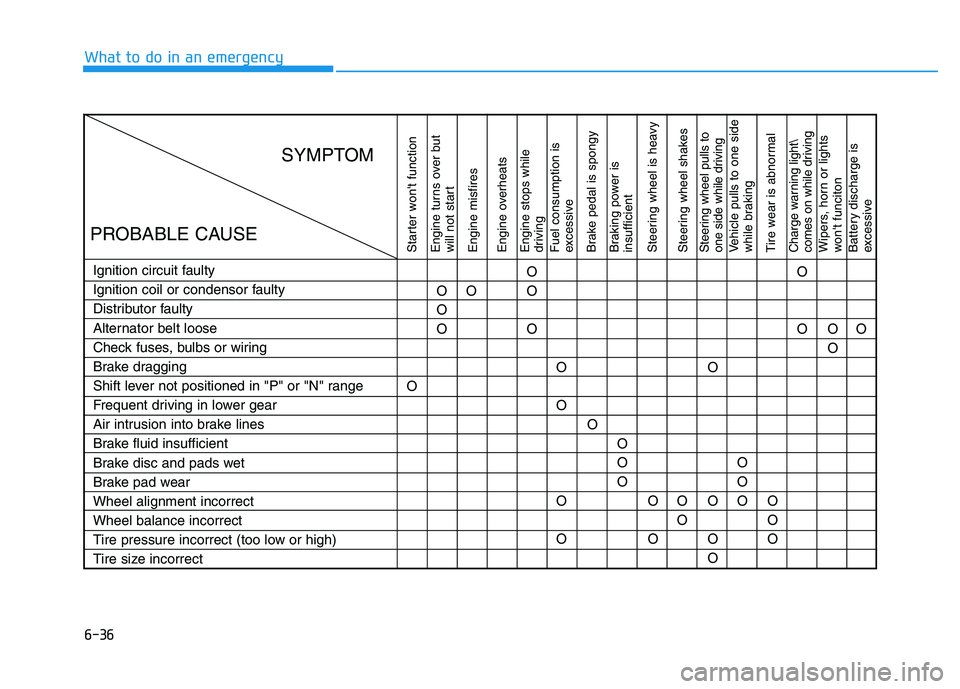
6-36
What to do in an emergency
Starter won't function
Engine turns over but
will not start Engine misfires
Engine overheats Engine stops while
driving Fuel consumption is
excessive
Brake pedal is spongy
Braking power is insufficient
Steering wheel is heavy
Steering wheel shakesSteering wheel pulls to
one side while drivingVehicle pulls to one side
while braking
Tire wear is abnormalCharge warning light\
comes on while drivingWipers, horn or lights
won't funciton
Battery discharge is
excessive
Ignition circuit faulty
Ignition coil or condensor faulty
Distributor faulty
Alternator belt loose
Check fuses, bulbs or wiring
Brake dragging
Shift lever not positioned in "P" or "N" range
Frequent driving in lower gear
Air intrusion into brake lines
Brake fluid insufficient
Brake disc and pads wet
Brake pad wearWheel alignment incorrectWheel balance incorrect
Tire pressure incorrect (too low or high)
Tire size incorrectO
O OO
O
OOOO O OO O O O O O
OOOO
OOO O
O O O
OO O O O O
O
SYMPTOM
PROBABLE CAUSE
Page 439 of 546
7
Maintenance
7
Maintenance
Engine compartment .............................................7-3
Maintenance services ...........................................7-4Owner's responsibility ......................................................7-4
Owner maintenance precautions ..................................7-4
Owner maintenance ...............................................7-5 Owner maintenance schedule ........................................7-6
Scheduled maintenance services.........................7-8 Normal maintenance schedule .......................................7-9
Maintenance under severe usage conditions ..........7-13
Explanation of scheduled maintenance items .. 7-15
Engine oil ..............................................................7-18 Checking the engine oil level .......................................7-18
Checking the engine oil and filter ..............................7-19
Engine coolant/Inverter coolant .......................7-20 Checking the engine/inverter coolant level .............7-20
Changing engine coolant...............................................7-23
Hybrid starter & generator (HSG) belt.............7-23 Checking the hybrid starter &
generator (HSG) belt ......................................................7-23
Brake fluid ............................................................7-24 Checking the brake fluid level .....................................7-24
Washer fluid .........................................................7-25 Checking the washer fluid level ..................................7-25 Parking brake .......................................................7-25
Checking the parking brake .........................................7-25
Air cleaner ............................................................7-26 Filter replacement ...........................................................7-26
Climate control air filter .....................................7-28 Filter inspection ...............................................................7-28
Wiper blades .........................................................7-30 Blade inspection ..............................................................7-30
Blade replacement ..........................................................7-30
Battery...................................................................7-32 For best battery service................................................7-33
Battery recharging .........................................................7-33
Reset features .................................................................7-34
Tires and wheels ..................................................7-35 Tire care ............................................................................7-35
Recommended cold tire inflation pressures.............7-36
Check tire inflation pressure........................................7-37
Tire rotation .....................................................................7-38
Wheel alignment and tire balance ..............................7-39
Tire replacement .............................................................7-39
Wheel replacement .........................................................7-40
Tire traction ......................................................................7-40
7
Page 441 of 546
7-3
7
Maintenance
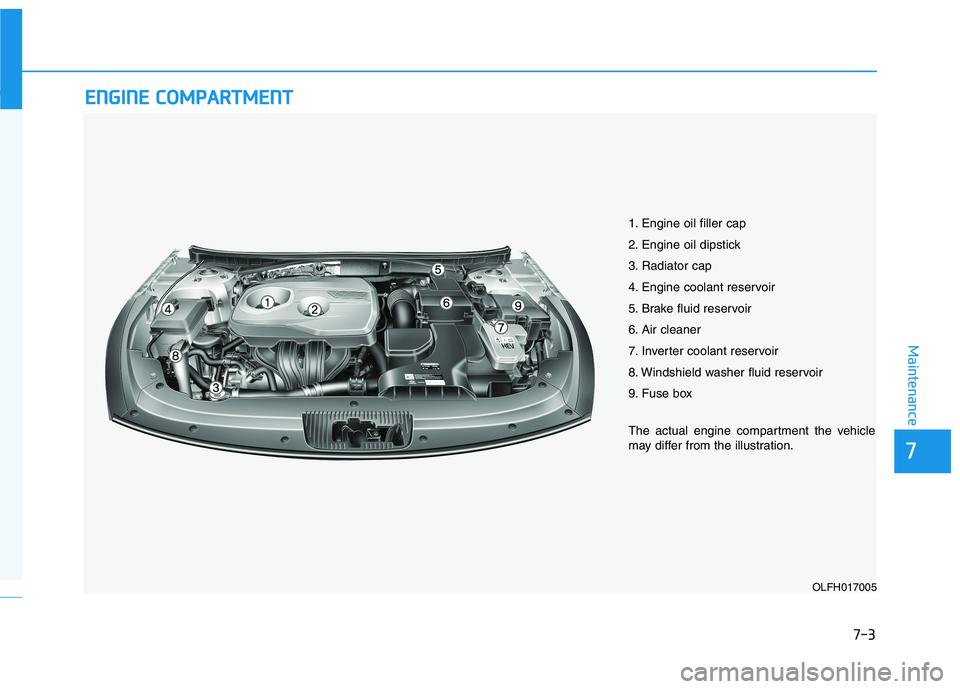
EENN GGIINN EE CC OO MM PPAA RRTTMM EENN TT
1. Engine oil filler cap
2. Engine oil dipstick
3. Radiator cap
4. Engine coolant reservoir
5. Brake fluid reservoir
6. Air cleaner
7. Inverter coolant reservoir
8. Windshield washer fluid reservoir
9. Fuse box
The actual engine compartment the vehicle
may differ from the illustration.
OLFH017005
Page 444 of 546
7-6
Maintenance
Owner maintenance schedule
When you stop for fuel:
Check the engine oil level.
Check coolant level in the enginecoolant reservoir.
Check the windshield washer fluid level.
Check for low or under-inflated tires.
While operating your vehicle:
Note any changes in the sound ofthe exhaust or any smell of
exhaust fumes in the vehicle.
Check for vibrations in the steering wheel. Notice if there is any
increased steering effort or loose-
ness in the steering wheel, or
change in its straight-ahead posi-tion.
Notice if your vehicle constantly turns slightly or "pulls" to one side
when traveling on smooth, levelroad.
When stopping, listen and check for unusual sounds, pulling to one
side, increased brake pedal travel
or "hard-to-push" brake pedal.
If any slipping or changes in the operation of your transmission
occurs, check the transmission
fluid level.
Check the automatic transmission P (Park) function.
Check the parking brake.
Check for fluid leaks under your vehicle (water dripping from the air
conditioning system during or after
use is normal).
At least monthly:
Check coolant level in the enginecoolant reservoir.
Check the operation of all exterior lights, including the stoplights, turn
signals and hazard warning flashers.
Check the inflation pressures of all tires including the spare for tires
that are worn, show uneven wear,or are damaged.
Check for loose wheel lug nuts.
Be careful when checking your
engine coolant level when the
engine is hot. This may result in
coolant being blown out of theopening and cause serious
burns and other injuries.
WARNING
Page 447 of 546
7-9
7
Maintenance
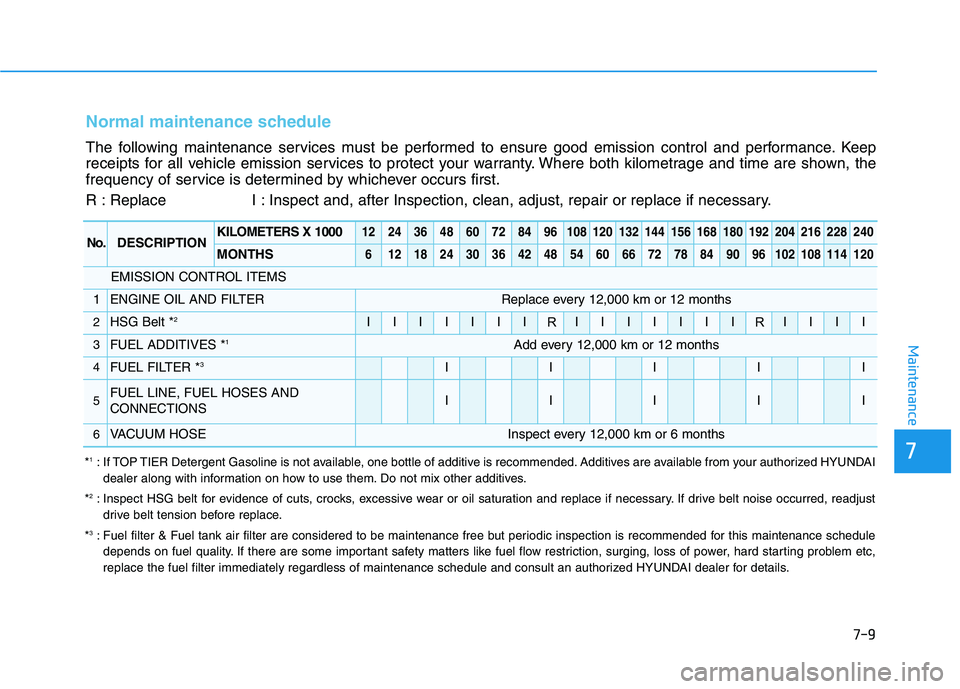
Normal maintenance schedule
The following maintenance services must be performed to ensure good emission control and performance. Keep
receipts for all vehicle emission services to protect your warranty. Where both kilometrage and time are shown, the
frequency of service is determined by whichever occurs first.
R : Replace I : Inspect and, after Inspection, clean, adjust, repair or replace if necessary.
* 1
: If TOP TIER Detergent Gasoline is not available, one bottle of additive is recommended. Additives are available from your authorized HYUNDAI
dealer along with information on how to use them. Do not mix other additives.
* 2
: Inspect HSG belt for evidence of cuts, crocks, excessive wear or oil saturation and replace if necessary. If drive belt noise occurred, readjust
drive belt tension before replace.
* 3
: Fuel filter & Fuel tank air filter are considered to be maintenance free but periodic inspection is recommended for this maintenance schedule
depends on fuel quality. If there are some important safety matters like fuel flow restriction, surging, loss of power, hard starting problem etc,
replace the fuel filter immediately regardless of maintenance schedule and consult an authorized HYUNDAI dealer for details.
No.DESCRIPTIONKILOMETERS X 10001224364860728496108120132144156168180192204216228240
MONTHS6121824303642485460667278849096102108114120
EMISSION CONTROL ITEMS
1ENGINE OIL AND FILTERReplace every 12,000 km or 12 months
2HSG Belt * 2IIIIIIIRIIIIIIIRIIII
3FUEL ADDITIVES * 1Add every 12,000 km or 12 months
4FUEL FILTER *3IIIII
5FUEL LINE, FUEL HOSES AND CONNECTIONSIIIII
6VACUUM HOSEInspect every 12,000 km or 6 months