wheel HYUNDAI SONATA LIMITED 2016 Owners Manual
[x] Cancel search | Manufacturer: HYUNDAI, Model Year: 2016, Model line: SONATA LIMITED, Model: HYUNDAI SONATA LIMITED 2016Pages: 708, PDF Size: 25.96 MB
Page 620 of 708
7-56
Maintenance
Pneumatic tire
A mechanical device made of rubber,
chemicals, fabric and steel or other
materials, that, when mounted on an
automotive wheel, provides the trac-
tion and contains the gas or fluid that
sustains the load.
Production options weight
The combined weight of installed
regular production options weighing
over 5 lb.(2.3 kg) in excess of the
standard items which they replace,
not previously considered in curb
weight or accessory weight, includ-
ing heavy duty brakes, ride levelers,
roof rack, heavy duty battery, and
special trim.
Recommended InflationPressure
Vehicle manufacturer’s recommend-
ed tire inflation pressure as shown
on the tire placard.
Radial Ply Tire
A pneumatic tire in which the ply
cords that extend to the beads are
laid at 90 degrees to the centerline of
the tread.
Rim
A metal support for a tire and upon
which the tire beads are seated.
Sidewall
The portion of a tire between the
tread and the bead.
Speed Rating
An alphanumeric code assigned to a
tire indicating the maximum speed at
which a tire can operate.
Traction
The friction between the tire and the
road surface. The amount of grip pro-
vided.
Tread
The portion of a tire that comes into
contact with the road.
Treadwear Indicators
Narrow bands, sometimes called
"wear bars," that show across the
tread of a tire when only 1/16 inch of
tread remains.
UTQGS
Uniform Tire Quality Grading
Standards is a tire information sys-
tem that provides consumers with
ratings for a tire’s traction, tempera-
ture and treadwear. Ratings are
determined by tire manufacturers
using government testing proce-
dures. The ratings are molded into
the sidewall of the tire.
Vehicle Capacity Weight
The number of designated seating
positions multiplied by 150 lbs. (68
kg) plus the rated cargo and luggage
load.
Page 621 of 708
7-57
7
Maintenance
Vehicle Maximum Load on theTire
Load on an individual tire due to curb
and accessory weight plus maximum
occupant and cargo weight.
Vehicle Normal Load on the Tire
Load on an individual tire that is
determined by distributing to each
axle its share of the curb weight,
accessory weight, and normal occu-
pant weight and dividing by 2.
Vehicle Placard
A label permanently attached to a
vehicle showing the original equip-
ment tire size and recommended
inflation pressure.
All season tires
HYUNDAI specifies all season tires
on some models to provide good
performance for use all year round,
including snowy and icy road condi-
tions. All season tires are identified
by ALL SEASON and/or M+S (Mud
and Snow) on the tire sidewall. Snow
tires have better snow traction than
all season tires and may be more
appropriate in some areas.
Summer tires
HYUNDAI specifies summer tires on
some models to provide superior
performance on dry roads. Summer
tire performance is substantially
reduced in snow and ice. Summer
tires do not have the tire traction rat-
ing M+S (Mud and Snow) on the tire
side wall. If you plan to operate your
vehicle in snowy or icy conditions,
HYUNDAI recommends the use of
snow tires or all season tires on all
four wheels.
Snow tires
If you equip your car with snow tires,
they should be the same size and
have the same load capacity as the
original tires. Snow tires should be
installed on all four wheels; other-
wise, poor handling may result. Snow
tires should carry 4 psi (28 kPa)
more air pressure than the pressure
recommended for the standard tires
on the tire label on the driver’s side of
the center pillar, or up to the maxi-
mum pressure shown on the tire
sidewall, whichever is less. Do not
drive faster than 75 mph (120 km/h)
when your vehicle is equipped with
snow tires.
Page 623 of 708
7-59
7
Maintenance
Because the sidewall of the low
aspect ratio tire is shorter than
the normal, the wheel and tire of
the low aspect ratio tire is easi-
er to be damaged. So, follow the
instructions below.
- When driving on a rough roador off road, drive cautiously
because tires and wheels may
be damaged. And after driving,
inspect tires and wheels.
- When passing over a pothole, speed bump, manhole, or curb
stone, drive slowly so that the
tires and wheels are not dam-
aged.
- If the tire is impacted, inspect the tire condition or contact
an authorized HYUNDAI deal-
er.
- To prevent damage to the tire, inspect the tire condition and
pressure every 1,800 miles
(3,000km).
CAUTION
It is not easy to recognize tire
damage with your own eyes.
But if there is the slightest
hint of tire damage, have the
tire checked or replaced
because the tire damage may
cause air leakage from the
tire.
If the tire is damaged by driv-
ing on a rough road, off road,
pothole, manhole, or curb
stone, it will not be covered by
the warranty.
CAUTION
Page 652 of 708
7-88
Maintenance
Finish damage repair
Deep scratches or stone chips in the
painted surface must be repaired
promptly. Exposed metal will quickly
rust and may develop into a major
repair expense.
If your vehicle is damaged and
requires any metal repair or
replacement, be sure the body
shop applies anti-corrosion mate-
rials to the parts repaired or
replaced.
Bright-metal maintenance
To remove road tar and insects,use a tar remover, not a scraper or
other sharp object.
To protect the surfaces of bright- metal parts from corrosion, apply a
coating of wax or chrome preser-
vative and rub to a high luster.
During winter weather or in coastal areas, cover the bright metal parts
with a heavier coating of wax or
preservative. If necessary, coat the
parts with non-corrosive petroleum
jelly or other protective compound.
Underbody maintenance
Corrosive materials used for ice and
snow removal and dust control may
collect on the underbody. If these
materials are not removed, acceler-
ated rusting can occur on underbody
parts such as the fuel lines, frame,
floor pan and exhaust system, even
though they have been treated with
rust protection.
Thoroughly flush the vehicle under-
body and wheel openings with luke-
warm or cold water once a month,
after off-road driving and at the end
of each winter. Pay special attention
to these areas because it is difficult
to see all the mud and dirt. It will do
more harm than good to wet down
the road grime without removing it.
The lower edges of doors, rocker
panels, and frame members have
drain holes that should not be
allowed to clog with dirt; trapped
water in these areas can cause rust-
ing.
NOTICE
Page 653 of 708
7-89
7
Maintenance
Aluminum wheel maintenance
The aluminum wheels are coated with
a clear protective finish.
Corrosion protection
Protecting your vehicle from corro-
sion
By using the most advanced design
and construction practices to combat
corrosion, HYUNDAI produces cars
of the highest quality. However, this is
only part of the job. To achieve the
long-term corrosion resistance your
vehicle can deliver, the owner’s
cooperation and assistance is also
required.
Common causes of corrosion
The most common causes of corro-
sion on your vehicle are:
Road salt, dirt and moisture that isallowed to accumulate underneath
the vehicle.
coatings by stones, gravel, abra-
sion or minor scrapes and dents
which leave unprotected metal
exposed to corrosion.
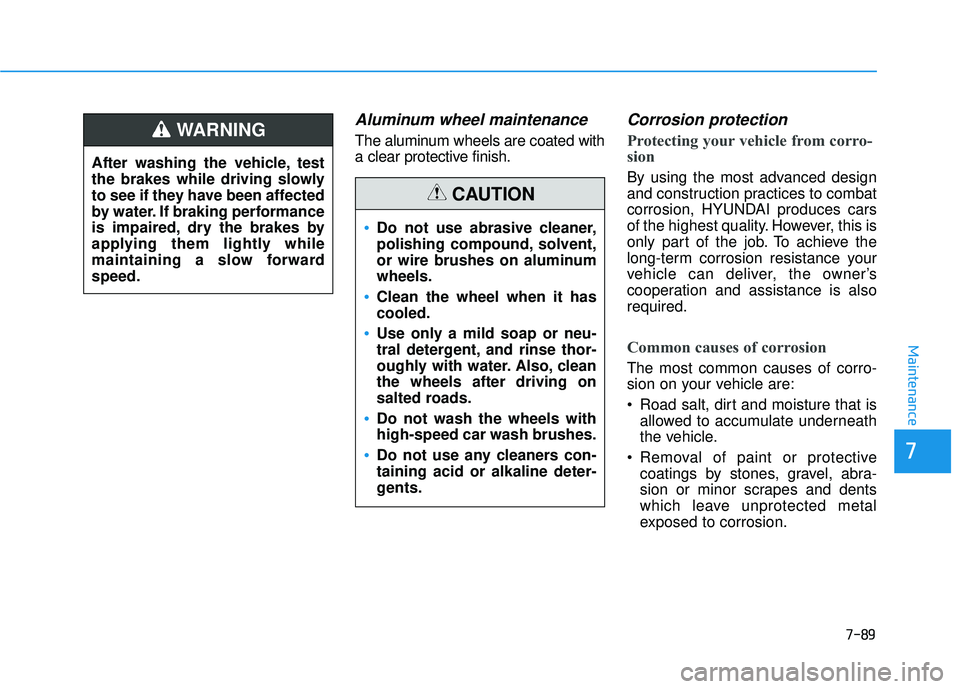
After washing the vehicle, test
the brakes while driving slowly
to see if they have been affected
by water. If braking performance
is impaired, dry the brakes by
applying them lightly while
maintaining a slow forward
speed.
WARNING
Do not use abrasive cleaner,
polishing compound, solvent,
or wire brushes on aluminum
wheels.
Clean the wheel when it has
cooled.
Use only a mild soap or neu-
tral detergent, and rinse thor-
oughly with water. Also, clean
the wheels after driving on
salted roads.
Do not wash the wheels with
high-speed car wash brushes.
Do not use any cleaners con-
taining acid or alkaline deter-
gents.
CAUTION
Page 655 of 708
7-91
7
Maintenance
vehicle, pay particular attention to
the components under the fenders
and other areas that are hidden
from view. Do a thorough job; just
dampening the accumulated mud
rather than washing it away will
accelerate corrosion rather than
prevent it. Water under high pres-
sure and steam are particularly
effective in removing accumulated
mud and corrosive materials.
When cleaning lower door panels, rocker panels and frame members,
be sure that drain holes are kept
open so that moisture can escape
and not be trapped inside to accel-
erate corrosion.Keep your garage dry
Don’t park your car in a damp, poor-
ly ventilated garage. This creates a
favorable environment for corrosion.
This is particularly true if you wash
your vehicle in the garage or drive it
into the garage when it is still wet or
covered with snow, ice or mud. Even
a heated garage can contribute to
corrosion unless it is well ventilated
so moisture is dispersed.
Keep paint and trim in good condition
Scratches or chips in the finish
should be covered with "touch-up"
paint as soon as possible to reduce
the possibility of corrosion. If bare
metal is showing through, the atten-
tion of a qualified body and paint
shop is recommended.
Bird droppings are highly corrosive
and may damage painted surfaces in
just a few hours. Always remove bird
droppings as soon as possible.
Interior care
Interior general precautions
Prevent caustic solutions such as
perfume and cosmetic oil, from con-
tacting the interior parts because
they may cause damage or discol-
oration. If they do contact the interior
parts, wipe them off immediately.
See the instructions for the proper
way to clean vinyl.
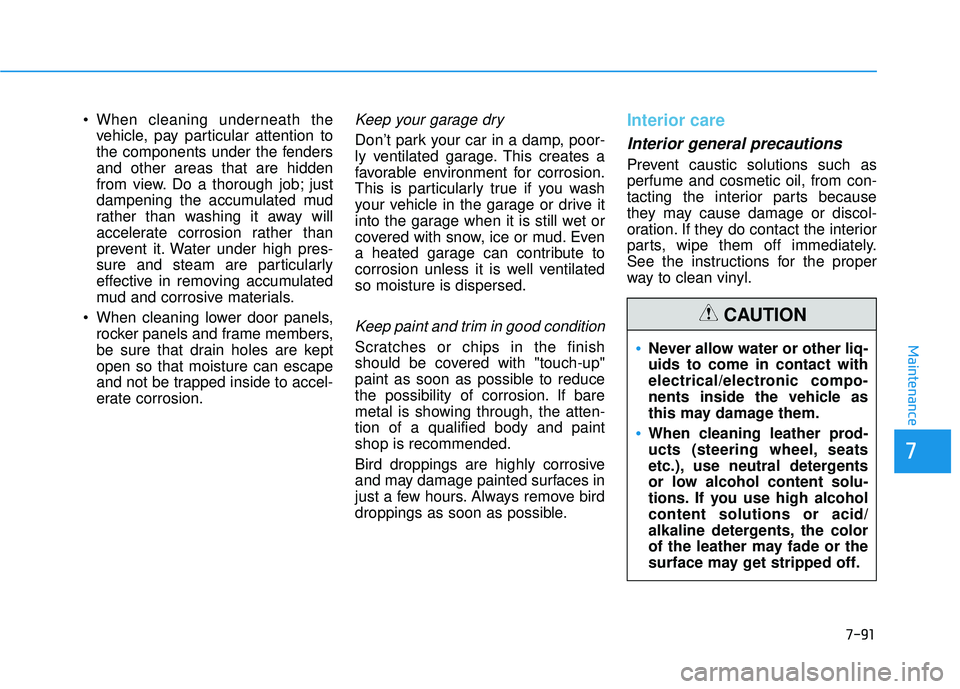
Never allow water or other liq-
uids to come in contact with
electrical/electronic compo-
nents inside the vehicle as
this may damage them.
When cleaning leather prod-
ucts (steering wheel, seats
etc.), use neutral detergents
or low alcohol content solu-
tions. If you use high alcohol
content solutions or acid/
alkaline detergents, the color
of the leather may fade or the
surface may get stripped off.
CAUTION
Page 662 of 708
888
Specifications & Consumer information
8
Specifications, Consumer information and Reporting safety defects
8
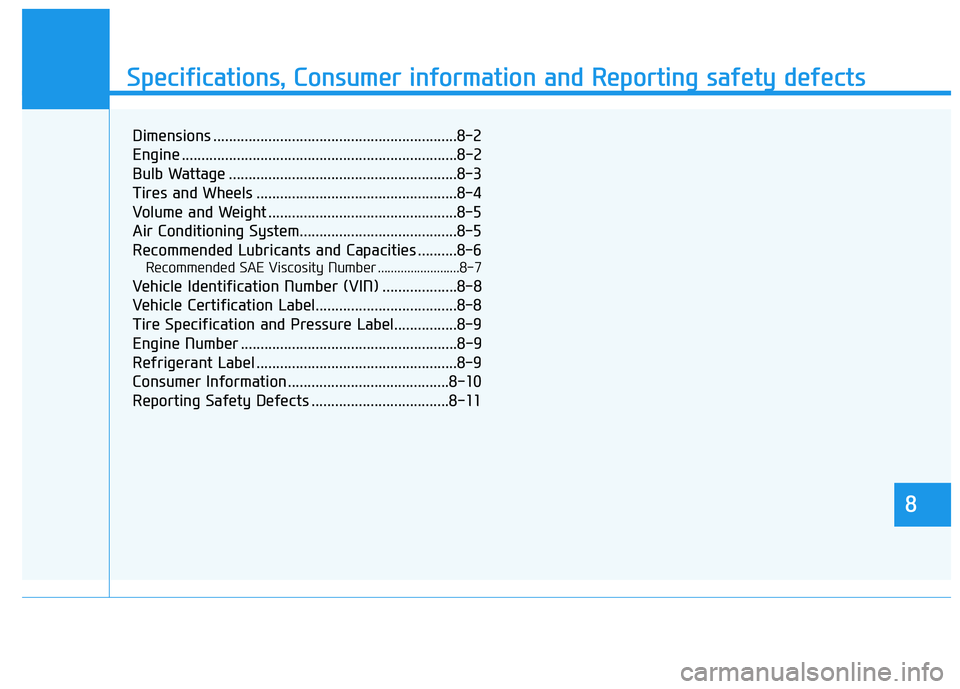
Dimensions ..............................................................8-2
Engine ......................................................................8-\
2
Bulb Wattage ..........................................................8-3
Tires and Wheels ...................................................8-4
Volume and Weight ................................................8-5
Air Conditioning System........................................8-5
Recommended Lubricants and Capacities ..........8-6
Recommended SAE Viscosity Number .........................8-7
Vehicle Identification Number (VIN) ...................8-8
Vehicle Certification Label....................................8-8
Tire Specification and Pressure Label................8-9
Engine Number .......................................................8-9
Refrigerant Label ...................................................8-9
Consumer Information .........................................8-10
Reporting Safety Defects ...................................8-11
Page 663 of 708
D
DI
IM
M E
EN
N S
SI
IO
O N
NS
S
8-2
Specifications, Consumer information and Reporting safety defects
E
EN
N G
GI
IN
N E
E
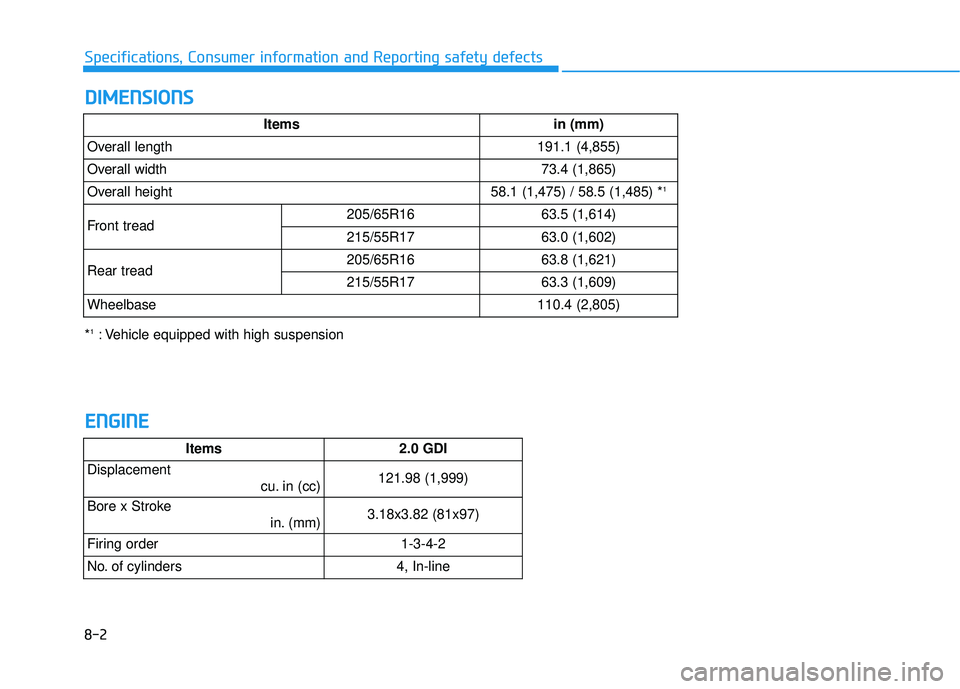
Itemsin (mm)
Overall length191.1 (4,855)
Overall width73.4 (1,865)
Overall height58.1 (1,475) / 58.5 (1,485) *1
Front tread205/65R1663.5 (1,614)
215/55R1763.0 (1,602)
Rear tread 205/65R1663.8 (1,621)
215/55R1763.3 (1,609)
Wheelbase110.4 (2,805)
Items 2.0 GDI
Displacement
cu. in (cc)121.98 (1,999)
Bore x Stroke in. (mm)3.18x3.82 (81x97)
Firing order1-3-4-2
No. of cylinders4, In-line
*1: Vehicle equipped with high suspension
Page 665 of 708
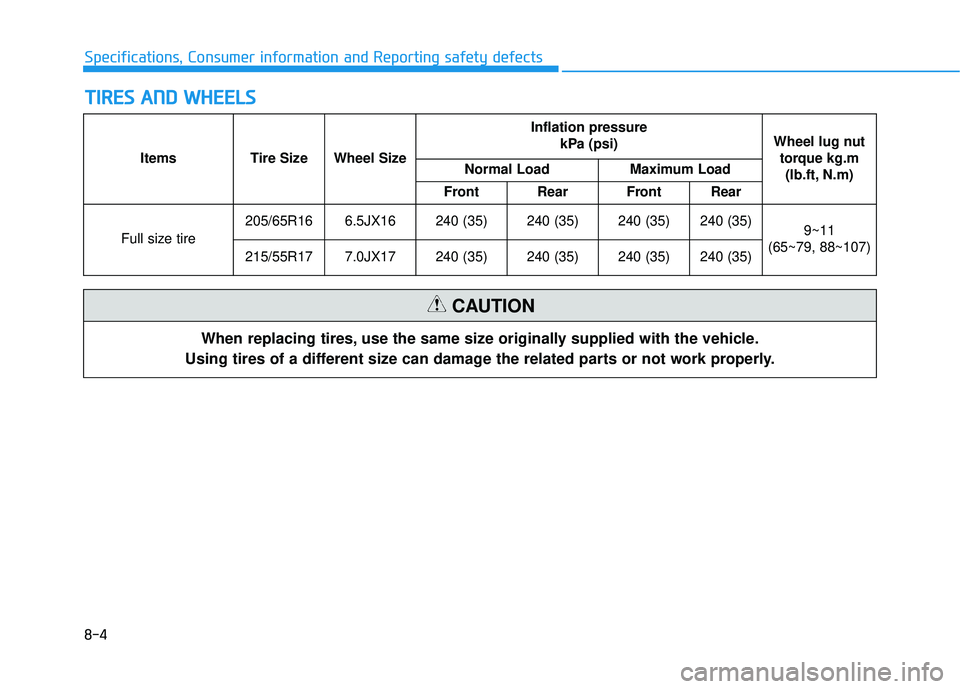
8-4
Specifications, Consumer information and Reporting safety defects
T
TI
IR
R E
ES
S
A
A N
N D
D
W
W H
HE
EE
EL
LS
S
When replacing tires, use the same size originally supplied with the vehicle.
Using tires of a different size can damage the related parts or not work properly.
CAUTION
Items Tire SizeWheel Size
Inflation pressure kPa (psi)Wheel lug nuttorque kg.m (lb.ft, N.m)
Normal LoadMaximum Load
FrontRearFrontRear
Full size tire
205/65R166.5JX16240 (35)240 (35)240 (35)240 (35)9~11
(65~79, 88~107)
215/55R177.0JX17240 (35)240 (35)240 (35)240 (35)
Page 677 of 708

I-5
Engine number ..................................................................8-9
Engine oil ........................................................................\
7-27
Engine start/stop button ....................................................5-4
Explanation of scheduled maintenance items.................7-24
Exterior care....................................................................7-86\
Exterior overview (front) ..................................................1-2
Exterior overview (rear) ...................................................1-3
Flat tire (with Tire Mobility kit) .....................................6-15
Floor mat anchor(s).......................................................3-152
FluidBrake fluid ..................................................................7-33
Washer fluid ...............................................................7-34
Folding rear seats ............................................................2-12
Folding the outside rearview mirror ...............................3-36
Foot parking brake ..........................................................5-20
Forward collision warning system (FCWS) ...................5-63
Front lamp .....................................................................3-1\
16
Front seats ........................................................................\
.2-6
Fuel Economy ...............................................................3-100
Fuel filler lid ...................................................................3-53 Emergency fuel filler door release .............................3-53
Fuel Gauge ......................................................................3-\
60
Fuel requirements .............................................................F-7
Fuse switch .....................................................................7-6\
2 Fuses ........................................................................\
.......7-60
Engine compartment panel fuse .................................7-62
Fuse switch .................................................................7-62
Fuse/relay panel description .......................................7-64
Instrument panel fuse .................................................7-61
Main fuse ....................................................................7-63\
Multi fuse ...................................................................7-63
Gauges........................................................................\
.....3-59
Glove box......................................................................3-\
145
Glove box lamp .............................................................3-119
Hazard warning flasher .....................................................6-2
Hazardous driving conditions .........................................5-78
Head restraints ................................................................2-16
Headlamp bulb replacement ...........................................7-73
Headlamp delay function ..............................................3-113
Headlamp position ........................................................3-108
Heated steering wheel .....................................................3-17
Heater Automatic climate control system............................3-128
Manual climate control system ................................3-129
HEV(Hybrid Electric Vehicle) system.............................H-2
High - beam operation ..................................................3-109
High mounted stop lamp.................................................7-84
I
Index
FG
H