spare wheel Hyundai Sonata
[x] Cancel search | Manufacturer: HYUNDAI, Model Year: , Model line: , Model:Pages: 411, PDF Size: 8.68 MB
Page 357 of 411
741
Maintenance
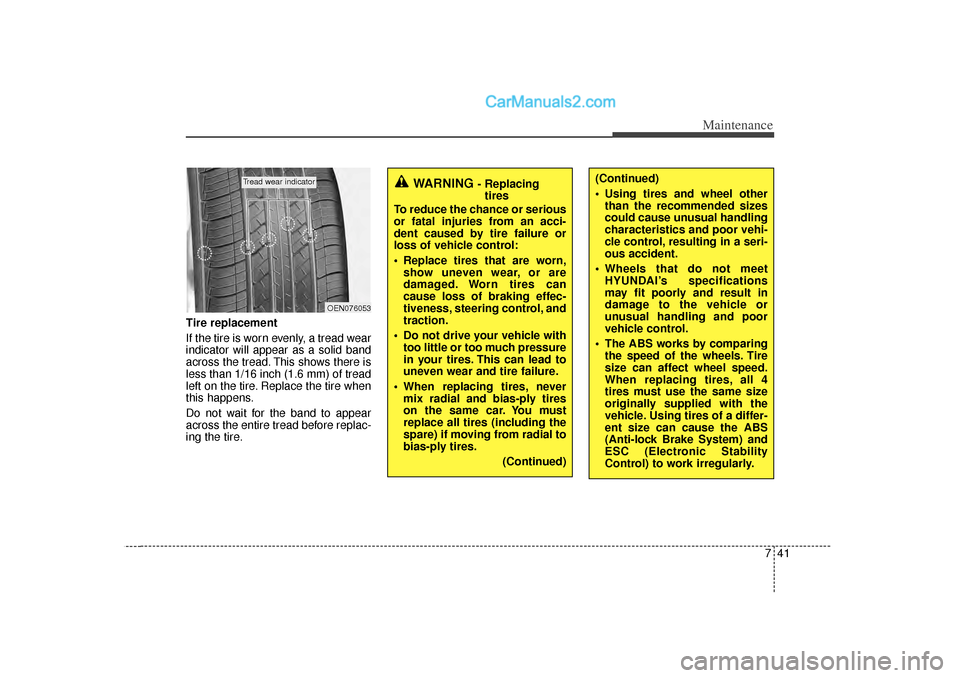
Tire replacement
If the tire is worn evenly, a tread wear
indicator will appear as a solid band
across the tread. This shows there is
less than 1/16 inch (1.6 mm) of tread
left on the tire. Replace the tire when
this happens.
Do not wait for the band to appear
across the entire tread before replac-
ing the tire.
OEN076053
Tread wear indicator
WARNING
- Replacingtires
To reduce the chance or serious
or fatal injuries from an acci-
dent caused by tire failure or
loss of vehicle control:
Replace tires that are worn, show uneven wear, or are
damaged. Worn tires can
cause loss of braking effec-
tiveness, steering control, and
traction.
Do not drive your vehicle with too little or too much pressure
in your tires. This can lead to
uneven wear and tire failure.
When replacing tires, never mix radial and bias-ply tires
on the same car. You must
replace all tires (including the
spare) if moving from radial to
bias-ply tires.
(Continued)
(Continued)
Using tires and wheel otherthan the recommended sizes
could cause unusual handling
characteristics and poor vehi-
cle control, resulting in a seri-
ous accident.
Wheels that do not meet HYUNDAI’s specifications
may fit poorly and result in
damage to the vehicle or
unusual handling and poor
vehicle control.
The ABS works by comparing the speed of the wheels. Tire
size can affect wheel speed.
When replacing tires, all 4
tires must use the same size
originally supplied with the
vehicle. Using tires of a differ-
ent size can cause the ABS
(Anti-lock Brake System) and
ESC (Electronic Stability
Control) to work irregularly.
Page 358 of 411
Maintenance42
7Compact spare tire replacement A compact spare tire has a shorter
tread life than a regular size tire.
Replace it when you can see the
tread wear indicator bars on the tire.
The replacement compact spare tire
should be the same size and design
tire as the one provided with your
new vehicle and should be mounted
on the same compact spare tire
wheel. The compact spare tire is not
designed to be mounted on a regular
size wheel, and the compact spare
tire wheel is not designed for mount-
ing a regular size tire. Wheel replacement
When replacing the metal wheels for
any reason, make sure the new
wheels are equivalent to the original
factory units in diameter, rim width
and offset.
Tire traction
Tire traction can be reduced if you
drive on worn tires, tires that are
improperly inflated or on slippery
road surfaces. Tires should be
replaced when tread wear indicators
appear. To reduce the possibility of
losing control, slow down whenever
there is rain, snow or ice on the road.
Tire maintenance
In addition to proper inflation, correct
wheel alignment helps to decrease
tire wear. If you find a tire is worn
unevenly, have your dealer check the
wheel alignment.
When you have new tires installed,
make sure they are balanced. This
will increase vehicle ride comfort and
tire life. Additionally, a tire should
always be rebalanced if it is removed
from the wheel.
WARNING
A wheel that is not the correct
size may adversely affect wheel
and bearing life, braking and
stopping abilities, handling char-
acteristics, ground clearance,
body-to-tire clearance, snow
chain clearance, speedometer
and odometer calibration, head-
light aim and bumper height.
Page 360 of 411
Maintenance44
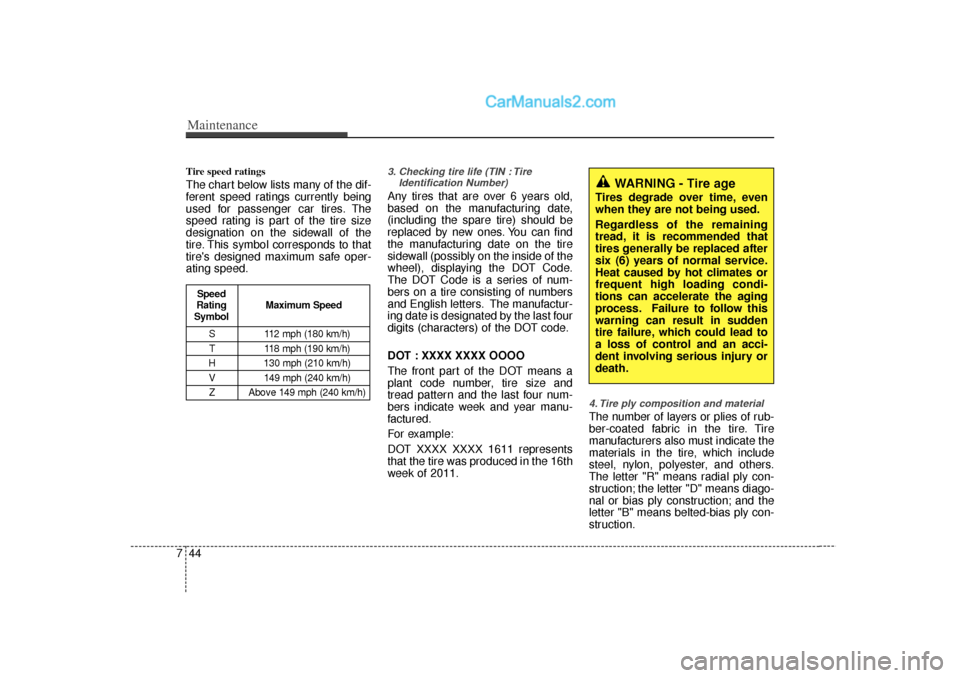
7Tire speed ratings The chart below lists many of the dif-
ferent speed ratings currently being
used for passenger car tires. The
speed rating is part of the tire size
designation on the sidewall of the
tire. This symbol corresponds to that
tire's designed maximum safe oper-
ating speed.
3. Checking tire life (TIN : Tire
Identification Number) Any tires that are over 6 years old,
based on the manufacturing date,
(including the spare tire) should be
replaced by new ones. You can find
the manufacturing date on the tire
sidewall (possibly on the inside of the
wheel), displaying the DOT Code.
The DOT Code is a series of num-
bers on a tire consisting of numbers
and English letters. The manufactur-
ing date is designated by the last four
digits (characters) of the DOT code.
DOT : XXXX XXXX OOOO
The front part of the DOT means a
plant code number, tire size and
tread pattern and the last four num-
bers indicate week and year manu-
factured.
For example:
DOT XXXX XXXX 1611 represents
that the tire was produced in the 16th
week of 2011.
4. Tire ply composition and materialThe number of layers or plies of rub-
ber-coated fabric in the tire. Tire
manufacturers also must indicate the
materials in the tire, which include
steel, nylon, polyester, and others.
The letter "R" means radial ply con-
struction; the letter "D" means diago-
nal or bias ply construction; and the
letter "B" means belted-bias ply con-
struction.
S 112 mph (180 km/h)
T 118 mph (190 km/h)
H 130 mph (210 km/h) V 149 mph (240 km/h)Z Above 149 mph (240 km/h)
Maximum Speed
Speed
Rating
Symbol
WARNING - Tire age
Tires degrade over time, even
when they are not being used.
Regardless of the remaining
tread, it is recommended that
tires generally be replaced after
six (6) years of normal service.
Heat caused by hot climates or
frequent high loading condi-
tions can accelerate the aging
process. Failure to follow this
warning can result in sudden
tire failure, which could lead to
a loss of control and an acci-
dent involving serious injury or
death.
Page 395 of 411
83
Specifications, Consumer information, Reporting safety defects
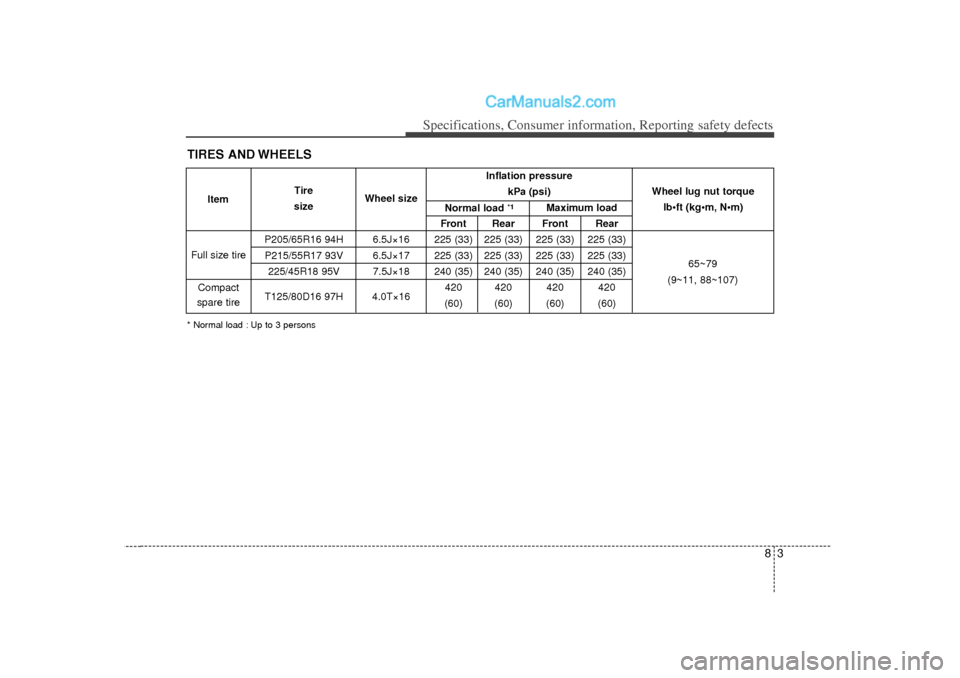
TIRES AND WHEELS* Normal load : Up to 3 persons
Inflation pressure kPa (psi)
Front Rear Front Rear
P205/65R16 94H 6.5J×16 225 (33) 225 (33) 225 (33) 225 (33) P215/55R17 93V 6.5J×17 225 (33) 225 (33) 225 (33) 225 (33) 225/45R18 95V 7.5J×18 240 (35) 240 (35) 240 (35) 240 (35)
T125/80D16 97H 4.0T×16 420 420 420 420
(60) (60) (60) (60)
Full size tire
Compact
spare tire Wheel lug nut torque
lb•ft (kgm, Nm)
65~79
(9~11, 88~107)
Item
Tire
size Wheel size
Normal load
*1
Maximum load
Page 410 of 411

I9
Index
Sports mode ··················\
··················\
··················\
·············5-17
Starting difficulties, see engine will not start ··················\
6-3
Starting the engine··················\
··················\
················5-6, 5-9\
Steering wheel···············\
··················\
··················\
·············4-39Horn··················\
··················\
··················\
··················\
···4-40
Electric power steering··················\
··················\
··········4-39
Tilt steering ··················\
··················\
··················\
·········4-39
Steering wheel audio control ··················\
··················\
···4-111
Storage compartment ··················\
··················\
···············4-105 Center console storage ··················\
··················\
········4-105
Glove box ··················\
··················\
··················\
··········4-105
Multi box ··················\
··················\
··················\
···········4-106
Sunglass holder ··················\
··················\
··················\
·4-106
Sunglass holder ··················\
··················\
··················\
······4-106
Sunroof··················\
··················\
··················\
··················\
···4-32
Sunvisor ··················\
··················\
··················\
·················4-10\
7
Tachometer··················\
··················\
··················\
···············4-51
Tether anchor system ··················\
··················\
·················3-33\
Theft-alarm system ··················\
··················\
··················\
··4-14
Tilt steering ··················\
··················\
··················\
··············4-39
Tire specification and pressure label ··················\
·············8-7
Tire chains··················\
··················\
··················\
················5-43
Tire pressure monitoring system (TPMS) ··················\
·····6-7 Tires and wheels ··················\
··················\
·················7-37\
, 8-3
Checking tire inflation pressure ··················\
··············7-38
Compact spare tire replacement ··················\
··············7-42
Recommended cold tire inflation pressures ··············7-37
Tire care··················\
··················\
··················\
···············7-37
Tire maintenance ··················\
··················\
··················\
·7-42
Tire replacement ··················\
··················\
··················\
··7-41
Tire rotation ··················\
··················\
··················\
·········7-39
Tire sidewall labeling ··················\
··················\
············7-43
Tire traction ··················\
··················\
··················\
·········7-42
Wheel alignment and tire balance ··················\
···········7-40
Wheel replacement ··················\
··················\
················7-42
Towing ··················\
··················\
··················\
··················\
···6-20
Trailer towing ··················\
··················\
··················\
··········5-52
Transaxle Automatic transaxle ··················\
··················\
··············5-14
Manual transaxle ··················\
··················\
··················\
·5-11
Trip computer ··················\
··················\
··················\
··········4-53
Trunk ··················\
··················\
··················\
··················\
······4-22
Vehicle break-in process ··················\
··················\
··············1-5
Vehicle certification label··················\
··················\
···5-49, 8-6
Vehicle data collection and event data recorders (EDR) ··················\
··················\
··················\
····1-6
Vehicle identification number (VIN) ··················\
·············8-6
Vehicle load limit ··················\
··················\
··················\
·····5-46 Certification label ··················\
··················\
··················\
5-49T
V