change time Hyundai Terracan 2003 User Guide
[x] Cancel search | Manufacturer: HYUNDAI, Model Year: 2003, Model line: Terracan, Model: Hyundai Terracan 2003Pages: 349, PDF Size: 4.56 MB
Page 143 of 349
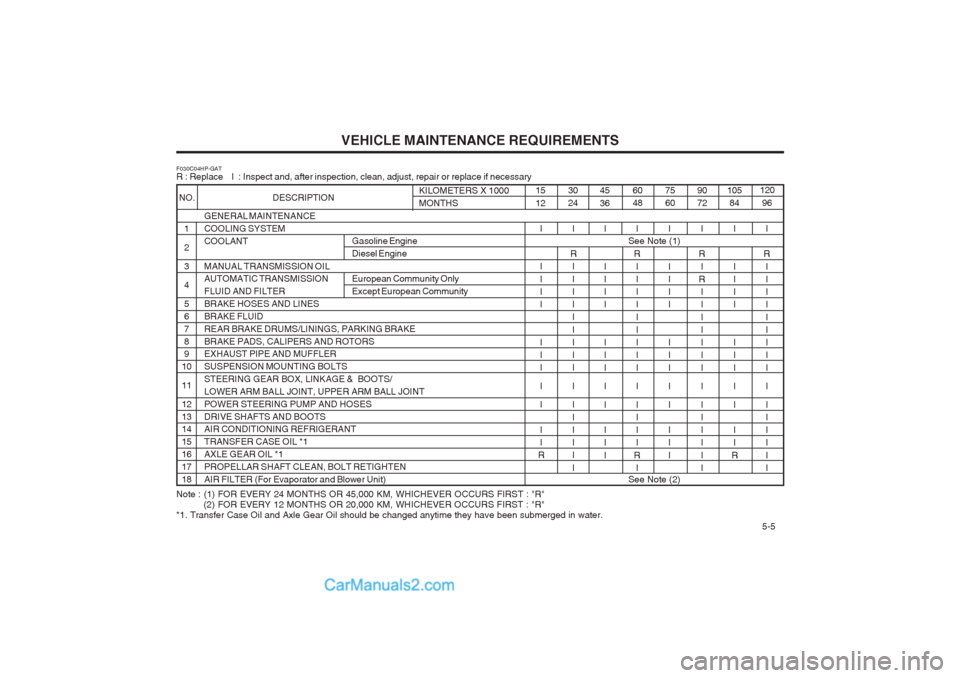
VEHICLE MAINTENANCE REQUIREMENTS 5-5
I
R I III I III I I I III
R I
GENERAL MAINTENANCECOOLING SYSTEMCOOLANT MANUAL TRANSMISSION OIL AUTOMATIC TRANSMISSION FLUID AND FILTERBRAKE HOSES AND LINESBRAKE FLUIDREAR BRAKE DRUMS/LININGS, PARKING BRAKEBRAKE PADS, CALIPERS AND ROTORS EXHAUST PIPE AND MUFFLER SUSPENSION MOUNTING BOLTSSTEERING GEAR BOX, LINKAGE & BOOTS/LOWER ARM BALL JOINT, UPPER ARM BALL JOINTPOWER STEERING PUMP AND HOSESDRIVE SHAFTS AND BOOTS AIR CONDITIONING REFRIGERANT TRANSFER CASE OIL *1AXLE GEAR OIL *1PROPELLAR SHAFT CLEAN, BOLT RETIGHTENAIR FILTER (For Evaporator and Blower Unit)
1 23 4 5 678 9
10 1112 13 14 15161718
F030C04HP-GAT R : Replace I : Inspect and, after inspection, clean, adjust, repair or replace if necessary
Note : (1) FOR EVERY 24 MONTHS OR 45,000 KM, WHICHEVER OCCURS FIRST : "R"
(2) FOR EVERY 12 MONTHS OR 20,000 KM, WHICHEVER OCCURS FIRST : "R"
*1. Transfer Case Oil and Axle Gear Oil should be changed anytime they have been submerged in water.
NO. DESCRIPTION
I
R I III I III I I I III I I15 12 30 24
45 36 60 48
75609072105
84 120
96KILOMETERS X 1000 MONTHS
I
R I I III I III I I I III I I I III I I I I I I I I
I I I II I II I I I I
R I I III I I I I I I I II
R I
R
I I I III I I I III I I I I III I I I I I I I
R
European Community Only Except European Community
See Note (1)Gasoline Engine Diesel Engine
See Note (2)
Page 155 of 349
DO-IT-YOURSELF MAINTENANCE 6-9
coolant container, add the appropriate quan- tity of coolant to the radiator.
G050D03HP
G050D01HP
G050D02HP
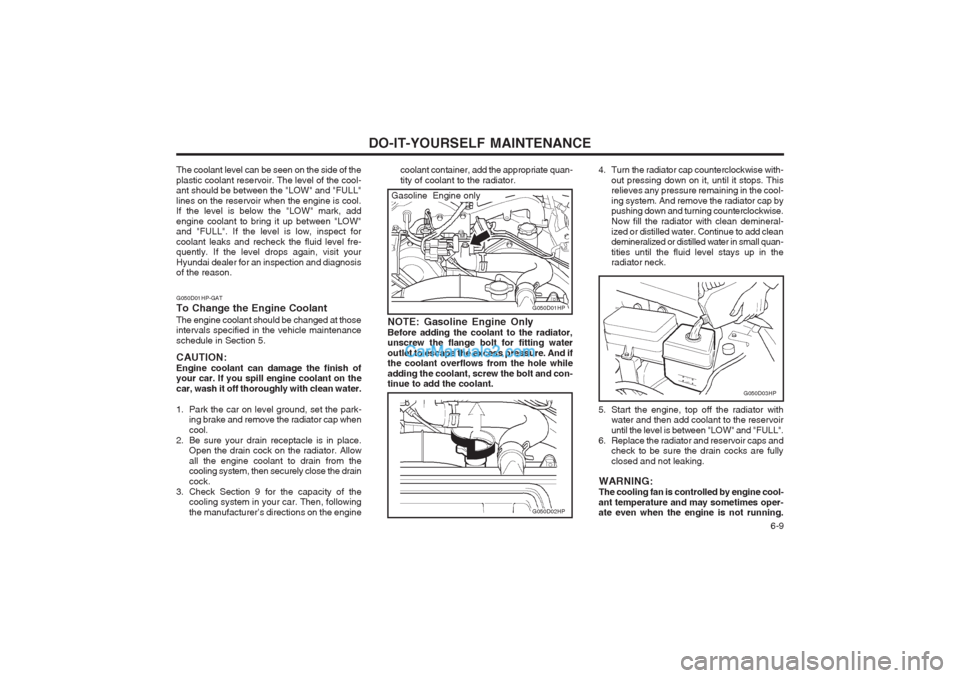
NOTE: Gasoline Engine Only Before adding the coolant to the radiator, unscrew the flange bolt for fitting water outlet to escape the excess pressure. And if the coolant overflows from the hole while adding the coolant, screw the bolt and con- tinue to add the coolant. 4. Turn the radiator cap counterclockwise with-
out pressing down on it, until it stops. Thisrelieves any pressure remaining in the cool- ing system. And remove the radiator cap by pushing down and turning counterclockwise. Now fill the radiator with clean demineral-ized or distilled water. Continue to add clean demineralized or distilled water in small quan- tities until the fluid level stays up in the radiator neck.
5. Start the engine, top off the radiator with water and then add coolant to the reservoir until the level is between "LOW" and "FULL".
6. Replace the radiator and reservoir caps and check to be sure the drain cocks are fullyclosed and not leaking.
WARNING:The cooling fan is controlled by engine cool-
ant temperature and may sometimes oper- ate even when the engine is not running.
Gasoline Engine only
The coolant level can be seen on the side of the plastic coolant reservoir. The level of the cool- ant should be between the "LOW" and "FULL" lines on the reservoir when the engine is cool. If the level is below the "LOW" mark, add engine coolant to bring it up between "LOW" and "FULL". If the level is low, inspect for coolant leaks and recheck the fluid level fre- quently. If the level drops again, visit your Hyundai dealer for an inspection and diagnosis of the reason.
G050D01HP-GAT To Change the Engine CoolantThe engine coolant should be changed at those intervals specified in the vehicle maintenance schedule in Section 5. CAUTION: Engine coolant can damage the finish of your car. If you spill engine coolant on the car, wash it off thoroughly with clean water.
1. Park the car on level ground, set the park-
ing brake and remove the radiator cap when cool.
2. Be sure your drain receptacle is in place. Open the drain cock on the radiator. Allowall the engine coolant to drain from the cooling system, then securely close the drain cock.
3. Check Section 9 for the capacity of the cooling system in your car. Then, followingthe manufacturer’s directions on the engine
Page 163 of 349
DO-IT-YOURSELF MAINTENANCE 6-17
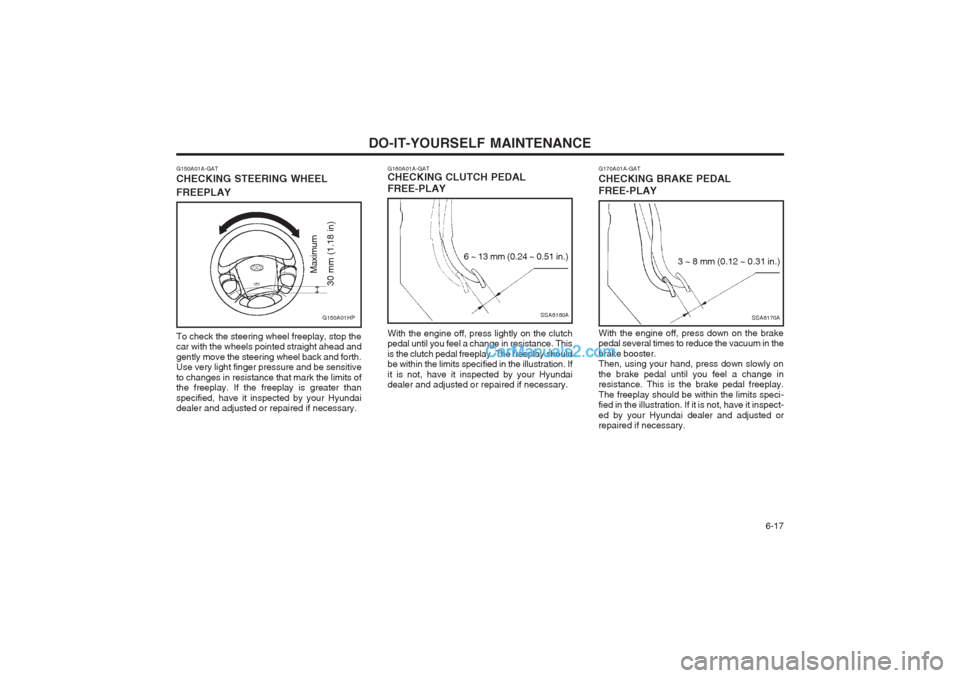
G160A01A-GAT CHECKING CLUTCH PEDAL FREE-PLAY With the engine off, press lightly on the clutch pedal until you feel a change in resistance. This is the clutch pedal freeplay. The freeplay should be within the limits specified in the illustration. If it is not, have it inspected by your Hyundai dealer and adjusted or repaired if necessary.
SSA6160A
6 ~ 13 mm (0.24 ~ 0.51 in.)
G170A01A-GAT CHECKING BRAKE PEDAL FREE-PLAY With the engine off, press down on the brake pedal several times to reduce the vacuum in the brake booster. Then, using your hand, press down slowly on the brake pedal until you feel a change in resistance. This is the brake pedal freeplay. The freeplay should be within the limits speci- fied in the illustration. If it is not, have it inspect- ed by your Hyundai dealer and adjusted or repaired if necessary.
SSA6170A
3 ~ 8 mm (0.12 ~ 0.31 in.)
G150A01A-GAT CHECKING STEERING WHEEL FREEPLAY To check the steering wheel freeplay, stop the car with the wheels pointed straight ahead and gently move the steering wheel back and forth. Use very light finger pressure and be sensitive to changes in resistance that mark the limits of the freeplay. If the freeplay is greater than specified, have it inspected by your Hyundai dealer and adjusted or repaired if necessary.
G150A01HP
Maximum
30 mm (1.18 in)
Page 239 of 349
CONTROLS AND EQUIPMENT1- 45
SB250A1-E HEATED REAR WINDOW (Not all models)
B380A02HP
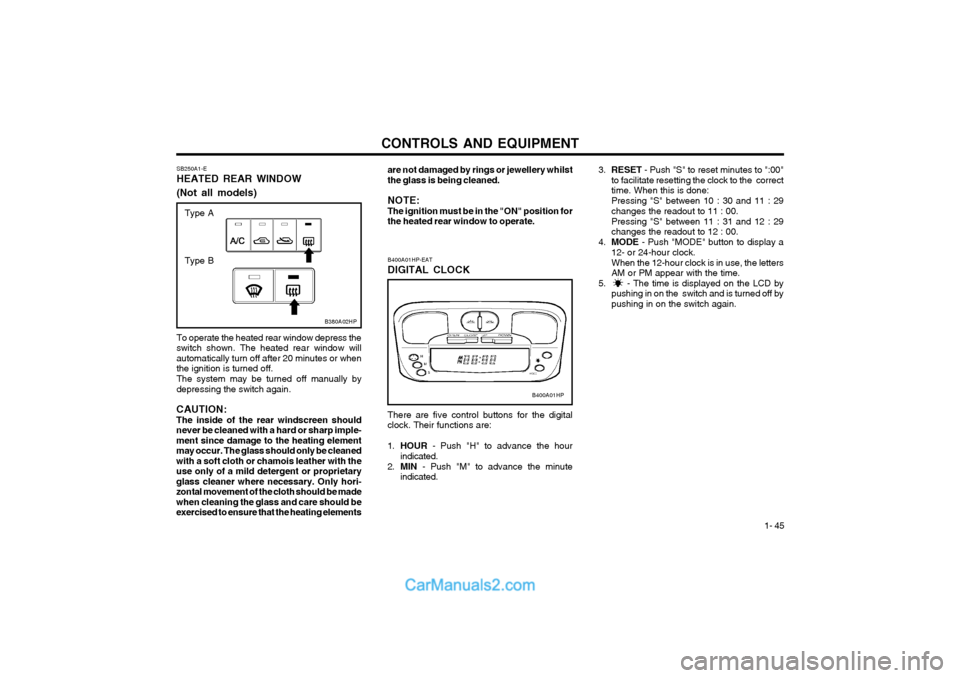
To operate the heated rear window depress the switch shown. The heated rear window willautomatically turn off after 20 minutes or whenthe ignition is turned off. The system may be turned off manually by depressing the switch again.
CAUTION:The inside of the rear windscreen shouldnever be cleaned with a hard or sharp imple-ment since damage to the heating elementmay occur. The glass should only be cleanedwith a soft cloth or chamois leather with theuse only of a mild detergent or proprietaryglass cleaner where necessary. Only hori-zontal movement of the cloth should be madewhen cleaning the glass and care should beexercised to ensure that the heating elements are not damaged by rings or jewellery whilstthe glass is being cleaned. NOTE: The ignition must be in the "ON" position forthe heated rear window to operate.
B400A01HP
B400A01HP-EAT DIGITAL CLOCK There are five control buttons for the digital
clock. Their functions are: 1. HOUR - Push "H" to advance the hour
indicated.
2. MIN - Push "M" to advance the minute
indicated.
3. RESET - Push "S" to reset minutes to ":00"
to facilitate resetting the clock to the correct time. When this is done: Pressing "S" between 10 : 30 and 11 : 29 changes the readout to 11 : 00. Pressing "S" between 11 : 31 and 12 : 29 changes the readout to 12 : 00.
4. MODE - Push "MODE" button to display a
12- or 24-hour clock. When the 12-hour clock is in use, the letters AM or PM appear with the time.
5. - The time is displayed on the LCD by pushing in on the switch and is turned off bypushing in on the switch again.
Type A
Type B
Page 257 of 349
CONTROLS AND EQUIPMENT1- 63
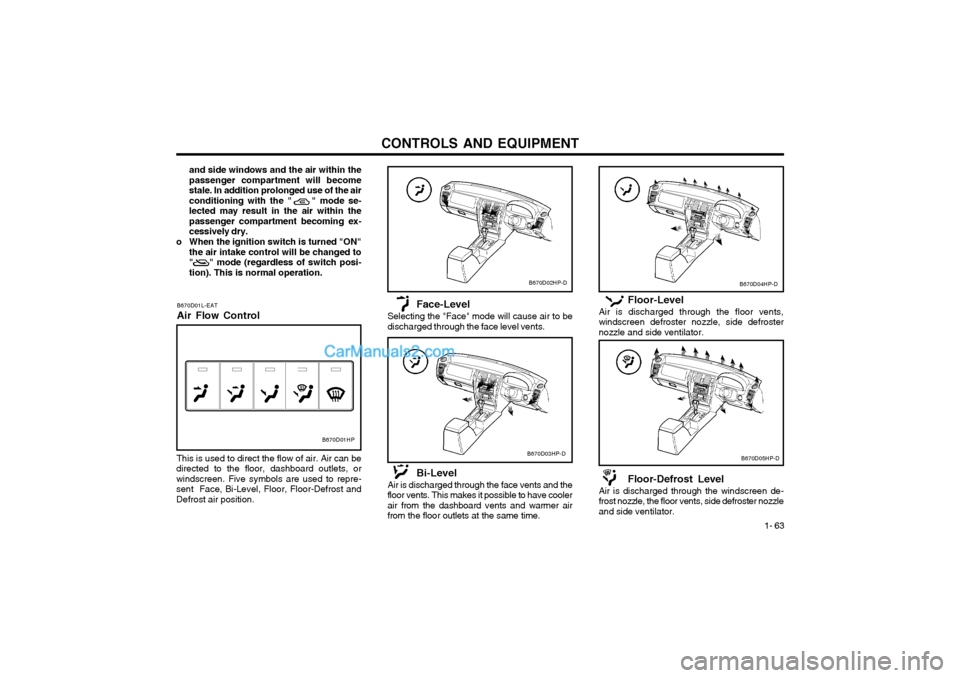
Floor-Level
Air is discharged through the floor vents, windscreen defroster nozzle, side defrosternozzle and side ventilator.
Floor-Defrost Level
Air is discharged through the windscreen de- frost nozzle, the floor vents, side defroster nozzleand side ventilator.
B670D04HP-D
B670D05HP-D
and side windows and the air within the passenger compartment will becomestale. In addition prolonged use of the airconditioning with the " " mode se-lected may result in the air within thepassenger compartment becoming ex-cessively dry.
o When the ignition switch is turned "ON" the air intake control will be changed to" " mode (regardless of switch posi-tion). This is normal operation.
B670D01L-EAT Air Flow Control
B670D01HP
This is used to direct the flow of air. Air can be
directed to the floor, dashboard outlets, or windscreen. Five symbols are used to repre-sent Face, Bi-Level, Floor, Floor-Defrost andDefrost air position. Face-Level
Selecting the "Face" mode will cause air to bedischarged through the face level vents.
Bi-Level
Air is discharged through the face vents and the floor vents. This makes it possible to have coolerair from the dashboard vents and warmer airfrom the floor outlets at the same time.
B670D02HP-D
B670D03HP-D
Page 290 of 349
DRIVING YOUR HYUNDAI 2- 19
CAUTION: If overheating should occur when towing,
(temperature gauge reads near red zone), taking the following action may reduce oreliminate the problem.
1. Turn off the air conditioner.
2. Reduce highway speed.
3. Select a lower gear when going uphill.
4. Whilst in stop and go traffic, place the gear selector in park or neutral and idle the engine at a higher speed.
HPC200E1-E
Trailer or Vehicle Towing Tips
1. Before towing, check towbar and safety cable connections as well as proper operation of the trailer running lights, brake lights, andturn signals.
2. Always drive your vehicle at a moderate speed (Less than 60 mph)
3. Trailer towing requires more fuel than nor- mal conditions.
4. To maintain engine braking efficiency and electrical charging performance, do not usefifth gear (manual transmission).
5. Always secure items in the trailer to prevent load shift whilst driving.
6. Check the condition and air pressure of all tyres on the trailer and your car. Low tyrepressure can seriously affect the handling.Also check the spare tyre.
7. The vehicle/trailer combination is more af- fected by crosswind and buffeting. When being passed by a large vehicle, keep a constant speed and steer straight ahead.If there is too much wind buffeting slowdown to get out of the other vehicle's airturbulence.
8. When parking your car and trailer, especial- ly on a hill, be sure to follow all the normalprecautions. Turn your front wheel into thecurb, set the parking brake firmly, and putthe transmission in 1st or Reverse (manual)or Park (automatic). In addition, place wheelchocks at each of the trailer's tyres. 9. If the trailer has electric brakes, start your
vehicle and trailer moving, and then applythe trailer brake controller by hand to besure the brakes are working. This lets youcheck your electrical connection at the sametime.
10. During your trip, check occasionally to be sure that the load is secure, and that thelights and any trailer brakes are still working.
11. Avoid jerky starts, sudden acceleration or sudden stops.
12. Avoid sharp turns and rapid lane changes.
13. Avoid holding the brake pedal down too long or too frequently. This could cause the brakes to overheat, resulting in reduced brakingefficiency.
14. When going down a hill, shift into a lower gear and use the engine braking effect. When ascending a long grade, downshift the transmission to a lower gear and reducespeed to reduce chances of engine over-loading and/or overheating.
15. If you have to stop whilst going uphill, do not hold the vehicle in place by pressing on theaccelerator. This can cause the automatictransmission to overheat. Use the parkingbrake or footbrake.
NOTE: When towing, check transmission fluid more
frequently.
Page 317 of 349
OWNER MAINTENANCE 6-5
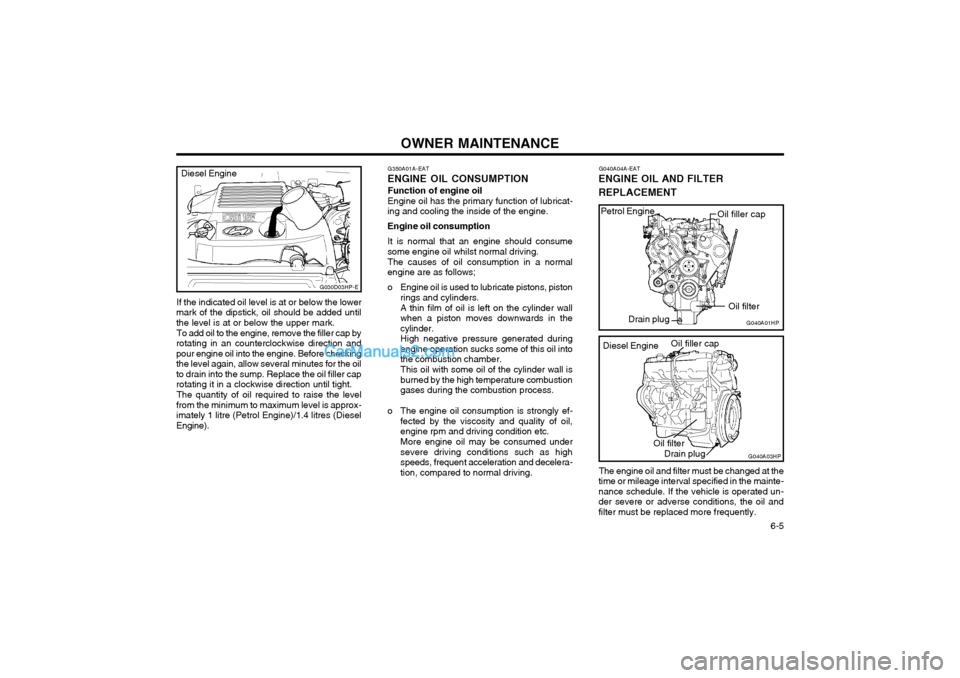
If the indicated oil level is at or below the lower
mark of the dipstick, oil should be added until the level is at or below the upper mark.
To add oil to the engine, remove the filler cap by
rotating in an counterclockwise direction andpour engine oil into the engine. Before checkingthe level again, allow several minutes for the oilto drain into the sump. Replace the oil filler caprotating it in a clockwise direction until tight.
The quantity of oil required to raise the level
from the minimum to maximum level is approx-imately 1 litre (Petrol Engine)/1.4 litres (DieselEngine). G350A01A-EAT
ENGINE OIL CONSUMPTION
Function of engine oil Engine oil has the primary function of lubricat-
ing and cooling the inside of the engine.
Engine oil consumption It is normal that an engine should consume
some engine oil whilst normal driving.
The causes of oil consumption in a normal
engine are as follows;
o Engine oil is used to lubricate pistons, piston rings and cylinders. A thin film of oil is left on the cylinder wall when a piston moves downwards in thecylinder.High negative pressure generated duringengine operation sucks some of this oil intothe combustion chamber. This oil with some oil of the cylinder wall is burned by the high temperature combustiongases during the combustion process.
o The engine oil consumption is strongly ef- fected by the viscosity and quality of oil,engine rpm and driving condition etc. More engine oil may be consumed under severe driving conditions such as highspeeds, frequent acceleration and decelera-tion, compared to normal driving.
G030D03HP-E G040A04A-EAT
ENGINE OIL AND FILTER REPLACEMENT
G040A03HP
Oil filler cap
Oil filter Drain plug
G040A01HP
Petrol Engine
Oil filter
Drain plug Oil filler cap
The engine oil and filter must be changed at the
time or mileage interval specified in the mainte- nance schedule. If the vehicle is operated un-der severe or adverse conditions, the oil andfilter must be replaced more frequently. Diesel Engine
Diesel Engine
Page 319 of 349
OWNER MAINTENANCE 6-7
NOTE: It is imperative that vehicles fitted with an
air conditioning system have a coolant con- centration of the recommended strength atall times. The use of the air conditioningsystem when the cooling system is filledwith water only will result in the heatermatrix freezing and subsequently bursting.
SG050C1-E
Coolant Level
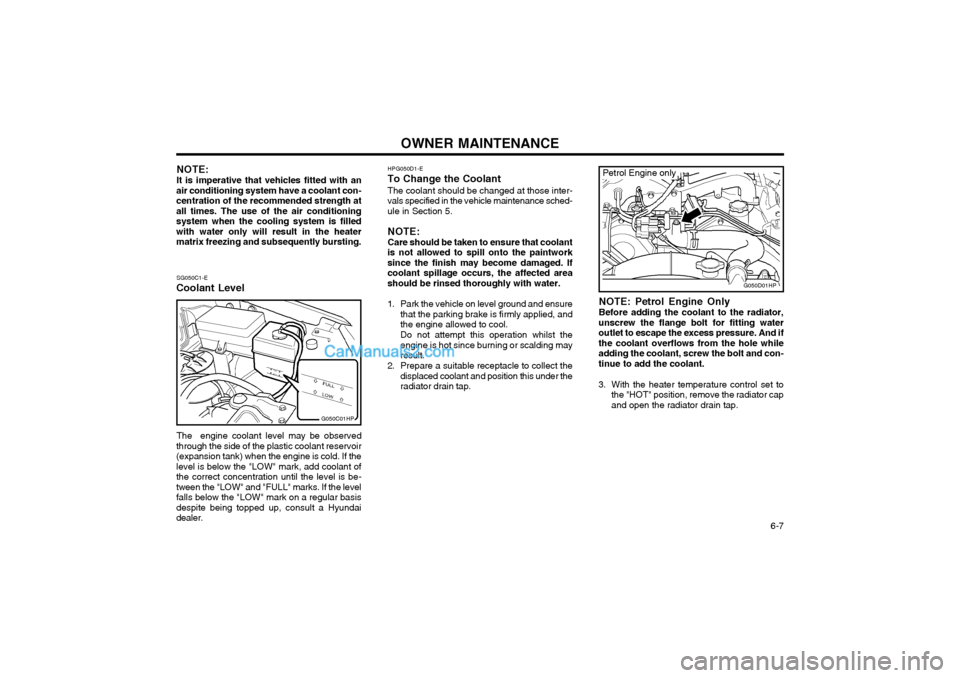
The engine coolant level may be observed
through the side of the plastic coolant reservoir(expansion tank) when the engine is cold. If thelevel is below the "LOW" mark, add coolant ofthe correct concentration until the level is be-tween the "LOW" and "FULL" marks. If the levelfalls below the "LOW" mark on a regular basisdespite being topped up, consult a Hyundaidealer. HPG050D1-E
To Change the Coolant
The coolant should be changed at those inter-
vals specified in the vehicle maintenance sched-ule in Section 5.
NOTE: Care should be taken to ensure that coolant
is not allowed to spill onto the paintwork since the finish may become damaged. Ifcoolant spillage occurs, the affected areashould be rinsed thoroughly with water.
1. Park the vehicle on level ground and ensure that the parking brake is firmly applied, and the engine allowed to cool. Do not attempt this operation whilst the engine is hot since burning or scalding mayresult.
2. Prepare a suitable receptacle to collect the displaced coolant and position this under theradiator drain tap. NOTE: Petrol Engine Only Before adding the coolant to the radiator,
unscrew the flange bolt for fitting water outlet to escape the excess pressure. And ifthe coolant overflows from the hole whileadding the coolant, screw the bolt and con-tinue to add the coolant.
3. With the heater temperature control set to the "HOT" position, remove the radiator cap and open the radiator drain tap.
G050D01HP
Petrol Engine only
G050C01HP
Page 321 of 349
OWNER MAINTENANCE 6-9
Type
RC10PYPB4 (CHAMPION) PFR5N-11 (NGK)
Remark
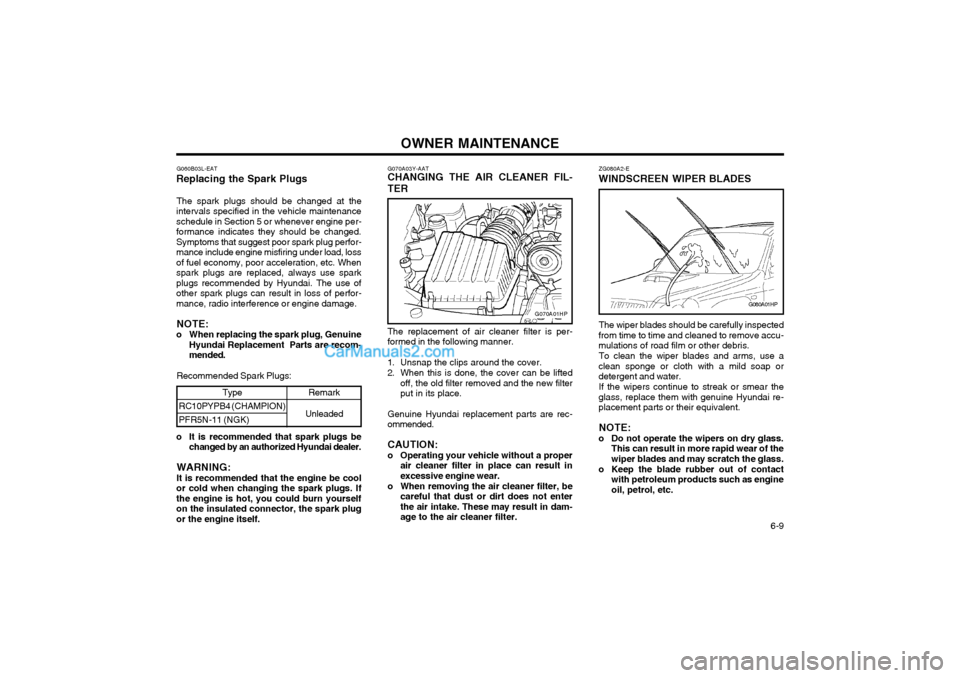
Unleaded G070A03Y-AAT CHANGING THE AIR CLEANER FIL- TER The replacement of air cleaner filter is per- formed in the following manner.
1. Unsnap the clips around the cover.
2. When this is done, the cover can be lifted
off, the old filter removed and the new filter put in its place.
Genuine Hyundai replacement parts are rec-ommended. CAUTION:
o Operating your vehicle without a proper air cleaner filter in place can result in excessive engine wear.
o When removing the air cleaner filter, be careful that dust or dirt does not enterthe air intake. These may result in dam-age to the air cleaner filter.
G070A01HPG080A01HP
ZG080A2-E
WINDSCREEN WIPER BLADES
G060B03L-EAT
Replacing the Spark Plugs
The spark plugs should be changed at the
intervals specified in the vehicle maintenance schedule in Section 5 or whenever engine per-formance indicates they should be changed.Symptoms that suggest poor spark plug perfor-mance include engine misfiring under load, lossof fuel economy, poor acceleration, etc. Whenspark plugs are replaced, always use sparkplugs recommended by Hyundai. The use ofother spark plugs can result in loss of perfor-mance, radio interference or engine damage.
NOTE:
o When replacing the spark plug, Genuine Hyundai Replacement Parts are recom-mended.
Recommended Spark Plugs: The wiper blades should be carefully inspected
from time to time and cleaned to remove accu-mulations of road film or other debris.
To clean the wiper blades and arms, use a
clean sponge or cloth with a mild soap ordetergent and water.
If the wipers continue to streak or smear the
glass, replace them with genuine Hyundai re-placement parts or their equivalent.
NOTE:
o Do not operate the wipers on dry glass. This can result in more rapid wear of thewiper blades and may scratch the glass.
o Keep the blade rubber out of contact with petroleum products such as engineoil, petrol, etc.
o It is recommended that spark plugs be
changed by an authorized Hyundai dealer.
WARNING: It is recommended that the engine be cool
or cold when changing the spark plugs. If the engine is hot, you could burn yourselfon the insulated connector, the spark plugor the engine itself.
Page 322 of 349
OWNER MAINTENANCE
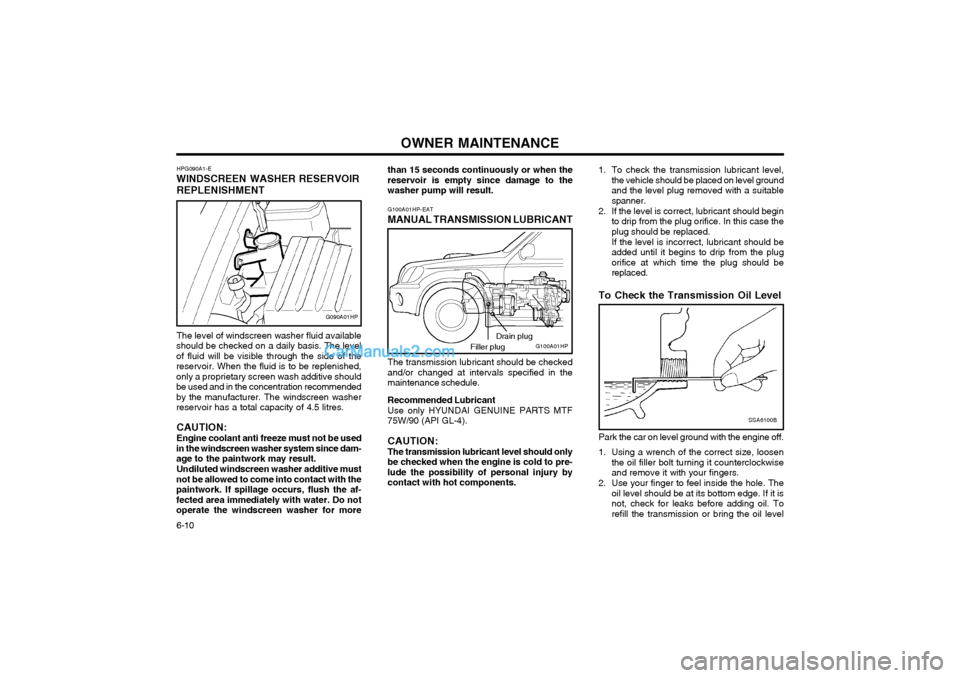
6-10 1. To check the transmission lubricant level,
the vehicle should be placed on level ground and the level plug removed with a suitablespanner.
2. If the level is correct, lubricant should begin to drip from the plug orifice. In this case theplug should be replaced. If the level is incorrect, lubricant should be added until it begins to drip from the plugorifice at which time the plug should bereplaced.
To Check the Transmission Oil Level
SSA6100B
Park the car on level ground with the engine off.
1. Using a wrench of the correct size, loosen the oil filler bolt turning it counterclockwise and remove it with your fingers.
2. Use your finger to feel inside the hole. The oil level should be at its bottom edge. If it isnot, check for leaks before adding oil. Torefill the transmission or bring the oil level
G100A01HP-EAT
MANUAL TRANSMISSION LUBRICANT
The transmission lubricant should be checkedand/or changed at intervals specified in themaintenance schedule. Recommended Lubricant Use only HYUNDAI GENUINE PARTS MTF 75W/90 (API GL-4). CAUTION: The transmission lubricant level should onlybe checked when the engine is cold to pre-lude the possibility of personal injury bycontact with hot components.
G090A01HP
HPG090A1-E
WINDSCREEN WASHER RESERVOIR
REPLENISHMENT The level of windscreen washer fluid available
should be checked on a daily basis. The level of fluid will be visible through the side of thereservoir. When the fluid is to be replenished,only a proprietary screen wash additive shouldbe used and in the concentration recommendedby the manufacturer. The windscreen washerreservoir has a total capacity of 4.5 litres.
CAUTION: Engine coolant anti freeze must not be used
in the windscreen washer system since dam- age to the paintwork may result.
Undiluted windscreen washer additive must
not be allowed to come into contact with thepaintwork. If spillage occurs, flush the af-fected area immediately with water. Do notoperate the windscreen washer for more than 15 seconds continuously or when thereservoir is empty since damage to thewasher pump will result.
G100A01HP
Drain plug
Filler plug