clock Hyundai Terracan 2003 User Guide
[x] Cancel search | Manufacturer: HYUNDAI, Model Year: 2003, Model line: Terracan, Model: Hyundai Terracan 2003Pages: 349, PDF Size: 4.56 MB
Page 127 of 349
WHAT TO DO IN AN EMERGENCY 3-3
7. Proceed with caution, keeping alert for fur-
ther signs of overheating. If overheating hap- pens again, call a Hyundai dealer for assis- tance.
CAUTION: Serious loss of coolant indicates there is a leak in the cooling system and this should be checked as soon as possible by a Hyundai dealer. D040A01HP-GAT SPARE TIREThe following instructions for the FULL SIZE spare tire should be observed: Check inflation pressure as soon as possible after installing the spare tire, and adjust to the specified pressure. The tire pressure should be periodically checked and maintained at the spec- ified pressure while the tire is stored.
Inflation Pressure
Tire Size
Full Size 200 kPa (29 psi)
Spare Tire Pressure
D040B01HP
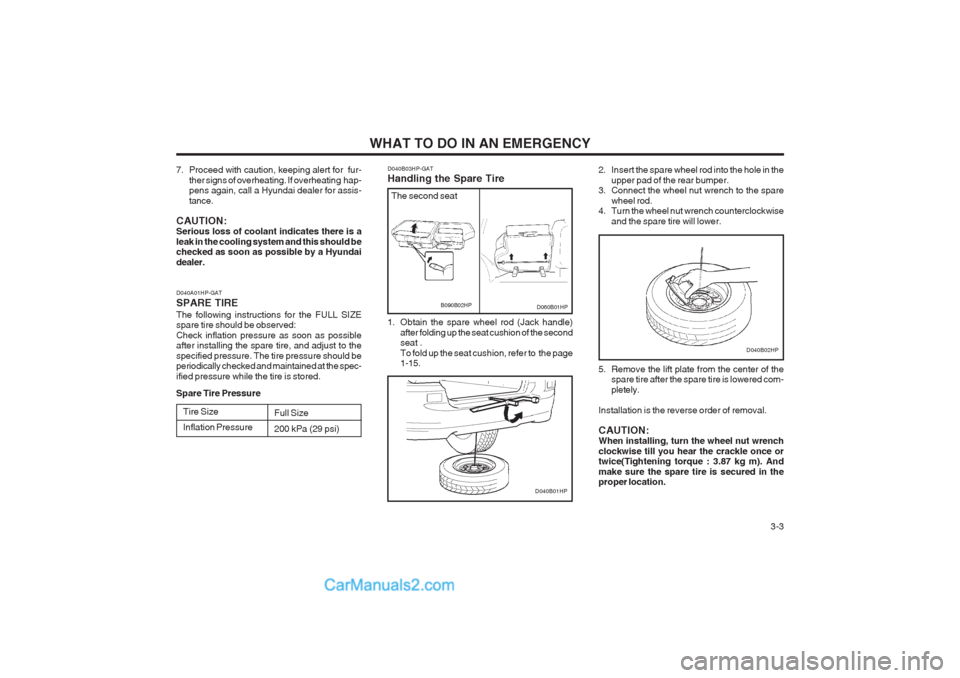
D040B03HP-GAT Handling the Spare Tire
1. Obtain the spare wheel rod (Jack handle)
after folding up the seat cushion of the second seat . To fold up the seat cushion, refer to the page 1-15. 5. Remove the lift plate from the center of the
spare tire after the spare tire is lowered com- pletely.
Installation is the reverse order of removal. CAUTION: When installing, turn the wheel nut wrench clockwise till you hear the crackle once or
twice(Tightening torque : 3.87 kg m). And make sure the spare tire is secured in the proper location.
D060B01HPB090B02HP
The second seat
D040B02HP
2. Insert the spare wheel rod into the hole in the upper pad of the rear bumper.
3. Connect the wheel nut wrench to the spare
wheel rod.
4. Turn the wheel nut wrench counterclockwise
and the spare tire will lower.
Page 129 of 349
WHAT TO DO IN AN EMERGENCY 3-5
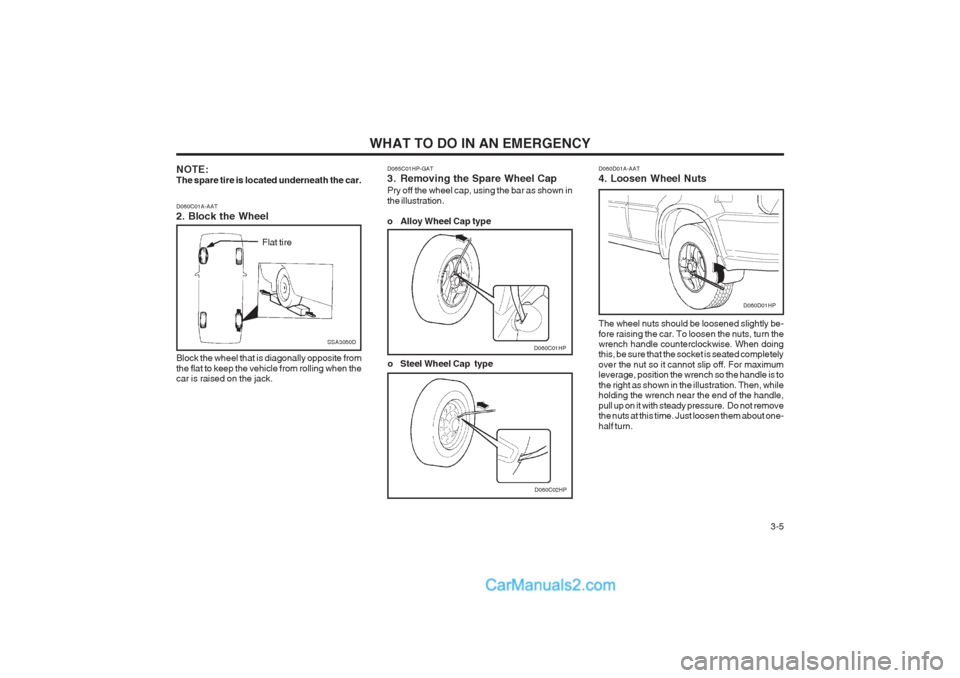
D060C01A-AAT 2. Block the Wheel Block the wheel that is diagonally opposite from the flat to keep the vehicle from rolling when the car is raised on the jack.
Flat tire
SSA3050D D060D01A-AAT 4. Loosen Wheel Nuts The wheel nuts should be loosened slightly be- fore raising the car. To loosen the nuts, turn the wrench handle counterclockwise. When doingthis, be sure that the socket is seated completely over the nut so it cannot slip off. For maximum leverage, position the wrench so the handle is to the right as shown in the illustration. Then, while holding the wrench near the end of the handle, pull up on it with steady pressure. Do not remove the nuts at this time. Just loosen them about one- half turn.
D060D01HP
D065C01HP-GAT
3. Removing the Spare Wheel Cap Pry off the wheel cap, using the bar as shown in the illustration.
o Alloy Wheel Cap type
D060C01HP
D060C02HP
o Steel Wheel Cap type
NOTE: The spare tire is located underneath the car.
Page 130 of 349
WHAT TO DO IN AN EMERGENCY
3-6
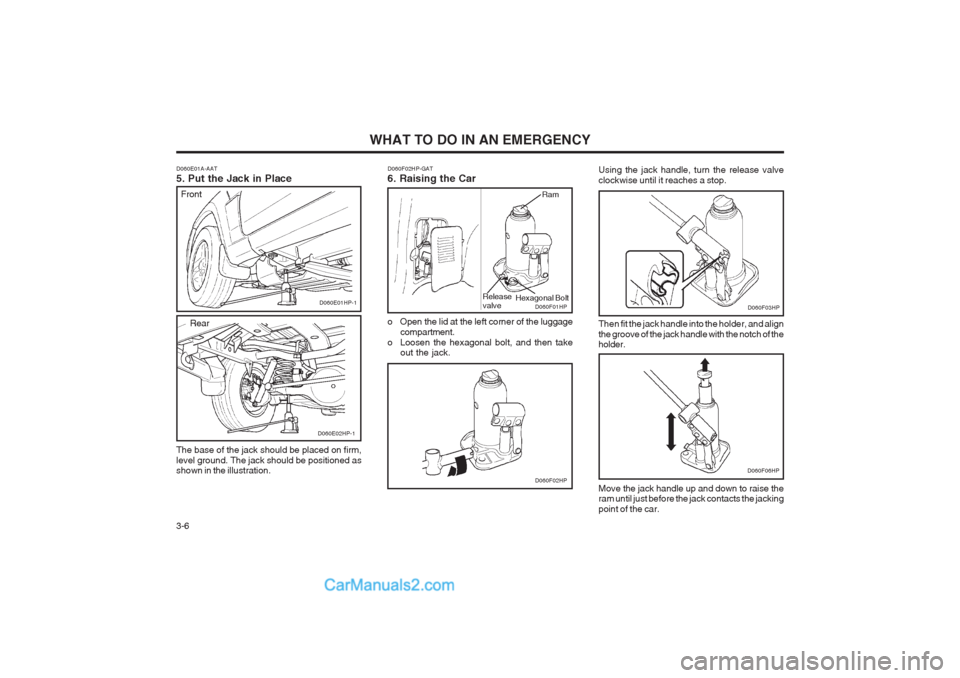
Using the jack handle, turn the release valve clockwise until it reaches a stop. Then fit the jack handle into the holder, and align the groove of the jack handle with the notch of the holder.
D060F02HP
D060F03HP
D060F02HP-GAT 6. Raising the CarD060F01HP
o Open the lid at the left corner of the luggage compartment.
o Loosen the hexagonal bolt, and then take out the jack.
Move the jack handle up and down to raise the ram until just before the jack contacts the jacking point of the car.
D060F06HP
Ram
Hexagonal BoltRelease valve
D060E01A-AAT 5. Put the Jack in Place The base of the jack should be placed on firm, level ground. The jack should be positioned as shown in the illustration.D060E01HP-1
D060E02HP-1
Rear
Front
Page 131 of 349
WHAT TO DO IN AN EMERGENCY 3-7
D060F04HP
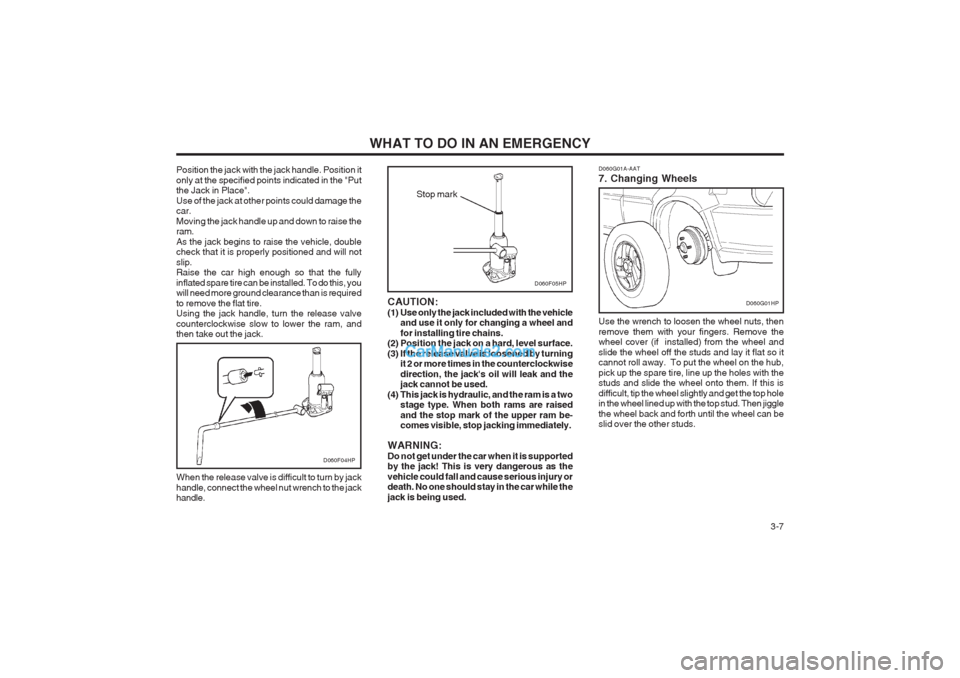
When the release valve is difficult to turn by jack handle, connect the wheel nut wrench to the jack handle. CAUTION:
(1) Use only the jack included with the vehicle
and use it only for changing a wheel andfor installing tire chains.
(2) Position the jack on a hard, level surface.
(3) If the release valve is loosened by turning it 2 or more times in the counterclockwisedirection, the jack's oil will leak and the jack cannot be used.
(4) This jack is hydraulic, and the ram is a two stage type. When both rams are raised and the stop mark of the upper ram be- comes visible, stop jacking immediately.
WARNING: Do not get under the car when it is supported by the jack! This is very dangerous as the vehicle could fall and cause serious injury or death. No one should stay in the car while the jack is being used. D060G01A-AAT 7. Changing Wheels Use the wrench to loosen the wheel nuts, then remove them with your fingers. Remove the wheel cover (if installed) from the wheel and slide the wheel off the studs and lay it flat so it cannot roll away. To put the wheel on the hub, pick up the spare tire, line up the holes with the studs and slide the wheel onto them. If this is difficult, tip the wheel slightly and get the top hole in the wheel lined up with the top stud. Then jiggle the wheel back and forth until the wheel can be slid over the other studs.
D060G01HP
D060F05HP
Position the jack with the jack handle. Position it only at the specified points indicated in the "Put the Jack in Place". Use of the jack at other points could damage the car. Moving the jack handle up and down to raise the ram. As the jack begins to raise the vehicle, double check that it is properly positioned and will not slip. Raise the car high enough so that the fully inflated spare tire can be installed. To do this, you will need more ground clearance than is required to remove the flat tire. Using the jack handle, turn the release valve counterclockwise slow to lower the ram, and then take out the jack.
Stop mark
Page 152 of 349
DO-IT-YOURSELF MAINTENANCE
6-6
G350A01A-GAT ENGINE OIL CONSUMPTION Function of Engine Oil Engine oil has the primary function of lubricat- ing and cooling the inside of the engine. Engine oil consumption It is normal that an engine should consume
some engine oil while normal driving. The cause of oil consumption in a normal engine are as follows;
o Engine oil is used to lubricate pistons, piston rings and cylinders. A thin film of oil is left on the cylinder wall
when a piston moves downwards in the cylinder. High negative pressure generated during engine operation sucks some of the oil into the combustion chamber. This oil with some oil of the cylinder wall is
burned by the high temperature combustion gases during the combustion process.
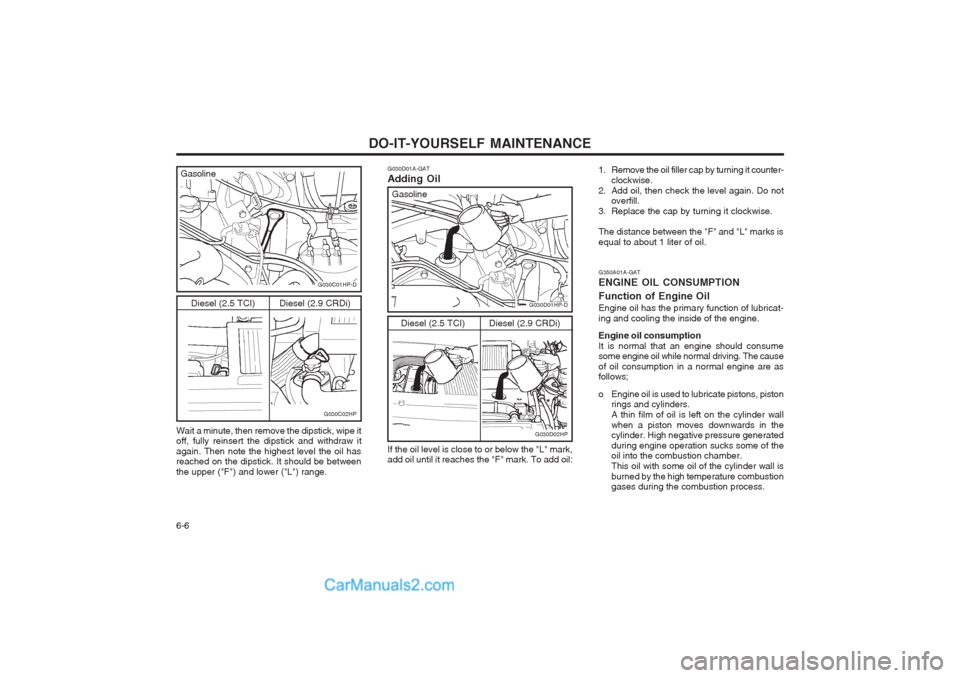
1. Remove the oil filler cap by turning it counter-
clockwise.
2. Add oil, then check the level again. Do not overfill.
3. Replace the cap by turning it clockwise. The distance between the "F" and "L" marks is equal to about 1 liter of oil.
G030D01A-GAT Adding Oil
G030D01HP-D
Gasoline
G030D02HP
Diesel (2.9 CRDi)
Diesel (2.5 TCI)
G030C01HP-D
G030C02HP
Diesel (2.9 CRDi)
Diesel (2.5 TCI)
Gasoline
Wait a minute, then remove the dipstick, wipe it off, fully reinsert the dipstick and withdraw it again. Then note the highest level the oil has reached on the dipstick. It should be between the upper ("F") and lower ("L") range. If the oil level is close to or below the "L" mark, add oil until it reaches the "F" mark. To add oil:
Page 153 of 349
DO-IT-YOURSELF MAINTENANCE 6-7
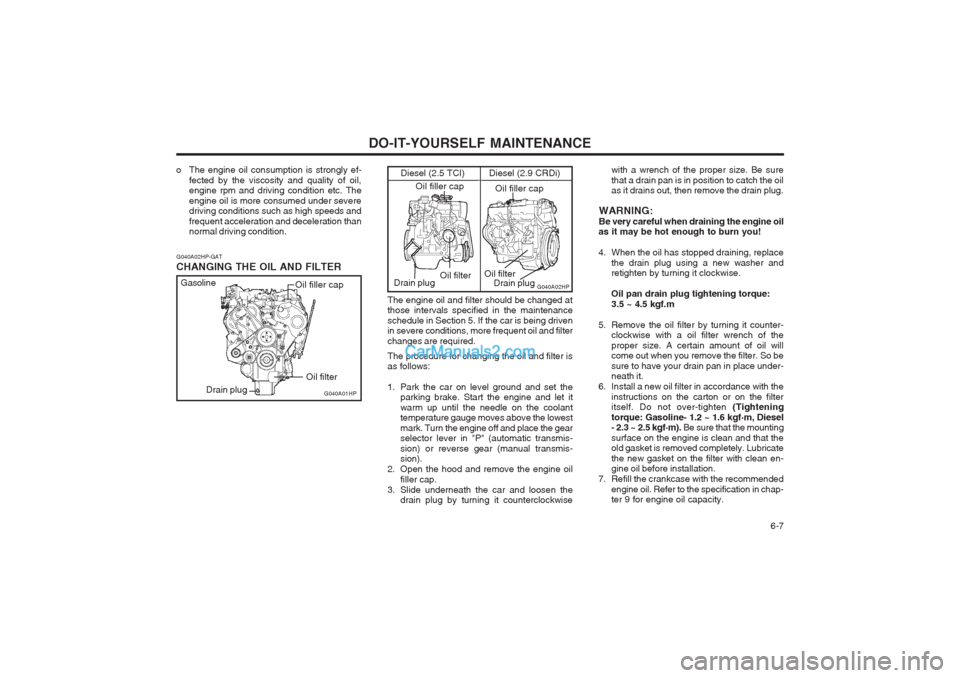
The engine oil and filter should be changed at those intervals specified in the maintenance schedule in Section 5. If the car is being driven in severe conditions, more frequent oil and filter changes are required. The procedure for changing the oil and filter is as follows:
1. Park the car on level ground and set theparking brake. Start the engine and let it warm up until the needle on the coolant temperature gauge moves above the lowest mark. Turn the engine off and place the gear selector lever in "P" (automatic transmis- sion) or reverse gear (manual transmis- sion).
2. Open the hood and remove the engine oil filler cap.
3. Slide underneath the car and loosen the drain plug by turning it counterclockwise with a wrench of the proper size. Be sure that a drain pan is in position to catch the oil as it drains out, then remove the drain plug.
WARNING: Be very careful when draining the engine oil
as it may be hot enough to burn you!
4. When the oil has stopped draining, replace
the drain plug using a new washer and retighten by turning it clockwise. Oil pan drain plug tightening torque: 3.5 ~ 4.5 kgf.m
5. Remove the oil filter by turning it counter- clockwise with a oil filter wrench of theproper size. A certain amount of oil will come out when you remove the filter. So be sure to have your drain pan in place under- neath it.
6. Install a new oil filter in accordance with the instructions on the carton or on the filteritself. Do not over-tighten (Tightening
torque: Gasoline- 1.2 ~ 1.6 kgf .
m, Diesel
- 2.3 ~ 2.5 kgf .
m). Be sure that the mounting
surface on the engine is clean and that theold gasket is removed completely. Lubricate the new gasket on the filter with clean en- gine oil before installation.
7. Refill the crankcase with the recommended engine oil. Refer to the specification in chap-ter 9 for engine oil capacity.
G040A02HP
Diesel (2.9 CRDi)
Diesel (2.5 TCI)
Oil filter
Oil filler cap
Oil filler cap
Drain plug Oil filter
Drain plug
G040A02HP-GAT CHANGING THE OIL AND FILTER
o The engine oil consumption is strongly ef-
fected by the viscosity and quality of oil, engine rpm and driving condition etc. The engine oil is more consumed under severe driving conditions such as high speeds and
frequent acceleration and deceleration than normal driving condition.
G040A01HP
Gasoline
Oil filter
Drain plug Oil filler cap
Page 155 of 349
DO-IT-YOURSELF MAINTENANCE 6-9
coolant container, add the appropriate quan- tity of coolant to the radiator.
G050D03HP
G050D01HP
G050D02HP
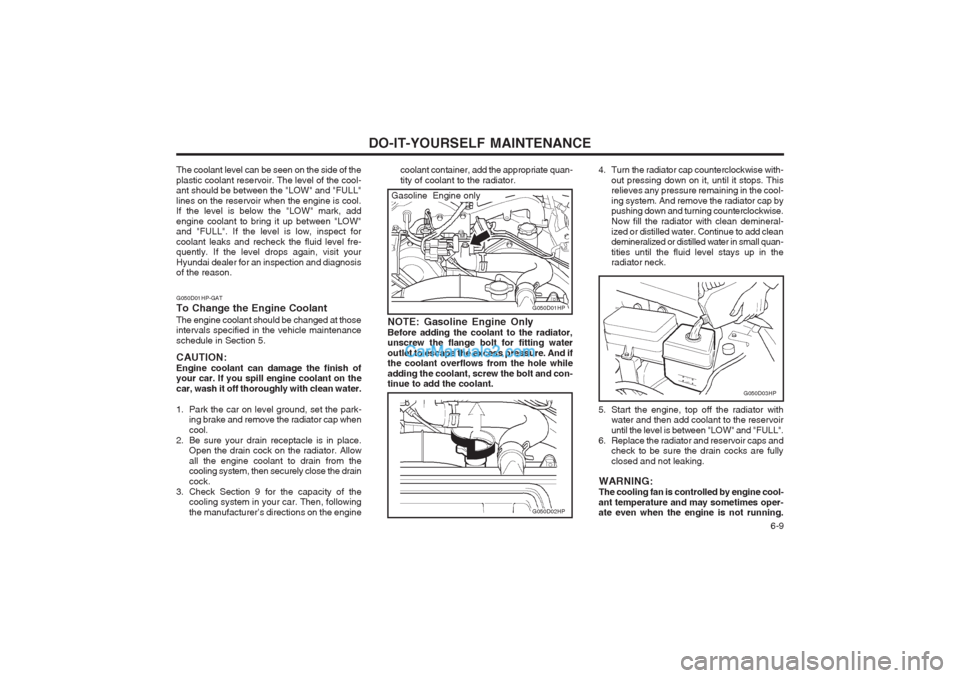
NOTE: Gasoline Engine Only Before adding the coolant to the radiator, unscrew the flange bolt for fitting water outlet to escape the excess pressure. And if the coolant overflows from the hole while adding the coolant, screw the bolt and con- tinue to add the coolant. 4. Turn the radiator cap counterclockwise with-
out pressing down on it, until it stops. Thisrelieves any pressure remaining in the cool- ing system. And remove the radiator cap by pushing down and turning counterclockwise. Now fill the radiator with clean demineral-ized or distilled water. Continue to add clean demineralized or distilled water in small quan- tities until the fluid level stays up in the radiator neck.
5. Start the engine, top off the radiator with water and then add coolant to the reservoir until the level is between "LOW" and "FULL".
6. Replace the radiator and reservoir caps and check to be sure the drain cocks are fullyclosed and not leaking.
WARNING:The cooling fan is controlled by engine cool-
ant temperature and may sometimes oper- ate even when the engine is not running.
Gasoline Engine only
The coolant level can be seen on the side of the plastic coolant reservoir. The level of the cool- ant should be between the "LOW" and "FULL" lines on the reservoir when the engine is cool. If the level is below the "LOW" mark, add engine coolant to bring it up between "LOW" and "FULL". If the level is low, inspect for coolant leaks and recheck the fluid level fre- quently. If the level drops again, visit your Hyundai dealer for an inspection and diagnosis of the reason.
G050D01HP-GAT To Change the Engine CoolantThe engine coolant should be changed at those intervals specified in the vehicle maintenance schedule in Section 5. CAUTION: Engine coolant can damage the finish of your car. If you spill engine coolant on the car, wash it off thoroughly with clean water.
1. Park the car on level ground, set the park-
ing brake and remove the radiator cap when cool.
2. Be sure your drain receptacle is in place. Open the drain cock on the radiator. Allowall the engine coolant to drain from the cooling system, then securely close the drain cock.
3. Check Section 9 for the capacity of the cooling system in your car. Then, followingthe manufacturer’s directions on the engine
Page 158 of 349
DO-IT-YOURSELF MAINTENANCE
6-12
G110D02HP-GAT
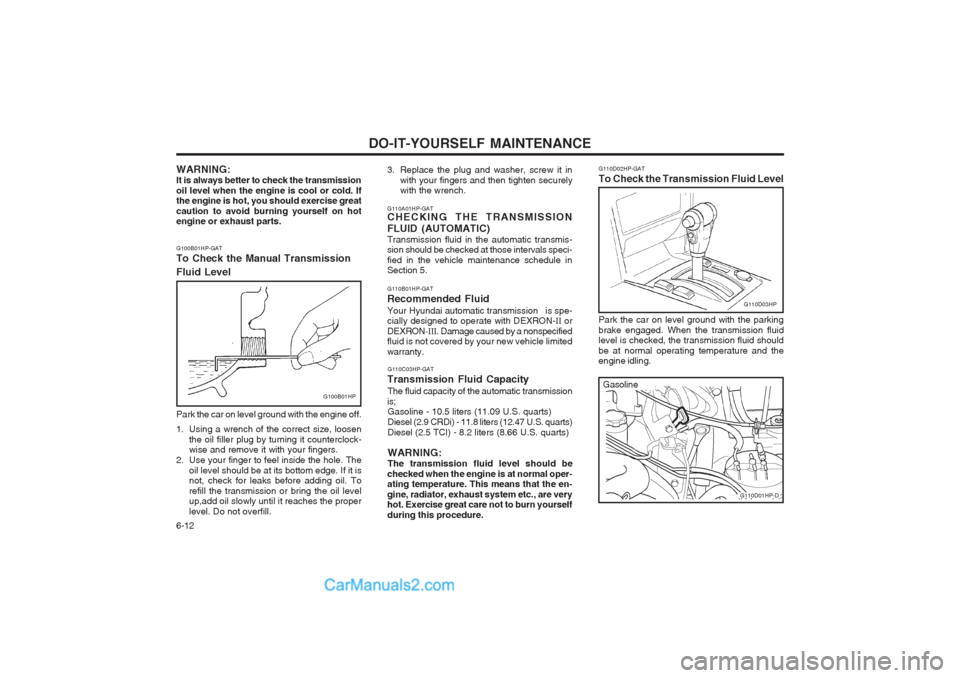
To Check the Transmission Fluid Level
G110D03HP
Park the car on level ground with the parking brake engaged. When the transmission fluid level is checked, the transmission fluid should be at normal operating temperature and the engine idling.
G110C03HP-GAT
Transmission Fluid Capacity The fluid capacity of the automatic transmission
is; Gasoline - 10.5 liters (11.09 U.S. quarts) Diesel (2.9 CRDi) - 11.8 liters (12.47 U.S. quarts)
Diesel (2.5 TCI) - 8.2 liters (8.66 U.S. quarts)
WARNING:The transmission fluid level should be
checked when the engine is at normal oper- ating temperature. This means that the en- gine, radiator, exhaust system etc., are very hot. Exercise great care not to burn yourself during this procedure.
G110A01HP-GAT
CHECKING THE TRANSMISSION FLUID (AUTOMATIC) Transmission fluid in the automatic transmis- sion should be checked at those intervals speci- fied in the vehicle maintenance schedule in Section 5. G110B01HP-GAT Recommended FluidYour Hyundai automatic transmission is spe- cially designed to operate with DEXRON- II or
DEXRON -III. Damage caused by a nonspecified
fluid is not covered by your new vehicle limited warranty.
3. Replace the plug and washer, screw it in
with your fingers and then tighten securely with the wrench.
G110D01HP-D
Gasoline
G100B01HP-GAT To Check the Manual Transmission Fluid LevelG100B01HP
WARNING: It is always better to check the transmissionoil level when the engine is cool or cold. If the engine is hot, you should exercise great caution to avoid burning yourself on hot engine or exhaust parts. Park the car on level ground with the engine off.
1. Using a wrench of the correct size, loosen
the oil filler plug by turning it counterclock- wise and remove it with your fingers.
2. Use your finger to feel inside the hole. The oil level should be at its bottom edge. If it isnot, check for leaks before adding oil. To refill the transmission or bring the oil level up,add oil slowly until it reaches the proper level. Do not overfill.
Page 182 of 349
INDEX 10-1
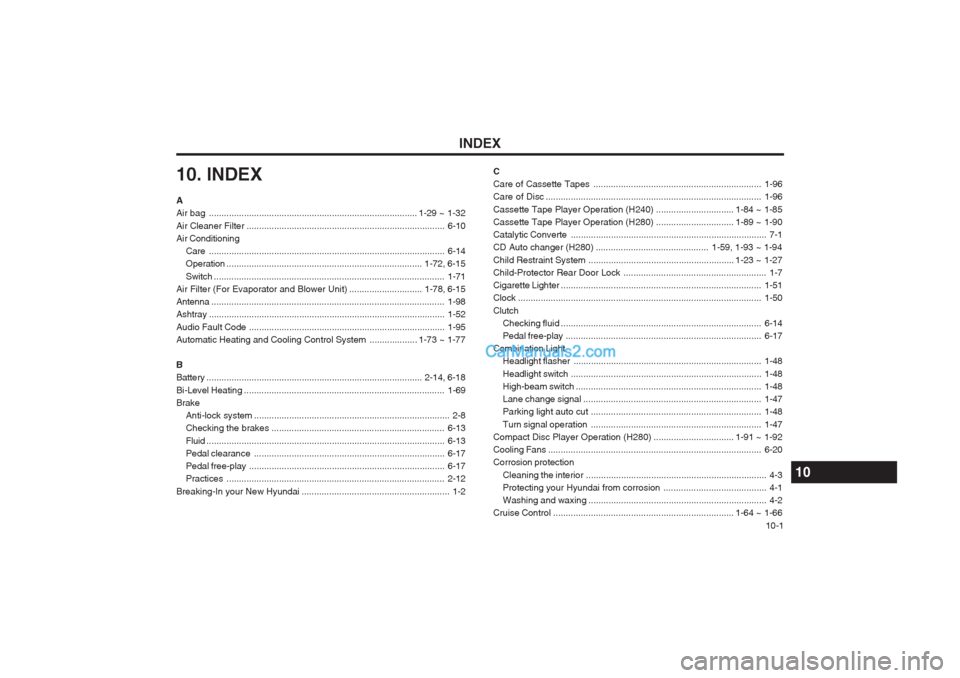
A Air bag
................................................................................... 1-29 ~ 1-32
Air Cleaner Filter ............................................................................... 6-10
Air Conditioning Care .............................................................................................. 6-14
Operation .............................................................................. 1-72, 6-15
Switch ............................................................................................ 1-71
Air Filter (For Evaporator and Blower Uni t) ............................. 1-78, 6-15
Antenna ............................................................................................. 1-98
Ashtray .............................................................................................. 1-52
Audio Fault Code .............................................................................. 1-95
Automatic Heating and Cooling Control System ................... 1-73 ~ 1-77
BBattery ...................................................................................... 2-14, 6-18
Bi-Level Heating ................................................................................ 1-69
Brake
Anti-lock system .............................................................................. 2-8
Checking the brakes ..................................................................... 6-13
Fluid ............................................................................................... 6-13
Pedal clearance ............................................................................ 6-17
Pedal free-play .............................................................................. 6-17
Practices ....................................................................................... 2-12
Breaking-In your New Hyundai ........................................................... 1-2 CCare of Cass
ette Tapes ................................................................... 1-96
Care of Disc ...................................................................................... 1-96
Cassette Tape Player Operation (H240) ............................... 1-84 ~ 1-85
Cassette Tape Player Operation (H280) ............................... 1-89 ~ 1-90
Catalytic Con verte .............................................................................. 7-1
CD Auto changer (H280) ............................................. 1-59, 1-93 ~ 1-94
Child Restraint System .......................................................... 1-23 ~ 1-27
Child-Protector Rear Door Lock ......................................................... 1-7
Cigarette Lighter ................................................................................ 1-51
Clock ................................................................................................. 1-50
Clutch Checking fluid ................................................................................ 6-14
Pedal free-play .............................................................................. 6-17
Combination Light Headlight flasher ........................................................................... 1-48
Headlight switch ............................................................................ 1-48
High-beam switch .......................................................................... 1-48
Lane change signal ....................................................................... 1-47
Parking light auto cut .................................................................... 1-48
Turn signal operation .................................................................... 1-47
Compact Disc Player Operation (H280) ................................ 1-91 ~ 1-92
Cooling Fans ..................................................................................... 6-20
Corrosion protection
Cleaning the interior ........................................................................ 4-3
Protecting your Hyundai from corrosion ......................................... 4-1Washing and waxing ....................................................................... 4-2
Cruise Control ........................................................................ 1-64 ~ 1-66
10. INDEX
10
Page 184 of 349
INDEX 10-3
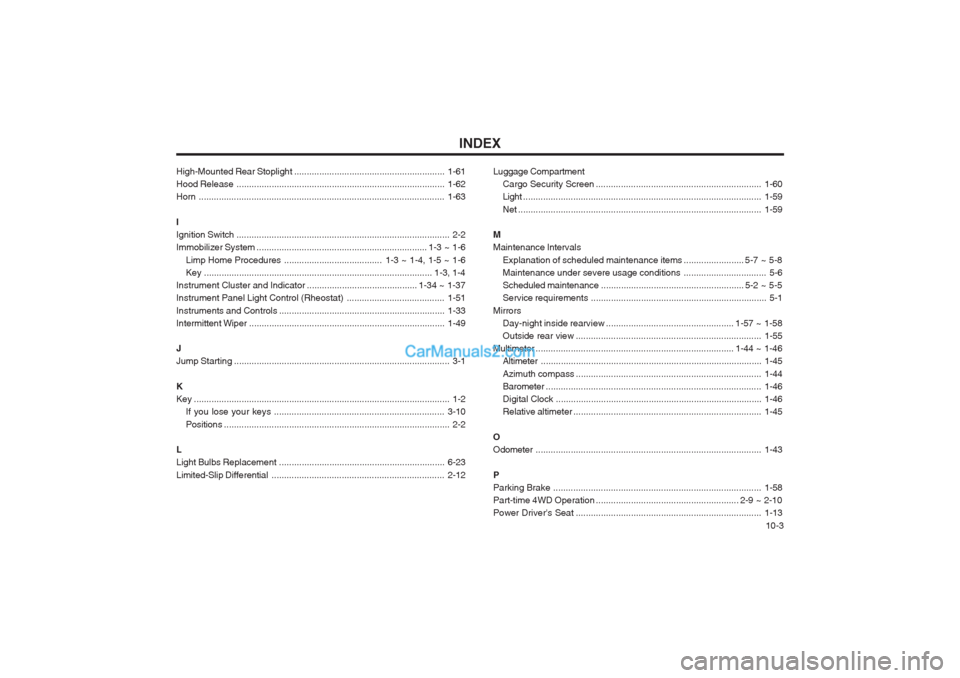
High-Mounted Rear Stoplight ............................................................
1-61
Hood Release ................................................................................... 1-62
Horn .................................................................................................. 1-63
I
Ignition Switch ..................................................................................... 2-2Immobilizer System .................................................................... 1-3 ~ 1-6
Limp Home Procedures ....................................... 1-3 ~ 1-4, 1-5 ~ 1-6
Key ........................................................................................... 1-3, 1-4
Instrument Cluster and Indicator ............................................ 1-34 ~ 1-37
Instrument Panel Light Control (Rheostat) .......................................1-51
Instruments and Controls ............. ..................................................... 1-33
Intermittent Wiper .............................................................................. 1-49
JJump Starting ...................................................................................... 3-1
K
Key ...................................................................................................... 1-2 If you lose your keys .................................................................... 3-10
Positions .......................................................................................... 2-2
L
Light Bulbs Replacement ............. ..................................................... 6-23
Limited-Slip Differential ..................................................................... 2-12Luggage Compartment
Cargo Security Screen .................................................................. 1-60
Light ............................................................................................... 1-59
Net ................................................................................................. 1-59
MMaintenance Intervals Explanation of scheduled maintenance items ........................ 5-7 ~ 5-8
Maintenance under severe usage conditions ................................. 5-6
Scheduled maintenance ......................................................... 5-2 ~ 5-5
Service requirements ...................................................................... 5-1
Mirrors Day-night inside rearview ................................................... 1-57 ~ 1-58
Outside rear view .......................................................................... 1-55
Multimeter ............................................................................... 1-44 ~ 1-46
Altimeter ........................................................................................ 1-45
Azimuth compass .......................................................................... 1-44
Barometer ...................................................................................... 1-46
Digital Clock .................................................................................. 1-46
Relative altimeter ........................................................................... 1-45
OOdometer .......................................................................................... 1-43
PParking Brake ................................................................................... 1-58
Part-time 4WD Operation ......................................................... 2-9 ~ 2-10
Power Driver's Seat .......................................................................... 1-13