maintenance schedule Hyundai Terracan 2003 User Guide
[x] Cancel search | Manufacturer: HYUNDAI, Model Year: 2003, Model line: Terracan, Model: Hyundai Terracan 2003Pages: 349, PDF Size: 4.56 MB
Page 159 of 349
DO-IT-YOURSELF MAINTENANCE 6-13
G110D03Y
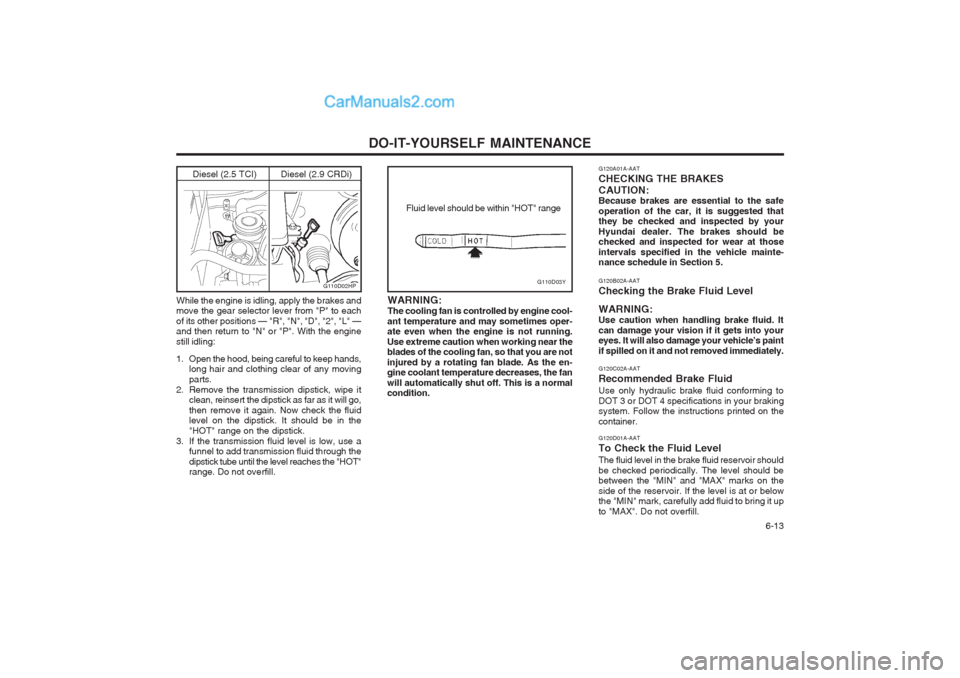
Fluid level should be within "HOT" range
G120A01A-AAT CHECKING THE BRAKESCAUTION: Because brakes are essential to the safe operation of the car, it is suggested that they be checked and inspected by your Hyundai dealer. The brakes should be checked and inspected for wear at those intervals specified in the vehicle mainte- nance schedule in Section 5.
WARNING: The cooling fan is controlled by engine cool-
ant temperature and may sometimes oper- ate even when the engine is not running. Use extreme caution when working near the blades of the cooling fan, so that you are not injured by a rotating fan blade. As the en- gine coolant temperature decreases, the fan will automatically shut off. This is a normal condition. G120B02A-AAT Checking the Brake Fluid Level WARNING: Use caution when handling brake fluid. Itcan damage your vision if it gets into your eyes. It will also damage your vehicle’s paint if spilled on it and not removed immediately. G120C02A-AAT Recommended Brake FluidUse only hydraulic brake fluid conforming to DOT 3 or DOT 4 specifications in your braking system. Follow the instructions printed on the container. G120D01A-AAT To Check the Fluid LevelThe fluid level in the brake fluid reservoir should be checked periodically. The level should be between the "MIN" and "MAX" marks on the side of the reservoir. If the level is at or below the "MIN" mark, carefully add fluid to bring it up to "MAX". Do not overfill.
While the engine is idling, apply the brakes and move the gear selector lever from "P" to each of its other positions — "R", "N", "D", "2", "L" — and then return to "N" or "P". With the engine still idling:
1. Open the hood, being careful to keep hands,
long hair and clothing clear of any moving parts.
2. Remove the transmission dipstick, wipe it clean, reinsert the dipstick as far as it will go,then remove it again. Now check the fluid level on the dipstick. It should be in the "HOT" range on the dipstick.
3. If the transmission fluid level is low, use a funnel to add transmission fluid through thedipstick tube until the level reaches the "HOT" range. Do not overfill.
Diesel (2.9 CRDi)
Diesel (2.5 TCI)
G110D02HP
Page 173 of 349
EMISSION CONTROL SYSTEMS 7-1
7. EMISSION
CONTROL SYSTEMS
H010A01A-GAT EMISSION CONTROL SYSTEMS (If installed) Your Hyundai is equipped with an emission control system to meet all requirements of the Emission prohibition rules of your province. There are three emission control systems which are as follows. (1) Crankcase emission control system (For a Gasoline Engine)
(2) Evaporative emission control system (For a Gasoline Engine)
(3) Exhaust emission control system In order to assure the proper function of the emission control systems, it is recommended that you have your car inspected and main- tained by an authorized Hyundai dealer in ac- cordance with the maintenance schedule in this manual. H010C02Y-GAT 2. Evaporative Emission Control
System; For a Gasoline Engine
The Evaporative Emission Control System is
designed to prevent fuel vapors from escaping into the atmosphere. Canister While the engine is inoperative, fuel vapors
generated inside the fuel tank are absorbed and stored in the canister. When the engine is
running, the fuel vapors absorbed in the canis- ter are drawn into the induction system through the purge control solenoid valve. Purge Control Solenoid Valve The purge control solenoid valve is controlled
by the ECM; when the engine coolant tempera- ture is low, and during idling, it closes, so that evaporated fuel is not taken into the surge tank.
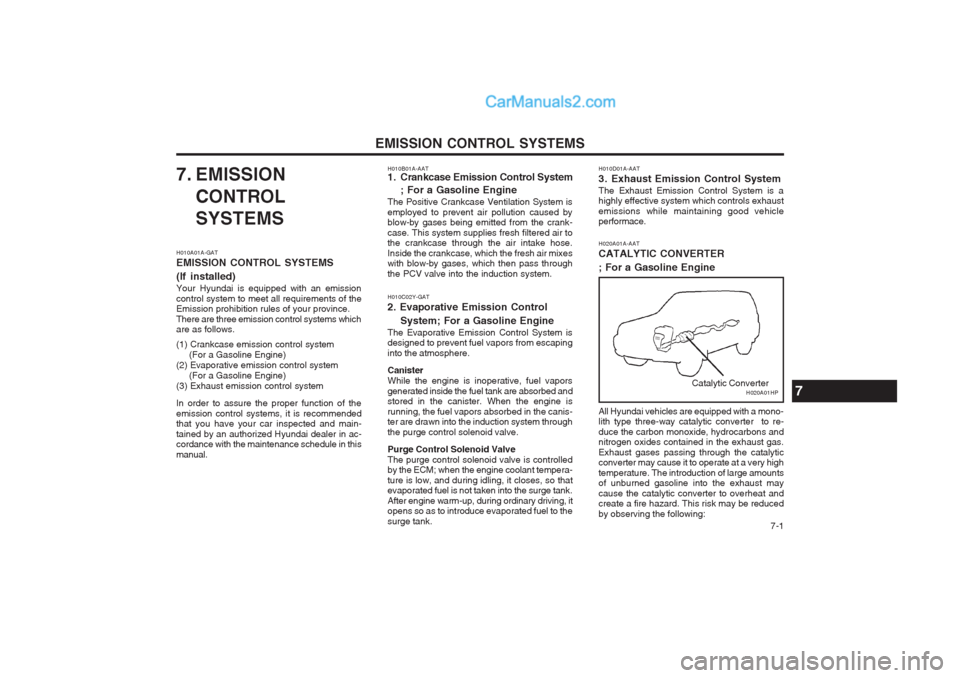
After engine warm-up, during ordinary driving, it opens so as to introduce evaporated fuel to the surge tank. H020A01A-AAT CATALYTIC CONVERTER ; For a Gasoline Engine
H020A01HP
Catalytic Converter
All Hyundai vehicles are equipped with a mono- lith type three-way catalytic converter to re- duce the carbon monoxide, hydrocarbons and nitrogen oxides contained in the exhaust gas. Exhaust gases passing through the catalytic converter may cause it to operate at a very high temperature. The introduction of large amounts of unburned gasoline into the exhaust may cause the catalytic converter to overheat and create a fire hazard. This risk may be reduced by observing the following:
H010B01A-AAT
1. Crankcase Emission Control System
; For a Gasoline Engine
The Positive Crankcase Ventilation System is employed to prevent air pollution caused by blow-by gases being emitted from the crank- case. This system supplies fresh filtered air to the crankcase through the air intake hose. Inside the crankcase, which the fresh air mixes with blow-by gases, which then pass through the PCV valve into the induction system.7
H010D01A-AAT
3. Exhaust Emission Control SystemThe Exhaust Emission Control System is a highly effective system which controls exhaust emissions while maintaining good vehicle performace.
Page 184 of 349
INDEX 10-3
High-Mounted Rear Stoplight ............................................................
1-61
Hood Release ................................................................................... 1-62
Horn .................................................................................................. 1-63
I
Ignition Switch ..................................................................................... 2-2Immobilizer System .................................................................... 1-3 ~ 1-6
Limp Home Procedures ....................................... 1-3 ~ 1-4, 1-5 ~ 1-6
Key ........................................................................................... 1-3, 1-4
Instrument Cluster and Indicator ............................................ 1-34 ~ 1-37
Instrument Panel Light Control (Rheostat) .......................................1-51
Instruments and Controls ............. ..................................................... 1-33
Intermittent Wiper .............................................................................. 1-49
JJump Starting ...................................................................................... 3-1
K
Key ...................................................................................................... 1-2 If you lose your keys .................................................................... 3-10
Positions .......................................................................................... 2-2
L
Light Bulbs Replacement ............. ..................................................... 6-23
Limited-Slip Differential ..................................................................... 2-12Luggage Compartment
Cargo Security Screen .................................................................. 1-60
Light ............................................................................................... 1-59
Net ................................................................................................. 1-59
MMaintenance Intervals Explanation of scheduled maintenance items ........................ 5-7 ~ 5-8
Maintenance under severe usage conditions ................................. 5-6
Scheduled maintenance ......................................................... 5-2 ~ 5-5
Service requirements ...................................................................... 5-1
Mirrors Day-night inside rearview ................................................... 1-57 ~ 1-58
Outside rear view .......................................................................... 1-55
Multimeter ............................................................................... 1-44 ~ 1-46
Altimeter ........................................................................................ 1-45
Azimuth compass .......................................................................... 1-44
Barometer ...................................................................................... 1-46
Digital Clock .................................................................................. 1-46
Relative altimeter ........................................................................... 1-45
OOdometer .......................................................................................... 1-43
PParking Brake ................................................................................... 1-58
Part-time 4WD Operation ......................................................... 2-9 ~ 2-10
Power Driver's Seat .......................................................................... 1-13
Page 189 of 349
DA030A1-EResponsibilty For Maintenance
It is the responsibility of the vehicle owner/driver to ensure that all routine maintenance services are undertaken in line with the recommendations specified in Section 5 of thismanual. In addition, in order to ensure continued validity of the new vehicle warrantyand safe operation of the vehicle, non scheduled maintenance/running repairs shouldbe undertaken at the earliest available opportunity. Under severe operating conditions, more frequent maintenance is required. Details of the maintenance schedule for such conditions are also given in section 5. It is recommended that all maintenance operations and repairs are entrusted to a franchised Hyundai dealer to ensure that the latest repair methods, specialized toolingand genuine Hyundai parts are used to ensure the continued reliability and safety ofthe vehicle.
Page 286 of 349
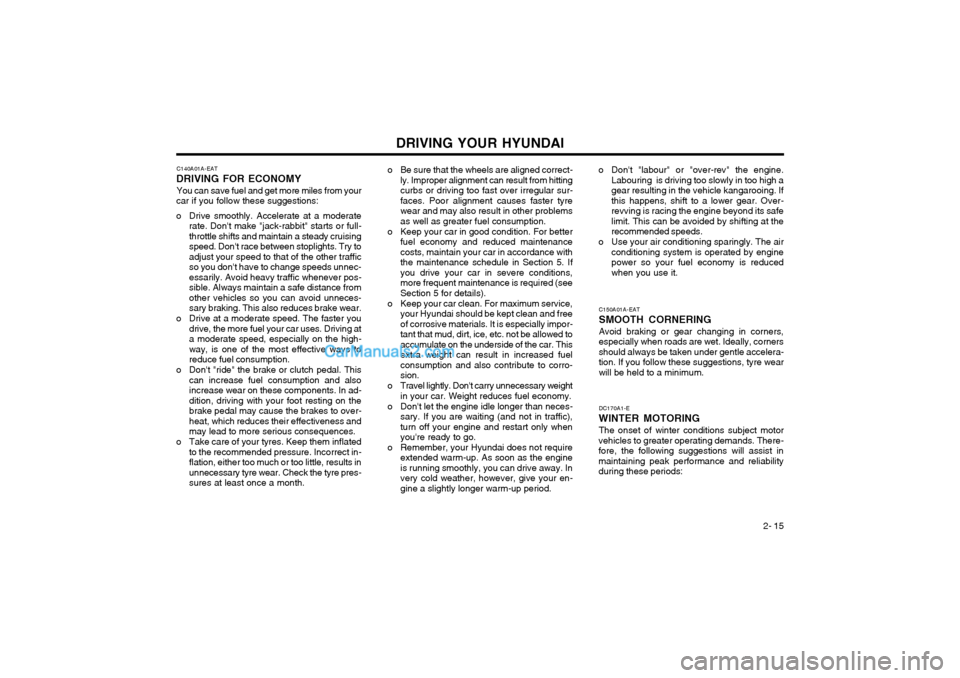
DRIVING YOUR HYUNDAI 2- 15
DC170A1-E
WINTER MOTORING The onset of winter conditions subject motor
vehicles to greater operating demands. There- fore, the following suggestions will assist inmaintaining peak performance and reliabilityduring these periods:
C140A01A-EAT
DRIVING FOR ECONOMY
You can save fuel and get more miles from your
car if you follow these suggestions:
o Drive smoothly. Accelerate at a moderate rate. Don't make "jack-rabbit" starts or full- throttle shifts and maintain a steady cruisingspeed. Don't race between stoplights. Try toadjust your speed to that of the other trafficso you don't have to change speeds unnec-essarily. Avoid heavy traffic whenever pos-sible. Always maintain a safe distance fromother vehicles so you can avoid unneces-sary braking. This also reduces brake wear.
o Drive at a moderate speed. The faster you drive, the more fuel your car uses. Driving ata moderate speed, especially on the high-way, is one of the most effective ways toreduce fuel consumption.
o Don't "ride" the brake or clutch pedal. This can increase fuel consumption and alsoincrease wear on these components. In ad-dition, driving with your foot resting on thebrake pedal may cause the brakes to over-heat, which reduces their effectiveness andmay lead to more serious consequences.
o Take care of your tyres. Keep them inflated to the recommended pressure. Incorrect in-flation, either too much or too little, results inunnecessary tyre wear. Check the tyre pres-sures at least once a month. o Be sure that the wheels are aligned correct-
ly. Improper alignment can result from hittingcurbs or driving too fast over irregular sur-faces. Poor alignment causes faster tyrewear and may also result in other problemsas well as greater fuel consumption.
o Keep your car in good condition. For better fuel economy and reduced maintenancecosts, maintain your car in accordance withthe maintenance schedule in Section 5. Ifyou drive your car in severe conditions,more frequent maintenance is required (seeSection 5 for details).
o Keep your car clean. For maximum service, your Hyundai should be kept clean and freeof corrosive materials. It is especially impor-tant that mud, dirt, ice, etc. not be allowed toaccumulate on the underside of the car. Thisextra weight can result in increased fuelconsumption and also contribute to corro-sion.
o Travel lightly. Don't carry unnecessary weight in your car. Weight reduces fuel economy.
o Don't let the engine idle longer than neces- sary. If you are waiting (and not in traffic),turn off your engine and restart only whenyou're ready to go.
o Remember, your Hyundai does not require extended warm-up. As soon as the engineis running smoothly, you can drive away. Invery cold weather, however, give your en-gine a slightly longer warm-up period. o Don't "labour" or "over-rev" the engine.
Labouring is driving too slowly in too high agear resulting in the vehicle kangarooing. Ifthis happens, shift to a lower gear. Over-revving is racing the engine beyond its safelimit. This can be avoided by shifting at therecommended speeds.
o Use your air conditioning sparingly. The air conditioning system is operated by enginepower so your fuel economy is reducedwhen you use it.
C150A01A-EAT SMOOTH CORNERINGAvoid braking or gear changing in corners, especially when roads are wet. Ideally, cornersshould always be taken under gentle accelera-tion. If you follow these suggestions, tyre wearwill be held to a minimum.
Page 305 of 349
VEHICLE MAINTENANCE REQUIREMENTS 5-1
NOTE:
The inspection and testing of certain elec-
tronic fuel injection/engine management and automatic transmission control sys-tems require specialised electronic equip-ment specifically designed for Hyundai ve-hicles. The use of general purpose electri-cal test equipment may result in damage tothe control unit microprocessors.
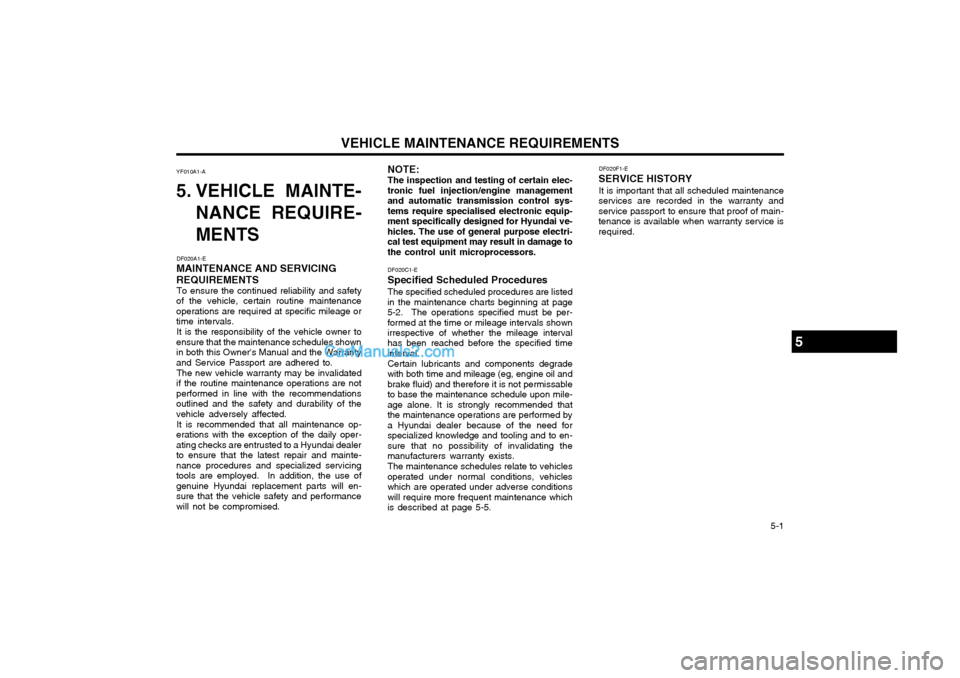
YF010A1-A
5. VEHICLE MAINTE-
NANCE REQUIRE- MENTS
DF020A1-E
MAINTENANCE AND SERVICING REQUIREMENTS To ensure the continued reliability and safety
of the vehicle, certain routine maintenance operations are required at specific mileage ortime intervals.
It is the responsibility of the vehicle owner to
ensure that the maintenance schedules shownin both this Owner's Manual and the Warrantyand Service Passport are adhered to.
The new vehicle warranty may be invalidated
if the routine maintenance operations are notperformed in line with the recommendationsoutlined and the safety and durability of thevehicle adversely affected.
It is recommended that all maintenance op-
erations with the exception of the daily oper-ating checks are entrusted to a Hyundai dealerto ensure that the latest repair and mainte-nance procedures and specialized servicingtools are employed. In addition, the use ofgenuine Hyundai replacement parts will en-sure that the vehicle safety and performancewill not be compromised. DF020C1-E
Specified Scheduled Procedures The specified scheduled procedures are listed
in the maintenance charts beginning at page5-2. The operations specified must be per-formed at the time or mileage intervals shownirrespective of whether the mileage interval has been reached before the specified time interval.
Certain lubricants and components degrade
with both time and mileage (eg, engine oil andbrake fluid) and therefore it is not permissableto base the maintenance schedule upon mile-age alone. It is strongly recommended thatthe maintenance operations are performed bya Hyundai dealer because of the need forspecialized knowledge and tooling and to en-sure that no possibility of invalidating themanufacturers warranty exists.
The maintenance schedules relate to vehicles
operated under normal conditions, vehicleswhich are operated under adverse conditionswill require more frequent maintenance whichis described at page 5-5. DF020F1-E
SERVICE HISTORY
It is important that all scheduled maintenance
services are recorded in the warranty andservice passport to ensure that proof of main-tenance is available when warranty service isrequired.
5
Page 306 of 349
VEHICLE MAINTENANCE REQUIREMENTS
5- 2 YF010A2-E
REGULAR SERVICING
In order to ensure continued reliability, safety and longevity, regular
maintenance performed at the intervals specified is essential. The maintenance intervals specified are based both on time elapsed andmileage covered since the previous maintenance service was per-formed. However, under severe operating conditions, certain scheduledoperations should be performed at shorter intervals. Regular maintenance should be entrusted to a Hyundai dealer who is
best able to provide the expertise required to ensure optimum opera-tional performance.
In addition the use of Hyundai replacement parts and service consumables
will ensure that the original build quality, operational performance andsafety are maintained.
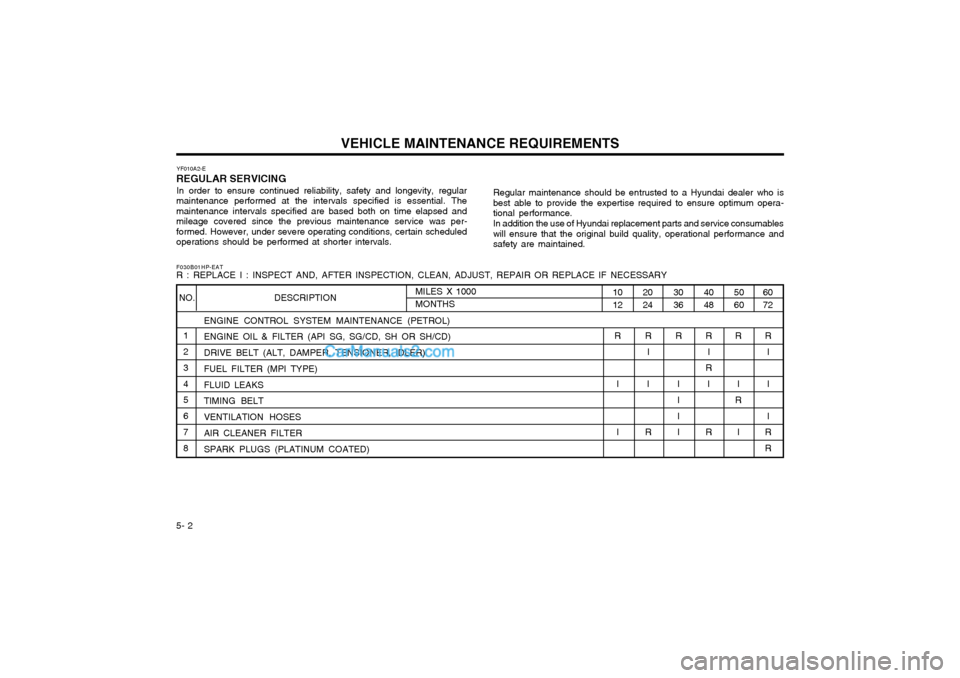
F030B01HP-EAT R : REPLACE I : INSPECT AND, AFTER INSPECTION, CLEAN, ADJUST, REPAIR OR REPLACE IF NECESSARY
ENGINE CONTROL SYSTEM MAINTENANCE (PETROL) ENGINE OIL & FILTER (API SG, SG/CD, SH OR SH/CD) DRIVE BELT (ALT, DAMPER, TENSIONER, IDLER) FUEL FILTER (MPI TYPE) FLUID LEAKS TIMING BELT VENTILATION HOSES AIR CLEANER FILTER SPARK PLUGS (PLATINUM COATED)
NO. DESCRIPTION60 72
5060
4048
3036
2024
1012
MILES X 1000 MONTHS
R
I I
l
R R
R
I
R
I
R
l
R
I
R
R
I I I I
R
l
I
R
R
I I1 2 3 4 5 6 7 8
Page 310 of 349
VEHICLE MAINTENANCE REQUIREMENTS
5- 6
F060B01A-AAT
o Drive belts Inspect all drive belts for evidence of cuts, cracks, excessive wear or oil and replace ifnecessary. Drive belts should be checkedperiodically for proper tension and adjusted asnecessary. F060C01A-AAT
o Fuel filter A clogged filter can limit the speed at which the vehicle may be driven, damage the emissionsystem and cause hard starting. If an exces-sive amount of foreign matter accumulates inthe fuel tank, the filter may require replace-ment more frequently. After installing a new filter, run the engine for several minutes, and check for leaks at theconnections. Fuel filters should be installed bytrained technicians.
F060M01A-AAT o Engine oil and filterThe engine oil and filter should be changed at the intervals specified in the maintenanceschedule. If the car is being driven in severeconditions, more frequent oil and filter changesare required.
F060D01TB-AAT
o Fuel lines, fuel hoses and connec-
tions
Check the fuel lines, fuel hoses and connec-tions for leakage and damage. Have a trainedtechnician replace any damaged or leakingparts immediately.
WARNING (Diesel only): Never work on injection system with en-gine running or within 30 seconds aftershutting off engine. High pressure pump,rail, injectors and high pressure pipes aresubject to high pressure even after theengine stopped. The fuel jet produced byfuel leaks may cause serious injury, if ittouch the body. People using pacemak-ers should not move than 30cm closer tothe ECU or wiring harness within theengine room while engine is running,since the high currents in the CommonRail system produce considerable mag-netic fields. F060E01A-AAT
o Timing beltInspect all parts related to the timing belt for damage and deformation. Replace any dam-aged parts immediately. F060G01A-EAT
o Vapour hose and fuel filler cap The vapour hose and fuel filler cap should be inspected at those intervals specified in themaintenance schedule. Make sure that a newvapour hose or fuel filler cap is correctlyreplaced.
F060F01A-AAT
o Vacuum, crankcase
ventilation hoses
Inspect the surface of hoses for evidence of
heat and/or mechanical damage. Hard andbrittle rubber, cracking, tears, cuts, abrasions,and excessive swelling indicate deterioration.Particular attention should be paid to examinethose hose surfaces nearest to high heatsources, such as the exhaust manifold.
Inspect the hose routing to assure that the
hoses do not come in contact with any heatsource, sharp edges or moving componentwhich might cause heat damage or mechani-cal wear. Inspect all hose connections, suchas clamps and couplings, to make sure theyare secure, and that no leaks are present.Hoses should be replaced immediately if thereis any evidence of deterioration or damage.
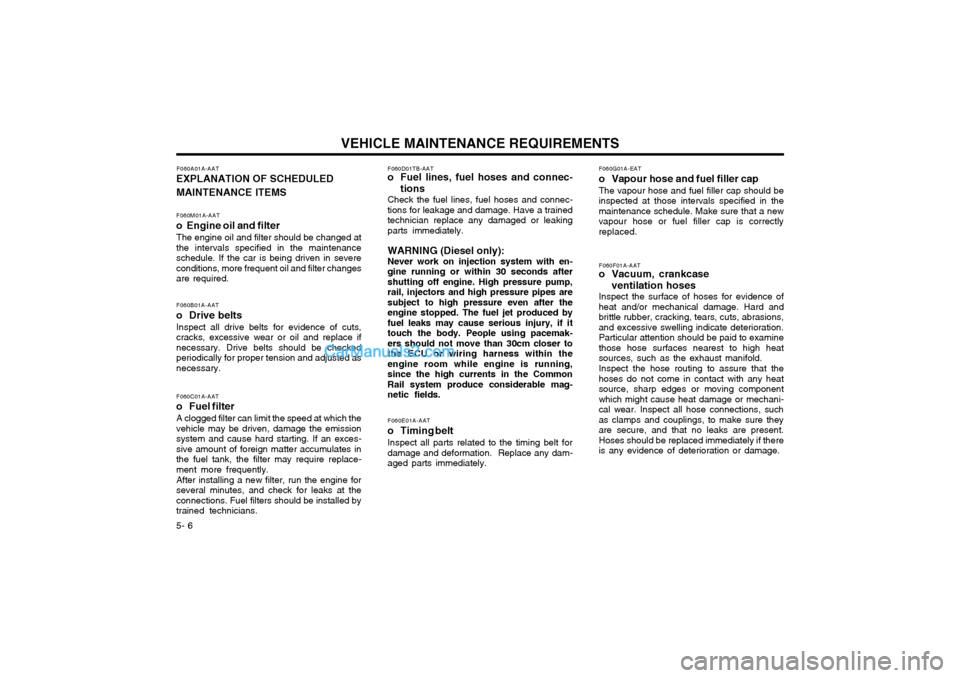
F060A01A-AAT
EXPLANATION OF SCHEDULED MAINTENANCE ITEMS
Page 311 of 349
VEHICLE MAINTENANCE REQUIREMENTS 5-7
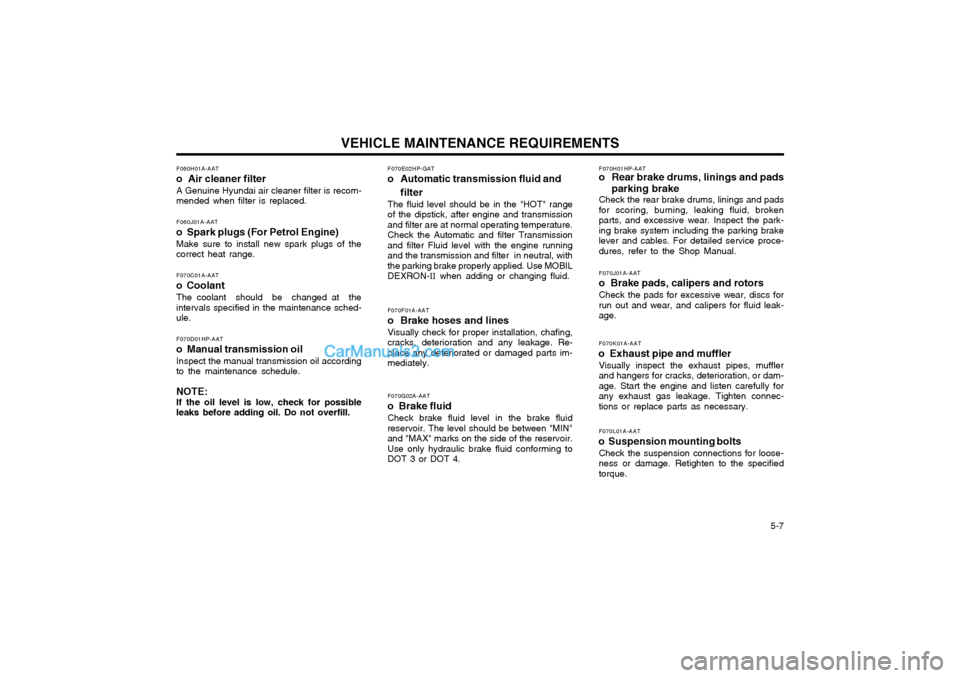
F070E02HP-GAT
o Automatic transmission fluid and
filter
The fluid level should be in the "HOT" range of the dipstick, after engine and transmissionand filter are at normal operating temperature.Check the Automatic and filter Transmissionand filter Fluid level with the engine runningand the transmission and filter in neutral, withthe parking brake properly applied. Use MOBILDEXRON- when adding or changing fluid.
F070F01A-AAT
o Brake hoses and lines Visually check for proper installation, chafing, cracks, deterioration and any leakage. Re-place any deteriorated or damaged parts im-mediately. F070G02A-AAT o Brake fluidCheck brake fluid level in the brake fluid reservoir. The level should be between "MIN"and "MAX" marks on the side of the reservoir.Use only hydraulic brake fluid conforming toDOT 3 or DOT 4. F070H01HP-AAT
o Rear brake drums, linings and pads
parking brake
Check the rear brake drums, linings and pads
for scoring, burning, leaking fluid, brokenparts, and excessive wear. Inspect the park-ing brake system including the parking brakelever and cables. For detailed service proce-dures, refer to the Shop Manual.
F070J01A-AAT
o Brake pads, calipers and rotors
Check the pads for excessive wear, discs for
run out and wear, and calipers for fluid leak-age. F070K01A-AAT
o Exhaust pipe and muffler Visually inspect the exhaust pipes, muffler and hangers for cracks, deterioration, or dam-age. Start the engine and listen carefully forany exhaust gas leakage. Tighten connec-tions or replace parts as necessary. F070L01A-AAT
o Suspension mounting bolts Check the suspension connections for loose- ness or damage. Retighten to the specifiedtorque.
F060H01A-AAT
o Air cleaner filter
A Genuine Hyundai air cleaner filter is recom-mended when filter is replaced. F060J01A-AAT
o Spark plugs (For Petrol Engine) Make sure to install new spark plugs of the
correct heat range.
F070C01A-AAT
o Coolant The coolant should be changed at the intervals specified in the maintenance sched-ule. F070D01HP-AAT
o Manual transmission oil Inspect the manual transmission oil according to the maintenance schedule.
NOTE: If the oil level is low, check for possibleleaks before adding oil. Do not overfill.
Page 317 of 349
OWNER MAINTENANCE 6-5
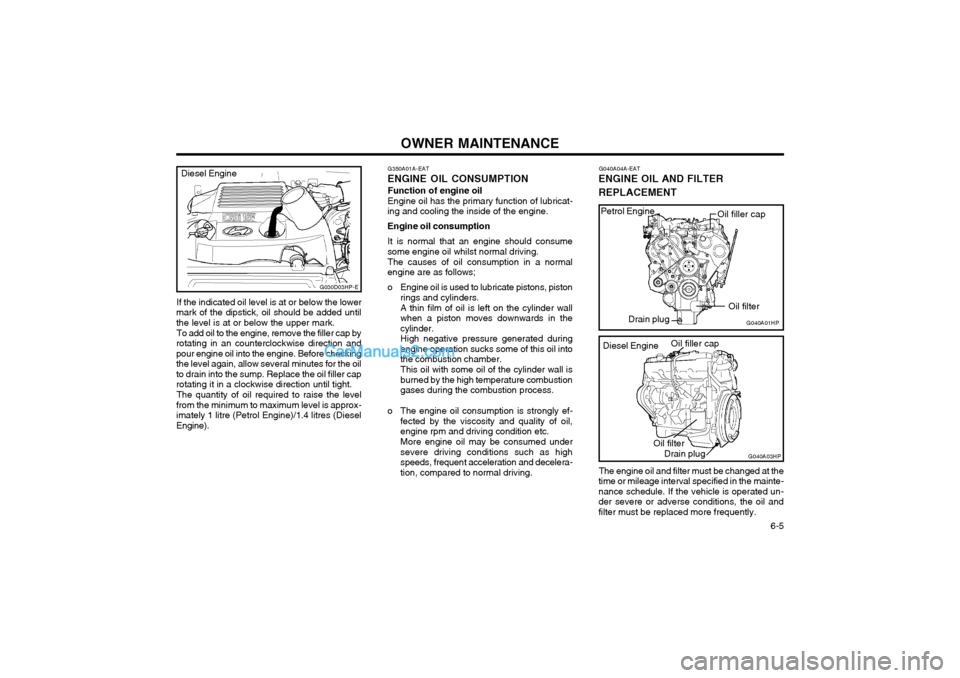
If the indicated oil level is at or below the lower
mark of the dipstick, oil should be added until the level is at or below the upper mark.
To add oil to the engine, remove the filler cap by
rotating in an counterclockwise direction andpour engine oil into the engine. Before checkingthe level again, allow several minutes for the oilto drain into the sump. Replace the oil filler caprotating it in a clockwise direction until tight.
The quantity of oil required to raise the level
from the minimum to maximum level is approx-imately 1 litre (Petrol Engine)/1.4 litres (DieselEngine). G350A01A-EAT
ENGINE OIL CONSUMPTION
Function of engine oil Engine oil has the primary function of lubricat-
ing and cooling the inside of the engine.
Engine oil consumption It is normal that an engine should consume
some engine oil whilst normal driving.
The causes of oil consumption in a normal
engine are as follows;
o Engine oil is used to lubricate pistons, piston rings and cylinders. A thin film of oil is left on the cylinder wall when a piston moves downwards in thecylinder.High negative pressure generated duringengine operation sucks some of this oil intothe combustion chamber. This oil with some oil of the cylinder wall is burned by the high temperature combustiongases during the combustion process.
o The engine oil consumption is strongly ef- fected by the viscosity and quality of oil,engine rpm and driving condition etc. More engine oil may be consumed under severe driving conditions such as highspeeds, frequent acceleration and decelera-tion, compared to normal driving.
G030D03HP-E G040A04A-EAT
ENGINE OIL AND FILTER REPLACEMENT
G040A03HP
Oil filler cap
Oil filter Drain plug
G040A01HP
Petrol Engine
Oil filter
Drain plug Oil filler cap
The engine oil and filter must be changed at the
time or mileage interval specified in the mainte- nance schedule. If the vehicle is operated un-der severe or adverse conditions, the oil andfilter must be replaced more frequently. Diesel Engine
Diesel Engine