seats Hyundai Terracan 2003 User Guide
[x] Cancel search | Manufacturer: HYUNDAI, Model Year: 2003, Model line: Terracan, Model: Hyundai Terracan 2003Pages: 349, PDF Size: 4.56 MB
Page 213 of 349
CONTROLS AND EQUIPMENT1- 19
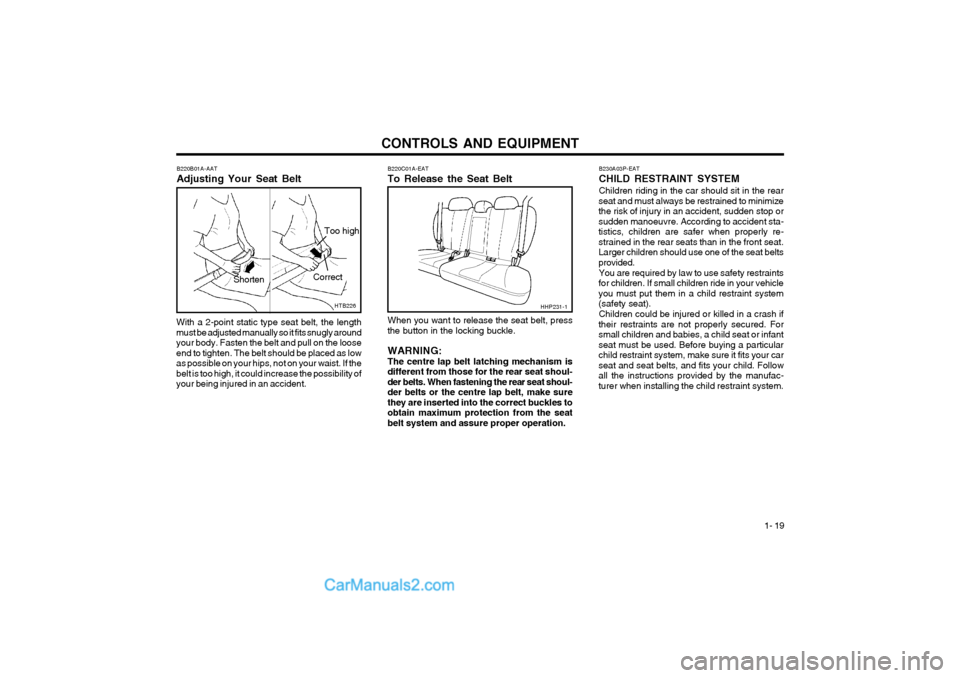
B220C01A-EAT To Release the Seat Belt When you want to release the seat belt, press
the button in the locking buckle.
WARNING: The centre lap belt latching mechanism is
different from those for the rear seat shoul-der belts. When fastening the rear seat shoul-der belts or the centre lap belt, make surethey are inserted into the correct buckles toobtain maximum protection from the seatbelt system and assure proper operation.
HHP231-1
B220B01A-AAT Adjusting Your Seat BeltHTB226
With a 2-point static type seat belt, the length must be adjusted manually so it fits snugly aroundyour body. Fasten the belt and pull on the looseend to tighten. The belt should be placed as lowas possible on your hips, not on your waist. If thebelt is too high, it could increase the possibility ofyour being injured in an accident. Correct
Shorten Too high
B230A03P-EAT CHILD RESTRAINT SYSTEMChildren riding in the car should sit in the rear
seat and must always be restrained to minimize the risk of injury in an accident, sudden stop orsudden manoeuvre. According to accident sta-tistics, children are safer when properly re-strained in the rear seats than in the front seat.Larger children should use one of the seat beltsprovided.
You are required by law to use safety restraints
for children. If small children ride in your vehicleyou must put them in a child restraint system(safety seat).
Children could be injured or killed in a crash if
their restraints are not properly secured. Forsmall children and babies, a child seat or infantseat must be used. Before buying a particularchild restraint system, make sure it fits your carseat and seat belts, and fits your child. Followall the instructions provided by the manufac-turer when installing the child restraint system.
Page 215 of 349
CONTROLS AND EQUIPMENT1- 21
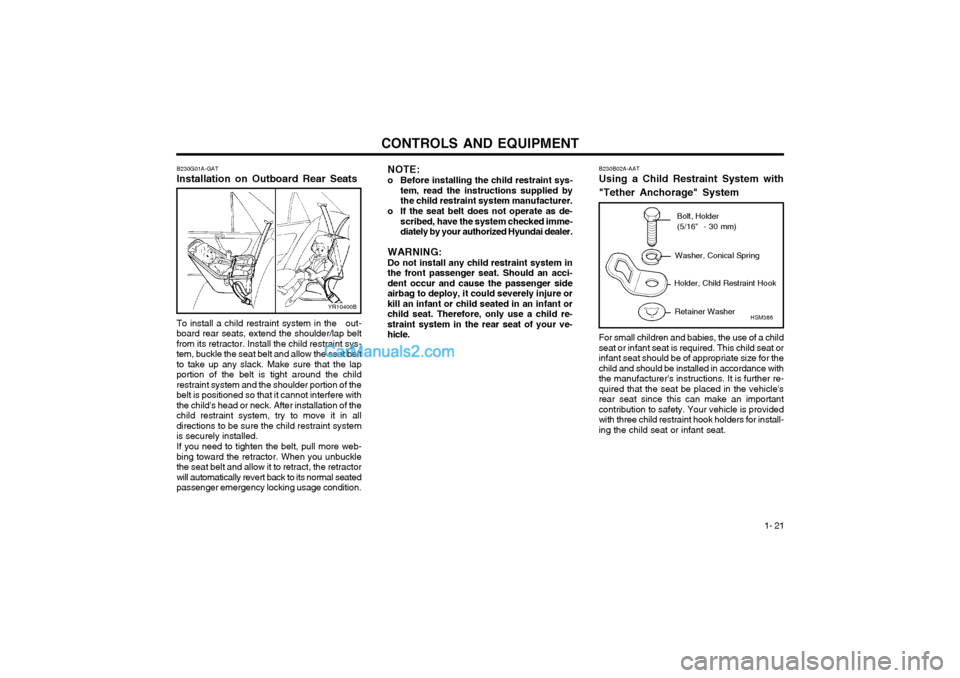
B230G01A-GAT Installation on Outboard Rear Seats To install a child restraint system in the out- board rear seats, extend the shoulder/lap beltfrom its retractor. Install the child restraint sys-tem, buckle the seat belt and allow the seat beltto take up any slack. Make sure that the lapportion of the belt is tight around the childrestraint system and the shoulder portion of thebelt is positioned so that it cannot interfere withthe child's head or neck. After installation of thechild restraint system, try to move it in alldirections to be sure the child restraint systemis securely installed. If you need to tighten the belt, pull more web- bing toward the retractor. When you unbucklethe seat belt and allow it to retract, the retractorwill automatically revert back to its normal seatedpassenger emergency locking usage condition.
NOTE:
o Before installing the child restraint sys- tem, read the instructions supplied bythe child restraint system manufacturer.
o If the seat belt does not operate as de- scribed, have the system checked imme-diately by your authorized Hyundai dealer.
WARNING:Do not install any child restraint system in
the front passenger seat. Should an acci-dent occur and cause the passenger sideairbag to deploy, it could severely injure orkill an infant or child seated in an infant orchild seat. Therefore, only use a child re-straint system in the rear seat of your ve-hicle.
YR10400B B230B02A-AAT Using a Child Restraint System with
"Tether Anchorage" System For small children and babies, the use of a child seat or infant seat is required. This child seat orinfant seat should be of appropriate size for thechild and should be installed in accordance withthe manufacturer's instructions. It is further re-quired that the seat be placed in the vehicle'srear seat since this can make an importantcontribution to safety. Your vehicle is providedwith three child restraint hook holders for install-ing the child seat or infant seat. Bolt, Holder (5/16" - 30 mm)
Washer, Conical Spring
Holder, Child Restraint Hook
Retainer WasherHSM386
Page 216 of 349
CONTROLS AND EQUIPMENT
1- 22
B230C01HP Child RestraintHook holders
Front of Vehicle
Tether strap hook
Child Restraint Hook Holder
Hole
B230B01HP-1
Tether anchor cover
B230C02HP-EAT Securing a Child Restraint System
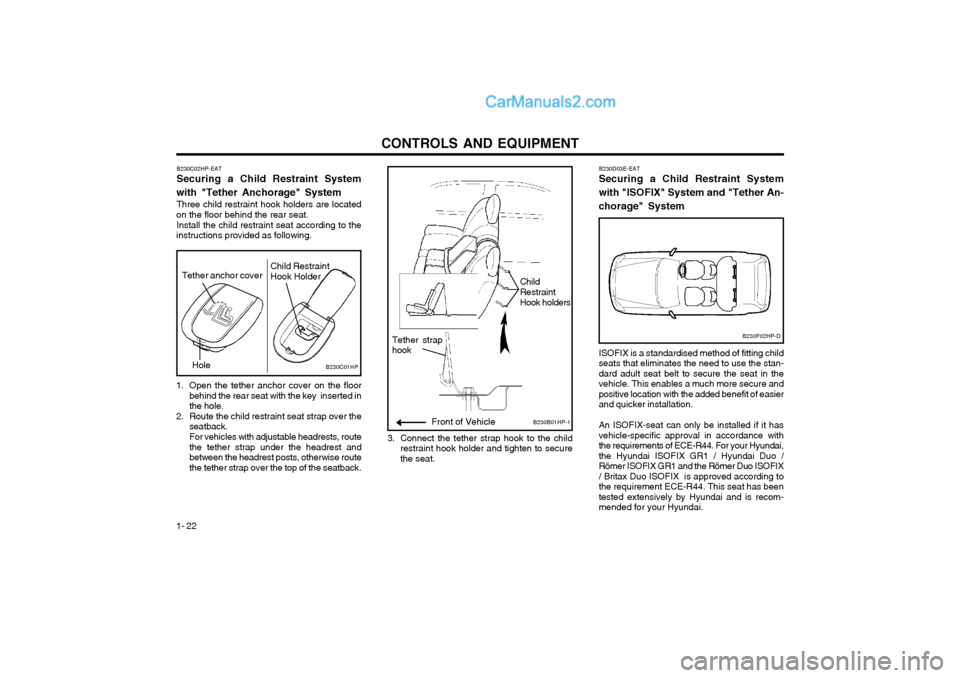
with "Tether Anchorage" System Three child restraint hook holders are located
on the floor behind the rear seat.
Install the child restraint seat according to the
instructions provided as following.
1. Open the tether anchor cover on the floor behind the rear seat with the key inserted in the hole.
2. Route the child restraint seat strap over the seatback. For vehicles with adjustable headrests, route the tether strap under the headrest andbetween the headrest posts, otherwise routethe tether strap over the top of the seatback. 3. Connect the tether strap hook to the child
restraint hook holder and tighten to securethe seat.
B230F02HP-D
B230D03E-EAT Securing a Child Restraint System with "ISOFIX" System and "Tether An-chorage" System ISOFIX is a standardised method of fitting child seats that eliminates the need to use the stan-dard adult seat belt to secure the seat in thevehicle. This enables a much more secure andpositive location with the added benefit of easierand quicker installation. An ISOFIX-seat can only be installed if it has vehicle-specific approval in accordance withthe requirements of ECE-R44. For your Hyundai,the Hyundai ISOFIX GR1 / Hyundai Duo /Römer ISOFIX GR1 and the Römer Duo ISOFIX/ Britax Duo ISOFIX is approved according tothe requirement ECE-R44. This seat has beentested extensively by Hyundai and is recom-mended for your Hyundai.
Page 218 of 349
CONTROLS AND EQUIPMENT
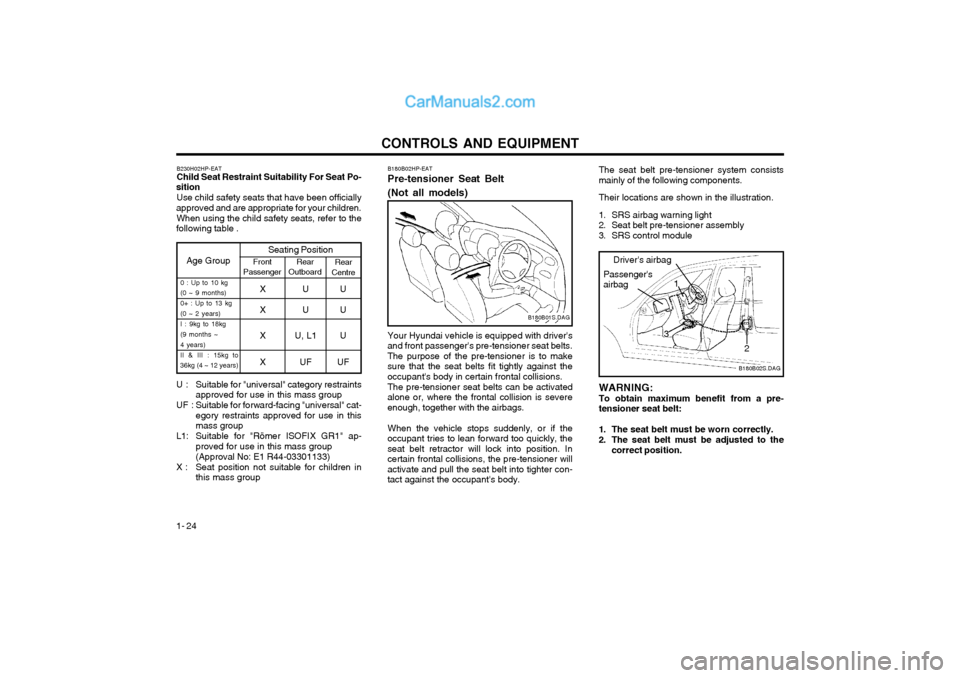
1- 24 The seat belt pre-tensioner system consists mainly of the following components. Their locations are shown in the illustration.
1. SRS airbag warning light
2. Seat belt pre-tensioner assembly
3. SRS control module WARNING: To obtain maximum benefit from a pre-tensioner seat belt:
1. The seat belt must be worn correctly.
2. The seat belt must be adjusted to the
correct position.
Age Group Seating PositionFront
Passenger Rear
Outboard Rear
Centre
0 : Up to 10 kg (0 ~ 9 months) 0+ : Up to 13 kg(0 ~ 2 years)I : 9kg to 18kg(9 months ~4 years) II & III : 15kg to
36kg (4 ~ 12 years)XUU
XUU
X U, L1 U XU FUF
B230H02HP-EAT Child Seat Restraint Suitability For Seat Po-
sition
Use child safety seats that have been officially
approved and are appropriate for your children.
When using the child safety seats, refer to the
following table .
U : Suitable for "universal" category restraints approved for use in this mass group
UF : Suitable for forward-facing "universal" cat- egory restraints approved for use in this mass group
L1: Suitable for "Römer ISOFIX GR1" ap- proved for use in this mass group (Approval No: E1 R44-03301133)
X : Seat position not suitable for children in this mass group Your Hyundai vehicle is equipped with driver's
and front passenger's pre-tensioner seat belts. The purpose of the pre-tensioner is to makesure that the seat belts fit tightly against theoccupant's body in certain frontal collisions.
The pre-tensioner seat belts can be activated
alone or, where the frontal collision is severeenough, together with the airbags.
When the vehicle stops suddenly, or if the
occupant tries to lean forward too quickly, theseat belt retractor will lock into position. Incertain frontal collisions, the pre-tensioner willactivate and pull the seat belt into tighter con-tact against the occupant's body. B180B02HP-EAT Pre-tensioner Seat Belt (Not all models)
B180B01S.DAG
B180B02S.DAG
Driver's airbag
1
Passenger's airbag
3
2
Page 346 of 349
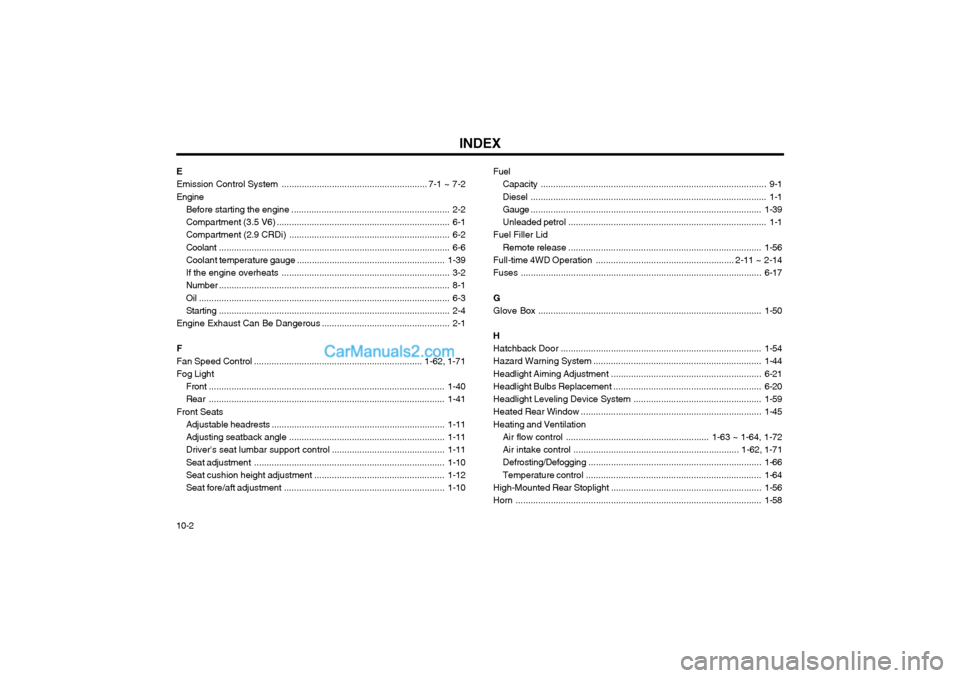
INDEX
10-2 E Emission Control System
.......................................................... 7-1 ~ 7-2
Engine Before starting the engine ............................................................... 2-2 Compartment (3.5 V6) ..................................................................... 6-1
Compartment (2.9 CRDi) ................................................................ 6-2
Coolant ............................................................................................ 6-6
Coolant temperature gauge ........................................................... 1-39
If the engine overheats ................................................................... 3-2
Number ............................................................................................ 8-1
Oil .................................................................................................... 6-3 Starting ............................................................................................ 2-4
Engine Exhaust Can Be Dangerous ................................................... 2-1
F Fan Speed Con trol ................................................................... 1-62, 1-71
Fog Light
Front .............................................................................................. 1-40
Rear .............................................................................................. 1-41
Front Seats Adjustable headrests ..................................................................... 1-11
Adjusting seatback angle .............................................................. 1-11
Driver's seat lumbar support control .............................................1-11
Seat adjustment ............................................................................ 1-10
Seat cushion height adjustment .................................................... 1-12
Seat fore/aft adjustment ................................................................ 1-10Fuel
Capacity .......................................................................................... 9-1
Diesel .............................................................................................. 1-1
Gauge ............................................................................................ 1-39
Unleaded petrol ............................................................................... 1-1
Fuel Filler Lid
Remote release ............................................................................. 1-56
Full-time 4WD Operation .................... ................................... 2-11 ~ 2-14
Fuses ................................................................................................ 6-17
G Glove Box ......................................................................................... 1-50
H Hatchback Door ................................................................................ 1-54
Hazard Warning System ................................................................... 1-44
Headlight Aiming Adjustment ............................................................ 6-21
Headlight Bulbs Replacement ........................................................... 6-20
Headlight Leveling Device System ................................................... 1-59
Heated Rear Window ........................................................................ 1-45
Heating and Ventilation Air flow control ......................................................... 1-63 ~ 1-64, 1-72
Air intake control .................................................................. 1-62, 1-71
Defrosting/Defogging ..................................................................... 1-66
Temperature control ...................................................................... 1-64
High-Mounted Rear Stoplight ............................................................ 1-56
Horn .................................................................................................. 1-58