torque Hyundai Terracan 2003 User Guide
[x] Cancel search | Manufacturer: HYUNDAI, Model Year: 2003, Model line: Terracan, Model: Hyundai Terracan 2003Pages: 349, PDF Size: 4.56 MB
Page 283 of 349
DRIVING YOUR HYUNDAI
2- 12 Driving 4WD Safely
(1) Be sure to wear the seat belt.
(2) Drive at lower speeds in strong crosswinds.
Because of your vehicle's high centre of gravity, its stability will be affected in cross-winds. Slower speeds ensure better vehiclecontrol.
(3) Check the brake condition after driving in wet or muddy conditions. Press the brakeseveral times as you move slowly until youfeel normal braking forces return.
(4) Do not drive the vehicle through water. (i.e. streams, rivers, lakes, etc.)
(5) The stopping distance of the full-time 4WD vehicle differs very little from that of the2WD vehicle.
When driving on a snow-covered road or a slippery, muddy surface, make sure thatyou keep a sufficient distance between yourvehicle and the one ahead of you.
(6) Since the driving torque is always applied to the 4 wheels, the performance of the full-time 4WD vehicle is greatly affected by thecondition of the tyres. Be sure to equip itwith all four tyres of the same size and type.o When replacement of any of the tyres or disc wheels is necessary, replace all ofthem.
o Rotate the tyres and check the tyre pres- sure at regular intervals.
(7) The full-time 4WD vehicle cannot be towed by an ordinary tow truck. Makesure that the vehicle is towed with itsfour wheels raised off the ground. o If the vehicle is towed with its only two
wheels raised off the ground, the 4WDsystem could be damaged.
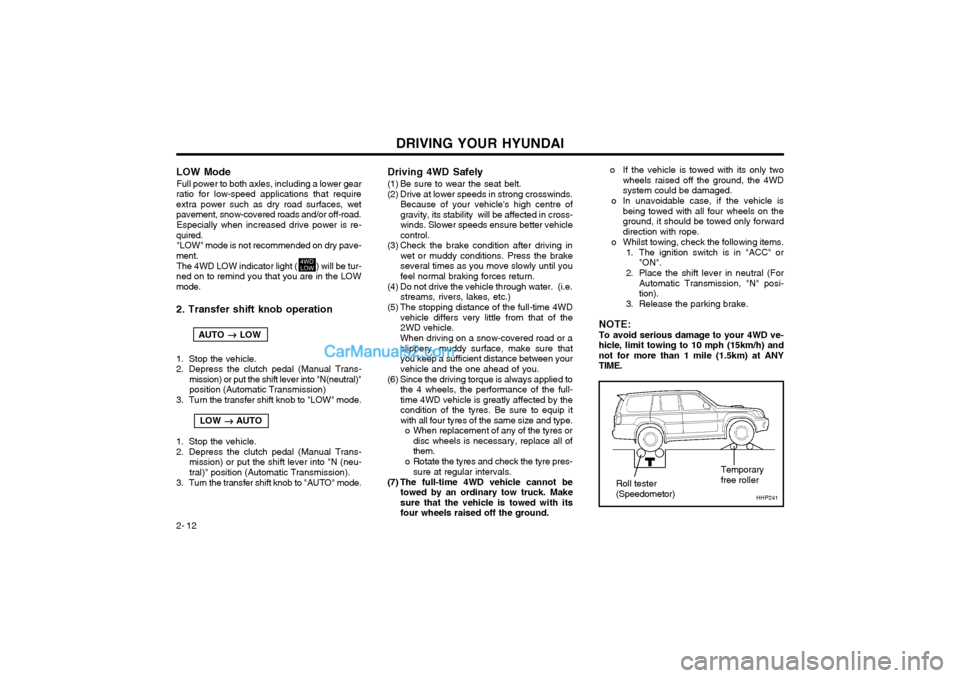
o In unavoidable case, if the vehicle is being towed with all four wheels on theground, it should be towed only forwarddirection with rope.
o Whilst towing, check the following items.
1. The ignition switch is in "ACC" or"ON".
2. Place the shift lever in neutral (For Automatic Transmission, "N" posi-tion).
3. Release the parking brake.
NOTE: To avoid serious damage to your 4WD ve- hicle, limit towing to 10 mph (15km/h) andnot for more than 1 mile (1.5km) at ANYTIME.
HHP241
Roll tester (Speedometor) Temporaryfree roller
LOW Mode
Full power to both axles, including a lower gear
ratio for low-speed applications that require extra power such as dry road surfaces, wetpavement, snow-covered roads and/or off-road.
Especially when increased drive power is re-
quired. "LOW" mode is not recommended on dry pave-
ment.
The 4WD LOW indicator light ( ) will be tur-
ned on to remind you that you are in the LOWmode. 2. Transfer shift knob operation
AUTO
LOW
1. Stop the vehicle.
2. Depress the clutch pedal (Manual Trans- mission) or put the shift lever into "N(neutral)"position (Automatic Transmission)
3. Turn the transfer shift knob to "LOW" mode.
LOW
AUTO
1. Stop the vehicle.
2. Depress the clutch pedal (Manual Trans- mission) or put the shift lever into "N (neu-tral)" position (Automatic Transmission).
3. Turn the transfer shift knob to "AUTO" mode.
Page 284 of 349
DRIVING YOUR HYUNDAI 2- 13
Driving on dry paved road and high- way
Select the AUTO to drive on dry paved roads.
Especially on dry highway, never select the LOW. Driving on snowy or icy roads
Select the AUTO or LOW in accordance with
the road conditions, and then gradually depress the accelerator pedal for a smooth start. Driving on sandy or muddy roads
Select the LOW and then gradually depress the
accelerator pedal for a smooth start. Keep the pressure on the accelerator pedal constant aspossible, and drive at low speed. Climbing sharp grades
Select the LOW to maximize use the engine
torque.Descending sharp grades
Select the LOW, use the engine brake and
descend slowly.
(8) For speedometer test or inspection/mainte- nance (I/M) program of full-time 4WD ve- hicle, use a four-wheel chassis dynamom-eter.
CAUTION: Never engage the parking brake whilst per-
forming these tests.
o In rare cases when it's unavoidable that a 4WD vehicle is to be inspected for speed- ometer test on 2WD roll tester, strictly followthe procedures next.
1. Check the tyre pressures recommended for your vehicle.
2. Place the rear wheels on the roll tester for speedometer test as shown in theillustration.
3. Release the parking brake.
4. Place the front wheels on the temporary free roller as shown in the illustration.
WARNING:Keep away from the front of the vehicle
whilst inspecting. This is very dangerous as the vehicle can jump forward and causeserious injury or death.
(9) When using tyre chains, always attach them to the rear wheels.
(10) I f the front or rear wheels get stuck in the
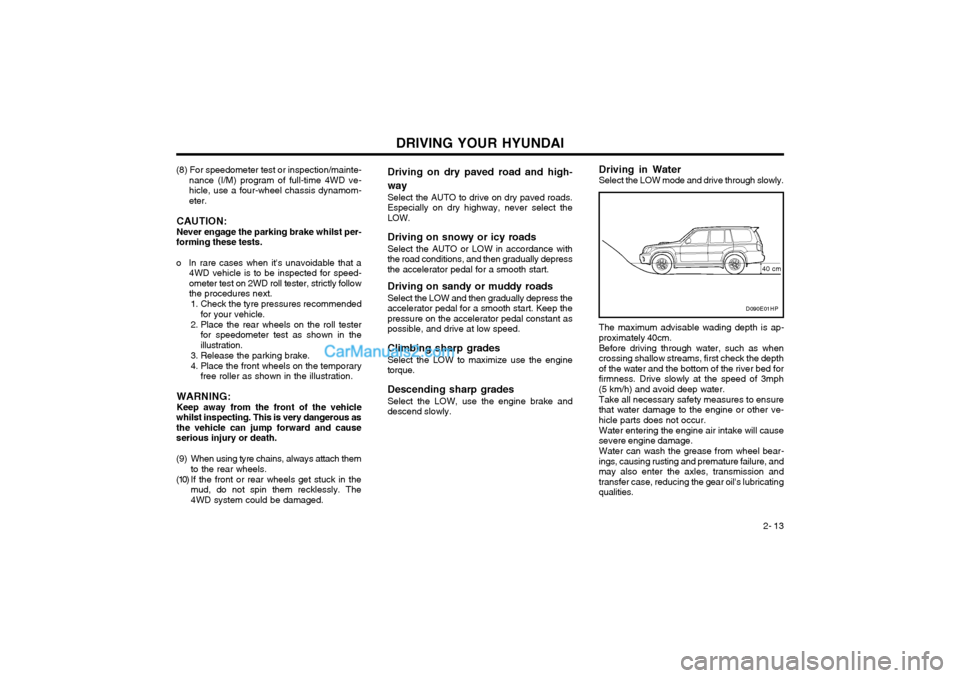
mud, do not spin them recklessly. The 4WD system could be damaged. Driving in Water Select the LOW mode and drive through slowly.
D090E01HP
The maximum advisable wading depth is ap-
proximately 40cm.
Before driving through water, such as when
crossing shallow streams, first check the depth of the water and the bottom of the river bed forfirmness. Drive slowly at the speed of 3mph(5 km/h) and avoid deep water.
Take all necessary safety measures to ensure
that water damage to the engine or other ve-hicle parts does not occur.
Water entering the engine air intake will cause
severe engine damage.
Water can wash the grease from wheel bear-
ings, causing rusting and premature failure, andmay also enter the axles, transmission andtransfer case, reducing the gear oil's lubricatingqualities.
40 cm
Page 285 of 349
DRIVING YOUR HYUNDAI
2- 14 D190A01O-EAT
LIMITED-SLIP DIFFERENTIAL (Not all models)
A limited-slip differential, if equipped, is for the
rear wheel differential only. The features of this limited-slip differential are described below:
Just as with a conventional differential, the
wheel on one side is allowed to turn at adifferent speed from the wheel on the other sidewhen the vehicle is cornering. The differencebetween the limited-slip differential and a con-ventional differential is that if the wheel on oneside of the vehicle loses traction, a greateramount of torque is applied to the rear wheel onthe other side to improve traction.
SC140A1-E
EFFECTIVE BRAKING Braking system performance and friction mate-rial life are greatly affected by the driving styleadopted. The following suggestions are madeto assist in achieving the best results from thebraking system.
o Anticipate the road and conditions ahead in order that heavy braking may be avoided.
o When descending long gradients, use the engine to assist in retarding the vehicle tominimize the possibility of brake fade occur-ring. o When trailer towing, ensure that the trailer
brakes function correctly and use enginebraking to assist the vehicle braking system.
o Use only genuine Hyundai replacement brake pads and shoes to ensure consistentfriction characteristics and wear rates.
o After driving through deep water (e.g. fording), the brakes may become wet andperformance reduced. Always check brakeefficiency after emerging from the water anddry the brakes by lightly depressing thebrake pedal several times whilst driving slow-ly.
o Apply the parking brake only when the vehi- cle is at rest.
o Since the power assistance provided by the brake servo is derived from the engine,coasting with the engine turned off or towingof the vehicle with the engine turned off willresult in greatly increased pedal pressuresbeing required to stop the vehicle.
o Do not hold the vehicle on the upgrade with the accelerator pedal. This can cause thetransmission to overheat. Always use thebrake pedal or parking brake.
CAUTION:
o Whilst the full-time 4WD vehicle is being raised on a jack, never start the engine orcause the tyres to rotate. There is the danger that rotating tyres touching the ground could cause thevehicle to go off the jack and to jumpforward.
o If one of the front or rear wheels begins to spin in mud, snow, etc., the vehiclecan sometimes be driven out by depress-ing the accelerator pedal further; how-ever, avoid running the engine continu-ously at high rpm because doing so coulddamage the 4WD system.
WARNING:
o Avoid high cornering speeds.
o Do not make quick steering wheel move- ments, such as sharp lane charges or fast, sharp turns.
o The risk of rollover is greatly increased if you lose control of your vehicle at high-way speeds.
o In a collision crash, an unbelted person is significantly more likely to die than aperson wearing a seatbelt.
o Loss of control often occurs if two or more wheels drop off the roadway and thedriver oversteers to reenter the roadway.
o In the event your vehicle leaves the road- way, do not steer sharply. Instead, slowdown before pulling back into the travellanes.
Page 294 of 349
IN CASE OF EMERGENCY
3-4 SD060A1-E
IN THE EVENT OF A PUNCTURE
If a puncture occurs whilst driving the vehicle:
1. Bring the car to rest as soon as it is safe to do so and with the minimum amount of braking required which will assist in main-taining the maximum amount of control. Thevehicle should be parked wherever possibleupon firm level ground to facilitate wheelchanging.
2. If the vehicle is creating a hazard and the road conditions do not permit the wheel tobe changed safely, assistance should besought.
3. Passengers must not be allowed to remain inside the vehicle during wheel changing. Ifa puncture occurs whilst the vehicle is on amotorway, the passengers should take ref-uge on the motorway embankment to avoidthe possibility of injury occurring should thevehicle be struck by other motorway traffic.
4. Wheel changing should be performed ac- cording to the following instructions. HPD070A1-E
CHANGING A FLAT TYRE
It is of the utmost importance that care isexercised when changing road wheels. Ensurethat the parking brake is set and that the gearshift lever is in reverse (P, if the vehicle hasautomatic transmission).
D060A01HP
5. Remove the lift plate from the centre of the spare tyre after the spare tyre is lowered completely.
Installation is the reverse order of removal.
CAUTION: When installing, turn the wheel nut wrench
clockwise till you hear the crackle once or
twice(Tightening torque : 3.87 kg m). Andmake sure the spare tyre is secured in theproper location.
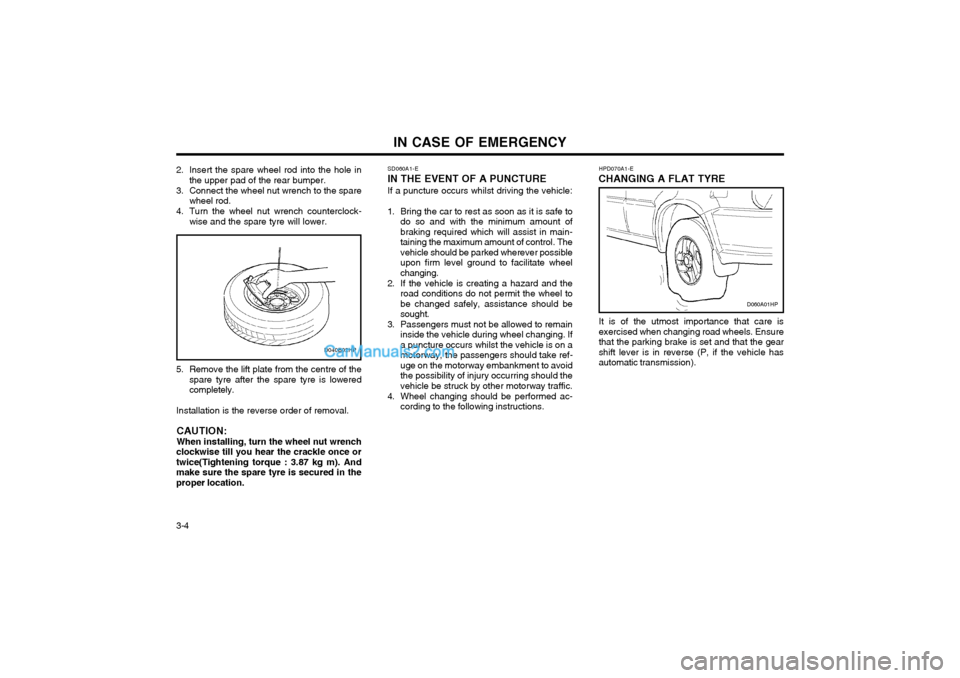
2. Insert the spare wheel rod into the hole in the upper pad of the rear bumper.
3. Connect the wheel nut wrench to the spare wheel rod.
4. Turn the wheel nut wrench counterclock- wise and the spare tyre will lower.
D040B02HP
Page 299 of 349
IN CASE OF EMERGENCY 3-9
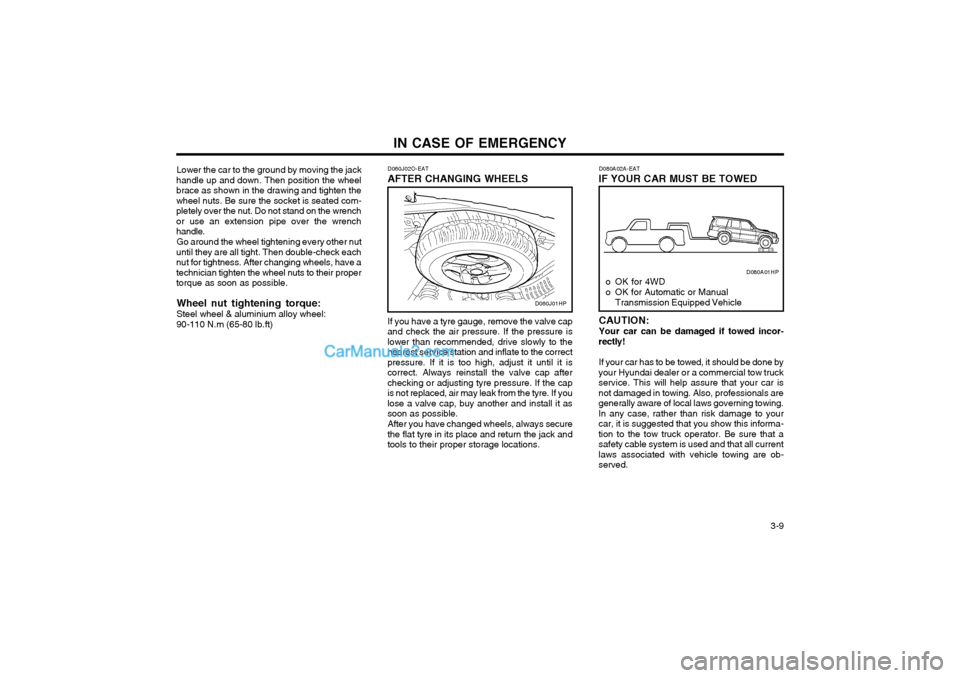
D060J01HP
Lower the car to the ground by moving the jack
handle up and down. Then position the wheel brace as shown in the drawing and tighten thewheel nuts. Be sure the socket is seated com-pletely over the nut. Do not stand on the wrenchor use an extension pipe over the wrenchhandle.
Go around the wheel tightening every other nut
until they are all tight. Then double-check eachnut for tightness. After changing wheels, have atechnician tighten the wheel nuts to their propertorque as soon as possible.
Wheel nut tightening torque: Steel wheel & aluminium alloy wheel:90-110 N.m (65-80 lb.ft) D060J02O-EAT
AFTER CHANGING WHEELS
If you have a tyre gauge, remove the valve cap
and check the air pressure. If the pressure is lower than recommended, drive slowly to thenearest service station and inflate to the correctpressure. If it is too high, adjust it until it iscorrect. Always reinstall the valve cap afterchecking or adjusting tyre pressure. If the capis not replaced, air may leak from the tyre. If youlose a valve cap, buy another and install it assoon as possible.
After you have changed wheels, always secure
the flat tyre in its place and return the jack andtools to their proper storage locations. D080A02A-EAT
IF YOUR CAR MUST BE TOWED
o OK for 4WD
o OK for Automatic or Manual Transmission Equipped Vehicle D080A01HP
CAUTION:Your car can be damaged if towed incor-
rectly!
If your car has to be towed, it should be done by
your Hyundai dealer or a commercial tow truck service. This will help assure that your car isnot damaged in towing. Also, professionals aregenerally aware of local laws governing towing.In any case, rather than risk damage to yourcar, it is suggested that you show this informa-tion to the tow truck operator. Be sure that asafety cable system is used and that all currentlaws associated with vehicle towing are ob-served.
Page 311 of 349
VEHICLE MAINTENANCE REQUIREMENTS 5-7
F070E02HP-GAT
o Automatic transmission fluid and
filter
The fluid level should be in the "HOT" range of the dipstick, after engine and transmissionand filter are at normal operating temperature.Check the Automatic and filter Transmissionand filter Fluid level with the engine runningand the transmission and filter in neutral, withthe parking brake properly applied. Use MOBILDEXRON- when adding or changing fluid.
F070F01A-AAT
o Brake hoses and lines Visually check for proper installation, chafing, cracks, deterioration and any leakage. Re-place any deteriorated or damaged parts im-mediately. F070G02A-AAT o Brake fluidCheck brake fluid level in the brake fluid reservoir. The level should be between "MIN"and "MAX" marks on the side of the reservoir.Use only hydraulic brake fluid conforming toDOT 3 or DOT 4. F070H01HP-AAT
o Rear brake drums, linings and pads
parking brake
Check the rear brake drums, linings and pads
for scoring, burning, leaking fluid, brokenparts, and excessive wear. Inspect the park-ing brake system including the parking brakelever and cables. For detailed service proce-dures, refer to the Shop Manual.
F070J01A-AAT
o Brake pads, calipers and rotors
Check the pads for excessive wear, discs for
run out and wear, and calipers for fluid leak-age. F070K01A-AAT
o Exhaust pipe and muffler Visually inspect the exhaust pipes, muffler and hangers for cracks, deterioration, or dam-age. Start the engine and listen carefully forany exhaust gas leakage. Tighten connec-tions or replace parts as necessary. F070L01A-AAT
o Suspension mounting bolts Check the suspension connections for loose- ness or damage. Retighten to the specifiedtorque.
F060H01A-AAT
o Air cleaner filter
A Genuine Hyundai air cleaner filter is recom-mended when filter is replaced. F060J01A-AAT
o Spark plugs (For Petrol Engine) Make sure to install new spark plugs of the
correct heat range.
F070C01A-AAT
o Coolant The coolant should be changed at the intervals specified in the maintenance sched-ule. F070D01HP-AAT
o Manual transmission oil Inspect the manual transmission oil according to the maintenance schedule.
NOTE: If the oil level is low, check for possibleleaks before adding oil. Do not overfill.
Page 318 of 349
OWNER MAINTENANCE
6-6
To replace the oil and filter, proceed as follows:
1. Ensure that the engine is at normal operat- ing temperature and park the vehicle on level ground with the parking brake securelyapplied and the engine turned off.
2. Open the bonnet and remove the oil filler cap.
3. Prepare a suitable receptacle to collect the displaced oil and remove the drain plug fromthe sump.
CAUTION: The oil being drained from the engine will be
hot. Care should be exercised to prevent scalding.
4. When the oil has drained from the sump, replace the drain plug using a new washer ensuring that the plug is not over tightened. Tightening torque is: 3.5 ~ 4.5 kgf.m
5. Remove the oil filter by rotating counter- clockwise, using a proprietary oil filter re- moval tool if necessary. Note that the oilfilter will contain approximately 0.5 litres ofoil and this should be collected in a suitablereceptacle.
6. Install a new oil filter having smeared the sealing ring with clean oil and rotating clock-wise until the filter contacts the mountingand then a further one half turn. Do not over-tighten. Tightening torque: Petrol Engine - 1.2 ~ 1.6 kgf.mDiesel Engine - 2.3 ~ 2.5 kgf.m
7. Pour the specified quantity of the recom- mended oil into the engine and replace the filler cap. Start the engine and ensure thatno oil leaks exist. Turn off the engine andafter a couple minutes, recheck the oil level.
WARNING: Prolonged and repeated contact with used engine oils may result in serious skin disor-ders including dermatitis and cancer. Avoidcontact with skin as far as possible andalways wash thoroughly after any contact.Keep used oils out of reach of children. It isillegal to pollute drains, water courses andsoil. Use only authorized waste collectionfacilities including civic amenity sites andgarages for the disposal of used oil and oilfilters. If in doubt, contact the local authorityfor disposal instructions. SG050A1-E
ENGINE COOLANT CHECKING AND REPLACING
WARNING: Do not remove the radiator cap when the engine is hot, since the system is pressur-ized and coolant may be ejected from theradiator resulting in scalding. SG050B1-E
Coolant recommendations Only ethylene glycol based coolant with a cor- rosion inhibitor suited to aluminium alloy enginecomponents should be used in the coolingsystem. No further additives or inhibitors shouldbe used. The coolant specific gravity should bechecked as prescribed in the maintenanceschedule to ensure adequate frost and corro-sion protection. In addition, the engine coolantmust be replaced at the specified interval sincethe corrosion inhibitor properties deteriorate withtime. It is important to note that whilst an increase in the concentration of anti freeze gives an in-crease in the level of frost protection, a solutionwhich is in excess of 65% anti freeze will resultin reduced frost protection and engine over-heating. Therefore the recommended concen-tration of 50% should not be exceeded forgeneral use.The use of methanol based anti freeze com-pounds may result in engine overheating andwill invalidate the vehicle warranty.