weight Hyundai Terracan 2003 User Guide
[x] Cancel search | Manufacturer: HYUNDAI, Model Year: 2003, Model line: Terracan, Model: Hyundai Terracan 2003Pages: 349, PDF Size: 4.56 MB
Page 249 of 349
CONTROLS AND EQUIPMENT1- 55
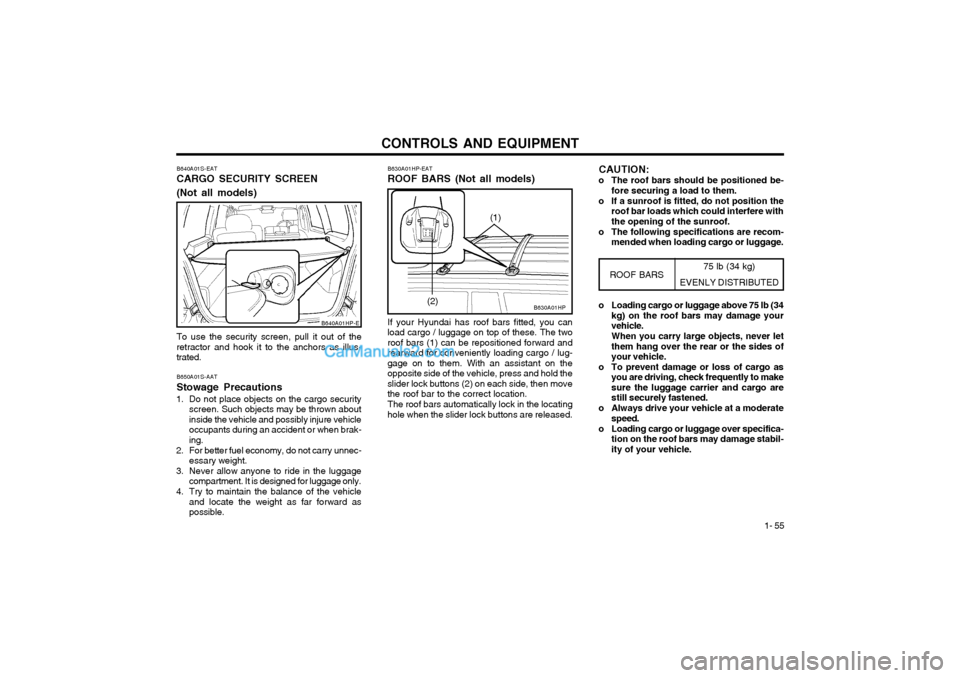
B640A01S-EAT CARGO SECURITY SCREEN (Not all models) To use the security screen, pull it out of the retractor and hook it to the anchors as illus-trated. B650A01S-AAT Stowage Precautions
1. Do not place objects on the cargo security screen. Such objects may be thrown about inside the vehicle and possibly injure vehicleoccupants during an accident or when brak-ing.
2. For better fuel economy, do not carry unnec- essary weight.
3. Never allow anyone to ride in the luggage compartment. It is designed for luggage only.
4. Try to maintain the balance of the vehicle and locate the weight as far forward aspossible.
B640A01HP-E
75 lb (34 kg)
EVENLY DISTRIBUTED
B630A01HP
B630A01HP-EAT ROOF BARS (Not all models) If your Hyundai has roof bars fitted, you can
load cargo / luggage on top of these. The two roof bars (1) can be repositioned forward andrearward for conveniently loading cargo / lug-gage on to them. With an assistant on theopposite side of the vehicle, press and hold theslider lock buttons (2) on each side, then movethe roof bar to the correct location.
The roof bars automatically lock in the locating
hole when the slider lock buttons are released.
ROOF BARS
(2) o Loading cargo or luggage above 75 lb (34
kg) on the roof bars may damage your vehicle. When you carry large objects, never let them hang over the rear or the sides ofyour vehicle.
o To prevent damage or loss of cargo as you are driving, check frequently to makesure the luggage carrier and cargo arestill securely fastened.
o Always drive your vehicle at a moderate speed.
o Loading cargo or luggage over specifica- tion on the roof bars may damage stabil-ity of your vehicle.
(1)
CAUTION:
o The roof bars should be positioned be- fore securing a load to them.
o If a sunroof is fitted, do not position the roof bar loads which could interfere with the opening of the sunroof.
o The following specifications are recom- mended when loading cargo or luggage.
Page 253 of 349
CONTROLS AND EQUIPMENT1- 59
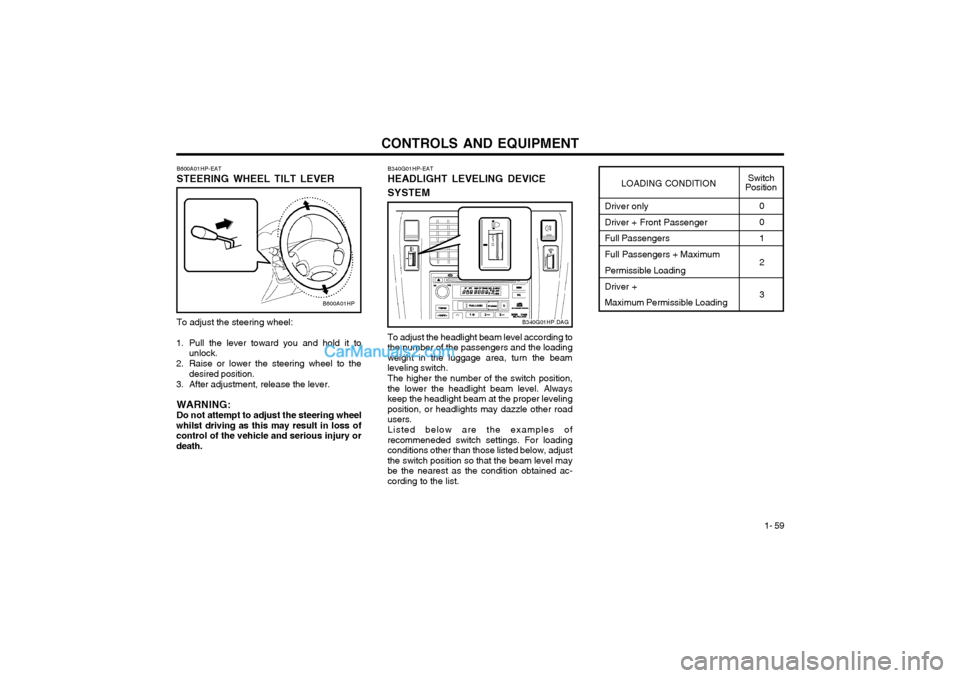
To adjust the steering wheel:
1. Pull the lever toward you and hold it to unlock.
2. Raise or lower the steering wheel to the desired position.
3. After adjustment, release the lever.
WARNING: Do not attempt to adjust the steering wheel
whilst driving as this may result in loss ofcontrol of the vehicle and serious injury ordeath. B600A01HP-EAT STEERING WHEEL TILT LEVER
B600A01HP
Driver only Driver + Front Passenger Full Passengers Full Passengers + Maximum Permissible Loading Driver + Maximum Permissible Loading0 0 1 2 3
LOADING CONDITION
Switch
Position
To adjust the headlight beam level according to
the number of the passengers and the loading weight in the luggage area, turn the beamleveling switch.
The higher the number of the switch position,
the lower the headlight beam level. Alwayskeep the headlight beam at the proper levelingposition, or headlights may dazzle other roadusers.
Listed below are the examples of
recommeneded switch settings. For loadingconditions other than those listed below, adjustthe switch position so that the beam level maybe the nearest as the condition obtained ac-cording to the list. B340G01HP-EAT HEADLIGHT LEVELING DEVICE SYSTEM
B340G01HP.DAG
Page 276 of 349
DRIVING YOUR HYUNDAI 2- 5
DC090C1-E
FUEL ECONOMY
The following suggestions are made to assist in
achieving the greatest degree of fuel economy.
o Maintaining a constant check on fuel con- sumption will enable the most economical use pattern and driving style to be adopted.
o Avoid using the vehicle for very short jour- neys if possible, particularly when a coldstart is involved.
o Ensure that tyre pressures are maintained at the correct level.
o Use only the recommended grade of fuel.
o Avoid carrying unnecessary weight, and if a roof rack is in use, remove it as soon as possible after use.
o Anticipate the road and conditions ahead to enable adjustments in speed to be madesmoothly. Avoid heavy acceleration andsharp braking.
o Avoid cruising at unnecessary high speeds.
o Always ensure that the periodic maintenance services are performed by a Hyundai dealer at the time and/or mileage intervals speci-fied.
o Use the air conditioner only when neces- sary. HPC090A2-E MANUAL TRANSMISSION
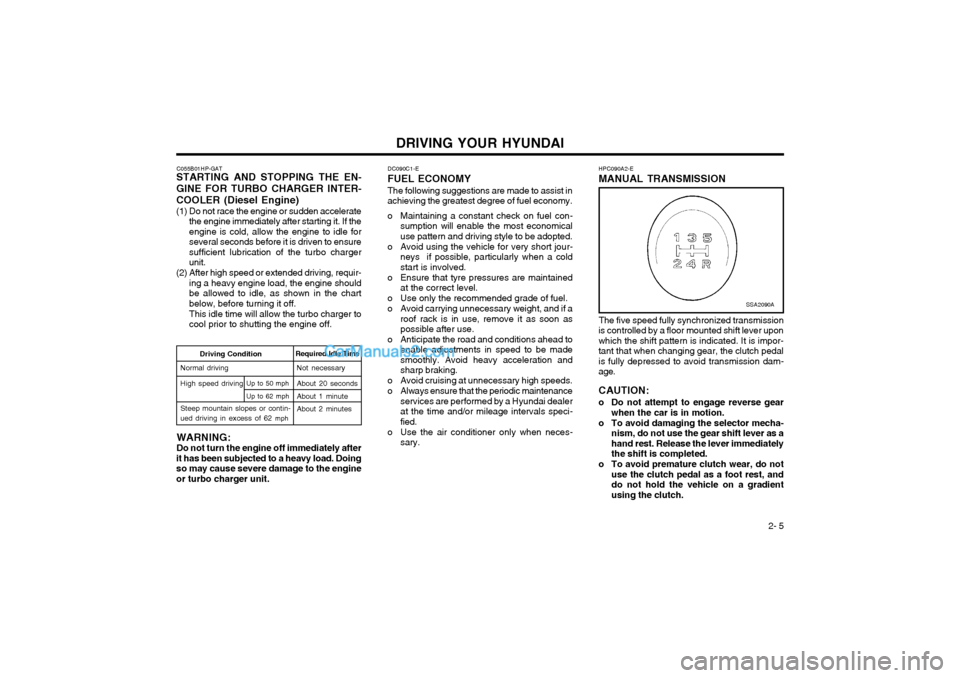
The five speed fully synchronized transmission
is controlled by a floor mounted shift lever upon which the shift pattern is indicated. It is impor-tant that when changing gear, the clutch pedalis fully depressed to avoid transmission dam-age. CAUTION:
o Do not attempt to engage reverse gear when the car is in motion.
o To avoid damaging the selector mecha- nism, do not use the gear shift lever as a hand rest. Release the lever immediatelythe shift is completed.
o To avoid premature clutch wear, do not use the clutch pedal as a foot rest, anddo not hold the vehicle on a gradientusing the clutch.
C055B01HP-GAT
STARTING AND STOPPING THE EN- GINE FOR TURBO CHARGER INTER- COOLER (Diesel Engine)
(1) Do not race the engine or sudden accelerate
the engine immediately after starting it. If the engine is cold, allow the engine to idle forseveral seconds before it is driven to ensuresufficient lubrication of the turbo chargerunit.
(2) After high speed or extended driving, requir- ing a heavy engine load, the engine shouldbe allowed to idle, as shown in the chartbelow, before turning it off. This idle time will allow the turbo charger to cool prior to shutting the engine off.
Required Idle Time
High speed driving Driving Condition
Normal drivingNot necessary About 20 seconds About 1 minute
Up to 62 mph
Up to 50 mph
Steep mountain slopes or contin-
ued driving in excess of 62 mphAbout 2 minutes
WARNING: Do not turn the engine off immediately after
it has been subjected to a heavy load. Doingso may cause severe damage to the engineor turbo charger unit.
SSA2090A
Page 286 of 349
DRIVING YOUR HYUNDAI 2- 15
DC170A1-E
WINTER MOTORING The onset of winter conditions subject motor
vehicles to greater operating demands. There- fore, the following suggestions will assist inmaintaining peak performance and reliabilityduring these periods:
C140A01A-EAT
DRIVING FOR ECONOMY
You can save fuel and get more miles from your
car if you follow these suggestions:
o Drive smoothly. Accelerate at a moderate rate. Don't make "jack-rabbit" starts or full- throttle shifts and maintain a steady cruisingspeed. Don't race between stoplights. Try toadjust your speed to that of the other trafficso you don't have to change speeds unnec-essarily. Avoid heavy traffic whenever pos-sible. Always maintain a safe distance fromother vehicles so you can avoid unneces-sary braking. This also reduces brake wear.
o Drive at a moderate speed. The faster you drive, the more fuel your car uses. Driving ata moderate speed, especially on the high-way, is one of the most effective ways toreduce fuel consumption.
o Don't "ride" the brake or clutch pedal. This can increase fuel consumption and alsoincrease wear on these components. In ad-dition, driving with your foot resting on thebrake pedal may cause the brakes to over-heat, which reduces their effectiveness andmay lead to more serious consequences.
o Take care of your tyres. Keep them inflated to the recommended pressure. Incorrect in-flation, either too much or too little, results inunnecessary tyre wear. Check the tyre pres-sures at least once a month. o Be sure that the wheels are aligned correct-
ly. Improper alignment can result from hittingcurbs or driving too fast over irregular sur-faces. Poor alignment causes faster tyrewear and may also result in other problemsas well as greater fuel consumption.
o Keep your car in good condition. For better fuel economy and reduced maintenancecosts, maintain your car in accordance withthe maintenance schedule in Section 5. Ifyou drive your car in severe conditions,more frequent maintenance is required (seeSection 5 for details).
o Keep your car clean. For maximum service, your Hyundai should be kept clean and freeof corrosive materials. It is especially impor-tant that mud, dirt, ice, etc. not be allowed toaccumulate on the underside of the car. Thisextra weight can result in increased fuelconsumption and also contribute to corro-sion.
o Travel lightly. Don't carry unnecessary weight in your car. Weight reduces fuel economy.
o Don't let the engine idle longer than neces- sary. If you are waiting (and not in traffic),turn off your engine and restart only whenyou're ready to go.
o Remember, your Hyundai does not require extended warm-up. As soon as the engineis running smoothly, you can drive away. Invery cold weather, however, give your en-gine a slightly longer warm-up period. o Don't "labour" or "over-rev" the engine.
Labouring is driving too slowly in too high agear resulting in the vehicle kangarooing. Ifthis happens, shift to a lower gear. Over-revving is racing the engine beyond its safelimit. This can be avoided by shifting at therecommended speeds.
o Use your air conditioning sparingly. The air conditioning system is operated by enginepower so your fuel economy is reducedwhen you use it.
C150A01A-EAT SMOOTH CORNERINGAvoid braking or gear changing in corners, especially when roads are wet. Ideally, cornersshould always be taken under gentle accelera-tion. If you follow these suggestions, tyre wearwill be held to a minimum.
Page 288 of 349
DRIVING YOUR HYUNDAI 2- 17
YC200D2-E
Safety Cables
Should the towbar connection between your car
and the trailer or vehicle you are towing fail, the trailer or vehicle could wander dangerouslyacross other lanes of traffic and ultimately leavethe roadway. To eliminate this potentially dan-gerous situation, safety cables, attached be-tween your car and the trailer or towed vehicle,are required.
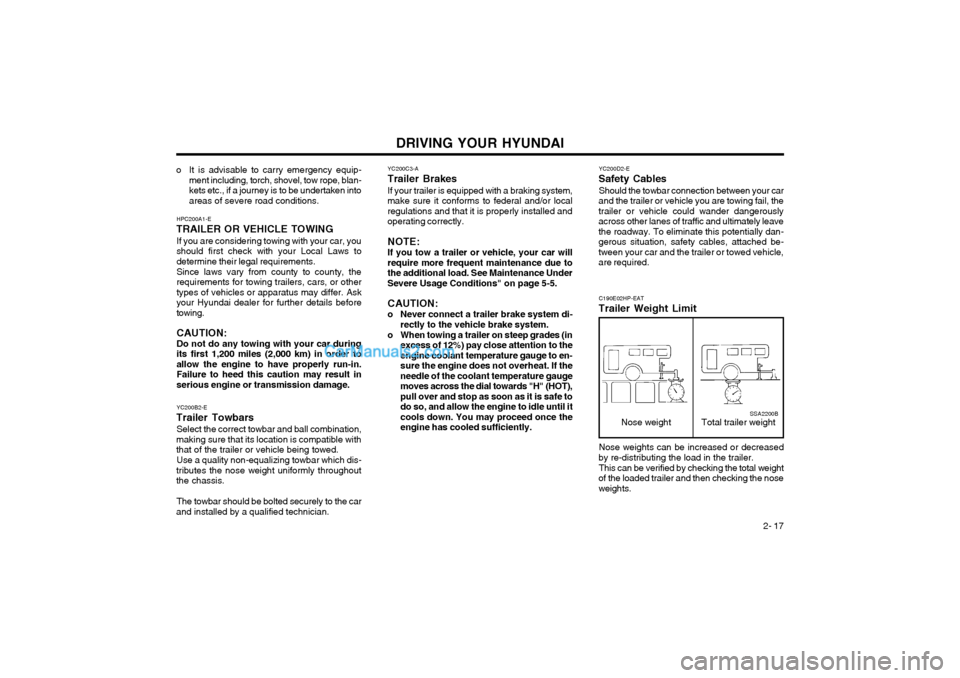
Nose weight Total trailer weightSSA2200B
C190E02HP-EAT
Trailer Weight Limit
Nose weights can be increased or decreased
by re-distributing the load in the trailer.
This can be verified by checking the total weight
of the loaded trailer and then checking the nose weights.
YC200C3-A
Trailer Brakes
If your trailer is equipped with a braking system,
make sure it conforms to federal and/or localregulations and that it is properly installed andoperating correctly.
NOTE: If you tow a trailer or vehicle, your car will
require more frequent maintenance due to the additional load. See Maintenance UnderSevere Usage Conditions" on page 5-5.
CAUTION:
o Never connect a trailer brake system di- rectly to the vehicle brake system.
o When towing a trailer on steep grades (in excess of 12%) pay close attention to theengine coolant temperature gauge to en-sure the engine does not overheat. If theneedle of the coolant temperature gaugemoves across the dial towards "H" (HOT),pull over and stop as soon as it is safe todo so, and allow the engine to idle until itcools down. You may proceed once theengine has cooled sufficiently.
HPC200A1-E
TRAILER OR VEHICLE TOWING
If you are considering towing with your car, youshould first check with your Local Laws todetermine their legal requirements. Since laws vary from county to county, the requirements for towing trailers, cars, or othertypes of vehicles or apparatus may differ. Askyour Hyundai dealer for further details beforetowing. CAUTION: Do not do any towing with your car duringits first 1,200 miles (2,000 km) in order toallow the engine to have properly run-in.Failure to heed this caution may result inserious engine or transmission damage. YC200B2-E
Trailer Towbars Select the correct towbar and ball combination,
making sure that its location is compatible with that of the trailer or vehicle being towed.
Use a quality non-equalizing towbar which dis-
tributes the nose weight uniformly throughoutthe chassis.
The towbar should be bolted securely to the car
and installed by a qualified technician.
o It is advisable to carry emergency equip-
ment including, torch, shovel, tow rope, blan-kets etc., if a journey is to be undertaken intoareas of severe road conditions.
Page 289 of 349
DRIVING YOUR HYUNDAI
2- 18 NOTE:
1. Never load the trailer with more weight in the back than in the front. About 60% of the trailer load should be in the front halfon the trailer and the remaining 40% inthe rear.
2. The total gross vehicle weight with trailer must not exceed the Gross Vehicle WeightRating (GVWR) shown on the vehicleidentification plate (see page 8-1). Thetotal gross vehicle weight is the com-bined weight of the vehicle, driver, allpassengers and their luggage, cargo,towbar hitch, trailer nose weight and otheroptional equipment.
3. The front or rear axle weight must not exceed the Gross Axle Weight Rating(GAWR) shown on the vehicle identifica-tion plate (see page 8-1). It is possiblethat your towing package does not ex-ceed the GVWR but exceeds the GAWR. Improper trailer loading and/or too much luggage in the trunk can overload therear axle. Redistribute the load and checkthe axle weight again.
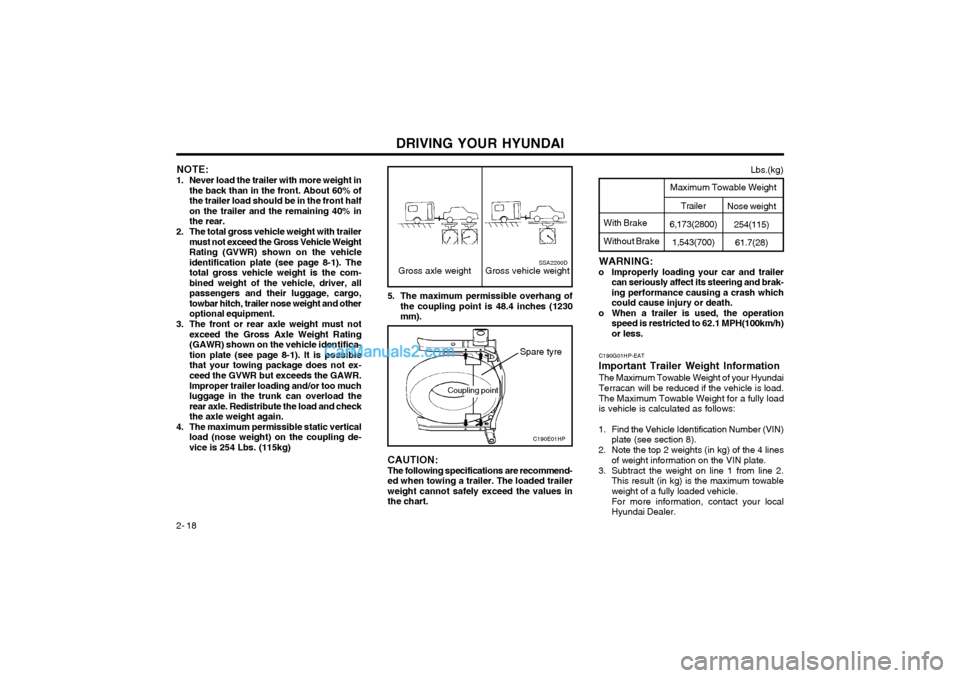
4. The maximum permissible static vertical load (nose weight) on the coupling de-vice is 254 Lbs. (115kg) 5. The maximum permissible overhang of
the coupling point is 48.4 inches (1230mm).
Gross axle weight Gross vehicle weightSSA2200D
CAUTION: The following specifications are recommend-ed when towing a trailer. The loaded trailerweight cannot safely exceed the values inthe chart.
Lbs.(kg)
Maximum Towable Weight
With Brake Without Brake Trailer
6,173(2800) 1,543(700) Nose weight
254(115)61.7(28)
WARNING:
o Improperly loading your car and trailer can seriously affect its steering and brak- ing performance causing a crash whichcould cause injury or death.
o When a trailer is used, the operation speed is restricted to 62.1 MPH(100km/h)or less.
C190E01HP
Spare tyre
Coupling point
C190G01HP-EAT
Important Trailer Weight Information
The Maximum Towable Weight of your Hyundai Terracan will be reduced if the vehicle is load. The Maximum Towable Weight for a fully load is vehicle is calculated as follows:
1. Find the Vehicle Identification Number (VIN) plate (see section 8).
2. Note the top 2 weights (in kg) of the 4 lines of weight information on the VIN plate.
3. Subtract the weight on line 1 from line 2. This result (in kg) is the maximum towableweight of a fully loaded vehicle. For more information, contact your local Hyundai Dealer.
Page 333 of 349
OWNER MAINTENANCE 6-21
G270A02HP
WARNING: The halogen bulb contains gas under pres- sure and if impacted could shatter, resultingin flying fragments. Always wear eye pro-tection when servicing the bulb. Protect thebulb against abrasions or scratches andagainst liquids when lighted. Turn the bulbon only when installing in a headlight. Re-place the headlight if damaged or cracked.Keep the bulb out of the reach of childrenand dispose of the used bulb with care.
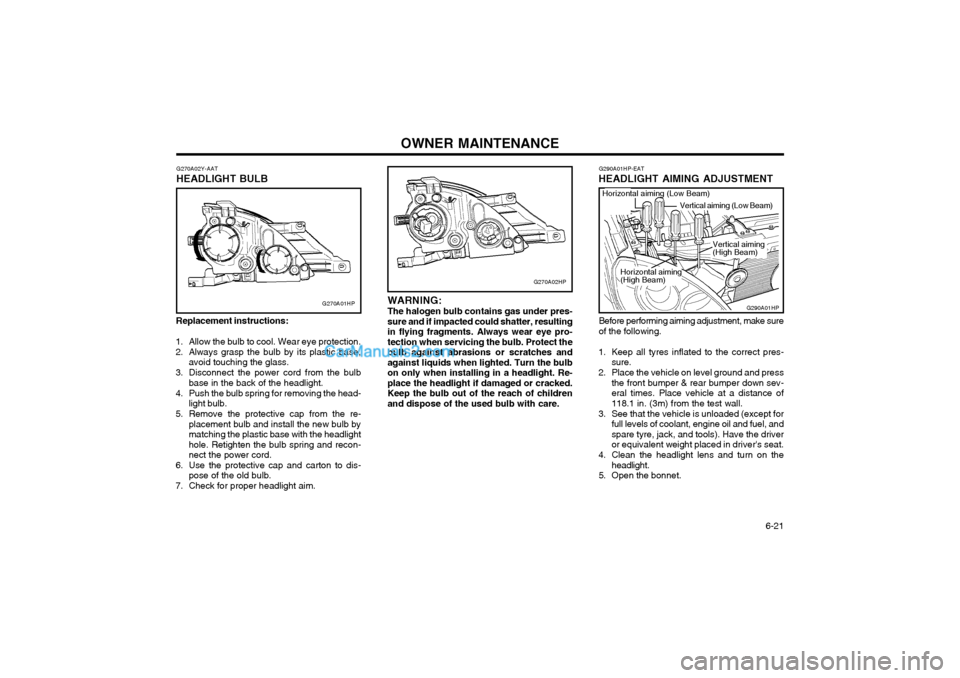
Replacement instructions:
1. Allow the bulb to cool. Wear eye protection.
2. Always grasp the bulb by its plastic base, avoid touching the glass.
3. Disconnect the power cord from the bulb base in the back of the headlight.
4. Push the bulb spring for removing the head- light bulb.
5. Remove the protective cap from the re- placement bulb and install the new bulb by matching the plastic base with the headlighthole. Retighten the bulb spring and recon-nect the power cord.
6. Use the protective cap and carton to dis- pose of the old bulb.
7. Check for proper headlight aim. G270A02Y-AAT
HEADLIGHT BULB
G270A01HP
G290A01HP-EAT
HEADLIGHT AIMING ADJUSTMENT
G290A01HP
Horizontal aiming (Low Beam)
Vertical aiming (Low Beam)
Before performing aiming adjustment, make sure of the following.
1. Keep all tyres inflated to the correct pres- sure.
2. Place the vehicle on level ground and press the front bumper & rear bumper down sev-eral times. Place vehicle at a distance of118.1 in. (3m) from the test wall.
3. See that the vehicle is unloaded (except for full levels of coolant, engine oil and fuel, andspare tyre, jack, and tools). Have the driveror equivalent weight placed in driver's seat.
4. Clean the headlight lens and turn on the headlight.
5. Open the bonnet. Vertical aiming (High Beam)
Horizontal aiming(High Beam)
Page 348 of 349
INDEX
10-4 R Rear Seat
Adjustable headrests ..................................................................... 1-14
Folding rear seatback and seat cushion ....................................... 1-15
Rear Seat Warning........................................................................... 1-16
Rheostat Switch ................................................................................ 1-46
Roof Bars .......................................................................................... 1-55
Running in Your New Hyundai ........................................................... 1-2
S Seat Belts 2-Point Sta tic Type ....................................................................... 1-18
3-Point system ................................................................... 1-17 ~ 1-18
Adjusting your seat belt ................................................................ 1-18
Care of seat belts ......................................................................... 1-17
Pre-tensioner Seat Belt ................................................................. 1-24
Precautions ................................................................................... 1-16
Seat Warmer ..................................................................................... 1-14
Sound
Brake Pad Wear Warning Sound .................................................1-38
Spark Plugs ........................................................................................ 6-8
Speedometer ..................................................................................... 1-39
Starting Procedure .............................................................................. 2-4Steering Wheel Free play ....................................................................................... 6-15
Tilt lever ........................................................................................ 1-59Stereo Sound System ............................................................ 1-75 ~ 1-76 Sun-visor
........................................................................................... 1-57
Sunroof ................................................................................... 1-48 ~ 1-49
TTachometer ....................................................................................... 1-40
Theft-Alarm system .................................................................... 1-7 ~ 1-8
Tyres
Balancing ......................................................................................... 8-2
Chains ............................................................................................. 8-2
Changing a flat ty re ................................................................ 3-4 ~ 3-9
In the event of a puncture ..... .......................................................... 3-4
Information ....................................................................................... 8-1
Pressures ........................................................................................ 8-1Replacement ................................................................................... 8-3
Rotation ........................................................................................... 8-2
Snow tyres ...................................................................................... 8-2
Spare tyre ....................................................................................... 3-3 Spare tyre and tools ....................................................................... 8-3
Towing A trailer (or vehicle) ........................................................... 2-17 ~ 2-19
Emergency .................................................................................... 3-10
If your car must be towed ..... .......................................................... 3-9
Important trailer weight information ............................................... 2-18