check engine Hyundai Terracan 2003 Owner's Guide
[x] Cancel search | Manufacturer: HYUNDAI, Model Year: 2003, Model line: Terracan, Model: Hyundai Terracan 2003Pages: 349, PDF Size: 4.56 MB
Page 134 of 349
WHAT TO DO IN AN EMERGENCY
3-10 D120A01A-GAT IF YOU LOSE YOUR KEYS If you lose your keys, many Hyundai dealers can make you a new key if you have your key number. If you lock the keys inside your car and you cannot obtain a new key, many Hyundai dealers can use special tools to open the door for you. Information about the key of immobilizer system (if installed) will be found on page 1-2.
D080D01O-GAT Emergency Towing
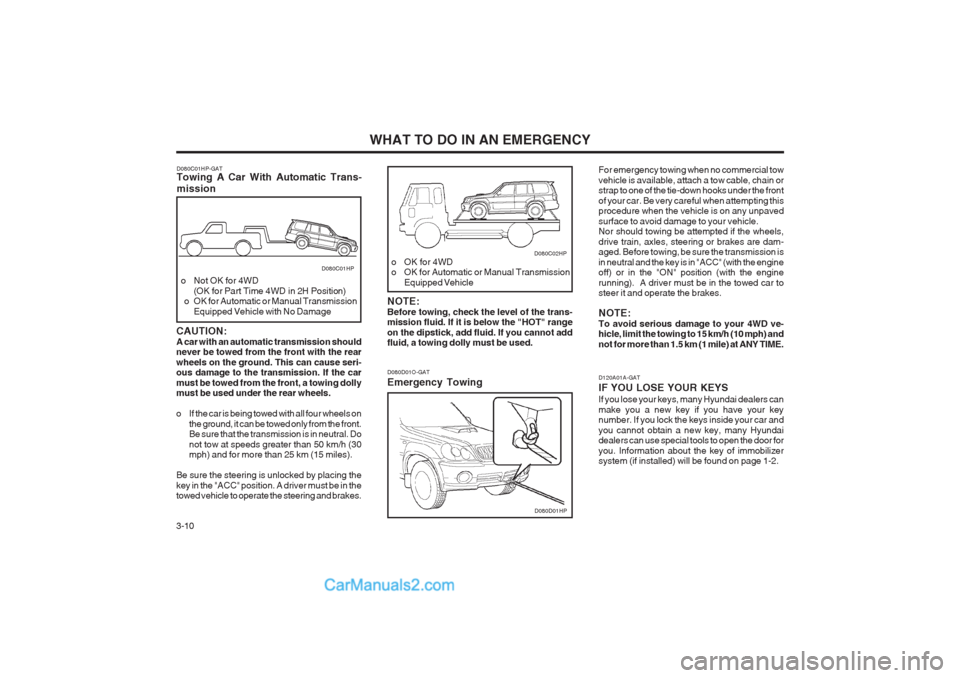
D080D01HP For emergency towing when no commercial tow vehicle is available, attach a tow cable, chain or strap to one of the tie-down hooks under the front of your car. Be very careful when attempting this procedure when the vehicle is on any unpaved surface to avoid damage to your vehicle. Nor should towing be attempted if the wheels, drive train, axles, steering or brakes are dam- aged. Before towing, be sure the transmission is in neutral and the key is in "ACC" (with the engine off) or in the "ON" position (with the engine running). A driver must be in the towed car to steer it and operate the brakes. NOTE: To avoid serious damage to your 4WD ve- hicle, limit the towing to 15 km/h (10 mph) and not for more than 1.5 km (1 mile) at ANY TIME.
o OK for 4WD
o OK for Automatic or Manual Transmission
Equipped VehicleD080C02HP
NOTE: Before towing, check the level of the trans- mission fluid. If it is below the "HOT" range on the dipstick, add fluid. If you cannot add fluid, a towing dolly must be used.
D080C01HP-GAT Towing A Car With Automatic Trans- mission
CAUTION: A car with an automatic transmission should never be towed from the front with the rear wheels on the ground. This can cause seri- ous damage to the transmission. If the car must be towed from the front, a towing dolly must be used under the rear wheels.
o If the car is being towed with all four wheels on the ground, it can be towed only from the front. Be sure that the transmission is in neutral. Do not tow at speeds greater than 50 km/h (30 mph) and for more than 25 km (15 miles).
Be sure the steering is unlocked by placing the key in the "ACC" position. A driver must be in the towed vehicle to operate the steering and brakes.
o Not OK for 4WD (OK for Part Time 4WD in 2H Position)
o OK for Automatic or Manual Transmission
Equipped Vehicle with No Damage
D080C01HP
Page 139 of 349
VEHICLE MAINTENANCE REQUIREMENTS 5-1
F010C01HP-GAT Specified Scheduled ProceduresThese are the procedures such as inspections, adjustments and replacements that are listed in the maintenance charts starting on page 5-2. These procedures must be performed at the intervals shown in the maintenance schedule to assure that your warranty remains in effect. Although it is strongly recommended that they be performed by the factory-trained or distribu- tor-trained technicians at your Hyundai dealer, these procedures may be performed at any qualified service facility. It is suggested that genuine Hyundai service parts be used for any required repairs or re- placements. Other parts of equivalent quality such as engine oil, engine coolant, manual or auto transmission oil, brake fluid and so on which are not supplied by Hyundai Motor Com- pany or its distributor may be used without affecting your warranty coverage but you should always be sure these are equivalent to the quality of the original Hyundai parts. Your Ser- vice Passport provides further information about your warranty coverage.
5. VEHICLE
MAINTENANCE
REQUIREMENTS F010E01A-AAT Do-It-Yourself Maintenance If you are mechanically inclined, own a few tools that are required and want to take the time to do so, you can inspect and service a number of items. For more information about doing it your- self, see Section 6.
F010D01A-AAT General ChecksThese are the regular checks you should per- form when you drive your Hyundai or you fill the fuel tank. A list of these items will be found on page 6-4.
F010A01A-GAT MAINTENANCE INTERVALS Service Requirements To assure that you receive the greatest number of kilometers of satisfying operation from your Hyundai, certain maintenance procedures must be performed. Although careful design and en- gineering have reduced these to a minimum, those that are required are of the utmost impor- tance. It is your responsibility to have these mainte-nance procedures performed to comply with the terms of the warranties covering your new Hyundai. The Service Passport supplied with your new vehicle provides further information about these warranties. F010B01A-AAT Maintenance RequirementsThe maintenance required for your Hyundai can be divided into three main areas: o Specified scheduled procedures o General checks o Do-it-yourself maintenance F010F01A-AAT A Few Tips
o Whenever you have your Hyundai serviced,
keep copies of the service records in your glove box. This will help ensure that you can document that the required procedures have been performed to keep your warranties in effect. This is especially important when service is not performed by an authorized Hyundai dealer.
o If you choose to do your own maintenance
and repairs, you may find it helpful to havean official Hyundai Shop Manual. A copy of this publication may be purchased at your Hyundai dealer's parts department.
F020A01Y-GAT SCHEDULED MAINTENANCE RE- QUIREMENTS Inspection should be performed any time a malfunction is experienced or suspected. Re- ceipts for all emission control system services should be retained to demonstrate compliance with conditions of the emissions system war- ranty. For severe usage maintenance requirements, see page 5-6 of this section.
5
Page 145 of 349
VEHICLE MAINTENANCE REQUIREMENTS 5-7
F060A01A-AAT EXPLANATION OF SCHEDULED MAIN- TENANCE ITEMS F060M01A-AAT o Engine Oil and FilterThe engine oil and filter should be changed at
the intervals specified in the maintenance sched- ule. If the car is being driven in severe condi- tions, more frequent oil and filter changes are required. F060B01A-AAT
o Drive BeltsInspect all drive belts for evidence of cuts, cracks, excessive wear or oil saturation and replace if necessary. Drive belts should be checked periodically for proper tension and adjusted as necessary. F060C01A-AAT
o Fuel Filter A clogged filter can limit the speed at which the vehicle may be driven, damage the emission system and cause hard starting. If an exces- sive amount of foreign matter accumulates in the fuel tank, the filter may require replacement more frequently.After installing a new filter, run the engine for several minutes, and check for leaks at the connections. Fuel filters should be installed by trained technicians.
F060D01A-AAT
o Fuel Lines, Fuel Hoses and Connec-
tions
Check the fuel lines, fuel hoses and connec- tions for leakage and damage. Have a trained technician replace any damaged or leaking parts immediately. F060E01A-AAT
o Timing BeltInspect all parts related to the timing belt for damage and deformation. Replace any dam- aged parts immediately. F060G01A-AAT
o Vapor Hose and Fuel Filler CapThe vapor hose and fuel filler cap should be inspected at those intervals specified in the maintenance schedule. Make sure that a new vapor hose or fuel filler cap is correctly re- placed. F060F01A-AAT
o Vacuum, Crankcase
Ventilation Hoses
Inspect the surface of hoses for evidence ofheat and/or mechanical damage. Hard and brit- tle rubber, cracking, tears, cuts, abrasions, and excessive swelling indicate deterioration. Par- ticular attention should be paid to examine those hose surfaces nearest to high heat sourc- es, such as the exhaust manifold. Inspect the hose routing to assure that thehoses do not come in contact with any heat source, sharp edges or moving component which might cause heat damage or mechanical wear. Inspect all hose connections, such as clamps and couplings, to make sure they are secure, and that no leaks are present. Hoses should be replaced immediately if there is any evidence of deterioration or damage. F060H01A-AAT o Air Cleaner FilterA Genuine Hyundai air cleaner filter is recom- mended when the filter is replaced. F060J01A-AAT o Spark PlugsMake sure to install new spark plugs of the correct heat range. F070C01A-AAT o Engine CoolantThe coolant should be changed at the intervals specified in the maintenance sched- ule. F070D01A-AAT o Manual Transmission OilInspect the manual transmission oil according to the maintenance schedule. NOTE: If the oil level is low, check for possible leaks before adding oil. Do not overfill.
Page 146 of 349
VEHICLE MAINTENANCE REQUIREMENTS
5- 8
F070E01HP-GAT
o Automatic Transmission Fluid and
Filter
The fluid level should be in the "HOT" range of the dipstick, after the engine and transmission are at normal operating temperature. Check the automatic transmission fluid level with the en- gine running and the transmission in neutral, with the parking brake properly applied. Use DEXRON- II or III when adding or changing
fluid. F070F01A-AAT
o Brake Hoses and LinesVisually check for proper installation, chafing, cracks, deterioration and any leakage. Replace any deteriorated or damaged parts immediate- ly. F070G02A-AAT o Brake FluidCheck brake fluid level in the brake fluid reser- voir. The level should be between "MIN" and "MAX" marks on the side of the reservoir. Use only hydraulic brake fluid conforming to DOT 3 or DOT 4. F070H01A-AAT
o Rear Brake Drums/ Linings,
Parking Brake
Check the rear brake drums and linings for scoring, burning, leaking fluid, broken parts, and excessive wear. Inspect the parking brake system including the parking brake lever and cables. For detailed service procedures, refer to the Shop Manual. F070J01A-AAT o Brake Pads, Calipers and RotorsCheck the pads for excessive wear, discs for run out and wear, and calipers for fluid leakage. F070K01A-AAT o Exhaust Pipe and Muffler Visually inspect the exhaust pipes, muffler and hangers for cracks, deterioration, or damage. Start the engine and listen carefully for any exhaust gas leakage. Tighten connections or replace parts as necessary. F070L01A-AAT o Suspension Mounting BoltsCheck the suspension connections for loose- ness or damage. Retighten to the specified torque. F070N01A-AAT
o Power Steering Pump, Belt and
Hoses
Check the power steering pump and hoses for leakage and damage. Replace any damaged or leaking parts immediately. Inspect the power steering belt for evidence of cuts, cracks, ex- cessive wear, oiliness and proper tension. Re- place or adjust it if necessary. F070P01A-AAT o Driveshafts and Boots Check the drive shafts, boots and clamps for cracks, deterioration, or damage. Replace any damaged parts and, if necessary, repack the grease. F070Q01A-AAT
o Air Conditioning RefrigerantCheck the air conditioning lines and connec- tions for leakage and damage. Check air condi- tioning performance according to the relevant shop manual if necessary.
F070M01B-AAT
o Steering Gear Box, Linkage & Boots/
Lower Arm Ball Joint, Upper Arm Ball Joint
With the vehicle stopped and engine off, check for excessive free-play in the steering wheel. Check the linkage for bends or damage. Check the dust boots and ball joints for deterioration, cracks, or damage. Replace any damaged parts.
Page 150 of 349
DO-IT-YOURSELF MAINTENANCE
6-4
G020A01A-AAT GENERAL CHECKS Engine Compartment The following should be checked regularly:
o Engine oil level and condition
o Transmission fluid level and condition
o Brake fluid level
o Clutch fluid level
o Engine coolant level
o Windshield washer fluid level
o Accessory drive belt condition
o Engine coolant hose condition
o Fluid leaks (on or below components)
o Power steering fluid level
o Battery condition
o Air filter condition G020B01A-AAT Vehicle Exterior The following should be checked monthly:
o Overall appearance and condition
o Wheel condition and wheel nut torque
o Exhaust system condition
o Light condition and operation
o Windshield glass condition
o Wiper blade condition
o Paint condition and body corrosion
o Fluid leaks
o Door and hood lock condition
o Tire pressure and condition (including
spare tire) G020C01A-AAT Vehicle InteriorThe following should be checked each time when the vehicle is driven:
o Lights operation
o Windshield wiper operation
o Horn operation
o Defroster, heating system operation (and air
conditioning, if installed)
o Steering operation and condition
o Mirror condition and operation
o Turn signal operation
o Accelerator pedal operation
o Brake operation, including parking brake
o Manual transmission operation, including clutch operation
o Automatic transmission operation, including "Park" mechanism operation
o Seat control condition and operation
o Seat belt condition and operation
o Sunvisor operation If you notice anything that does not operate correctly or appears to be functioning incorrect- ly, inspect it carefully and seek assistance from your Hyundai dealer if service is needed. G030A01A-AAT CHECKING THE ENGINE OILEngine oil is essential to the performance and service of the engine. It is suggested that you check the oil level at least once a week in normal use and more often if you are on a trip or driving in severe conditions. G030B03HP-GAT Recommended Oil 1. Gasoline Engine
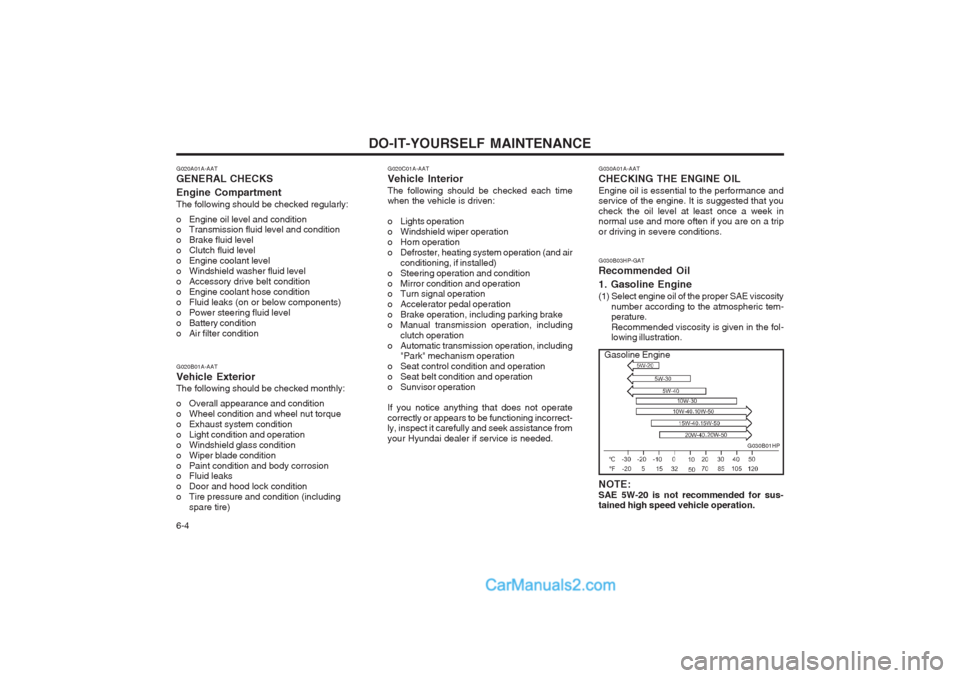
(1) Select engine oil of the proper SAE viscosity
number according to the atmospheric tem- perature. Recommended viscosity is given in the fol- lowing illustration.
G030B01HP
NOTE: SAE 5W-20 is not recommended for sus- tained high speed vehicle operation.
Gasoline Engine
Page 151 of 349
DO-IT-YOURSELF MAINTENANCE 6-5
G030B02HP
(2) The engine oil quality should meet the fol-
lowing API classification. Europe : SG, SG/CD, SH OR SH/CD Except Europe : SE or ABOVE
2. Diesel Engine
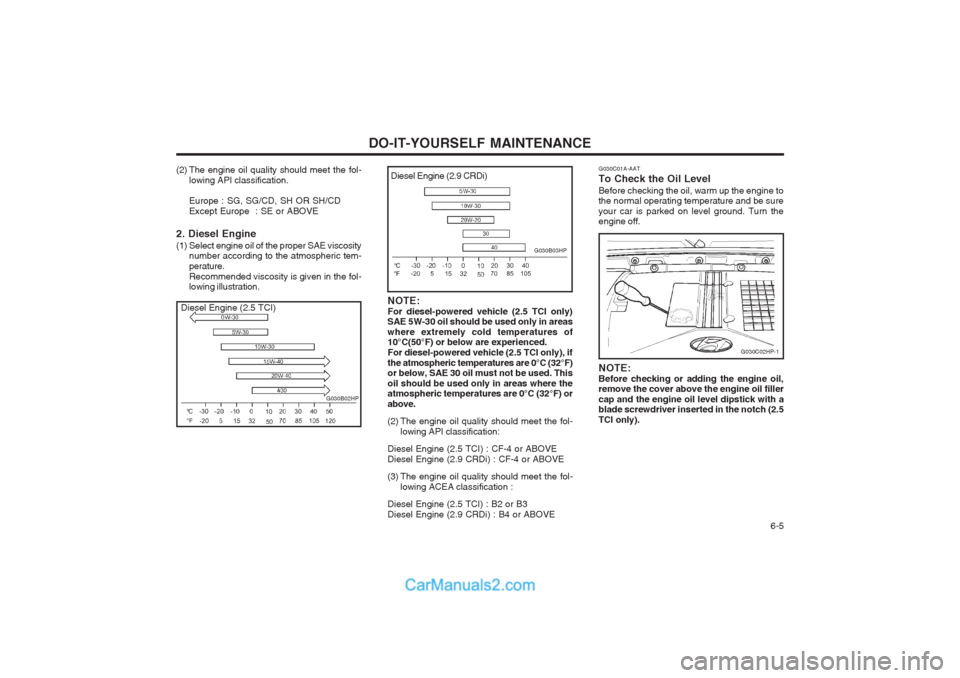
(1) Select engine oil of the proper SAE viscosity number according to the atmospheric tem- perature.Recommended viscosity is given in the fol- lowing illustration.
NOTE: For diesel-powered vehicle (2.5 TCI only) SAE 5W-30 oil should be used only in areas where extremely cold temperatures of 10°C(50°F) or below are experienced. For diesel-powered vehicle (2.5 TCI only), ifthe atmospheric temperatures are 0°C (32°F) or below, SAE 30 oil must not be used. This oil should be used only in areas where the atmospheric temperatures are 0°C (32°F) or above.
(2) The engine oil quality should meet the fol-lowing API classification:
Diesel Engine (2.5 TCI) : CF-4 or ABOVE Diesel Engine (2.9 CRDi) : CF-4 or ABOVE
(3) The engine oil quality should meet the fol- lowing ACEA classification :
Diesel Engine (2.5 TCI) : B2 or B3 Diesel Engine (2.9 CRDi) : B4 or ABOVE
G030B03HP
Diesel Engine (2.5 TCI) Diesel Engine (2.9 CRDi)
G030C01A-AAT To Check the Oil LevelBefore checking the oil, warm up the engine to the normal operating temperature and be sure your car is parked on level ground. Turn the engine off.
G030C02HP-1
NOTE: Before checking or adding the engine oil, remove the cover above the engine oil filler cap and the engine oil level dipstick with a blade screwdriver inserted in the notch (2.5 TCI only).
Page 152 of 349
DO-IT-YOURSELF MAINTENANCE
6-6
G350A01A-GAT ENGINE OIL CONSUMPTION Function of Engine Oil Engine oil has the primary function of lubricat- ing and cooling the inside of the engine. Engine oil consumption It is normal that an engine should consume
some engine oil while normal driving. The cause of oil consumption in a normal engine are as follows;
o Engine oil is used to lubricate pistons, piston rings and cylinders. A thin film of oil is left on the cylinder wall
when a piston moves downwards in the cylinder. High negative pressure generated during engine operation sucks some of the oil into the combustion chamber. This oil with some oil of the cylinder wall is
burned by the high temperature combustion gases during the combustion process.
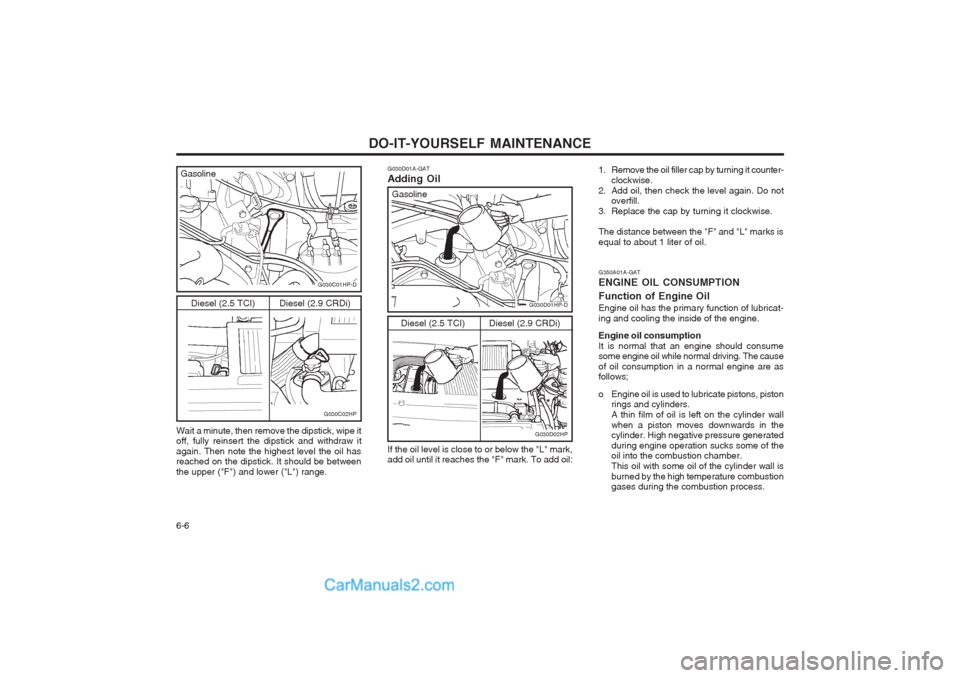
1. Remove the oil filler cap by turning it counter-
clockwise.
2. Add oil, then check the level again. Do not overfill.
3. Replace the cap by turning it clockwise. The distance between the "F" and "L" marks is equal to about 1 liter of oil.
G030D01A-GAT Adding Oil
G030D01HP-D
Gasoline
G030D02HP
Diesel (2.9 CRDi)
Diesel (2.5 TCI)
G030C01HP-D
G030C02HP
Diesel (2.9 CRDi)
Diesel (2.5 TCI)
Gasoline
Wait a minute, then remove the dipstick, wipe it off, fully reinsert the dipstick and withdraw it again. Then note the highest level the oil has reached on the dipstick. It should be between the upper ("F") and lower ("L") range. If the oil level is close to or below the "L" mark, add oil until it reaches the "F" mark. To add oil:
Page 154 of 349
DO-IT-YOURSELF MAINTENANCE
6-8
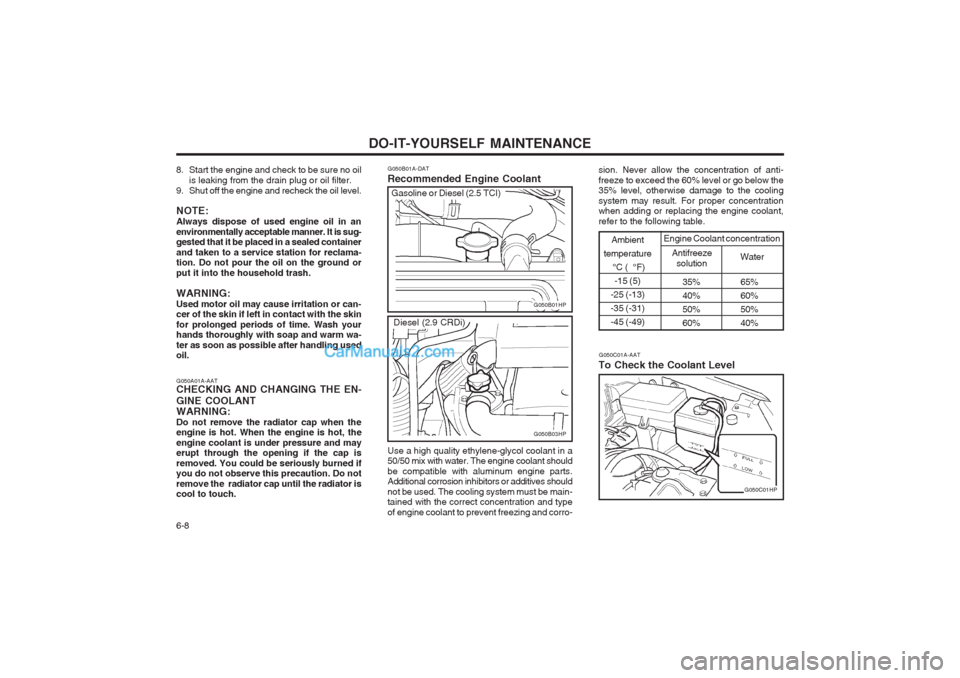
G050B01A-DAT Recommended Engine Coolant
35% 65%
40% 60%
50% 50%
60% 40%
Ambient
temperature °C ( °F)-15 (5)
-25 (-13) -35 (-31)-45 (-49)
Antifreeze solution Water
Engine Coolant concentration
G050B01HP
G050C01A-AAT
To Check the Coolant Level
G050C01HP
Use a high quality ethylene-glycol coolant in a 50/50 mix with water. The engine coolant should be compatible with aluminum engine parts. Additional corrosion inhibitors or additives should not be used. The cooling system must be main- tained with the correct concentration and type of engine coolant to prevent freezing and corro-
Gasoline or Diesel (2.5 TCI)
G050B03HP
Diesel (2.9 CRDi) sion. Never allow the concentration of anti- freeze to exceed the 60% level or go below the 35% level, otherwise damage to the cooling system may result. For proper concentration when adding or replacing the engine coolant, refer to the following table.
8. Start the engine and check to be sure no oil
is leaking from the drain plug or oil filter.
9. Shut off the engine and recheck the oil level. NOTE: Always dispose of used engine oil in anenvironmentally acceptable manner. It is sug- gested that it be placed in a sealed container and taken to a service station for reclama- tion. Do not pour the oil on the ground or put it into the household trash. WARNING: Used motor oil may cause irritation or can- cer of the skin if left in contact with the skin for prolonged periods of time. Wash your hands thoroughly with soap and warm wa- ter as soon as possible after handling used oil. G050A01A-AAT CHECKING AND CHANGING THE EN- GINE COOLANT WARNING: Do not remove the radiator cap when the engine is hot. When the engine is hot, the engine coolant is under pressure and may erupt through the opening if the cap is removed. You could be seriously burned if you do not observe this precaution. Do not remove the radiator cap until the radiator is cool to touch.
Page 155 of 349
DO-IT-YOURSELF MAINTENANCE 6-9
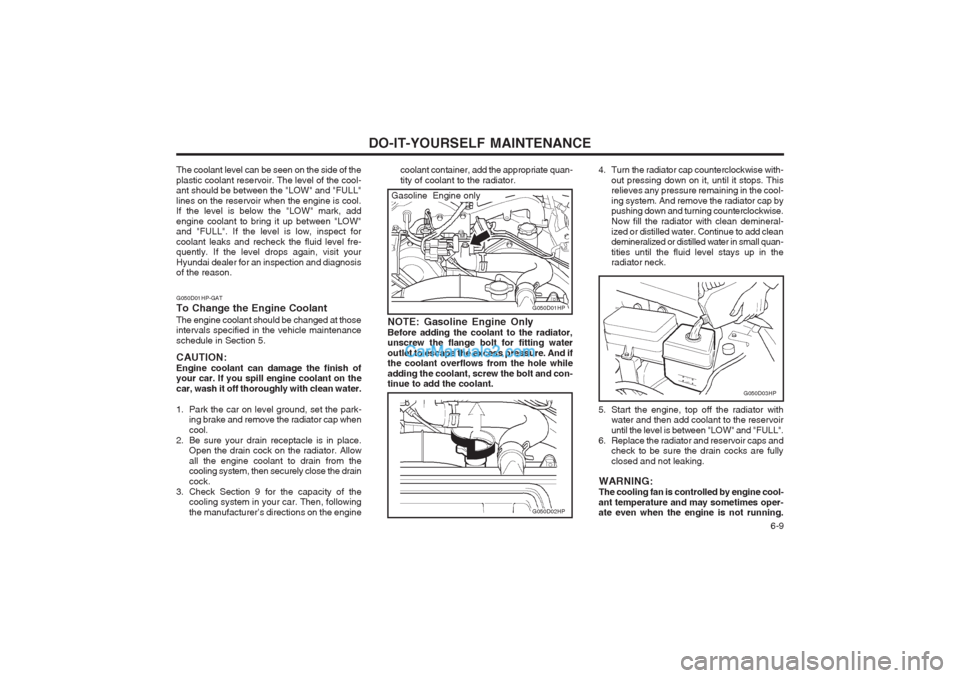
coolant container, add the appropriate quan- tity of coolant to the radiator.
G050D03HP
G050D01HP
G050D02HP
NOTE: Gasoline Engine Only Before adding the coolant to the radiator, unscrew the flange bolt for fitting water outlet to escape the excess pressure. And if the coolant overflows from the hole while adding the coolant, screw the bolt and con- tinue to add the coolant. 4. Turn the radiator cap counterclockwise with-
out pressing down on it, until it stops. Thisrelieves any pressure remaining in the cool- ing system. And remove the radiator cap by pushing down and turning counterclockwise. Now fill the radiator with clean demineral-ized or distilled water. Continue to add clean demineralized or distilled water in small quan- tities until the fluid level stays up in the radiator neck.
5. Start the engine, top off the radiator with water and then add coolant to the reservoir until the level is between "LOW" and "FULL".
6. Replace the radiator and reservoir caps and check to be sure the drain cocks are fullyclosed and not leaking.
WARNING:The cooling fan is controlled by engine cool-
ant temperature and may sometimes oper- ate even when the engine is not running.
Gasoline Engine only
The coolant level can be seen on the side of the plastic coolant reservoir. The level of the cool- ant should be between the "LOW" and "FULL" lines on the reservoir when the engine is cool. If the level is below the "LOW" mark, add engine coolant to bring it up between "LOW" and "FULL". If the level is low, inspect for coolant leaks and recheck the fluid level fre- quently. If the level drops again, visit your Hyundai dealer for an inspection and diagnosis of the reason.
G050D01HP-GAT To Change the Engine CoolantThe engine coolant should be changed at those intervals specified in the vehicle maintenance schedule in Section 5. CAUTION: Engine coolant can damage the finish of your car. If you spill engine coolant on the car, wash it off thoroughly with clean water.
1. Park the car on level ground, set the park-
ing brake and remove the radiator cap when cool.
2. Be sure your drain receptacle is in place. Open the drain cock on the radiator. Allowall the engine coolant to drain from the cooling system, then securely close the drain cock.
3. Check Section 9 for the capacity of the cooling system in your car. Then, followingthe manufacturer’s directions on the engine
Page 157 of 349
DO-IT-YOURSELF MAINTENANCE 6-11
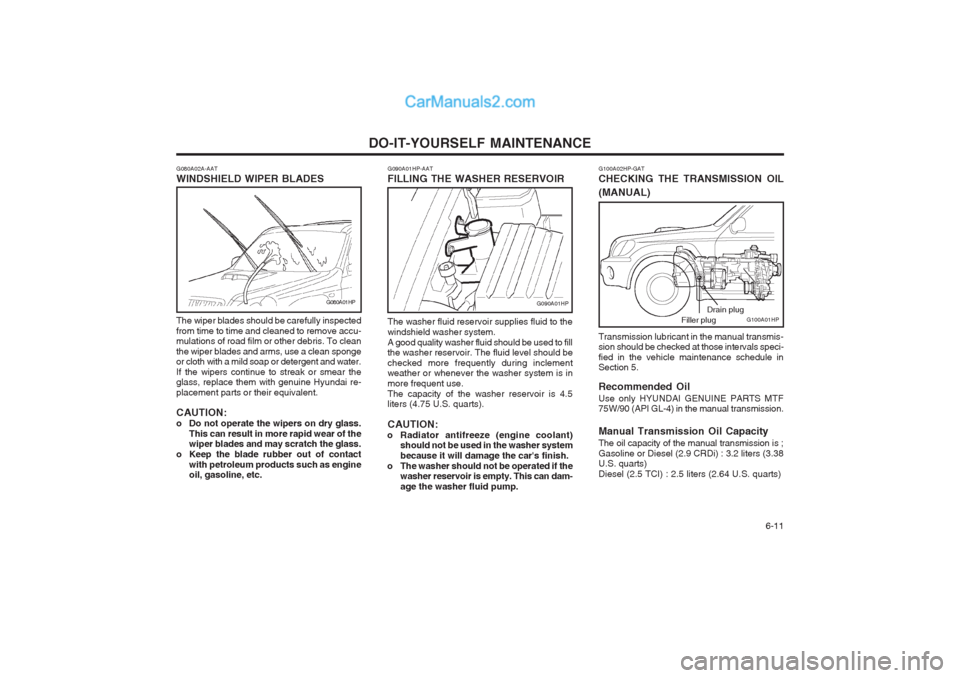
G090A01HP-AAT FILLING THE WASHER RESERVOIR
G090A01HP
The washer fluid reservoir supplies fluid to the windshield washer system.A good quality washer fluid should be used to fill the washer reservoir. The fluid level should be checked more frequently during inclement weather or whenever the washer system is in more frequent use.The capacity of the washer reservoir is 4.5 liters (4.75 U.S. quarts). CAUTION:
o Radiator antifreeze (engine coolant) should not be used in the washer system because it will damage the car's finish.
o The washer should not be operated if the washer reservoir is empty. This can dam-age the washer fluid pump.
G100A02HP-GAT CHECKING THE TRANSMISSION OIL (MANUAL)
G100A01HP
Drain plug
Filler plug
Transmission lubricant in the manual transmis- sion should be checked at those intervals speci- fied in the vehicle maintenance schedule in Section 5. Recommended Oil Use only HYUNDAI GENUINE PARTS MTF 75W/90 (API GL-4) in the manual transmission. Manual Transmission Oil Capacity The oil capacity of the manual transmission is ; Gasoline or Diesel (2.9 CRDi) : 3.2 liters (3.38 U.S. quarts) Diesel (2.5 TCI) : 2.5 liters (2.64 U.S. quarts)
G080A02A-AAT WINDSHIELD WIPER BLADES
The wiper blades should be carefully inspected from time to time and cleaned to remove accu- mulations of road film or other debris. To clean the wiper blades and arms, use a clean sponge or cloth with a mild soap or detergent and water. If the wipers continue to streak or smear the glass, replace them with genuine Hyundai re- placement parts or their equivalent. CAUTION:
o Do not operate the wipers on dry glass. This can result in more rapid wear of the wiper blades and may scratch the glass.
o Keep the blade rubber out of contact with petroleum products such as engineoil, gasoline, etc.
G080A01HP