lights Hyundai Terracan 2003 Owner's Guide
[x] Cancel search | Manufacturer: HYUNDAI, Model Year: 2003, Model line: Terracan, Model: Hyundai Terracan 2003Pages: 349, PDF Size: 4.56 MB
Page 124 of 349
DRIVING YOUR HYUNDAI
2- 18
5. Always secure items in the trailer to prevent
load shift while driving.
6. Check the condition and air pressure of all
tires on the trailer and your car. Low tire pressure can seriously affect the handling.
Also check the spare tire.
7. The vehicle/trailer combination is more af-
fected by crosswind and buffeting. When being passed by a large vehicle, keep a constant speed and steer straight ahead. If there is too much wind buffeting slow down to get out of the other vehicle's air turbulence.
8. When parking your car and trailer, especially
on a hill, be sure to follow all the normal precautions. Turn your front wheel into the curb, set the parking brake firmly, and put the transmission in 1st or Reverse (manual) or Park (automatic). In addition, place wheel
chocks at each of the trailer's tires.
9. If the trailer has electric brakes, start your vehicle and trailer moving, and then apply the trailer brake controller by hand to be sure the brakes are working. This lets you check your
electrical connection at the same time.
10. During your trip, check occasionally to be
sure that the load is secure, and that the lights and any trailer brakes are still working.
11. Avoid jerky starts, sudden acceleration or sudden stops.
12. Avoid sharp turns and rapid lane changes.
13. Avoid holding the brake pedal down too long or too frequently. This could cause the brakes to overheat, resulting in reduced braking effi- ciency.
14. When going down a hill, shift into a lower gear
and use the engine braking effect. When ascending a long grade, downshift the trans- mission to a lower gear and reduce speed to reduce chances of engine overloading and/or overheating.
15. If you have to stop while going uphill, do not
hold the vehicle in place by pressing on the accelerator. This can cause the automatic transmission to overheat. Use the parking brake or footbrake.
NOTE: When towing, check transmission fluid more frequently. CAUTION: If overheating should occur when towing, (temperature gauge reads near red zone), taking the following action may reduce or
eliminate the problem.
1. Turn off the air conditioner.
2. Reduce highway speed.
3. Select a lower gear when going uphill.
4. While in stop and go traffic, place the gear selector in park or neutral and idle theengine at a higher speed.
Page 126 of 349
WHAT TO DO IN AN EMERGENCY
3-2 tinue to apply water to the affected area with a sponge or cloth.
o The gas produced by the battery during the
jump-start operation is highly explosive. Do not smoke or allow a spark or an open flame in the vicinity.
o The battery being used to provide the jump
start must be 12-volt. If you cannot determine that it is a 12-volt battery, do not attempt to use it for the jump start.
o To jump start a car with a discharged battery,
follow this procedure exactly:
1. If the booster battery is installed in another vehicle, be sure the two vehicles are nottouching.
2. Turn off all unnecessary lights and acces-
sories in both vehicles.
3. Attach the clamps of the jumper cable in the
exact location shown in the illustration. First, attach one clamp of the jumper cable to the positive (+) post or cable of the discharged battery. Then attach the other end of the same cable to the positive (+) post or cable of the booster battery. Next, using the other cable, attach one clamp to the negative (-) post or cable of the booster battery. Then attach the other end of that cable to a solid metal part of the engine away from the battery. Do not connect the cable to any moving part.
4. Start the engine in the car with the booster battery and let it run for a few minutes. This will help to assure that the booster battery is fully charged. During the jumping operation,run the engine in this vehicle at about 2000 rpm.
5. Start the engine in the car with the discharged battery using the normal starting procedure. After the engine starts, leave the jumper cables connected and let the engine run at fast idle or about 2000 rpm for several min- utes.
6. Carefully remove the jumper cables in the reverse order of attachment.
If you do not know why your battery became discharged (because the lights were left on, etc.), have the charging system checked by your Hyundai dealer. visible loss of coolant and no steam, leave theengine running and check to be sure the engine cooling fan is operating. If the fan is not running, turn the engine off.
4. Check to see if the water pump drive belt is
missing. If it is not missing, check to see that it is tight. If the drive belt seems to be satis- factory, check for engine coolant leaking from the radiator, hoses or under the car. (If the air conditioning had been in use, it is normal for cold water to be draining from it when you stop).
WARNING: While the engine is running, keep hands and clothing away from moving parts such as the fan and drive belts to prevent injury.
5. If the water pump drive belt is broken or coolant is leaking out, stop the engine im- mediately and call the nearest Hyundai deal- er for assistance.
WARNING: Do not remove the radiator cap when the engine is hot. This can allow coolant to be blown out of the opening and cause serious burns.
6. If you cannot find the cause of the overheat- ing, wait until the engine temperature has returned to normal. Then, if coolant has been lost, carefully add coolant to the reservoir (Page 6-8) to bring the fluid level in the reser- voir up to the halfway mark.
D030A01HP-AAT IF THE ENGINE OVERHEATS If your temperature gauge indicates overheating, you experience a loss of power, or hear loud pinging or knocking, the engine is probably too hot. If this happens to you, you should:
1. Pull off the road and stop as soon as it is safe
to do so.
2. Place the gear selector lever in "P" (auto- matic), or neutral (manual transmission) and set the parking brake. If the air conditioning is on, turn it off.
3. If engine coolant is running out under the car or steam is coming out from under the hood, stop the engine. Do not open the hood until the engine coolant has stopped running or the steaming has stopped. If there is no
Page 150 of 349
DO-IT-YOURSELF MAINTENANCE
6-4
G020A01A-AAT GENERAL CHECKS Engine Compartment The following should be checked regularly:
o Engine oil level and condition
o Transmission fluid level and condition
o Brake fluid level
o Clutch fluid level
o Engine coolant level
o Windshield washer fluid level
o Accessory drive belt condition
o Engine coolant hose condition
o Fluid leaks (on or below components)
o Power steering fluid level
o Battery condition
o Air filter condition G020B01A-AAT Vehicle Exterior The following should be checked monthly:
o Overall appearance and condition
o Wheel condition and wheel nut torque
o Exhaust system condition
o Light condition and operation
o Windshield glass condition
o Wiper blade condition
o Paint condition and body corrosion
o Fluid leaks
o Door and hood lock condition
o Tire pressure and condition (including
spare tire) G020C01A-AAT Vehicle InteriorThe following should be checked each time when the vehicle is driven:
o Lights operation
o Windshield wiper operation
o Horn operation
o Defroster, heating system operation (and air
conditioning, if installed)
o Steering operation and condition
o Mirror condition and operation
o Turn signal operation
o Accelerator pedal operation
o Brake operation, including parking brake
o Manual transmission operation, including clutch operation
o Automatic transmission operation, including "Park" mechanism operation
o Seat control condition and operation
o Seat belt condition and operation
o Sunvisor operation If you notice anything that does not operate correctly or appears to be functioning incorrect- ly, inspect it carefully and seek assistance from your Hyundai dealer if service is needed. G030A01A-AAT CHECKING THE ENGINE OILEngine oil is essential to the performance and service of the engine. It is suggested that you check the oil level at least once a week in normal use and more often if you are on a trip or driving in severe conditions. G030B03HP-GAT Recommended Oil 1. Gasoline Engine
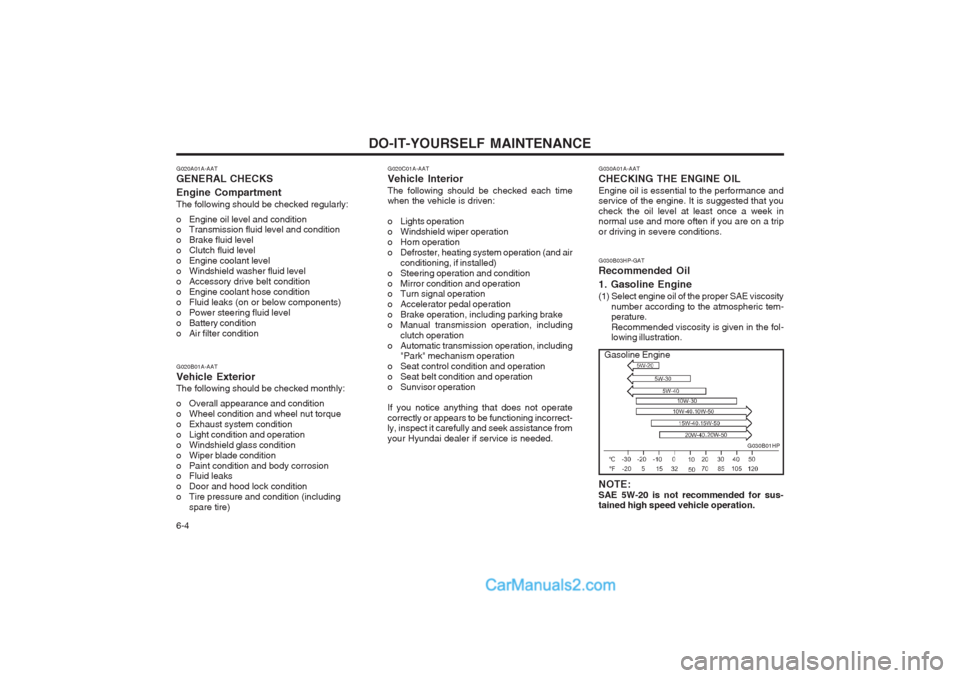
(1) Select engine oil of the proper SAE viscosity
number according to the atmospheric tem- perature. Recommended viscosity is given in the fol- lowing illustration.
G030B01HP
NOTE: SAE 5W-20 is not recommended for sus- tained high speed vehicle operation.
Gasoline Engine
Page 165 of 349
DO-IT-YOURSELF MAINTENANCE 6-19
AXA6201B
3. Be sure to check all other fuses even if you find one that appears to have burned out.
4. Replace the blown fuse by pressing a new fuse of the same rating into place. The fuse should be a snug fit. If it is not, have the fuse clip repaired or replaced by a Hyundai dealer. If you do not have a spare fuse, you may be able to borrow a fuse of the same or lower rating from an accessory you can tempo- rarily get along without (the radio or cigarette lighter, for example). Always remember to replace the borrowed fuse.
1. Turn off the ignition and all other switches.
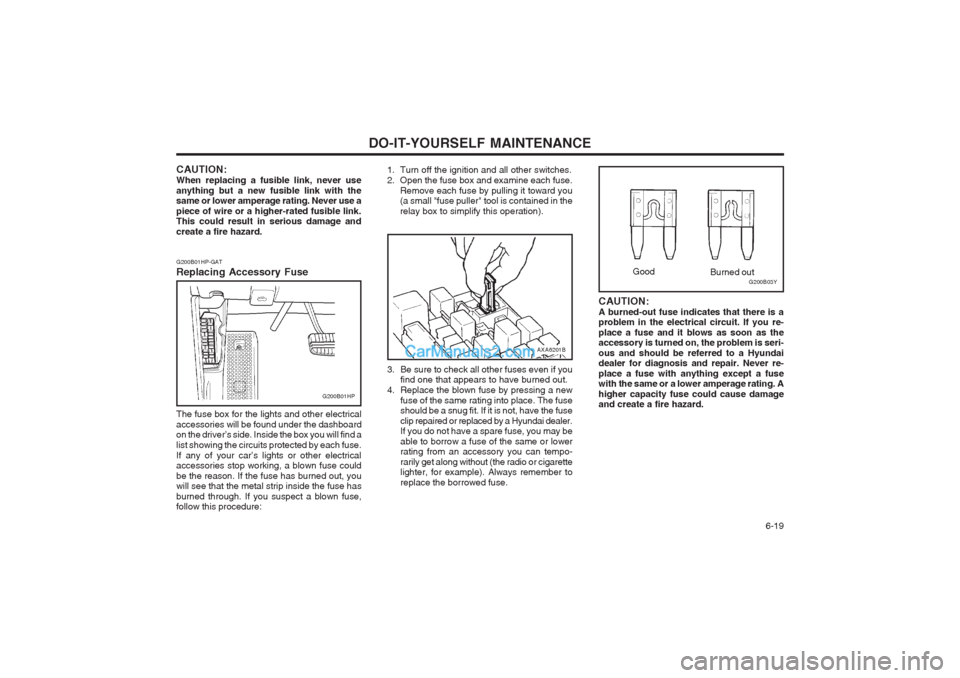
2. Open the fuse box and examine each fuse.
Remove each fuse by pulling it toward you (a small "fuse puller" tool is contained in the relay box to simplify this operation).
Good
G200B03YBurned out
CAUTION: A burned-out fuse indicates that there is a problem in the electrical circuit. If you re- place a fuse and it blows as soon as the accessory is turned on, the problem is seri- ous and should be referred to a Hyundai dealer for diagnosis and repair. Never re- place a fuse with anything except a fuse with the same or a lower amperage rating. A higher capacity fuse could cause damage and create a fire hazard.
G200B01HP-GAT Replacing Accessory Fuse
G200B01HP
The fuse box for the lights and other electrical accessories will be found under the dashboard on the driver’s side. Inside the box you will find a list showing the circuits protected by each fuse.If any of your car’s lights or other electrical accessories stop working, a blown fuse could be the reason. If the fuse has burned out, you will see that the metal strip inside the fuse has burned through. If you suspect a blown fuse, follow this procedure:
CAUTION: When replacing a fusible link, never useanything but a new fusible link with the same or lower amperage rating. Never use a piece of wire or a higher-rated fusible link. This could result in serious damage and create a fire hazard.
Page 171 of 349
DO-IT-YOURSELF MAINTENANCE 6-25
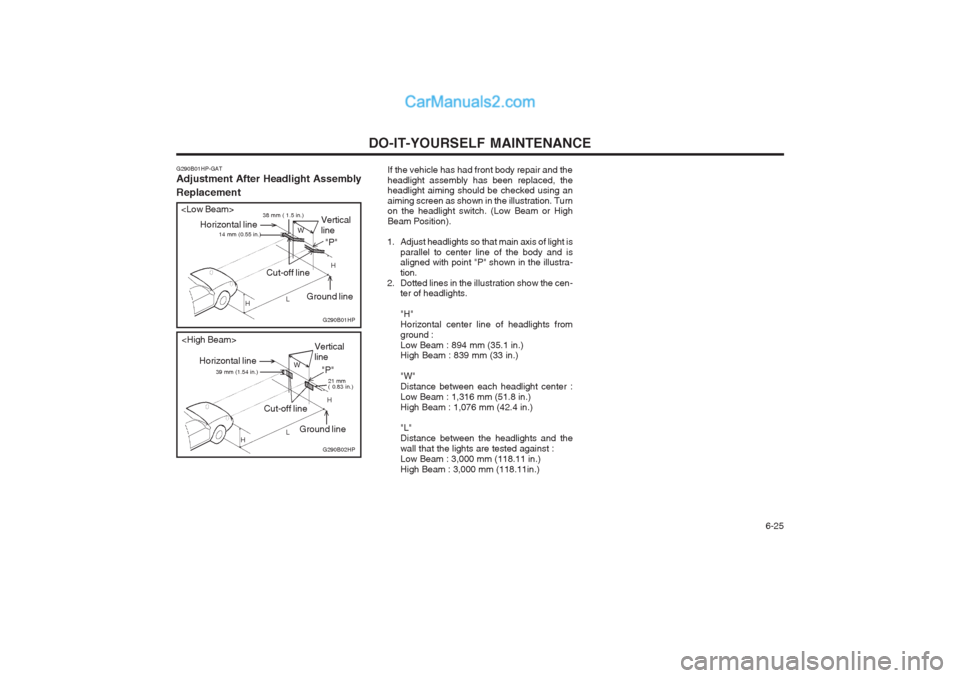
If the vehicle has had front body repair and the headlight assembly has been replaced, the headlight aiming should be checked using an aiming screen as shown in the illustration. Turn on the headlight switch. (Low Beam or High Beam Position).
1. Adjust headlights so that main axis of light is parallel to center line of the body and is aligned with point "P" shown in the illustra- tion.
2. Dotted lines in the illustration show the cen- ter of headlights. "H" Horizontal center line of headlights fromground :Low Beam : 894 mm (35.1 in.) High Beam : 839 mm (33 in.) "W" Distance between each headlight center :Low Beam : 1,316 mm (51.8 in.)High Beam : 1,076 mm (42.4 in.) "L" Distance between the headlights and thewall that the lights are tested against :Low Beam : 3,000 mm (118.11 in.)High Beam : 3,000 mm (118.11in.)
G290B02HP
Vertical line
Cut-off line Ground line
L W
H
H "P"
21 mm ( 0.83 in.)
Horizontal line 39 mm (1.54 in.)
Vertical line
Cut-off line Ground line
L W
H
H "P"
38 mm ( 1.5 in.)
14 mm (0.55 in.)Horizontal line
G290B01HP-GAT Adjustment After Headlight Assembly Replacement
G290B01HP
Page 172 of 349
DO-IT-YOURSELF MAINTENANCE
6-26 No.
9
10 11 12 Wattage
16 40
21/5 2121 215
G280A01HP-GAT
No.
1 2 345 6 78 Part Name
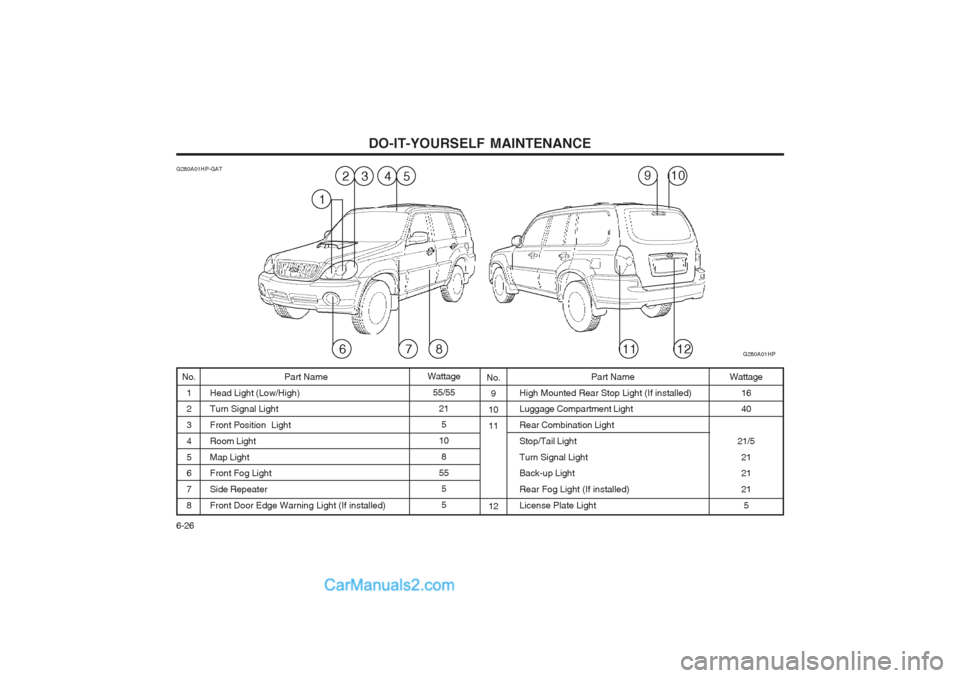
Head Light (Low/High) Turn Signal Light
Front Position LightRoom LightMap Light Front Fog Light Side RepeaterFront Door Edge Warning Light (If installed) Part Name
High Mounted Rear Stop Light (If installed) Luggage Compartment Light Rear Combination LightStop/Tail LightTurn Signal Light Back-up Light Rear Fog Light (If installed)License Plate LightWattage 55/55 215
10
8
55 5 5
G280A01HP
532
87611
910
1
4
12
Page 186 of 349
INDEX 10-5
Towing
A trailer (or vehicle) ........................................................... 2-16 ~ 2-18
Emergency .................................................................................... 3-10
If your car must be towed ............................................................... 3-9
Transmission Automatic ............................................................................... 2-6 ~ 2-8
Automatic transmission fluid checking ..........................................6-12
Manual .................................................................................... 2-4 ~ 2-5
Manual transmission oil ch ecking ................................................. 6-11
Trip Odometer ................................................................................... 1-41
U
Under Tray ........................................................................................ 1-14
VVehicle Identification Number ............................................................. 8-1
Vehicle Specifications ................................................................ 9-1 ~ 9-3
W
Warning Lights ....................................................................... 1-38 ~ 1-42 Windows Power ............................................................................................ 1-10
Windshield Wiper and Washer ......................................................... 1-48
Rear Wiper and Washer Switch ................................................... 1-49
Windshield Wiper Blades ............. ..................................................... 6-11
Page 201 of 349
CONTROLS AND EQUIPMENT1- 7
B070A01A-EAT THEFT-ALARM SYSTEM (Not all models) This system is designed to provide protection
from unauthorized entry into the car. This sys- tem is operated in three stages: the first is the"Armed" stage, the second is the "Alarm" stage,and the third is the "Disarmed" stage. If trig-gered, the system provides an audible alarmwith blinking of turn signal lights.
B070B01O-EAT Armed Stage
B070B02HP.DAG
Park the car and stop the engine. Arm the
system as described below.
UNLOCK LOCK
B040G01HP-AAT Central Door Locks (Not all models)
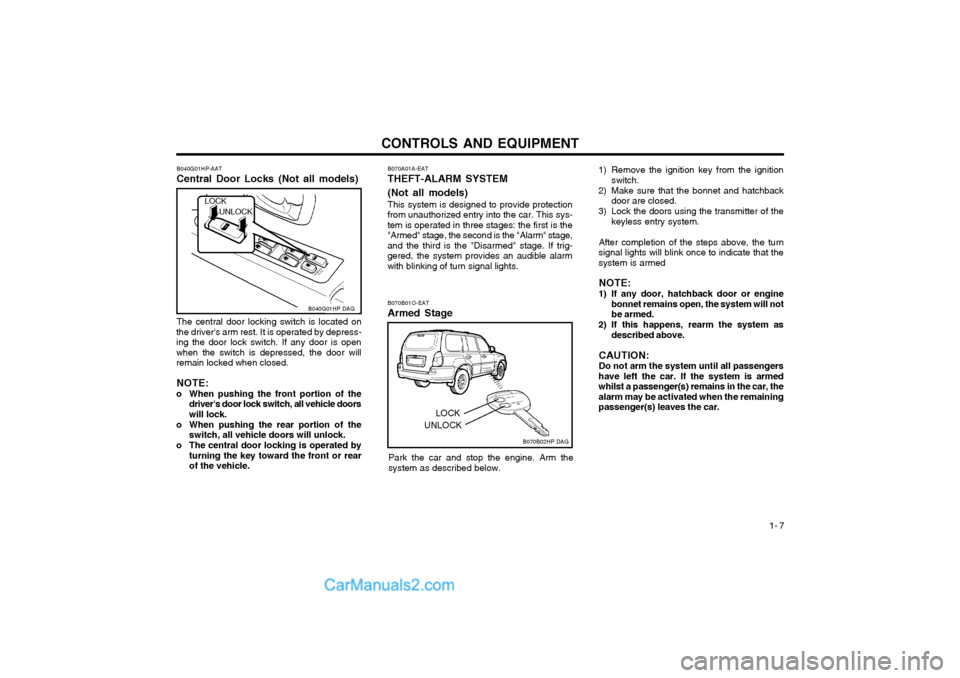
The central door locking switch is located on
the driver's arm rest. It is operated by depress- ing the door lock switch. If any door is openwhen the switch is depressed, the door willremain locked when closed.
NOTE:
o When pushing the front portion of the driver's door lock switch, all vehicle doorswill lock.
o When pushing the rear portion of the switch, all vehicle doors will unlock.
o The central door locking is operated by turning the key toward the front or rearof the vehicle.
B040G01HP.DAG 1) Remove the ignition key from the ignition
switch.
2) Make sure that the bonnet and hatchback door are closed.
3) Lock the doors using the transmitter of the keyless entry system.
After completion of the steps above, the turn
signal lights will blink once to indicate that the system is armed
NOTE:
1) If any door, hatchback door or engine bonnet remains open, the system will notbe armed.
2) If this happens, rearm the system as described above.
CAUTION:Do not arm the system until all passengers
have left the car. If the system is armedwhilst a passenger(s) remains in the car, thealarm may be activated when the remainingpassenger(s) leaves the car.
LOCK
UNLOCK
Page 202 of 349
CONTROLS AND EQUIPMENT
1- 8
B070D01HP-EAT Disarmed StageThe system will be disarmed when the driver's or passenger's door is unlocked by depressingthe "UNLOCK" button on the transmitter. After completion of the step above, the turn signal lights will blink twice to indicate that thesystem is disarmed. If any door, hatchback door or engine bonnet is not opened within 30 seconds, the system willbe rearmed. CAUTION: Only the transmitter can disarm the armed stage. If the transmitter does not disarm thesystem, it is necessary to take the followingsteps;
1. Unlock the door with the key, which will cause, the alarm to be activated.
2. Insert the key in the ignition key cylinder and turn the ignition key to "ON" posi- tion.
3. Wait for 30 seconds. After completion of the steps above, the system will be disarmed.
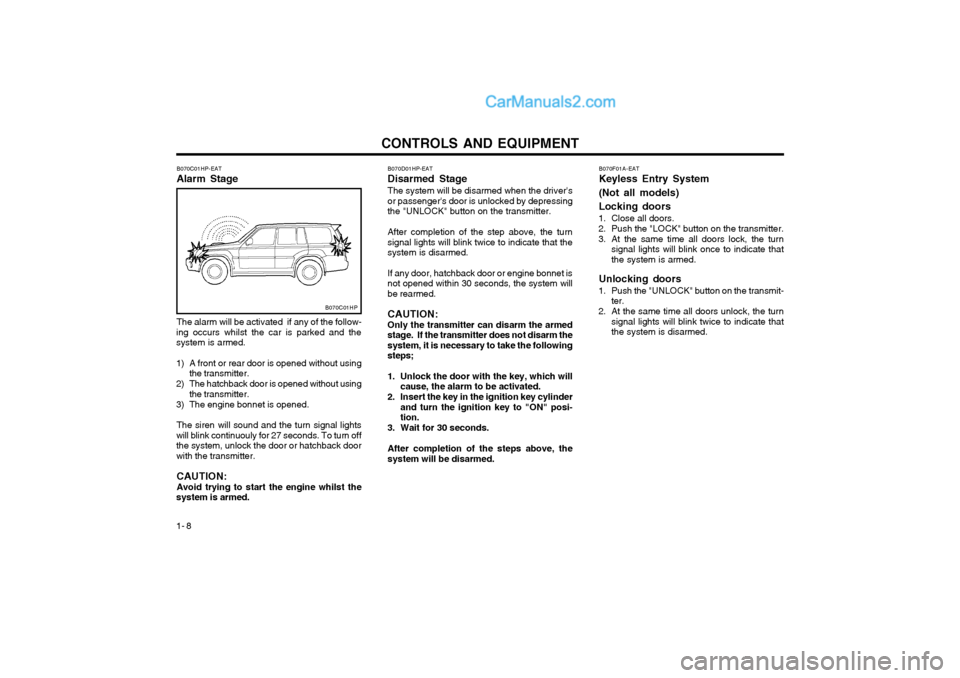
B070C01HP-EAT Alarm Stage
B070F01A-EATKeyless Entry System (Not all models) Locking doors
1. Close all doors.
2. Push the "LOCK" button on the transmitter.
3. At the same time all doors lock, the turn signal lights will blink once to indicate that the system is armed.
Unlocking doors
1. Push the "UNLOCK" button on the transmit- ter.
2. At the same time all doors unlock, the turn signal lights will blink twice to indicate thatthe system is disarmed.
B070C01HP
The alarm will be activated if any of the follow-
ing occurs whilst the car is parked and the system is armed.
1) A front or rear door is opened without using the transmitter.
2) The hatchback door is opened without using the transmitter.
3) The engine bonnet is opened.
The siren will sound and the turn signal lights
will blink continuouly for 27 seconds. To turn off the system, unlock the door or hatchback doorwith the transmitter.
CAUTION: Avoid trying to start the engine whilst the
system is armed.
Page 226 of 349
CONTROLS AND EQUIPMENT
1- 32
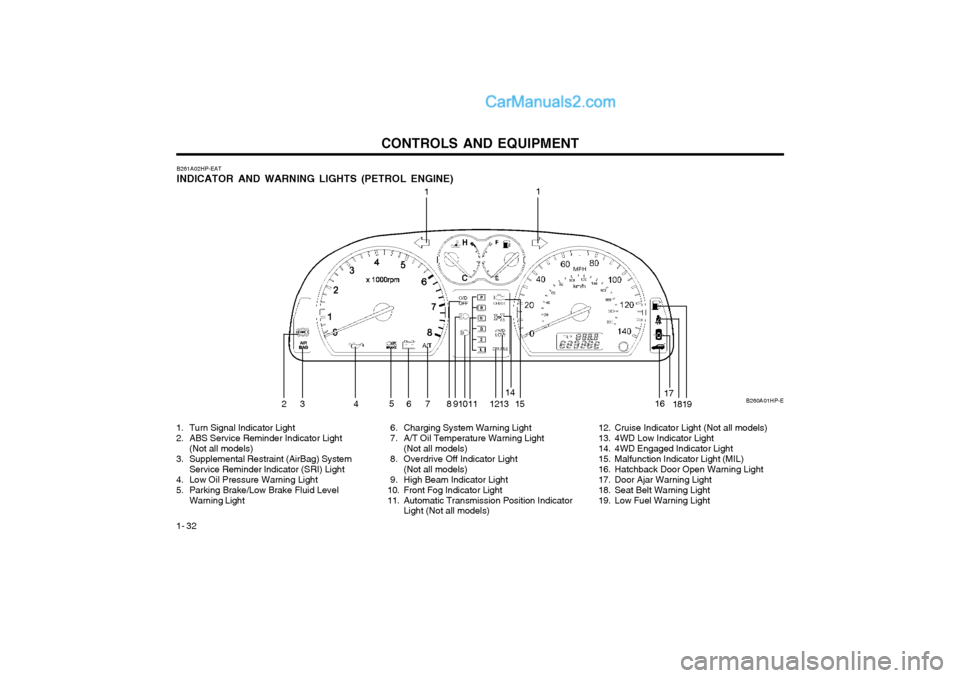
B261A02HP-EAT INDICATOR AND WARNING LIGHTS (PETROL ENGINE)
1 1
23 4 5
6 7 8 91011 1213 14
15 1617
18
19
1. Turn Signal Indicator Light
2. ABS Service Reminder Indicator Light (Not all models)
3. Supplemental Restraint (AirBag) System Service Reminder lndicator (SRI) Light
4. Low Oil Pressure Warning Light
5. Parking Brake/Low Brake Fluid Level
Warning Light 6. Charging System Warning Light
7. A/T Oil Temperature Warning Light
(Not all models)
8. Overdrive Off Indicator Light (Not all models)
9. High Beam Indicator Light
10. Front Fog Indicator Light
11. Automatic Transmission Position Indicator Light (Not all models) 12. Cruise Indicator Light (Not all models)
13. 4WD Low Indicator Light
14. 4WD Engaged Indicator Light
15. Malfunction Indicator Light (MIL)
16. Hatchback Door Open Warning Light
17. Door Ajar Warning Light
18. Seat Belt Warning Light
19. Low Fuel Warning LightB260A01HP-E