belt Hyundai Terracan 2003 Repair Manual
[x] Cancel search | Manufacturer: HYUNDAI, Model Year: 2003, Model line: Terracan, Model: Hyundai Terracan 2003Pages: 349, PDF Size: 4.56 MB
Page 228 of 349
CONTROLS AND EQUIPMENT
1- 34
B260A03HP-E
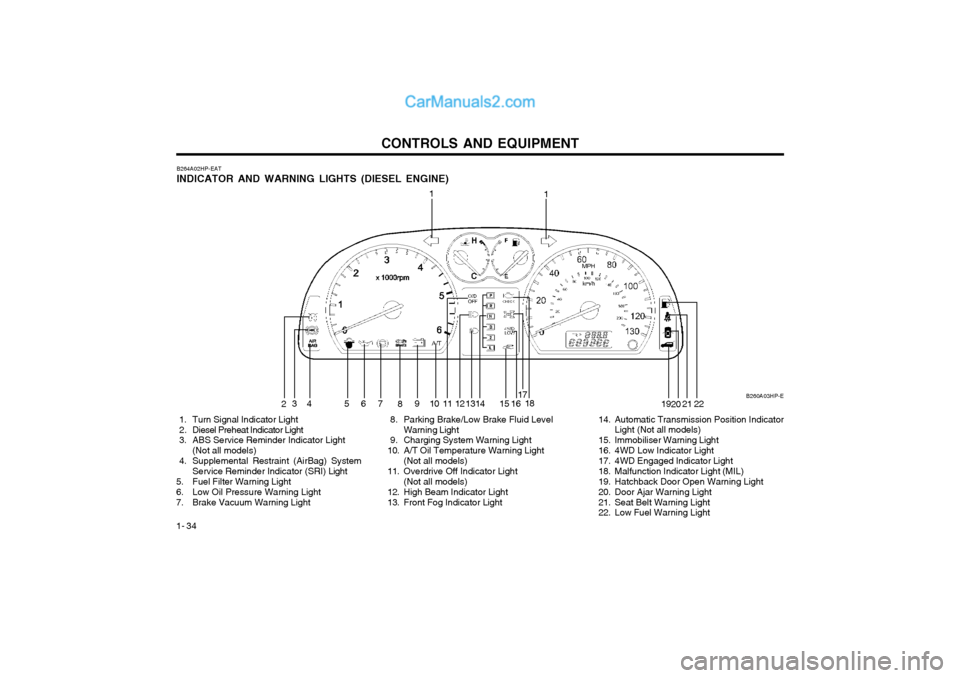
B264A02HP-EAT INDICATOR AND WARNING LIGHTS (DIESEL ENGINE)
1
2 34 5 6
7
8910111213 15 17
18 192021
1
22
1416
1. Turn Signal Indicator Light
2. Diesel Preheat Indicator Light
3. ABS Service Reminder Indicator Light(Not all models)
4. Supplemental Restraint (AirBag) System Service Reminder Indicator (SRI) Light
5. Fuel Filter Warning Light
6. Low Oil Pressure Warning Light
7. Brake Vacuum Warning Light 8. Parking Brake/Low Brake Fluid Level
Warning Light
9. Charging System Warning Light
10. A/T Oil Temperature Warning Light
(Not all models)
11. Overdrive Off Indicator Light (Not all models)
12. High Beam Indicator Light
13. Front Fog Indicator Light 14. Automatic Transmission Position Indicator
Light (Not all models)
15. Immobiliser Warning Light
16. 4WD Low Indicator Light
17. 4WD Engaged Indicator Light
18. Malfunction Indicator Light (MIL)
19. Hatchback Door Open Warning Light
20. Door Ajar Warning Light
21. Seat Belt Warning Light
22. Low Fuel Warning Light
Page 230 of 349
CONTROLS AND EQUIPMENT
1- 36
B260M01A-AAT Low Fuel Level Warning Light
The low fuel level warning light comes on when the fuel tank is approaching empty. When itcomes on, you should add fuel as soon aspossible. Driving with the fuel level warning lighton or with the fuel level below "E" can cause theengine to misfire and damage the catalyticconverter. B260K01B-EAT Hatchback Door Open Warning Light
This light remains on unless the tail gate is completely closed.
B260E01HP-GAT
Seat Belt Warning Light
The seat belt warning light blinks for about 6seconds when the ignition key is turned fromthe "OFF" position to "ON" or "START".
B260L01A-GAT Door Ajar Warning Light
The door ajar warning light warns you that a door is not completely closed.
B260A01B-GAT Front Fog Indicator Light
Front fog indicator light comes on whenever the fog light switch is on.
B260J01S-EAT Charging System Warning Light
The charging system warning light should come
on when the ignition is turned on, then go out when the engine is running. If the light stays onwhilst the engine is running, there is a malfunc-tion in the electrical charging system. If the lightcomes on whilst you are driving, stop, turn offthe engine and check under the bonnet. First,make certain the generator drive belt is inplace. If it is, check the tension of the belt. And then, have the system checked by your
Hyundai dealer.
CAUTION: If the drive belt (generator belt) is loose,
broken, or missing whilst the vehicle is driv- ing, there may be a serious malfunction,engine could overheat because this belt alsodrives the water pump.
B260Q01HP-EAT
Cruise Indicator Light (Not all models)
The cruise indicator light in the instrument clus- ter is illuminated only when the vehicle cruisingspeed has been set using the control switch onthe steering wheel. The indicator light does not illuminate when the main cruise control switch is activated.Information on the use of cruise control may befound on page 1-60.
The brake fluid level warning light indicates that
the brake fluid level in the brake master cylinderis low and hydraulic brake fluid conforming toDOT 3 or DOT 4 specifications should beadded. After adding fluid, if no other trouble isfound, the car should be immediately and care-fully driven to a Hyundai dealer for inspection.If further trouble is experienced, the vehicleshould not be driven at all but taken to a dealerby a professional towing service or some othersafe method.
Your Hyundai is equipped with dual-diagonal
braking systems. This means you still havebraking on two wheels even if one of the dualsystems should fail. With only one of the dualsystems working, more than normal pedal traveland greater pedal pressure are required to stopthe car. Also, the car will not stop in as short adistance with only half of the brake systemworking. If the brakes fail whilst you are driving,shift to a lower gear for additional engine brak-ing and stop the car as soon as it is safe to doso.
Page 233 of 349
CONTROLS AND EQUIPMENT1- 39
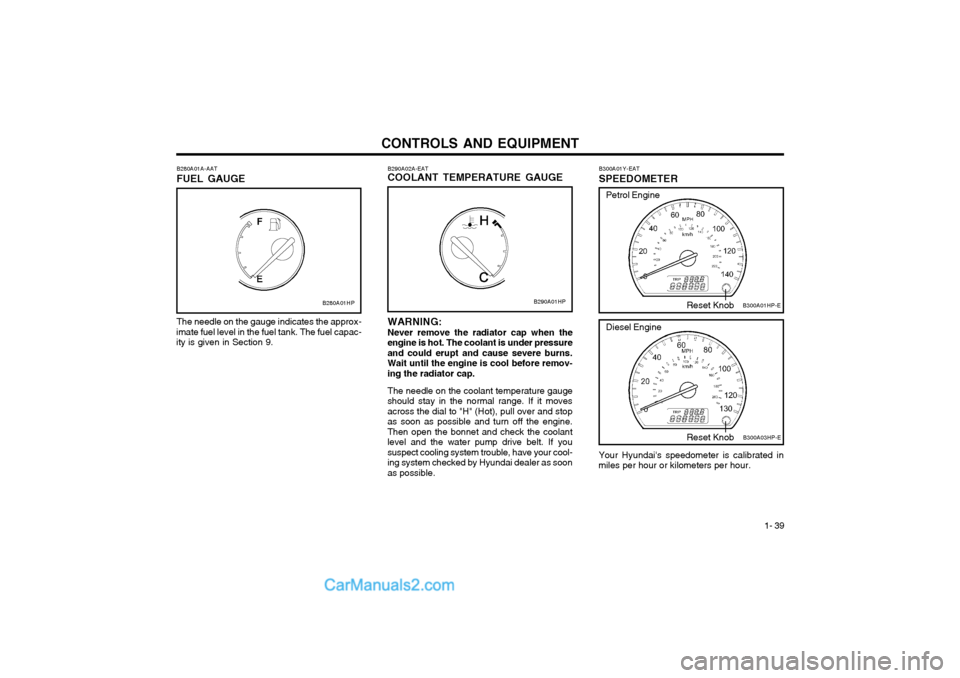
B300A01Y-EAT SPEEDOMETER Your Hyundai's speedometer is calibrated in
miles per hour or kilometers per hour. B300A03HP-EB290A02A-EAT COOLANT TEMPERATURE GAUGE WARNING: Never remove the radiator cap when the
engine is hot. The coolant is under pressure and could erupt and cause severe burns.Wait until the engine is cool before remov-ing the radiator cap.
The needle on the coolant temperature gauge
should stay in the normal range. If it movesacross the dial to "H" (Hot), pull over and stopas soon as possible and turn off the engine.Then open the bonnet and check the coolantlevel and the water pump drive belt. If yoususpect cooling system trouble, have your cool-ing system checked by Hyundai dealer as soonas possible.
B280A01A-AAT FUEL GAUGE The needle on the gauge indicates the approx-
imate fuel level in the fuel tank. The fuel capac- ity is given in Section 9.
B280A01HPB290A01HP
Petrol Engine
Reset Knob
B300A01HP-E
Diesel EngineReset Knob
Page 273 of 349
DRIVING YOUR HYUNDAI
2- 2 C020A01A-EAT
BEFORE STARTING THE ENGINE
Before you start the engine, you should always:
1. Look around the vehicle to be sure there are no flat tyres, puddles of oil or water or other indications of possible trouble.
2. After entering the car, check to be sure the parking brake is engaged.
3. Check that all windows, and lights are clean.
4. Check that the interior and exterior mirrors are clean and in position.
5. Check your seat, seatback and headrest to be sure they are in their proper positions.
6. Close all the doors.
7. Fasten your seat belt and be sure that all other occupants have fastened theirs.
8. Turn off all lights and accessories that are not needed.
9. When you turn the ignition switch to "ON" check that all appropriate warning lights are operating and that you have sufficient fuel.
10.Check the operation of warning lights and all bulbs when key is in the "ON" position. C030A01HP-EAT COMBINATION IGNITION SWITCH AND STEERING LOCK To Start the Engine
o If your Hyundai is equipped with a manual
transmission, place the shift lever in neutral and depress the clutch pedal fully.
o If your Hyundai has an automatic transmis- sion, place the shift lever in "P" (park).
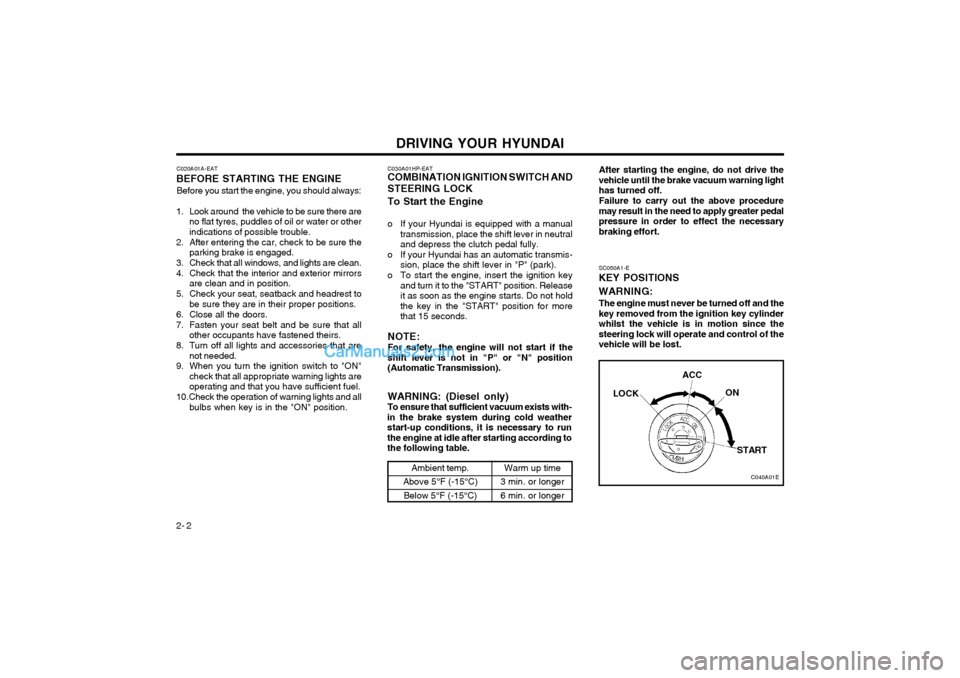
o To start the engine, insert the ignition key and turn it to the "START" position. Releaseit as soon as the engine starts. Do not holdthe key in the "START" position for morethat 15 seconds.
NOTE: For safety, the engine will not start if the shift lever is not in "P" or "N" position(Automatic Transmission). SC050A1-E
KEY POSITIONS WARNING:
The engine must never be turned off and the key removed from the ignition key cylinderwhilst the vehicle is in motion since thesteering lock will operate and control of thevehicle will be lost.
C040A01E
LOCK
ACC
ON
START
WARNING: (Diesel only) To ensure that sufficient vacuum exists with-
in the brake system during cold weatherstart-up conditions, it is necessary to runthe engine at idle after starting according tothe following table.
Ambient temp.
Above 5°F (-15°C) Below 5°F (-15°C)Warm up time
3 min. or longer 6 min. or longer After starting the engine, do not drive the vehicle until the brake vacuum warning lighthas turned off. Failure to carry out the above procedure may result in the need to apply greater pedalpressure in order to effect the necessarybraking effort.
Page 275 of 349
DRIVING YOUR HYUNDAI
2- 4 low the engine to idle for 20 seconds or so before driving the vehicle. CAUTION: Do not leave the vehicle unattended whilst idling. Never allow the vehicle to idle orwarm up in a confined space (ie garage)longer than is necessary to move the vehi-cle into an open area.
HPC060A1-E
STARTING THE ENGINE
1. Ensure that the transmission is in neutral and that the clutch pedal is held depressed (manual transmission) or the transmissionselector is at the "P" position (automatictransmission vehicle).
2. Turn the ignition key to and hold at the "Start" position until the engine starts. Whenthe engine has started, release the key.
NOTE: Do not operate the starter for more than 15
seconds continuously or continue to oper- ate the starter after the engine has started toavoid damaging the starter motor. If theengine makes a false start, allow it and thestarter motor to come to rest before at-tempting to start the engine again. Neverattempt to start the engine with the trans-mission in gear. Do not depress the accel-erator pedal whilst starting the engine. Al-
C050A01E
C050B01HP-EAT
Starting Procedure
1. Insert key, and fasten the seat belt.
2. Apply the parking brake.
3. If your Hyundai is equipped with a manual transmission, place the shift lever in neutral and depress the clutch pedal fully. If yourHyundai has an automatic transmission,place the shift lever in "P" (park).
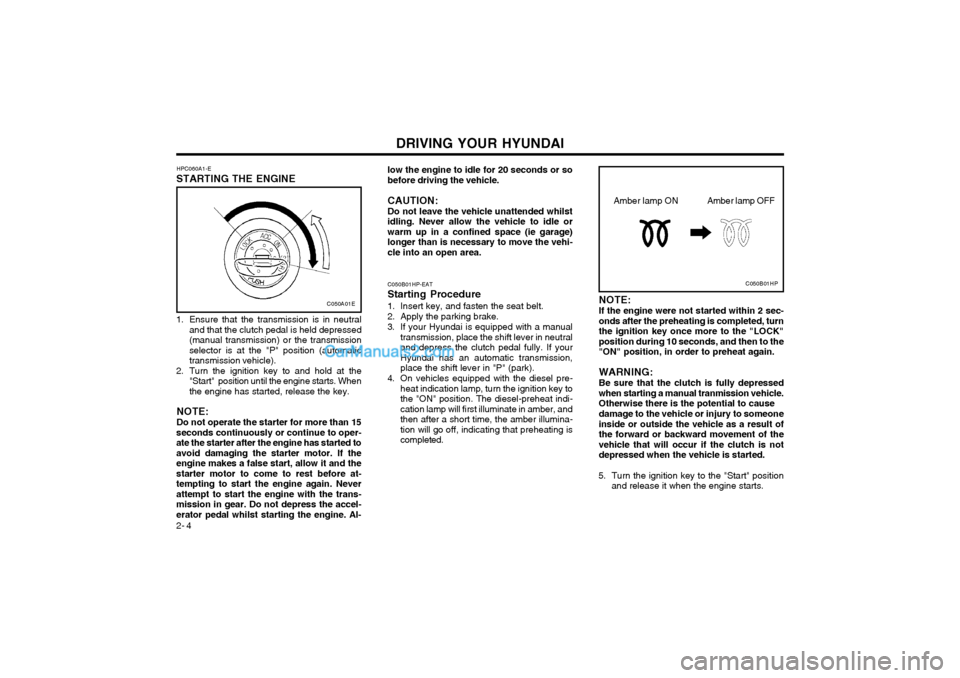
4. On vehicles equipped with the diesel pre- heat indication lamp, turn the ignition key tothe "ON" position. The diesel-preheat indi-cation lamp will first illuminate in amber, andthen after a short time, the amber illumina-tion will go off, indicating that preheating iscompleted.C050B01HP
Amber lamp OFF
Amber lamp ON
NOTE: If the engine were not started within 2 sec- onds after the preheating is completed, turnthe ignition key once more to the "LOCK"position during 10 seconds, and then to the"ON" position, in order to preheat again. WARNING: Be sure that the clutch is fully depressed when starting a manual tranmission vehicle.Otherwise there is the potential to cause damage to the vehicle or injury to someone inside or outside the vehicle as a result ofthe forward or backward movement of thevehicle that will occur if the clutch is notdepressed when the vehicle is started.
5. Turn the ignition key to the "Start" position and release it when the engine starts.
Page 281 of 349
DRIVING YOUR HYUNDAI
2- 10
2. Transfer shift knob operation By turning the transfer shift knob(4H, 4L), both
axles of the vehicle are rigidly connected with each other. This improves the traction charac-teristics.
2H
4H
Turn the transfer shift knob from the 2H mode
to the 4H mode at speed below 50mph (80 km/h). It is not necessary to depress the clutchpedal (Manual Transmission) or put the shiftlever into "N(neutral)" position (Automatic Trans-mission). Perform this operation when drivingstraight.
4H
2H
Turn the transfer shift knob from the 4H mode
to the 2H mode at speed below 50mph (80 km/h). It is not necessary to depress the clutchpedal (Manual Transmission) or put the shiftlever into "N(neutral)" position (Automatic Trans-
mission). Perform this operation when driving straight.
4H
4L
1. Stop the vehicle.
2. Depress the clutch pedal (Manual Trans- mission) or put the shift lever into "N (neu- tral)" position (Automatic Transmission).
3. Select the 4L mode.
4L
4H
1. Stop the vehicle.
2. Depress the clutch pedal (Manual Trans- mission) or put the shift lever into "N (neu- tral)" position (Automatic Transmission).
3. Select the 4H mode.CAUTION: Do not select 4WD (4H or 4L) mode on dry
paved roads. Especially on dry highway, never select the 4WD mode.
Four-wheel driving on dry paved roads for a
long period will increase the fuel consump-tion with possible noise generation and ear-ly tyre wear. In addition, axle gear oil tem-perature increases with possible driving sys-tem part wear. D090E01HP-EAT
Driving Four-wheel drive safely
o The driving posture should be more upright; adjust the seat to a good position for easy steering and pedal operation.
o Be sure to wear the seat belt.
o Drive carefully when off the road and avoid dangerous areas.
o 4WD has higher ground clearance and a narrower track to make them capable of performing in a wide variety of off roadapplications. Specific design characteristicsgive them a higher centre of gravity thanordinary cars. An advantage of the higherground clearance is a better view of the roadallowing you to anticipate problems. Theyare not designed for cornering at the samespeeds as conventional 2-wheel drive vehi-cles any more than low-slung sports carsare designed to perform satisfactorily underoff-road conditions. If at all possible, avoidsharp turns or abrupt maneuvers. As withother vehicles of this type, failure to operatethis vehicle correctly may result in loss ofcontrol or vehicle rollover.
o Do not grip the inside or spokes of the steering wheel when driving off-road. Thesteering wheel could jerk and injure yourhands. Always firmly hold the outer steeringwheel when you are driving off-road.
o Drive at lower speeds in strong crosswinds. Because of your vehicle’s high centre ofgravity, its stability will be affected in cross-winds. Slower speeds ensure better vehiclecontrol.
Page 283 of 349
DRIVING YOUR HYUNDAI
2- 12 Driving 4WD Safely
(1) Be sure to wear the seat belt.
(2) Drive at lower speeds in strong crosswinds.
Because of your vehicle's high centre of gravity, its stability will be affected in cross-winds. Slower speeds ensure better vehiclecontrol.
(3) Check the brake condition after driving in wet or muddy conditions. Press the brakeseveral times as you move slowly until youfeel normal braking forces return.
(4) Do not drive the vehicle through water. (i.e. streams, rivers, lakes, etc.)
(5) The stopping distance of the full-time 4WD vehicle differs very little from that of the2WD vehicle.
When driving on a snow-covered road or a slippery, muddy surface, make sure thatyou keep a sufficient distance between yourvehicle and the one ahead of you.
(6) Since the driving torque is always applied to the 4 wheels, the performance of the full-time 4WD vehicle is greatly affected by thecondition of the tyres. Be sure to equip itwith all four tyres of the same size and type.o When replacement of any of the tyres or disc wheels is necessary, replace all ofthem.
o Rotate the tyres and check the tyre pres- sure at regular intervals.
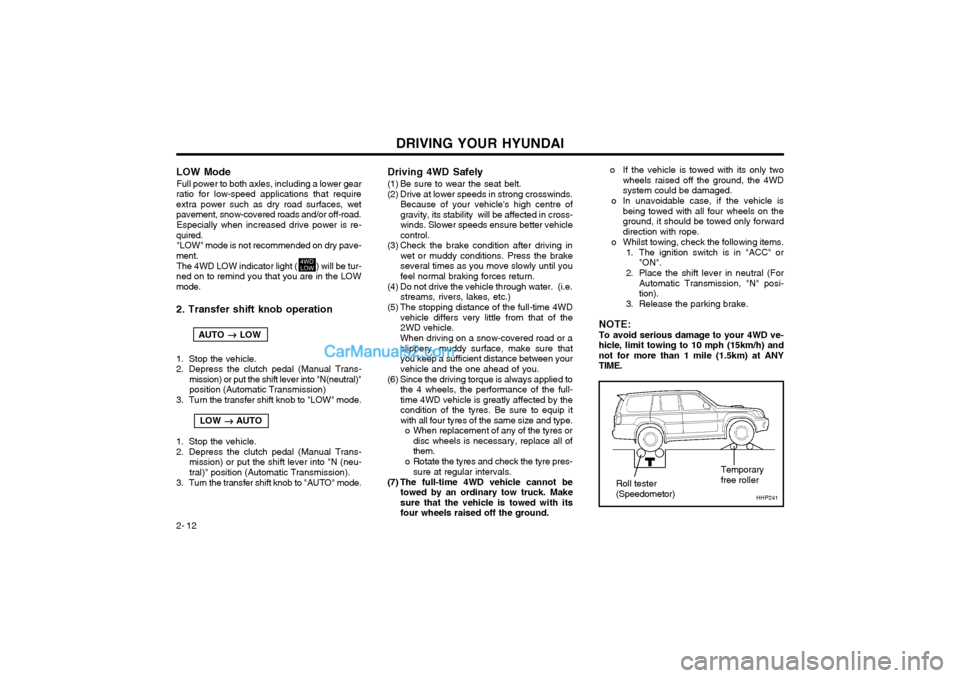
(7) The full-time 4WD vehicle cannot be towed by an ordinary tow truck. Makesure that the vehicle is towed with itsfour wheels raised off the ground. o If the vehicle is towed with its only two
wheels raised off the ground, the 4WDsystem could be damaged.
o In unavoidable case, if the vehicle is being towed with all four wheels on theground, it should be towed only forwarddirection with rope.
o Whilst towing, check the following items.
1. The ignition switch is in "ACC" or"ON".
2. Place the shift lever in neutral (For Automatic Transmission, "N" posi-tion).
3. Release the parking brake.
NOTE: To avoid serious damage to your 4WD ve- hicle, limit towing to 10 mph (15km/h) andnot for more than 1 mile (1.5km) at ANYTIME.
HHP241
Roll tester (Speedometor) Temporaryfree roller
LOW Mode
Full power to both axles, including a lower gear
ratio for low-speed applications that require extra power such as dry road surfaces, wetpavement, snow-covered roads and/or off-road.
Especially when increased drive power is re-
quired. "LOW" mode is not recommended on dry pave-
ment.
The 4WD LOW indicator light ( ) will be tur-
ned on to remind you that you are in the LOWmode. 2. Transfer shift knob operation
AUTO
LOW
1. Stop the vehicle.
2. Depress the clutch pedal (Manual Trans- mission) or put the shift lever into "N(neutral)"position (Automatic Transmission)
3. Turn the transfer shift knob to "LOW" mode.
LOW
AUTO
1. Stop the vehicle.
2. Depress the clutch pedal (Manual Trans- mission) or put the shift lever into "N (neu-tral)" position (Automatic Transmission).
3. Turn the transfer shift knob to "AUTO" mode.
Page 285 of 349
DRIVING YOUR HYUNDAI
2- 14 D190A01O-EAT
LIMITED-SLIP DIFFERENTIAL (Not all models)
A limited-slip differential, if equipped, is for the
rear wheel differential only. The features of this limited-slip differential are described below:
Just as with a conventional differential, the
wheel on one side is allowed to turn at adifferent speed from the wheel on the other sidewhen the vehicle is cornering. The differencebetween the limited-slip differential and a con-ventional differential is that if the wheel on oneside of the vehicle loses traction, a greateramount of torque is applied to the rear wheel onthe other side to improve traction.
SC140A1-E
EFFECTIVE BRAKING Braking system performance and friction mate-rial life are greatly affected by the driving styleadopted. The following suggestions are madeto assist in achieving the best results from thebraking system.
o Anticipate the road and conditions ahead in order that heavy braking may be avoided.
o When descending long gradients, use the engine to assist in retarding the vehicle tominimize the possibility of brake fade occur-ring. o When trailer towing, ensure that the trailer
brakes function correctly and use enginebraking to assist the vehicle braking system.
o Use only genuine Hyundai replacement brake pads and shoes to ensure consistentfriction characteristics and wear rates.
o After driving through deep water (e.g. fording), the brakes may become wet andperformance reduced. Always check brakeefficiency after emerging from the water anddry the brakes by lightly depressing thebrake pedal several times whilst driving slow-ly.
o Apply the parking brake only when the vehi- cle is at rest.
o Since the power assistance provided by the brake servo is derived from the engine,coasting with the engine turned off or towingof the vehicle with the engine turned off willresult in greatly increased pedal pressuresbeing required to stop the vehicle.
o Do not hold the vehicle on the upgrade with the accelerator pedal. This can cause thetransmission to overheat. Always use thebrake pedal or parking brake.
CAUTION:
o Whilst the full-time 4WD vehicle is being raised on a jack, never start the engine orcause the tyres to rotate. There is the danger that rotating tyres touching the ground could cause thevehicle to go off the jack and to jumpforward.
o If one of the front or rear wheels begins to spin in mud, snow, etc., the vehiclecan sometimes be driven out by depress-ing the accelerator pedal further; how-ever, avoid running the engine continu-ously at high rpm because doing so coulddamage the 4WD system.
WARNING:
o Avoid high cornering speeds.
o Do not make quick steering wheel move- ments, such as sharp lane charges or fast, sharp turns.
o The risk of rollover is greatly increased if you lose control of your vehicle at high-way speeds.
o In a collision crash, an unbelted person is significantly more likely to die than aperson wearing a seatbelt.
o Loss of control often occurs if two or more wheels drop off the roadway and thedriver oversteers to reenter the roadway.
o In the event your vehicle leaves the road- way, do not steer sharply. Instead, slowdown before pulling back into the travellanes.
Page 287 of 349
DRIVING YOUR HYUNDAI
2- 16 ZC170E1-E
Windscreen Washers & Wipers
The windscreen washer bottle should be filled with a solution of water and a proprietary winterscreen wash additive. The windscreen wipersshould not be used if the blades are frozen tothe windscreen or if they are covered withsnow, before this is removed. NOTE: Never allow undiluted screen washer fluid additive to spill upon the paintwork or useengine coolant anti-freeze since damage tothe paintwork may result.
o When driving in extreme conditions, the windscreen wiper blades may fail to clearthe screen properly due to the formation ofice upon the blade edge. It will therefore benecessary to periodically remove such iceto restore their efficiency.
o If the power operated door mirrors become frozen, attempts to adjust these may dam-age the mechanism.
o The formation of snow or ice build up inside the wheel arches may interfere with theroadwheels or steering mechanism. In suchinstances, unusual noises or an increase insteering effort may result. Therefore, ensurethat the wheelarches are checked periodi-cally and any accumulated snow or ice re-moved.
ZC170B1-E
Electrical System
Winter conditions impose severe demands upon
vehicle electrical systems, particularly the charg-ing circuit. The battery condition and perfor-mance along with the alternator performanceand drive belt condition should be checked priorto the onset of winter.
YC170C1-E
Anti-freeze/Corrosion inhibitor The cooling system must always contain anEthylene-Glycol based anti-freeze solution. Thesystem is filled during manufacture with solu-tion of the correct strength which should bechecked before the onset of winter and adjust-ed or changed as required. NOTE: The anti-freeze solution contains a corro- sion inhibitor to prevent degradation of thealuminium castings contained within theengine. Therefore, never, drain the systemand refill with water only. In addition, anti-freeze solution must ALWAYS be used in vehicles fitted with air conditioning,to prevent the heater matrix from freezing andsubsequently bursting with the refrigeration sys-tem in use. ZC170D1-E
Door Locks
Should the door lock mechanism become fro-zen, a proprietary lock de-icer should be used.Alternatively, warming the door key may thawthe door lock. However, the key should behandled carefully to avoid burning the fingers. Never attempt to thaw a frozen door lock using hot water, since the water will eventually freezeand compound the problem. NOTE: The proper temperature for using the immo-bilizer key is from -40°F to 176°F (-40°C to80°C). If you heat the immobilizer key over176°F to open the frozen lock, it may causedamage to the transponder in its head.
Page 292 of 349
IN CASE OF EMERGENCY
3-2
CAUTION:
Personal injury and damage to the vehicle
may occur if jump starting is not performed correctly. If any doubt exists as to how thisoperation should be performed, seek assis-tance from qualified personnel. WARNING:
Motor vehicle batteries contain sulphuric
acid and emit hydrogen gas. Protective cloth- ing should be worn and care exercised toprevent the acid from coming into contactwith skin or clothing and the vehicle. Nakedlights should not be permitted in the vicinityof the battery. Care should be exercised toprevent sparks occurring during connec-tion. If acid accidentally comes into contactwith skin or eyes, the affected area shouldimmediately be flushed with copious CAUTION: If the jump cable is incorrectly installed, damage to the vehicle electrical system mayoccur, in particular the electronic compo-nents such as the Fuel Injection system
computer and the Automatic Transmissioncomputer. The battery must never be dis-connected whilst the engine is running.
SD030A1-E JUMP STARTING
amounts of water and medical assistance sought.
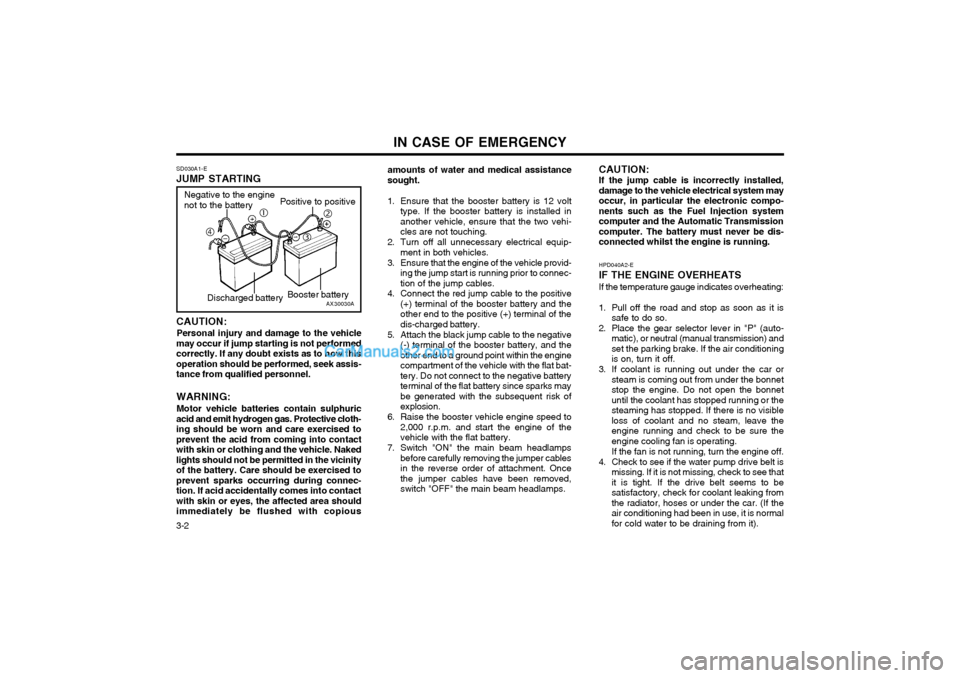
1. Ensure that the booster battery is 12 volt type. If the booster battery is installed inanother vehicle, ensure that the two vehi-cles are not touching.
2. Turn off all unnecessary electrical equip- ment in both vehicles.
3. Ensure that the engine of the vehicle provid- ing the jump start is running prior to connec-tion of the jump cables.
4. Connect the red jump cable to the positive (+) terminal of the booster battery and theother end to the positive (+) terminal of thedis-charged battery.
5. Attach the black jump cable to the negative (-) terminal of the booster battery, and theother end to a ground point within the enginecompartment of the vehicle with the flat bat-tery. Do not connect to the negative batteryterminal of the flat battery since sparks maybe generated with the subsequent risk ofexplosion.
6. Raise the booster vehicle engine speed to 2,000 r.p.m. and start the engine of thevehicle with the flat battery.
7. Switch "ON" the main beam headlamps before carefully removing the jumper cablesin the reverse order of attachment. Oncethe jumper cables have been removed,switch "OFF" the main beam headlamps. HPD040A2-E IF THE ENGINE OVERHEATS If the temperature gauge indicates overheating:
1. Pull off the road and stop as soon as it is
safe to do so.
2. Place the gear selector lever in "P" (auto- matic), or neutral (manual transmission) and set the parking brake. If the air conditioningis on, turn it off.
3. If coolant is running out under the car or steam is coming out from under the bonnetstop the engine. Do not open the bonnetuntil the coolant has stopped running or thesteaming has stopped. If there is no visibleloss of coolant and no steam, leave theengine running and check to be sure theengine cooling fan is operating. If the fan is not running, turn the engine off.
4. Check to see if the water pump drive belt is missing. If it is not missing, check to see that it is tight. If the drive belt seems to besatisfactory, check for coolant leaking fromthe radiator, hoses or under the car. (If theair conditioning had been in use, it is normalfor cold water to be draining from it).
AX30030A
Negative to the engine not to the battery
Positive to positive
Booster battery
c
e
f d
Discharged battery