belt Hyundai Terracan 2003 Service Manual
[x] Cancel search | Manufacturer: HYUNDAI, Model Year: 2003, Model line: Terracan, Model: Hyundai Terracan 2003Pages: 349, PDF Size: 4.56 MB
Page 164 of 349
DO-IT-YOURSELF MAINTENANCE
6-18
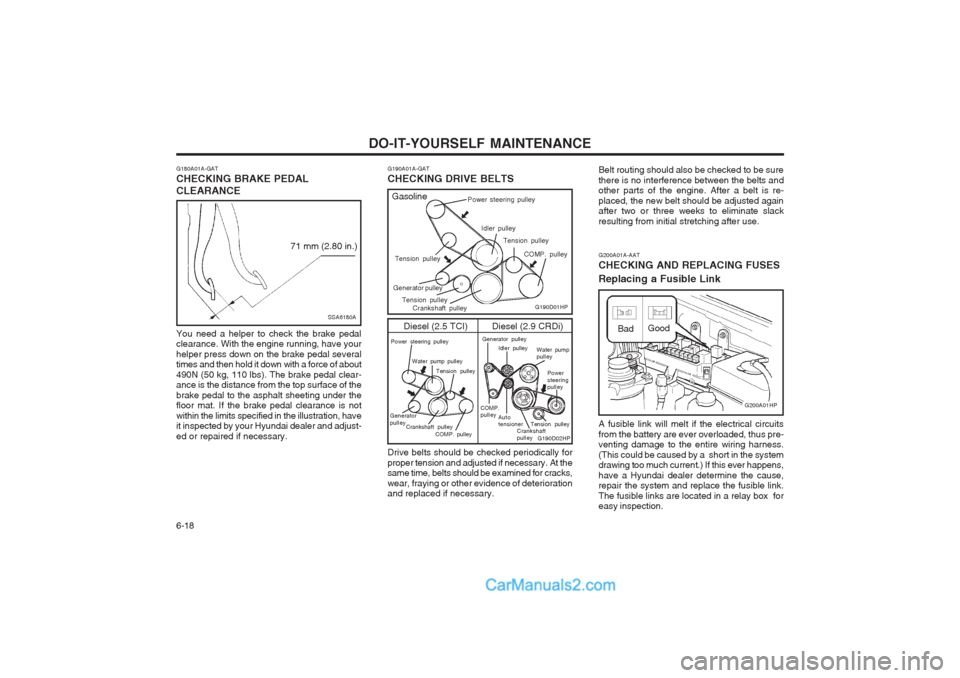
G200A01A-AAT CHECKING AND REPLACING FUSES Replacing a Fusible Link A fusible link will melt if the electrical circuits from the battery are ever overloaded, thus pre- venting damage to the entire wiring harness. (This could be caused by a short in the system drawing too much current.) If this ever happens, have a Hyundai dealer determine the cause, repair the system and replace the fusible link. The fusible links are located in a relay box for easy inspection.
G200A01HP
Bad
Good
Belt routing should also be checked to be sure there is no interference between the belts and other parts of the engine. After a belt is re- placed, the new belt should be adjusted again after two or three weeks to eliminate slack resulting from initial stretching after use.
G190A01A-GAT CHECKING DRIVE BELTS Drive belts should be checked periodically for proper tension and adjusted if necessary. At the same time, belts should be examined for cracks, wear, fraying or other evidence of deterioration and replaced if necessary. Diesel (2.5 TCI)
G190D01HP
G190D02HP
Gasoline
Generator pulley
Idler pulley Water pump pulley
COMP.pulley Autotensioner
Crankshaft pulley
Diesel (2.9 CRDi)
Crankshaft pulleyCOMP. pulley
Generator pulley Power steering pulley
Idler pulley Tension pulley
COMP. pulley
Power steering pulley
Water pump pulley Tension pulley Power steering pulley
Crankshaft pulleyTension pulleyGenerator pulley
Tension pulley
Tension pulley
G180A01A-GAT CHECKING BRAKE PEDAL CLEARANCE You need a helper to check the brake pedal clearance. With the engine running, have your helper press down on the brake pedal several times and then hold it down with a force of about 490N (50 kg, 110 lbs). The brake pedal clear- ance is the distance from the top surface of the brake pedal to the asphalt sheeting under the floor mat. If the brake pedal clearance is not within the limits specified in the illustration, have it inspected by your Hyundai dealer and adjust- ed or repaired if necessary.
SSA6180A
71 mm (2.80 in.)
Page 183 of 349
INDEX
10-2
D Defrosting/Defogging
......................................................................... 1-70
Door
Locking, unlocking front door with a key ........................................ 1-6
Drink Holder ...................................................................................... 1-52
Drive Belts ............................................................................... 6-15, 6-18
Driving
Driving for economy ...................................................................... 2-13
Smooth cornering .......................................................................... 2-14
Winter driving ................................................................................ 2-14
E
Emission Control System ................................................................... 7-1
Engine
Before starting the engine ............................................................... 2-2
Compartment (3.5 V6) ..................................................................... 6-1
Compartment (2.5 TCI) ................................................................... 6-2
Compartment (2.9 CRDi) ................................................................ 6-3
Coolant ............................................................................................ 6-7
Coolant temperature gauge ........................................................... 1-42
If the engine overheats ................................................................... 3-2
Number ............................................................................................ 8-1
Oil .................................................................................................... 6-4Starting ............................................................................................ 2-3
Engine Exhaust Can Be Dangerous ................................................... 2-1
FFan Speed Control ................................................................... 1-66, 1-75 Fog Light
Front .............................................................................................. 1-47
Rear .............................................................................................. 1-47
Front Seats Adjustable front seats ................................................................... 1-11
Adjustable headrests ..................................................................... 1-12
Adjusting seat forward and rearward ............................................1-11
Adjusting seatback angle .............................................................. 1-11
Fuel Capacity .......................................................................................... 9-1
Gauge ............................................................................................ 1-42
Unleaded gasoline ........................................................................... 1-1
Fuel Filler Lid Remote release ............................................................................. 1-61
Full-time 4WD Operation ....................................................... 2-10 ~ 2-12
Fuses ................................................................................................ 6-18
GGeneral Checks .................................................................................. 6-4
Glove Box ......................................................................................... 1-55
HHazard Warning System ................................................................... 1-50
Headlight Aiming Adjustment ............................................................ 6-24
Headlight Leveling Device System ...................................................1-64
Heating and Ventilation Air flow control ......................................................... 1-67 ~ 1-68, 1-76
Temperature control ...................................................................... 1-68
Page 185 of 349
INDEX
10-4
Power Outlet .....................................................................................
1-51
Power Steering Fluid Level ............................................................... 6-20
R
Rear Seat Warning ...... ..................................................................... 1-18
Rear Window Defroster Switch ......................................................... 1-50
Roof Rack ......................................................................................... 1-60
SSeat Belts 3-Point system ................................................................... 1-20 ~ 1-21
2-Point Sta tic Type ....................................................................... 1-22
Adjusting your se at belt ................................................................ 1-21
Care of seat belts ......................................................................... 1-19
Precautions ................................................................................... 1-18
Pretensioner Seat Belt ................ ..................................................1-27
Seat Warmer ..................................................................................... 1-14
Second Seat
Adjustable Headrests .................................................................... 1-15
Folding Rear Seatback and Seat Cushion ........................1-15 ~ 1-16
Side Under View Mirror .................................................................... 1-57
Sound
Brake Pad Wear Warning Sound .................................................1-42
Spark Plugs ...................................................................................... 6-10
Speedometer ..................................................................................... 1-42
Starting Procedure .............................................................................. 2-3Steering Wheel Free play ....................................................................................... 6-17Steering Wheel Tilt
Lever ................................................................. 1-63
Stereo Radio Operation (H240, H280) ............. 1-81 ~ 1-83, 1-86 ~ 1-88
Stereo Sound System ............................................................ 1-79 ~ 1-80
Sun roof ................................................................................. 1-53 ~ 1-54
Sun visor ........................................................................................... 1-62
Sunshade .......................................................................................... 1-53
T Tachometer ....................................................................................... 1-43
Tail Gate ........................................................................................... 1-58
Theft-Alarm system .................................................................. 1-8 ~ 1-10
Third Seat Adjusting Seatback Angle ............................................................. 1-16
Folding Rear Seatback and seat cushion .....................................1-18
To get in and out of the third seat ................................................ 1-17
Tires
Balancing ......................................................................................... 8-2
Chains ............................................................................................. 8-2
Changing a flat tire ................................................................. 3-4 ~ 3-8
If you have a fl at tire ....................................................................... 3-4
Information ....................................................................................... 8-1
Pressure .......................................................................................... 8-1
Replacement ................................................................................... 8-3
Rotation ........................................................................................... 8-2
Snow tires ....................................................................................... 8-2
Spare tire ......................................................................................... 3-3
Traction ........................................................................................... 8-2
Page 196 of 349
CONTROLS AND EQUIPMENT
1- 2 YB020A1-E BEFORE ENTERING THE VEHICLE
o Ensure that all windows, mirrors and lamps are clean.
o Check condition of all tyres.
o Ensure that no fluid leaks are evident.
o Ensure that the area around the vehicle is clear before driving off.
YB020B1-E AFTER ENTERING THE VEHICLE
o Ensure that all occupants fasten and cor- rectly adjust seat belts.
o Ensure that seat and headrestraint positions are adjusted for optimum safety, control and comfort.
o Adjust interior and exterior rear view mir- rors.
o Verify correct operation of lamps, horn and other electrical equipment.
o Ensure that warning lamps illuminate when ignition is turned on.
NOTE: Fluid levels such as engine oil, engine cool- ant, brake and windscreen washer fluidshould be checked daily or at each refuel-ling, whichever occurs sooner. B020A01FC-EAT RUNNING IN YOUR NEW HYUNDAIThe longevity and performance of the vehicle are greatly affected by the care exercised dur-ing the first 1000 miles of motoring. Because ofmodern manufacturing techniques, rigid guide-lines regarding maximum road speeds havebecome unnecessary. However, certain pre-cautions should be observed in order to obtainthe best possible performance and useful lifefrom the vehicle.
1) Do not race the engine without a load (i.e revving the engine in neutral).
2) During the first 500 miles the maximum engine speed should be restricted to 3000rpm and gradually increased thereafter.
3) Avoid prolonged constant speed operation. The internal components of the engine willbecome run-in more quickly if the operation
speed is varied during the running in period.
4) Never allow the engine to labour. Use the gearbox freely and avoid large throttle open-ings when the engine speed is below 1500rpm.
5) Avoid rapid acceleration and maximum throttle openings.
6) Avoid harsh braking during the first 100 miles of urban motoring or 1000 miles ofmotorway driving to allow the friction facingsof the brake pads and shoes to bed againstthe discs and drums properly.
7) No trailer towing should be undertaken dur- ing the running-in period. B880A01HP-EAT IMMOBILISER SYSTEM
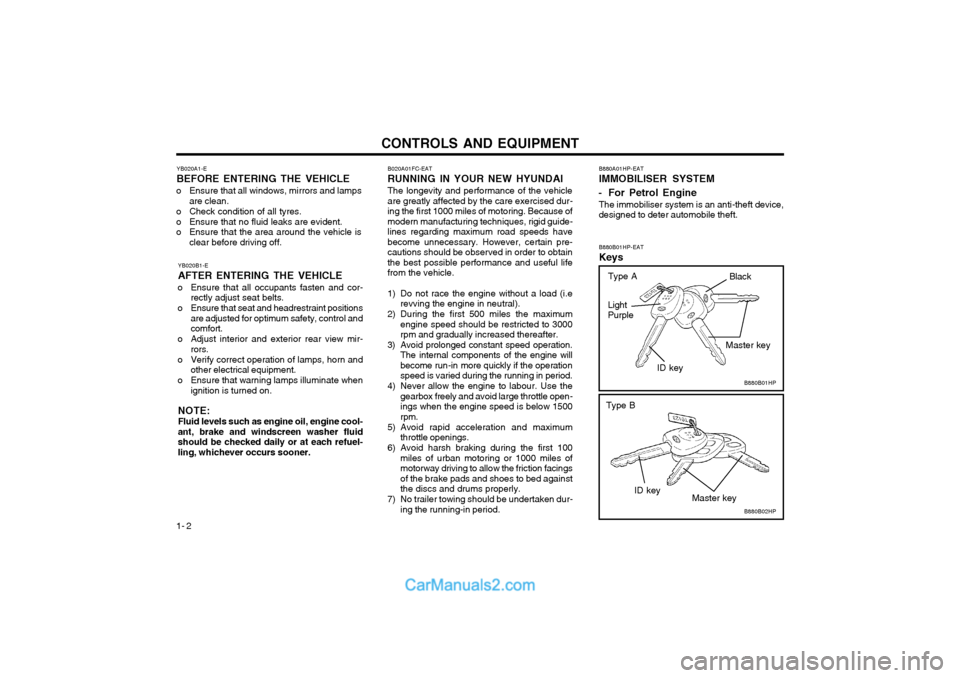
- For Petrol Engine The immobiliser system is an anti-theft device, designed to deter automobile theft. B880B01HP-EAT Keys
B880B01HP
B880B02HP
Light Purple
ID key
ID key Master key
Master key
Type B
Black
Type A
Page 205 of 349
CONTROLS AND EQUIPMENT1- 11
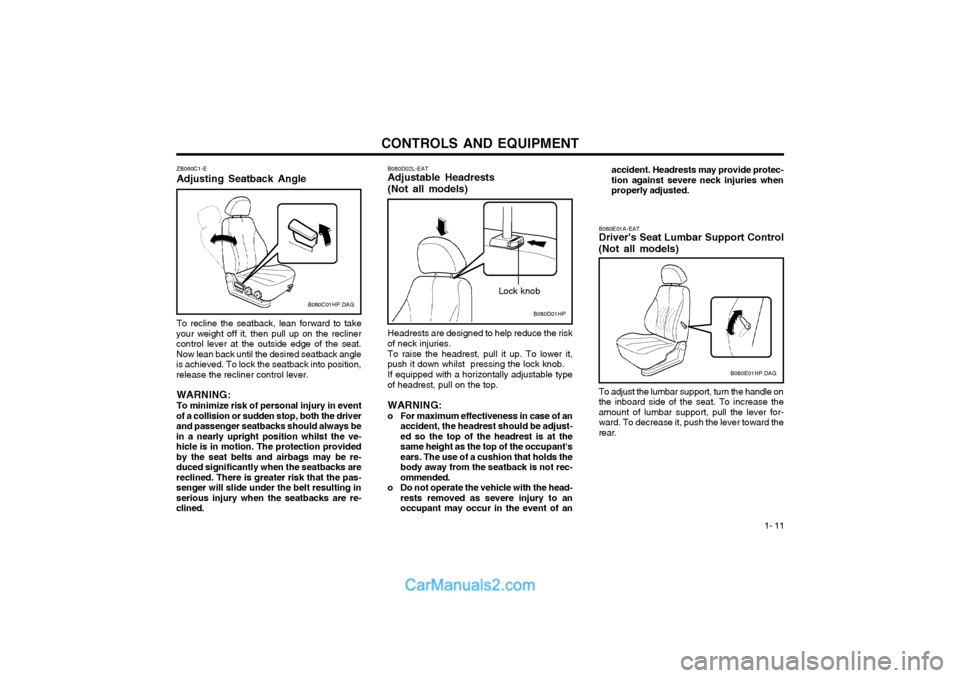
To recline the seatback, lean forward to take
your weight off it, then pull up on the recliner control lever at the outside edge of the seat.Now lean back until the desired seatback angleis achieved. To lock the seatback into position,release the recliner control lever.
WARNING: To minimize risk of personal injury in event
of a collision or sudden stop, both the driver and passenger seatbacks should always bein a nearly upright position whilst the ve-hicle is in motion. The protection providedby the seat belts and airbags may be re-duced significantly when the seatbacks arereclined. There is greater risk that the pas-senger will slide under the belt resulting inserious injury when the seatbacks are re-clined. ZB060C1-E Adjusting Seatback Angle
B080C01HP.DAG
To adjust the lumbar support, turn the handle on the inboard side of the seat. To increase theamount of lumbar support, pull the lever for-ward. To decrease it, push the lever toward therear.
B080D02L-EAT Adjustable Headrests (Not all models) Headrests are designed to help reduce the risk
of neck injuries.
To raise the headrest, pull it up. To lower it,
push it down whilst pressing the lock knob.
If equipped with a horizontally adjustable type
of headrest, pull on the top.
WARNING:
o For maximum effectiveness in case of an accident, the headrest should be adjust- ed so the top of the headrest is at thesame height as the top of the occupant'sears. The use of a cushion that holds thebody away from the seatback is not rec-ommended.
o Do not operate the vehicle with the head- rests removed as severe injury to anoccupant may occur in the event of an B080E01A-EAT Driver's Seat Lumbar Support Control
(Not all models)
B080E01HP.DAG
B080D01HP
Lock knob accident. Headrests may provide protec- tion against severe neck injuries whenproperly adjusted.
Page 207 of 349
CONTROLS AND EQUIPMENT1- 13
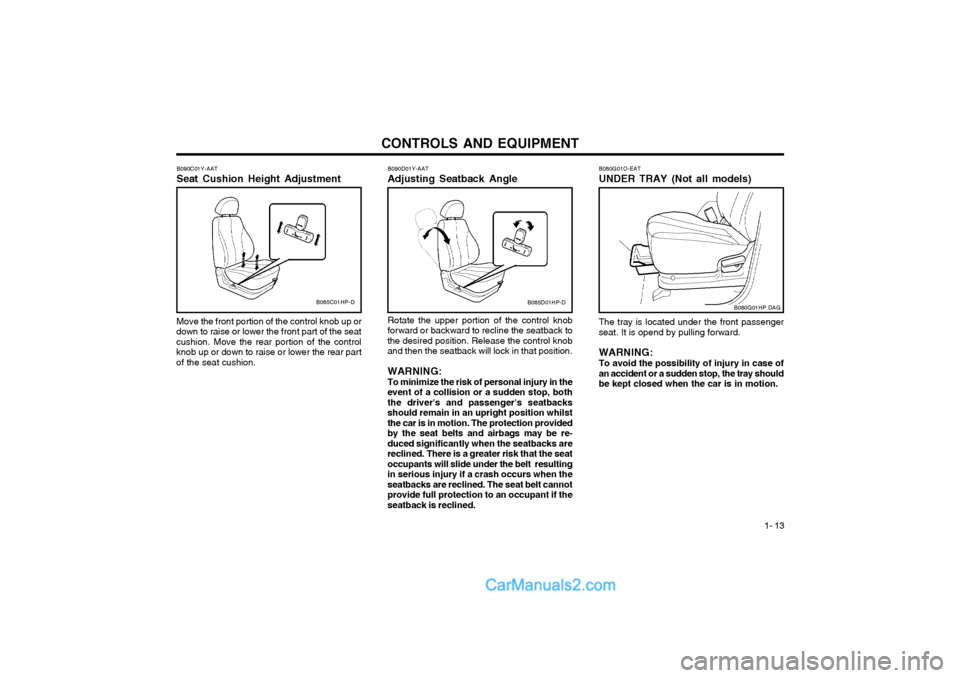
B090C01Y-AAT Seat Cushion Height Adjustment Move the front portion of the control knob up or
down to raise or lower the front part of the seat cushion. Move the rear portion of the controlknob up or down to raise or lower the rear partof the seat cushion.
B085C01HP-D B080G01O-EAT UNDER TRAY (Not all models)B080G01HP.DAG
The tray is located under the front passenger seat. It is opend by pulling forward. WARNING: To avoid the possibility of injury in case of an accident or a sudden stop, the tray shouldbe kept closed when the car is in motion.B085D01HP-D
B090D01Y-AAT Adjusting Seatback Angle Rotate the upper portion of the control knob
forward or backward to recline the seatback to the desired position. Release the control knoband then the seatback will lock in that position.
WARNING: To minimize the risk of personal injury in the
event of a collision or a sudden stop, both the driver's and passenger's seatbacksshould remain in an upright position whilstthe car is in motion. The protection providedby the seat belts and airbags may be re-duced significantly when the seatbacks arereclined. There is a greater risk that the seatoccupants will slide under the belt resultingin serious injury if a crash occurs when theseatbacks are reclined. The seat belt cannotprovide full protection to an occupant if theseatback is reclined.
Page 209 of 349
CONTROLS AND EQUIPMENT1- 15
o When you return the seatback to its uprightposition, always be sure it is locked into position by pulling and pushing on the top ofseatback.
WARNING:
o The purpose of the fold-down rear seat back and the fold-up rear seat cushion isto allow you to carry more objects thancould be accommodated. Never allowpassengers to sit on the cargo area whilstthe car is moving. This is not a properseating position and no seat belts areavailable for use when the seat back isfolded down. This could result in serious injury or death in case of an accident or a suddenstop. Objects should not extend higherthan the top of the front seatbacks.This could allow cargo to slide forwardand cause injury or damage during sud-den stops.
o When you return the rear seatback to its upright position after being folded down,be careful not to damage the seatbeltwebbing or buckle. In addition, do notallow the seatbelt webbing or buckle toget caught or pinched in the rear seat.
o Do not allow passengers to fold down and up the seatback and seat cushionwhilst the car is moving.
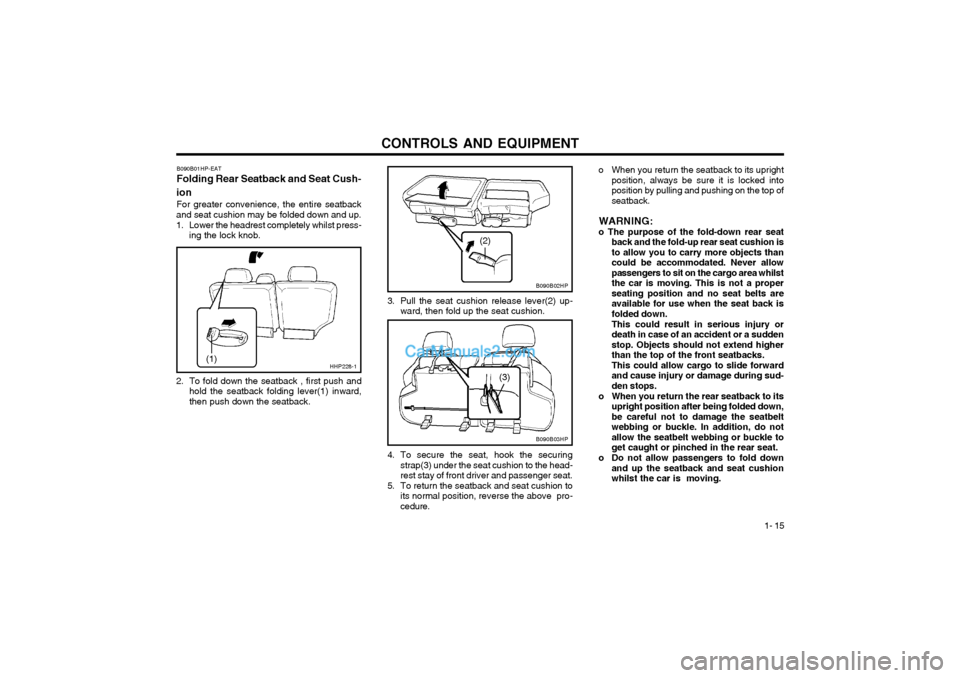
3. Pull the seat cushion release lever(2) up-ward, then fold up the seat cushion.
B090B02HP
(2)
B090B03HP
(3)
4. To secure the seat, hook the securing strap(3) under the seat cushion to the head- rest stay of front driver and passenger seat.
5. To return the seatback and seat cushion to its normal position, reverse the above pro-cedure.
B090B01HP-EAT Folding Rear Seatback and Seat Cush-
ion For greater convenience, the entire seatback
and seat cushion may be folded down and up.
1. Lower the headrest completely whilst press- ing the lock knob.
2. To fold down the seatback , first push and hold the seatback folding lever(1) inward, then push down the seatback.
HHP228-1(1)
Page 210 of 349
CONTROLS AND EQUIPMENT
1- 16 SB090F1-E Seat Belt OccupancyThe seat belts are designed to be used by one seat occupant only. The use of a seat belt bymore than one person increases the levels ofinjury which may be sustained in the event of anaccident.
SB090E1-E Injured PersonsA seat belt should be used when an injured person is being transported. For specific rec-ommendations, the advice of a qualified Medi-cal Practioner should be sought. SE090G1-E Do Not Lie DownTo ensure that the maximum level of protection
may be afforded by the seat belt system, all passengers should be sitting in an upright posi-tion throughout the journey. The seat belt will beunable to afford maximum protection if the frontseats are at or near the fully reclined position.
SB090C1-E Larger ChildrenLarger children should occupy the rear seat
and be restrained at all times. The restraint may take the form of a special safety belt or theoriginal factory fitted seat belt used in conjunc-tion with an approved booster cushion depend-ing upon the size and weight of the child. Underno circumstances should children be allowed totravel standing, kneeling or lying on the seat.
Never allow childen to ride in the front passen-
ger seat.
SB090A1-E SEAT BELT PRECAUTIONS Seat belts should be worn at all times by all
occupants front and rear. The possibility of injury or the severity of injuries suffered in theevent of an accident will be greatly reduced bythe wearing of seat belts.
In addition the following recommendations
should be observed. SB090B1-E
Babies/Small Children
Babies and small children must be restrained
using a restraint system specifically designedfor this purpose. Under no circumstances shoulda child be carried in the vehicle without the useof a suitable restraint which meets the regula-tions in force in the country where the vehicle isin operation.
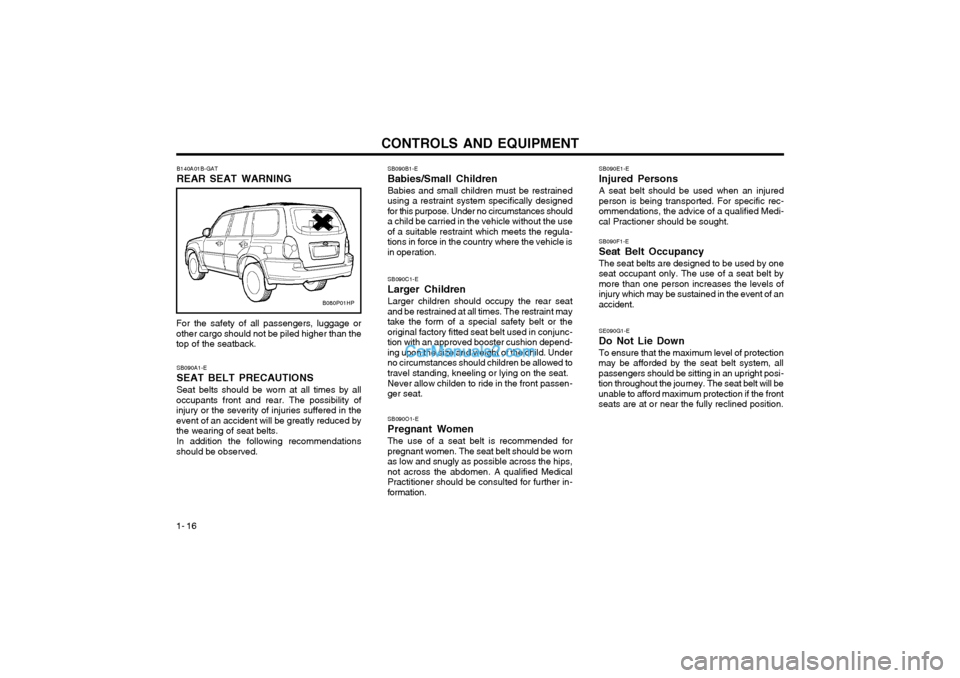
B140A01B-GAT REAR SEAT WARNING
B080P01HP
For the safety of all passengers, luggage or other cargo should not be piled higher than thetop of the seatback.
SB090O1-E Pregnant WomenThe use of a seat belt is recommended for
pregnant women. The seat belt should be worn as low and snugly as possible across the hips,not across the abdomen. A qualified MedicalPractitioner should be consulted for further in-formation.
Page 211 of 349
CONTROLS AND EQUIPMENT1- 17
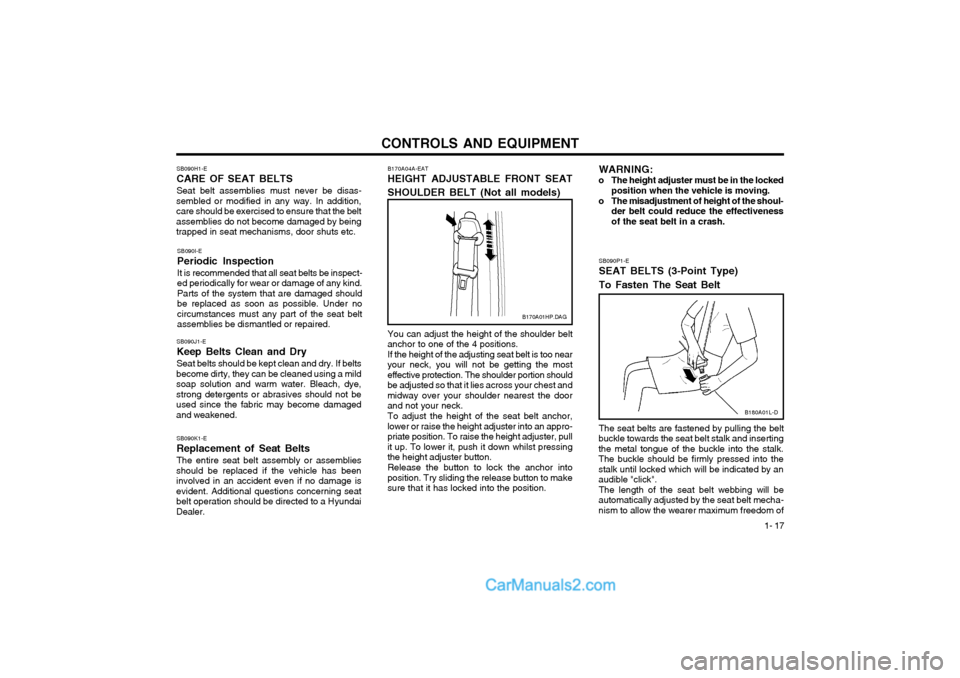
You can adjust the height of the shoulder belt
anchor to one of the 4 positions. If the height of the adjusting seat belt is too near
your neck, you will not be getting the most effective protection. The shoulder portion shouldbe adjusted so that it lies across your chest andmidway over your shoulder nearest the doorand not your neck.
To adjust the height of the seat belt anchor,
lower or raise the height adjuster into an appro-priate position. To raise the height adjuster, pullit up. To lower it, push it down whilst pressingthe height adjuster button.
Release the button to lock the anchor into
position. Try sliding the release button to makesure that it has locked into the position.
SB090J1-E Keep Belts Clean and Dry Seat belts should be kept clean and dry. If belts
become dirty, they can be cleaned using a mild soap solution and warm water. Bleach, dye,strong detergents or abrasives should not beused since the fabric may become damagedand weakened.
SB090K1-E Replacement of Seat BeltsThe entire seat belt assembly or assemblies
should be replaced if the vehicle has been involved in an accident even if no damage isevident. Additional questions concerning seatbelt operation should be directed to a HyundaiDealer. B170A04A-EAT HEIGHT ADJUSTABLE FRONT SEAT
SHOULDER BELT (Not all models)
B170A01HP.DAG
SB090H1-E CARE OF SEAT BELTSSeat belt assemblies must never be disas-
sembled or modified in any way. In addition, care should be exercised to ensure that the beltassemblies do not become damaged by beingtrapped in seat mechanisms, door shuts etc.
SB090I-E Periodic InspectionIt is recommended that all seat belts be inspect- ed periodically for wear or damage of any kind.Parts of the system that are damaged shouldbe replaced as soon as possible. Under nocircumstances must any part of the seat beltassemblies be dismantled or repaired.
WARNING:
o The height adjuster must be in the locked position when the vehicle is moving.
o The misadjustment of height of the shoul- der belt could reduce the effectiveness of the seat belt in a crash.
SB090P1-E SEAT BELTS (3-Point Type) To Fasten The Seat Belt
B180A01L-D
The seat belts are fastened by pulling the belt
buckle towards the seat belt stalk and inserting the metal tongue of the buckle into the stalk.The buckle should be firmly pressed into thestalk until locked which will be indicated by anaudible "click". The length of the seat belt webbing will be
automatically adjusted by the seat belt mecha-nism to allow the wearer maximum freedom of
Page 212 of 349
CONTROLS AND EQUIPMENT
1- 18
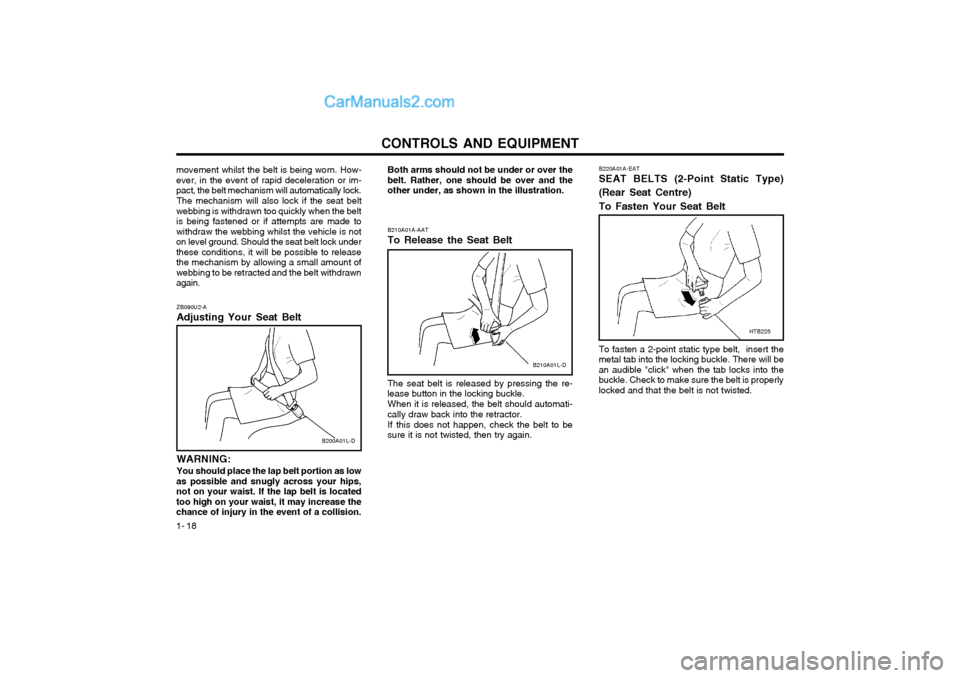
B220A01A-EAT SEAT BELTS (2-Point Static Type) (Rear Seat Centre) To Fasten Your Seat Belt To fasten a 2-point static type belt, insert the metal tab into the locking buckle. There will bean audible "click" when the tab locks into thebuckle. Check to make sure the belt is properlylocked and that the belt is not twisted. HTB225
B210A01A-AAT To Release the Seat Belt The seat belt is released by pressing the re-
lease button in the locking buckle.
When it is released, the belt should automati-
cally draw back into the retractor.
If this does not happen, check the belt to be
sure it is not twisted, then try again.
B210A01L-D
ZB090U2-A Adjusting Your Seat Belt WARNING: You should place the lap belt portion as low
as possible and snugly across your hips, not on your waist. If the lap belt is locatedtoo high on your waist, it may increase thechance of injury in the event of a collision.
B200A01L-D
movement whilst the belt is being worn. How- ever, in the event of rapid deceleration or im-pact, the belt mechanism will automatically lock.
The mechanism will also lock if the seat belt
webbing is withdrawn too quickly when the beltis being fastened or if attempts are made towithdraw the webbing whilst the vehicle is noton level ground. Should the seat belt lock underthese conditions, it will be possible to releasethe mechanism by allowing a small amount ofwebbing to be retracted and the belt withdrawnagain. Both arms should not be under or over thebelt. Rather, one should be over and theother under, as shown in the illustration.